Asymco

Asymmetric Intelligence

Horace Dediu

  1. Capital.bg | Nobody wants to buy RIM

    Research · 24 comments

    Технологии и наука | Хорацио Дедиу: Никой не иска да купи Research In Motion RIM - Капитал.

    My thanks again to Andrian Georgiev for interview questions [Bulgarian] related to RIM. My answers to his questions (in English) are below:

    Q: What should RIM do to reinvent itself? Should it stray from its business-oriented image?

    RIM had begun to move away from a business image already in 2005 or so when it started its "Pearl" brand and a consumer-oriented strategy. The company probably foresaw that business customers would not be enough to maintain the growth they had become accustomed to. The strategy has led to a growing popularity in Latin America and other regions like the Middle East where the product is used as a low-cost alternative to SMS for avid texters. Even in the US, many teenagers use Blackberries instead of iPhones because they can use it for the BBM service (at a lower cost). I believe that it is not coincidence that iMessage was launched.

    The company's salvation is not in branching into new markets but in establishing a credible platform. When Nokia announced that they would be the "third option" after the iPhone and Android ecosystems, they did not even mention the Blackberry. The fact that Blackberry is not seen as an ecosystem is the root of the problem.

    Q: How should RIM accelerate the introduction of QNX?

    QNX is a solid operating system and I believe RIM should have begun developing with it much earlier. By waiting long after the iPhone launched (and even after Android) to upgrade its OS, RIM missed a great opportunity. The foothold market the company had was wasted by not leveraging it into building a mobile computing ecosystem.

    There is little that can be done to move any more rapidly now. Product development cannot be done any faster. What the company could do is to very carefully define why QNX based products are better than the competition and not rely on specifications. In other words, what jobs does their platform solve for users that current solutions don't address? I note that this is the problem with the Playbook. It's not differentiated on what it does to improve the life of the user.

    Q: Should RIM move on with just one CEO?

    The problem is not the number of managers but their view of the world. What would benefit the company is a better marketing manager where marketing is defined as understanding of user needs. Engineering expertise is not enough.

    Q: What would you advice RIM to do in terms of R&D?

    RIM is an engineering led company. Many successful companies rightly develop their engineering skills first because that is what allows them to create new products more quickly. This is true of Nokia and also of Apple and Microsoft in their early years. What is difficult is to allow marketing people to define products after that early phase. This is partly due to the fact that there is less respect for "Marketing" among engineers. Many see it as a "soft" discipline where there is little rigor. But this is not an accurate or fair picture. Great marketing determines what products should be built not just how they should be sold. Engineering can discover new products based on new technology becoming available, but Marketing can discover new products based on unmet user needs. Both need each other.

    My advice would be to allow a way for R&D to absorb input from marketing.

    Q: Do you think that RIM could be bought by a bigger company in the short-term?

    Mature companies are usually bought for their assets and not so much for their vision or priorities. The opposite is true for young companies who are selling themselves to the public via IPOs. For young companies the vision or priorities of business models is seen as more important. When companies are only valued for their assets, they are usually very under-valued. When companies are only valued for their vision, they are usually over-valued.

    RIM's challenge is that nobody believes they have any vision and their assets are weak (no good ecosystem as I pointed out above.) So the price anybody would pay for RIM today would probably be far lower than what management thinks it's worth. And since they are still profitable they won't sell the company at a deep discount.

    So my guess is that we won't see any acquisition soon.
  2. Thinking over Apple's value

    Research · 71 comments

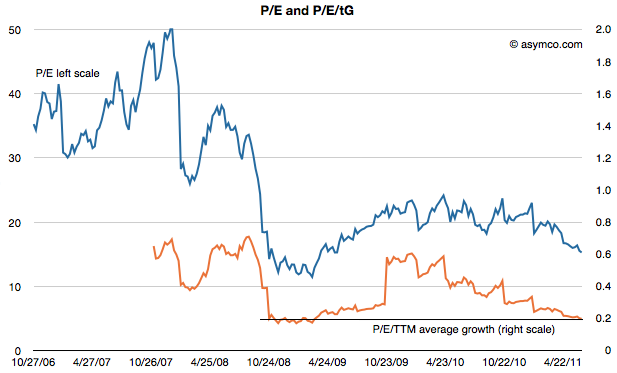
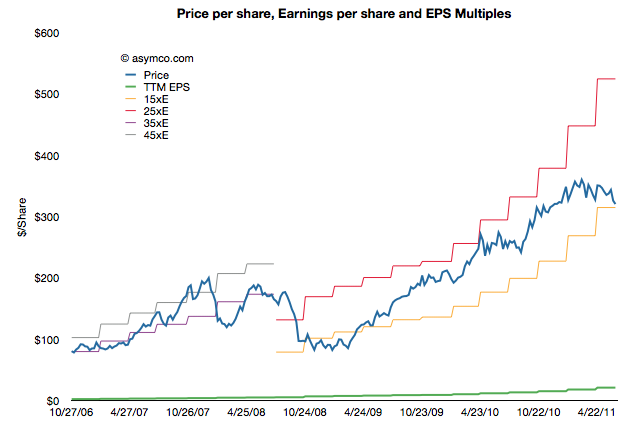
    In intra-day trading Apple's stock price traded at a P/E ratio below 15. That threshold is now at a price of about $315/share. Excluding cash the P/E is under 12. On a forward basis, there is widespread agreement that Apple has the reward (yield) profile of a bond without the risk of inflation.

    The history of the P/E ratio and the share price is shown in the following chart:

    As the chart shows, Apple traded in a range of P/E between 35 and 45 until late 2008 and has been trading between a range of 15 and 25 since about spring 2009. It might seem that the price is rewarding growth, but it's not.

    When adjusting for the growth the company has maintained, the company is at a similar P/E/tG (Price/Earnings/trailing Growth) to the depths of the recession.

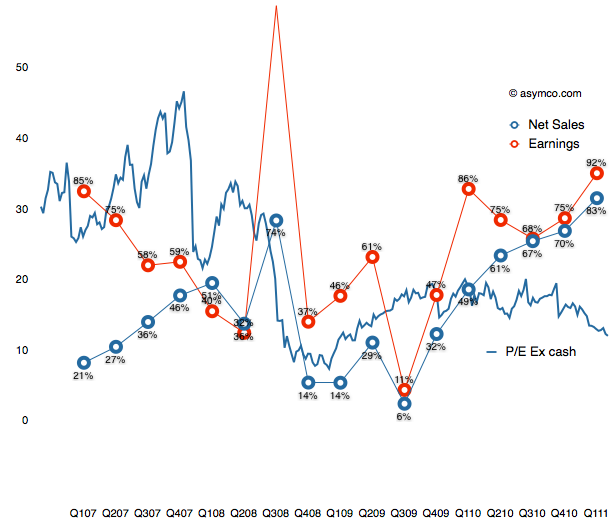
    At the trough shown above, the company was growing earnings at high 30% rates and sales in the teens. Today the company is growing earnings at 92% and sales at 83%. the following chart shows P/E ratio vs. growth.

    From a historic perspective, Apple is as cheap as it was at the bottom of the recession. At the time there were many reasons given for why the company would suffer 'headwinds'. Most commonly cited was that the company was a maker of "luxury" products and luxury does not sell in a recession.

    Today reasons being given for why the company will not prosper are far more nuanced. I won't re-iterate them but they deal with competition, platform issues, production issues, sympathy with companies that are failing, and saturation of markets.

    The trouble is that these arguments are easier to refute than the luxury vs. economy argument.  Exactly because the arguments are more precise, there is data that can be used to counter pessimism.

    And yet, with or without data, markets sometimes decide that profits are not reliable indicators of value created or potential for value creation.

  3. Apple could buy the mobile phone industry

    Research · 75 comments

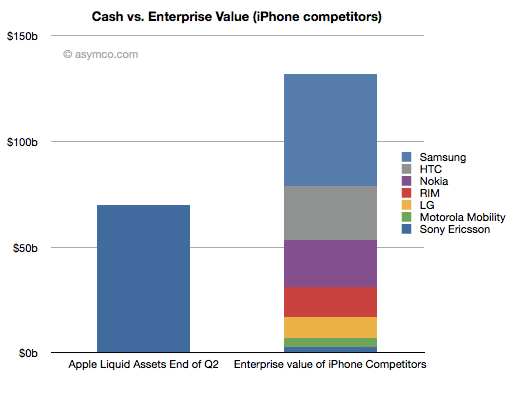
    The second quarter ends in less than two weeks. When it does, I expect Apple will have over $70 billion in Cash, Cash Equivalents, Short-term marketable securities and long-term Marketable Securities. That figure has been growing predictably.

    Also predictable has been the decline in value of Apple's mobile phone competitors. Most spectacularly Nokia and RIM. The enterprise values of the public companies selling 75% of all phones sold world-wide are as follows:

    • Nokia $22.6b
    • RIM $13.8b
    • HTC $25.4b
    • Motorola Mobility $4.2b

    The values of the profitable phone-making subsidiaries are a bit more difficult to estimate but we can use multiples of trailing operating profits. I generously use the multiple applied to HTC (14).

    • Sony Ericsson $0.21b x 14 = $3.0b
    • Samsung $3.76b x 14 = $53b

    That leaves valuing LG's phone business which has not been profitable in the last four quarters. I assume a nominal value of $10b. These data points are shown in the following chart:

    Given the current valuations, it would not be difficult for Apple to acquire every phone vendor except for Samsung with cash alone.

    The more remarkable thing is that as market values of phone vendors continue to decline, Apple's cash will continue to grow dramatically. Indeed, a time may soon come when Apple's cash will be worth more than the entire phone industry.

  4. The app industry vs. the music industry

    Research · 25 comments

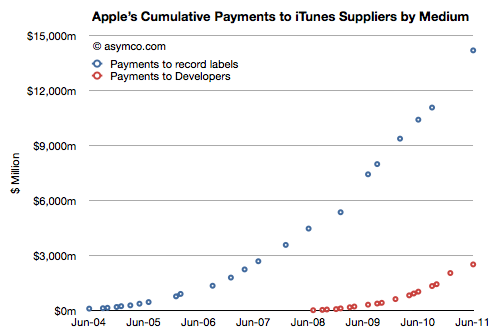
    By my estimate, Apple has paid out $16.6 billion to content owners. $2.5 billion to app developers and about $14 billion to music companies. The developer payments are published by Apple, the music payments are estimated based on total downloads and guesses about the split and pricing of that content (90% for the content and $1 to $1.2 average pricing over time.) There might be reason to move the music figure up or down but the difference will still be nearly a factor of 5.

    The cumulative payments are shown in the following chart:

    From this perspective, the music business is still a far bigger ecosystem than apps. However that's cumulative data and digital music has been around far longer. The story can be told a different way: What's the rate of sale in the present period? From what we know about the business, we can see what Apple takes in for apps and music (I've already estimated what Apple "keeps" after paying content owners)

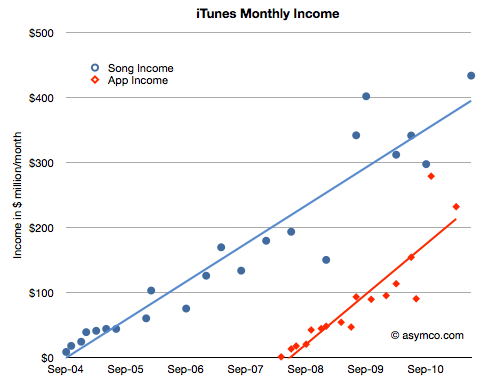
    The combined "sales rate" is a remarkable $665 million per month, but the split now is that music generates only twice the income of apps (i.e. cumulative is a factor of 5 but on a monthly basis the factor is 2). But what should be more impressive is how quickly the app business is ramping. By the slope of the trend lines, it would appear that app income will exceed music income within three years. Therefore, it's only a matter of time before apps generate as much income (exclusive of advertising) as music.

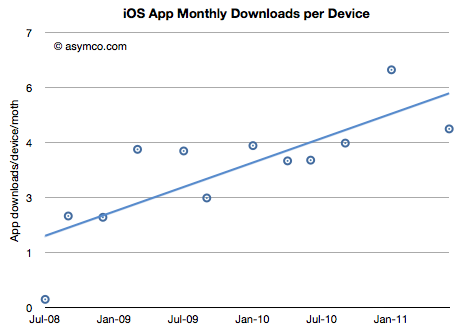
    Another perspective is the number of downloads per device per month. This shows that the rate of consumption of apps is increasing and is now about 6 apps per device per month.

    (You have to think of apps not as traditional computer applications or console games where each device has a certain number of expected apps attached, but rather that apps are more like a subscription where there is recurring monthly income).

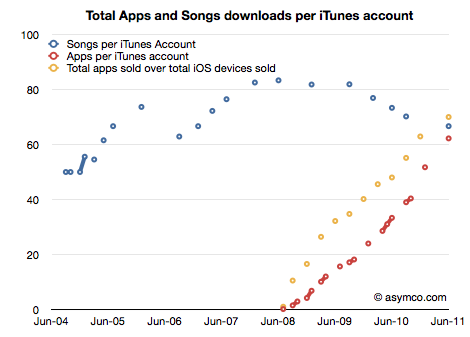
    I don't have a comparable figure for music because the number of iPods and Macs as target devices is hard to estimate, but I doubt consumption for music on a per device basis is increasing. As a consolation, I can estimate the number of apps or songs per iTunes account. Here the story is consistent.

    Each iTunes account has "consumed" about 67 songs but also 62 apps. Remarkable parity in such a short time. And the trend speaks for itself.

    All this data points again to the ascendancy of apps as a new medium. In a mere three years these digital objects have redefined themselves. They went from being tools to enhance the use of your phone to a new medium of expression and art. They have the ability to create a powerful economy of their own and will likely lead a profound shift in where value resides in mobile computing.

  5. iPhone liquidity: Why an unlocked Phone in the US matters

    Research · 93 comments

    The iPhone is now available in the US unlocked. Judging by the lack of reaction to the news, one would assume that this is not a significant event. I would argue however that it's a very significant event.

    What is unappreciated is that the iPhone is a very restricted product. Unlike any of Apple's other products (iPod, Mac and iPad), the iPhone is designed to be hard to get. Apple did not make it easy in the one dimension of ease that matters most: its purchase.

    Consider that many people in the world cannot buy an iPhone because it's not available locally. In case it is, in most cases you need to sign a contract and commit to a long-term relationship with a company other than Apple. In those cases where you don't sign a contract, you cannot use it with a service provider other than the one (arbitrarily) chosen for you.

    A few have been able to buy iPhones unlocked if they lived in a few countries (UK, France, Australia, Belgium, Hong Kong[1]) but those phones could only be purchased online if sent to a local address or in an Apple retail store--of which there are not many.

    Consider that in Europe alone, the following countries do not have iPhone distribution: Albania, Armenia, Azerbaijan, Belarus, Bosnia, Georgia, Iceland, Kazakhstan, Serbia and Ukraine. The populations total over 100 million people. In Asia the number of countries without iPhone distribution outnumber those with distribution. Add in Africa, Latin America and the Middle East and the unaddressed market begins to look very large.

    If you contrast this with every other phone platform out there, Blackberry, Android or Symbian, the iPhone is extremely restricted and the number of people that are permitted to buy it much more limited. The number of operators supporting Blackberry outnumber the iPhone at least by a ratio of two to one.

    Then there is the matter of distributors. This is a channel that iPhone does not leverage. Distributors account for more than half of Nokia's volumes. They buy in bulk and resell (sometimes illegally or in violation of contracts) vast quantities of phones.

    By offering unlocked iPhones in the US, the restriction on distribution is lifted to a large degree. What's different is that these phones can be purchased in 200+ retail locations. Many of these locations are in tourist hubs where there are large diaspora communities rotating continuously back to home countries. iPhones can now be purchased with cash and become as good as cash.

    And this is not a new phenomenon. When the original iPhone was available, Apple had to restrict buyers to 5 per person and stopped accepting cash because of the huge grey market demand. The same thing happened with the original iPad and with iPad 2 lines are still forming for it because distribution is so restricted. Consider also that sales in Verizon stores pale in comparison with those for GSM products.

    The way to think about it is that the iPhone has just become more "liquid" and it can now flow to parts of the world where it has been difficult to acquire. The iPhone was already liquid to some degree with unlocking and sales through Hong Kong/UK, but the US market's retail footprint and the lower costs that result will boost liquidity dramatically and probably increase volumes substantially.

    ---

    Note:

    1. According to Apple, the following 27 countries offer phones which are not "locked to carrier" : Belgium, Czech Republic, Finland, Germany, Greece, Italy, Luxembourg, Russia, Slovakia, Turkey, Hong Kong, India, Indonesia, South Korea, Macau, Malaysia, New Zealand, Singapore, Taiwan, Thailand, Vietnam, Bahrain, Kuwait, Qatar, Saudi Arabia, United Arab Emirates, South Africa
  6. iTunes now costs $1.3 billion/yr to run

    Research · 83 comments

    The iTunes store continues to grow. The data that Apple published in the last event included the following:

    • 15 Billion iTunes song downloads
    • 130 million book downloads
    • 14 billion app downloads
    • $2.5 billion paid to developers
    • 225 million accounts
    • 425k apps
    • 90k iPad apps
    • 100k game and entertainment titles
    • 50 million game center accounts

    As this data is added to the existing data and cross-referenced additional insight into the economics of iTunes is emerging.

    Since we know something about the average price of songs and apps, and we know the split between developers and Apple (and roughly between music labels and Apple) we can get a rough estimate of the amount Apple retains to run its store.

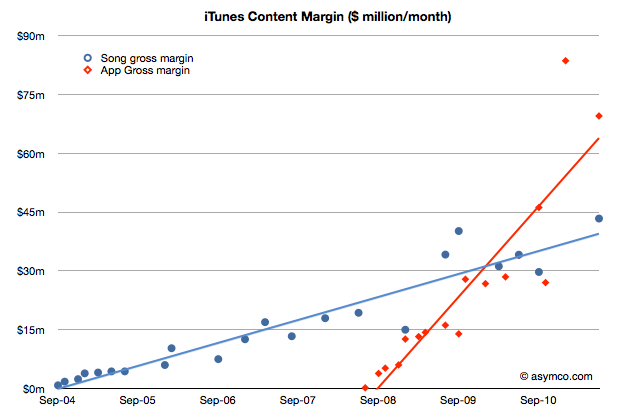
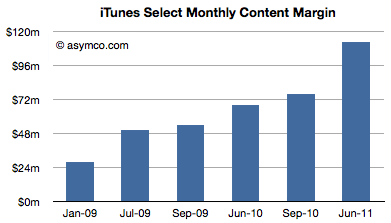
    The following chart shows iTunes "content margin" by month. This margin is what Apple "keeps" after paying content owners but before paying for other costs like payment processing and delivery/fulfillment which should be accounted as variable costs. Strictly speaking this margin is not "gross margin".

    If we add the content margins from music and apps and assume the store runs at break even we can get an idea of what it costs to operate the store.  The latest number is $113 million per month (from a total income of $313 million/mo.). It implies over $1.3 billion per year.

    Much of that cost does go into serving the content (traffic and payment processing). Some of it goes to curation and support. But it's very likely that there is much left over to be invested in capacity increases.

    I would like to hear alternative opinions, but my guess is that much of the capex that went into the new data centers Apple built came from the iTunes operating margin.

  7. Getting to one billion iTunes accounts

    Research · 37 comments

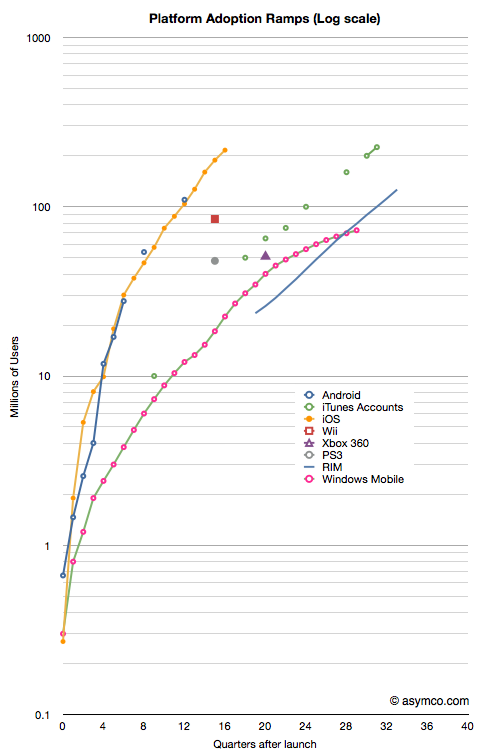
    There are 225 million iTunes account holders. 25 million joined in the three months. As the iTunes store has been operating since April 2003 it's possible to step back and look at its history and measure the rate of growth relative to other ecosystems.

    The following chart shows various platforms/ecosystems in terms of adoption. In the case of phone operating systems and consoles, the cumulative units sold is shown. The scale is 10 years by 1 billion users with users measured on a logarithmic scale.

    What can be easily observed is that iTunes continues to grow on a logarithmic scale even at its advanced age of 7 years. This cannot be said for console-based gaming systems or for some alternative mobile phone platforms (e.g. Windows Mobile or Symbian).

    The reason for this prosperity at an advanced age may be due to the fact that iTunes has survived the transition from one device (the iPod) to a device platform (iOS). It also was able to embrace multiple media from music, to movies to TV and apps. iTunes turned out to be far more flexible and resilient given what was technologically foreseeable at its birth.

    Looking to the future, is it possible that iTunes could grow in parallel with iOS toward the 1 billion user limit that the slope in the chart implies? Much will depend on gaining users who are unlikely to have credit cards and live in emerging markets. If there is one obstacle to the iEmpire it's the addressability of markets which lack consumer credit infrastructure. I suspect, however, that these problems are not unsurmountable given that telecom infrastructure leapfrogged credit infrastructure growth with nary a ripple. Apple could certainly offer that service directly to the consumer.

  8. Android developers are more prolific but less persistent than iOS developers

    Research · 29 comments

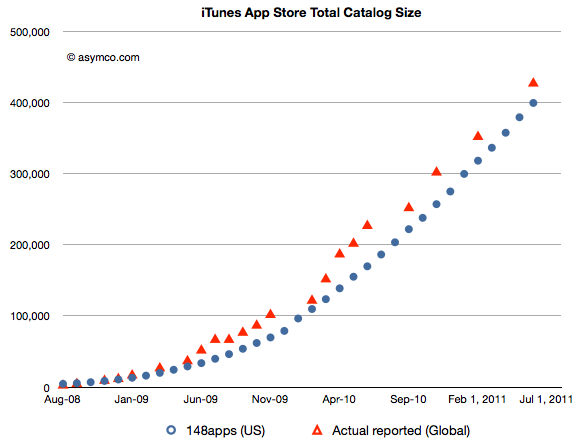
    According to 148apps.biz, the App Store has seen over half a million apps since inception. The number of available apps, according to Apple, is now 425k. (148apps claims 402k apps available in the US store.) The history of the App store catalog is shown in the following chart (showing both US and World-wide measures).

    In an interesting new post by Appsfire, APPtrition - or why app store size does not matter that much... Ouriel Ohayon makes a good point: available is very different than accepted. When comparing catalogs it's important to distinguish between these measures. Apps are published and then unpublished for various reasons. He calls this app attrition and details the reasons it might happen.

    What makes this interesting is the contrast between attrition rates on Android's Market and those on Apple's App Store. About 80k (or 16%) of Apple's catalog has been removed while nearly a third of Android apps have disappeared from the catalog. (By another measure, the submission total is tracked here and shows nearly 375k apps while Ouriel points out that there are 206k available. An apparent attrition rate of 45%.)

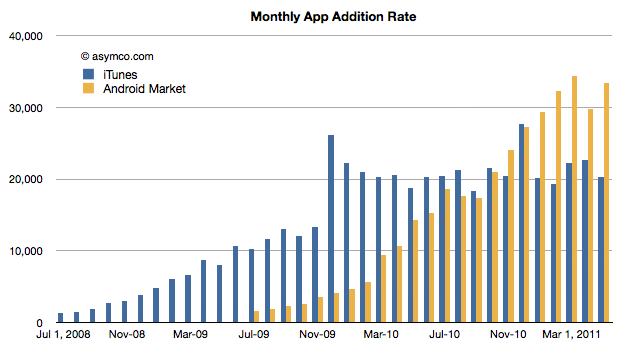
    We can compare how the two marketplaces are adding apps here:

    (The iTunes data is US only)

    This data would indicate that the iTunes App Store has plateaued at about 20k apps per month while Android is still growing and adding at about 30k per month. The challenge for an observer is to reconcile the growth in Android submissions with the apparently far higher attrition rate.

    In other words, Android developers and producers seem to be more prolific but less persistent.  With few if any constraints on submission it's understandable that there will be more apps thrown into the catalog. But why would they be so rapidly removed remains a mystery. Maybe economics, maybe policing, maybe something else altogether explains this.

  9. A new show launched today. Critical Path #1: The Five Year Plan - 5by5

    Podcast · 45 comments

    Critical Path #1: The Five Year Plan - 5by5.

    Critical Path is a talk show contemplating the causality of success and failure in mobile computing. Using Apple as a lens to look at both telecom and traditional computing markets, we try understand what it means to be great.

    In this inaugural episode, Horace Dediu and Dan Benjamin try to weigh the strategic implications of Apple’s WWDC announcements. We take a look at the impact on RIM, operators, Google and Apple’s flirtation with Twitter.