Asymco

Asymmetric Intelligence

Horace Dediu

  1. The price of Windows Phone: Nokia's evaporating smartphone share

    Research · 61 comments

    In the last quarter Nokia sold 28.3 million Symbian phones. The average selling price was €156 or approximately $210. That price was down 17% year-on-year.

    According to the company,

    The 17% year-on-year decline in our converged mobile devices ASPs was mainly driven by general price erosion and an increase in the proportion of lower-priced converged mobile devices sales.

    ASP erosion has been a fact of life across all of Nokia's products for quite some time, checked only by the increasing mix of smartphones. However the smartphones it sells have been consistently positioned for lower price points. This is consistent with Nokia's long-term goal of serving "billions" of users.

    The trouble with the new strategy is that the Windows Phone product lines currently in the market are not likely to be priced in the $200 range. The reason is that the minimum specifications for Windows Phone 7 are:

    • Capacitive, 4-point multi-touch screen with WVGA (480x800) resolution
    • 1 GHz ARM v7 "Cortex/Scorpion" or better processor
    • DirectX9 rendering-capable GPU
    • 256 MB of RAM with at least 8 GB of Flash memory
    • Accelerometer with compass, ambient light sensor, proximity sensor and Assisted GPS
    • 5-megapixel camera with an LED flash

    These don't add up to a product that can be sold profitably at $200. The bill of materials is likely to be in that range (and one has to add $15 for Microsoft).

    So there are two possible implications for Nokia's new smartphone strategy.

    1. Windows Phone will be ported to lower spec/cost hardware to allow the traditional Nokian market growth model to continue and perhaps combat Android proliferation
    2. Nokia's smartphone portfolio will consist of high-priced products, and exclude mid-to-low price products.

    Option 1 is difficult to imagine. The user experience that Microsoft is putting forward as its differentiation depends on significant hardware which is unlikely to become very cheap very soon. It is an interesting exercise to think through however. What would we have to believe for this option to become real?

    Option 2 is more likely as Nokia conforms to this a new definition of smartphone as "high-end" only. This seems to be the default option given what is visible to observers today.

    If Option 2 is in fact the outcome of the new strategy, then it leaves Nokia very vulnerable to a low-end disruption (after it's succumbed to a new market disruption.) The $50 smartphone will be reality this year.

    Option 2 also most certainly guarantees that Nokia's current market share of 30% in smartphones is likely to be lost and never regained.

    Some might argue that's no great loss. After all, Apple does very well with low share and high prices. However, Nokia is almost religious about market share. The reason being that scale offers significant purchasing power and logistical leverage. It sustains a cost structure, distribution network and a business model that is central to the company's core competency. It's also presumably the reason Microsoft partnered with Nokia in the first place: volumes and wide distribution.

    So we're back to the old question: how does the new deal lead to a thriving ecosystem? Does it depend on vendors other than Nokia? If so how does Nokia benefit from the sale of Samsung phones?
  2. Mobile World Congress: Revisiting the $85 smartphone

    Research · 9 comments

    While a low-end 3G Android smartphone could be sold currently at U$80 (wholesale price) and the adoption of ARM’s Cortex A5 should allow smartphone costs to fall to around US$50, they’ll still have some way to fall to catch up with the cost of 3G feature phones that are already reaching price points of below $30.

    via » #MWC11 Day 3 – Same old song. (Informa)

    The ubiquity of smartphones is inevitable.

  3. The certainty of unforeseeable growth: The rise of ZTE and Huawei

    Research · 37 comments

    • According to rumors, Huawei shipped 30 million phones last year. The target for this year is 60 million of which 15 will be smartphones.
    • According to IDC ZTE is now the fourth largest mobile phone vendor with 51.8 million units in 2010. Assuming 70% for 2011, ZTE could ship 88 million units in 2011, 25 million of which would be smartphones.
    • These data imply that ZTE and Huawei will ship nearly 150 million phones in 2011 of which 40 million would be smartphones.
    • That would imply approximately 7% share of the global smartphone market for these two companies together.

    What is remarkable about this is that the market share of these vendors was zero in the previous year.  It's hard to get comfortable with this market entry. The challenge for forecasters and analysts is that there is little history to draw upon. How will the entrants affect the rivalry between firms? Will the distribution be overlapping with incumbents or will the entrants be competing with non-consumption?

    The only thing we can be certain of is that the adoption of smartphones is increasing at a faster rate than is foreseeable.

  4. Who will buy the next 150 million Symbian smartphones?

    Research · 94 comments

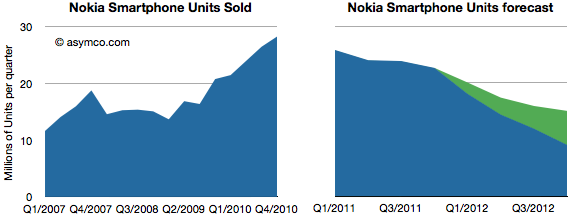
    Stephen Elop stated that Nokia expects to sell approximately 150 million more Symbian devices before the transition to Windows Phone is complete. Assuming that figure is achievable (which is far from certain) I tried to understand how that figure will affect the volume and share numbers for Nokia in the coming years.

    It's very likely that the first WP phones will not ship in large volumes until 2012. Product development cycles being what they are, unless there is an ODM rebranding (i.e. taking an HTC phone and gluing a Nokia sticker on it) the minimum development time is at least 12 months. Keep in mind that Nokia does not have engineers to build such a product today and hiring them alone can take months.

    The following two charts show what a two year forecast that adds up to 150 million Symbian devices looks like. I assumed Windows Phones begin to ship in 2012 and, keeping in mind that WP7 is designed for a higher hardware specification than the current Symbian phones, I show a modest ramp for a total of 15 million units in the first year.

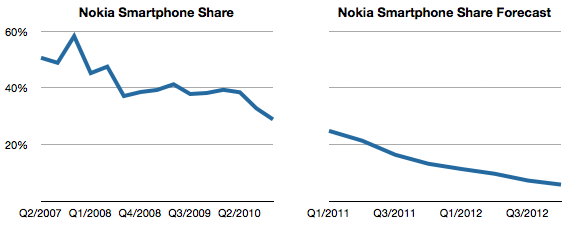
    I also forecast the overall market assuming continuing growth levels and calculated the effect of Nokia's share.

    The share at the end of 2012 would be approximately 6%.

    Note however that the share above depends highly on Nokia selling 150 million Symbian units in the next two years. One could question why would anyone buy a product whose platform that's been declared end of life. Perhaps there is a built-in assumption that end users are inherently stupid. However even in that scenario the question is which distributors will make the same bet with Nokia? Or, even more perplexing, which operators are willing to stock EOL products for two years when that shelf space is getting strong bids from Nokia's rivals.

  5. In memoriam: Microsoft's previous strategic mobile partners

    Research · 223 comments

    Microsoft's new "strategic partnership" with Nokia is not its first. For a decade the software company has courted and consummated relationships with a variety of companies in mobile and telecom. Here are the ones I can remember:

    • LG. In February 2009 Microsoft Corp. signed a multiyear agreement for Windows Mobile to be included on devices from LG Electronics Inc. LG would use Windows Mobile as its "primary platform" for smartphones and produce about 50 models running the software.

    What happened? LG made a few Windows Mobile devices but with WinMo uncompetitive, they abandoned the platform and moved to Android losing years of market presence and all their profits.

    • Motorola. In September 2003, Motorola  and Microsoft announced an alliance. "Starting with the introduction of the new Motorola MPx200 mobile phone with Microsoft Windows Mobile software, the companies will collaborate on a series of Smartphone and Pocket PC wireless devices designed to create a virtual "remote control" for the Web-centric, work-centric, always-on-the-go mobile professional." In addition, the alliance includes cooperation on joint marketing and wireless developer programs.

    What happened? Motorola launched a series of Windows Mobile phones culminating in the Motorola Q "Blackberry killer". As Motorola hit the rocks in profitability new management reached for the Android liferaft. The company now relies exclusively on the Droid franchise.

    • Palm. In September 2005 Palm and Microsoft announced a strategic alliance to "accelerate the Smartphone market segment with a new device for mobile professionals and businesses. Palm has licensed the Microsoft Windows Mobile operating system for an expanded line of Treo Smartphones, the first of which will be available on Verizon Wireless’ national wireless broadband network."

    What happened? Palm shipped a few Windows Mobile, famously dismissing Apple's potential entry as something "PC guys" could never achieve. A new CEO, a private placement and an acquisition later the company is a division of HP making its own operating system.

    • Nortel. When Steve Ballmer was famously laughing at the iPhone and saying that he likes the Windows Mobile strategy "a lot" he was sitting next to the then-CEO of Nortel (Mike Zafirovski formerly of Motorola) with whom the company had just closed a strategic deal.  "an alliance between Microsoft and Nortel announced in July 2006 ...  includes three new joint solutions to dramatically improve business communications by breaking down the barriers between voice, e-mail, instant messaging, multimedia conferencing and other forms of communication".

    What happened? Nortel declared bankruptcy two years later.

    • Verizon. In January 2009 "Verizon Wireless has selected Microsoft Corp. to provide portal, local and Internet search as well as mobile advertising services to customers on its devices. The five-year agreement will go into effect in the first half of 2009 when Microsoft Live Search is targeted to be available on new Verizon Wireless feature phones and smartphones." The deal would ensure Bing distribution to all of Verizon's smartphone customers.

    What happened? Bing did ship on some devices but in October 2009 Droid came to Verizon.

    • Ericsson. In September 2000, "Ericsson and Microsoft Corp. today launched Ericsson Microsoft Mobile Venture AB. This previously announced joint company will drive the mobile Internet by developing and marketing mobile e-mail solutions for operators. The first solutions are expected to be on the market by the end of the year. The company is part of a broader strategic alliance between Ericsson and Microsoft"

    What happened? Ericsson divested itself of the mobile division forming a joint venture which would go on and make more strategic alliances with Microsoft over Windows Mobile culminating in a loss of profits and eventual flight to Android.

    • Sendo. In February 2001, Microsoft announced a partnership, in which Microsoft bought $12m of Sendo shares and a seat on the board. Sendo was to be Microsoft's "go to market partner" for the Stinger smartphone platform that would become Smartphone 2002.

    What happened? Sendo after litigating IP issues with Microsoft went bankrupt in 2005.

    And finally,

    • Nokia. No, not this OS deal, but in August 2009 "The worldwide leader in software and the world’s largest smartphone manufacturer have entered into an alliance that is set to deliver a groundbreaking, enterprise-grade solution for mobile productivity. Today, Microsoft Business Division President Stephen Elop and Nokia’s Executive Vice President for Devices Kai Öistämö announced the agreement, outlining a shared vision for the future of mobile productivity. This is the first time that either company has embarked on an alliance of this scope and nature."

    The plan was to bring "Microsoft Office Mobile and Microsoft business communications, collaboration and device management software to Nokia’s Symbian devices."

    What happened? One and a half years later the same Stephen Elop announced that Symbian will be deprecated.

  6. Two turkeys don't make an eagle, but no penguin will ever soar.

    Research · 155 comments

    Vic Gundotra of Google tipped off the world two days in advance that on Feb 11 Android would play no part in Nokia's strategy. To be sure, Elop said that Nokia didn't choose Android because of "differentiation challenges and commoditization risk" (begging the question of how these challenges and risks are mitigated by licensing another openly available OS).

    But I won't weigh the merits of one module vs. another. Rather, the more pertinent discussion should be on why license instead of build. Clearly, Nokia threw in the towel. Not because they could not build, but because their building processes could not create greatness.

    But can greatness ever come from modularity? I've argued that it can't. I'll maintain that argument as long as what is being built is not good enough. In other words, as long as innovation remains relevant, improvements will be absorbed and rewarded. Once innovation exceeds what can be absorbed, the basis of competition will shift to convenience and price which are best served with a modular business architecture.

    Android is a fast follower. The first Android prototypes looked like Blackberries because that was the input paradigm of 2006. When capacitive touch was shown to be a better input method, Android reacted swiftly. When app stores created a new medium Android reacted swiftly. When the iPad demonstrated that computing can be done in new settings, Android reacted. At such time when there will be nothing to follow Android will be the king of the last commoditized innovation, but as long as there is something worth inventing Android will be there to reproduce it.

    This is not a judgement, but an observation: Nokia and Microsoft may not make an Apple but neither will Android ever create the future.

  7. Changing places: Microsoft trades HP for Nokia

    Research · 56 comments

    The juxtaposition of HP's strategy of increased independence and Nokia's new strategy of increased dependence can't be more striking.

    HP is probably Microsoft's biggest customer. As the largest licensee of Windows it probably generated more revenue for Microsoft than any other company. The fact that HP invested in a new operating system for its mobile efforts shows a level of discomfort with the lack of strategic leverage.

    Nokia, on the other hand, has been resolutely independent in its software strategy. For over a decade it held out against licensing any OS, especially one from Microsoft. The pantomime theatrics that took place over that decade will make a great case study some day.

    But now we have a complete reversal of roles: The abandonment of platform independence by a mobile giant at precisely the same time as the acquisition of platform resolve by an IT giant.

    It seems almost poetic. And that should be a clue. Whenever you see poetry, you need not look far for some truth.

    These chess moves are taking place in the context of a greater game: the collision and disruption of IT and Telecom. It's not surprising that massive market forces are causing incumbents to react. HP, Microsoft and Nokia are in the throes of fundamental disruption. Even if these moves may not be all in the same direction, they each react in ways that make sense to them.

    It's also very likely that all the moves are for naught. Incumbents rarely win with reactions. Let's not forget that the entrants came with different business models. Apple and Google are not making money in the ways of Nokia and HP (who are channel dependent) or Microsoft (who is license dependent). The reaction must itself be asymmetric. So far it's not clear where the asymmetry lies.

    Read more:

    HP/Palm’s Rubinstein believes in integration

    WebOS: HP, and HP Only. QNX: RIM and RIM Only

    HP’s PC group spends 0.7% of sales on R&D

    The reason Robbie Bach was fired

  8. Visualizing jumping off a burning platform

    Research · 75 comments

    Here's what a platform jump looks like:

    The devil is in the details. Although there was great excitement among investors at the prospect of platform agnosticism, the reality of the press releases shows that Nokia may have some significant short term pain.

    First problem is that Symbian phones have become feature phones. They have zero platform value and will therefore have no opportunity for premium pricing. This is a risk to the bottom line.

    Second problem is that we don't have any indication when any competitive WP7 phones will ship. It could be years for the "catalytic" effect of a new ecosystem. As observers of Microsoft press-release-ware will note, these types of "strategic relationships" don't pan out half the time.

    Third problem is that the organization does not look all that different. One or two executives changed seats and one is gone, but this is not a new dream team.

    Fourth problem is that there is no clarity on any long term win for Nokia. Maps licensing seems like the only possible new source of revenue and a minor one at that. What competitive advantage did Nokia just gain? Is there any advantage Nokia has over any other licensee of Windows Phone?

    Perhaps management will address these issues, but strategy takes a long time to bear fruit and the new announcement doesn't have any short term wins.

  9. A review of Asymco Predictions on Nokia’s new platform strategy

    Research · 25 comments

    Predictions on Nokia’s new platform strategy: new OS for the US | asymco.

    Here are my predictions from January 27 for the February 11 Nokia strategy announcement followed by the actual quotes from Nokia's press release:

    • Prediction: There will be a multiple OS strategy.

    Actual: The following sub-units [make up] Smart Devices: Symbian Smartphones, MeeGo Computers, Strategic Business Operations. To support the planned new partnership with Microsoft, Smart Devices will be responsible for creating a winning Windows Phone portfolio.

    • Prediction: The US market will be the first to see a new non-Nokia OS. I would guess Windows Phone with AT&T.

    Actual: "Plans for a broad strategic partnership with Microsoft to build a new global mobile ecosystem; Windows Phone would serve as Nokia's primary smartphone platform"

    • Low end devices will remain with Symbian due to price considerations for the chipsets, components.

    Actual: "Symbian becomes a franchise platform, leveraging previous investments to harvest additional value. This strategy recognizes the opportunity to retain and transition the installed base of 200 million Symbian owners. Nokia expects to sell approximately 150 million more Symbian devices in the years to come."

    • Prediction: MeeGo will be phased out in phone products but development will continue for tablets

    Actual: Under the new strategy, MeeGo becomes an open-source, mobile operating system project. MeeGo will place increased emphasis on longer-term market exploration of next-generation devices, platforms and user experiences

    More details to follow, but so far it looks like there are no surprises.

  10. The (iPod)Touch(i)Pad

    Research · 99 comments

    The world's largest PC company just launched a "media tablet[1]". Conflating the iPod Touch and iPad brands into "TouchPad" HP joins RIM in announcing an integrated OS/device product to compete as a platform vs. iOS and Android (and to some degree even against Windows).

    There are others waiting in the wings. Presumably, Microsoft is hard at work to release a tablet-compatible Windows sometime near the middle of this decade. MeeGo is also going through its gestation period targeting Atom-based tablets. John Gruber notes the excitement around tablet platforms in his article about this post-PC renaissance in computing alternatives. I also noted that the end of the PC era was marked by the end of WinTel at CES.

    In that context, yesterday's WebOS event was perhaps anticlimactic. But it's still remarkable. Consider how far we've come. Step back now and remember the dark days only one year ago when, right after the iPad announcement, a  nearly unanimously chorus was pouring derision on the concept.

    AAPLinvestors is still maintaining the iPad death watch which I took a snapshot of back in March 2010. To reminisce: It was exactly one year ago, on Feb. 10th 2010, that Bill Gates was quoted as saying "It’s a nice reader, but there’s nothing on the iPad I look at and say, ‘Oh, I wish Microsoft had done it.’" On the same day, Shannon Zimmerman of The Motley Fool wrote: "[Apple's] hamster-wheel of innovation ... may have hit a snag with the iPad." Those are just two of dozens other memorable quotes.

    I noted last May that the secrecy surrounding the iPad prior to launch was unnecessary. Nobody understood the product for months after it launched (and many still don't a year later).

    Apple keeps a tight lid on new products so that competitors don’t get a head-start on copying, but in the case of the iPad, advance knowledge would not have had any impact. Competitors look at the iPad and see nothing.  They’ll only react once the market explodes and they start to feel belated pain.

    Indeed, responses only came after sales figures started to cause consternation among competitors.

    How did these presumably keen observers of the market fail to notice the sea change under way? This is not just a rhetorical question. It really is hard. Students of disruption know that spotting such change is a difficult skill to obtain. But it is a skill, not a gift.

    So here we are, 12 months later and the derision has turned to flattery by imitation. The only scorn I hear about the TouchPad is that it can't come to market fast enough.

    ----

    1. I find this term repugnant and highlight it here only to ridicule those who coined it.
  11. Why focusing on a few products is hard

    Research · 59 comments

    "Focus is about saying no." This quote is perhaps apocryphal but it's credited to Steve Jobs. It's not a novel idea. Many companies chant this mantra but do they really understand what focus implies?

    Focus is the antithesis of portfolio theory. Portfolio theory is a great concept. Every pedestrian in New York City has experienced it. While the weather is fine, street vendors sell their regular wares, but when a rainstorm appears it seems everyone is selling umbrellas.

    The idea that you keep umbrellas in stock seems very prudent. It's a hedge that people will need a different product under different circumstances. Maintaining a product portfolio is a way of selecting a collection of products that has collectively lower risk than any individual product. The formulation of this even earned its creators the Nobel prize.

    But "focus" is the willful rejection of this theory. By saying no to alternatives you increase risk disproportionally to the reward. If you have the means to maintain a portfolio it certainly seems imprudent not to do so.

    So why would someone want to focus?

    The answer is that too much diversification is dangerous. It's dilutive to everything the company uses to create value: its resources, its processes and its priorities. It dulls the mind and tarnishes the brand.

    So focus is not just saying no. It's being supremely confident in what you say yes to. It's having the ability to call the winners and the losers. A company that lives and breathes product gains this confidence. A company that puts markets or profit formulas first never obtains the confidence to focus, inflates its portfolio and thus risks everything.