Asymco

Asymmetric Intelligence

Horace Dediu

  1. Apparel is next

    Podcast · 81 comments

    If software can be injected into an industry's product it will bend to the will of the software writers.

    This theory expands on Marc Andreessen's observation that "software is eating the world". The evidence is that software, coupled with microprocessors, sensors, batteries and networking becomes applicable to an increasingly larger set of problems to be solved ((Or, put another way, is eligible to be hired to perform an increasingly large set of jobs)). Software has "eaten" large portions of entertainment (e.g. Pixar, iTunes, video games), telecommunications (iPhone, Android, Messaging), various professions including journalism, management and law, and is entering transportation, energy and health care and poised over banking, finance and government.

    As entry happens, asymmetries are enabled and disruption follows. This is the bending to the will of the writers--who tend not to be incumbents. The incumbents can't embrace the changes in business models enabled by software without destroying their core businesses and thus, invariably, they disappear.

    The pattern is easily observed but the speed and timing of it is difficult to predict and hence investment success is not certain. ((Which, ironically, means that the jobs of venture capitalists are still safe. At least until the theory develops to the point where it can predict with more accuracy winners and losers.)) There are many entrants who try and few succeed and there are many incumbents who will survive longer than a prophet can stay hungry.

    Nevertheless, this process of software-induced turnover in wealth--and, incidentally, vast, additional wealth creation--is inevitable.

    But can we predict anything other than timing? For example, can we predict the next industry to succumb to this force?

    There is hope because the last big disruption was predictable. When looking at what caused telecom to become a domino, the pattern of development of hardware pointed the way. It was clear in the late 1990s that computers would become small enough to fit in one hand. The first instances were PDAs (mid-1990s) and once they proved valuable in solving many jobs it was easy to plot their evolution into phones.

    So if we follow the "packaging" constraint, it's clear that computers are becoming small enough to be worn. Many prototypes exist and even small companies can build them.

    All that is needed is a new user interface and a new platform will be born. Once a platform is born, the creativity of millions can be unleashed to expand the problem set that can be solved. The process then repeats.

    So it's obvious that as a computer becomes wearable it will affect the industry that currently is hired to also be worn: apparel.

    Apparel is the word describing every garment, shoe and accessory product sold and amounts to about $1.2 trillion/yr. ((The US is about $331 billion or 28%.)) ((The Telecom industry is slightly larger at about $1.3 trillion)) This amount of money is not spent only to protect the wearer from the elements--any more than the money spent on telecommunications is spent to convey vital information. Most of the value in apparel, perhaps 80%, is spent on solving psychological needs.

    And therein lies the opportunity. As the value is beyond functional, substitution of psychological jobs by new products is a matter of engineering better solutions. Consider the behavior of US teens: anecdotally, their spending on apparel is fading as the solution to feeling good about themselves increasingly relies on a device and service. Already, in this context, apparel retail is in crisis while buying shifts to devices.

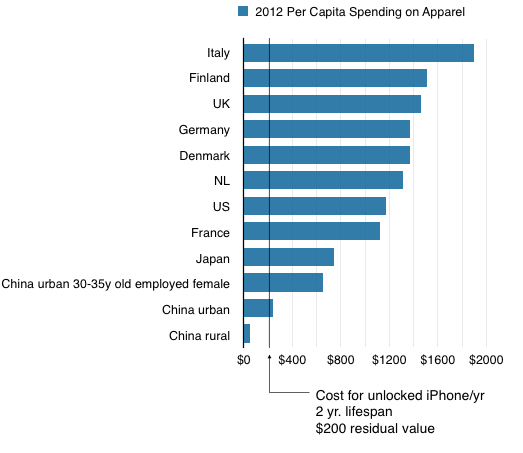
    While looking at the spending, it's also easy to see how much there is to divert from a non-functional to a functional/service bundle:
    Screen Shot 2014-08-28 at 8-28-1.01.40 PM

    In many markets individuals spend more on apparel than on personal technology. And as personal technology increasingly competes for the same jobs to be done, that spending will transfer to the entrants.

    To know who's already planning for this you can follow the trade news on the hiring of talent.
  2. Interview With Horace Dediu: What To Expect When Apple's Expecting

    Research · 24 comments

    My thanks to Eric Jackson for his thought-out questions on Apple. As published in Forbes, here is his Interview With Horace Dediu: What To Expect When Apples Expecting.

    A few excerpts:

    Q: Do you expect to see a sapphire cover on the new iPhone(s)? Is that material significant?

    I expect Sapphire will become a signature feature across many products. I don’t know if they will have capacity to deploy on iPhone this year but on a watch it’s essential. Here’s a clue: if the screen has any curvature, especially around edges, it needs to be sapphire as glass can’t take strain in that shape. The scope of the plant they are building with GT implies that they will have massive volume potential with at least one major iPhone model using the material. It’s a significant material because it allows design freedom in new directions, especially curved (concave) touch surfaces that retain a jewel-like feel. This has Jony Ive all over it.

    Q: Is it fair to conclude now based on the 5C and 5S that Apple will never launch a “cheap iPhone”?

    Oscar Wilde said a cynic is someone who knows the price of everything and the value of nothing. When I see the word “cheap” I never know if it refers to price or value. And even when we talk about price, an iPhone is cheaper than buying all the things it replaces so it’s always been a low end disruptor in my mind. (I saw a tweet with an image of a Radio Shack ad from the 1980s and every single item available on that page is now a part of the iPhone. It would have cost thousands to buy all those things back then–and dollars were worth a lot more.) Furthermore, I think Apple holds a black belt in pricing. They seem to define their position in the market by anchoring certain prices and “owning” them. Given all that I would say that Apple is not going to move their price points much. They will expand the portfolio and offer some iPhones at $300 but they will be older models. The average selling price (ASP) I expect to remain constant on a year-long average.

    Q: In the past, Apple critics were quick to dismiss the new iPad and 5C iPhone as failures upon their introduction.  You never judge. You just report the facts and data.  That said, is there anything about past new Apple products launches that we should look at as a predictor of how a new iWatch might be received by customers?

    When the iPad was imminent the great debate was over whether it would run iOS or OS X. Many imagined a touch-based Mac rather than the “big screen iPod touch”. It was a tough call and one which Microsoft could not and still does not make. Therefore, the interesting question for me with respect to iWatch is: What OS it will run? I will be shocked to the core if it does not run iOS. It is my opinion that making iOS work on it is the entire reason Apple is sweating this segment. They are in it because they are trying to make a platform product with a novel user experience and all the power of an ecosystem run on a wrist. It’s as big a problem as getting a phone-sized device to run a touch UI was in 2007. That is the crucial contribution that Apple is making to this next generation of computing. Now you might ask what users are asking for in this segment. The answer is nothing. Nobody is asking for this. As nobody asked for the iPhone (or the Mac or the iPad). It’s a new computer form factor and how it will be used will be determined by the apps written for it. But it will work and be magical out of the box in version 1. This is in contrast to the single purpose or accessory model of wearables we see to date.

    Q: As a student of disruption, where is Apple most vulnerable to being disrupted?

    Apple is a new market disruptor but much of what is put forward as a threat to it is low-end disruption. I think Apple knows enough about how that happens that it can manage its way around it. The strategy they employ is one of attrition. If you wait long enough a low-end threat tends to wear itself out as it starves of profit and is constantly gnawed-at by alternatives. (You see, if the disruptor cannot manage a profit then they cannot climb up the trajectory to get on top of the incumbent. Being profitable is a key requirement for successful disruption in the long term.) The attrition strategy works as long as you have the fortitude to hold out and the deep pockets to keep improving your product as alternatives flame out. It is my belief that Jobs made sure that thinking is inculcated in the company. So if not low-end is the company vulnerable to new-market disruptors? This is more subtle and the threat here is what Google/FaceBook/Amazon and the other ecosystems are all about. It’s creating new usage models and shifting where consumers place brand value. I think this is more what keeps Apple’s management awake at night. They are not standing still however. iTunes and Software and Services (now with Beats on board) is the way they are staying on top of that threat.

    Lots more here.

  3. Asymcar 17: 27 Quadrillion BTUs

    Research · 2 comments

    Part I is a review of the “automotive stack” and note how there is no singular event that seems to affect disruptive change. From changing jobs to be done, modular design and manufacturing processes, powertrain evolution, urbanization, environmental interests, regulation and taxation.

    Part II is a review of a framework of analysis based on sources and uses of energy.  Inputs, efficiency/losses, network effects and inertia, what can change and what can’t change.

    For a shot of theory, Horace reflects on the dichotomy of efficiency vs. efficacy when it comes to predicting change in the sector.

    via Asymcar 17: 27 Quadrillion BTUs | Asymcar.

  4. Cash exceptionalism

    Research · 13 comments

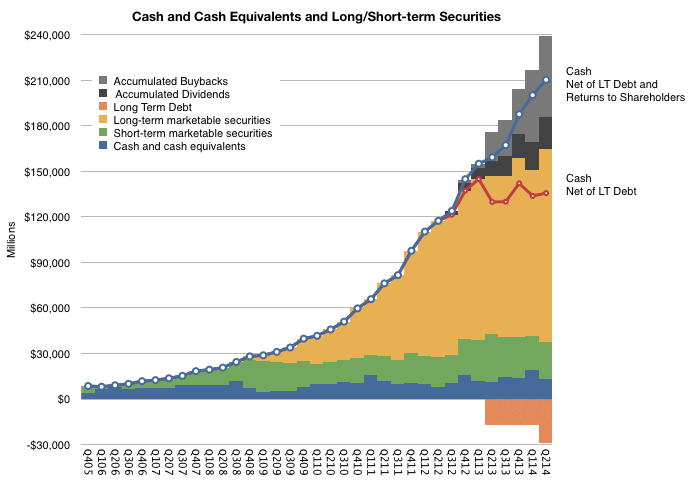
    Prior to implementing a dividend and share buyback plan, Apple had accumulated about $120 billion in cash and marketable securities. In the eight quarters since implementing the cash return plan, Apple has paid about $21.5 billion in dividends and spent another $53 billion of its shareholder's money buying its own shares and retiring them. That's $74.5 billion in cash that's been removed from its balance sheet.

    To avoid some repatriation taxes it also borrowed about $29 billion.

    Of course, in the meantime, it also generated cash from operations.

    Before the plan's implementation, eyeing the cash allowed for easy tracking of the accumulation of retained earnings. After the plan it's become a bit more complicated. The following graph shows all the quantities involved:

    Screen Shot 2014-08-18 at 8-18-2.09.00 PM

    The graph lets us answer the question "What would have happened if Apple had not paid any dividends, bought back shares and taken on debt?" ((The grey and black area of the last column is the total "cash returned to shareholders" and sums up to the $74.5 billion mentioned earlier. The grey area is only theoretically valuable as it depends on the outstanding (i.e. not retired) shares retaining their value. In this case, the value of the shares grew, making this an actual gain for shareholders))

    The answer is in the blue line. It would be about $210 billion today. There are about a dozen companies other than Apple worth more than that amount.

    As the company is not growing as quickly as it used to, the slope of the blue line is constant (i.e. it's nearly linear.) Though that might be seen as evidence of failure, it's more useful to treat this vast quantity as a recognition of past successes. The company's beleaguered status needs to be carefully preserved.

  5. Beleaguered

    Research · 94 comments

    Amazon's recent disputes with publishers (Hachette and Disney) shows a degree of market power that is closer to monopsony than to monopoly but this power is nevertheless real. It may not not be something that requires intervention, regulation or even scrutiny but market power is evident in both how companies operate and in how they are valued.

    If you look at the following graph, it's easy to spot those with "monopoly" power. The graph shows a short history of revenues/operating income and P/E ratios. Modest or no growth in earnings coupled with extraordinary high P/E ratios indicate that the market understands the business is not threatened by competition.

    Screen Shot 2014-08-14 at 8-14-1.40.47 PM

    In contrast, "beleaguered" companies include those with great sales growth but no perceived long term prospects. This perception is evidenced by a low P/E ratio. It indicates how long the company can maintain its present level of profitability. I've highlighted Apple's continuing, and indeed perpetual, beleaguered state. Excluding its existing capital base, Apple rarely gets votes for a life span longer than 10 years. One can see the same status in many Asian companies. Samsung is even more beleaguered than Apple by this measure.

    The underlying implication is axiomatic as far as investments are concerned.: Being under threat all the time is undesirable.

    But is this true?

    One of the issues with monopoly/monopsony is that it leads to business practices and strategic priorities that are tainted by hubris. In contrast, the stress of competition leads to "paranoia" and to a sense of urgency which is blessed by innovative insight.

    This is a corollary of Grove's "only the paranoid survive" or Jobs' rant on why Microsoft was unable to come up with breakthroughs. Grove and Jobs looked at dominance of a market (as either buyer or seller) and saw a curse. Their understanding of the human condition went beyond what the arithmetic of markets would suggest. Running a business and managing people who are asked to create things leads to this insight. Peering at spreadsheets doesn't.

    The observation to be made is that those who invest in companies haven't caught on.

  6. A Dollar a Day

    Research · 136 comments

    There are 80 million Mac users. The last 12 months saw sales of 18 million Macs.

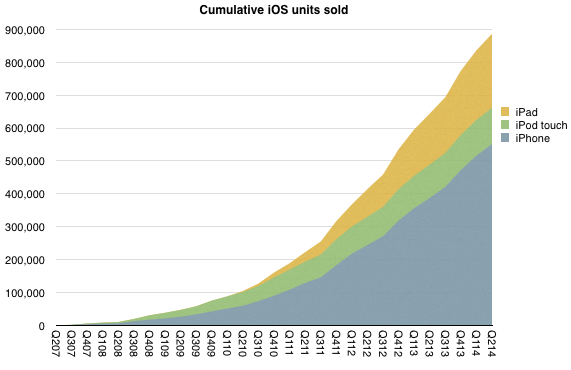
    As of the end of June there were 886,580,000 iOS devices sold. As of today the total is well over 900 million. One billion sold will happen well before this year is out. Estimates of current iOS users vary but they are probably at least 500 million and could be 600 million.

    Screen Shot 2014-07-25 at 7-25-2.44.06 PM

    Apple claims 800 million iTunes accounts.

    Therefore, in terms of revenues:

    • Mac User = $289/yr
    • iOS User = $262/yr
    • iTunes User = $25/yr (( Measured from billings ))

    Adding iTunes usage to either Mac or iOS yields

    • One Mac owner = $323/yr or 89c/day
    • One iOS device owner = $287/yr or 79c/day (( This conforms well to the rule of thumb that, after taxes and accessories/services, one Apple device is worth about $1/day ))

    This should make valuing Apple easy.

    80 million Mac Users and 500 million iOS users add up to about $169.3 billion in sales per year. If we assume that the number of Mac users grows to 90 million  and 600 million for iOS then next year Apple should get another $200 billion from its population of users.

    So over the next 30 months Apple sales should easily be higher than its current enterprise value. (( Enterprise Value = Market Capitalization - Cash + Debt = $585 billion - $164.5 billion + $29 billion = $449.5 billion ))

    This would be the forward price to sales ratio of about 2.5. Each sale yields a certain net profit, which for Apple is on average 21%. Multiplying 2.5 by (1/.21) gives 12 which is about the P/E ex cash.

    This exercise summarizes Apple's valuation nicely: Apple is expected to keep its current customers for about a decade and then disappear.

  7. Is the PC back?

    Research · 119 comments

    Gartner's own press release has an interesting spin:

    "After Two Years of Decline, Worldwide PC Shipments Experienced Flat Growth in Second Quarter of 2014, According to Gartner"

    Gartner's actual figure is 0.1% growth. Gartner and IDC measure slightly different quantities as "PC" but they don't disagree much. IDC still shows declining PC sales at about -1.7%. However both also include the Mac in their accounting of PC. If we were to remove the Mac and measure "Windows PC" ((In quotes because this total includes Linux and Chromebook)) Gartner's figures would show -0.8% drop in PC ex-Mac shipments.

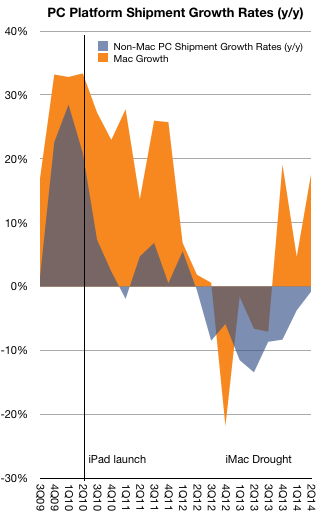
    The difference in growth between the Mac and non-Mac PCs is shown in the following graph.

    Screen Shot 2014-07-23 at 7-23-5.23.08 PM

    As Apple puts it, the Mac grew faster (and hence gained share) for 31 out of the last 32 quarters.  It missed on this perfect record during the fourth quarter of 2012 when the then fresh new iMac was impossible to buy due to production issues.

    So as far as the Mac is concerned the slowing of the decline in PC unit shipments isn't at its expense. What has been discussed as a cause for the moderation of market contraction is the expiration of Windows XP support. Certainly that seems plausible and is supported anecdotally. If it's true then the PC respite may be transient.

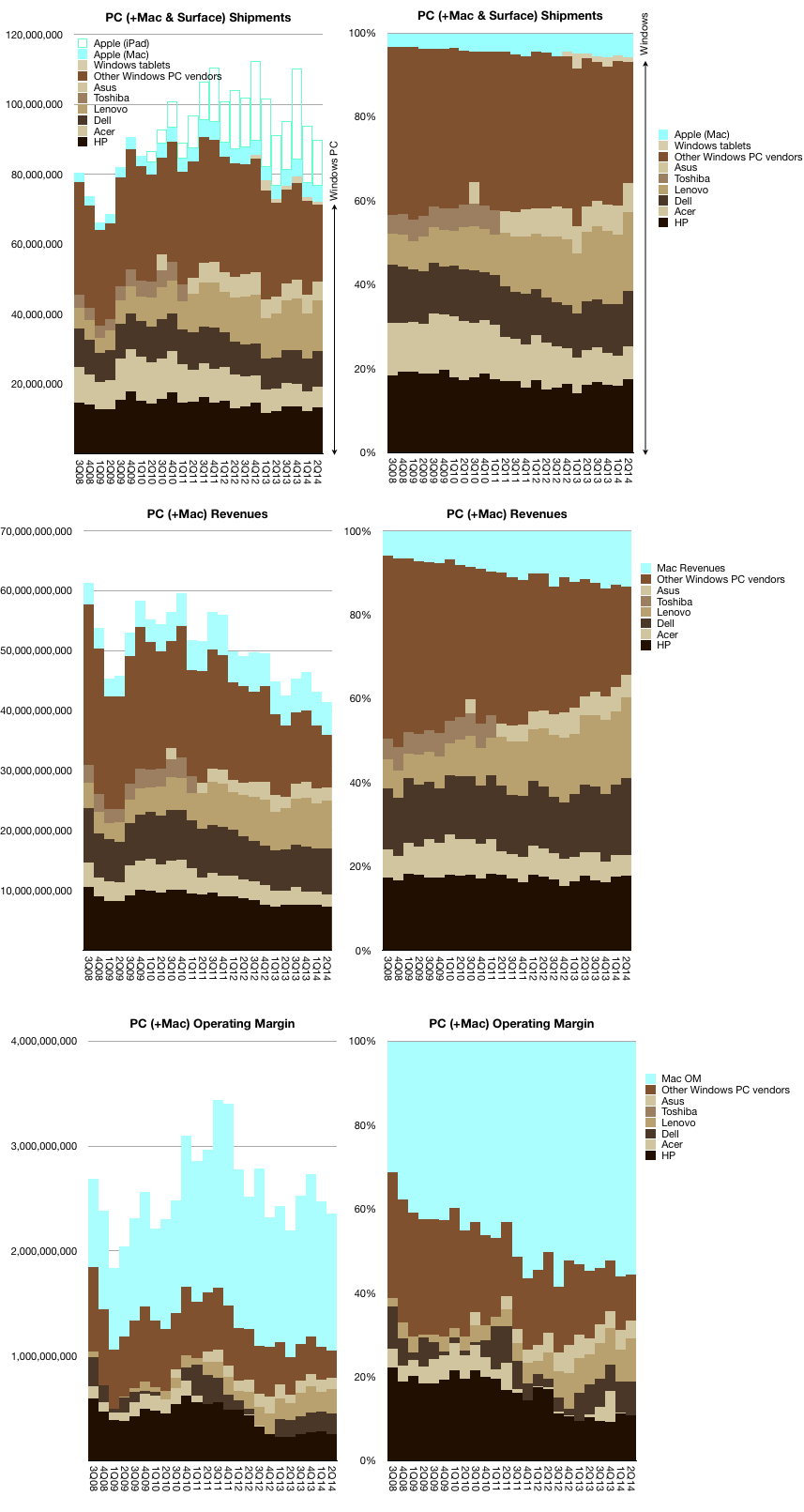
    To put a finer point on it, it would be useful to know  revenues and profits  in addition to volumes. Thanks to Charles Arthur for providing most of the data that allows this picture to be drawn:

    The revenue pictures shows that (non-Mac) PCs have been declining for almost four years and into the present quarter and operating margin ("profit") has shrunk to nearly $1 billion (while being generous with "other" PC vendors).

    Incidentally, the Mac is nearly the highest revenue PC brand and by far the most profitable. Indeed, it's more profitable than all the other vendors put together.

    If one includes the Mac, the PC industry may be limping along, but if we were to exclude it then this post conforms to Betteridge's law of headlines.

  8. Airshow is coming to Tokyo

    Conference

    I will be conducting our 10th Airshow event in Tokyo on Thursday, 17 July 2014.

    Airshow

    The purpose of Airshow is to:

    • Understand how data can be used to persuade through an appeal to logic as well as through empathy.
    • Understand the basics of "data cinematicism" including the techniques analogous to cinematography and direction.
    • Understand story development techniques including how to facilitate the audience's entry into the story.
    • Learn how to build a cinematic presentation.

    The method we devised borrows heavily from the techniques of cinematography and screenwriting to impart meaning to the audience beyond the literal words spoken or images shown on screen. These techniques are demonstrated with "feature presentations" and then deconstructed in interactive lectures. Throughout we also weave Aristotelian rhetorical tips and present from the Asymco repertoire of stories.

    See Airshow Tokyo event page for more information. Registrations are available. Students may register for academic discounts.

  9. Late late majority

    Research · 64 comments

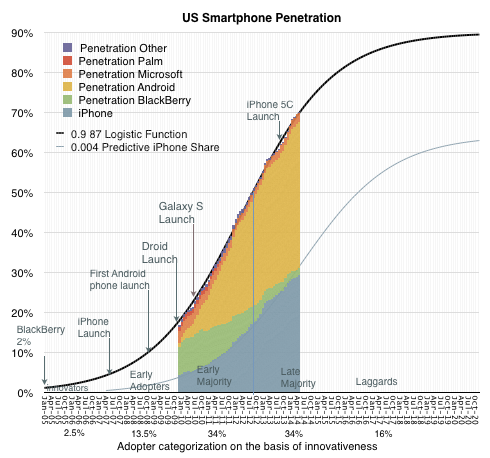
    Seven years after the iPhone was launched, 70% of the US population is using smartphones. Smartphones existed before the iPhone so the category is older than seven years but as far as adoption goes this is nearly the fastest ever.

    The CD Player reached 55% in seven years and the Boom Box about 62%. If measuring the period between 9% penetration and 90% ((which I consider the "economically attractive" period of growth)) the smartphone in the US will have a lifespan of about 9 years starting in 2008. Before this period, the product was largely experimental and participating vendors ((Palm, BlackBerry, Nokia)) mostly failed. After this period most products will be "commoditized" with decreasing margins and increasing consolidation.

    The rapidity of growth is all the more remarkable given the penetration is at the individual, not household level. The total user base is therefore over 270 million rather than the 115 million usually targeted by consumer technology, nearly 60% more purchases. This is also remarkable because the product has a shorter lifespan of use (two years) than is typical for other consumer technology products ((e.g. TVs, Refrigerators, Radios, etc.))

    We are therefore now in the "Late Majority" phase of the US market. This is not a surprise. The inflection point in the market occurred in mid 2012 so we've been in this phase for two years already. It's not therefore controversial to predict two years of continuing though decelerating growth.

    Screen Shot 2014-07-08 at 7-8-2.39.27 PM

    As Geoffrey Moore explained, the marketing of technology products needs to be varied as we get into different phases of the market. Innovators (first 2.5%) need to be sold on the premise of novelty itself. Early adopters (next 13.5%) seek status and exclusivity. Early majority (34%) seek acceptance and Late Majority (34%) seek pragmatic productivity. Laggards (last 16%) seek safety.

    One aspect of this adoption cycle that is misunderstood is the role of pricing. The assumption is that pricing matters more as adoption increases. This is misunderstood because pricing always matters and therefore it never matters. Pricing is one of many elements of marketing mix and at any time there are product choices across a wide spectrum of pricing. Pricing is also a signal which can be elaborately obfuscated through bundling and unbundling.

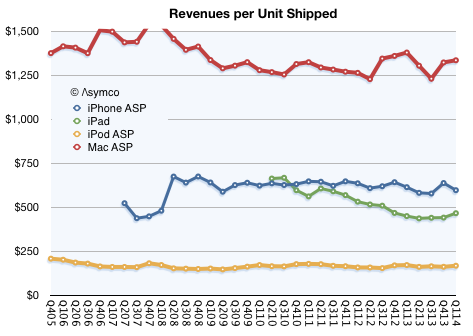
    One way to illustrate this is to consider how Apple products behave in the late phases of markets. Apple products have notoriously firm pricing.

    Screen Shot 2014-07-08 at 7-8-2.38.26 PM

    The revenue per unit of Macs, iPods, iPhones and iPads remains stubbornly consistent. This is not to say that each unit sold is the same price. The company tweaks "the mix" of mid, low and high products to keep the average selling price constant. But fundamentally the average remains constant which means that regardless of market phase, Apple retains its margins.

    So as we look forward to the last two years of growth for smartphones, how will Apple fare?

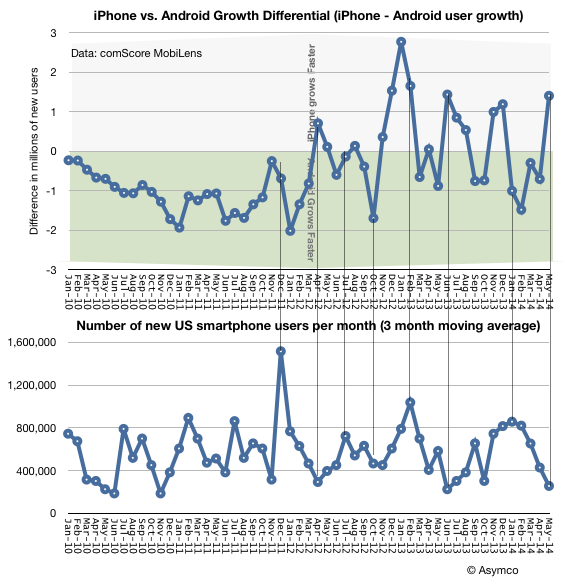
    There are weak signals that it will do rather well. I looked at two sets of data for clues: the number of new-to-smartphone users being added each month relative to the increase of usage of either iPhone or Android.

    Screen Shot 2014-07-08 at 7-8-2.40.19 PM

    [Edit: The title of the second graph above should be "Number of new US smartphone users per week (3 month moving average)"]

    What I'm looking for is a relationship between the rate of adoption of the overall product and the rate of adoption of iPhones. I measured the new-to-smartphone users as the change in user population (per week) and the preference for iPhone as a growth differential. ((iPhone growth in millions of users minus Android growth in millions of users. Positive data points suggest iPhone grew faster in a period and negative points suggest Android grew faster.)) The data shows no perceptible correlation between adoption rate and preference for either platform, however when looking closer there is a  periodicity to the addition of users, especially starting in 2012.

    The range is not insignificant, ranging from ~300k users/week to well over 1 million. The periods of growth of users could be due to new product launches or incentives and promotions done by the mobile operators. Whatever the reason, there is some flux.

    If we look at the corresponding adoption differential in platforms the relationship seems to be that peaks in adoption are matched to Android preference and troughs to iPhone preference. This might seem logical: after the 50% saturation point, when promotions are run by operators, non-consumers are drawn in and they tend to adopt the "low-cost" product.

    However, this is also paradoxical. Why, when we are in a late stage of the market, does the iPhone do well when users are not incentivized to adopt? The graph above shows that as we crossed 70% adoption, 1.4 million more users adopted the iPhone than Android.

    Even if we look out to the last six months, iPhone added 15.5 million late majority users while Android added 14.2 million. If promotions decrease for the "late late majority" and laggards then would the iPhone do even better relative to Android?

    The only answer seems to be that "low cost" is not what's driving this market. But then again, it never did. Towards the end of the "pre-smartphone" market the most wildly popular voice phone in the US was the RAZR. And it was a premium product.