Asymco

Asymmetric Intelligence

Nota Bene

News Commentary from Asymco's Horace Dediu.

  1. iPhone becomes India's top single export item

    Nota Bene · 1 comment

    Five iPhone assembly plants — three operated by Tata Group entities and two by Foxconn — supported by a supply chain of around 45 companies

    Apple Inc.'s iPhone became India's top single export item in 2025, with shipments worth $23 billion, largely to the US, driven by the government's PLI scheme and supply chain diversification from China. Smartphones emerged as India's leading export category with Apple contributing 76 per cent.

    Smartphones were India's top export category for the first time, surpassing automotive diesel fuel, with a total $30.13 billion worth of exports in the January-December period. Apple accounted for 76 per cent of total smartphone exports. Apple's five‑year PLI window is scheduled to end in March 2026.

    Source: International Business Times

    NB: During the last Active conference I discussed with the author of...

    NB: ... Apple in China whether Apple could repeat their success in China with India. He said it was not possible. I saw a pattern. China was not the first conquest and it would not be the last. In a future research post I will examine the history, current size and growth potential of iPhone in India. We can measure this market and we can extrapolate it as well as we can do China, Europe or the US. It's remarkable what has already happened.


  2. Are Solid State Batteries Finally Here?

    Nota Bene

    Do I Believe?

    Donut Lab has commissioned the internationally renowned VTT Technical Research Centre of Finland to conduct independent measurements of the battery’s performance and key characteristics. Unless otherwise stated, all tests presented here have been conducted by VTT. Full reports will be published alongside detailed video documentation that walks through the procedures, showcases the test setups, and explains the results.

    Source: https://idonutbelieve.com

    NB: I happen to know of VTT Technical Research Center ...

    NB: .... A former boss of mine actually was a director there and I visited premises to discuss testing of solar panel efficiencies. It is a state-owned and strictly impartial institution. Donut Labs is run by Finns and knowing a bit about their tendencies I'm also disinclined to disbelieve claims they make, even if they are extraordinary.

    Today's evidence may begin to dispel some doubts. If valid, the implications of this technology would be quite profound. Solid state batteries with the specifications offered (charging rate, power density, morphology, duty cycle, temperature range, safety, cost) would change the economics of energy overall, not just transportation.

    Storage of energy for grids and devices would enable a new degree of mobility and conformability to jobs-to-be-done that can hardly be overstated. Devices which would not only have longer useful life but that could compute more at the edge would bring in a new level of privacy, independence and integration--all very sustaining to Apple's core.


  3. Apple #1 phone vendor in Europe

    Nota Bene

    Up 7 percent y/y in Q4

    As expected, Apple took the top spot in Q4 2025 and increased its share compared to Q4 2024, with shipments growing 7% YoY thanks to a strong performance by the iPhone 17 series.

    Samsung took second place, with its shipments growing 4% YoY and share also increasing YoY to 29%.

    Apple’s strong growth in Eastern Europe and increased competition in Western Europe ate into Xiaomi’s market share, causing a 6% YoY decline.

    Source: Counterpoint

    NB: Original article suggests bad news on the way ...

    NB: ... as memory price increases could cause downturn in 2026. However the low end will face bigger challenges and therefore Apple and Samsung will probably see increased share. The "Others" are now about 20% share and lack of supply might cause a shift to premium or at least a stronger secondary (i.e. used) market will pull demand from below. As usual, the secondary market is not watched closely enough. Stay tuned for more details on the 1.5 billion used iPhone base.


  4. Bankers complain that Apple has a tight grip on mobile payments

    Nota Bene · 2 comments

    it’s not like they [haven’t] fought to keep Canada a very heavily centralized oligopoly

    The Canadian mobile wallet and payments market, valued at roughly US$1.39 billion in 2024, is projected to reach about US$20.48 billion by 2030, according to research firm MarkNtel Advisors. Bank of Canada data shows that among Canadians who pay with their phones, nearly 90 per cent use Apple Pay, Google Pay or Samsung Pay.

    Around 2014, several banks, including RBC, Scotiabank and TD Bank, launched their own mobile wallets on Apple and Android devices. Almost all of these apps were ditched, with TD citing “growing popularity of other digital wallets” as a reason for the shutdown in 2022. Canadian banks got “innovated out of the space,” said Christie Christelis, president of market research company Technology Strategies International.

    Source: The Logic vis Apple Stocks

    NB: Having worked at a bank many years ago I would say ...

    ...that technology and banks make strange bedfellows. Banks are risk management machines and technology companies are risk taking machines. There are conflicting priorities and mismatched resources. Nothing much has changed in this regard for the many decades that I've observed fintech.  

  5. The US Supreme Court has ruled against US President Donald Trump's decision to impose a raft of global tariffs

    Nota Bene · 1 comment

    When do we get our money back?

    The US Supreme Court has ruled against US President Donald Trump's decision to impose a raft of global tariffs.

    Six of the court's nine judges voted to overturn the signature economic policy.

    The judgment was in response to an application brought by businesses affected ‌by the tariffs from 12 mostly Democrat-run states.

    The applicants challenged US President Donald Trump's use of an executive order to impose the sweeping country-specific taxes.

    Trump latest: Tariffs snubbed by Supreme Court

    From 2 April, a day described by Mr Trump as "Liberation Day", countries across the world were hit with taxes on their exports.

    Source: Threads, Sky News.

    NB: I have many questions. On Liberation day or soon after Apple shares fell from $223 to $169 or about 24%. Will we see a recovery of 20% now that Trump tariffs are declared invalid? Will Apple receive its tariff payments back? How big is the refund?

    "Companies have already filed hundreds of protective lawsuits seeking to preserve their ability to claim refunds from the government for tariffs they have already paid, in the event the court struck down the levies."

    At time of writing Apple shares are up 0.6%.


  6. iPhone Emergency SOS via Satellite Helped Six Skiers Survive Tahoe Avalanche

    Nota Bene

    From luxury to necessity

    Six skiers who survived a deadly avalanche near Lake Tahoe stayed connected to rescuers by using Emergency SOS via satellite on iPhone. The group was on a multi-day backcountry trip in the Sierra Nevada mountains when the avalanche struck. While six people survived, eight died and one remains missing and presumed dead. During the rescue effort, survivors relied on satellite connectivity to communicate with authorities for hours.

    According to a report from The New York Times, the survivors used Emergency SOS via satellite to stay in touch with the Nevada County Sheriff’s Office while rescue teams worked in difficult terrain. The feature allowed them to send and receive messages even though there was no cellular or Wi Fi coverage in the area.

    Don O’Keefe, Chief of Law Enforcement for the California Office of Emergency Services, described how critical that communication was during the operation.

    Source: The Mac Observer

    NB: The evolution of two-way satellite communication from a costly tool for wealthy to accessible to most is similar to how mobile terrestrial communications also evolved. The difference is in the rate of adoption. Terrestrial is quicker and scales better. The bandwidth to low earth orbit, even with a constellation of satellites will be constrained by network saturation far more. Currently LEO satellites can serve millions but billions will take a lot more


  7. Secure the chips, absorb the costs, and grab more market share

    Nota Bene

    If Apple is stressed imagine how the other guys feel.

    Analyst Mark Newman resets Apple price target, weighing in on memory cost inflation.

    Rising memory costs may increase iPhone prices, but Apple’s execution and ecosystem provide resilience.

    Apple’s AI ambitions, particularly regarding Siri 2.0, could drive a major upgrade cycle and services revenue.

    Apple’s latest Wall Street price targets
    Wedbush: $350 (outperform).
    Goldman Sachs: $330 (buy).
    JPMorgan: $325 (overweight).
    BofA Securities: $325 (buy).
    Morgan Stanley:$315 (overweight).
    Sources: Yahoo Finance, Investing.com

    Apple’s cost pressures are real, but the growth story is bigger

    Despite memory cost inflation being a big deal, it still doesn’t fundamentally impact Apple’s tremendous earnings power, Newman shared in a CNBC interview.

    That’s not to say he doesn’t expect iPhone production costs to rise, though.

    Heightened component costs could push iPhone prices up by as much as 15%, Newman added, while bumping the overall average selling price by nearly 12% as some customers trade down to cheaper models.

    Source: thestreet.com

    NB: Hard disagree...

    ... on iPhone costs and price and customer behavior. Apple guided to higher margins while stating that there would be "a bit more of an impact." I almost certain that there will be no iPhone price increases in Q1 and therefore higher margins suggest a tailwind in components cost.

    However Newman does make a point about the consequences on the market. Whatever the impact on Apple, Samsung et. al. will have it worse. When components are scarce the advantages lie with the volume players. The higher the volume the more leverage exists. A similar phenomenon occurred when the iPod was new. Apple bought so much of the 1" drive capacity that nobody could source any. Nokia did a similar thing with RF components in an earlier episode. In both cases market share rose as competitors simply had no products on the shelf.

    The idea that Apple is somehow always the most fragile and most vulnerable while the exact opposite is true is a recurring one. A true market psychosis.

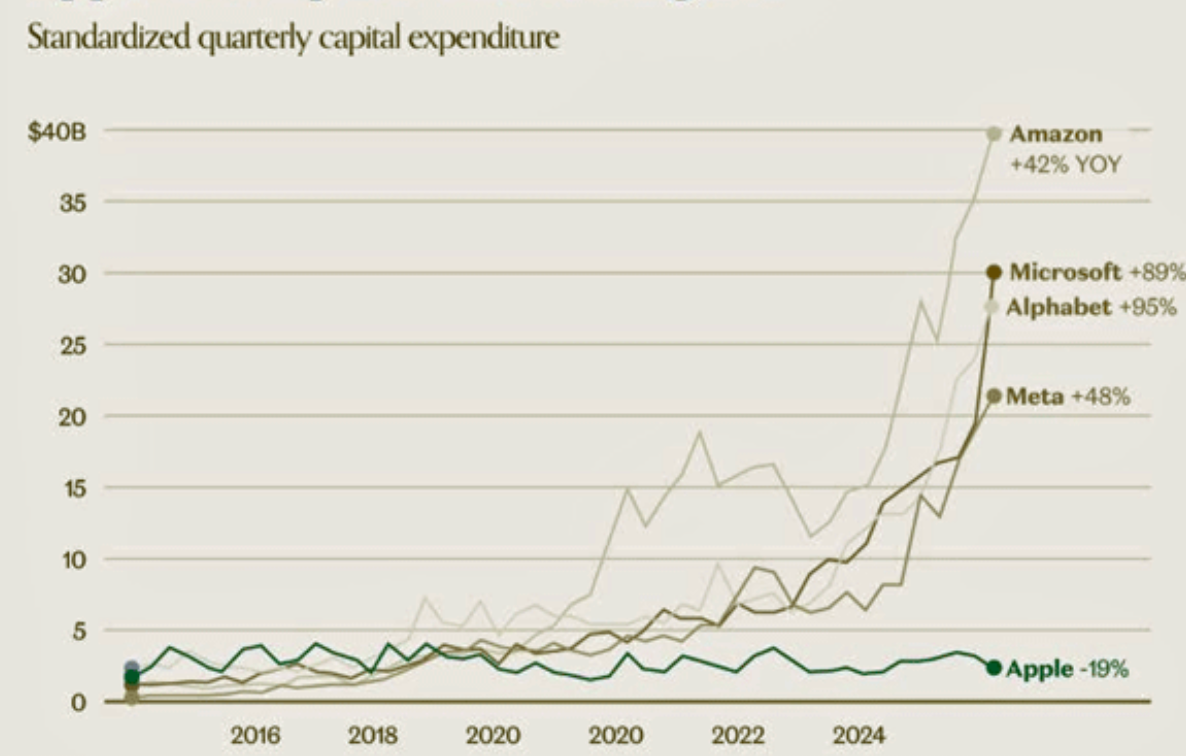
  8. While big tech burns cash on AI, Apple waits

    Nota Bene · 1 comment

    Bonfire of the Tech Vanities

    But consider an alternative reading. The foundation model market is beginning to exhibit classic signs of commoditisation. When one company introduces agentic capabilities, the others follow within months. Benchmark leadership changes constantly, with no provider establishing a durable lead. Prices are collapsing: Anthropic recently cut prices by 67%, Google has slashed rates by 70%-80%, and OpenAI has repeatedly reduced costs on successive models. This is textbook commodity market behaviour.

    If foundation models are heading toward commodity status, then the strategic value shifts to whoever controls the integration layer and the user relationship. Apple has 2.4 billion active devices. It has the most valuable distribution channel in technology. And its recent moves suggest a deliberate strategy: rather than building frontier models, source them from whoever is best at any given moment.

    This is precisely what Apple has done. It partnered with OpenAI in 2024, then switched to Google’s Gemini to power the next generation of Siri. The company is not building the engine; it is curating the best available engine at any given moment, wrapping it in Apple’s privacy architecture, and integrating it across the ecosystem. Own the experience, outsource the commodity.

    Source: stocks.apple.com

    NB: The definition of disruption is the process whereby a "good enough" entrant displaces an "over serving" incumbent by gradually improving and capturing low value customers first, but moving up-market thereafter with improved performance. However, implicit in this inversion of fortunes is the aversion of the incumbent to pursue the same strategy. Call it an allergic reaction to the low-end. Justified by lower margins and typically worsening financial metrics.

    I've often said that Apple shows no aversion of AI whether building their own (Siri, ML in silicon) or licensing it (Gemini) or using it internally (Claude). There is nothing in AI which Apple finds repulsive, quite the opposite.

    Moreover, the gold rush (or perhaps more appropriately, the spending rush) is an arms race with commoditization as the reward. It seems defensive to me and the participants are hardly humble about it. Keep watching this space for continuing debate on the topic.

  9. Dan Ives Says Apple's AI Alone Could Be Worth $1.5 Trillion

    Nota Bene

    What's the value of distribution?

    Dan Ives Says Apple's AI Alone Could Be Worth $1.5 Trillion — And Almost No One Is Pricing It In  Benzinga

    Apple's Biggest AI Advantage Is Its Installed Base
    Unlike most AI companies still searching for users, Apple already has them — more than 2.5 billion active devices and over 1.5 billion iPhones worldwide. That gives Apple an unmatched distribution engine to roll out AI-powered services instantly across its ecosystem.

    Ives expects Apple's long-awaited Siri overhaul and broader AI platform to begin rolling out in phases starting this summer, with more advanced capabilities arriving into 2026. The real opportunity isn't just smarter devices — it's monetization.

    Apple could introduce AI-driven subscription services, embedding recurring, high-margin software revenue into its ecosystem — a shift that would move Apple deeper into SaaS-like economics.

    Source: Benzinga

    NB: Modeling AI opportunities is an evolving problem. First we have the problem of costs which are changing rapidly and then there is adoption which is changing even faster. Revenues and cash flows are harder still as the business models are unclear. The products themselves are not necessarily stable and jobs-to-be-done questions abound.

    What is however clear is that Apple's 2.5 billion active devices and 1.5 billion user base are the best audiences for all types of services. Whether it's search, transportation, commerce, entertainment/content or social media/advertising. The primary role Apple has played for over 20 years is as the aggregator of the greatest customers. It does so with the greatest products, carefully limiting their scope so that opportunities for developers abound. We will discuss the economics and business of AI at length but Dan Ives' comments are on point with respect to distribution and monetization.

    Line graph comparing standardized quarterly capital expenditure of major tech companies from 2016 to 2024, showing significant increases for Microsoft, Alphabet, and Meta, with Amazon also rising, while Apple shows a decline.


  10. Why not maroon? The Macalope ponders the power of color

    Nota Bene

    Never underestimate the power of color

    If a cheaper MacBook with a less powerful chip excites you, then you’ll love what else Apple is expected to ship soon! The iPhone 17e is expected imminently, adding an A19 chip and MagSafe charging, something the horny one did not realize the 16e did not have. A new base model iPad and iPad Air are expected early this year, but will just be speed bumps of the existing models.

    Source: Macworld

    NB: A cheaper MacBook with a phone chip does excite me. And so do new colors. We don't mention rumors on this site but anything the Macalope's research uncovers is worth ruminating over.


  11. Apple adds video experience to Apple Podcasts

    Nota Bene

    Remembering where the "pod" in podcasts came from

    Apple first brought podcasting to a mainstream audience when it added the category to iTunes in 2005. And the dedicated Apple Podcasts app has been a central part of the landscape ever since. Today, users can get the app in more than 170 countries and regions. It offers millions of shows across hundreds of categories, plus features like Enhance Dialogue mode, playback speeds from 0.5x to 3x, automatic chapter creation, timed links and transcripts for over 125 million episodes in 13 languages.

    A major update to Apple Podcasts will introduce full video podcast support this spring using the company’s HTTP Live Streaming (HLS) technology, the iPhone giant said Monday.

    The update promises a seamless experience for both viewers and podcast creators, with new tools for monetization and content distribution that Apple said will set a new standard for the medium.

    “By bringing a category-leading video experience to Apple Podcasts, we’re putting creators in full control of their content and how they build their businesses, while making it easier than ever for audiences to listen to or watch podcasts,” said Eddy Cue, Apple SVP of Services.

    Source: Cult of Mac

    NB: YouTube has become a juggernaut swallowing music, podcasts, shorts/reels and not least of all movies and TV. It's hard to overstate just what a hegemony this has become. I must say that it has always been evident to me as a low-end disruption to video. It became the tail that wags the dog of entertainment. Apple's efforts can only be distinguished as "premium". Premium TV, premium music and premium podcasting (and premium News). The challenge for Apple is to attract creators not just listeners. We do distribute our Asymetric Podcast on Apple Podcasts and we will move to video but it's clear that there are other platforms that have higher volumes. The big news is support for ads.

    Creators can dynamically insert video ads — including host-read spots — unlocking access to the broader video advertising market while maintaining full creative control.

    "Apple does not charge hosting providers or creators to distribute podcasts on Apple Podcasts, whether via traditional RSS/MP3 or HLS video. Apple will charge participating ad networks an impression-based fee for the delivery of dynamic ads in HLS video on Apple Podcasts starting later this year."