With the launch of RIM's tablet computer based on QNX and HP's confirmation that WebOS will not be licensed, we have
Apple the largest tablet and music player company,
HP the largest PC company,
RIM the largest smartphone company in the US, and
Nokia largest smartphone company in the world
avoiding Android.
These are the companies which today are profitable and enjoy large market shares. Why did they choose integrated (aka "closed") software with their hardware vs. the modular (aka "open") approach offered by Google and Microsoft?
"You could buy your way in, if you are Microsoft," he said. "This is a market where a deep balance sheet will help Microsoft determine where they want to go."
He notes a good marketing campaign can do wonders for adoption, with Ehud predicting Microsoft will hit 15% market share in 2012 (about the same as the iPhone’s share now)
"With [Microsoft's] resources, I think they can sustain double-digit market share," he said.
He notes Microsoft, with $36.8 billion in the bank, could win market share in multiple other ways, including subsidizing phone costs.
He still however predicts Android will lead the pack with 30%, Apple next with 25%, and RIM, Nokia and Microsoft all having 15% of the market.
There you have it: users are so easily persuaded that a platform purchasing decision can be acquired via small outlays of cash for ads and subsidies for vendors and operators.
ZDNet reports Sony Ericsson are abandoning Symbian for Android, and Samsung headed down the Android and Bada road a while back. There are precious few device manufacturers remaining as foundation members, e.g. ZTE, Sharp and Compal, none of whom are exactly trend-setting industry leaders.
I was going to ask what happened to 'Open always wins?' but decided against it.
What I will say is that open sourcing Symbian was not a new beginning for the platform but the beginning of the end. I don't think anybody seriously considered it a viable multi-vendor platform, least of all Nokia.
I'm willing to bet that Google pays between $5 to $10 per iPhone for the privilege of default search. I think that's where Schmidt got the figure for what Android is worth. It also makes sense given the rumor that surfaced that Google paid $100 million for the default search placement in the first round.
“I am sure there are things we could have done better and innovations we missed,” Ms. Suominen added. “But that happens to all companies. We have been very successful with some other innovations.”
She cited Nokia’s large patent portfolio and its 770 Internet Tablet, a compact, flat-screen device without a phone, released in 2005. It worked with a pen stylus and was made for Internet browsing but is no longer sold.
If I may suggest a better list of innovations for Nokia to stand behind:
The first GSM call in 1991 was made on a Nokia phone and a Nokia network
The first mass-market smartphone, the Communicator in 1998
First compact smartphone, the 7650 in 2002.
While these innovations and "firsts" happened many years ago, Nokia's ability to innovate is just as important at the low end. Nokia was the first company to address the lowest tiers of the market with over a billion customers served. This was no small feat and many observers faulted the strategy when it began in the middle of the decade.
I would not discount the difficulty and determination required in reaching those customers. Engineering a profitable low end product is as hard if not harder than engineering a high end superphone. More importantly, you have to find a way to distribute to these hard-to-reach customers and find ways to make the product useful, usable and affordable. Were it not for these efforts, the company would be facing collapse today, similar to the fate of Motorola or Ericsson: squeezed in the mid-range.
Blaming "culture" is nothing more than suggesting bad management. The culture of Nokia did not change between the few years when it was successful and the years when it was not.
The challenge Nokia faces is not complacency. It's that the business model for selling voice-oriented phones is diametrically opposed to the business model for selling data-oriented phones. In one case you cooperate with and sustain operators, in the other you compete with and disrupt them. It looks damn near impossible to do both with the same organization. Everything must be done differently. The real problem is that Nokia has not realized this and therefore can't build its own replacement.
In the last article I described growth vs. P/E and price change for the largest "ultra-large cap" companies, of which Apple features prominent.
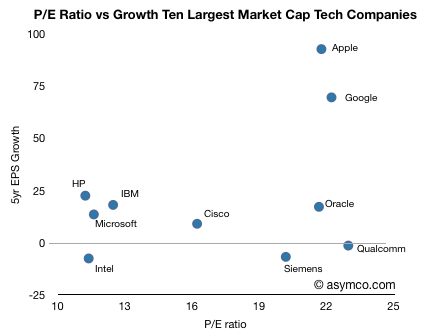
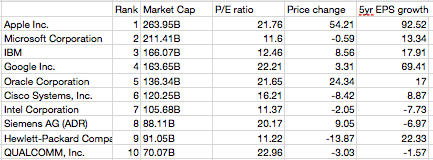
In this article I take the same analysis to the top ten largest technology companies (by market cap, see table at bottom).
In this comparison, Apple no longer has the largest P/E ratio. Qualcomm, Google and Oracle are all at similar levels of valuation relative to earnings, however Apple's growth outstrips them, only with Google in the same quadrant.
Note the "Wintel" cohort consisting of Intel, Microsoft, HP clustered around the Low growth, low valuation quadrant in the lower left (coincidentally co-located with IBM). Oracle, Qualcomm and Siemens show high valuation with low long-term EPS growth. Cisco is somewhat on the fence.
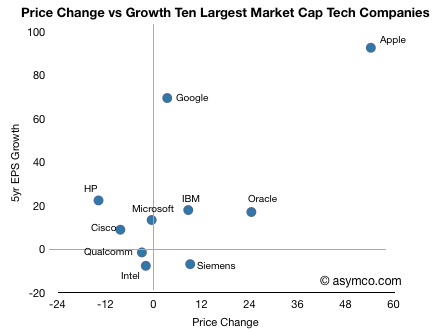
When comparing how the market has rewarded growth through share price appreciation, the correlation to growth is much better. Google seems under-rewarded.
Apple's stock price has been rising. Although it's still priced at a P/E of 22 while facing near term EPS growth well above 50%, this is belated recognition of the potential of the iPad and the iPhone.
However, as it has grown, Apple's valuation is now not only higher than any other technology company but it's nearly the most valuable company on the planet. There is a theory that ultra-large market caps are reserved for companies that are past their prime. Sometimes this is attributed to the law of large numbers: that conclusion that big numbers cannot grow much bigger because compounding growth is exponential whereas markets are limited and become quickly saturated.
The trouble with this theory is that "large" is relative; large is often simply "the largest". Large market caps are not what they used to be. During past booms, large caps touched a trillion dollars. Today, the largest market cap is merely $314 billion.
So I don't put much faith in large number "laws". The real question of under/over-valuation rests on whether the company is growing or not. Valuation is simply the net present value of future free cash flows (plus assets). So the most important determinant of current value is growth in cash flows.
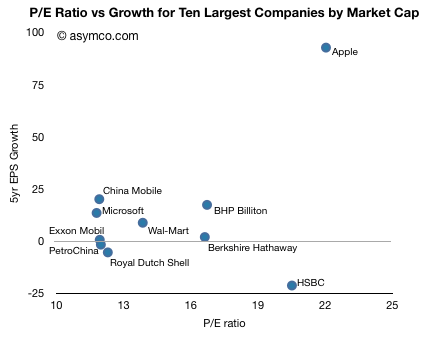
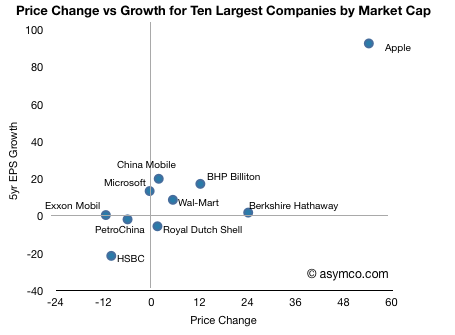
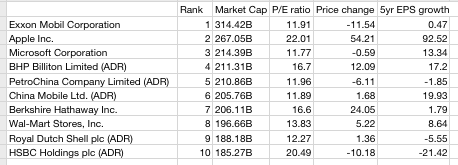
It's fairly easy to assess this: compare P/E which is a proxy for valuation with EPS growth. The following chart does this for the top ten largest market caps traded on US exchanges (as listed by finance.google.com).
One should see some correlation between the two variables, but given the 5 year time frame, many of these companies showed large volatility. There are outliers like HSBC which has a rapidly rising value even though it was badly affected by the credit crunch.
The other outlier is Apple. The company showed 93 percent EPS growth over a five year period and has a P/E of 22. The company with the next highest total value (Exxon Mobil) had 0.5% growth with a P/E of 12. The company with the next lowest total value (Microsoft) had 13.3 percent growth with a P/E of 12.
For an ultra-large cap, Apple's growth is unprecedented and extraordinary. It's in fact off the scale. The average growth of the other 9 top caps is 3.6 percent!
Apple's growth is a factor of 25x higher. The P/E is only 1.6x higher.
The result has been a much higher appreciation in the stock price as shown in the following chart.
So it's clear that Apple, in this peer group, is far from ordinary.
The chances are extremely small. There are three scenarios where this would make sense:
If there was a specific market that required it. It would also need to be a large opportunity since developing a new platform and diluting existing platforms need significant upside. The only such market is the US, but there are better options available, namely Android that have better potential and Android is treated as a toxin by Nokia (see metaphor).
Specific users. Windows Mobile used to be justified for business users, but Windows Phone is not targeting business users.
The last option would be "strategic" i.e. Microsoft paying Nokia for using the OS (directly or indirectly through marketing co-spend or other symbolisms). I don't think Nokia is desperate enough yet.
Although it's never prudent to say never, I just don't see any logic for Nokia to add to its bill of materials for phones while facing price pressure.
HP took the control panel display from a printer and made it detachable. The idea, according to the manager in charge, is that this will encourage printing. Printing is a good business for HP because they manage to charge $7500 per gallon of ink.
I suppose there can be some sense to this idea but I don't use inkjet printers so I can't judge how popular this can be. But the headline suggestion that the new display panel cum web pad is "an iPad Spoiler" calls into question the author's motivations. Maybe he did it for a bet.
But the real gem is a quote from Richard Shim an IDC PC analyst who says "Everyone is trying to figure out the opportunity for these types of devices, how to position media tablets in a way that they don't cannibalize other businesses."
That's an interesting comment coming from a PC analyst. It says that the vendors in the industry are already feeling that the iPad is substituting regular PCs (and hence the need for a response that is sustaining not disruptive).
This acknowledgment means it's only a matter of time before the idea of iPad as PC morphs from crazy talk to conventional wisdom.
Despite being based on Android, a Facebook phone would be competition for Google as much as it is for Apple. Google benefits from ad revenue tied to their search and other services which would likely be supplanted by Facebook services on a Facebook-based phone.