Some say that advertising keeps the internet lights on. Advertising is a great business model for services but it has limits. There are only so many ad budgets to go around. What will fuel an internet that outgrows all the ad money in the world?
This is the topic that Ben Bajarin and I will explore in our next event: SUBSCRIBE: The Future of Online Services.
We will explore:
How will the online services business models evolve?
How will VR affect entertainment and communications?
How will AI affect shopping?
How will blockchain affect economics?
How will hardware affect software and services and vice versa?
How will users, usage, and capital connect?
Join us to learn more about the internet economy by studying the economics of the internet.
In my quoting of the "Cook Doctrine" I cited the primary criteria for Apple to enter a new market:
We believe that we need to own and control the primary technologies behind the products we make, and participate only in markets where we can make a significant contribution.
These criteria, often repeated, were certainly in force when Apple chose to enter the watch market. Apple has sought and achieved a significant market share and did so while owning and controlling the primary technologies behind the product.
I now turn to the significant contribution criterion to study the possibility of Apple's entry into the car industry. ((Control of the primary technologies behind the product is a topic for another post.))
The significance test shifts the speculation from whether Apple would build a car, to how many cars is could build. Making a few cars is easy (see first commandment of The Entrant's Guide to the Automotive Industry). Making lots of cars is hard and hence significance in the automotive market (as in watches and phones) means achieving some degree of adoption, a higher degree of usage and a very high degree of profitability.
So what does being significant in the car business mean? Does it mean becoming the next Tesla? The next BYD or the next VW? How quickly?
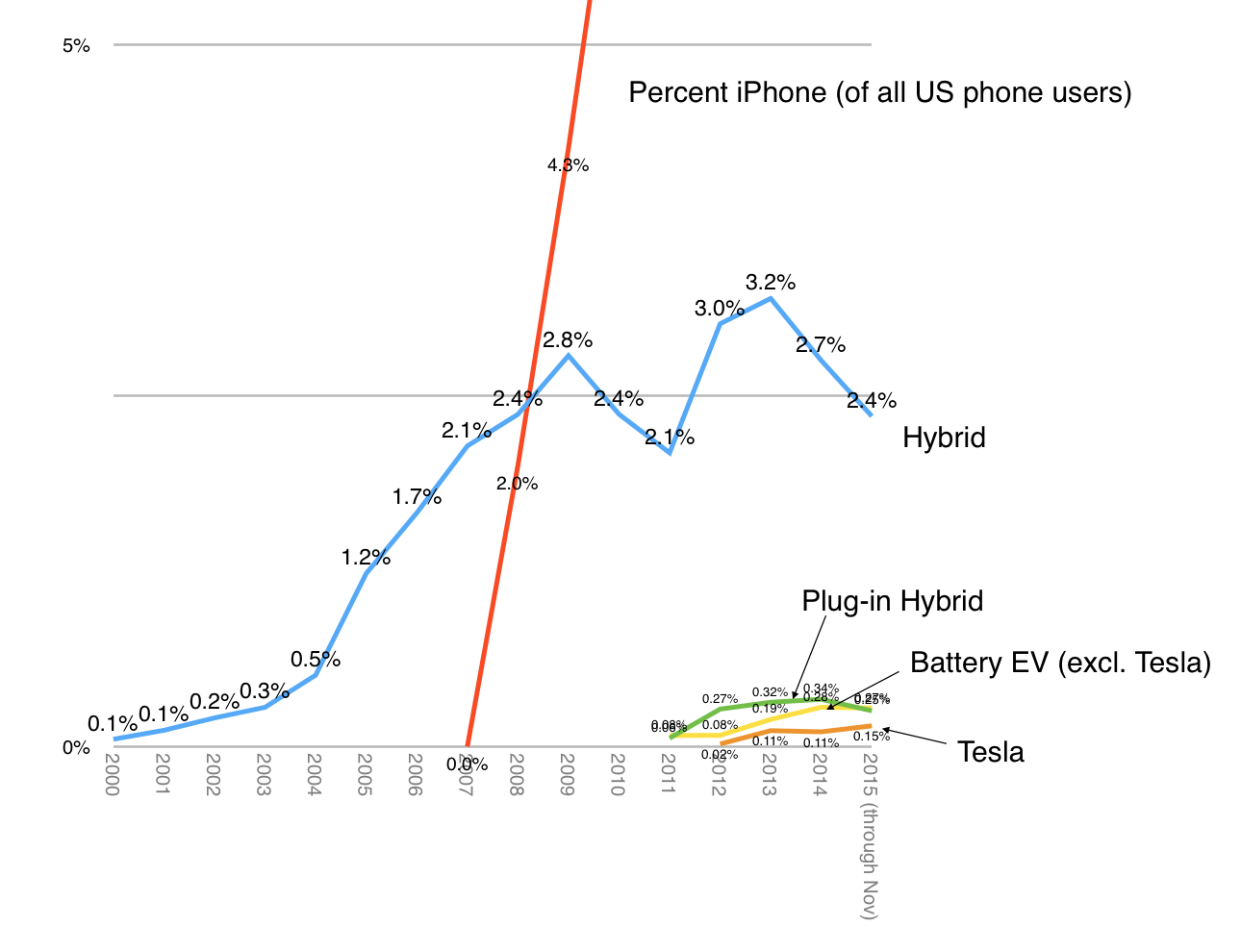
Fortunately, we have something to compare an Apple entry to. Apple has made a "significant" market entry in phones and others have made entries in cars. If we contrast the rate of growth of Tesla, EVs, and Hybrids ((Of which Toyota has 70% to 80% share)) to the rate of growth of iPhones in their respective US markets, we obtain a test of significance:
The graph shows the percent of sales for the alternative car technologies (and Tesla) vs. the percent of US phone users using iPhones (comScore). Here are the conclusions:
Hybrid cars were introduced in 2000 in the US. They managed to gain 2.5% within 8 years but have not increased to a consistently higher level since.
Electric vehicle sales re-sarted in earnest in 2008 and have gained 0.4% share in eight years. They are still growing, partly helped by significant federal and state subsidies.
Between sales start in 2008 and 2015 Tesla achieved 0.15% share.
The iPhone ushered in a new paradigm within the phone market ((Incidentally the number of phones in use and cars in use in the US is comparable.)) in mid 2007. In the time since, Apple achieved the equivalent of about 35% share of unit sales. ((Significantly more in terms of sales value and over 90% of profitability.))
Between 2002 and 2015 the share of smartphones as a percent of all phones reached over 80%.
To summarize, the range for entrant technology share capture spans between 0.4% (EVs between 2008 and 2015), 2.4% (Hybrids between 2000 and 2015) and 80% (Smartphones between 2002 and 2015).
Within a similar time frame, the range for entrant company share capture spanned between 0.15% (Tesla as percent of US car market) and 35% (Apple iPhone percent of US phone market). ((Toyota's capture of 2% of the market with hybrids may or may not be considered entrant--I chose to consider Toyota an incumbent which took share from others with the Prius))
The differences thus span two orders of magnitude (>100x). Put another way, if Tesla's car entry was equivalent to Apple's iPhone entry they would have delivered about 5.5 million cars rather than the 50.5k they delivered in 2015.
This wide gap in the impact of entry in the two markets has much to do with how modular are the systems being engaged by the entrants. An electric automotive system requires new infrastructure, new user behavior, and, in the case of Tesla, new distribution network and new post-sales support network. Offsetting this partially is a government subsidy.
In contrast, the smartphone communications and computing system leveraged existing infrastructure ((And vice-versa)), consistent behavior, at least initially, and the same distribution and support network. In addition, smartphones benefited from significant hardware and software and services ecosystems which encouraged third parties to add value to the system.
The difference in collaborative development and conforming user experiences (i.e. modularity) between the two innovations allowed the speed of change to be two orders of magnitude faster. The result is what I would consider significance for the iPhone vs. insignificance for electric vehicles to date.
Which leads us back to the question of why Apple would enter this market. If the absence of modularity prevents rapid change, that implies Apple cannot achieve any significant impact from entry.
We could ask the question differently: If they do enter, they could achieve significance only if they change the degree of modularity in the system. Think of it as allowing infrastructure leverage, consistent user behavior, wide distribution, wide support network, ecosystems, and component architecture; allowing rapid scale production and lower costs, etc.
Therefore the only way that Apple could justify entry would be if they "rationalized" the system into a sufficiently modular alternative. Only if we assume that change is possible could we then target share above the 0.1% insignificant change that has been demonstrated. They might even perhaps aim at 1% impact within a few years of entry. 1% was the iPhone target within the first full year of sales.
If system-wide change could be brought about and made uniquely (through some form of sustainable asymmetry) then the foreseeable share possibility quickly reaches the 10% range.
The last time that happened was when Toyota changed the way cars are designed and built. ((VW before Toyota and GM before VW. Incidentally Toyota, GM and VW are now nearly tied as the top three automakers globally.))
Apple Watch was released April 10th 2015. Eight months later we are holding the first Apple Watch conference. To kick off the discussion, here are my favorite myths about this new product:
The Apple Watch scored 100 out of 100 on the "IBM Watson Trend Scale". According to various surveys, about 100 million people will shop this Thanksgiving weekend in the US. One wonders how many purchases by 100 million shoppers merit a score of 100/100.
My estimate for units shipped has been 20 million in the first calendar year. About 7 million have been sold in the first two quarters. That leaves 13 for the holiday and Q1 (which includes Chinese New Year.) I still like these odds.
To learn more about the reasoning around this estimate and hear additional supporting data, join us at Glance conference.
Since writing Peak Cable six months ago, surveys, research and analysis have contributed to the themes of unbundling the TV package. The data under scrutiny is, as usual, the data that can be gathered. Unfortunately the data that can't be gathered is where the insight into what is happening may lie. For instance, what matters for an entertainer is not how much you're watched but how much you're loved. Measuring love is done poorly with data on payment for subscriptions.
A better proxy might be time. Liam Boluk makes the point in his post that "focusing on cord cutting or even cord shaving largely misses the point." Don't follow the dollars, he says, follow the time or engagement. "Relevance" is what matters.
His data shows how linear TV has fallen by roughly 30% among the young (12-34) in the last five years. The trouble for the TV bundle (and advertisers) is that this is the most culturally influential group. They are also the group which will grow into the highest income group over the next decade. And this group does not love TV.
We have to remember that it was the youth who drove early radio, TV and consumer electronics markets. Those young are now the old which still cling to the old media, served by companies that grew old with them. They are the "high-end" customers with which Nielsen itself has grown. They have the most money to spend and they are the targets for the ads ((no longer the Pepsi generation, they are the Depend and Viagra and pharmaceuticals generation))
Paying $150/month to watch incontinence and erectile dysfunction ads—at a time not of your choosing—is preposterous for the young. They may like the programs but not the way they are packaged, delivered or interrupted. They are not smarter than their parents. They, like their parents, took to new technology more quickly. What makes the technology new is also what lets its makers separate the content from its delivery. These new technologies allow "modularizing" or unbundling that which was was integrated/bundled and thus allow their developers to focus on the customer's real jobs-to-be-done.
Unsurprisingly, incumbents have responded by throttling access to original programming–an asset over which they still exert influence as distributors. Netflix and Amazon are taking the path of responding with their own blockbuster productions. Although Silicon Valley has more capital to deploy than Hollywood this battle of attrition is by no means one that incumbents will win, and generally, it's not going to be pretty.
Tweaking the nose of the incumbent might not be the way to establish asymmetry. The better tactic may be to help the system survive but offer a "short-term alternative". This is how iTunes took on and won Music. When Napster and file sharing created a clear and present danger to the industry, Apple's approach of a controlled alternative allowed the industry to finally move to a digital download model.
An observer in 2004 would have said that Apple was bowing to the industry and providing it sustenance against "disruptive" free music. However, as behavior shifted to an overwhelming preference of iTunes downloads over physical media, the music labels found themselves in an untenable negotiating position. They had to concede on DRM, pricing and bundling itself. The music disruption occurred with a tacit acceptance and collaboration by the incumbents.
Is history repeating? Looking at the situation around TV today, the strategies of the challengers can be summarized in a similar way:
The content low-end: Now, YouTube, Twitch. Then, Napster, Gnutella
The distribution low-end: Now, Netflix, Amazon. Then, incumbent music download sites.
The nominally sustaining: Now Apple TV. Then, iTunes
Apple cannot play an "ignore me" strategy because as much as investors think the company is irrelevant, everything it does is closely watched by anybody who might be even remotely touched by it. Especially in entertainment.
In addition, due to brand considerations, the company cannot ship low-quality or no-quality product, including material that sits on its platform.
They have to do something different. Something more complicated and something that takes much longer.
What Apple best contributes asymmetrically is a new experience. The experience allows new behavior, new usage models and hence new loyalties to emerge. The loyalties create affinity which shifts the "love interest" for the user. The new Apple TV attempts to provide such a contribution. Not only in terms of the experience but also for becoming, finally, a platform for developers, who will try to make the product itself better in collaboration with Apple. Thus the "new experience" flips when bits which are streamed cohabit a device with bits which expect a consumer response.
This "appification" becomes an interesting experiment in behavior alteration. Will "couch time" change from pure passivity to partial interaction?
To the orthodox adherents to the religion of linearity of immersive programming this sounds impossible. But why else should a product deserve to exist? A great product is one which changes the user and for Apple TV to become great it needs to engage us to do something different than we do today. It needs to make us feel we are better for using it.
Is this new Apple TV up to it? We'll have to wait and see. But then again, if not this one, then another one will. TV will not remain unchanged forever.
Mathew Desmond of Capgemini joins us to discuss Cars Online 2015: “The Selfie Experience, The evolving power of the connected customer.”
We begin with the finding that “One-half of customers are interested in buying a car from a tech company like Apple or Google. This is true even of customers who are satisfied with their current brand and dealer experience. It is particularly true of young customers (65%) and those in growth markets (China: 74%; India: 81%).”
Backing up a bit, we discuss the automaker’s dilemma, that is the legacy manufacturing, distribution and support infrastructure and contrast that with the “clean slate” approach an entrant might enjoy.
The concept and inherent conflicts of a “Master Customer Record” fuels a deeper dive into “Continuity”, the buyer’s desire for a seamless experience.
Finally, we reflect on the perils that may lie ahead as the auto ecosystem attempts to improve the retail experience.
What makes a product great? I struggle with this question because being great is not just being better than good. Greatness is to goodness as wisdom is to smarts. Just like getting smarter and smarter may never make you wise, getting better and better does not mean ever becoming great.
Greatness is transcendental. It's hard to pin down. It inspires debate. It divides as much as it unites. It creates emotions as much as thoughts. It builds legends. It engages and persists. It lives in memory and penetrates culture. It implants itself in our consciousness persistently, to linger and dwell in our minds while we are bombarded with stimuli.
We use words such as "iconic" or "epic" to capture this permanent "mental tattoo" that we get from greatness. As important as this notion is, we struggle to define it. We don't even have a proper word for it. Perhaps it is what art tries to be, or what drives us to achieve beyond surviving. As vague a notion as it may be, it is one of the most important notions I can think of. Greatness is the cause, perhaps, of our ascent.
In the absence of any measurement of greatness, how do we spot it? It may just be down to "knowing when we see it". But not everybody does. ((Language is another indicator. When people attach brands to entire categories we get an indication of ubiquity and permanence. As much as the brand owner fears it, the genericization of a trademark is very probably an indication of greatness in consumer products. Aspirin, iPod, xerox, jell-o and app are examples where brands became words.))
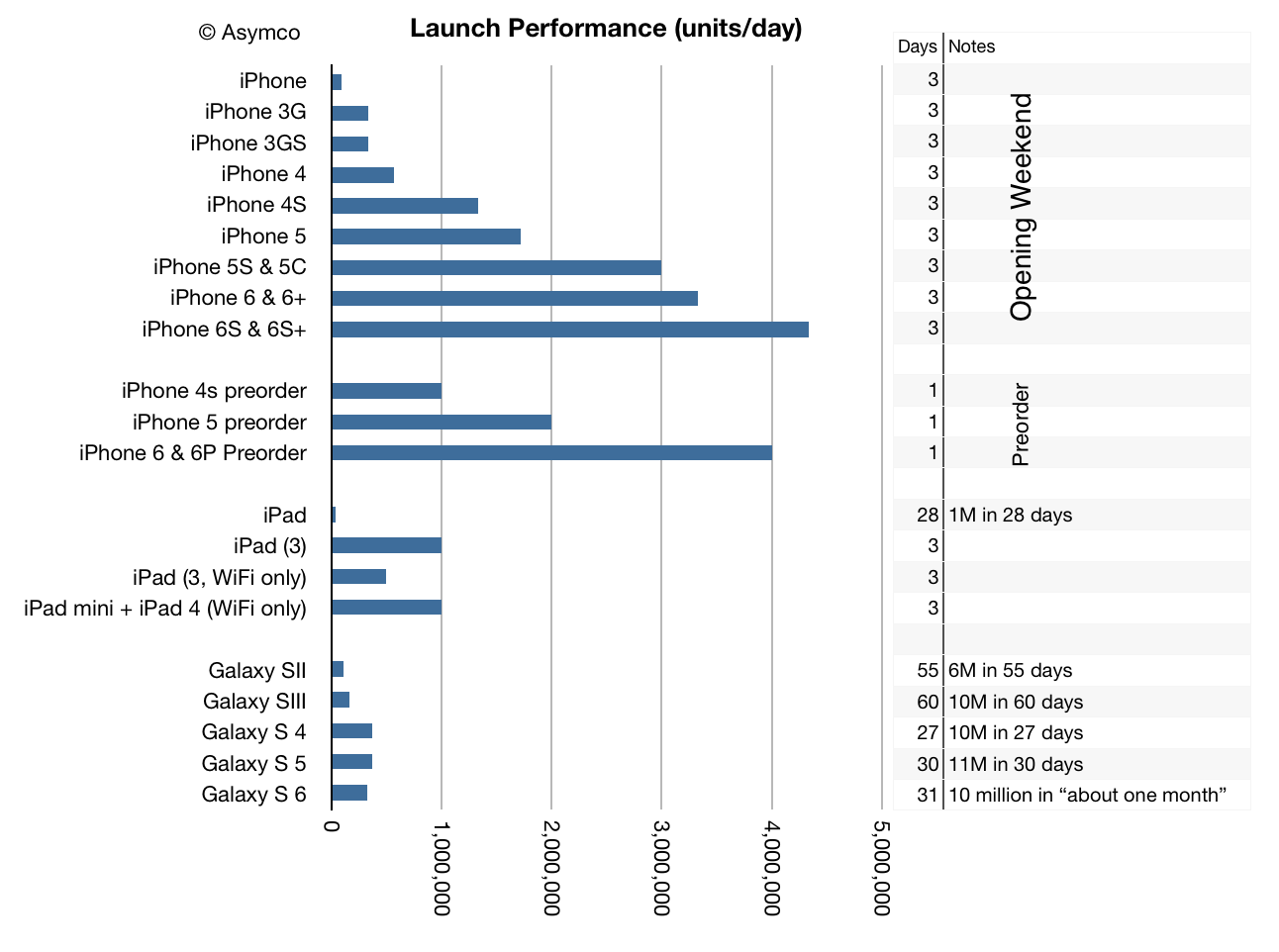
This quandary came to mind when looking at the performance of the latest iPhone, the 6S. Observing it closely, we lose sight of it. We see only minute changes between versions; marginal changes which can't be weighed. And yet these changes have a more important attribute: they are absorbable. A change that is ignored is not only valueless, it may actually destroy perception of value. It creates clutter and confusion. A change that is absorbable is valuable. It is meaningful.
Looking at new features like 3D Touch, Live Photos, and better cameras, one can observe how easily acceptable and desirable they are to those who first see them. As were Siri, FaceTime, Touch ID and iCloud, making something meaningfully better is a sign of sustaining innovation which does not over-serve.
Paradoxically, the improvements are not usually things that users ask for. Surveys always show that consumers want "better battery life" or a "bigger screen" but delivering something else entirely which nevertheless leads to mass adoption shows an uncanny insight into what really matters. Indeed, those who deliver only what customers ask for end up marginalized and bereft of profit.
To see improvements which lead to ever-increasing success in the marketplace year after year proves that this is not a transient event. This is no flash-in-the pan. This is not a stroke of genius. This is a process, a factory, a machine. The consistency and relentlessness of success is evidence of something at work that is more permanent.
The definition of greatness for products then becomes easier to frame:
Improvements which are not asked for but which change behavior suggest that the product is valued because it changes the buyer. I believe this is what causes us to pause and appreciate them. We feel we have been improved by the thing we bought though we did not ask to be made better by it. Collectively, multiplying by millions, the improvement we feel compels us to anoint the product as great.
Apple is a company that builds greatness because they built a process to make their customers better. They do it without permission and they do it without offense. But when the buyer perceives the change they feel in debt to the object. Getting payments on that debt of gratitude is how Apple is rewarded.