Asymco

Asymmetric Intelligence

Research

  1. Postmodern computing

    Research · 99 comments

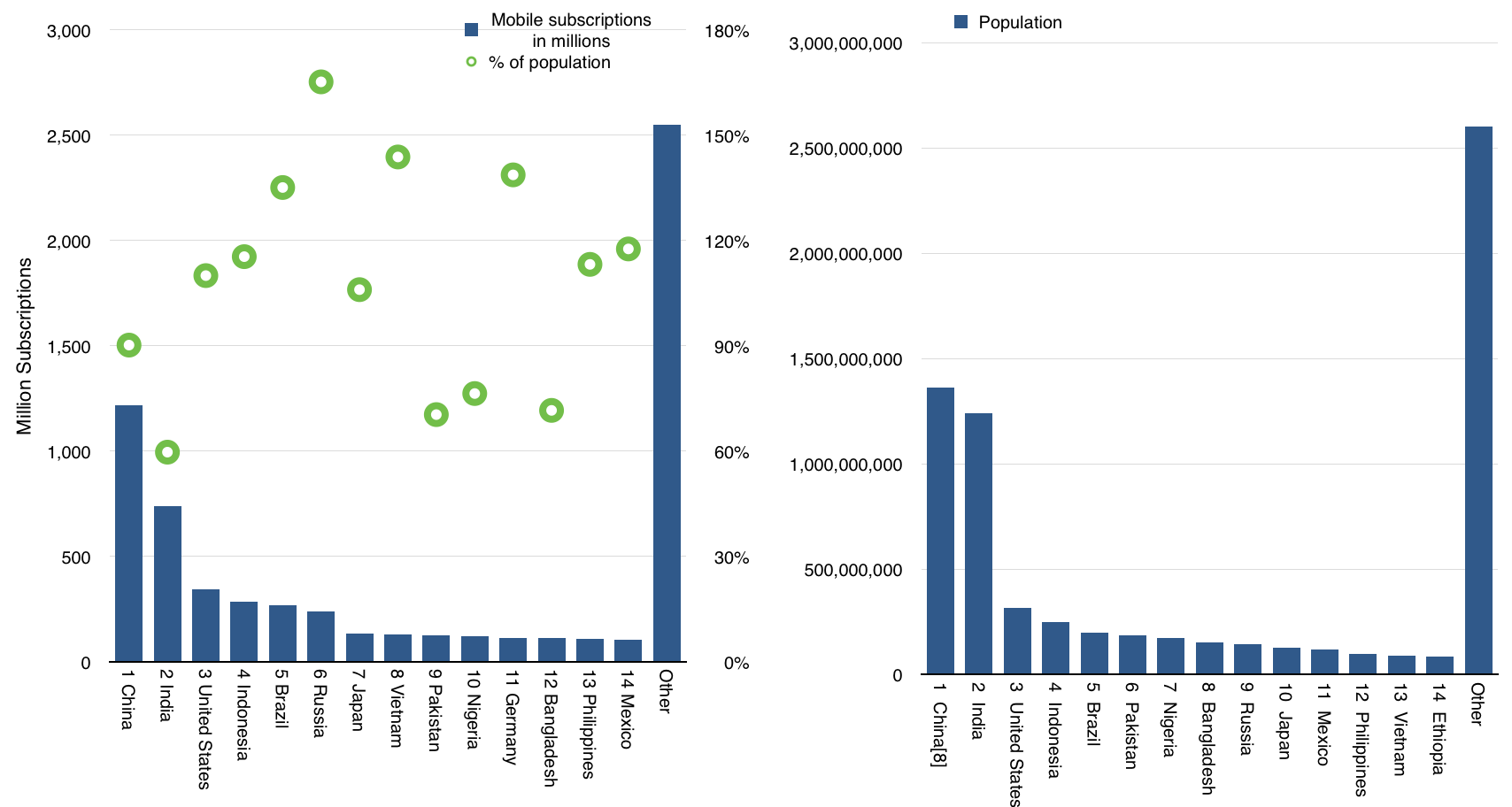
    There are 7.1 billion people on Earth. Coincidentally there are also 7 billion mobile connections.  Those connections are held by 3.45 billion unique mobile subscribers. ((GSMA)) Unsurprisingly, the largest national mobile markets (by number of subscriptions) correspond closely to the most populous nations.
    Screen Shot 2014-04-07 at 7.21.46 AM

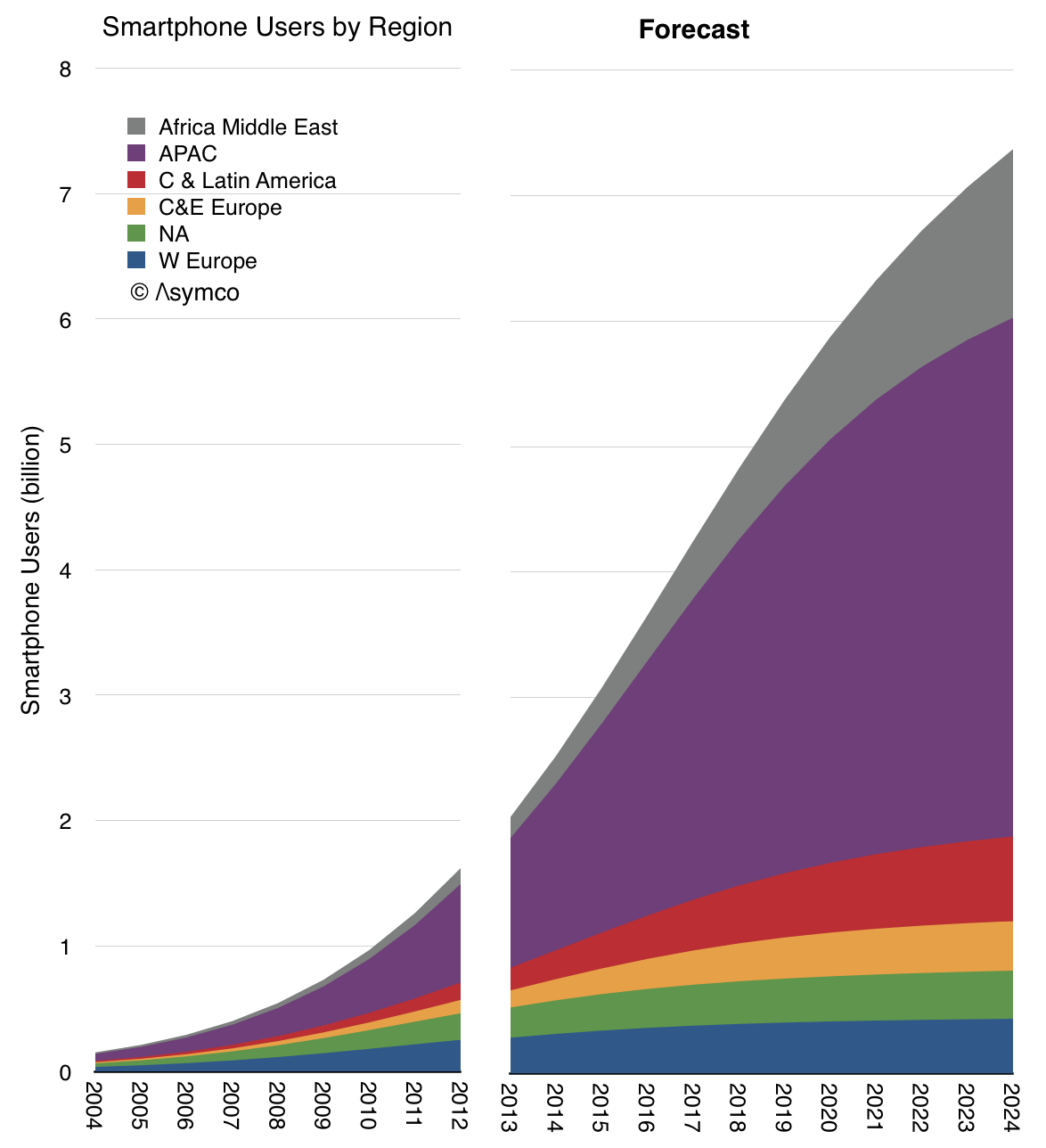
    Considering smartphones, last year 1 billion smartphones were sold and the number of smartphones in use is about 2 billion ((There are also about 2 billion 3G/4G connections world-wide))

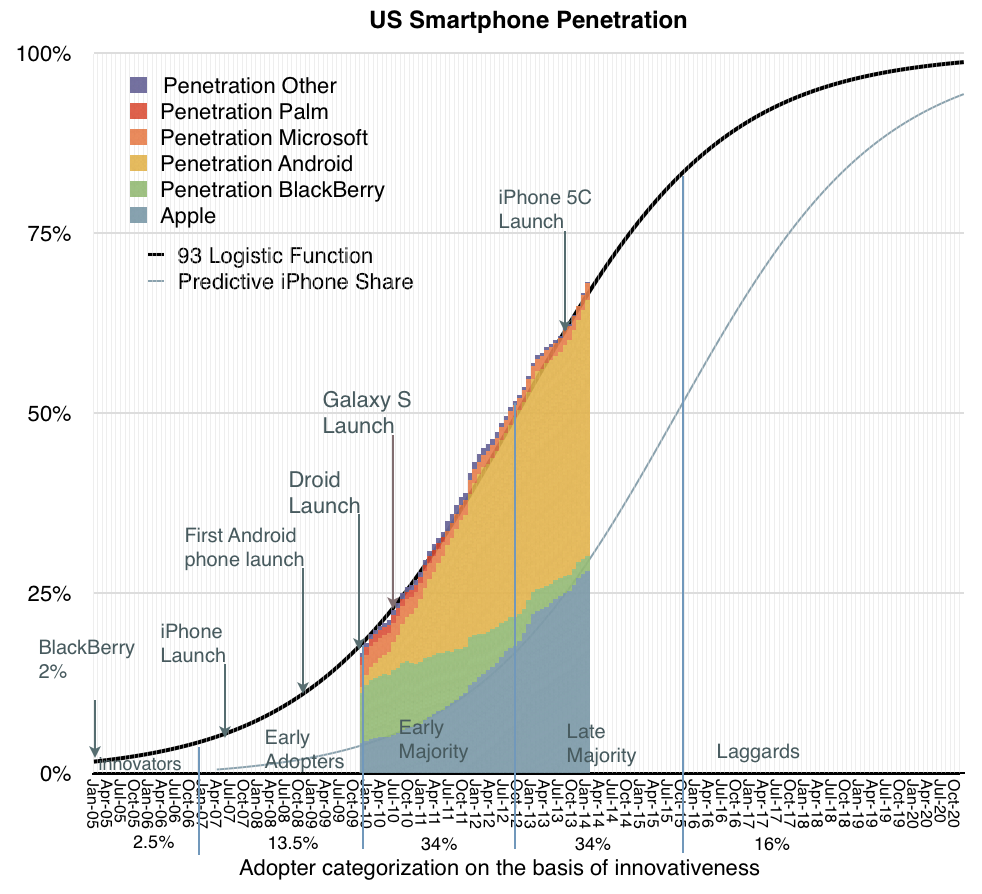
    Given the rapid adoption of smartphones, it's also safe to assume that smartphone penetration will follow population distribution. In the US, where comScore data is published monthly, penetration is following a predictable logistic curve.
    Screen Shot 2014-04-07 at 7.55.13 AM


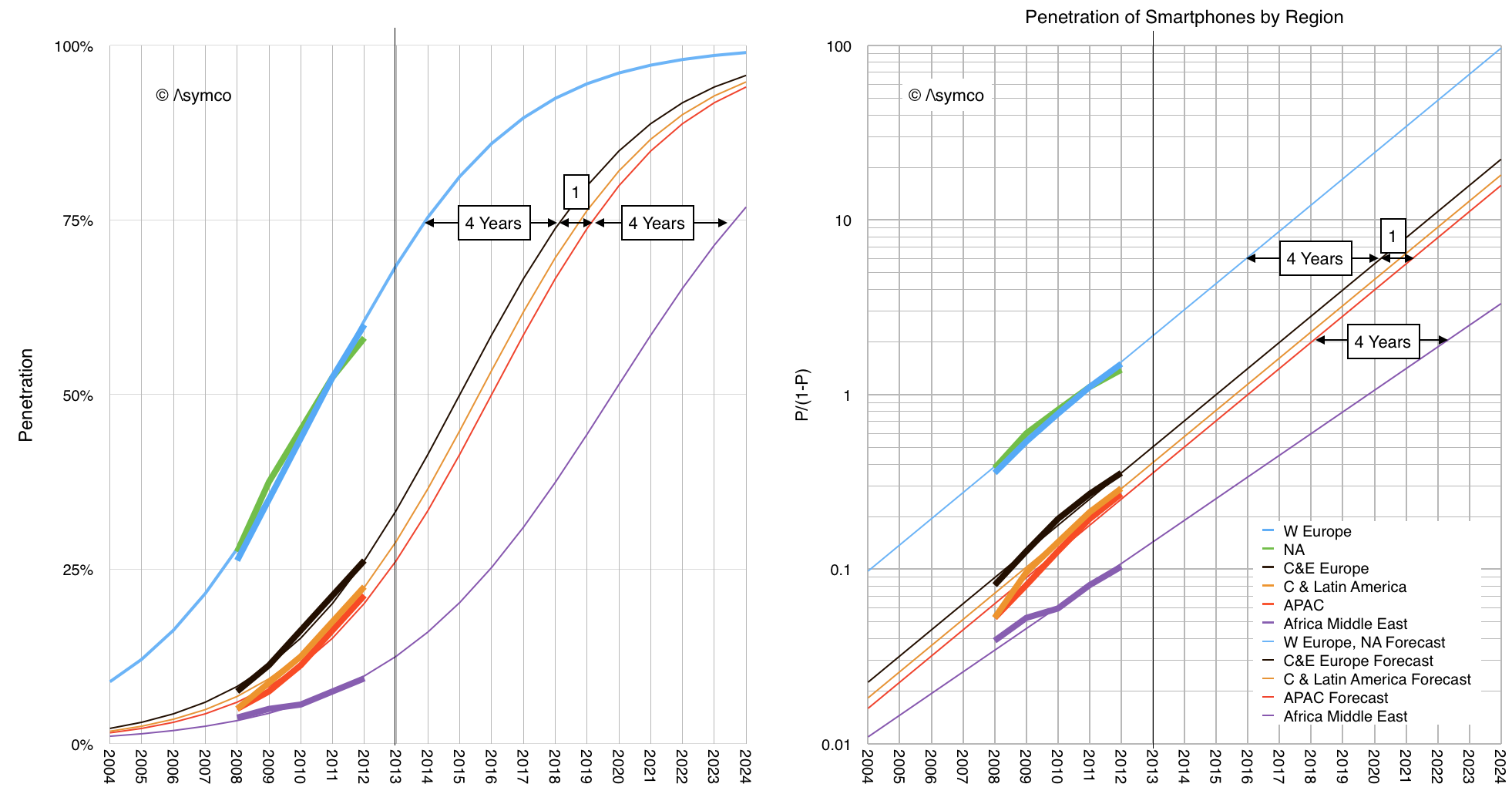
    Assuming similar patterns world-wide we can forecast regional smartphone penetration.
    Screen Shot 2014-04-07 at 7.56.49 AM

    This yields the following forecast for smartphone usage world-wide.
     alt=

    Three years ago the notion of smartphones becoming as ubiquitous as toothbrushes seemed far fetched but it's now gradually being accepted. The smartphone is well on its way to becoming the most successful technology in history.

    So what?

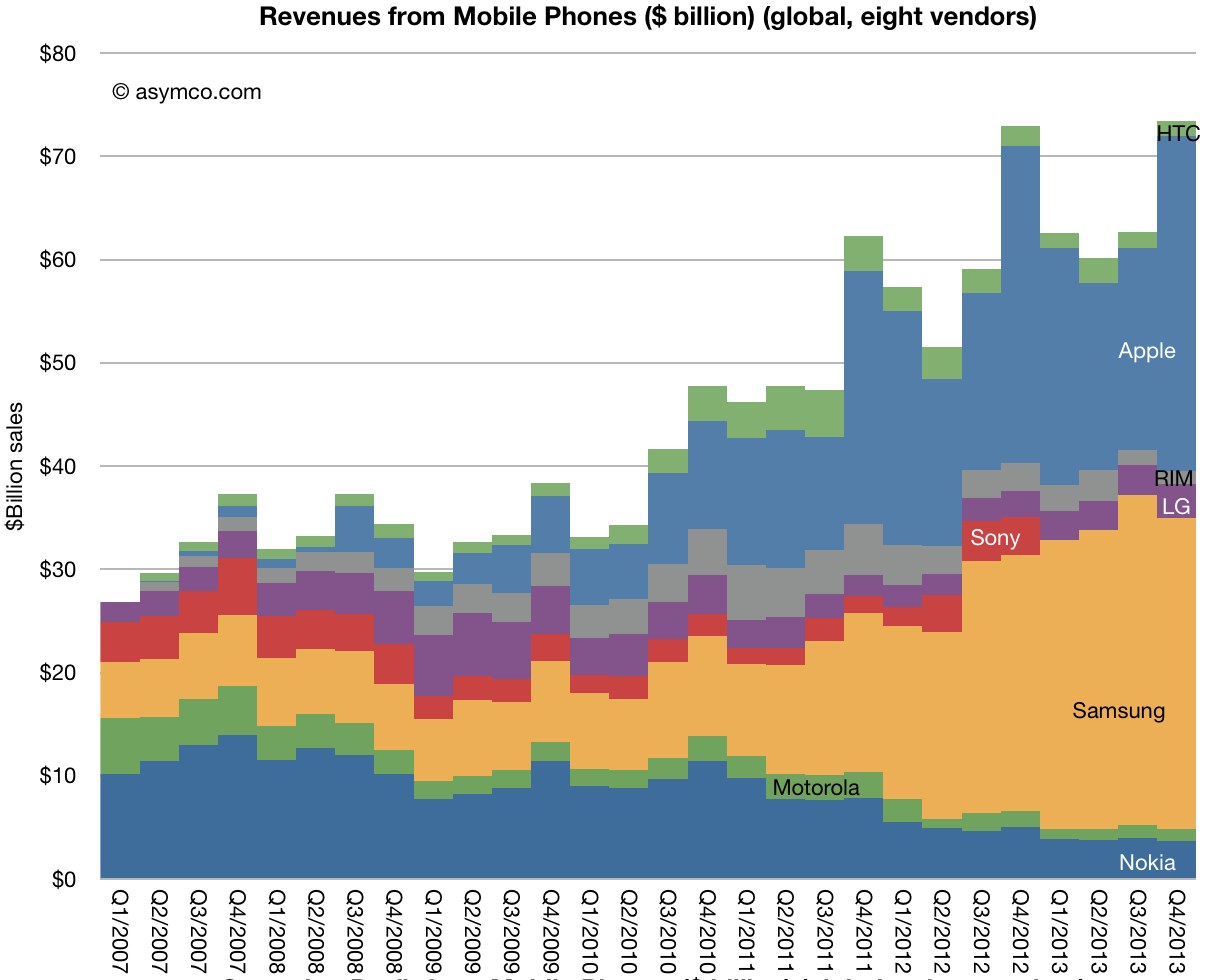
    What will the smartphone do for us? Does smartphone ubiquity change anything? Besides increasing ARPU slightly in a $1.2 trillion industry? Besides doubling the size of the device business? ((
    Screen Shot 2014-04-07 at 8.17.26 AM

    ))

    Besides creating a $20 billion app industry? How do we assess the impact of having a connected computer in one's pocket? In everyone's pockets? With us all day. Every day.

    Before we answer, we have to realize that the smartphone has been disruptive. Which means it has that special quality of not affecting the world in a predictable way. Its growth has been largely unforeseen and has affected the fortunes of the incumbents. As big and ubiquitous as it has become, the companies which were most intimately aware of it, its very own creators, were cursed by it.

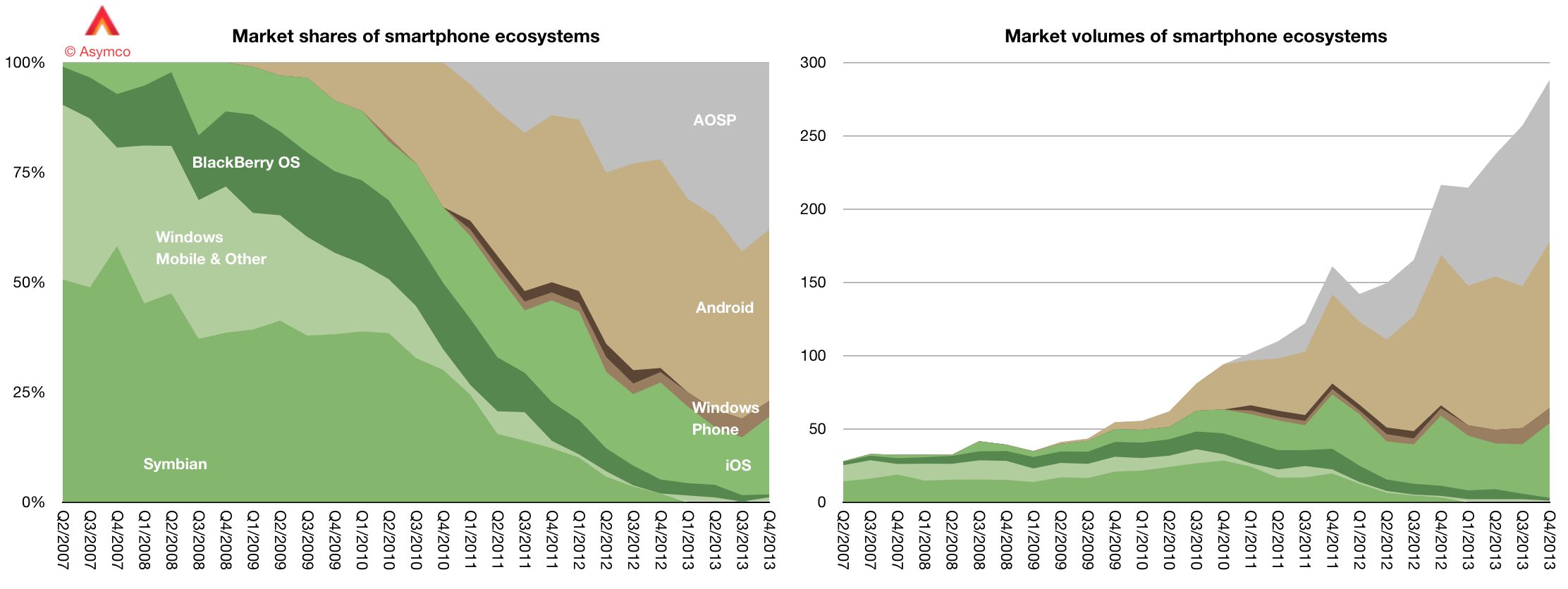
    The evidence is in this graph:
    Screen Shot 2014-04-07 at 8.32.19 AM


    As the market exploded, the incumbent platforms all but disappeared. The innovators fell into the trap of treating the complex new product as a niche whose appeal was for selected "segments" described by the coarse data they were able to gather. Ubiquity itself was asymmetric to the basis of competition they established.

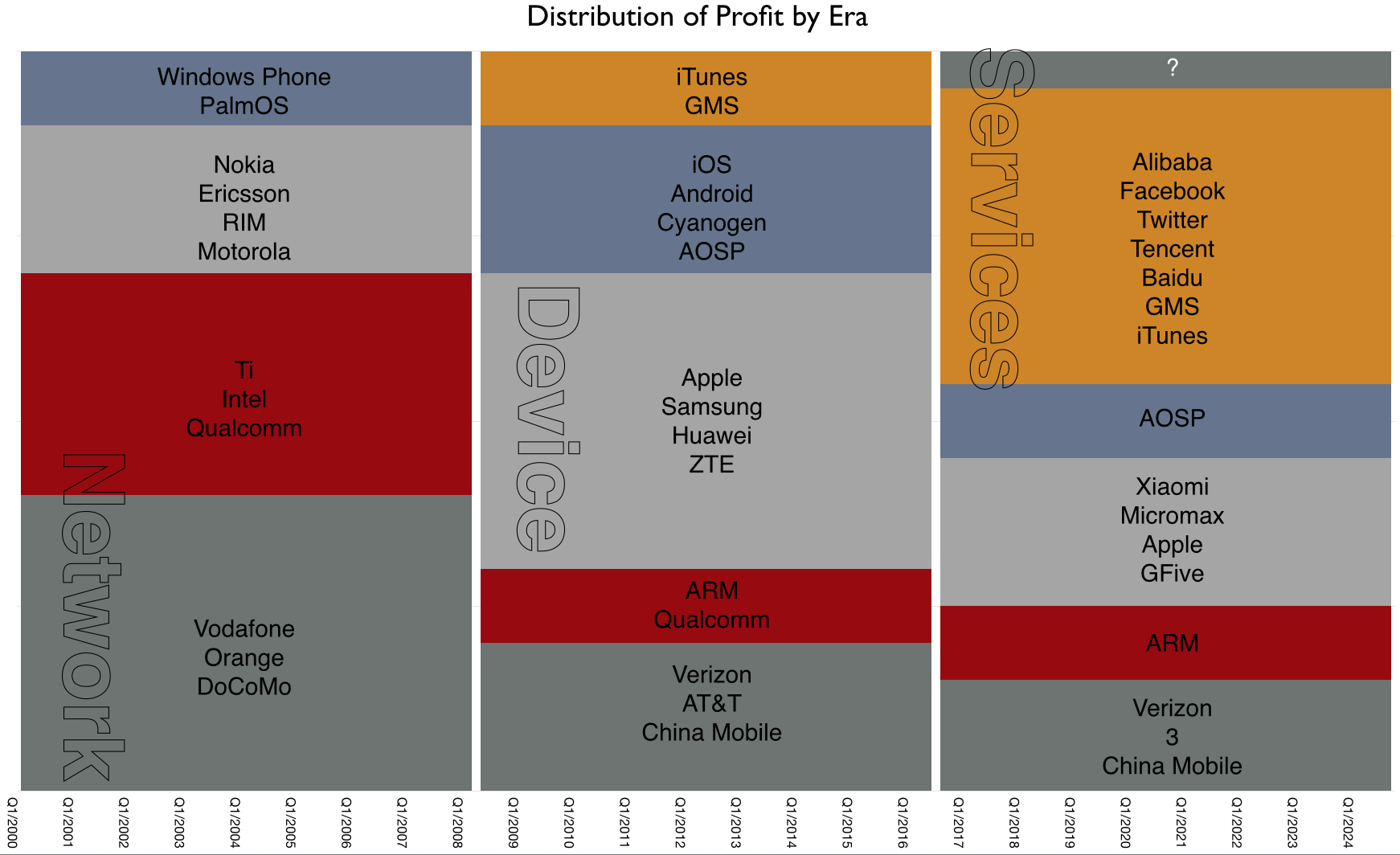
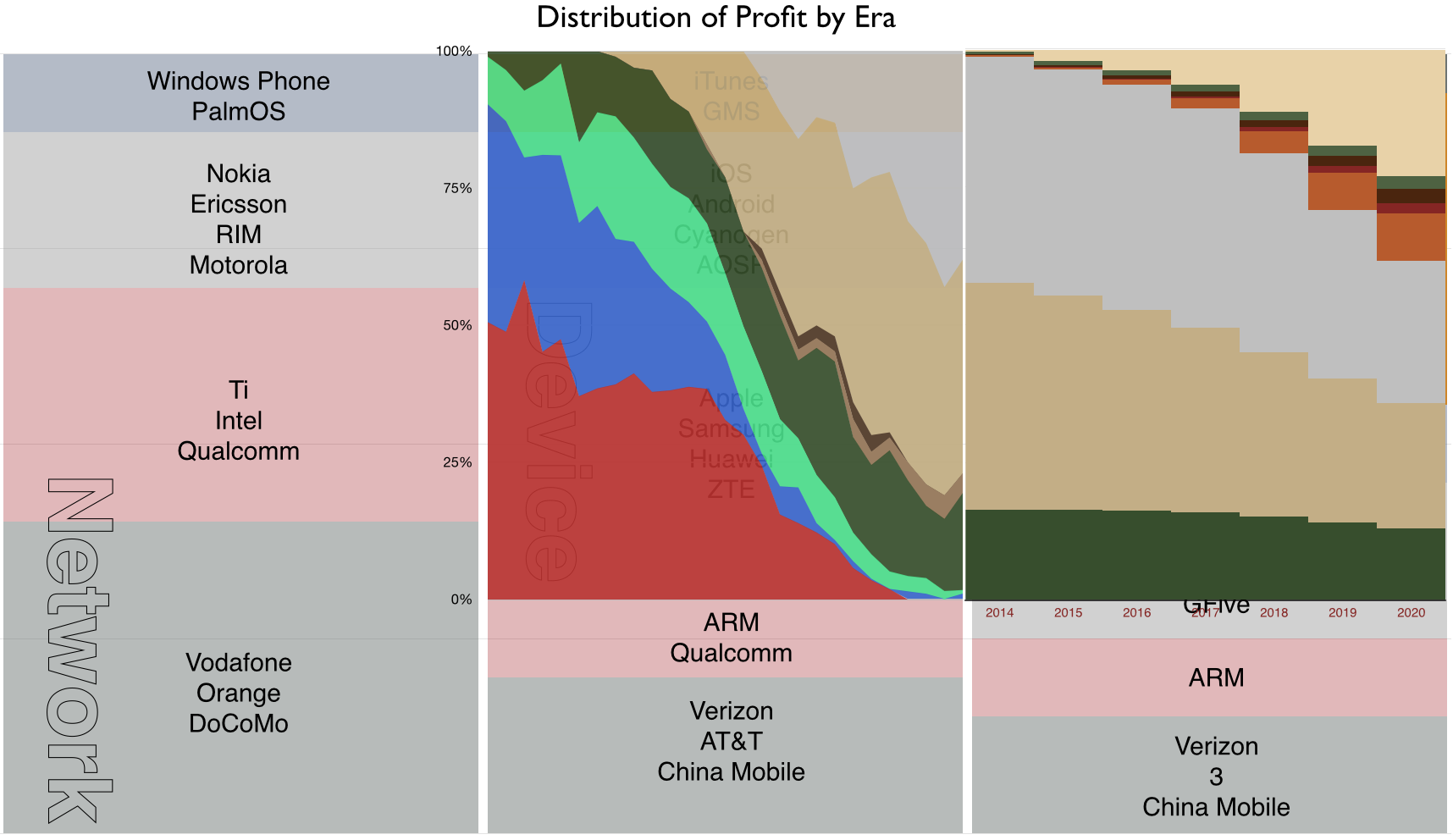
    Today we can note how even the usurpers iOS and GMS Android are being swamped by the more modular alternative AOSP. Indeed, if we squint a bit we might notice that the OS/platform churn we see is part of a trend where the value is migrating up the stack from Components and Networks, through Devices and Operating Systems and on to Services and Experiences.

    I call these the three mobile eras: (Firm names used are representative of a cohort and are not a complete list of participants.)
    Screen Shot 2014-04-07 at 8.51.45 AM

    The thesis is based on Value Chain Evolution Theory which states that disruptions cause profits to evaporate from commoditized segments and condense in adjacent spaces, usually toward more modular, more convenient or lower cost innovations.

    Note that the eras have specific time spans. If the pattern holds then we can overlay the time frame of smartphone penetration on these eras and even plot ecosystem entrants.
    Screen Shot 2014-04-07 at 9.06.55 AM


    Disruption suggests that we are likely to see yet more shifting of fortunes. It means enabling new ecosystems to take advantage of the modularization of platforms. But how can it happen given the entrenched nature of the incumbent duopolists?

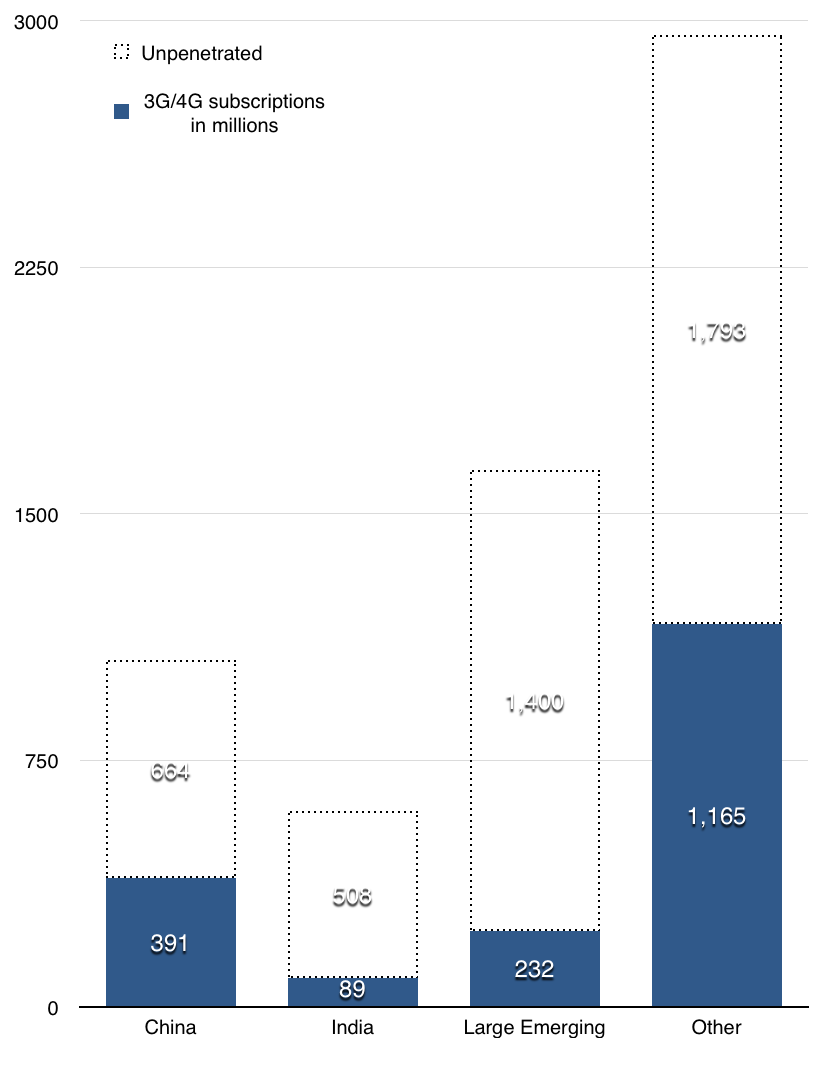
    The clue lies in the first graph in this post: It suggests a geographic segmentation. The largest markets are large enough to sustain independent ecosystems. Note that China and Russia have already established alternative local service ecosystems. We may dismiss the possibility of localized Google and Facebooks in emerging markets but China and India are universes in and of themselves. But there are another 10 markets of more than 100 million users. That's another billion users among them.
    Screen Shot 2014-04-07 at 9.31.22 AM

    But it's not just the availability of a vast pool of new users. The rapidity of growth of services like WhatsApp and SnapChat and Tencent shows that barriers to entry are low. We see increasing indigenous innovation in payments, logistics and business models in the newest markets. We see no shortage of talent and capital to start these businesses. We see increasing language and culture clustering in social media. We see political resistance to hegemony.

    Focusing on the established, highly penetrated markets as an indicator of opportunity would be a mistake. Those markets foretell the rate of adoption but not the evolution of the value chain. Apple and Google will continue to anchor in those markets but there is no reason for the remaining two thirds of the world to follow. Indeed, there are incentives not to.

    Incentives exist to localize services. Indeed, service businesses have always been local businesses. There are few global service brands. This has been true in retail, transportation, banking, hospitality, media and communications. Why should we believe that ecosystems can overcome the advantages of localization? Services are local because they are delivered by individuals and have high "touch" with the user.

    Fundamentally, ecosystems are social systems and social systems have cultural and political dependencies. ((Post-modernism is a typological world view which  sees truth as socially constructed and a rejection of 'totality')) Technology does not homogenize unless it is centrally controlled. The control of mobile computing has already been abdicated by its creators.
  2. Invaluable

    Research · 323 comments

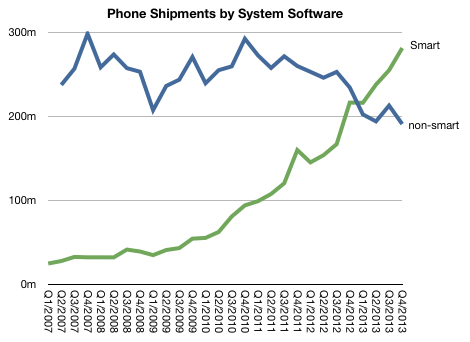
    The smartphone market continues to grow. 2013 saw total shipment of around one billion units (up from 683 million in 2012). In contrast, non-smartphone shipments continue to decline, with shipments around 800 million (down from 987 million in 2012).

    This pattern is shown below:

    Screen Shot 2014-03-18 at 3-18-12.45.12 PM

    Note that prior to 2012 the non-smart market seemed to be holding steady in spite of the growth in smartphones. The notion that smartphones would become universal was widely dismissed. I certainly heard many objections to my 2010 hypothesis that not only would smartphones become ubiquitous but that it would become increasingly difficult to find anything else to buy. (This in spite of the clearly evident demand for "low-end" non-smart devices.) ((The analogy I used was that of the black-and-white TV market as color TV became increasingly popular. There probably was a market for monochrome screens for a long time after they were discontinued but that is beside the point: the old technology becomes increasingly scarce because of economies of scale))

    I also suggested that the notion of distinguishing phones with the"smart" tag would become irrelevant and that we would just call these devices "phones". That is coming to pass, at least among the conversations I'm privy to.

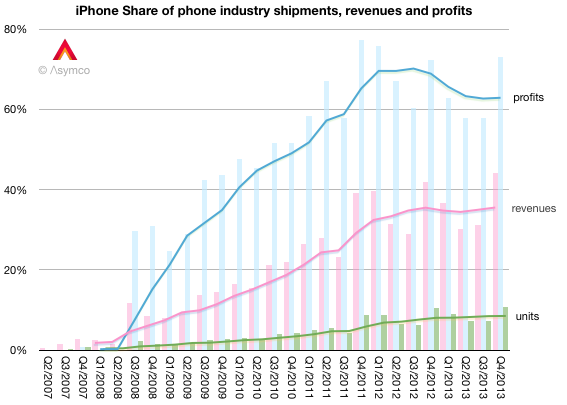
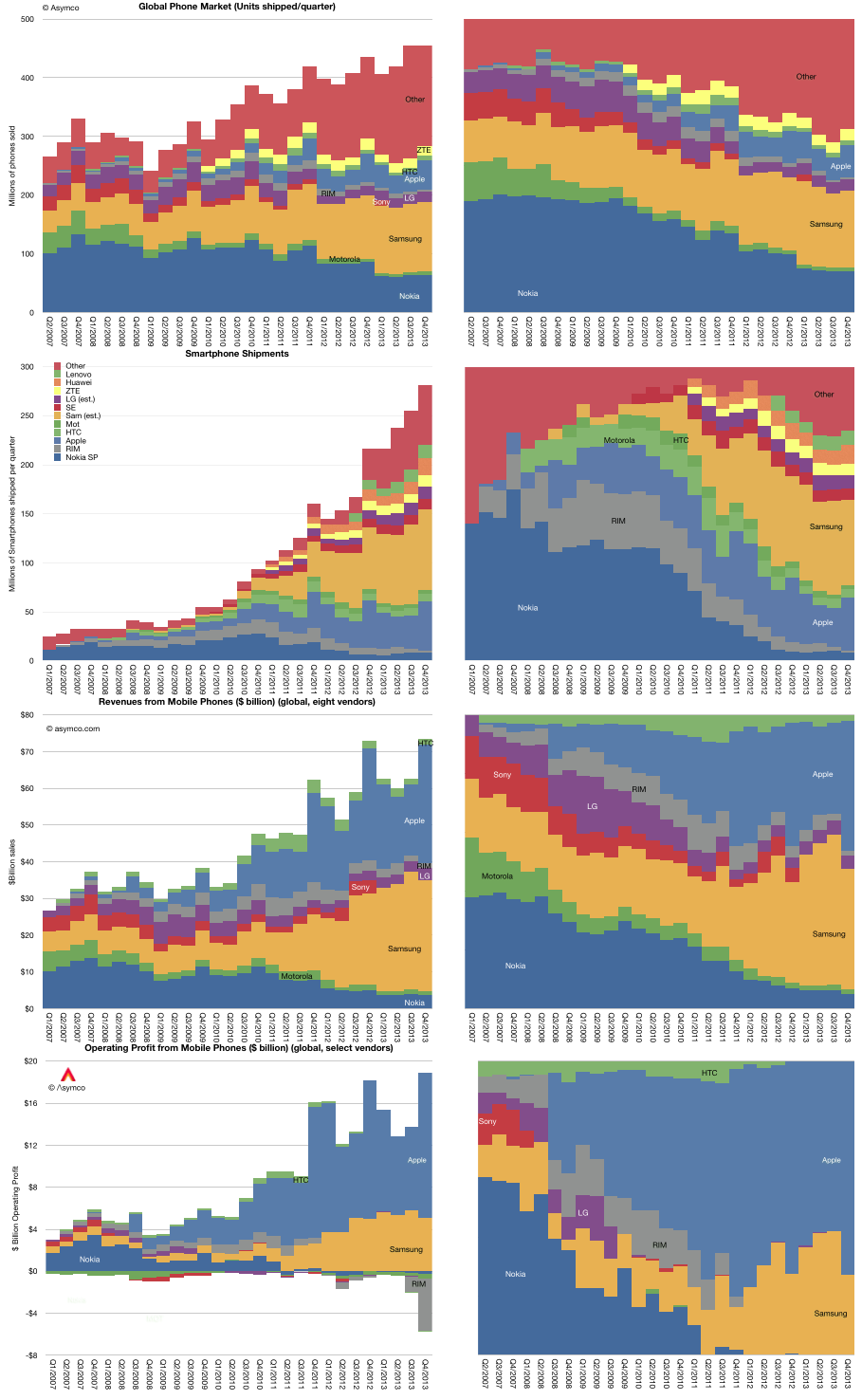
    So if the conversation is about "phones" and the expectation that all phones will be smart, what can we observe about the market? The following graphs provide the picture of shipments, revenues and operating margin in absolute and relative measure for the most significant brands.

    Screen Shot 2014-03-18 at 3-18-12.42.08 PM

    This arrangement shows the disruptive effect of adding "smart" to phones. In only a few short years ((Six shown but the effect was pronounced already in four)) profits have dramatically shifted in the industry.

    Indeed, since the launch of the iPhone ((Which I consider to be the start of the current epoch of the industry)) the net profits earned by the collection of protagonists shown was $215 billion (($234 billion of positive operating earnings, offset by $19 billion of operating losses)).  60% has been earned by Apple, a newcomer to the market. That figure is also consistent on an ongoing basis, having reached 60% as early as 2011 and remained in a band around that figure since.

    Screen Shot 2014-03-18 at 3-18-1.23.52 PM

    The fact that this happened without corresponding dominance in units shipped shows evidence of something startling: Consistent value creation.

    To earn profit is hard, to do so in an outsized way is very hard and to do so with consistency shows a defensibility of market access that is rarest of all. The only cases where this typical is in a monopoly or protected market situation (aka cronyism.) Apple's lack of market monopoly coupled with a (near-) monopoly in profits can only be explained by disproportionate value creation.

    The mystery then is how is it possible to build a monopoly in value creation.

  3. The Thin Red Line | Asymcar

    Research · 2 comments

    We explore the strategic and tactical considerations behind BMW’s i sub-brand. Why did BMW attach a new BMW sub-brand to a new powertrain rather than using another brand, like Mini? The answer helps explain how innovations and brands inter-relate and how incumbents can attempt to absorb what is potentially non-sustaining.

    We consider the pros and cons of innovation within an operating business – “intrepreneurship” – compared with creating an autonomous enterprise for the “new new thing”. I contrast BMW i with General Motors’ failed Saturn experiment.

    We consider the burden that regulation, girth, cycle times, legacy practices, financialization and strategy taxes place on incumbents.

    Finally, we look at what it takes to cross over the line which separates the device-based nice-to-have infotainment options from the must-have driver and ownership assistants that will inevitably find home in these devices.

    via The Thin Red Line | Asymcar.

  4. On Google's Future. Part 1

    Research · 85 comments

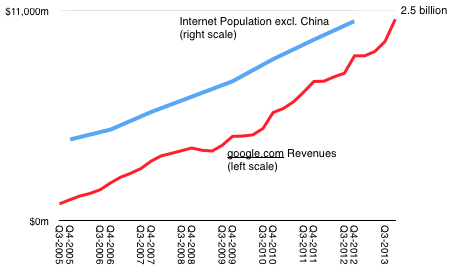
    From 2005 through 2012 Google site revenues ((Google revenues are reported as "Google.com", "Network", "Motorola" and "Other". For this analysis I am including only the Google.com revenues)) have risen at a rate consistent  with the growth in global Internet population excluding China ((Internet population is calculated as a combination of penetration as reported by the ITU and population data from the World Bank)). The Internet population and Google.com revenues for the period 2005-2012 are shown in the following graph.

    Screen Shot 2014-03-13 at 3-13-3.17.02 PM

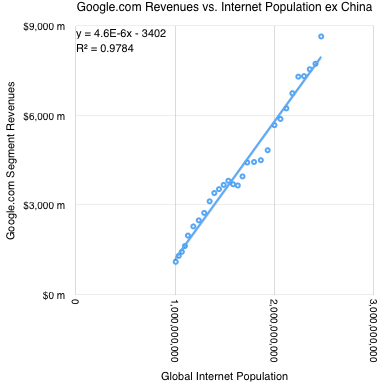
    The correlation is shown in the following graph:

    Screen Shot 2014-03-13 at 3-13-3.17.21 PM

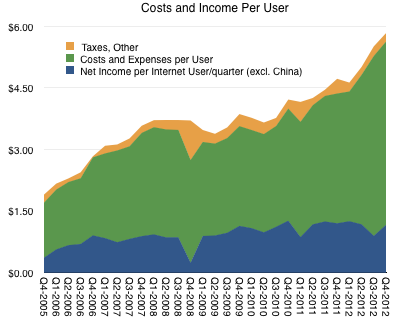
    Taking into account costs and expenses, on a per-user basis profitability per user (assuming all non-Chinese internet users are Google users) is shown below:

    Screen Shot 2014-03-13 at 3-13-3.17.14 PM

    The simple conclusion is that Google earns approximately $1.2 per user per quarter (net income is the blue area above). This figure is relatively constant with a slight increase (~20%) over 3 years.

    If the company does not alter its business model then the future potential of the business could be measured as a function of Internet (ex. China) population growth.

    How hard can that be?

    The next post will answer this question.

  5. Tim Cook's outburst [Updated]

    Research · 64 comments

    When trying to assess the success of an ecosystem, the primary measure is the size of the user base or the "audience" for the product. Companies like FaceBook and WhatsApp and Twitter are measured first and foremost on this metric. Companies like Google, Amazon, Apple and Microsoft are less so. When revenues are firmly attached to products the focus shifts to "follow-the-money" rather than "follow-the-users" metrics.

    That's as it should be, but for the sake of understanding the competition between ecosystems, they should be compared on some similar basis. If the basis of competition in this day and age is ecosystems ((As Microsoft, Apple and Google seem to agree it is.)) how does one evaluate Facebook's vs. Microsoft's? Or, more poignantly, how does one compare WhatsApp's valuation with that of iMessage?

    It's common to value a company which aggregates audiences at a multiple of that audience size. The implication being that each member of the audience returns a certain cash flow to the aggregator and the discounting of those flows is the net present value. Which is why, for example, a newspaper is valued in terms of its subscribers. As is a TV network and as might be a social network. Using this metric, a WhatsApp (i.e. free messaging) user is worth $40 and the average social media user may be worth around $100. ((The degree to which a user is actually worth the sum of all the subscriptions she may have made is a good topic for discussion.))

    The implication is that users/subscribers/audience members are loyal and will stay with the programming for some time. There is also a second implication that businesses which are not measured by audience size don't have this loyal and recurring revenue base. The absence of an "audience" implies transience and impermanence and results in deep discounting of long-term viability.

    Which is why ecosystems are the desired business construct for technology companies. They allow a more consistent and repeatable transaction model and offer predictability which is sorely lacking in the rapidly changing technology industries. It allows a company to define itself on its customers rather than on its products.

    However, old habits die hard. Regardless of the exhortations of product companies, the notion of being valued on audiences is reserved for the service-oriented. Hence the outburst from Tim Cook at the latest shareholder's meeting. Reports have him saying that:

    Apple now has 800 million iOS users and has handled over 16 trillion push notifications, with 40 billion new ones occurring every day. Apple also delivers several billion iMessages and FaceTime requests every day. Cook added that iPad now accounts for 78 percent of all tablets used throughout the enterprise.

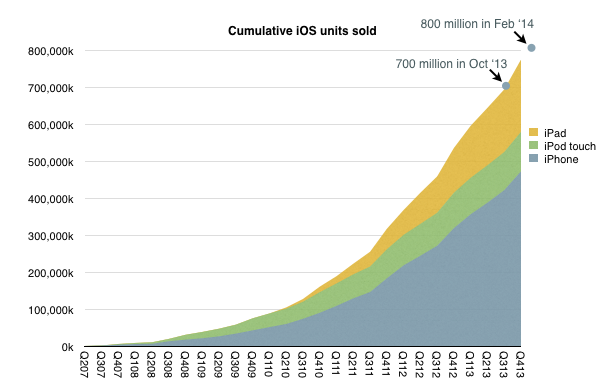
    Trillions of push notifications aside, the claim that Apple has 800 million iOS users seemed way out of line. This is because the number of iOS devices (excluding Apple TVs) shipped through to the end 2013 was exactly 774,336,000. One could easily imagine another 25 million or so since, giving us about 800 million sold, but I cannot see the number in use being the same, and even if they were, the number of users being the same.

    The following graph shows the claim in context of shipments.

    Screen Shot 2014-03-05 at 9.54.13 AM

    Note that last September Cook made the claim that 700 million iOS devices "by October", which did indeed happen. The 800 million claim in February is certainly believable in that context.

    Determining the total number in use is a very speculative exercise. Assuming useful life of 9 quarters for iPhone and iPod and negligible iPad retirements yields about 560 million iOS devices in use. Obviously this can be very inaccurate as also there can be multiple users per device but the claim of 800 million users seems very hard to reconcile.

    Perhaps he was mis-quoted or he mis-spoke but the real question isn't the exact number but rather the implication that Apple should be seen for its users rather than its quarterly shipments.

    Them's fighting words, Mr. Cook.

    [Update: Thanks for Philip Elmer-DeWitt's investigation, Apple clarified that Tim Cook referred to 800 million as the number of iOS devices sold not users of iOS. He was mis-quoted.]

  6. Review: Jony Ive by Leander Kahney

    Research · 67 comments

    I don't usually find books about Apple to be quotable. There are certainly some interesting anecdotes and observations but few appeal to the analytical mind. The popular books on Apple have tended to cover what close watchers have already known and are thus compilations with few revelations.

    This is not the case with Leander Kahney's book on Ive. It certainly is the best compilation of detail on product development at Apple during the Ive years (and some time before.) Moreover, it's also filled with choice insights into the process of development.

    This process-orientation is what makes the book stand out for me personally. There are character observations and personality intrigues but they are not the main focus or ambition for the author. Rather, as befits the book's subject, there is an exposition of detail about how things are done. It's not a complete exposition--nor can there be one--but it goes much further than any other Apple book I've read.

    For this reason I found myself tweeting quite a few quotes from the book. Here are some examples:

    “In a company that was born to innovate, the risk is in not innovating. The real risk is to think it is safe to play it safe” - Jony Ive

    “Scott Forstall wasn’t allowed to visit. His badge wouldn’t even open the door.”

    “Design is the fundamental soul of a man-made creation” - Steve Jobs

    "I have seen buildings where, as far as the eye can see, you see machines carving, mostly aluminum."

    "I do not want any of my guys thinking about cost. They should not care…that is not their job”

    “The thing is, you could transplant me and this design group to another place and we wouldn’t work at all”

    "they wanted to give PowerPoint presentations, but Jobs quickly banned them. He saw PowerPoints as rambling and nonsensical”

    The book mostly follows Ive's career with chapters covering most significant episodes chronologically, however there are deep dives into the "how" rather than just the "what" happened. There is a hint of causality rather than correlation between events and outcomes.

    For example, there is a mesmerizing description of the actual Apple design studio even though it has never been depicted in any public photo or video or diagram. There is a great attention paid to manufacturing and materials, as indeed there should be if talking about Apple design (but not necessarily if talking solely about design in general.)

    There is an amazing revelation of the existence of the "ANPP" or the Apple New Product Process. This process directs the "extreme detail [for] every stage of product development". The presence of such a "giant checklist" implies a degree of process and rigor which is in contrast to the "heroic" effort that prevails in popular folklore about how Apple develops its products.

    If there was one disappointment it was that I felt as if half was missing. The half which would tie the dots together and see where they might lead. But that's perhaps too much to ask for what is essentially a biography of an individual rather than a company.

    Nevertheless, for anyone interested in the process of innovation that remains Apple's principal asset, Jony Ive, The Genius Behind Apple's Greatest Products by Leander Kahney is available at the iBookstore.

  7. The billion dollar hobby

    Research · 67 comments

    During the latest shareholder meeting Tim Cook revealed that Apple TV sales were above $1 billion in the last fiscal year (ending September 2013). The company later clarified that this figure includes device and content sales.

    This poses a problem. In previous statements the company cited device (unit) shipments rather than value. The statements made to date suggested that cumulative volume of 3rd (current) generation Apple TV totaled 6 million units as of January 1, 2013.

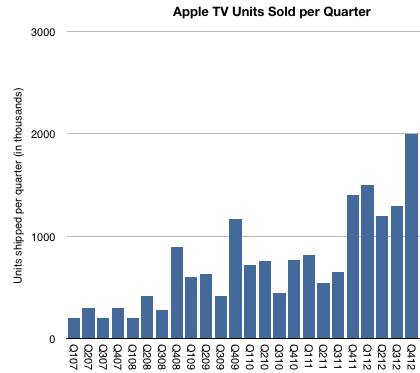
    The following graph includes an estimate of quarterly Apple TV sales based on comments made to date.

    Screen Shot 2014-03-02 at 3-2-8.07.43 PM

    As there were no additional comments during 2013, the "Billion Dollar" quote is all we have to go with for the year.  The problem with trying to separate content from hardware is complicated by several factors:

    • How are we to attach content revenues to Apple TV? For example, what if I purchase a series of shows on iTunes or an iPhone and decide to watch them on my Apple TV. Do these purchases count as being "attached" to Apple TV? Do we attach the full transaction value or do we attach the portion that Apple keeps (as in agency accounting)?
    • How does Apple account for channel placement on Apple TV? Do the channels prominently displayed on its user interface pay for this access (even though the user needs a cable subscription?) Is this the primary source of content revenue that is attributed to Apple TV?
    • What about Netflix, YouTube, etc? What is the content licensing deal with these channels? Does the Netflix channel actually cause an Apple TV purchase or does the Apple TV purchase cause a Netflix subscription?
    • Without content, one might think that the $1 billion revenue would yield total device shipments approximately 10 million units in fiscal 2013 (assuming $99 unit pricing). This is not quite right however as Apple's revenue per unit is unlikely to be $99 unless all units are sold through its own retail stores (including online). Sales through other retailers probably allow for some retailer margin so Apple's average selling price will be below $99.
    • Another question is the fiscal year accounting. We have visibility into the fourth quarter of 2012 (about 2 million units est.) so we only need to fill in the first three calendar quarters of 2013 to understand the Billion Dollar volume.
    • Finally, I already estimate separately the overall video market (in my iTunes Business Report) which, based on historic data and other inferences suggests a total video content gross (contributing to iTunes revenues) of $1.8 billion for the fiscal quarter. If a significant portion (50%) of this were allocated to Apple TV it would imply that the hardware business contracted sharply in 2013. Put another way, if I add what we know about C2012 units (6 million and an ASP of $89) to what I estimate video content revenues to have been in 2012 ($1.6 billion) I get a $2.1 billion business. This would be a "two billion dollar" business in 2012.

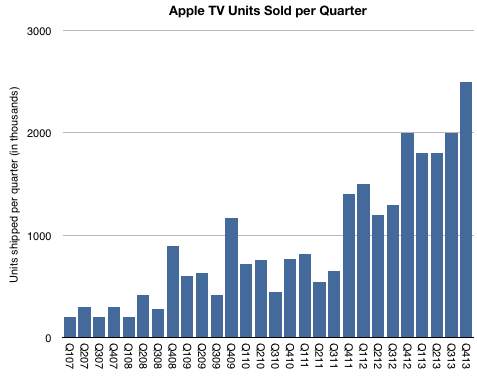
    All this makes the Billion Dollar Hobby a puzzle. The way I can make it square with existing assumptions is by saying that "Apple TV content revenues" are mostly, if not entirely, distribution revenues from channel placement rather than iTunes purchases. ((This revenue will end up in licensing/other revenues in iTunes/Software/Services segment and separate from Apple TV (which is a part of Accessories).))  As a result, my best guess now is that there were about 7.6 million Apple TVs sold in fiscal 2013, with a bit over 8 million for calendar 2013.

    If I'm right, the complete history of the shipments would be similar to this graph:

    Screen Shot 2014-03-02 at 3-2-9.08.24 PM

    By Apple standards this is indeed a modest story. The total units sold would add up to more than 25 million units with healthy growth. But it would not be in the same magnitude as other iOS devices which have so far sold 800 million units.

    More important than this picture however, or the Billion Dollar Business threshold, would be a better understanding of how Apple sees Apple TV as a business. We already knew that it was a low value hardware business. I even suggested that it's "Apple's equivalent of the Kindle": Hardware sold at low margins as a gateway for a high volume content business (iTunes). The problem with that model is that selling other people's content is never a good margin business. If it were to be sustained, Kindle may ultimately have to become an Amazon Prime salesman.

    So that leaves the Apple TV as a product without a satisfactory business model. Unsatisfactory, at least, to Apple's standards; hence the hobby label. But what if the model is turning out to be a platform for discovery of content and therefore the equivalent of (dare I say it?) a portal! ((Exclamation point.)) The TV UI certainly limits search or traditional browsing interaction but it enables eye candy for a few choice placed offers. It is a low interaction model. Think of how the prevailing UI for TV for decades has been that of pressing one button repeatedly, also known as channel surfing.

    If so , the business of Apple TV may be the auctioning of the real estate on the landing page. In some ways this is how iTunes is already behaving by "featuring" exclusive music content.

    There are all sorts of implications, which I will leave as an exercise to the reader.

  8. Horace Dediu drops in to chat on MWC 2014

    Research · 2 comments

    It’s a good thing Horace Dediu got ready to start our Mobile World Congress #MWC14 tweetchat #IBMMWCChat on 2/24 a few minutes early – because as usual, the dialogue took off fast and went full steam ahead for an hour. Here is our basic topic list (ordering is mine, chat was slightly different)

    • Android Commoditization
    • Nokia,
    • Microsoft and Google
    • The OS, The Platform and the Ecosystem
    • Tizen
    • Wearables
    • Monetize This
    • The Operator Challenge
    • Nest again
    • The odds and endings

    Read Tweet transcript here: Horace Dediu @Asymco drops in to chat on #MWC14 | Electronics industry.

  9. Nokia welcomes Android developers

    Research · 100 comments

    Barcelona, Spain - Today at Mobile World Congress, Nokia unveiled five new affordable handsets including a new family of smartphones debuting on the Nokia X software platform. Based on the Android Open Source Project AOSP, and backed by Nokias deep ties with operators, the Nokia X platform gives AndroidTM developers the chance to tap into, and profit from, a rapidly expanding part of the market.

    via Nokia welcomes Android developers; expands global developer footprint with momentum across Lumia and Asha » Nokia – Press.

    It's worth remembering the distinction between operating systems, platforms and ecosystems.

    Today's announcement is consistent with the declaration of Nokia is engaged in a "war of ecosystems." Note that this is in contrast to "a war of platforms" or a "battle of operating systems" or a "competition of devices."

    Devices are commoditizing, operating systems are commodities and the Android platform is a commodity. Value will not be captured in any of these technology modules. Ecosystems are another matter. It's where Facebook (and its acquisitions) reside. It's where Google lives and it's where iTunes has been for a decade.

    Nokia's adoption of AOSP as an operating system is consistent with the ecosystem strategy set forth three years ago, and is also consistent with Microsoft's competitive strategy.

    Which is why I believe Microsoft is not only comfortable with this development but had agreed to it over a year ago when work on this initiative was already well under way.

  10. Asymcar 10: Asleep at the switch

    Research · 8 comments

    The orthodox vs. the unorthodox: Tata, Tesla and Toyota. Why might an asymmetric competitor lose and a symmetric competitor win?

    We begin with Tesla and Apple. We continue with aluminum vehicles and re-visit information asymmetry as Horace exploits it to buy a Mercedes on eBay.

    We talk about car APIs (Aux input jack and ODBII) and much, much more.

    A brief discussion considers the perils of endless line extension up and down the market, perhaps fueled by financialization.

    This is a good one.

    Asymcar 10: Asleep at the switch | Asymcar.

  11. The price is right

    Research · 162 comments

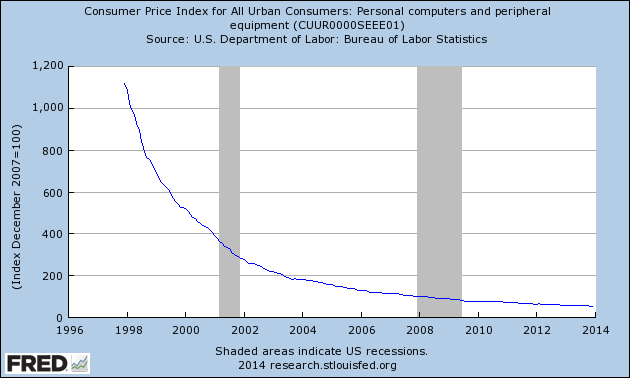
    One of the axioms of hardware business is that prices fall over time. The consumer price index for personal computers and peripheral equipment from 1998 to 2014 is shown below:

    CUUR0000SEEE01_Max_630_378

    The price index suggests that prices for computers should be 54% of 2007 levels. Charles Arthur illustrated this on a global basis using a separate set of data.

    The data shows that the weighted average selling price (ASP) of a PC has fallen from $614.60 in the first quarter of 2010 to just $544.30 in the third quarter of 2013, the most recent date for which data is available.

    The result is a chronically low margin for computer manufacturers. As Charles points out, the average profit for a PC is less than the price of a coffee at Starbucks. LG and Sony's exits from the market are symptomatic of the crisis. This is not a new phenomenon. There has been a long series of mergers, acquisitions and exits by incumbents.

    Except of course for one incumbent.

    The Mac, aged 30, seems to soldier on. Phil Schiller noted that of its original competitors, Apple is the only PC maker to still be in the market. One could imagine that this existence is marginal, or that the Mac managed to survive by giving up on unit volumes or pricing.

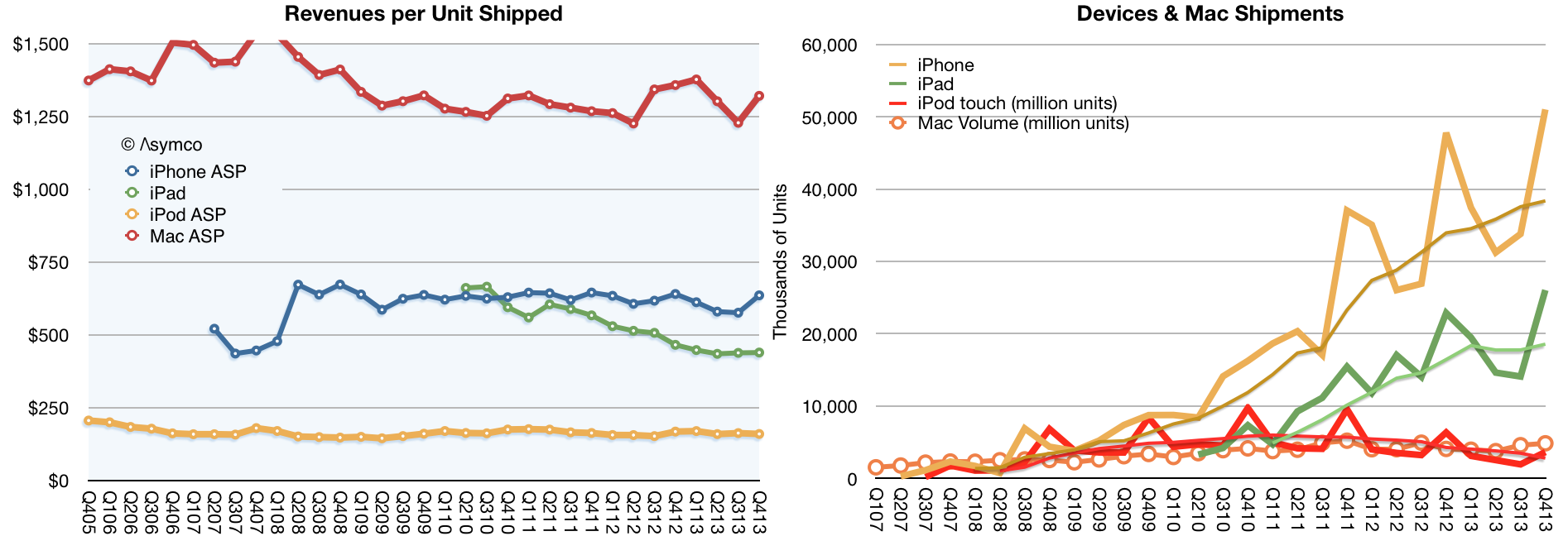
    The following graph shows the revenue per unit for the Mac and its volumes.

    Screen Shot 2014-02-20 at 2.59.43 PM

    The Mac not only continues to preserve pricing but it also seems to grow volumes at a time of overall market decline. Going back to the consumer price index, the Mac in December 2007 was priced, on average, at $1539. In December 2014, the price was $1322, with $40 deferred.

    So rather than being 54% of December 2007 prices, the Mac is almost at 90%.

    You'll note that along with the Mac I also illustrate the pricing of Apple's other devices. Even with the iPod, the pricing has remained stubbornly consistent for over 7 years. Whether the volumes are falling, rising rapidly or remaining flat, Apple's product pricing remains predictably consistent.

    The point being that the violation of the axiomatic price erosion rule in PCs is not anomalous. It suggests something about the violation of the same rule in devices. It suggests that perhaps the company does not respond to the same market forces.

    But we already know that. Jony Ive told us as much:

    “We’re keenly aware that when we develop and make something and bring it to market that it really does speak to a set of values. And what preoccupies us is that sense of care, and what our products will not speak to is a schedule, what our products will not speak to is trying to respond to some corporate or competitive agenda. We’re very genuinely designing the best products that we can for people.”

    The result is plain to see: Caring about the product means that it can be priced at a point which consumers care to pay.

    Trouble is, judging by how Apple is valued, nobody believes that this is sustainable. Regardless of the evidence within Apple's own history, it's the exception, not the rule and the bet continues to be that they cannot continue to remain an exception.

    Is Apple going to continue to repeal the laws that govern its industry, as it has for decades, or will it, as the market expects, abide by them?