Asymco

Asymmetric Intelligence

Research

  1. Unforgiven, Continued

    Research · 5 comments

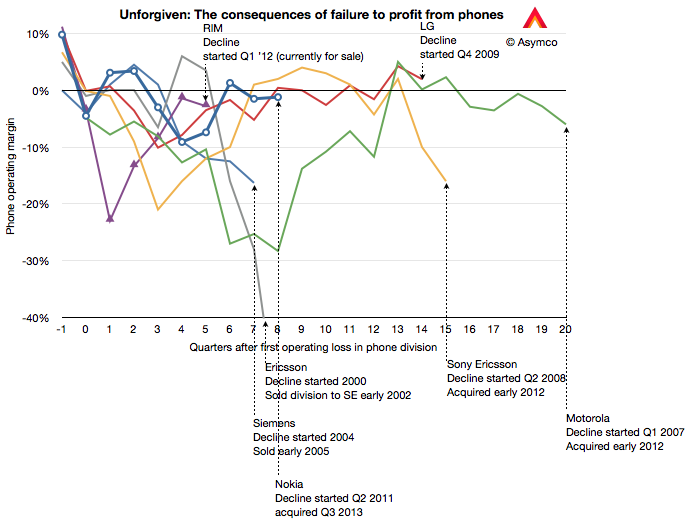
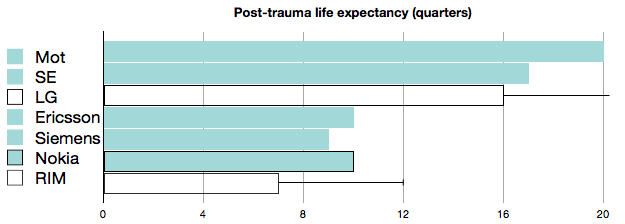
    In June of 2011 I asked "Does the phone market forgive failure?" Not much time has passed since but the answer still seems to be no. The trigger I was using for this point of no return when the vendor began making losses.

    The list at the time consisted of 13 phone vendors who either merged, were liquidated or acquired after this trigger point was reached. There were no examples of vendors who recovered. Since then two more vendors reached the threshold (Nokia and RIM) and a third will do so this quarter (HTC). One vendor (LG) may be recovering but Nokia has just been acquired and RIM has put itself up for sale. Some Japanese vendors like Panasonic have also called it quits since then. So the score so far is about 18 triggers, 15 exits and three pending.

    Some of this data is summarized in the following graph:

    Screen Shot 2013-09-03 at 9-3-9.19.51 AM

    It shows that post-trauma life expectancy is now running at about 2.5 years. As RIM is only in its second year, one could perhaps expect another 6 to 9 months of independence. HTC could go on until 2015 but the smaller the company, the more vulnerable, so HTC's exit time should be shorter.

    Screen Shot 2013-09-03 at 9-3-9.20.57 AM

    The exception might be LG which seems to be recovering. As a conglomerate, LG is much less vulnerable and might have the resources internally to sustain the phone business indefinitely.


  2. The rear view mirror

    Research · 57 comments

    In the Innovator's Curse I reflected on the fact that a serial innovator cannot be efficiently financed or even rewarded for having figured out how to repeatably create. If anything, a serial innovator has to suffer a discount to peers who do not habitually (or ever) innovate. The innovation process is the proverbial goose that lays the golden eggs but is destined to perish due to the lack of faith in its existence.

    So how can I back this up?

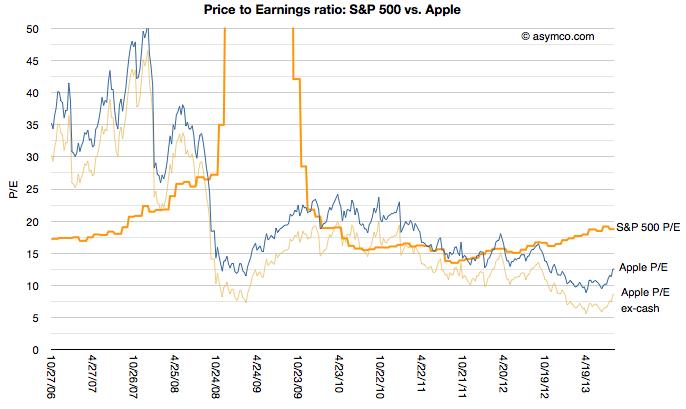
    To start, this is partially evidenced in this graph of Apple's price to earnings ratio since 2006 vs. the S&P 500's. The S&P reflects the 500 largest companies in the US and is thus a proxy for the "average" company.

    Screen Shot 2013-08-30 at 8-30-6.36.23 PM

    [I added Apple's P/E excluding cash for additional perspective.]

    The graph shows that during the period of time when iPhone and iPad changed computing and telecommunications, Apple was mostly held in contempt: the profits it was generating were not considered of "sufficient quality" relative to an average company. Since markets look forward, not backward (one assumes), the vote cast is decidedly that success cannot be repeated. Put another way: you can trust that a soft drink maker like Coca Cola (P/E of 19) or a utility like ConEd (P/E of 18) will continue in the manner we've seen them perform in the last year more than Apple (P/E of 12) will.

    I can offer yet another way to consider this curse. Apple's iOS business is designed to capture profits through the sale of hardware. That hardware is manufactured through a process where, while not being the manufacturer, Apple purchases tooling in a capital-intesive strategy to control the means of production.  I've discussed this at length before.

    But Apple's business is more complex than just enabling manufacturing. Tooling allows for production and production allows for supply but supply is nothing without demand. And demand of the product is driven by investments in software and services and design and marketing and countless details.

    In other words, for Apple's modus operandi, if anything should correlate with value it's opex, not capex. It's the investment in the people Apple employs not in the tools it buys.

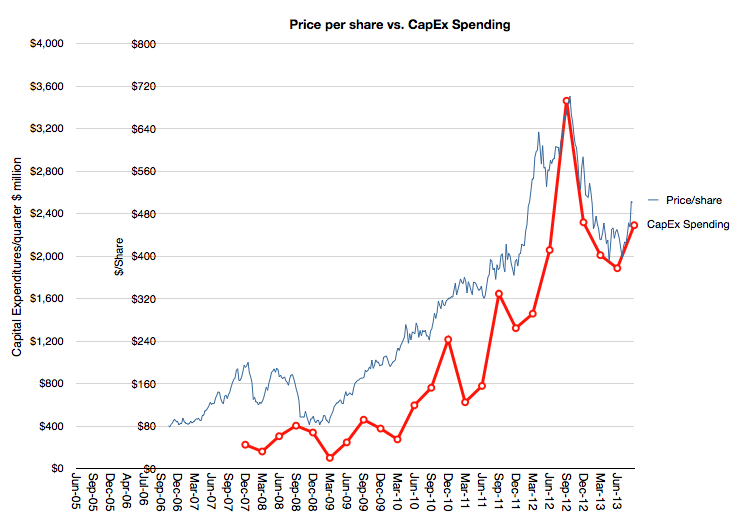
    And yet consider this graph:

    Screen Shot 2013-08-30 at 8-30-6.50.57 PM

    It shows how the market (though its pricing of Apple shares) values the company overlaid with a Apple's spending on capital equipment (PP&E capex).

    The relationship is uncanny. I'm not suggesting causality—that capex (which is publicly pre-announced) determines the share price level—but I am suggesting that there is a valuing of Apple as a producer of goods (for which tooling is a handy proxy). There is no sophistication to this formula. The more iPhones are built, the more the company is valued. Obvious.[1]

    But it's not obvious that prior to the iPhone there was iPod, which was a different business (and prior to it was the Mac, ditto.) The stock did not reflect the transitions nor does it assume that anything else will follow. It is, in other words, looking backward, not forward.

    --

    Notes:

    1. One could suggest looking at CapEx months in advance and predict the stock price, but who would believe such an absurd idea?
  3. Asymcar 3: Road Trip

    Research · 4 comments

    Horace Dediu and Jim Zellmer discuss the pleasures of traversing continents by road. This leads to a grand tour of powertrains, composites, fuel efficiency, regulation and Tesla’s luxury market entry. Which naturally leads to a conversation on emerging auto modularization, apps and ecosystems and where value will accrue.

    via AsymCAR 3: Road Trip | Asymcar.

  4. Steve Ballmer and The Innovator's Curse

    Research · 207 comments

    The most common, almost universally accepted reason for company failure is "the stupid manager theory". It's the corollary to "the smart manager theory" which is used to describe almost all company successes. The only problem with this theory is that it is usually the same managers who run the company while it's successful as when it's not. Therefore for the theory to be valid then the smart manager must have turned stupid at a specific moment in time, and as most companies in an industry fail in unison, then the stupidity bit must have been flipped in more than one individual at the same time in some massive conspiracy to fail simultaneously.

    So the failures of Microsoft to move beyond the rapidly evaporating Windows business model are attributed to the personal failings of its CEO. The calls for his head have been getting loud and rancorous for years. Taking this theory further, now that he's leaving, the prosperity of the company depends entirely on the choice of a new (smarter) CEO.

    It's all nonsense of course.

    Microsoft is composed of people, processes and priorities. And nothing else. The CEO is but one person, admittedly one with a high degree of authority. However, that authority is not unlimited. A change of leadership in a company may have some impact on a larger set of people, at least in the short term, but the bulk of existing resources, institutionalized processes, and priorities set by customers and cash flows limit what any one person can do.

    What really causes a company to fail is disruption. The business model around which all products, customers and priorities are built; the culture, the skills and "DNA" of the company; is vulnerable. This vulnerability is why companies have considerably shorter lifespans than the people who work there. They are one of the most fragile of organisms: high infant mortality, with short, unpredictable lives.

    Microsoft ascended because it disrupted an incumbent (or two) and is descending because it's being disrupted by an entrant (or two). The Innovator's Dilemma is very clear on the causes of failure: To succeed with a new business model, Microsoft would have had to destroy (by competition) its core business. Doing that would, of course, have gotten Ballmer fired even faster.

    Steve Ballmer's only failing was delivering sustaining growth (from $20 to over $70 billion in sales.) He did exactly what all managers are incentivized to do and avoided all the wasteful cannibalization for which they are punished.

    If anything, Steve Ballmer avoided The Innovator's Curse. Being successful with new market innovations would probably have led to an even shorter tenure. Destroying prematurely the pipeline of Windows in favor for a profit-free mobile future would have been a fireable offense. Where established large companies are concerned, markets punish disruptors and reward sustainers.

    Steve Ballmer will not be remembered as favorably as the man who created Microsoft. But at least he won't be remembered as the fool who killed it. That epitaph is reserved for his successor.

  5. The Innovator's Curse

    Research · 108 comments

    When Clay Christensen discusses innovation (for example his talk at BoxWorks here) he puts forward theories on the causes of success and failure of innovation. Through a repertoire of case studies evoking David vs. Goliath he offers a convincing alternative to the management orthodoxy which prevents innovation, especially the meaningful disruptive kind, in established organizations. More importantly he asserts that innovation is not something that happens randomly or only through the incantations of a Chief Magical Officer. There is a process and even perhaps a repeatable process for successful innovation.

    But one assumption that underlies this narrative is that innovation is good. Or more precisely, that innovation is rewarded--making its goodness desirable through market mechanisms. The happy ending to the story is that the innovator solves the dilemma, delivers the great innovation, perhaps more than once, and then basks in glory.

    But my observation is that the way markets behave often contradicts this measure of worth of innovation.

    Here's the problem: If a company produces a string of successes, the conventional wisdom is that the chances of another success are precisely zero.  A company is valued based on its cash flows and foreseeable improvements to them. What it's not valued on is its innovation flows (and foreseeable improvements to them).

    In other words, if you've succeeded in the past, the only certainty is that you will not be able to succeed again. This assumption exists even if you've succeeded more than once. The wisest will offer as many excuses for being lucky more than once as they will for being lucky once. In fact, just as the illusion of a run of heads means the next coin flip must surely be a tail, a string of random successes is deemed to increase the probability that the next attempt will end in failure.

    This discounting of repeatable success means that the reward for a process of innovation is zero and therefore that innovation itself is a priori value-free.[1]

    This means that an innovator not only has to struggle with getting an organization to create something new (the gist of The Innovator's Solution) but also to do so without the benefit of capital markets. When trying to raise financing for a sustainable innovation engine, the markets speak unanimously: you haven't got a chance.

    Therefore the only way an innovator can finance the next innovation is to use proceeds from a previous innovation, having faith in his engine of creation. Listening to the market would only convince the innovator that the new thing is pointless. In fact, the best idea is to stop trying.[2]

    I call this The Innovator's Curse: that building repeatable innovations provides the innovator no respite. There shall be no basking in glory, only expectations of imminent failure and attribution of success to good fortune.

    When I first realized this I thought I chanced upon a remarkable paradox. That this must be some new insight into human nature. That realizing this will change everything.

    But just like Disruption Theory is beautifully illustrated through the ageless David vs. Goliath parable, The Innovator's Curse is but a retelling of this fable:

    A cottager and his wife had a Goose that laid a golden egg every day. They supposed that the Goose must contain a great lump of gold in its inside, and in order to get the gold they killed it. Having done so, they found to their surprise that the Goose differed in no respect from their other geese.

    Even if the cottagers were naive enough to have faith in the replicating miracle of golden egg laying geese, wise men would quickly advise them to kill it and get the gold more quickly. The Goose is doomed no matter what.

    --

    1. A company will be priced according to products it created in the past, and that price might be significant, but as competitive pressures increase, the value itself is discounted. What is certain to be worthless however is the ability of any company to come up with something new.
    2. When managers give in to the temptation to stop trying they build great sustaining companies which are subject to disruption and invariably fail.
     

  6. The Revenue Table (imperial units edition)

    Research · 40 comments

    Tim Cook famously said:

    We can put all of our products on the table you’re sitting at. Those products together sell $40 billion per year. No other company can make that claim except perhaps an oil company.

    For those of you laughing, that was three years ago. The revenues quadrupled since to a total of $170 for the last four quarters. But the more interesting thought is that the table has not gotten bigger. When Tim spoke the iPad had just been announced but was not yet for sale. So we can't be sure if he thought it should be on the table or not, but it does not take up that much space.

    It would be fun to actually lay out all the Apple products on a table to see how big it would be. The trouble is that there are many things Apple sells which take up no space at all. Things like iTunes content or services and AppleCare.

    So rather than trying to imagine a table full of Apple products (some of which are non-phyisical) I thought a more fitting analogy would be to allocate the revenues from these products to a table and thinking about how much space relative to each other the products would take.

    To make conversion easier, I picked a rather large table; 10 feet long, big enough to fit a small conference room. What would this table covered in product revenue look like?

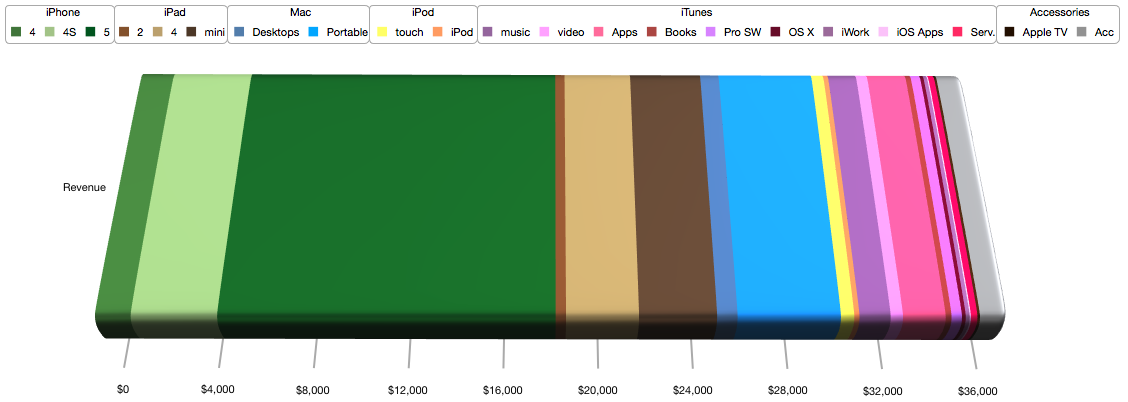
    My estimate is that it would look like this:

    Screen Shot 2013-08-22 at 8-22-11.50.54 AM

    I color coded the product lines as shown in the legend: Greens for iPhone, Browns for iPad, Blues for Mac, Yellow for iPod, Red/Purples for iTunes and Grey for Accessories.

    At this categorization the table would allocate the following space to each category:

    • iPhone (Greens): 60 inches or about half the table.


      Product
      Inches
      iPhone 4
      4.7
      iPhone 4S
      11.4
      iPhone 5
      44.5
    • iPad (Browns): 21 inches


      iPad 2
      1.4
      iPad 4
      9.6
      iPad mini
      10.3
    • Macs (Blues): 5 inches


      Desktops
      2.7
      Portable
      13.6
    • iPod (yellows): 2.5 inches


      touch
      1.8
      iPod
      0.7
    • iTunes (reds), software and services: 15.5 inches


      music
      4.1
      video
      1.6
      Apps
      5.6
      Books
      0.8
      Pro SW
      1.4
      OS X
      0.5
      iWork
      0.5
      iOS Apps
      0.2
      Serv.
      0.9
    • Accessories (Greys): 4 inches.


      Apple TV
      0.3
      Acc
      3.6

    If this colorful table were used to support the actual products, where each product would have to fit within its color band, then the truth of one saying would become apparent: good things come in small packages.

  7. AMP Index update

    Research · 50 comments

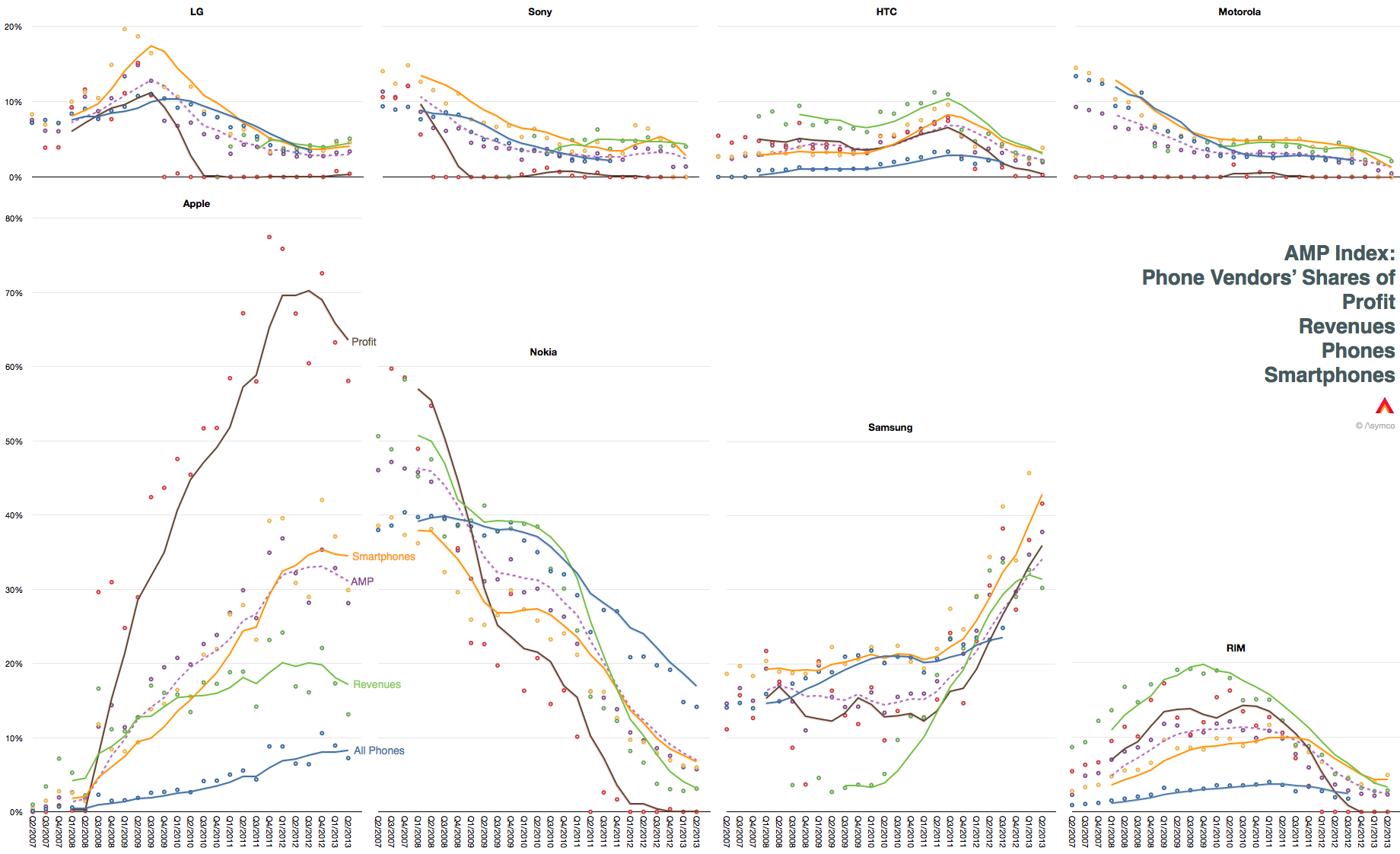
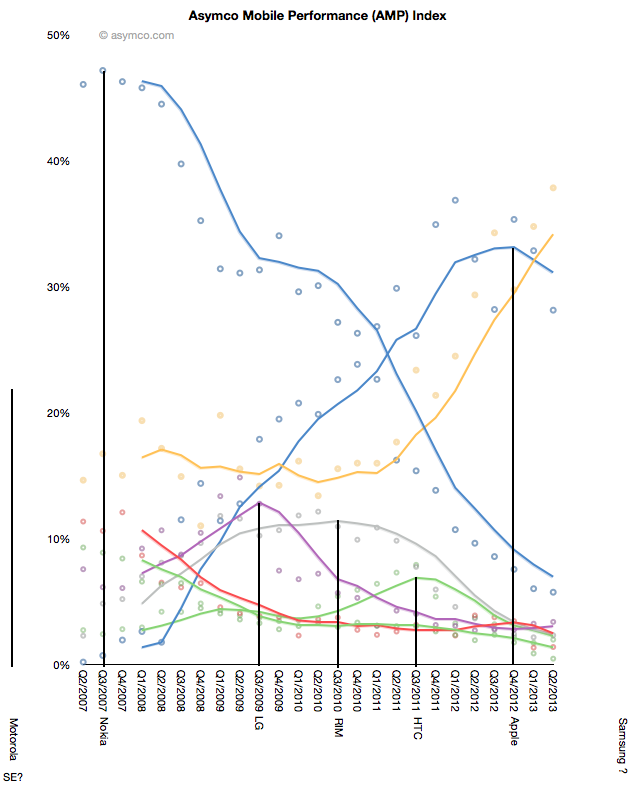
    The following graphs show the most visible global phone brands and the approximate percent of value they captured since 2007.

    Screen Shot 2013-08-21 at 8-21-6.17.19 PM

    The graphs each show trailing four quarter average of shares of units shipped, revenues, operating profits and smartphones shipped. I also averaged the four shares into a single share number called the AMP index (Asymco Mobile Performance).

    Note that this data ignores those "other" vendors whose financials are not available.

    I placed all AMP indexes on the same graph and looked for some patterns. The result is shown below.

    Screen Shot 2013-08-21 at 8-21-6.58.01 PM

    It's not much to go on, but there seems to a pattern where each vendor reaches a peak share, though that peak varies greatly in value. If the pattern holds, we could perhaps anticipate a peak for Samsung in one year or so.

    I'm searching for some hypothesis of what is happening and what is causing this pattern, if it is a pattern. The instability of the market is certainly a pattern. (Many markets would show horizontal lines for many years rather than what we see here.)

    But the constant turnover and the periodicity of success and failure is a characteristic of either a market where there is a hidden hand (operators? regulation? etc.) or one where disruptive change is extremely consistent and rapid.

  8. The last frontier

    Research · 51 comments

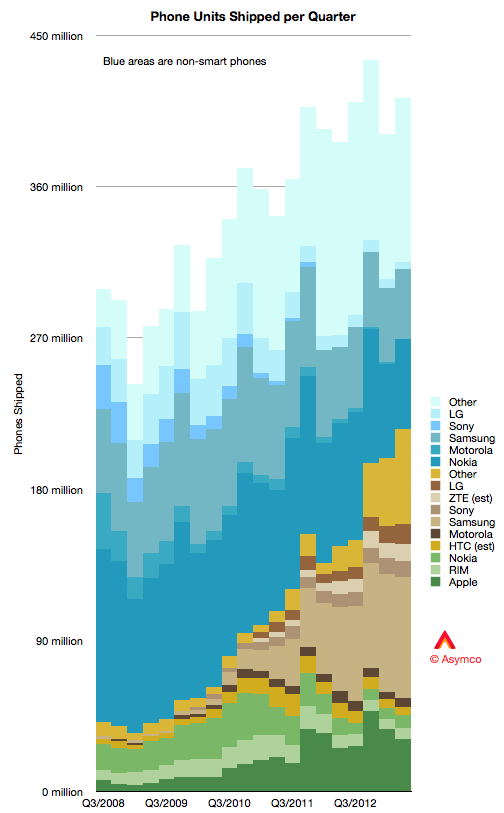
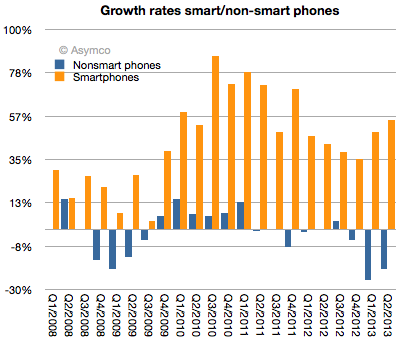
    Tracking the mobile phone market hasn't been getting any easier. The lack of published data from many incumbents (including the largest) is compounded by the lack of visibility into entrants. It's not just ZTE and Huawei which are up-and-coming, but companies such as Lenovo, Xiaomi and Yulong make up an increasingly large part of the overall market. (Not to mention BBK, Meizu, OPPO and TCL).

    Canalys suggests that China's top five vendors make up 20% of the world's smartphone shipments. This is mostly due to the rapid rise of the category in China and the advantages local vendors have in that market. Absent this large segment, a complete picture of the market is simply not possible. Nevertheless a fuzzy picture of the entire market can be still be painted.

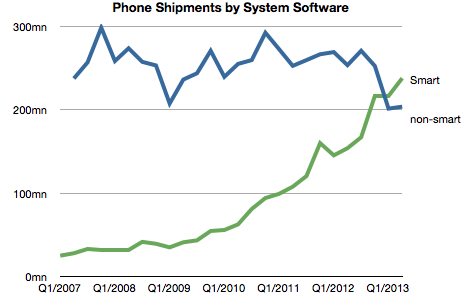
    Screen Shot 2013-08-20 at 8-20-12.44.02 PM

    What I see in this graph is that competition with smartphone non-consumption is still fierce. Non-smart phones are still shipping at the rate of about 200 million per quarter. Not as many as the smartphone units, which are nearly 225 million, but their numbers have not so much plummeted as not risen. Smartphones meanwhile have expanded greatly.

    Screen Shot 2013-08-20 at 8-20-1.55.15 PM
    Screen Shot 2013-08-20 at 8-20-1.05.38 PM

    The other observation is that these non-smart units are increasingly being made by no-name brands and sell in emerging markets through grey markets. Nokia's non-smart business is contracting and Samsung, the only other branded vendor with any material non-smart volumes is fleeing upmarket.

    Consider that India, a market of 700 million users purchased barely 9 million smartphones last quarter. Contrast that with the Chinese market where 1.1 billion users purchased 88 million. The preference in India is for super low cost products of dubious progeny.

    In other words, the preference in India is about what it used to be in China two years ago.

    Will India follow China out of non-consumption? It's hard to say. There are many factors beyond market forces at work. Although that's true in most phone markets, India is particularly byzantine. Not only is distribution different (retail only and very fragmented and multi-level distributed) but there are few 3G users and networks are notoriously difficult to scale. For a vendor trying to apply a global strategy in India the odds are very poor indeed. And there are few vendors more uniform in their approach than Apple.

    The Indian market is not yet "cracked" as Tim Cook would say.  One wonders if it ever will be.

  9. The Meanings of Appleiness

    Research · 212 comments

    I've never worked at Apple and know very few people who did. Nevertheless, I read Adam Lashinsky's book and enough Folklore.org that I think I can get away with replying to the Meaning of Googliness with the following:

    Googliness meansAppleiness means
    Doing the right thingDoing the best thing
    Striving for excellenceStriving for greatness
    Keeping an eye on the goalsKeeping both eyes on your task
    Being proactiveBeing obsessive
    Going the extra mileGoing to the moon
    Doing something nice for others, with no strings attachedDoing everything for the user
    Being friendly and approachableKeeping your mouth shut
    Valuing users and colleaguesValuing functions other than your own
    Rewarding great performancePunishing failure
    Being humble, and letting go of the egoKeeping your mouth shut
    Being transparent, honest, and fairKeeping your mouth shut
    Having a sense of humorNever writing a post on what Appleiness means
  10. It's a wonder

    Research · 3 comments

    My responses to questions from Juliette Garside of The Guardian newspaper:

    Q: Will noise from Icahn distract the Cook from focussing on product?

    A: Investors may think that they can influence management but they do so only when companies are in distress. It’s only then that shareholders can affect some change with their votes as they have a common purpose. The voice of investors carries little weight or distraction when a company is successful. At first glance it seems that Icahn thinks he can unlock value in Apple by getting management to accelerate share buybacks. That’s a modest goal and not one which needs to distract managers.

    Q: What will do most for the share price – a buyback or a blockbuster new device?

    A: Neither. What will do most for the share price is a change in the perception that Apple is not going to survive as a going concern. At this point of time, as at all other points of time in the past, no activity by Apple has been seen as sufficient for its survival. Apple has always been priced as a company that is in a perpetual state of free-fall. It’s a consequence of being dependent on breakthrough products for its survival. No matter how many breakthroughs it makes, the assumption is (and has always been) that there will never be another. When Apple was the Apple II company, its end was imminent because the Apple II had an easily foreseen demise. When Apple was a Mac company its end was imminent because the Mac was predictably going to decline. Repeat for iPod, iPhone and iPad. It’s a wonder that the company is worth anything at all.

  11. How will iPhones 5S and 5C be priced?

    Research · 175 comments

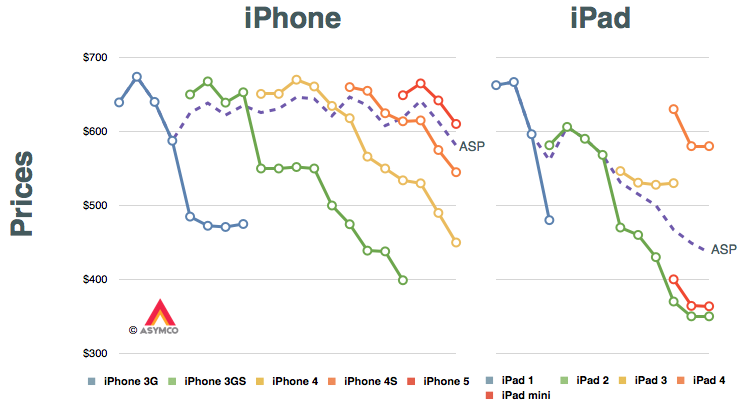
    The answer may lie in the way the iPad mini has been marketed. The pattern for iPhone pricing is pretty regular but that for the iPad shows a marked difference. The reason is, of course, that the iPad has already gone through a portfolio broadening. The following graphs tell the story.

    Screen Shot 2013-08-12 at 8-12-11.30.09 AM
    Screen Shot 2013-08-12 at 8-12-11.49.19 AM

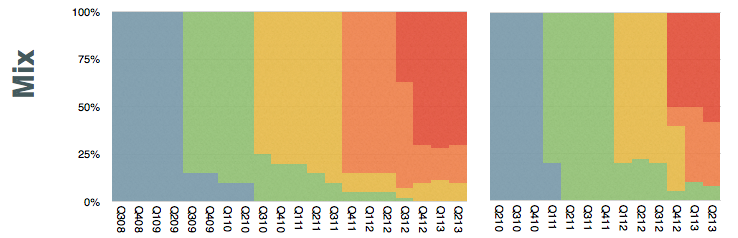
    The only data in these graphs that is provided by Apple are the dashed purple lines. They represent the average selling prices (ASP[*]) for the two product lines. I added assumptions about product mix (shown in the lower set of graphs) and thus generated prices for each product variant at a given point in time shown as  line graphs.

    If you look at the iPad, ignoring the legacy iPad 2 (which I presume sells mostly to educational institutions) the replacement of the iPad 3 was with a "bracketed" portfolio of the higher-priced iPad 4 and the lower-priced iPad mini. Note also that the mini reflects similar pricing to the legacy iPad 2.

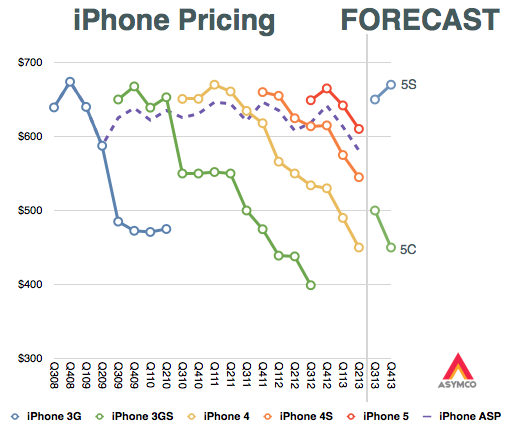
    My second assumption is therefore that the 5S and 5C will form a similar bracket as the new iPads did. I also assume that the iPhones 4 and 4S will be retired. This means that the 5C will take up the trajectory of the 4S while the 5S will take up the upper bracket around $650.

    Screen Shot 2013-08-12 at 8-12-11.44.05 AM

    The average pricing for the entire portfolio will depend on the mix. This is still highly speculative since we can't predict how the end-user (operator) pricing will be set for the 5C. Aggressive promotion and new market growth might skew the 5C considerably. On the other hand, upgrade promotions might move the 5S in existing markets.

    ---

    Notes:

    • These prices reflect blended average prices of all SKUs to the channel and do not necessarily reflect prices offered to end-users.