Asymco

Asymmetric Intelligence

Research

  1. Is Android responsible for Apple's deep market discount?

    Research · 96 comments

    At last night's closing price Apple was trading at a P/E of 16.3. Excluding cash that ratio was at 13. On a conservative forward basis (my estimates) the stock is priced at less than 10 times next twelve months' earnings.

    These figures show a remarkable pessimism that has persisted around Apple for years. It was slightly, but not much, worse during the great recession. It persisted whether the company was growing at 30% of, as now, 95%.

    There are many hypotheses about why Apple's earnings and growth are considered worthless. They come and go with the whims of the age: recession, elitist, luxury branding, health issues, macro "headwinds", earthquakes, phantom competition.

    Lately it's become fashionable to blame Android. That's a curious thing to me, because Android has been discussed at length here and it has been shown to be, for the time being, benign. Apple has not "lost sales" to Android as it has been selling all it can produce. In some ways it's been a boon as a co-belligerent against non-consumption.

    The argument that the discount is in effect because of the future of Android has one first strike against it: the fact that the market does not often discount the distant future. Capital markets are notoriously incompetent in spotting disruptions and often reward those who are failing right up until the bitter end.

    But let's take the "Android hypothesis" (i.e. that Android is causal to Apple's share price) seriously and analyze it. How could the impact be measured?

    Since Apple is trading at a fraction of (a) historic multiple (b) multiple based on growth (c) comparable companies' multiples then we can assume that a "normal" valuation would be twice the current (i.e. a multiple of about 32). That would still be a discount to growth and history but it would begin to match some of the comparables. A doubling of the P/E would be a good start.

    But a multiple of 32 would imply a doubling of market cap, which means that the Android hypothesis is causing the evaporation of about $300 billion in future profits. So it stands to reason that it's responsible for a $300 billion destruction of Apple shareholder value.

    That's an interesting number since Google itself is only worth about $169 billion.

    The measurement then presents a remedy: If Apple bought Google (it already has a third of its value in cash) and it shut down Android, it could create $300 billion in value. If could even throw away all of Google and still walk out with a profit.

    Seems like a great bargain.
  2. Apple Earnings: Evaluating my performance

    Research · 24 comments

    As chronicled here, this quarter I went through three sets of estimates. This is a departure from my standard practice of sticking with one forecast made three months in advance. I felt last quarter was filled with materially important developments which deserved updating.

    So how did I do?

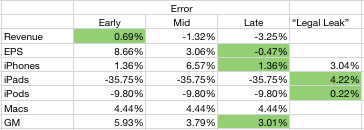
    I wanted to see if the additional information helped or hindered predictability so I put my three predictions side-by-side and measured the errors. I also added the "legal leak" from April 15th (published April 19th) to see whether it was an accurate predictor. The table below shows the error rates with the lowest error highlighted.

    It's clear that my error rate decreased as new information was used. It's also clear that the "legal leak" was very accurate. What follows is a discussion of each line item.

    The iPhone forecast was very accurate both early and late in the quarter. At 1.36% error it was even lower than what was leaked by Apple. I used the information about China and Verizon to boost sell-in and increased the growth rate to 110%. That proved to be the right call. I did not pay any attention to talk of component shortages as I did not consider them to affect Apple whose market share of devices is so low. I would score my "late" estimate as an "A".

    Even though I disclaimed it, my iPad forecast was very inaccurate. In contrast, the leak was very accurate. Although mitigated by the higher sell-through (5.1 million) shipments were constrained by the change in product. Details like the date of shipment, the date of announcement and the ramps made this a particularly difficult transition to predict. At 36% error, I score it as an "F".

    The iPod error was about 10%. That's mediocre. The product dropped in sales by 17% (vs. 10% expected). Again, the mitigating factors, like higher mix of iPod touch and thus increased prices helped to keep the financial performance decent. I score this as a B-.

    The Mac prediction was accurate. The error was less than 5%. I will discuss the Mac business in a separate posting but it suffices to say that the growth was excellent but predictable. I score my prediction as an "A-".

    Revenues were reasonably predictable however pricing seems to have been affected by exchange rate volatility. The iPhone turned out to have a huge average selling price ($660) which made up for the lower revenues from iPad. The error of 3.25% is acceptable. I score it as an "A".

    The Earnings number was very accurate. The error for the late estimate was less than one half of one percent. This bottom line number is a function of all the other numbers so it's the most encompassing. You have to account for factors like interest income, changes in the number of outstanding shares and tax rates. None of these are predictable. However, I was lucky. With an error below 1%, I rate this as an "A+".

    My overall performance as a grade point average would be 3.43 or B.

  3. iOS vs. Android: the tale as told by Wall Street

    Research · 90 comments

    Yesterday I wrote about the growth in Android vs. iOS. The two platforms' can be said to be enjoying healthy growth, though in markedly different patterns.

    The consequences of this growth are being felt across the telecom and computing industries. There are almost 300 million platform devices in use today that were not even dreamed of three years ago. Operators are transporting petabytes more data and dozens of phone vendors are scrambling to meet demand. There are tens of billions of app downloads and hundreds of thousands of apps being sold by tens of thousands of new app publishers. There is a lot of hay being made while the sun shines.

    But what about the poor saps that are funding the development? What about the shareholders of the companies behind these platforms. Are they being rewarded or punished?

    The following charts tell the story:

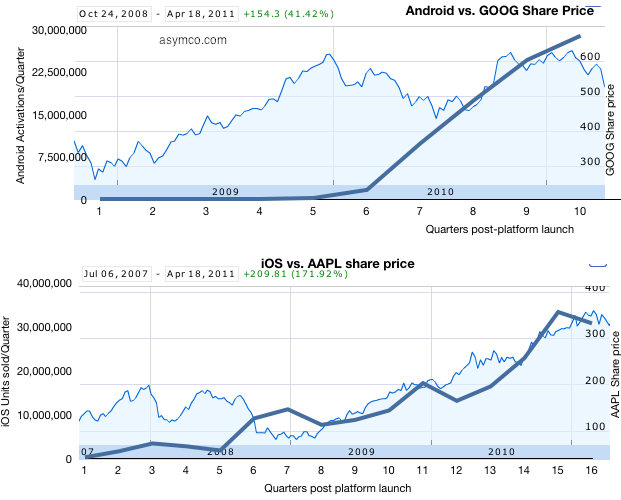
    I took the platform growth data published yesterday and overlaid it on the share price data (source: Google finance). Each plot begins at the point in time when the respective platform was available in the market and ends today. There are two vertical axes: the left side axis shows "activations" or units sold and corresponds to the thick blue line; the right side axis shows share price and corresponds to the area chart. Overall date range and growth in share price is shown in the upper left corner.

    What can we interpret from this superimposition?

    1. Both Apple and Google shareholders saw share price appreciation during the two platforms' histories. Apple shareholders benefited more (+172% vs. +41%)
    2. Apple's share price appreciation seems highly correlated to iOS growth but Google's doesn't. Google share price had dramatic growth during 2009 while Android was moribund and was flat to down during 2010 when Android growth was explosive.
    3. We can also interpret the difference as Google's fortunes being far less dependent on mobile platforms than Apple's. Google has been subject to selling pressure this year due to corroding cost structures irrespective to platforms growth. Conversely, Google may not benefit from mobile computing as handsomely as Apple.

    Correlation is not causation and clearly there are many factors at work in share price changes but I think it's fair to say that Apple is obtaining fuel for growth with iOS while Google is in a more precarious situation with mobility--partly benefiting but partly threatened. The market behaves in bizarre ways in the short term but in the long term one can see logic and reason.

  4. The Android step function

    Research · 40 comments

    There is precious little data on Android units sold. There are estimates but no actual summary. Google themselves don't seem to know as they don't report sales, preferring to report "activations."

    Assuming that activations means "unique activations of new devices" then we can draw some equivalency between Google's reports and the reported units of iOS sold. There is some uncertainty with respect to iPod touch units, but that is not very big (estimates are drawn from Apple's reporting of overall iOS units at several points in time.)

    To estimate Android, I took the download rates currently available and placed them in the month when they were published. I then interpolated the data monthly and quarterly.

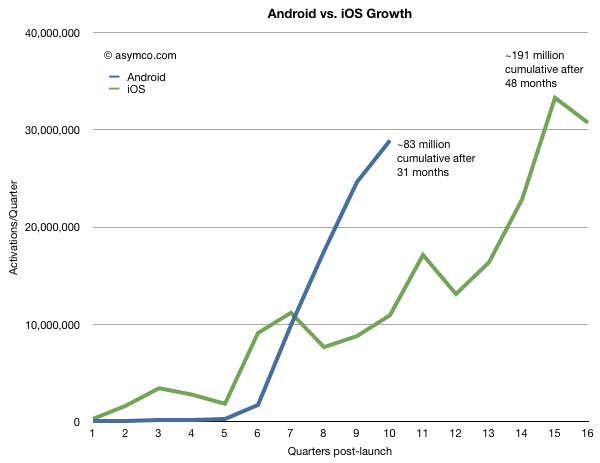
    To make the comparison more valuable, I chose to index the starting point at the launch of each respective platform and plot quarterly units (or activations). This way we can observe how the platforms ramped in growth and where they were at similar points in their lifetimes.

    The following graph results.

    There is likely to be more seasonality in Android data than is shown, but the impressive thing is that Android is running at three times the equivalent adoption rate for iOS at similar points in time. In fact Android is being "sold" as rapidly as iOS today even though iOS has been in the market about 15 months longer.

    Overall, cumulative units sold for iOS are still about twice as many but if Android will continue to grow as rapidly as it does now, it will likely overtake iOS in installed base in less than a year.

    One should be careful about drawing conclusions that this implies effective competition. Both platforms are growing very quickly. iOS is growing at at least 100%/yr and Android's second year was 65x bigger than its first. iOS growth is limited by the ramp rates of a limited portfolio of products. Android growth is limited by how quickly vendors can bring out products. Neither platform is demand constrained and hence they are competing for share of growth not for share of a fixed pie.

    Extrapolation is a dangerous game, but the chart above shows some predictability in Apple's curve whereas Android has a "step function" or discontinuous feel to it and that's a curious thing.

    Not so much for its lack of predictability but because it's so asymmetric to iOS.

    A dictum of classical physics states that in nature everything is continuous. However, in quantum physics everything is discontinuous. Both models of the physical universe have their uses.

    It should be noted that both business models represented above can also co-exist, at least for the foreseeable future.

  5. Revisiting Estimates for Apple’s second quarter earnings (ended March)

    Research · 29 comments

    Estimates for Apple’s second quarter earnings ending March | asymco.

    Since making the original estimates In January,

    • Revenue: $24.5 billion
    • EPS: 5.89
    • iPhone unit sales: 18.4m
    • iPod unit sales: 10m
    • Mac unit sales: 3.6m
    • iPad unit sales: 7.3m
    • Gross margin percentage: 38.8%

    I revised them at the end of March to the following:

    • Revenue: $25 billion
    • EPS: 6.21
    • iPhone unit sales: 17.5m
    • iPod unit sales: 10m
    • Mac unit sales: 3.6m
    • iPad unit sales: 7.3m
    • Gross margin percentage: 39.6%

    In the past I was comfortable keeping untouched estimates made three months in advance. This quarter however there have been several developments during the quarter which were unforeseen and cause me to revisit my estimates.

    1. The Verizon iPhone launch. Observations of the event focused on line lengths and buying activity. However, Apple reports shipments not sell-through. I believe the deal structure was such that Apple obtained a very large order as condition to the relationship. The January and March update analysis did not consider this order size. We have also more data on sales from HTC and RIM and there is no letup in the market's growth. As a result I am revising the growth for the iPhone back up to 110% y/y and 18.4 million units.
    2. Crucially, I'm increasing iPhone ASP to $625 on the basis of this new demand and the likely delay of iPhone 5 launch.
    3. The iPad 2 launch. This product is still too young to see production and sales patterns. However, demand for the second version seems higher than for the first. Distribution is broader too. The unknown is production. I am keeping the unit number at 7.3 million which is the same as the level of CQ4.
    4. China is booming. The Chinese New Year occurred in the quarter and since last year that has meant a sequential increase in device sales for Apple. But it's a double edged-sword. Almost all production activity is shut down during the holiday period. Apple depends on China exclusively for manufacturing so they will certainly be affected. So whereas it's likely that we'll see increased demand from China this year due to even better distribution, macroeconomics and brand value I'm unsure if supply rose to match. Overall, I'm not changing unit growth due to his increased demand but I'm cautioning that there could be downside bias in my estimates.
    5. The tsunami disaster in Japan will affect some demand in Japan and some of the supply chain will be disrupted. However, the effect will be felt more by weaker competitors. It's possible that the event will amplify the shortages that Apple's pre-purchase agreements already created. The consequences are bad news for Apple's competitors but I rate it as neutral for Apple.

    Given these new facts coming to light, I would update my estimates as follows:

    • Revenue: $25.5 billion
    • EPS: 6.43
    • iPhone unit sales: 18.4m
    • iPod unit sales: 10m
    • Mac unit sales: 3.6m
    • iPad unit sales: 7.3m
    • Gross margin percentage: 39.9%

    Resulting EPS growth would thus be 93%.

    For the record, I value my January estimates since they are based on long-term pattern recognition rather than transient events and thus are more useful in forming a market theory.

    However, these transient events cannot be ignored and analysis needs to be informed by both theory and events. I will be watching to see which set of predictions (early, mid or late) will be more accurate.

  6. First quarter PC forecast: Windows down 2%, Mac+iPad up 250%

    Research · 100 comments

    Charles Arthur of The Guardian writes that PC sales "may have passed their peak".  That's a powerful, concise statement. It's backed up by a quote from Gartner's Mikako Kitagawa:

    "This was the third consecutive quarter of mobile PC shipment declines in the US"

    IDC even lays part of the blame to something called "media tablets"[1]:

    "While it's tempting to blame [PC] decline completely on the growth of media tablets we believe other factors [...] played equally significant roles."

    But there are several problems with both IDC and Gartner's analysis of the market. It's hard to make out causality from their data. There is separation by vendor but not by operating system and there is exclusion of devices hired to do the same jobs as PCs.

    For this reason, I need to do my own analysis. I retrieved Gartner's public statements on the overall market and layered actual Mac and iPad units sold. I also added my estimates for the Q1 2011 quarter just ended to complete the picture.

    We can now get an understanding of how the industry behaves with and without various platforms. The chart at the left gives the various growth rates of the market with platforms isolated from each other. I apologize for the shape of the chart but the scale does not permit a concise visual.

    Including the iPad, the total PC growth is shown by the blue line. It shows that the market peaked during the recovery but is now slowing considerably.

    The green line shows the PC industry excluding both the Mac and the iPad. Although it might include Linux or computers sold without an OS, the label "Windows PC" is a fairly close approximation. It shows that the market excluding Apple entered contraction this quarter and is out of sync with overall economic recovery and growth.

    The red line shows the behavior of the Mac franchise. It's well ahead of the overall market with 2x to 3x the growth. This has been a pattern for over 18 quarters.  I had some thoughts on this in a November 2010 hypothesis.

    But the most telling line is the orange line which includes both the Mac and the iPad. In an industry where growth is usually measured in single digits, the iPad business brings growth in three digits.

    This near tripling of unit sales is symptomatic of fundamental change that cannot be ignored. Although some analysts contend that the iPad is not causal to the decline in other PC sales, teasing out platforms data seems to show a divergent view.

    The bottom line is that Windows-only computer units are down 2.0% while OSX-based computer units are up 272% (this excludes both the iPhone and iPod touch).

    Correlation is not causation but tests or surveys where substitution can be proven do exist. For example, a recent survey shows that 77% of users reported that their PC usage decreased after getting a tablet. It also showed that 28% considered their iPad as their primary computer.

    So coupling the sales data with the usage data does point an accusatory finger for the decline on the iPad.

    In addition, some vendors are being hit harder than others which also hints at where substitution is happening. For example, IDC reports that Acer US unit shipments fell 42% in the first quarter and 16% globally (Gartner's numbers are less dramatic but in the same direction). Since Acer is known for its netbook computers it's another telling sign of possible substitution (Acer's own management has indicated as much.)

    So the weight of evidence is beginning to be conclusive: the iPad is the new PC. It should be clear by now that the iPad moves computing into new contexts so it does not yet substitute the PC market but extends it and increases consumption. Substitution is happening in low-end grazing type of usage, a place where the PC was ill-fitting anyway. Incumbent vendors might actually be relieved that the lower margin netbook is finally being supplanted and they can concentrate on the higher end.

    --

    Notes:

    1. Analysts like to call the iPad a "media tablet" but the same AdMob survey shows media consumption to be one of its least popular uses.
  7. Mobile device OS upgrades: How hard can it be?

    Research · 45 comments

    Until the iPhone's arrival in 2007, upgrading the software on a mobile phone was a rare experience for users. So rare that effectively it was not done. Few people were bothered though since they did not see the product they used as a software product.

    This was even true for Windows Mobile and Symbian which were licensed platforms. Microsoft tried several times to offer upgrade paths, but more often than not the device vendors did not push out updates or the process required to perform an upgrade made it the reserve of either those who were paid to do it or those who enjoyed the challenge.

    In the era of the modern smartphone, upgrades are more common. Certainly with the iPhone the process is easy enough that opting out of an upgrade is more challenging than opting in. But it's still not as common with other platforms. Even with all the resources and experience behind them, Microsoft is still stumbling with Windows Phone upgrading.

    UPDATE 1-Microsoft explains phone software update delay | Reuters

    But is it really a matter of blundering or is there evidence of nominal partners working at cross-purposes?

    Upgrading a mobile device is technically challenging. There are many things that can go wrong. Integration helps, but it is also possible for a modular solution to be implemented. There are harder things to coordinate.

    However, things go wrong and as the linked article above shows, fingers get pointed. Device vendors who have no stake in a platform can easily interpretan upgraded OS as one fewer hardware upgrade. Platform vendor's lament that device guys want to proliferate unique versions and act with passive aggression. Device vendors see the software upgrade cycle as increased support and engineering costs with no upside. Consumers don't know whom to blame and often turn to the operators since that's who they pay every month.

    The problem of upgrade failure is a symptom of a deeper dysfunction inherent in immature modular business architectures. It's not just that the brightest at Microsoft or Nokia or Google can't make an upgrade stick. It's that the upgrade is not universally beneficial to the value chain. To remedy this, licensors have to resort to contractual obligations to ensure upgrades, but enforcement is non-trivial and can lead to aggravated relationships.

    Unless all licensees of a platform find compelling value in shouldering the burden of upgrades, they will continue to be really hard. This leads to increasing fragmentation and a corrosion of platform value for licensed platforms vis-à-vis their integrated alternatives.

  8. Pattern recognition for smartphone investors

    Research · 42 comments

    I spent the last few days in Hong Kong at a conference discussing the smartphone industry. The participants were mainly investors or investment managers. One of the most frequently asked questions was how to spot investable trends in this notoriously unpredictable sector.

    The data I presented did not offer much of an answer. If anything, it showed just how much the industry has changed and how unlikely it is to remain a facsimile of what it is today.

    But theory allows us to still make some bold claims. Grounding your investment thesis in pattern recognition rather than extrapolation should be the better strategy. So here are the telltale signs I recommend watching for investable ideas.

    1. In hardware look for what's not good enough. The smartphone is great. But it's not good enough for many jobs that we can recognize with little effort. For example, smart devices never seem to have enough battery life. Storage, screen quality and speed are pretty good, but battery life is worse than what voice phones offered years ago. Companies dedicated to improving battery technology or charging technology should be worthy of a bet. Breakthroughs in power saving will be much more valuable than breakthroughs in storage or processing speed or screens.
    2. Pricing needs innovation. Phone pricing is opaque, user unfriendly and often leaves buyers confused and angry. I use the word innovation instead of reduction because it's not about making prices necessarily lower, but removing complexity and defining value clearly through price. The challenge is not just for devices but for service providers as well. Companies innovating by abstracting pricing complexity will do very well. Interestingly, pricing innovation is not as easily copied as it may seem. It is often coupled with business model innovation and cost restructuring.
    3. Applications currently conform to platform needs but there will come a time when platforms will need to conform to application needs. By applications I mean not just apps but the app/service bundle that will drive consumer purchasing behavior. If we consider social media, entertainment and shopping as applications, it will make sense for those applications to eventually take some control or equity in the platforms. Android is the first sign of this: search and services associated with search and advertising sought control over platforms. Perhaps Facebook, Amazon and Baidu will feel a similar need.
    4. As a new medium, apps will eventually be more valuable than the tools used to render them. The global app brands are probably not yet born, but some day they will be as important as Disney, News Corp and Universal Pictures in their heyday. The App Store is the incubator for these embryonic megabrands.

    I realize that these are not specific enough investable ideas but casting your eye on patterns should yield better returns than selecting winners from a set of "current players".  After all the great returns from smartphones to date have come from bets on entrants (HTC, Apple, RIM) and not from incumbents (Nokia, Microsoft or Motorola).


  9. HTC and self-determination

    Research · 74 comments

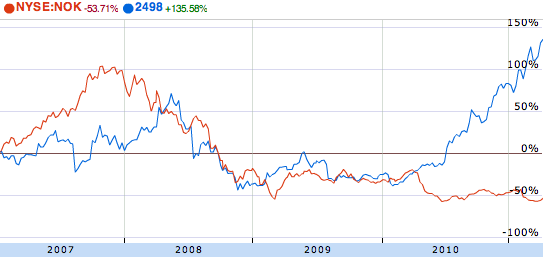
    HTC's market cap has just overtaken Nokia's. While market capitalization is a fickle thing, shifting with sentiment, this is still a remarkable feat. Nokia's market capitalization has almost halved in the space of a year while HTC has more than tripled from $10 billion to over $33 billion.

    If you roll back to 2007 and the start of the modern era of smartphones, you can see how the two companies stocks traded places:

    (source: Google finance)

    The recession was hard on everybody but HTC soared during 2010 while Nokia never recovered. Markets reward unforeseen growth and typically that means above-market growth.

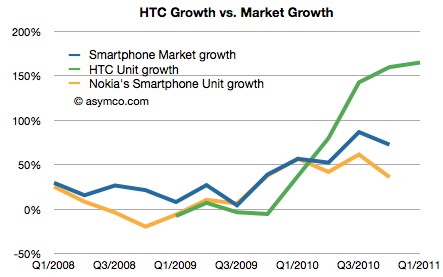
    That's reflected in the following chart (admittedly units and not profits, but pricing and margins for both have remained relatively steady.)

    As Nokia's growth lagged the market the stock was punished. As HTC's growth exceeded the market's growth, the stock was rewarded.

    But there are a few more observations to make:

    • HTC's smartphone business was under-performing the market for most of 2009. In fact, it was even in negative growth for three quarters.
    • The surge in growth coincided with HTC adding Android to its portfolio and given no other changes, seems to be causal.
    • Although not within the time range of the charts above, HTC had another period of rapid growth in the mid 2000s.

    A year ago HTC was making excuses and apologizing. Today they are more valuable than the largest phone vendors. All thanks to Android.

    But why no thanks to Microsoft?

    HTC was the primary Windows Mobile vendor a few years ago. They claimed at one point to have shipped over 80% of all Windows Mobile devices. They were also the leader in the Pocket PC franchise as they were the ODM behind the iPaq brand from HP/Compaq. HTC would not exist today were it not for Microsoft.

    The relationship is such that HTC is paying Microsoft for protection from (potential) Android IP infringements. HTC has also licensed Windows Phone though the relationship between Nokia and Microsoft must give them pause.

    But that's the whole problem. Those who live by the sword shall die by it. HTC was a Microsoft dependent and now they're a Google dependent. As the basis of innovation shifted, HTC was agile enough to make the transition. Perhaps they can execute a portfolio switch yet again as their upstream suppliers change whims or business models.

    But then again, as we saw with Windows Phone, perhaps not.

    If HTC wants to control its destiny it needs to control its suppliers. Now that its power and brand have grown, it needs software because in their market software is self-determination.

  10. Divinely inspired analysis

    Research · 103 comments

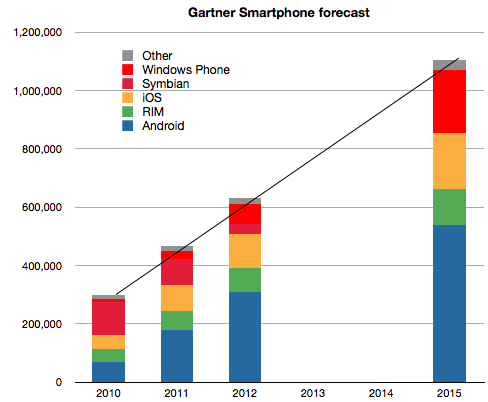
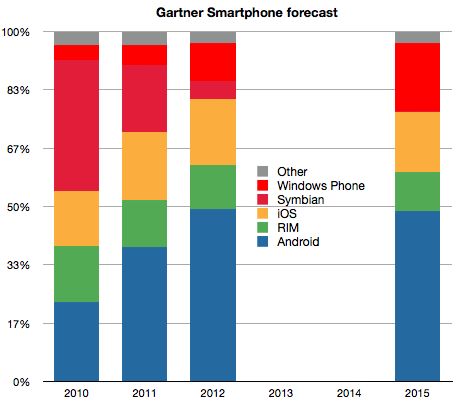
    Three things stand out from Gartner's latest smartphones forecast:

    1. They published a four year forecast with seven significant digits of precision (implying a margin of error of 0.00001%).
    2. There is a linear growth in total market size.
    3. There are no significant share changes after 2012.

    The latter two claims are illustrated below:

    Notwithstanding the defensibility of these claims Gartner analysts makes some further assumptions (quoted verbatim).

    1. "Apple will be interested in maintaining margins rather than pursuing market share by changing its pricing strategy"
    2. "RIM’s migration from BlackBerry OS to QNX which is expected in 2012"
    3. "Nokia will push Windows Phone well into the mid-tier of its portfolio by the end of 2012"

    These assumptions may be valid, but from where I'm sitting, the first assumption contradicts Apple's COO, the second would be an engineering marvel and the third would be an organizational miracle.

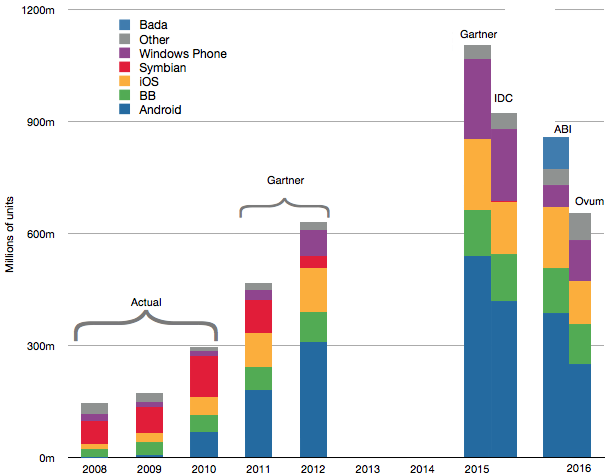
    Putting together all the long term forecasts with what is already known about the market history gives the following combined forecast.

    At the risk of repeating myself, the only thing I can summarize from this collective wisdom is that the over-riding assumption in forecasting seems to be that the future is an extrapolation of the present. That would indeed be a miracle.


  11. Expert system

    Research · 16 comments

    Since starting this blog, I've receives several requests for career advice. I am most heartened and humbled by these requests, especially when they come from young people just starting out. I've responded as best I can and tried to offer specific advice, but it's very hard to be specific when the task is so grand.

    But here are some pieces of advice that I can offer, which although not specific, may be interpreted into something useful.

    On becoming an expert

    The path to becoming an expert is never clear. The way to think about it is this: Ask your parents what it was that they did to make you a great son or daughter. Most parents don't have a clear map on how to build a family. Building great families, careers or businesses are similar empirical endeavors in that it takes constant trial and error and infinite patience.

    Similarly, ask an athlete what is the formula for athleticism. It's has something to do with talent but more than likely it's constant practice and attention to detail. Most overnight successes took a lifetime of preparation.

    On getting the motivation to practice

    In all cases, the path to greatness lies in passion. Without passion there is never the energy to continue doing something when there is no clear benefit in sight. Passion is a relation of faith so many who have faith find it easier to have passion and vice versa. If you have neither for the task at hand, you need to look for something else to do.

    On communication

    Understanding and communication are inter-twined in many ways. Usually, if you cannot communicate something effectively, it's likely you haven't understood it completely. Likewise, if your understanding is weak it's because you have not communicated enough. Practice one and the other will get better.

    On learning

    Formal learning if not sufficient but it is something you should seek as much as possible. Think of a degree program like a language class. As someone said once, gain a new language and gain a new soul.

    If you passionately practice, learn and communicate, expertise just follows.