Asymco

Asymmetric Intelligence

Research

  1. Disney (still) loves Android

    Research · 51 comments

    We removed the malicious applications from Android Market, suspended the associated developer accounts, and contacted law enforcement about the attack.

    via An Update on Android Market Security - Official Google Mobile Blog.

    It's great to see that Google is quick to call law enforcement to prosecute those who took advantage of its open(!) market. Now I wonder what Google will do about policing copyright infringement on the same market .

    In September I wrote a note about how some of the top applications in the Market seemed to be infringing on copyrights (and attempting to hide the fact). Today I went back and searched for "Disney". I was offered about 350 apps and I am pretty sure that none one of them is endorsed by Disney.[1]

    While there is a vast amount of copyright infringement on YouTube, Google is actively working with video content publishers to either compensate them or to take unlicensed content out. This after extensive legal maneuvering.

    I'm not sure how policing or licensing deals will be struck for content on the Android Market. Apps are content, but of a different sort. It's not so easy to scan for infringements. It's not easy to draw up a compensation contract. The revenue model is ad-based (by and large.)

    The fact that there seems to be little activity[2] to filter the material today indicates that it's not a burning issue for Disney. Could it be because Disney is unaware of the success of Android Market, or could it be that Android Market is not big or successful enough to become a priority at Disney legal?

    ---

    1. You can do the same search in iTunes and get about 120 iPhone apps, though at least half are clearly sanctioned with most of the rest being related to the parks franchise.
    2. There might be activity to police the copyrights as, unlike in September, there don't seem to be many infringing apps in the top seller or featured sections.
  2. iOS distribution: do operators hold the keys?

    Research · 31 comments

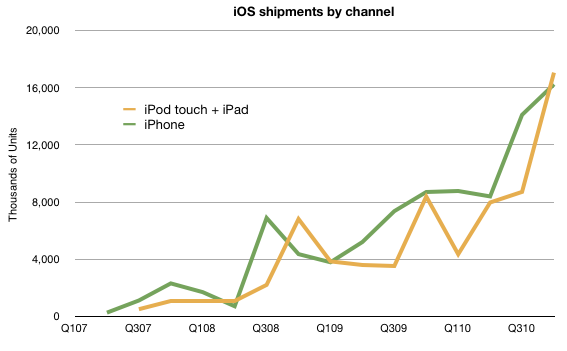
    As iPad shipment volumes increase and as the iPod touch becomes the de-facto iPod, it's time to look at the overall split between iOS devices.

    I will focus the discussion between iPhone and iOS "others" because I believe the two categories differ greatly in terms of their positioning and market strategy due to the different channels.

    The company does not provide iPod touch units shipment data but it can be estimated that, based on overall iOS numbers released in September, iPod touch represents approximately 50% of iPod units sold.

    If we put all we know together about volumes, we have the following chart:

    Note that iPod touch has, occasionally outsold the iPhone. The pattern of approximately equal volumes for the two types of products is likely to continue depending greatly on the growth rates.

    Next, I turn the spotlight on revenues.


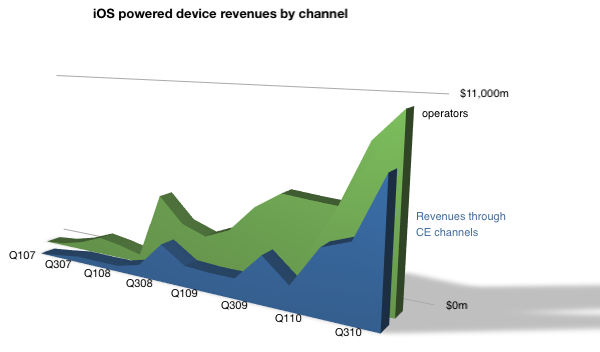
    Over $10 billion flowed in from Operators, and a bit under $8 billion from other channels.

    Note that I labeled the iPod touch and iPad as non-operator channel (Consumer electronics) distribution. Although this is not entirely true (and conversely iPhones are often sold through Apple stores) this gives a rough indication of split.

    The iPhone business is staying ahead of the other iOS businesses but the gap is narrowing.

    As previously noted, the iPhone is a unique product in Apple's portfolio. It depends on a distribution channel that no other product was designed around. This has advantages and disadvantages. The advantage is a high margin due to service revenue sharing but the disadvantage of network incompatibilities, politics and a range of telecom-related regulations.

    What I believe is that the non-operator channel will grow as a proportion of iOS revenues. This is both as iPad grows to disrupt personal computing and as the iPad emerges as a communications tool.

    As time passes, I believe Apple is motivated to also move revenues to its traditional channels. Whether, or to what extent, cellular phones will move in that direction remains to be estimated.

  3. On Android [Updated]

    Research · 43 comments

    Demonstrating the value of openness and broad support from partners:

    In terms of openness and broad support we've done very well... Literally available on over 150 different handsets. It's available from over one hundred different mobile operators around the world. We will probably license about 20 million devices this year which is really quite dramatic at least among smartphone systems. So we have great momentum. We've brought [a new version] to market. We're driving forward on our future releases. We'll have to see what [the competition] does. Right now they have a press release [...] We have many many millions of customers, great software, many hardware devices and they're welcome in our world.

    Inspired by a tweet from Charles Arthur.

    [Update]

    The quote is Steve Ballmer speaking in 2007 soon after the announcement of Android and in response to a question of what he thought about Android. The source video is here.

  4. Flummoxed, again

    Research · 184 comments

    The last time I took a snapshot of the iPad death watch it was March 9th, 2010. Almost a year ago. The now-classic quotes are reproduced here.  Last May I wrote:

    Apple keeps a tight lid on new products so that competitors don’t get a head-start on copying, but in the case of the iPad, advance knowledge would not have had any impact. Competitors look at the iPad and see nothing.  They’ll only react once the market explodes and they start to feel belated pain.

    I thought that would be that. As the success of the product would become self-evident, predictions of imminent demise would trail off. The pain of share loss would prompt a wave of challenger copycats. Imitation would be the the best form of flattery.

    But no.

    Critics were not silenced. One year, 15 million units, and $9.2 billion later I went back to the source of the quotes and found the following (published quotes dated after March 9th 2010). (Cited from aaplinvestors.net with some editing for brevity and relevance):

    “Problematically, the Android competition is just as expensive as the iPad lineup, so Apple obviously feels free to continue gouging consumers on iPad pricing.” Paul Thurrott, Windows IT Pro, 3 March 2011

    “Apple’s iPad 2 might be ‘magical’ but it still should’ve been better ... It needs more G’s. It’s still just a toy” Zach Epstein, Boy Genius 2 March 2011

    “11 reasons NOT to buy an iPad 2 ... Reason 5: Competition David Gewirtz, ZDNet, 23 February 2011

    “Given what I’ve seen of Honeycomb and Motorola’s excellent tablet, Cupertino will have some serious catching up to do with their iPad 2.” J.P. Mangalindan, Fortune, 4 February 2011

    “We very carefully chose our tablet processor, the Nvidia Tegra 2, and to really compete it will take [Apple] some time. You know, [Nvidia] is well known for graphics.” Jonney Shih, Asustek Computer, 3 February 2011

    “If you were to ask me in two years time, will Apple have less than 50 percent of the global tablet market, I think that’s a certainty. Neil Mawston, Strategy Analytics, 31 January 2011

    “We have an extreme focus on the innovation of LePad and LePhone because these products will dominate the future market. Though Apple is winning a significant share in the Chinese market, it has not gained a clearly leading position yet. Our advantage is we know this market better.” Liu Chuanzhi, Lenovo, 27 January 2011

    “The iPad may still be the lone leader, but with 100+ competitors on the way, it won’t likely keep its majority market share unless the pending next generation iPad really addresses all the complaints about the current version, like a missing camera and a lack of a USB port, and the company has to add those features without a major price increase - a tall order, to be sure.” James Brumley, Investopedia, 13 January 2011

    “Hands-on PlayBook demonstrations at CES showed its differentiation in multitasking and performance, which may be difficult for Apple/Android to rival.” Mike Abramsky, Royal Bank of Canada Analyst, 11 January 2011

    “Apple Inc.’s popular iPad is getting its strongest competition thus far as consumer-electronics manufacturers unveil tablet computers with bigger screens, front-facing cameras for video chatting and more.” Rachel Metz, AP Technology Writer, 3 January 2011

    Apple may be simply trying to get in ahead of Research in Motion’s aggressively priced PlayBook or combat the early success of Samsung’s Galaxy Tab.” Rick Aristotle Munarriz, The Street, 29 December 2010

    4. Competitors are coming. Brett Arends, Wall Street Journal, 22 December 2010

    Reason 6: WiFi is still unreliable David Gewirtz, ZDNet, 16 December 2010

    “I can’t imagine anyone under the age of 30 wanting an iPad. A PS3, Wii, GameBoy, or even a useful laptop maybe, but an iPad? Furthermore, I do not recall ever seeing anyone under 30 actually using an iPad.” John C. Dvorak, PC Mag, 13 December 2010

    “We hope our tablet PCs can reach a global market share of 10-20% initially, and become the market leader in two to three years.” Gianfranco Lanci, CEO and President, Acer, 26 November 2010

    “It’s a nice-to-have product, for those of us who don’t have a budget, but is it a must-have product? I don’t think so.” Ashok Kumar, Analyst, Rodman & Renshaw LLC, 12 November 2010

    “Steve Jobs never says anything without thinking through it carefully. But I think in this case he may be a little afraid of this category. And he’s finding whatever he can to attack because he sees [seven-inch tablets] as a challenge to the dominance of the iPad.” Adam Hanin, VP Marketing, Viewsonic, 1 November 2010

    “There could literally be millions of first-generation iPads gathering dust in people’s home offices already. This product is the tech industry’s biggest MacGuffin yet.” Paul Thurrott, Windows IT Pro, 23 October 2010

    “I cannot see a need for the thing.”John Dvorak, MarketWatch, 22 October 2010

    ”For those of us who live outside of Apple’s distortion field, we know that 7″ tablets will actually be a big portion of the market and we know that Adobe Flash support actually matters to customers who want a real web experience.” Jim Balsillie, Research In Motion, 20 October 2010

    “iPhone and iPad have been amazing products that have opened new markets. But I do not think they will own either market in a few years. Android will.” Fred Wilson, AVC.com, 18 October 2010

    “The constant search for an ‘iPad killer’ and the sheer multitude of tablet computers launching in the next 18 months should make Apple aware that its competition is fierce and will only become tougher.” Barbara E. Hernandez, PCWorld, 5 October 2010

    “HP’s New Tablet Could Be an iPad Spoiler HP’s decision to bundle a tablet computer with its new $399 printer could make trouble for competitors.” Cliff Edwards and Aaron Ricadela, Bloomberg Businessweek, 23 September 2010

    “Our tablet will be better than the iPad.” Chang Ma, VP Marketing, LG, 20 August 2010

    “Not only is Apple typically lost in the enterprise, but it focuses very little of its time there. And with a new, potentially more compelling tablet coming — the Cisco Cius — the iPad’s success in the corporate world could be short-lived. Here’s why:... 10 The power of Windows” Don Reisinger, Channel Insider, 5 August 2010

    “I don’t think there is one size that fits all…I’ve been to too many meetings with journalists who spent the first 10 minutes of the meeting setting up iPad to look like a laptop.” Steve Ballmer, Microsoft, 29 July 2010

    “ [...] It still isn’t the device that I’d take to a meeting because it has no input.” Bill Gates, Microsoft, 2 June 2010

    “Which means I end up on the iPad — and tablets more generally — where I started. Tablets will not create a new category, but will supplant (or merge with) one or more of the current substitutes: smartphones or netbooks.Here I am less optimistic about the iPhone and webOS than I am about Android. ” Joel West, professor of Innovation & Entrepreneurship, College of Business at San José State University, 30 May 2010

    “The iPad is useless. Beautiful, but useless. The iPad is too heavy. It’s awkward to hold and view in public. It’s fragile. It requires expensive accessories to protect it and extract more functionality. ”Josh Belzman, MSNBC.com, 20 May 2010

    “Mum, the iPad is not ‘amazing.’ It’s just marketed very well, both by Apple and its culpable partners in mainstream media. ” Paul Thurrott (in response to comment by Mum), Paul Thurrott’s Super Site for Windows, 26 April 2010

    “In short, I don’t get the ‘magical and revolutionary’ vibe that Apple chief executive Steve Jobs touted at the iPad’s January unveiling.” Rob Pegoraro, Washington Post, 9 April 2010

    “The first troubling sign is the fact that you can still get an iPad today. They didn’t sell out. The pure slate form factor has failed all these years because, other than for vertical applications, people want and/or need a keyboard for regular use. The fact of the matter is that a touch screen or bluetooth keyboard just doesn’t compensate.” Jonathan Yarmis, Ovum, part of Datamonitor Group, 6 April 2010

    “I don’t get it. It costs $500 for the basic model, when you could get a laptop with a lot more functionality for about the same price. The iPad hype machine has been in full effect this week, and I still think it’s just that—hype. ” Alex Cook, Frontier Outlook, 3 April 2010

    “As far as what this means to Apple, one thing to keep in mind: Even if the iPad sells more than the iPhone did in its first year, it’s still only around 5% of the company’s revenue. So it’s a very small slice. From there, it probably doesn’t grow as large as the smartphone market. So, if you’re buying under rumors, keep perspective in mind. The iPad’s a great product, but it’s probably not a game-changer.” Eric Bleeker, Analyst, Fool.com, 31 March 2010

    “The iPad will remain an expensive, niche device compared to all-purpose netbooks.I think that one of the iPad’s most important uses will be for reading ebooks and publications. Even so, though, when it comes to the marketplace, netbooks will sales still far outstrip those of the iPad.” Preston Gralla, PC World, 30 March 2010

    “Don’t Believe the iPad Hype. Apple has sold out pre-orders of the forthcoming device, but it could all be a marketing tactic. By not manufacturing enough iPads for the initial launch date, is this a case of Apple shooting itself in the foot?” Mike Schuster, Minyanville.com, 29 March 2010

    “‘iPad Killer’ May be Palm’s Last Hope”Tom Bradley, PC World, 20 March 2010

    “Even if your company has relented and now supports the iPhone, as growing numbers of businesses do (70% of the Fortune 100 are at least testing it, says Apple) you’ll want to say “No” to the iPad and other tablets. Here’s why: 8. Speaking of money, there is no money in the company budget to pay for iPads. 9. Not supporting iPad will be the enterprise norm. Robert McGarvey, CIO Update, 16 March 2010

    “This morning, the fool’s parade gets started. Apple is taking online “pre-orders” for its iPad tablet, which is supposed to begin shipping on April 3. Buying a new kind of product sight unseen is foolish. Especially given how mysterious Apple has been on what the iPad can do and what restrictions on capabilities and media access it will place on users and content providers.” Galen Gruman, InfoWorld, 12 March 2010

    “The recent launch of Apple, the iPad tablet, has won the award for the second edition of Fiasco Awards delivered this Thursday in Barcelona. From the more than 7,000 people who voted via the website www.fiascoawards.com, 4,325 have considered it the fiasco of the year. Fiasco Awards, 2010, 11 March 2010

    “I think I’ve mentioned this once or twice before, but it bears repeating until it sinks in: the Apple iPad is not unique, nor necessarily the best of breed in the media tablet sector it is spearheading. And it ain’t gonna help Apple shareholders any.’” Anders Bylund (TMF Zahrim), 11 March 2010

    From this critical review, it looks like 2011 will indeed be the year of the iPad 2.
  5. iTunes App Store generated $3 billion in sales

    Research · 33 comments

    The announcement of $2 billion total for App store payments to developers did not come as a surprise. On January 22nd Apple reached 10 billion total apps downloaded. From that figure and an earlier derivation of the average selling price, I estimated $2 billion was paid out around the same time frame.

    We don't know exactly how many apps have been sold at exactly the moment when $2 billion was paid out so we don't have the means to update the ASP of apps (currently estimated at 29c).

    We do know for certain however that the app store generated $2.86 billion in sales if $2 billion was paid out.

    The new data affirms existing estimates.

  6. Android vs. Windows Phone: Which vendors benefit?

    Research · 32 comments

    Who is Winning the U.S. Smartphone Battle? | Nielsen Wire.

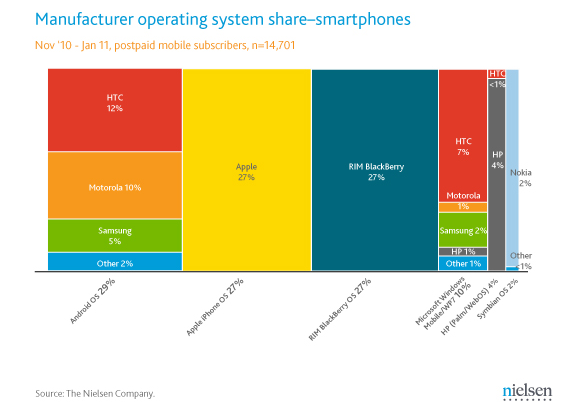
    This is a great chart from Nielsen showing the split in manufacturer share by OS in US installed base. What I consider significant is how the modular software platforms Windows Mobile and Android worked out for the licensees.

    Whereas in the case of Windows Mobile HTC took a significant, nearly dominant share, the Android ecosystem was more balanced between HTC and Motorola. However, HP and Motorola left the Microsoft camps, Motorola going exclusively for Android and HP buying Palm. That leaves Microsoft with HTC, Samsung and Other (mainly LG I presume).

    The question of how Windows Phone will shape up vs. Windows Mobile and Android remains. Motorola has signaled they are not interested in WP7 for the time being and so it's likely that they will stick with Android. Samsung is always hedging its bets so it will probably balance its portfolio. One could conceive of Nokia stepping into the US with significant WP volumes, but there are many hurdles on the way.

    One can see the challenge individual modular vendors have to edge the overall volumes of the integrated vendors. As Nielsen points out:

    But an analysis by manufacturer shows RIM and Apple to be the winners compared to other device makers since they are the only ones creating and selling smartphones with their respective operating systems

    Not only are the volumes higher, but so are the margins and hence profit share.

  7. Apps are 15 times more popular than ebooks

    Research · 71 comments

    “It doesn’t matter how good or bad the product is, the fact is that people don’t read anymore,” he said. “Forty percent of the people in the U.S. read one book or less last year. The whole conception is flawed at the top because people don’t read anymore.”

    The Passion of Steve Jobs - NYTimes.com

    It was almost exactly three years ago that Steve Jobs dismissed the Kindle reader as a futile attempt to change user behavior.

    Yesterday, Steve Jobs announced that the iBooks store served 100 million ebooks in its first 11 months of operations.

    So do we have another example of Steve's classic misdirection where he dismisses a category only to enter and dominate it at some later time?

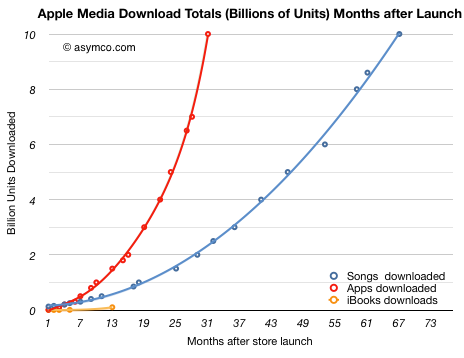
    Let's look at the data. The chart below shows the sales ramp of three media types served by Apple: songs, apps and books.

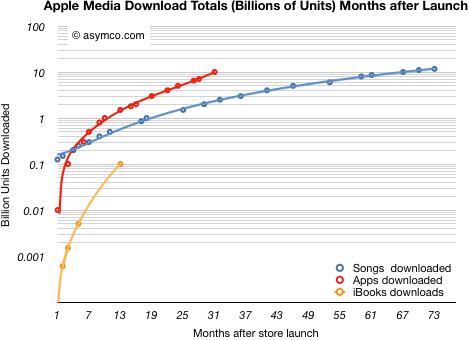
    At the same point in time (11 months post-launch) there were five times as many songs downloaded and 15 times as many apps downloaded as ebooks. You can see the relationship between different media consumption more clearly on a log chart:

    The conclusion that can be drawn so far is that apps/songs show an order of magnitude more popularity than ebooks. Perhaps Kindle ebooks outsell Amazon music downloads, but we don't have comparable data from Amazon and it would be a challenge to compare the two Amazon media as they are packaged and dlievered in different ways (Amazon's digital music is not an integrated offering while their ebooks are.)

    Books are a 400 year old medium. Songs only 100 years old and apps a mere 10. For three centuries, the book medium had a monopoly on solitary entertainment. The download data shows how quickly new media displace the old. Therefore, in this context, it's perhaps fair to say that Steve was right three years ago when he said "People don't read anymore."

    Today he could add that people use apps instead. Many of the apps available are hired to do the same job for users: solitary, immersive entertainment.

  8. Lookout ZTE and Huawei: Here come NEC, Sharp and Kyocera

    Research · 29 comments

    Sony Ericsson, NEC and Kyocera are among the other Japanese handset makers also betting on Android as their path to international sales.

    via Japanese Phone Makers Look to Ride Android’s Surge - NYTimes.com.

    The Japanese positioning is based on the notion that current Android phones are not good enough and that they can bring "great hardware, great R&D and great engineers" to solve the existing problems with Android portfolio phones.

    That's an interesting observation by Google's own director of Android Global Partnerships. The idea that the market can still reward hardware innovation would also imply that Apple could benefit from that demand.

    So is the message that there is still room for device innovation?

    Perhaps not. Perhaps Android's pursuit of Japanese vendors (and vice-versa) is just evidence of the rush into smartphones by those possessing excess hardware R&D and manufacturing capacity and a deficit of software assets.

    It's still striking that there are hundreds of hardware vendors and supposedly "only two" platforms.

  9. Nokia: We depend on uninformed customers, deception preserves brand value and uncompetitive software will keep us competitive

    Research · 99 comments

    In a previous post I asked whether Nokia's strategy is dependent on a "built-in assumption that end users are inherently stupid."

    Nokia confirmed that this is indeed the case.

    “Millions of consumers are oblivious to the announcements that we have made,” she said. Those consumers value Nokia’s brand, she said, and will continue to buy devices provided the company keeps making competitive products.

    via Nokia's Jo Harlow on the Move To Windows Phone, the Future of Symbian and More | Ina Fried | Mobilized | AllThingsD

    There are three statements being made:

    1. Nokia is counting on uninformed customers, not just end users but the shops and operators which will keep stocking the end-of-life product lines. There needs to be a conspiracy of stupidity for this plan to work.
    2. Nokia's brand will survive even after customers are deceived into buying lame duck products. The idea that buyers value a brand that is offering products that the company does not believe have a future is cynical.
    3. The absurd implication that Nokia's products will be "competitive" even though management asserted clearly and emphatically that the software they run--the very basis of competition for any smartphone--isn't. If a smartphone is expected to be competitive even though its software isn't then it's not competing on the basis of software. If it isn't then how smart is this smartphone?

    One gets the sense that Nokia is undergoing significant ethical decay.

    [UPDATE]

    To paraphrase the ethical dilemma:

    "We want a three horse race. We're not there yet. In the meantime we have a sturdy donkey that can still walk. We expect 150 million people to bet on it."

    [UPDATE 2]

    I take issue with the ethics of jumping off a burning platform while selling tickets to tourists to come visit.

  10. Asymco Interactive

    Research · 5 comments

    Ever since I started publishing this blog there have been requests for access to the underlying data sets. That's not an easy thing to do. Spreadsheets are not "productized". It's very hard to explain how to use one and even harder for charts. Having been an user of commercial spreadsheet models, I know that it's a massive undertaking to produce and support them. Many large companies can afford this but few individuals would be willing to pay $15,000 for an analyst's data.

    In many cases even at large companies professional information services staff are employed to master the data sets and answer questions for the general user. The complexity and cost of comprehensive market research is a huge burden for innovation in analysis.

    As an independent analyst, I've struggled with the question of how to provide this access to a large audience on any device.

    Fortunately, modern browsers have the capability to allow interaction with rich charts. Inspired companies are taking advantage of this and implementing data viewers which extend the way users can visualize complex data. Timetric is one such company.

    Over the past few months we've worked together to find a way to deliver Asymco charts and data as an interactive and downloadable product.

    Our first result is this report: Mobile Phone Market Overview: Q4 2010

    The video below highlights the main features of the Asymco Interactive report:

    httpv://www.youtube.com/watch?v=maNxiXmKVTA

  11. Why operators will find it hard to sell tablets

    Research · 107 comments

    On the eve of iPad 2.0, it's time to think again about this curious new computer. My intuition tells me that this product category will behave very differently from the iPhone and will not be subject to the same sales ramp.

    The iPad has been on the market for less than a year but it's still a puzzle for many. It's a product that's often seen as an iPhone product line extension. From a hardware point of view, it certainly seems to be. It has an almost identical internal architecture and uses almost the same software. An engineer would look at it and reasonably say it's the same thing.

    However, from the way it's used and the way it's sold, it has very little in common with its smaller cousin. There are plenty of experts who can detail how the products are used differently, but I would highlight the portability of the iPhone makes it suitable for a completely different set of tasks than the less portable but more immersive iPad.

    But what I want to dwell on here is how differently the products are sold.

    I'll build the case from evidence that Apple provides. The most important observation is that the iPad is an unlocked product. Although you can hire an operator to provide you with data services for it, the product is designed not to rely on that. As a result the product is effectively "divorced" from the operator channel. This means it does not typically benefit (or suffer) from subsidy.

    This may seem an interesting side-note to the iPad story, but I think this is a central pillar of the market strategy. The iPhone was designed around a high-ARPU data plan. I've even suggested that the iPhone is nothing more than a data plan wrapped in glass and polished metal. Because it was designed to enable migration of cellular voice users to data plans, it's priced to skim profits from the migration. At some future point in time when a skimming strategy is no longer optimal, the iPhone might be re-positioned for penetration, but that time is not now.

    As part of a skimming strategy, the iPhone has a limited distribution channel. It's only sold through special agreement with selected operators. Again, timing is crucial. That channel is expanding, but for nearly four years the product has not been positioned for sale through any channel other than Apple retail and Operator retail.

    On the other hand, the iPad is marketed for penetration. It had a low price and an unlimited distribution strategy. It could be sold through any consumer electronics product point of sale. And then some. It could conceivably be sold through as many if not more points of sale as the iPod (i.e. tens of thousands.)

    It can be sold in any country, can be distributed through middlemen and can be priced arbitrarily [1]. It can be bought in bulk by companies or schools or hospitals. It can be re-sold in a secondary market. It is essentially a perfectly liquid commodity.

    Now we can step back and ask why and what are the implications for competitors.

    The reason the iPad was positioned asymmetrically to the iPhone is, I believe, because it could be. I believe that the iPhone is sold the way it is (through operators) because that's the only way it could be sold effectively. Cellular products have always come with lots of fine print, footnotes and asterisks rooted in the regulatory environment that underlies the industry.

    The iPad is a product built and sold along the lines of the Mac and the iPod--unrestricted by orifices and aligned with the unregulated environment that computers have always enjoyed. Essentially, for the iPhone, Apple chose to go along with the telecom industry's rules but as soon as it had a product that did not need to comply to those rules, it ran back to its comfort zone: control.

    If we take this to be the cause, the implications for competitors become clearer. Apple is more in its element selling the iPad than it is in selling the iPhone. Other tablet contenders however are in an opposite strategic stance. Almost all the credible tablet alternatives rely on the telecom channel for distribution. The rush to build iPad alternatives is as predictable as the derision that was poured on the product when it was launched.

    But the alternative products are positioned in different ways. They are positioned as big phones.

    Which brings me to my final point: selling big phones is hard.

    These products are not compliant with what users expect from an operator: a service plan. As a result they are also not competitively priced with the iPad. Apple engineered a price for the iPad that makes comparisons extremely favorable. Buyers know the thing they are buying is not a phone so they look at the price carefully.

    But the most crucial weakness of alternative vendors is the fact that operators don't know how to sell tablets. Tablets are small computers. They are bought in the same way that buyers buy laptops: in-store testing. Notice that except for the iPhone operators only provide phone mockups in their stores. This is because they want buyers to discuss their purchase with a sales rep. This is not the way laptop hunters shop. Another tell-tale sign of a disconnect between operators and tablets is that operator shops are physically tiny. PCs (and tablets) need large tables for users to look, touch, heft and fondle. Just on square feet alone, operators and tablets are not a good match.

    If you need any more evidence, consider the plight of operator-subsidized netbooks.


    ---

    Notes:

    1. I realize that this is not currently true and the distribution is limited but that's only a matter of supply constraints. There is no theoretical positioning limitation.