Asymco

Asymmetric Intelligence

Research

  1. Which mobile users will platforms harvest first?

    Research · 23 comments

    When tallying up the race to a billion users, I noted that both iOS and Android seem to have the potential to reach that size of user base. However, that raises the question of where those users will come from. We have to note the fact that there aren't a billion users to be captured today.

    If not today, then how soon, and where are they?

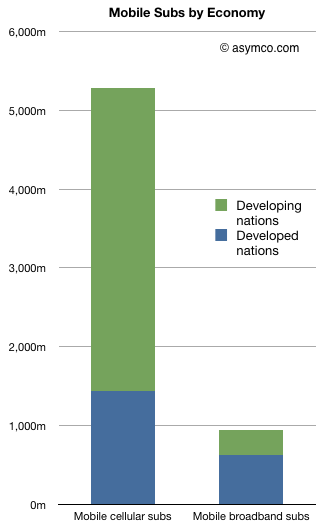
    The first question is who is addressable. If we stick with mobile cellular subscribers, there seem to be plenty of users (at least 5.3 billion as of October 2010 according to the ITU). However, the number of "mobile broadband" (i.e. 3+G network subs) is about 940 million. The chart to the left shows the difference and adds the subdivision between developed and developing economies.

    Over half (51.1%) of developed nations' populations have signed up for mobile broadband while only 5.4% of developing country populations are on 3G. And whereas developing countries have added 2.6 billion mobile subs in 5 years, they added only 293 million mobile broadband (MB) subs. Developed nations added 574 million MBs in the same time frame.

    As a result, two thirds of mobile broadband subscribers reside in developed nations as of 2010. This number will decrease rapidly as MB penetration reaches saturation in developed countries, however the race to a billion is being run in these markets first.

    Which leads back to the question of platform potential. Platforms that target developing nations have the challenge of low broadband availability in the near term in addition to the challenge of device pricing. There are still 800 million developed country subscribers who have yet to upgrade to mobile broadband.

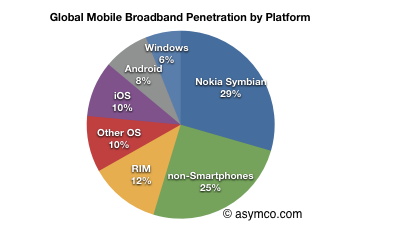
    At the time these statistics and knowing the platform sales histories, my estimate is that only 18% of mobile broadband subscribers were using either iOS or Android. 25% were not even using a smartphone and 29% were using Symbian. (See pie chart).

    But existing smartphone users are not the most attractive market to target with a new platform device.

    A new smartphone user could come from the following groups of users:

    1. Existing smartphone users:  700 million. This is tough head-to-head competition for every new user.
    2. Existing mobile broadband users who are not smartphone users: 240 million. The easiest group to switch to using smartphones.
    3. Developed nation mobile subs who don't have mobile broadband or smartphones: 800 million. This seems very attractive since they can be mostly upgraded using subsidized phones into an available 3G network.
    4. Developing nation mobile subs who don't have mobile broadband or smartphones: 3.5 billion. This is a very tough market because the availability of 3G will take time and until it appears, the buyers are unlikely to adopt devices that are useful only though a 3G data plan. They are also a difficult market to target with high ARPU phones/plans.

    To assess the timing, one could assign some probability weights to these categories to create various scenarios for adoption. My own guess is that the next 500 million smartphone users are easily within reach in the next two years without a significant amount of inter-platform rivalry (See stacked bar chart to the left).

    Only after two years will existing smartphone users become attractive for poaching and even that assumes that developing nation networks will still be largely unaddressable.
  2. Ads for ads: The ad-supported app bubble

    Research · 25 comments

    By one estimate (Gartner), about 81% of apps downloaded today are free. The way free apps are able to generate revenue is through advertising. 16 percent of application store markets' $5.2 billion revenue was generated from advertising.

    But advertising what?

    It seems that most of the ad dollars spent on in-app ads are spent by developers to promote other apps. I'd like to get hard data to prove this, but assuming it's true, we have to ask if the apps being promoted through ads in apps are free apps seeking more revenue from ads...from other apps.

    To put it bluntly, the $816 million that "comes from advertising" is not coming from consumers but churning around the ecosystem like a hot potato. This figure is said to triple this year.

    It's arguable that this is only logical. App users are pre-qualified as app downloaders so it makes sense to target them through apps for more apps. But where does value actually flow into the ecosystem from consumers? This problem of commerce through apps being nothing but virtual app goods implies that there is a bubble forming. This is more likely to be a problem for Android as the ratio of advertising to purchase of Android apps is higher than on iOS, but it's a problem for all app advertising.

    It's even more ironic that the developer looking to create revenues through their app is promoting competing apps seeking the same user.

    I don't see how this can end well.

    The only way ads really work is for users to transfer cash for underlying value. Aside from paid apps which have entertainment or functional value, how much spending from traditional ad buyers (brands) is targeting apps? Perhaps transitioning ad buyers is what Apple had in mind a year ago with iAd. Signs so far are not encouraging that their approach is working. That may be bad news for Apple, but it's worse news for AdMob.

  3. Talent follows where business models lead: The Media Business Disruptions

    Research · 46 comments

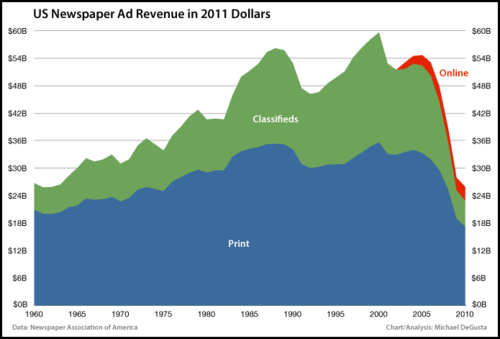
    Michael DeGusta created beautiful and informative charts on how The Newspaper Business Implodes.

    With charts, he also told the story of how the recorded music industry followed a similar path:

    Image (media.tumblr.com)

    He writes:

    As in the music business, digital revenue is failing to make up for the loss of traditional revenue. Ominously, online revenue is largely flat, basically unchanged from 5 years ago and still below its 2007 peak.

    What I find fascinating is how both industries reacted to the crisis of old media. They embraced the new "digital" distribution model, earnestly tried to transplant their business models and found no succor.

    Many observers may say that both print and music businesses were "foolish" and that they ignored the new medium of web. That somehow management dithered and missed the new wave blaming failure on incompetence. Putting aside the fact that all industry participants seem to have conspired to be foolish at the same time, this is not supported by the data. As the charts show, both industries built digital businesses. Newspapers have some of the most desirable web properties and digital music is a growing business with clever new distribution deals. They became quite smart in their respective adaptations of web distribution.

    They may have started slowly but there are many cases where incumbents reacted slowly to technological change, and won.

    But it's not working.

    The reason is that what we have here is a disruption. Unlike a sustaining technological shift, the new medium of the web did not permit the same business models to continue. Money was being made, just not in the same way and thus could not support the cost structures of the incumbents. Consumption of news and music is increasing but the way that it is valued is changing.

    Furthermore, it's become modularized. All the objects contained in a newspaper could, with the web, be offered independently of one-another (opinion, news, classifieds, lifestyle can each be built by specialists.)

    This is because the technology of the printing press benefits the integration of content while the technology of the web benefits the disintegration of content (similar phenomenon to the music industry's bundling into albums, vs. unbundling of digital downloads.)

    Now I'm going to take a leap and suggest that a re-birth of the container of the newspaper in the tablet medium will require a re-integration once again. As I've pointed out before in The integrated iPad news daily: Read all about it! the answer is not in integration or disintegration per se. It's in approaching the question of value chain evolution with an eye toward what is good enough and what isn't. Integrate when the product is emerging and unsatisfying, modularize when the product is mature and over-serving.

    We're observing the same phenomenon with television. Netflix, a distributor, is vertically integrating by entering production with an exclusive top talent series.

    Developers are not the only innovators that see disruption happening. Just like in "The Daily", in music and television, talent follows where business models lead.

  4. Who's knifing what?

    Research · 147 comments

    Microsoft just declared the Zune end of life. This makes it a good time to look back to some notable episodes in the evolution of digital media distribution. First, an episode from 1997:

    During two days on the stand, Tevanian accused Microsoft of seeking to divide the multimedia market and then "sabotaging" QuickTime's ability to work with Windows computers when Apple declined to go along with Microsoft's plan. Justice also is accusing Microsoft of attempting to illegally allocate the Internet browser market.

    In particularly colorful testimony on Nov. 5, Tevanian described an April, 1997, meeting between two Apple and two Microsoft officials. Tevanian, who was not at the meeting, said Microsoft officials suggested that Apple abandon its business of providing "playback" software that enables users to view multimedia content on the computers. Instead, they offered Apple the much smaller portion of the market for the tools that developers use to create the content. In Apple's mind, though, the playback software was its baby.

    According to Tevanian, Apple executive Peter Hoddie asked Microsoft officials, "'Are you asking us to kill playback? Are you asking us to knife the baby?'" He said Microsoft official Christopher Phillips responded, "'Yes, we want you to knife the baby.' It was very clear."

    Business Week Online/Microsoft Watch on the cross-examination of Apple's Senior Vice-President Avadis "Avie" Tevanian Jr. during the Microsoft antitrust trial.

    Ten years later:

    “We came into the [media player] market, a market in which they are very strong, and we took, I don’t know, but I think most estimates would say we took about 20-25% of the high end of the market,” “We weren’t down at some of the lower price points, but for devices $249 and over we took, you know, let’s say about 20% of the market. So, I feel like we’re in the game, we’re driving our innovation hard and, uh, okay, we’re not the incumbent, he’s the incumbent in this game, but at the end of the day, he’s going to have to keep up an agenda that we’re gonna drive as well.”

    Steve Ballmer on Zune, iPhone (CNBC interview) .

    Four years later the Zune is no more. Besides being interesting anecdotes, what patterns emerge from these episodes?

    The evolution of the bases of competition for media distribution between 1997, 2007 and 2011 is striking.

    • In 1997 the struggle was between specific modules (formats, players and technical standards.)
    • In 2007 the basis of competition was devices integrated with music services (which encompassed formats, standards and players).
    • By 2011 the competitive standard that the iOS ecosystem is putting forward is at an even higher level of integration. Not only are the sub-modules integrated into a whole, but now apps bespoke to a platform are attracting a virtuous cycle of third party innovation.

    Now consider how the two protagonists evolved (or didn't) during this 14 year saga.

    Apple has maintained its attention steadfastly on products while Microsoft has maintained unwavering focus on the distribution and control over value chains. During the 1990s one strategy worked and the other didn't. During the following decade they changed places. The locus of the two strategies did not change. What seems to have changed is what the market values.

    So we have to ask: Is the end of the Zune a matter of poor execution or is the cause for failure something more profound? Is Microsoft's real problem that they have prioritized that which is no longer valued?

  5. On Feeds and Speeds

    Research · 54 comments

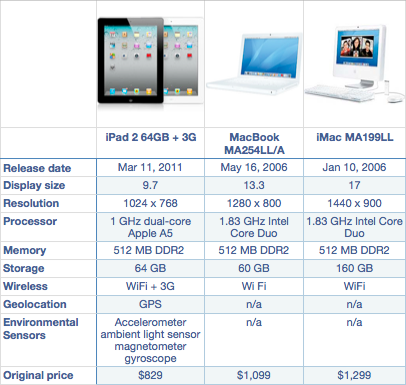
    And a lot of folks in this tablet market are rushing in and they're looking at this as the next PC. The hardware and the software are done by different companies. And they're talking about speeds and feeds just like they did with PCs

    Steve Jobs, iPad 2 launch event March 2011.

    I'm not above doing a feeds and speeds comparison.

    All the products above have dual core processors, 512 MB of memory. The iPad processor is a bit slower. The iPad also has a slightly smaller resolution screen than a MacBook from mid 2006. However, unlike the others, the iPad has cellular broadband connectivity, loads more sensors, and a battery that will last at least 5 times longer.

    It's also a lot cheaper and a lot smaller.

    Although five years old, nobody would question that the MacBook or iMacs shown above are still computers. They still run the latest versions of OS X and are probably still in widespread use.

    The new iPad is still not considered a computer by the majority of market analysts. One wonders how long this will go on. The specs of the iPad are just going to keep getting better...

  6. Star-crossed partners

    Research · 36 comments

    Until very recently, we believed our competitive position in smartphones could be improved with Symbian, as well as MeeGo, and our strategy based on those platforms. We are now of the view, however, that for the longer term our Symbian platform is not sufficiently competitive in leading markets.

    Nokia's SEC Form 20F.

    The company's fiscal year, which ended in June, was one of the worst to date for the mobile space. Although in development since 2008, the Kin was pulled after just over six weeks of sales and amounted to a $240 million write-off before including the $500 million to buy Danger. Windows Mobile's ramp down is partly intentional as Microsoft is rebooting the platform with Windows Phone 7 and is investing $500 million in marketing to spark new interest.

    Microsoft CEO bonus cut for Kin flop, lack of iPad rival | Electronista One irony is inescapable: the world's largest device company can't build commercially successful software and the world's largest software company can't built commercially successful devices.

    Another irony is that the competitive threats that both companies face came from challengers that were not perceived as such a few years ago.

    Google was not a platform vendor three years ago and Apple was not a phone vendor four years ago.

    The largest incumbents in separate industries sought salvation in each other after the market they strove to build went to unforeseen challengers. All in a span of three years.

    I cannot think of a more succinct testament to the process of disruption.

    One can only speculate about the probability of success of this pairing, however, I struggle to find a historic precedent where this type of relationship succeeded.

  7. The billion dollar Smart Cover

    Research · 105 comments

    I was only half-joking when, on first sight, I tweeted that I will buy a new iPad 2 to go with my new Smart Cover. The new iPad cover is enchanting.

    It also seems to be enchanting to many.

    I'm estimating that at least 60% of iPad buyers will get one. Based on an estimate of 36 million iPads sold in 2011 and an average price of $48 (70% polyurethane and 30% leather mix), the total revenue for Smart Covers will top $1 billion this year.

    I further estimate that with a very modest gross margin of 75% (average cost to produce of $12), the Smart Cover could contribute $777 million to Apple's gross margins.

    The iPad by itself should generate $23 billion in revenue and a contribution of $7.7 billion. That means that the Smart Cover will add 4% to sales and 9% to gross profits. If taken as a bundle, the iPad+SC will increase gross margin over the iPad alone by nearly 200 basis points (taking it from 33% to 35%).

    It will be interesting to compare the Smart Cover business with competitor tablet businesses.

  8. The Allegory of Treo

    Research · 35 comments

    The following is a work of fiction.

    The combination seemed unthinkable just a few years ago. Nokia envisioned itself as a substantial rival to Redmond, threatening to head off its computing dominance as the power of desktop computing shifted to pocket-size devices. But a series of miscues substantially weakened the company, leaving it little choice but to team up with the world's largest software maker.

    Although Nokia has pledged to continue using the Symbian OS in both handhelds and phones, the company has now significantly tied its fortunes to the rival it once denounced.

    In doing so, Nokia is making a tough bet. The company is gambling that Microsoft's operating system has advanced far enough to power a decent cell phone, while still having enough rough edges that Nokia can carve out a niche by going beyond the standard Windows Phone software. In doing so, Nokia hopes it can avoid the fate of being just another clone cranking out hardware on Microsoft's behalf.

    Microsoft, meanwhile, has scored a significant win in its decade-long quest to crack the mobile market. In wooing Nokia, Microsoft has brought a one-time rival into its fold and ideally gained a new creative force as it tries to move its PC empire into the burgeoning market for cell phones.

    "Nokia always did great work, and so we lusted after some of those things that they do well," Ballmer told reporters at Monday's launch.

    The partnership is not totally out of the blue, of course. The two companies offered a glimpse at the detente last year, announcing a pact that allowed Symbian OS-based smartphones to connect directly with Microsoft's Exchange servers for corporate e-mail and calendar information.

    In its secret meetings, Nokia execs managed to convince their Microsoft counterparts to build several software hooks they needed into the latest version of Windows Phone. The changes allowed Nokia to add some handy features into the Windows version of the N series phones. One new trick allows Nokia owners to ignore an incoming cell call, instead sending a brief text message to the caller. A second feature allows Nokia owners to navigate multiple voice-mail accounts using VCR-like buttons, rather than having to know that "5" is the key for fast forward or remember that "7" saves voice mail at work, but deletes it at home.

    A key question, though, is whether Microsoft will give Nokia enough room to innovate in the future, now that it has successfully wooed the device maker. By going with Microsoft, Nokia is letting go of one of the key differentiators between its products and those from better-known competitors.

    Elop said he understands the risk and only undertook it with assurances that Nokia would be able to build enough software on top of the OS to make his products stand out.

    "It was the only way we felt it could work for us," he said at the Monday press conference.

    Executives from both companies suggest that the Nokia-Microsoft relationship, forged at those meetings in Cannes and New Orleans, will continue to be close. But it remains to be seen whether Nokia will retain its individuality now that it has the Microsoft imprimatur.

    Wirt acknowledges that there are no formal procedures in place that ensure that Nokia will get the things it asks for the next time, or the time after that. "It's functioned more as a relationship-type thing."

    Elop said Nokia could try to patent particularly strong advances, but in general he said the company believes the best way to stay ahead is to keep cranking out new products.

    "We have ideas about many things that we didn't get to do in this version," he assured reporters.

    But for all its ideas, Nokia is still a relatively small company. And given that it has pledged continued support for the Symbian OS, it must now divide its limited engineering resources between two incompatible efforts.

    Elop acknowledged that the challenges of developing for two entirely different operating systems are enough to keep his firm hopping. He emphatically shook his head back and forth when asked if Android and MeeGo-based Nokia phones might be next.

    "We don't need another operating system," he said, adding later, "It's too much effort."

    This fictional article was created by taking an actual article from 2005 about Palm and Microsoft (Palm's tale of Treo intrigue - CNET News) and changing the words "Palm" for" Nokia", and "Colligan" for "Elop", "Ballmer" for "Gates", "Treo" for N series (or Nokia) and "Symbian" for "PalmOS". A few paragraphs about the mechanics of the deal process were deleted.

    Credit: This tweet from Charles Arthur.

  9. The Race to a Billion

    Research · 22 comments

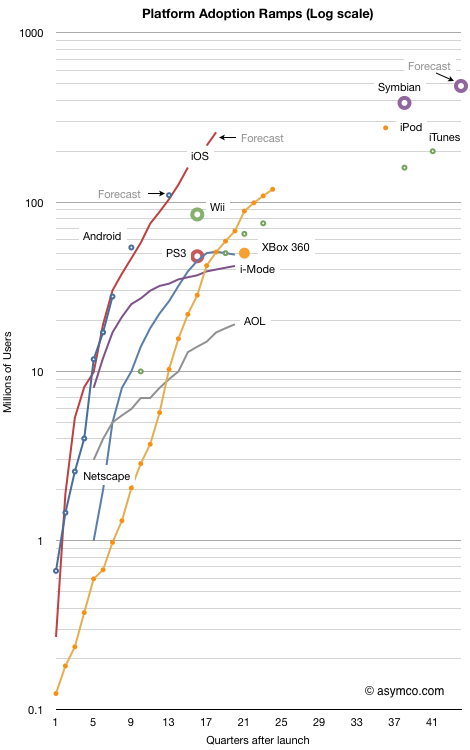
    I last looked at the race to a billion in September 2010. I've now added a few more data points to the tracked platforms and also added points for the major console game platforms and Symbian.

    The chart shows the cumulative number of users (approximated by units sold) for 11 platforms indexed to the same starting date. The horizontal axis is the number of quarters since a platform launched. Every fourth quarter is numbered so each number on the axis represents a new year. The last number on the axis represents 10 years.

    The vertical axis is the cumulative number of users on a logarithmic scale. Each number of the vertical axis is 10x more users than the previous number. The top of the graph represents a billion users.

    The overall chart shows how quickly a platform has grown and is bounded by a billion users and a decade of usage.

    When judging the performance of a platform, the adoption slope and sustainability over time is perhaps the most interesting measure.

    One can see how many platforms slow down before reaching 100 million and so far none have hit the billion mark (Windows has but not in the 10 year time frame of this chart.) Looking at game consoles also shows the limits of a narrowly focused platform. They performed better than i-Mode and Netscape but not as well as iTunes or iPod which themselves have growth limits.

    If you're looking for the "fastest growing" title, it's a toss-up. Both iOS and Android are following almost identical trajectories.[see Notes]

    The absolute highest cumulative sales total is Symbian, though now that it's been deprecated, it's set to be bypassed.

    It does appear that Android and iOS each have the potential to reach a billion users in less than a decade. Perhaps Android will do so faster but the mobile computing platform race will not play out as the personal computing platform race did.

    ---

    Notes:

    1. For Android I used my own summary data for historic performance except for the last estimate and forecast which came from IMS Research.
    2. iOS forecasts are my own.
    3. Symbian data comes from VisionMobile. Forecast is based on Nokia's 150 million additional sales prediction.
    4. Game console data is current as of end of 2010 via Wikipedia.
    5. Other data sourced from Morgan Stanley.
  10. The skill of strategy analysis: Uncovering company priorities

    Research · 86 comments

    John Siracusa dusted off an interesting quote from a former Microsoft employee.

    Spolsky: But synergy…there are also negative synergies. In the case of Microsoft they call it "strategy tax." Where, like, the Internet Explorer team is not allowed to fix the DHTML editor because it might compete with Word. So they’re forced to make that continue to be bad.

    Via: The Apple strategy tax

    The notion is an interesting one and is a reframing of the metaphorical expression that those who live by the sword die by the sword: Building a business a certain way will, in the end cause it to perish by that way.

    In the case of Microsoft, the focus on their platform lock-in strategy binds them into avoiding compelling opportunities and, even more tellingly, keeps them from improving existing products.

    It's tempting to suggest that this "strategy tax" also applies to a company like Apple when it seems to act irrationally or sub-optimally to some arbitrary definition of optimality.

    However, what if Apple's motives are not "strategic"? What if Apple actually does act in a way to optimize what they perceive to be important: the end user experience or as I like to call it "the product".

    What if "the product" is dogma and nothing is allowed to compromise it?

    This question is not designed to glorify or defend any one approach, but rather to ask what is to be compromised. In Microsoft's case dogmatic "strategy" means the installed base and channel cannot be compromised. In Apple's dogmatic product approach, is the relationship with partners subject to compromise? Is the platform itself compromised?

    I would argue that yes, the product-focused company has to "pay a tax" for its product priority. It uses an approach with a huge built-in opportunity cost. But I would also argue that every company has some tax to pay for its priorities.

    Ultimately, every company needs to decide what is important and to pay the tax for not doing what is unimportant. Business management, like engineering, is about compromise and the choice of trade-offs. Outside observers, unaware of what the company's priorities really are, will always find it puzzling why companies do what they do. But to insiders, the puzzle is why anybody would do anything else.

    The most important skill for an analyst, and that which separates her from the casual observer, is to determine what the company's priorities really are. Interestingly, many companies don't clearly state their priorities and may not even be aware themselves of what they implicitly are.

    I believe that there are deterministic ways of uncovering priorities and categorizing companies according to them. I believe that knowledge of priorities leads to a more precise understanding of strategy and competition. I hope that within this forum, I can share and provoke debate over these methods so that these skills can become more commonplace.

  11. What's a Post-PC device?

    Research · 86 comments

    Microsoft's Steve Ballmer argues that the tablet computers (aka slates, media tablets or iPads) are PCs. Steve Jobs argues that they are post-PC devices. There are analogies to trucks, cars and various metaphors for what these new devices symbolize. Some argue that because the iPad needs a PC, it's not a post-PC device.

    But how to define a new generation of computing? Since the PC is not the beginning of computing, it may make sense to look to the eras of computing that preceded it.

    The first post-mainframe computers worked alongside mainframes and were typically used by engineering departments (vs. the finance and accounting departmental role occupied by mainframes.) They did not require a dedicated (often external) mainframe service team and could be administered by in-department system administrators. Input was not through dedicated data entry personnel and output was not a ream of folded paper. Users could use a CRT terminal to interact with the computer directly. Digital Equipment Corporation, Control Data, HP, Honeywell, Prime, et. al. grew up in the shadow of IBM but thrived. Their products were cheaper and simpler to operate. Initially, the products were not more powerful.

    The first post-minicomputer microcomputers (also known as PCs) were used alongside mainframes and mini-computers. They were typically used for 2-dimensional spreadsheets analysis by individuals in many departments and were easier to justify cost-wise than the time-sharing cost structure of the incumbent computers. Many microcomputers were able to access mini-computers and mainframes through terminal emulation software (and sometimes special hardware boards) so they were still able to work with existing business processes. They did not require dedicated personnel for administration but had a shared support department. Input and data storage were on the "desktop" as was printing. Compaq, Dell, HP, Apple and IBM embraced this new form factor. Their products were cheaper and simpler to operate than the previous generation of computers. Initially, the products were not more powerful.

    The first post-microcomputer tablets are used alongside microcomputers for tasks such as presentations and entertainment. They have software available that allows access to desktop computers and services dependent on PC-architectured servers. They depend on PCs for data backup and software updates. They do not require IT support. They do not require a keyboard or a desk. Apple and many mobile phone vendors are embracing the new technology. They are cheaper and simpler to operate. The new products are not more powerful.

    To define a new generation of computing by its isolation and exclusion of the previous generation is not sustained by the history of computing.

    I would suggest that the definition of a new generation of computing is that the new products rely on new input / output methods and allow a new population of non-expert users to use the product more cheaply and simply.

    I might add that the consequences of each generational shift are:

    1. Consumption increases
    2. Skill required decreases
    3. Support required decreases
    4. There are new applications and use cases
    5. The economics are not favorable for incumbents
    6. The economics are favorable for new entrants
    7. The older generation slowly fades through diminished growth but never disappears