Asymco

Asymmetric Intelligence

Research

  1. Two turkeys don't make an eagle, but no penguin will ever soar.

    Research · 155 comments

    Vic Gundotra of Google tipped off the world two days in advance that on Feb 11 Android would play no part in Nokia's strategy. To be sure, Elop said that Nokia didn't choose Android because of "differentiation challenges and commoditization risk" (begging the question of how these challenges and risks are mitigated by licensing another openly available OS).

    But I won't weigh the merits of one module vs. another. Rather, the more pertinent discussion should be on why license instead of build. Clearly, Nokia threw in the towel. Not because they could not build, but because their building processes could not create greatness.

    But can greatness ever come from modularity? I've argued that it can't. I'll maintain that argument as long as what is being built is not good enough. In other words, as long as innovation remains relevant, improvements will be absorbed and rewarded. Once innovation exceeds what can be absorbed, the basis of competition will shift to convenience and price which are best served with a modular business architecture.

    Android is a fast follower. The first Android prototypes looked like Blackberries because that was the input paradigm of 2006. When capacitive touch was shown to be a better input method, Android reacted swiftly. When app stores created a new medium Android reacted swiftly. When the iPad demonstrated that computing can be done in new settings, Android reacted. At such time when there will be nothing to follow Android will be the king of the last commoditized innovation, but as long as there is something worth inventing Android will be there to reproduce it.

    This is not a judgement, but an observation: Nokia and Microsoft may not make an Apple but neither will Android ever create the future.
  2. Changing places: Microsoft trades HP for Nokia

    Research · 56 comments

    The juxtaposition of HP's strategy of increased independence and Nokia's new strategy of increased dependence can't be more striking.

    HP is probably Microsoft's biggest customer. As the largest licensee of Windows it probably generated more revenue for Microsoft than any other company. The fact that HP invested in a new operating system for its mobile efforts shows a level of discomfort with the lack of strategic leverage.

    Nokia, on the other hand, has been resolutely independent in its software strategy. For over a decade it held out against licensing any OS, especially one from Microsoft. The pantomime theatrics that took place over that decade will make a great case study some day.

    But now we have a complete reversal of roles: The abandonment of platform independence by a mobile giant at precisely the same time as the acquisition of platform resolve by an IT giant.

    It seems almost poetic. And that should be a clue. Whenever you see poetry, you need not look far for some truth.

    These chess moves are taking place in the context of a greater game: the collision and disruption of IT and Telecom. It's not surprising that massive market forces are causing incumbents to react. HP, Microsoft and Nokia are in the throes of fundamental disruption. Even if these moves may not be all in the same direction, they each react in ways that make sense to them.

    It's also very likely that all the moves are for naught. Incumbents rarely win with reactions. Let's not forget that the entrants came with different business models. Apple and Google are not making money in the ways of Nokia and HP (who are channel dependent) or Microsoft (who is license dependent). The reaction must itself be asymmetric. So far it's not clear where the asymmetry lies.

    Read more:

    HP/Palm’s Rubinstein believes in integration

    WebOS: HP, and HP Only. QNX: RIM and RIM Only

    HP’s PC group spends 0.7% of sales on R&D

    The reason Robbie Bach was fired

  3. Visualizing jumping off a burning platform

    Research · 75 comments

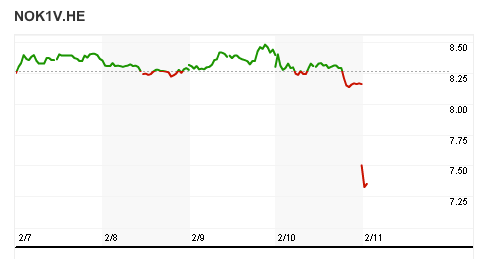
    Here's what a platform jump looks like:

    The devil is in the details. Although there was great excitement among investors at the prospect of platform agnosticism, the reality of the press releases shows that Nokia may have some significant short term pain.

    First problem is that Symbian phones have become feature phones. They have zero platform value and will therefore have no opportunity for premium pricing. This is a risk to the bottom line.

    Second problem is that we don't have any indication when any competitive WP7 phones will ship. It could be years for the "catalytic" effect of a new ecosystem. As observers of Microsoft press-release-ware will note, these types of "strategic relationships" don't pan out half the time.

    Third problem is that the organization does not look all that different. One or two executives changed seats and one is gone, but this is not a new dream team.

    Fourth problem is that there is no clarity on any long term win for Nokia. Maps licensing seems like the only possible new source of revenue and a minor one at that. What competitive advantage did Nokia just gain? Is there any advantage Nokia has over any other licensee of Windows Phone?

    Perhaps management will address these issues, but strategy takes a long time to bear fruit and the new announcement doesn't have any short term wins.

  4. A review of Asymco Predictions on Nokia’s new platform strategy

    Research · 25 comments

    Predictions on Nokia’s new platform strategy: new OS for the US | asymco.

    Here are my predictions from January 27 for the February 11 Nokia strategy announcement followed by the actual quotes from Nokia's press release:

    • Prediction: There will be a multiple OS strategy.

    Actual: The following sub-units [make up] Smart Devices: Symbian Smartphones, MeeGo Computers, Strategic Business Operations. To support the planned new partnership with Microsoft, Smart Devices will be responsible for creating a winning Windows Phone portfolio.

    • Prediction: The US market will be the first to see a new non-Nokia OS. I would guess Windows Phone with AT&T.

    Actual: "Plans for a broad strategic partnership with Microsoft to build a new global mobile ecosystem; Windows Phone would serve as Nokia's primary smartphone platform"

    • Low end devices will remain with Symbian due to price considerations for the chipsets, components.

    Actual: "Symbian becomes a franchise platform, leveraging previous investments to harvest additional value. This strategy recognizes the opportunity to retain and transition the installed base of 200 million Symbian owners. Nokia expects to sell approximately 150 million more Symbian devices in the years to come."

    • Prediction: MeeGo will be phased out in phone products but development will continue for tablets

    Actual: Under the new strategy, MeeGo becomes an open-source, mobile operating system project. MeeGo will place increased emphasis on longer-term market exploration of next-generation devices, platforms and user experiences

    More details to follow, but so far it looks like there are no surprises.

  5. The (iPod)Touch(i)Pad

    Research · 99 comments

    The world's largest PC company just launched a "media tablet[1]". Conflating the iPod Touch and iPad brands into "TouchPad" HP joins RIM in announcing an integrated OS/device product to compete as a platform vs. iOS and Android (and to some degree even against Windows).

    There are others waiting in the wings. Presumably, Microsoft is hard at work to release a tablet-compatible Windows sometime near the middle of this decade. MeeGo is also going through its gestation period targeting Atom-based tablets. John Gruber notes the excitement around tablet platforms in his article about this post-PC renaissance in computing alternatives. I also noted that the end of the PC era was marked by the end of WinTel at CES.

    In that context, yesterday's WebOS event was perhaps anticlimactic. But it's still remarkable. Consider how far we've come. Step back now and remember the dark days only one year ago when, right after the iPad announcement, a  nearly unanimously chorus was pouring derision on the concept.

    AAPLinvestors is still maintaining the iPad death watch which I took a snapshot of back in March 2010. To reminisce: It was exactly one year ago, on Feb. 10th 2010, that Bill Gates was quoted as saying "It’s a nice reader, but there’s nothing on the iPad I look at and say, ‘Oh, I wish Microsoft had done it.’" On the same day, Shannon Zimmerman of The Motley Fool wrote: "[Apple's] hamster-wheel of innovation ... may have hit a snag with the iPad." Those are just two of dozens other memorable quotes.

    I noted last May that the secrecy surrounding the iPad prior to launch was unnecessary. Nobody understood the product for months after it launched (and many still don't a year later).

    Apple keeps a tight lid on new products so that competitors don’t get a head-start on copying, but in the case of the iPad, advance knowledge would not have had any impact. Competitors look at the iPad and see nothing.  They’ll only react once the market explodes and they start to feel belated pain.

    Indeed, responses only came after sales figures started to cause consternation among competitors.

    How did these presumably keen observers of the market fail to notice the sea change under way? This is not just a rhetorical question. It really is hard. Students of disruption know that spotting such change is a difficult skill to obtain. But it is a skill, not a gift.

    So here we are, 12 months later and the derision has turned to flattery by imitation. The only scorn I hear about the TouchPad is that it can't come to market fast enough.

    ----

    1. I find this term repugnant and highlight it here only to ridicule those who coined it.
  6. Why focusing on a few products is hard

    Research · 59 comments

    "Focus is about saying no." This quote is perhaps apocryphal but it's credited to Steve Jobs. It's not a novel idea. Many companies chant this mantra but do they really understand what focus implies?

    Focus is the antithesis of portfolio theory. Portfolio theory is a great concept. Every pedestrian in New York City has experienced it. While the weather is fine, street vendors sell their regular wares, but when a rainstorm appears it seems everyone is selling umbrellas.

    The idea that you keep umbrellas in stock seems very prudent. It's a hedge that people will need a different product under different circumstances. Maintaining a product portfolio is a way of selecting a collection of products that has collectively lower risk than any individual product. The formulation of this even earned its creators the Nobel prize.

    But "focus" is the willful rejection of this theory. By saying no to alternatives you increase risk disproportionally to the reward. If you have the means to maintain a portfolio it certainly seems imprudent not to do so.

    So why would someone want to focus?

    The answer is that too much diversification is dangerous. It's dilutive to everything the company uses to create value: its resources, its processes and its priorities. It dulls the mind and tarnishes the brand.

    So focus is not just saying no. It's being supremely confident in what you say yes to. It's having the ability to call the winners and the losers. A company that lives and breathes product gains this confidence. A company that puts markets or profit formulas first never obtains the confidence to focus, inflates its portfolio and thus risks everything.

  7. Android and iPhone: Conquistadors or pioneers?

    Research · 93 comments

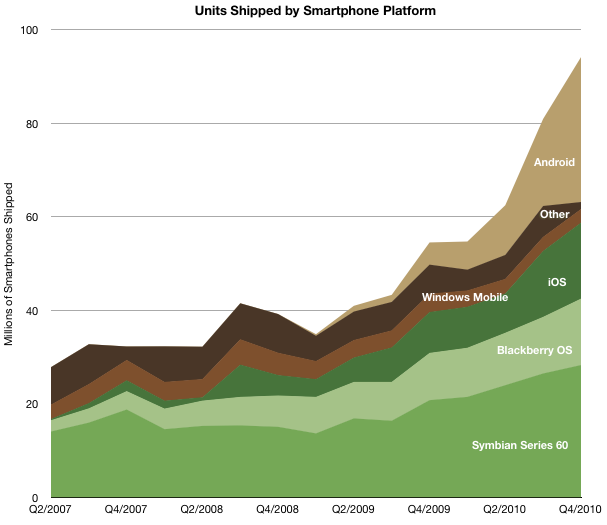
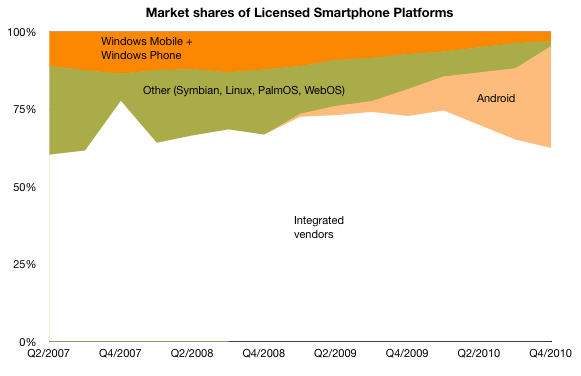
    Picking up the discussion of vendor share, I used Canalys estimates of platform shares to visualize the effect of Android on the smartphone market:

    Not wishing to belabor the point, but Android and iOS are less than 2 years old as platforms. In that time frame these two johnny-come-latelys have taken 50.2% of the most competitive technology market on the planet.

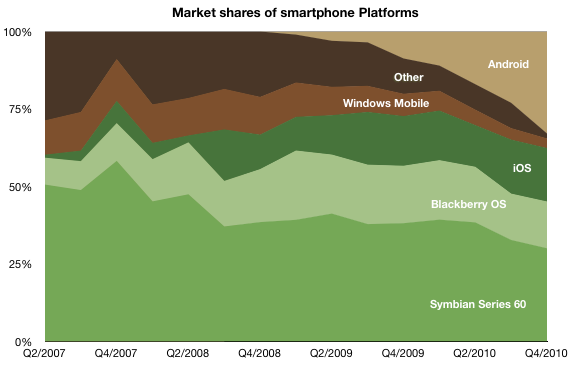
    Here is the share data:

    Since the market is not a zero-sum game, I prefer the first chart, but this second view stresses the transition away from incumbent "others" / Windows Mobile toward Android in the licensed OS market.

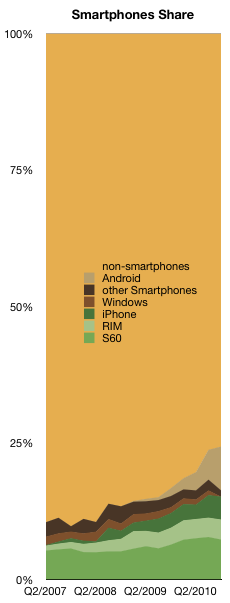
    The final chart shows the competition against smartphone non-consumption. I like this chart best of all as it shows the effect of Android in growing the entire pie for smartphones.

    What would have happened without Android is anyone's guess but my bet is that the market would not have grown as quickly. Apple is producing iPhones at capacity and RIM is growing into new markets. Symbian's strongest markets also do not overlap (much) with Android.

    However, the trend seems to be for consolidation of platforms (fragmentation within platforms notwithstanding). This trend, however, is over a very short time span. The smartphone industry started a decade ago and the time frame shown in these charts is a mere 3.5 years.

    The question remains whether the headroom visible in this chart still allows for new entrants or whether the platforms we see today are the last we'll ever see in mobile computing.

    I'm still willing to bet that there is room for innovation and for new platforms. Just like the two newcomers that came to conquer half the market emerged seven years after its inception, new contenders like Windows Phone, Bada, MeeGo, WebOS can still make an impact.

    The conquerors came with new business models and a focus on computing not telephony. Can factor innovation and the ubiquity of mobile broadband keep this market open to newcomers?

  8. The Apple doctrine

    Research · 95 comments

    The best way to get to the essence of any company is by evaluating its priorities. These priorities are like an unwritten constitution. The analog in theology is dogma which when codified becomes doctrine. In law it's common or case law.[1] In business, priorities are hard to discern and are usually only anecdotally observed.

    At Apple the top priority is the product.

    Sounds trivial, but very few companies place product first. Those who do tend to be producing creative works (e.g. movie or advertising studios, companies built around a creative process). Most companies place either production or distribution first.

    Placing product first forces the bizarre behavior that Apple is well known for: being innovative and quixotic. It makes them foolish and hungry. Sometimes it even makes them catastrophically destructive to competitors.

    ---

    Notes:

    1. These definitions are from Wikipedia:

    Constitution: A set of fundamental principles or established precedents according to which a state or other organization is governed. These rules together make up, i.e. constitute, what the entity is.

    Dogma: The established belief or doctrine held by a religion, or by extension by some other group or organization. It is authoritative and not to be disputed, doubted, or diverged from, by the practitioner or believers.

    Military Doctrine: an established procedure to a complex operation in warfare. The typical example is tactical doctrine in which a standard set of maneuvers, kinds of troops and weapons are employed as a default approach to a kind of attack.

    Common law: also known precedent, is law developed by judges through decisions of courts and similar tribunals rather than through legislative statutes or executive branch action.

  9. Smartphone users still prefer branded phones

    Research · 23 comments

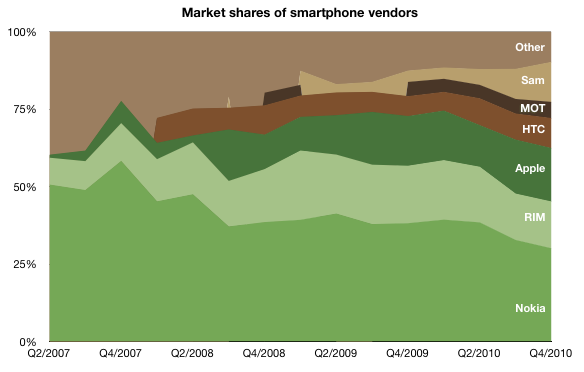
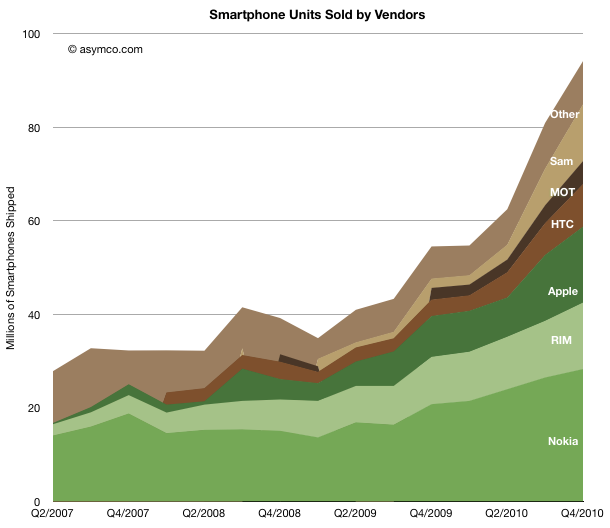
    The smartphone market has grown threefold in the span of three years. However, as noted previously, the share of units running a licensed OS has not grown dramatically. The following chart shows the vendors' shares with the same brown/green dichotomy between licensed and unlicensed OS's.

    In order to gain some insight into this licensed OS area (and who the "others" are) we need some visibility into which OSs are being licensed and what their shares are.

    The following chart shows the share of the various licensed platforms[1]. (I blanked out the Integrated vendors.)

    Before we dive in to understand the effect of Android, we have to understand the licensing of OSs in 2007.

    The chart shows Windows Mobile and "Other" splitting the market. Windows Mobile is rather easy to understand. It was still growing as a platform and Ballmer was famously quoted in 2007 as saying he liked their strategy "a lot".

    But "Other" is something of a mystery. What "Other" actually mostly meant was Symbian[2]. But not only the Symbian that Nokia was shipping and licensing to some vendors. At the time, Symbian also had a version called MOAP "Mobile Oriented Applications Platform" which was in use in Japan (somewhat analogous to the variants of Android now in use in China).

    Fujitsu, Mitsubishi, Sony Ericsson and Sharp developed phones for NTT DoCoMo, using an interface developed specifically for DoCoMo's FOMA "Freedom of Mobile Access" network brand. This UI platform was based on the UI from earlier Fujitsu FOMA models[3]. The user could not install new C++ applications and therefore these were not platform devices, however the industry still included these units as "smartphones" .

    So what we've witnessed in the last two to three years is the replacement of MOAP and Windows Mobile share with Android TAPAS and OMS.[4]

    But, more significantly, when looking at the rise of Samsung and Motorola and HTC we were also witnessing the demise of Palm, Fujitsu, Mitsubishi and Sharp (plus a myriad of Windows Mobile licensees even larger than the Android army).

    The significance here is that "other" in smartphones is still mostly about branded vendors. This is in stark contrast to the low-end of the phone market where “others” are quickly replacing branded vendors.

    So we can conclude that the smartphone market is so far showing a distinct preference for branded vendors. The value of the brand is still evident. But ZTE and Huawei are quickly developing Android competencies. How long will it be before the branded vendors feel the pressure from the upstarts?

    ----

    Notes:

    1. The Other category includes WebOS which was not licensed during this time frame but is not material enough in terms of share.
    2. A few million units running flavors of Linux were also on the market in 2007/2008.
    3. FOMA was also implemented with a Linux OS and the same UI.
    4. It should be noted that except for Windows Mobile, all the licensed mobile OSs including LiMO and Symbian are now open source. Android's success is not therefore due to being the only OS that is "open".
  10. Comparing Share of Growth: Integrated smartphone vendors held their own in Q4

    Research · 24 comments

    The smartphone market grew to about 100 million units last quarter. That's nearly double what it was a year earlier and triple what it was three years earlier, the year the iPhone made its debut.

    Few markets grow this quickly, especially as this tripling happened during one of the worst recessions for a century. 100 million units a quarter is not a small number. The rate at which smartphones are growing makes clear the trajectory of where all phones are going.

    As I've shown in profitability charts, vendors have been benefiting to differing degrees. The overall smartphone market with individual vendors is shown below:

    I've used the color coding of shades of green for vendors which use their own operating systems and shades of brown for vendors which use a licensed operating system (licensees).

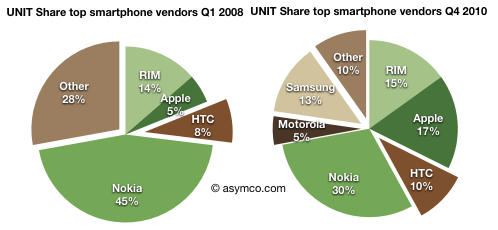
    What remains interesting is how the share of licensed OS products has changed since 2007. I selected two snapshots in time: Q1 2008 and Q4 2010 and compared the shares that licensees were able to obtain.

    The shares of licensees was then 36%, and is now 38%. Not a huge increase, but an increase nevertheless. In the last such analysis in Q3, the share of these vendors (which I also call "Modular") was actually lower than in early 2008.

    RIM has held steady in terms of share. HTC has added a few points of share. Apple seems to have gained a healthy share which Nokia seems to have lost. Samsung and Motorola have certainly made a bigger mark in the last few quarters.

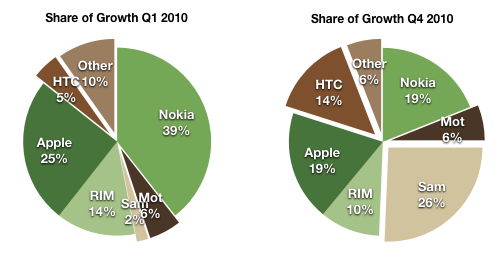
    But I would caution that share comparisons when the market is growing at nearly 100% are not very meaningful. All vendors are increasing their sales, though a different rates. What would be more meaningful would be a "share of growth" measure where each vendor's increase in units is divided by the overall market's increase.

    That analysis gives us the following chart. (I added Q1 2010 for comparison).

    Samsung did very well, but surprisingly perhaps, so did Nokia, tying Apple for second place.

    The licensees (whose pie slices have been exploded) added up to 52% of total growth (y/y) and the integrated vendors had 48%. A pretty even split.

  11. Nokia employs as many people to develop its smartphone software as Apple does to develop all its products

    Research · 106 comments

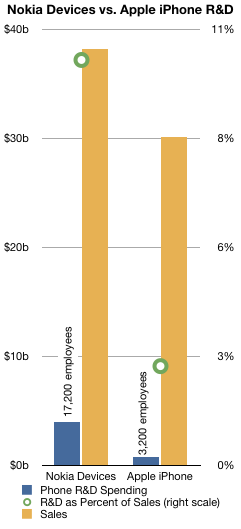
    In a recent post I pointed out that Apple's R&D was about 2.2% of sales in the last quarter. Bernstein took a look at the R&D for Nokia and presented a chart showing the difference between the mobile industry players in terms of total expenditure on R&D.

    I took inspiration from that to plot the Devices R&D for both Nokia and Apple over the entire 2010 period. I also compared that with sales and computed the ratio between R&D and sales.

    The result is shown in the chart on the left.

    Bottom line: Nokia spent 10.2% of phone sales in 2010 on phone R&D while Apple spent 2.5%.

    Bernstein goes on to argue that at least for Devices,

    Nokia spent $3.9bn in R&D in 2010, almost 3x the average of its peers, 31% of the industry's R&D total spending, for an output that we can qualify as visibly disappointing.

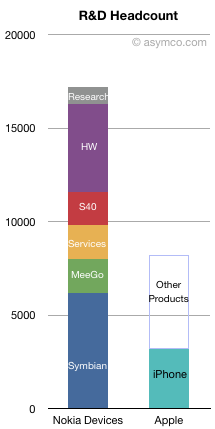
    To relate the $3.9 billion for Devices into head count, they estimate that Symbian projects employ 6,200 people; MeeGo and Qt 1,800; Services 1,800; and S40 1,800. Hardware headcount is assumed to be 4,700 and 900 more for fundamental research.

    So Nokia's total software headcount adds up to 11,600 people. Nokia smartphone headcount adds up to about 8,000.

    Applying a similar formula ($240k/employee[1]) to Apple's estimated iPhone R&D (from Bernstein's chart) yields a headcount of about 3,200 and a total Apple company R&D headcount of 8,200.

    So Nokia employs about the same number of engineers[2] for its smartphone software platforms as Apple does for all its product lines[3].

    In fact, Symbian alone may cost twice as much to develop than the iPhone (including the hardware).

    ---

    Notes:

    1. The cost per employee is obviously different between the companies as they operate in different countries. However there are enough sources of error in these estimates that they probably overwhelm the cost of living/tax differentials.
    2. I know that engineers are not all that R&D headcount covers, but let's assume that the mix of overhead is similar for the two companies.
    3. The total for Symbian + MeeGo is 8000 and the total for Apple overall is 8,200, however one can comfortably allocate 200 out of 900 researchers out of Nokia research to their mobile software effort.