The Modularity Revolution. How markets are created
My presentation at Aalto University in Helsinki on The Modular Revolution. This is what you get if you give me a whole hour to talk.
My presentation at Aalto University in Helsinki on The Modular Revolution. This is what you get if you give me a whole hour to talk.
Research #Theory · 126 comments
What makes a product great? I struggle with this question because being great is not just being better than good. Greatness is to goodness as wisdom is to smarts. Just like getting smarter and smarter may never make you wise, getting better and better does not mean ever becoming great.
Greatness is transcendental. It's hard to pin down. It inspires debate. It divides as much as it unites. It creates emotions as much as thoughts. It builds legends. It engages and persists. It lives in memory and penetrates culture. It implants itself in our consciousness persistently, to linger and dwell in our minds while we are bombarded with stimuli.
We use words such as "iconic" or "epic" to capture this permanent "mental tattoo" that we get from greatness. As important as this notion is, we struggle to define it. We don't even have a proper word for it. Perhaps it is what art tries to be, or what drives us to achieve beyond surviving. As vague a notion as it may be, it is one of the most important notions I can think of. Greatness is the cause, perhaps, of our ascent.
In the absence of any measurement of greatness, how do we spot it?
It may just be down to "knowing when we see it". But not everybody does. ((Language is another indicator. When people attach brands to entire categories we get an indication of ubiquity and permanence. As much as the brand owner fears it, the genericization of a trademark is very probably an indication of greatness in consumer products. Aspirin, iPod, xerox, jell-o and app are examples where brands became words.))
This quandary came to mind when looking at the performance of the latest iPhone, the 6S. Observing it closely, we lose sight of it. We see only minute changes between versions; marginal changes which can't be weighed. And yet these changes have a more important attribute: they are absorbable. A change that is ignored is not only valueless, it may actually destroy perception of value. It creates clutter and confusion. A change that is absorbable is valuable. It is meaningful.
Looking at new features like 3D Touch, Live Photos, and better cameras, one can observe how easily acceptable and desirable they are to those who first see them. As were Siri, FaceTime, Touch ID and iCloud, making something meaningfully better is a sign of sustaining innovation which does not over-serve.
Paradoxically, the improvements are not usually things that users ask for. Surveys always show that consumers want "better battery life" or a "bigger screen" but delivering something else entirely which nevertheless leads to mass adoption shows an uncanny insight into what really matters. Indeed, those who deliver only what customers ask for end up marginalized and bereft of profit.
To see improvements which lead to ever-increasing success in the marketplace year after year proves that this is not a transient event. This is no flash-in-the pan. This is not a stroke of genius. This is a process, a factory, a machine. The consistency and relentlessness of success is evidence of something at work that is more permanent.
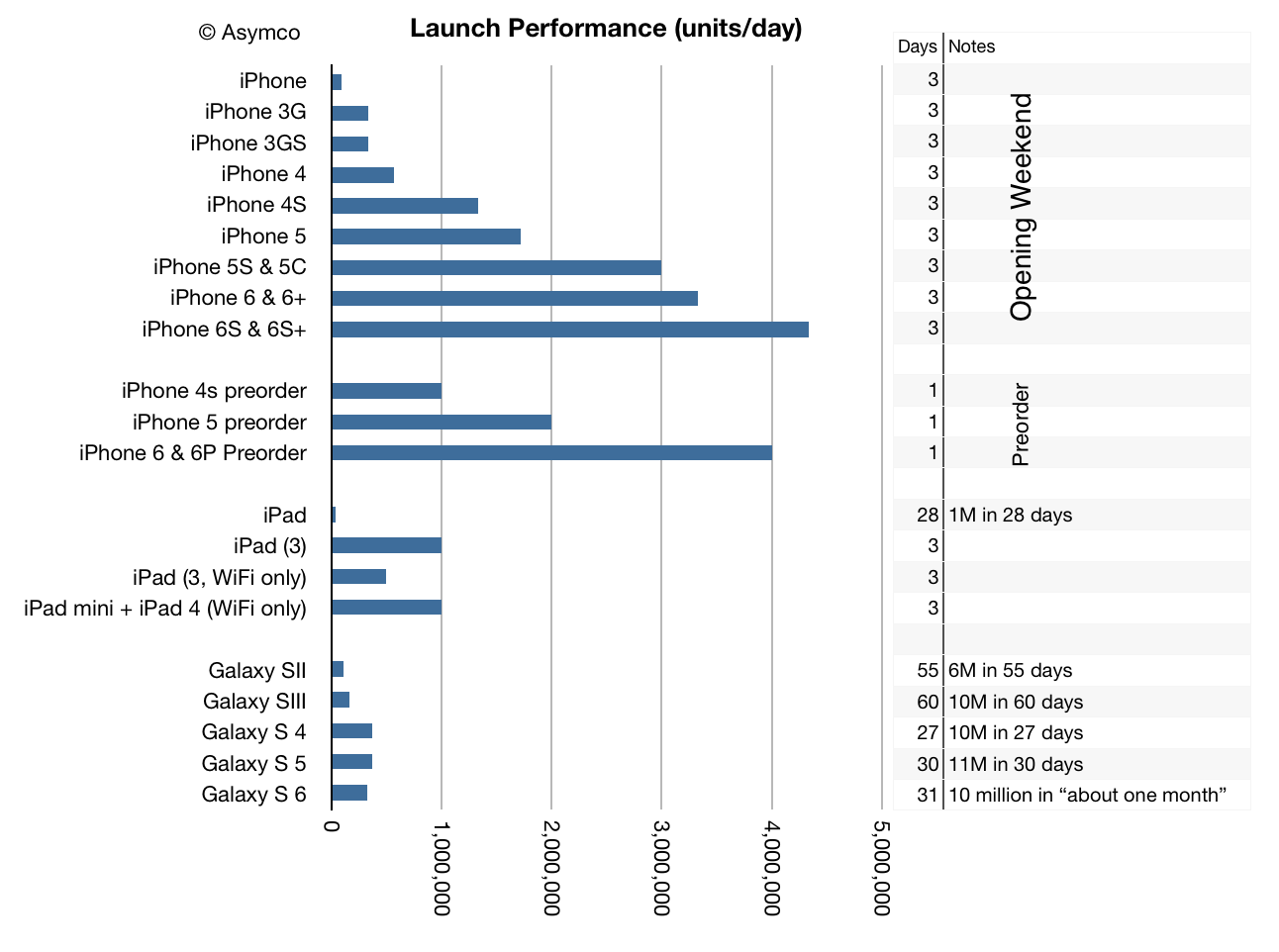
The definition of greatness for products then becomes easier to frame:
Improvements which are not asked for but which change behavior suggest that the product is valued because it changes the buyer. I believe this is what causes us to pause and appreciate them. We feel we have been improved by the thing we bought though we did not ask to be made better by it. Collectively, multiplying by millions, the improvement we feel compels us to anoint the product as great.
Apple is a company that builds greatness because they built a process to make their customers better. They do it without permission and they do it without offense. But when the buyer perceives the change they feel in debt to the object. Getting payments on that debt of gratitude is how Apple is rewarded.
Research #Industry #Market #Theory · 37 comments
What if Apple did make a car? How significant could their products be? What would it take to influence the industry's architecture?
The global market is forecast to reach 88.6 million vehicles in 2015 and there are many ways to segment it. One could look at geography or at product configurations or the emergence of new powertrain technologies.
One could also look at the participants.
In 2014 Toyota was the top selling automaker with a total sales volume of 10.23 million vehicles. The following graph shows the leading 15 producers and the percent of total production.
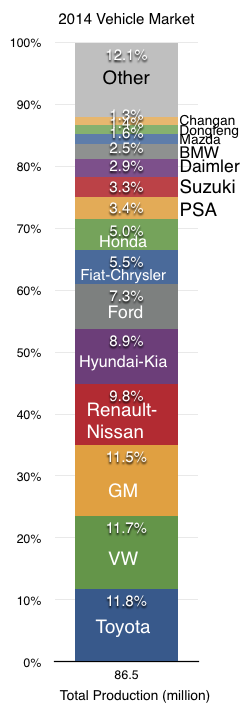
One thing to note is the relative balance in market share. The top five vendors have volumes in a very similar range (9 to 12 million). Two vendors are at around 5%. Three are at 3%. To preserve this equilibrium the industry undergoes periodic merging and consolidation. Over the last half-century, there has been room for new entrants. Japanese brands entered between the 1960s and 1970s. Korean entries occurred in the 1990s and Chinese in the 2000s.
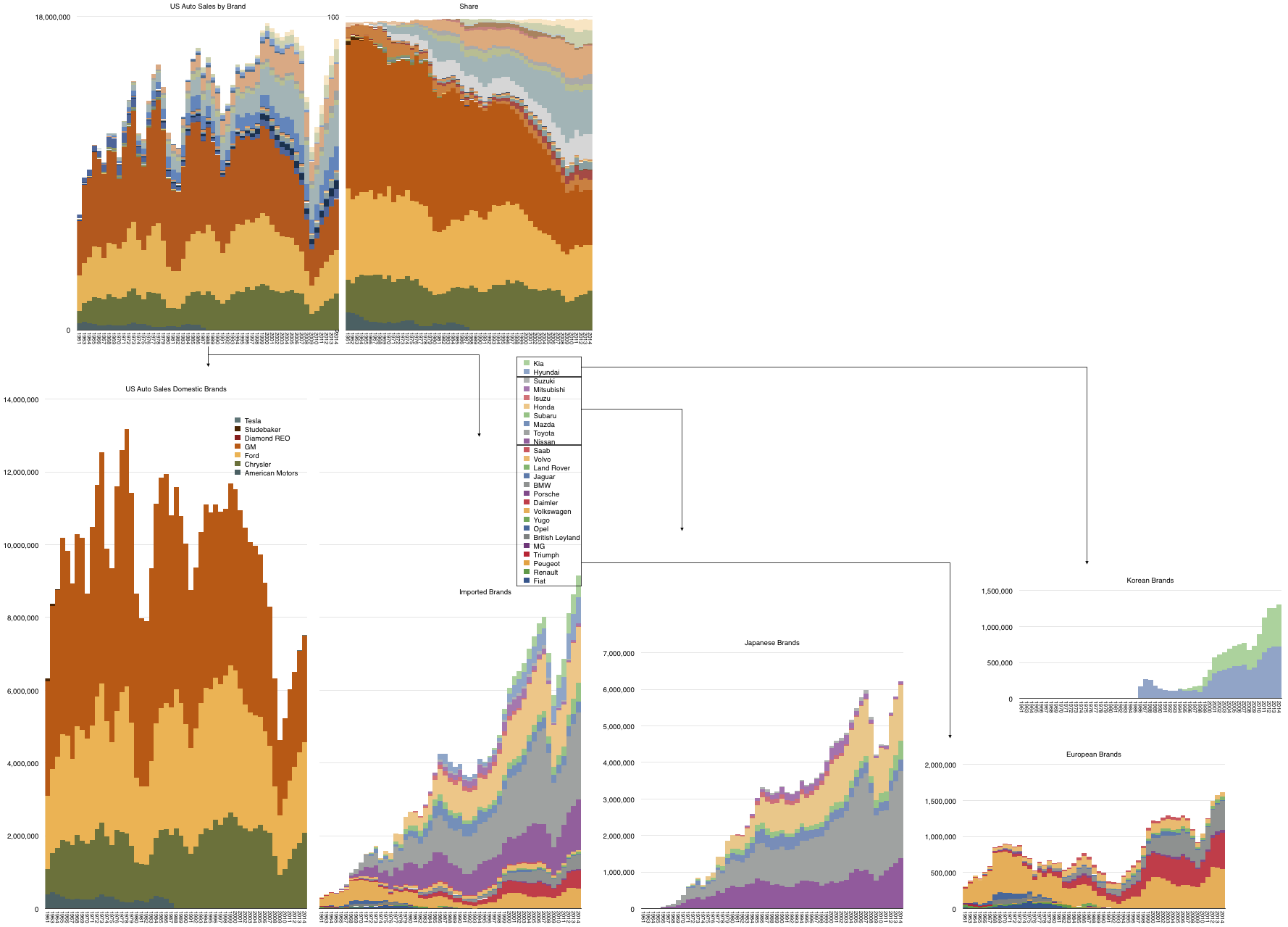
Regardless of the entries, the industry has a high degree of centralization. Ownership is often more narrowly controlled through cross-ownership and licensing. French/Japanese, US/Italian/German, Indian/German/UK cross-over ownerships indicate a globalization of financing. Indeed, only a dozen countries account for over 80% of the production (less than 10% of nations produce significant numbers of vehicles).
This structure is driven by the cost structure of volume production. The production system dictates financing and location and time constraints which underpin all deals. None of the entries (Japan, Korea, China) did much to redefine the core industry architecture (resources, processes or priorities).
So how could Apple think different?
First, the model of production could be substituted with a modular approach. This would separate the engine/body/paint/assembly plant into a deeper supplier network where components would be sourced and tooling dependence would be reduced.This speeds up ramps, reduces capital expenditure, increases flexibility, and accelerates the cadence of product evolution. Essentially, the focus would shift away from manufacturing toward design, iteration, customization and experience engineering.
Second, Apple could change the distribution model. Controlling the relationship with the end user could allow a conversation which will reveal new jobs to be done.
Third, Apple could affect the vehicle's lifespan and hence the financing/resale and inherent brand promise of car ownership.
These are fairly obvious business innovations and they are easily foreseen.But are they enough? Would they even "move the needle"?
To break into the top 10 brands would imply a production volume of at least 2.5 million units (about the same as Daimler ships today.) At 2.65 million and a price of $55k/vehicle Apple's revenues from cars would total about $145 billion. This is roughly the sales value of the iPhone business today. Not bad. Maybe that would satisfy a financial analyst. ((Yeah, right.))
Even so, would a top 10 rank in shipments change the industry's structure?
When I first saw the iPhone I knew that nothing would be the same after it and that Apple was poised to dominate the phone business. For the Apple car to do a similar trick in transportation the product itself has to change the perception of what a car is. Today a phone is barely something one speaks into.
Approaching the operations side of the business with a clean sheet of paper allows a fresh and rational attack on the problem. But to really make a dent in the universe Apple also needs to change the product in ways that re-define what it's good for. And this is supposedly why Apple gets into markets. To make a meaningful contribution.
Horace and Anders revisit Apple TV and answer listener questions in this special 2 hour episode.
Source: 5by5 | The Critical Path #159: The Appification of TV, Revisited
Research #Theory · 38 comments
Executives at car companies have suddenly had to answer questions about potential entrants into their business. This is a big change. I don't recall a time when this was necessary for over 30 years. For decades the questions have been about labor relations, health care costs, regulation, recalls and competition from other car makers. To ask questions about facing challengers posing existential questions must seem terribly impertinent.
For this reason, Bob Lutz, in his dismissal of Apple's entry, is not alone. The industry has a century of history and has seen little disruption in the classic sense. I wrote a long piece on the fundamentals of the industry titled “The Entrant’s Guide to the Automobile Industry” which explained why this industry has been so resistant to disruptive change. At best a massive effort over multiple decades usually leads in a small shift in market share.
However, one should read that post as a thinly veiled threat. Just because disruption seems hard does not mean it isn't possible. Indeed, the better you understand the industry the more easily you can observe its vulnerability and the more rigid the industry seems the more vulnerable it may be to dramatic change.
The formula for successful entry is the same for all industries: compete asymmetrically. This means introduce products which change the basis of competition and deter competitive responses by making your goals dissimilar from those of the incumbents. This is classic “ju-jitsu” of disruptive competition.
Here’s how it would work.
Bob Lutz suggests that there is no profit to be gained from selling cars on the premise that costs are very high while pricing will be held down by competition. That may be true but entrants could deploy new processes that lower the costs of production. Traditional car making is capital intensive due to the processes and materials used. There are however alternatives on the shelf. iStream from Gordon Murray Design proposed switching to tubular frames and low cost composites. BMW has an approach using carbon fiber and other composites. 3D printing is waiting in the wings. All offer a departure from sheet metal stamping.
With new materials, costs for new plants can be reduced by as much as 80% and since amortizing the tooling is as much as 40% of the cost of a new car, the margins on new production methods could result in significant boosts in margin.
There is a downside however. What is usually compromised when using these new methods is volume and scale of production. So that becomes the real question: how many cars can Apple target? 10k, 50k, 100k per year? Could they target 500k? That would be 10 times Tesla's current volumes but only a bit more than the output of the Mini brand.
Now consider that the total market is 85 million vehicles per year. For Apple to get 10% share would imply 8.5 million cars a year, a feat that is hard to contemplate right now with any of the new production systems. On the other hand selling 80 million iPhones and iPads in a single quarter has become routine for Apple and that was considered orders of magnitude beyond what they could deliver. Amazing what 8 years of production ramping can offer.
So the answer to the operating margin might be in a combination of new processes and new ramp strategies.
But there are more levers of change. Car making can be revolutionized through modularity: divide the car into subsystems and act as integrator. Electric cars have the benefit of few moving parts, smaller motors, fewer points of failure and wear, lower heat signatures and more interchangeable systems architecture. This allows companies to enter without needing to design their own engines or many other parts.
The fact is that engineering cars is actually fairly easy. Building them is the hard part and the costs of engineering new models that are cited as so extraordinary are because most of the effort is in engineering for production (The maxim is that it’s far harder to make a Ford than a Ferrari). You can see this in the proliferation of “boutique” supercars which have hyper performance but low volumes. McLaren, Bugatti, Pagani and dozens of others are all recent hypercars which show the power of engineering and design without worrying about volumes.
Apple could combine new production methods with modularity in engineering to bring design, integration of experience and iteration to the industry. Not to mention what software could add to that. Couple that with the brand value and Apple’s entry will very likely be hugely successful. I just don’t know if they can manage production at the level of demand that I expect them to create.
Research #Market #Theory · 32 comments
I was always bemused by the notion that the Internet was able to exist solely because most users did not know they could install an ad blocker. Like removing Flash, using an Ad blocker was a rebellious act but one which paid off only for early adopters. But like all good ideas, it seemed obvious that this idea would spread.
What we never know is how quickly diffusion happens. I've observed "no-brainer" technologies or ideas lie unadopted for decades, languishing in perpetual indifference and suddenly, with no apparent cause, flip into ubiquity and inevitability at a vicious rate of adoption.
Watching this phenomenon for most of my life, I developed a theory of causation. This theory is that for adoption to accelerate there has to be a combination of conformability to the adopter's manifest needs (the pull) combined with a concerted collaboration of producers to promote the solution (the push). Absent either pull or push, adoption of even the brightest and most self-evident ideas drags on.
Ad blocking offers a real-time example of this phenomenon. On desktop or even laptop computers ads were tolerable and the steps required to naviagate in order to implement effective ((By effective I mean a combination of whitelists and customizations)) blocking were non-trivial. In addition, no platform vendors were keen to promote products which hindered revenues for their most important ecosystem partners.
Ad blocking as an activity had neither the pull nor the push.
However—and there's always a however—as browsing moved to mobile devices and as ad networks hijacked the relationships between publisher and consumer, ads became detrimental to the experiences platform vendors depended on to remain competitive. Apple first (and no doubt others soon) chose to enable mobile browsers to load third party content blocking software. This is a hesitant first step. No major promotional effort and only the most obscure setting was enabled (defaulting to off).
Nevertheless, it's important to see this action as a "push". The bit that flipped was not of the consumer but of the producer. Movement to a new consuming paradigm and the incessant corrosion of the online experience threatened to taint a platform and something had to give.
Thus the "push" signal was sent and the consumer now has to pick up with a "pull" action. We still have to watch how quickly the pull happens and how network effects of users showing one-another the results will accelerate adoption and whether the push intensifies as the solutions improve.
But from this first enablement, the ecosystem, network effects, distribution and value chain leverage could cause gates to open and ad blocking reach majority followed by universal adoption. Measuring the ease of switching, the independence of the solution from other frictions and basing the estimate on historic rates, I could imagine internet ads will become largely invisible in less than five years.
Alternatives will emerge; the written word will find its business model, yet again. But the current model, contemptuous of the reader and disrespecting of the art will not long last.
Research #Industry #Theory · 42 comments
Apple is categorized as a vendor of consumer electronics. More specifically, a member of the "Electronic Equipment" industry in the "Consumer Goods" sector. If indeed this is what it's thought to be selling, there is a problem because it isn't what its customers are buying.
Apple's customers buy a mix of hardware, software and services under a brand that assures a certain quality of experience. This bundling and integration of otherwise disparate things is why the brand is such a success.
This anomaly between what Apple is thought to sell and what buyers actually buy can leave the casual observer confused. As a result the company's categorization as vendor of hardware deeply discounts its shares. It is, in other words a less valuable business. This is because a seller of consumer electronics does not benefit from "system valuation" since there is minimal loyalty to the product after the sale.
The consumer electronics vendor has no network to leverage, no ecosystem adding value after the sale, no platform and works through multiple levels of distribution to reach the customer. In contrast, a system vendor can expect benefits from network effects, ecosystems, and a coveted relationship with the end user.
The result is that the valuation of a consumer electronics vendor is based on the momentum of individual products. Apple has always been valued this way. Each hit product is considered to be a stroke of luck/genius and the chances of recurring are discounted to about zero. Regardless of the fact that it has a track record of "home runs", Apple's hit rate is not considered sustainable. ((The P/E ratio is the primary indicator in this analysis)). Certainly Apple is not valued as being able to generate reliably recurring revenues.
But what if we were to value Apple on the basis of what people are buying rather than what it's thought to be selling?
The model is simple enough: determine the number of users, estimate the lifespan of the products, and figure out the services attached to the products; then, given the price, obtain a price per product per day. You then can get a recurring revenue figure.
I did just that and the results are in the following table:
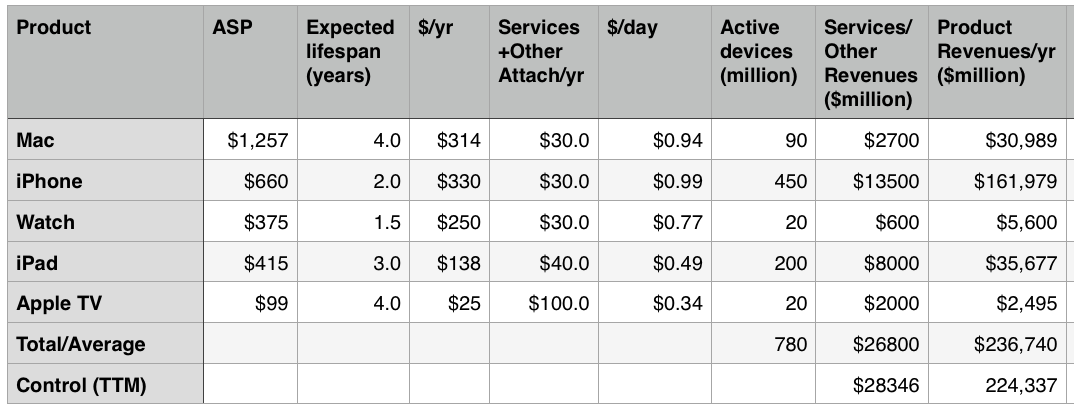
The first column is the product, the second is the Average Selling Price (ASP), the third is the expected lifespan of the product, and the fourth column is a calculation of the end user’s “spending per year” on the product.
The fifth column is an estimate of the revenues from Apple's Services and "Other" groups from post-sale revenues attached to the product. This Services revenue includes AppleCare, iCloud, Music, App Store, other stores, Beats, accessories, iAd, and Made for i (MFI) licensing. It also includes Google traffic acquisition revenues and other licensing.
The sixth column is an estimate of the consumer "spend per day" on Apple's product lines taking into consideration Services.
The seventh column is an estimate of the number of active devices in the hands of users. Note that these are expected to change over time.
The eighth column is a calculation of Services/Other income on a per-product allocation. This is a test of the Services+Other estimate and is meant to sum to nearly what Apple currently reports as Services+Other revenues.
The ninth column is a test of overall revenues on a per-product allocation. This should add up to total revenues (estimated for next year.) ((Naturally, the active devices estimate is the most sensitive but it should be tweaked to create a reasonable forecast for next year.))
The bottom line is the following graph which shows the revenue per device per day inclusive of Services and Other income (The sixth column).
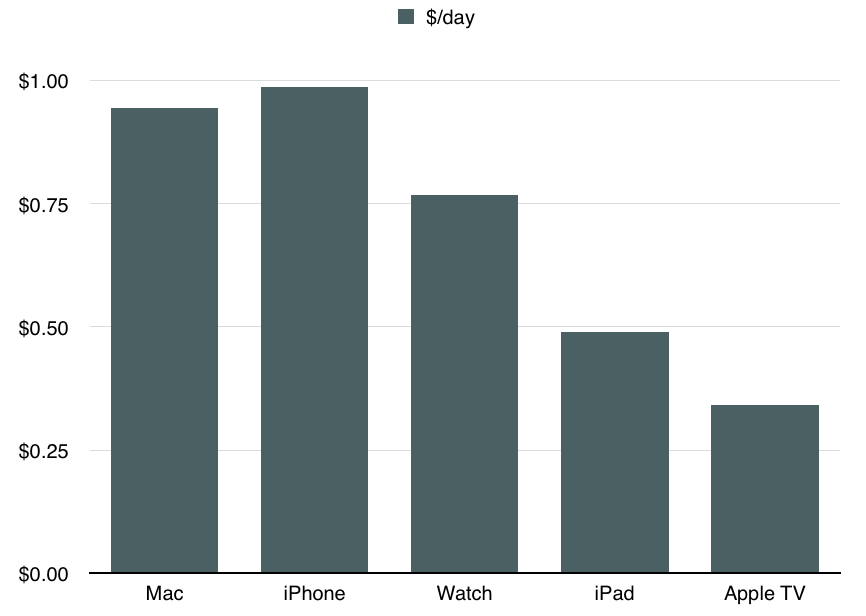
This is, in my opinion, a reasonable way to approach valuation of Apple as a business. It's also a way to inspect its strategy.
As a valuation we can easily obtain the net present value. The model gives us sales and by estimating a net margin (which is remarkably steady around 22%) we can get the free cash flow.Iterate into perpetuity with a discount rate, and you can get the net present value of the company. With a modest growth rate leading to a billion active devices in use and a normalized revenue per device of $0.92 you can easily see cash flows equivalent to $1 trillion in present value.
But much more interesting than this value is the notion that Apple is in business to deliver a product/service mix to loyal customers and to preserve their loyalty through constant improvement and innovation. You can see strategic intent in increasing the attach rate of services per device. You can see a strategic intent in building loyalty and the right customer base which is likely to be loyal. You can see strategic intent in the iteration of the product in a way that extends loyalty and expands the solid base but also increases the $/day rate. This analysis correctly informs almost all decisions the company makes.
What we just saw in the launch of a new Apple TV and a new iPad is consistent with this strategy. Apple TV will have a higher service attach rate with apps while keeping pricing well below consoles thus expanding the user base. The iPad is increasing in price and getting more accessories. The developers are encouraged to build richer and more valuable apps that are uniquely enabled by the new device.
The fact that Apple has just launched a subscription service for the iPhone makes what was clearly their strategy all along plain to see however it has been a strategy in effect for decades.
It isn't a difficult idea to embrace. It always surprises me that it's not more commonly held. The reason may be that Apple is mis-categorized.
Or perhaps the entire categorization of industries and sectors is obsolete in what is a new post-industrial age. Some have figured this out already. Others will take longer.
Should organizations hire people with industry skills and experience or capable, driven outsiders?
Horace shares tales from Henry Ford’s personnel practices during the Model T to Model A transition.
A discussion of aesthetics and jobs to be done. Tesla’s development, supply chain, aesthetics and market position while contrasting that with Toyota’s introduction of the Prius.
We close with speculation on what a “meaningful contribution” to the auto ecosystem might look like.
Horace interviews Whitney Johnson about her new book Disrupt Yourself. How can the theory of disruptive innovation be applied to you? How can you disrupt yourself?
Source: The Critical Path #158
Research #Industry · 26 comments
When exactly did enterprises become late adopters of technology? We know that they were some of the first buyers of computers. IBM sold tabulating and later computing machines to businesses starting in the 1910s. During the 1980s it was businesses which bought PCs in significant numbers to augment, and later replace, their centralized computing resources. Networking was in use in government and in business long before consumers saw any value in it.
In my talks I often point out that if you wanted to create a near-monopoly in computing in the 1990s all you needed was to convince 500 people to adopt your technology: the IT managers of the Fortune 500. If the largest companies used your product then they would impose the standard on all their suppliers and distributors and pretty soon there would be no alternatives.
So what happened during the last decade or so?
Today IT departments are known as the Information Denial department. I recall that when the DVD first became an option on desktop or laptop computers, IT departments were first to decline the option (presumably because it would be used for entertainment rather than work.) When instant messaging first became available, it was IT departments who blocked the ports. When mobile devices with cameras became available signs went up that no cameras would be allowed on company premises. When USB sticks became available, USB ports started getting glued shut. When iOS became available, no devices running it were allowed on the network. Then came Facebook, Instagram and dozens of social media.
This pattern of not only a refusal to adopt but an outright ban on new technologies by enterprises made them fall off the radar of technology developers. Quite simply everyone outside the supply chain into enterprises stopped developing new markets around them. From venture funds to developers, enterprises fell out of the business plans.
The enterprise stood as a place of "legacy" and "security" which prevented mobile or other forms of computing. Paradoxes emerged wherein an administrative assistant had more computing power in his pocket than the CEO had in her data center; where the same assistant would know what was happening faster than any of the bosses. Homes had better connectivity than offices and productivity at small firms increased faster than at big firms. Incidentally, even the slowest enterprises were faster then the government. The bigger the firm, the slower and stupider it seemed. Were large firms employing dumb managers or did being a manager in a large firm make you dumb?
One resolution to this paradox might be that mobility and the movement of processing onto consumer devices increased the cadence of product development to such a degree that the purchase cycle and dollar amounts involved ran out of the range which companies could absorb.
A simple way to explain it is this: A company takes longer to decide to purchase a device than the device's shelf life. In other words, by the time all the salespeople and committees and standards setting and golf playing and dining and site visits would be completed, the object whose purchase was being discussed would be discontinued.
A more onerous issue is that companies have procedures for accepting technologies (capital expenditures) which require high degrees of interaction and decision making. In order to step though these procedures, the vendors need to have sales people who need to invest lots of their time and therefore need to be compensated with large commissions. If those commissions are a percent of sale then the total sales price needs to be large enough "to make it worth while to all parties". As a result, paradoxically, an enterprise technology must be sufficiently slow and expensive to be adopted.
Mobility was disruptive to enterprise because the new computing paradigm was both too fast and too cheap to be implementable.
This implies that the problem with enterprises is not the stupidity of its buyers. They are no less smart than the average person--in fact, they are as smart with their personal choices for computing as anybody. The problem is that enterprises have a capital use and allocation model which is obsolete. This capital decision process assumes that capital goods are expensive, needing depreciation, and therefore should be regulated, governed and carefully chosen. The processes built for capital goods are extended to ephemera like devices, software and networking.
It does not help that these new capital goods are used to manage what became the most important asset of the company: information. We thus have a perfect storm of increasingly inappropriate allocation of resources to resolving firms' increasingly important processes. The result is loss of productivity, increasingly bizarre regulation and prohibition of the most desirable tools.
Which brings us to the latest announcement of collaboration between the new disruptor of computing Apple and the vendors supplying Enterprises like IBM and Cisco.
Apple was the loser in the standardization of computing during the 1990s but is the winner in the mobilization of computing during the 2010s. The company positioned itself in both cases on consumer computing but it never gave up on enterprises.
The approach of Apple seems to be to enable the larger suppliers of technology to enterprises to bundle iOS as part of the acceptable set of services and products. In essence, Apple is complying with the requirement to be slow and expensive in order to be adopted. It can maintain the cadence of product development while attaching itself to the purchase cycle of the enterprise.
In a way it's like an automatic transmission in a car. Operating through gears, the engine can rev at a different rate than the wheels turn. Occasionally, shifting happens but the fluid coupling keeps both the engine and the wheels from absorbing any damaging shocks.
Over the last couple of years we have been witness to the rise (and fall) of new research initiatives. What defines them, and what drives them to take on the market as they do? Hosts Thom and Derk Erbé are joined by Phil Fersht, Michael Coté, William Tincup and Horace Dediu. The panel drills down on new types of industry analysts and how they will change the IT research landscape.This is the third and final part of this podcast.
Source: Influencer Insights Podcast | Kea Company's Influencer Insights