The Critical Path #157
Horace discusses the recent market turmoil and takes listener questions on everything from Alphabet to SpaceX.
Source: The Critical Path #157
Horace discusses the recent market turmoil and takes listener questions on everything from Alphabet to SpaceX.
Source: The Critical Path #157
Horace and Anders discuss Uber's transportation business and discuss how software modularizes the world. In the second half of the show, they take listener questions posted to Twitter using the hashtag #CriticalQuestion.
Source: The Critical Path #156
Research #Industry · 36 comments
Eddy Cue seems like a nice guy. I can't say that for sure as I've never met him, but he seems to be amiable enough. Maybe it's because he has a seat on Ferrari's board of directors. Maybe it's because he enjoys dancing.
Or maybe it's because he's in charge of the only real "division" at Apple. All the other senior managers have functional roles. Eddy has a bona-fide business unit called Services.
Services is Apple's division of many things. It has the iTunes stores (Music, Video, Apps and iBooks). It has Software with consumer bundles like iWork and iLife and Pro tools like Aperture, Final Cut Pro and Logic Pro. It still has OS X as a product, though revenues are pretty low as updates are now free. It also includes Services with iCloud, Apple Music and Applecare.
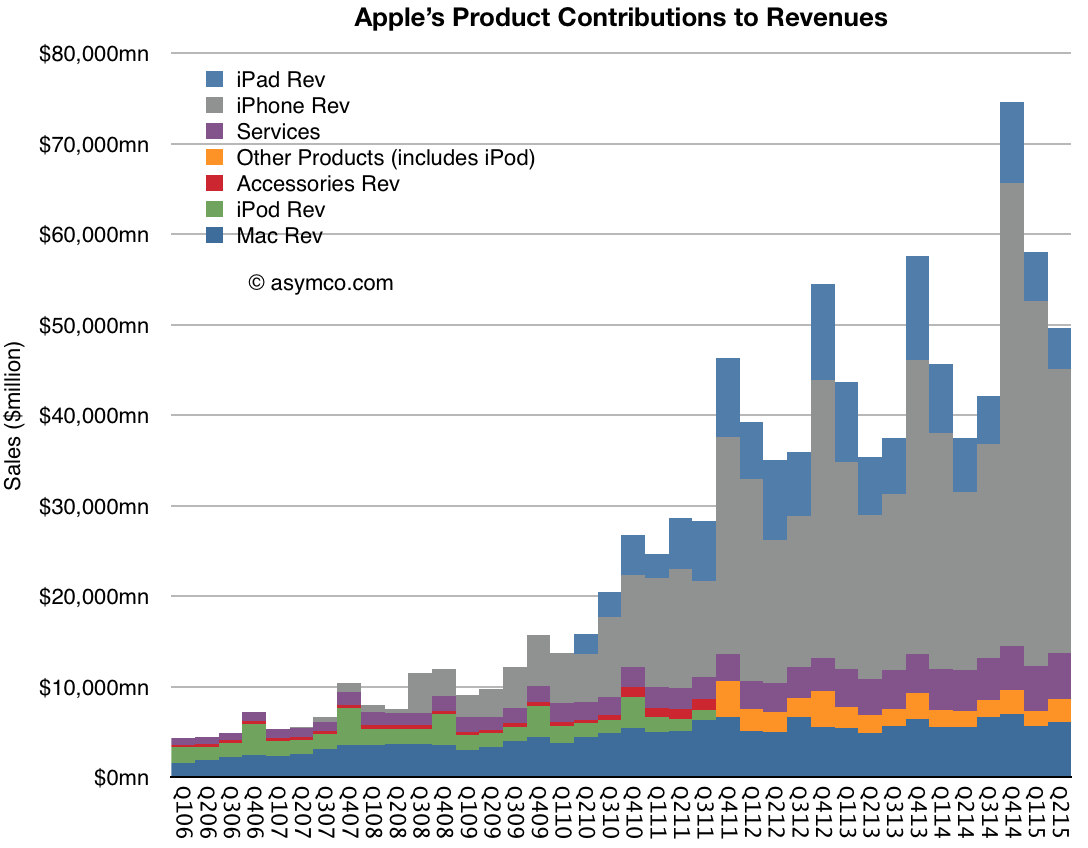
These things are not iPhones or iPads but they are many and all together they form a modest little unit. I say modest because not much is said about it. When seen in contrast to the other Apple product lines, it's hard to be impressed. In the graph below it's the purple area.
Apple does not help much. Occasionally Apple offers updates on iTunes/Services using various (rarely the same) metrics. For example, in early August, Eddy Cue offered an update during an interview with USA Today on Apple Music relating how many users there were one month after the service started (11 million). It was worth a few headlines.
However he also noted in passing that the App store did $1.7 billion in transactions during July. If you convert that to a yearly run-rate it comes out to about $20 billion/yr. Digging through previous announcements, the equivalent figure for 2014 was about $13.7 billion. Nice growth.
But is $20 billion of "transactions" of any significance? It's not even a figure that Apple reports as revenue. For apps, Apple reports only the 30% fee as revenues so 70% of that transaction value passes through to developers and is therefore not part of its statement of accounts. ((From SEC filings: For third-party applications sold through the App Store and Mac App Store and certain digital content sold through the iTunes Store, the Company does not determine the selling price of the products and is not the primary obligor to the customer. Therefore, the Company accounts for such sales on a net basis by recognizing in net sales only the commission it retains from each sale. The portion of the gross amount billed to customers that is remitted by the Company to third-party app developers and certain digital content owners is not reflected in the Company’s Consolidated Statements of Operations.))
However perhaps we should consider the figure in some way. It represents transactions in an economic sense--the amount people spend on apps. It's therefore comparable with what people spend on other forms of entertainment. Movies for example.
The following graph shows the spending on apps within the iTunes App Store ((note that this does not include Google's Play Store whose transaction values are not public and is therefore not a gauge of all apps.)) as well as spending on other forms of iTunes stores as well as Services. It also shows how all the services compare with box office revenues from movies. Both the US and World-wide. And how these figures changed over the few years that the App Store has been in existence. The individual service line items are shown in the graph on the left and the stacked totals are on the right.
Note that already last year App Store Billings overtook US Box Office gross revenues and that Services a whole overtook Global Box Office gross revenues. It's not likely to happen this year but next year Apple's Apps will almost certainly overtake global Box Office in revenues.
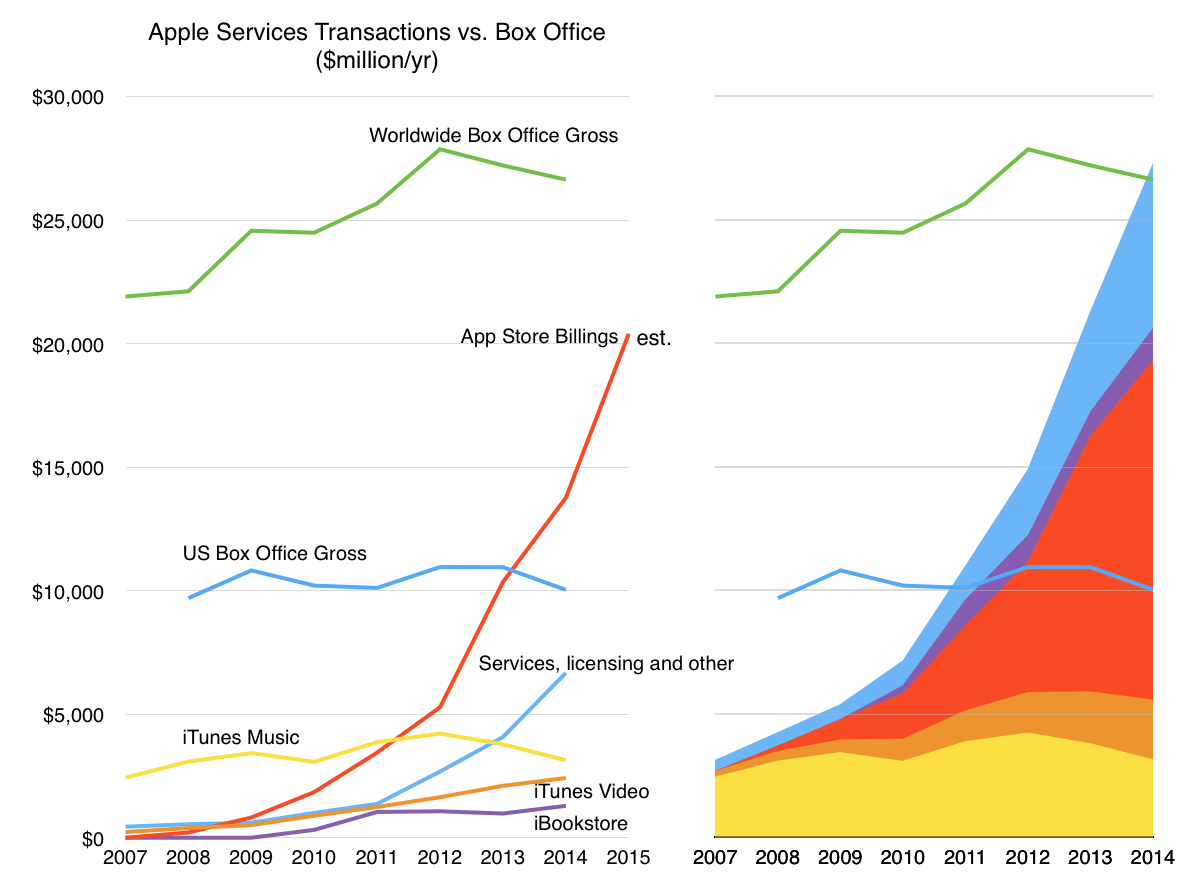
This contrast with movies gives some perspective on the creation of a new market. Apps did not exist as a medium in 2007. But, together with Android apps, apps are likely to have already overtaken revenues from an industry that is a century old. And not just any industry. Hollywood represents more than an economic power, it has a cultural power affecting perceptions and political opinion. And although universally envied, it has not been successfully replicated.
So having created this market and becoming bigger than Hollywood, and grossing more than what 90 countries produce, Apple's Services not something that is interesting to many who think about technology or even to many who think about Apple.
Which is why I think Eddy's such a nice guy. No matter how little attention is paid to his economic empire, he always seems to be in a good mood. Maybe he knows something we don't.
Due to some research and related writing I’ve been working on which revolve around the potential for disruption in the auto industry, I have wanted the ability to quickly search the Asymcar and The Critical Path podcasts to locate material I remember hearing. Naturally, this is difficult at best with the material in audio format only. I know that an edited version of the first year of TCP was presented in a book format some time ago. But since Asymcar contains much of the content that I needed to referenc
Source: Impetus | Transcribing Asymcar
Over the last couple of years we have been witness to the rise (and fall) of new research initiatives. What defines them, and what drives them to take on the market as they do? Hosts Thom and Derk Erbé are joined by Phil Fersht, Michael Coté, William Tincup and Horace Dediu. The panel drills down on new types of industry analysts and how they will change the IT research landscape.
This is the second part of this podcast. The first part can be found here.
Source: Podcast: The New Industry Analysts, Who Are They? (Part Two)
Over the last couple of years we have been witness to the rise (and fall) of new research initiatives. What defines them, and what drives them to take on the market as they do?
Hosts Thom and Derk Erbé are joined by Phil Fersht, Michael Coté, William Tincup and Horace Dediu. The panel drills down on new types of industry analysts and how they will change the IT research landscape.
Source: Podcast: The New Industry Analysts, Who Are They? (Part One)
Research #Industry · 86 comments
For the last few years, I've been proposing that the way to conceptualize Google is as two separate entities: Google A and Google B.
Roughly speaking Google A was the R&D ((Research and Development)) organization and Google B was SG&A ((Sales, General and Administrative)). You can find the operating expenses of running each of these organizations in the company's income statement. In the last quarter R&D was about $2.8 billion and SG&A was about $3.5 billion ((Sales and marketing was $2.1 billion and General and Administrative was $1.5 billion)). The two entities are further distinguished as follows:
In summary, Google A is altruistic, Google B is pragmatic. Google A engages in research, Google B engages in commerce. Google A operates in a structure similar to a Bell Labs for the good of humanity ((Using a definition of Good as established by the founder)), Google B operates in a structure similar to AT&T and collects monopoly rents but without any government oversight.
This was an effective construct for analysis which explained to me much of how Google operated and how it made decisions. So what do we make of Google's new Alphabet? Is this a dissolution of the Google B/Google A dichotomy?
My initial answer is no. We don't have a change in this core structure. What we have instead is a split of Google A into Google A and Google A+.
A+ is the crème de la crème of the altruistic Google A. It's the stuff that really does not make money. It's the laboratory of Bell laboratories. It's the moonshot manufacturer. It's the incubator where hobbies are hatched. It's the funder of ventures.
After A+ is carved out, Google A and Google B remain exactly as they were, now under a new CEO. The previous CEO no longer has any day-to-day input in the running of Google A and is no longer soiled by association with Google B.
Alphabet is therefore the "holding company" of Google A+, Google A and Google B. I can only suppose that the separation of A+ from A (and the previous A from B) allows the founders to distance themselves even further from the purchase decisions which, through pricing signals, determine where value lies and how resources should be allocated. That must be a great relief.
Research #Market · 66 comments
During the last quarterly earnings call, Tim Cook said that Apple has seen the highest switching rate from Android ever. That there is switching isn't surprising. We've seen many surveys which show higher loyalty with iOS than with Android. But it's been very hard to spot the evidence in the data which is visible publicly. Both iOS and Android are adding users and sales for both platforms are still increasing.
The switching effect is easier to discern when the market is not growing overall. In that situation one platform's growth has to be at the expense of another. However, some markets do show evidence of "churn" in users.
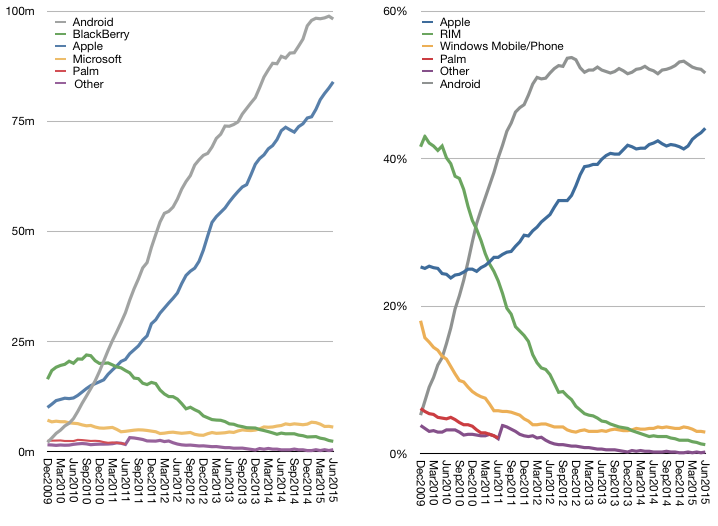
Consider the ComScore data on US platform users (above). If we look at the last six months' data ((these data are actually three month averages)) we can count that there are about 8.2 million more Americans using iPhones than there were six months ago. At the same time, there are 1.6 million Android users. One million users left the BlackBerry platform and about 700,000 left Windows Mobile. The data also suggests that the total number of first-time smartphone users is about 8.3 million.
Now, we could say that Android recruited all the Windows and BlackBerry users that switched (1.6 gained equivalent to 1.7 million lost) and Apple recruited all the new-to-smartphone users (8.2 million gained by Apple vs. 8.3 million non-consumers).
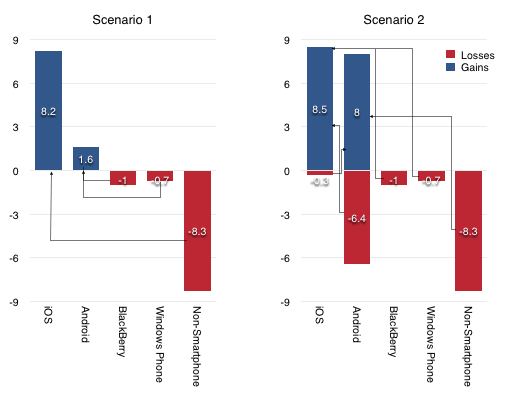
But this is not very plausible. It's much more likely that Apple converts existing smartphone users while Android converts first-time users.
In this scenario, 8 million non-users first started using Android while 1.7 million BlackBerry and Windows users switched to iPhone. But that leaves the question of what happened to the missing 6.3 million that Apple should have gained.
That's where the switching number comes into the picture. This Scenario 2 is shown in the figure above and suggests that although Android gained 8 million new users, it lost 6.4 million to iPhone for a net gain of 1.6.
Apple may have also lost a few users to Android but overall gained switchers from other platforms, mainly Android. This is what would support Tim Cook's comments.
Thinking further ahead, as the markets mature globally, they may well evolve into the way the US market evolves today. Apple's brand promise ensures loyalty while competing platforms slowly "leak" users. If this sounds eerily familiar then you'd be right. This is exactly how the PC market behaves today.
Horace and Anders discuss car production methods, the BMW i3, tubular and composite frame construction and how Uber could change the landscape.
Source: The Critical Path #155
Research #Industry · 41 comments
Will there come a time when Samsung will earn more profits from the iPhone franchise than from its own Galaxy product line?
The problem for Samsung is that although it still sells the most phones ((over 80 million but we don't have a precise figure)), and the most smartphones, the price and margins for these products are collapsing. The pattern is shown in the graphs below:
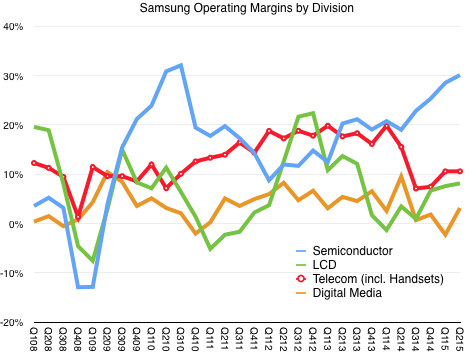
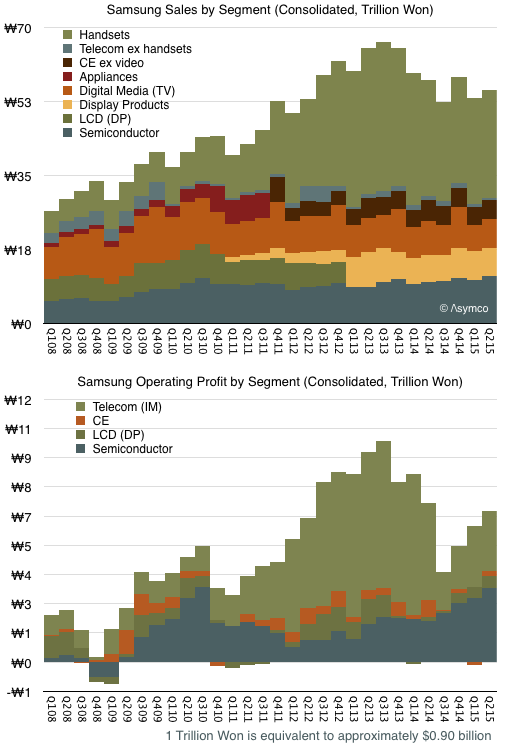
Phone operating margins peaked in Q1 2014 at 20% but are half that level today. These margins have dropped to levels Samsung had in 2009, before the Galaxy launched and before they had any substantial revenues from smartphones.
In contrast, the semiconductor group is growing both revenues and margins. Margins and operating profits are both 50% higher than those of devices.
We also know that Apple is Samsung Semiconductor's single biggest customer. We can't be sure how much of the total revenue/profit comes from Apple but if the pattern continues then Apple could be the greatest contributor to Samsung's profitability in the near future.
How could this be? Wasn't Samsung supposed to "disrupt" Apple?
The reality is that Samsung's own smartphones are being disrupted by good-enough Android devices, typically made by Chinese brands. This low-end disruption is also affecting LG, another phone maker and Apple supplier.
Unlike Samsung and LG, Apple is less susceptible to low-end disruption. What Apple offers is a brand promise, an ecosystem, associated products and services and what amounts to a new market. It's this parallel value network that competes with Android/Google, rather than with Samsung.
Samsung is a supplier in the Apple network and a licensee in the Google network. As a result, it has a near monopoly position with a platform controller (Apple) and a commodity position with a platform licensor.
Neither position is one of control, but the current market stage benefits Samsung within the Apple ecosystem more than in Google's ecosystem. It's a situation analogous to one where Intel made both x86 chips and PCs that ran Windows. Long term it's likely that the sole-source chip business does a lot better than the multi-source systems business.
That should be a warning to others who hoped to survive as Android OEMs. They don't have semiconductors to sell to Apple.
Research #Nostalgia #Theory · 50 comments
Let's say I offered you the option to invest in a monopoly or in a hit-driven company whose survival depends on always finding the next big thing? Which would you invest in?
Before you answer, let's say I offered you the option to invest in a person who has a large inheritance or a person who is poor but is hustling for any opportunity. Whom would you invest in?
Before you answer, let's say I offered you the option to invest in real estate of a city which depends on a stable, capital-intensive manufacturing base or one where they make nothing but movies. Where would you buy land?
Each of these reflect the same choice: stability vs. instability, the known vs. the unknown.
Historically, capital has always gone toward the stable and away from the unstable. Wealth has gone the other way.
Onward.