Back from the Apple Watch event, Horace gives his trip report discussing watch pricing and what we now know of how Apple intends to sell them. What cognitive illusions might come into play as people consider the watch?
The incomparable Citroen DS (French homophone: déesse), 60 years old this year. Hydropneumatic, self-levelling suspension aerodynamic and interior design efficiency, swiveling headlights, novel construction methods. Ahead of its time even in 1985. Why did this iconic design not endure?
Paying for TV has been a curious consumer phenomenon. There was a time when TV was free to consumers. It was delivered as a broadcast over-the-air and paid for either by commercials (US mostly) or by taxes on viewers (Europe mostly). The consumers were delighted with the idea as it was far better than radio and radio was delightful because it was far better than no radio.
The process of convincing consumers to pay for something that used to be free was quite interesting. The first benefit to be articulated was that the quality of the picture would be much better. It would, in essence, be noise-free. ((This was in fact the birth of cable TV: a shared antenna for a community in an electromagnetic shadow))
The second benefit was an increase in the number of channels. VHF and UHF television would cover about three and 5 channels respectively while cable could offer dozens, many specializing on specific types of content like the Home Box Office (HBO) offering movies and ESPN offering sports only and MTV music videos and CNN news only.
The third benefit was fewer (or no) commercials for some of the channels. This was especially valued by fans of movies whose interruption by commercials was often detracting from the immersive value and continuity of the cinematic experience.
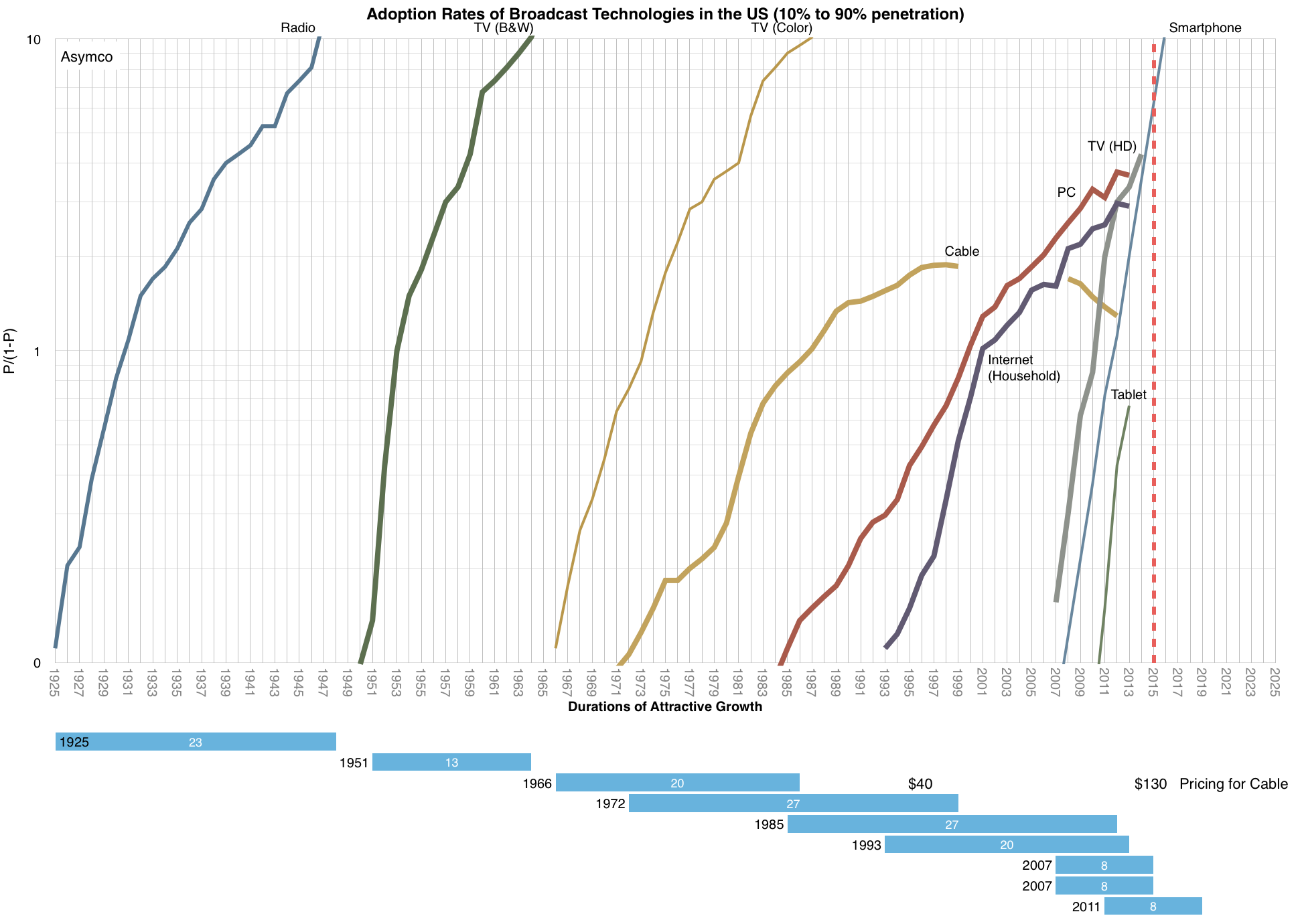
These benefits were very attractive during the 1980s, to the extent that about 60% of US households adopted cable. An additional group later adopted satellite-based pay-TV as the technology became reasonably cheap.
These benefits were priced modestly but as the quality and breadth of programming increased, prices rose. An average cable bill of $40/month in 1995 is $130 today ((a 6.1% compounded rate of price growth vs. a 2.4% rate of inflation)). Some of that revenue went into upgrading the capital equipment in use (the plant) and some into paying for the higher production values. Yet more went to the sports leagues and their players whose business models increasingly depended on broadcast rights.
And so over a period of about 40 years, watching TV went from free to quite expensive. More expensive even than a family's communications costs (i.e. telephone service.) That's quite an achievement at a time when technology diffusions caused huge price reductions in other goods and services. Consider that the TV set used to watch the programming improved dramatically while decreasing in price over the same period.
Meanwhile, some of the benefits began to be less relevant. Commercials are more abundant than ever. Ad buyers spend about $60/month per household to deliver ads ((Implying that the TV "business" has a $200/household/month revenue model)) The quality of the TV picture is actually worse due to compression than one might get with over-the-air digital broadcast. Finally, the abundance of channels is beyond anyone's absorption rate. Those channels which used to be "pure" became polluted and undifferentiated as each tried to be the other. ((A pursuit no doubt driven by seductive but toxic market research))
On top of these paradoxes is the fact that actual penetration of the service has been declining. As the graph above shows, Cable TV has declined (though Pay TV much less so). The industry has reached saturation decades ago and has not offered anything meaningful in terms of innovation.
Disruption theory suggests that once a product over-serves on meaningful bases of value creation (and underserves on value) it opens the door to disruption. Which leads me to ask not whether cable is past its prime but rather why it's still around?
The answers are usually immediate and plentiful: conspiracies of monopolists, lobbying, back-room deals, lock-in of content and all kinds of other misdemeanors. To which I would say: You can fool some of the people all of the time and all of the people some of the time but you can't fool all of the people all of the time.
So again, why have all the people been fooled all this time? Twenty years have passed since the industry reached saturation and prices keep rising. Today the average cable bill is projected to rise to $200/month by 2020.
My answer is that disruption is predictable. Users are cutting cords, the "uncabled" or "never-cabled" are a significant portion of the population. 13.5% of broadband households with an adult under 35 have no pay-TV subscriptions. 8.6 million US households have broadband Internet but no pay-TV subscription. That's 7.3% of households, up from 4.2% in 2010. Another 5.6 million households "are prime to be among the next wave of cord-cutters," according to Experian.
The same phenomenon occurred with mobile vs. fixed telephony. For several years it seemed that mobile was sustaining to fixed or that fixed was immune due to lock-ins. The fixed telephone incumbents insisted that the data was inconclusive. Then the trickle of abandonment turned into a deluge. The quality of service for mobile kept increasing and, with data, it became clear that the mobile devices could unleash unfathomable functionality and value.
And so it goes. A business dies first slowly then quickly. (('How did you go bankrupt?' Bill asked. 'Two ways,' Mike said. 'Gradually and then suddenly.' -The Sun Also Rises (1926) Ernest Hemingway)) The exact timing is tricky because of the non-linearity of the phenomenon. It's also hard to declare end-of-life since business zombies are very common. What is clear however is that the economics will change dramatically and the alliances between talent and distribution will shift to entrants and away from incumbents. The point when we will look back and say that cable was finished will probably come by the end of this decade.
Horace and Anders discuss Apple's brand reorientation from the intellectual and analytical to the emotional and instinctual. Moore's Law is fundamentally incompatible with luxury so new measures are necessary. What should one call this new paradigm?
Horace and Anders discuss the design of Gordon Murray and what it might take to enter the automotive industry. Is an integrated strategy the only way? What job would an Apple car be hired to do?
According to Folkore, in 1981 Apple took out a two page ad in Scientific American which explained that whereas humans cannot run as fast as other animals, a human on a bicycle is the fastest species on earth.
Jobs had made the observation that a computer was "a bicycle for the mind" earlier, in 1980, at a time when the decision to purchase a computer was driven by an intellectual curiosity and justified as an improvement or assistant to the intellect. It was to make the lighten the labors of our intellect.
Apple brand at the time as an appeal to the intellect via a humanistic argument. A more emotive positioning of a tool, but a tool nonetheless. This positioning evolved throughout the 80s and 90s into an "intersection of technology and the liberal arts."
We can see how the conversation with the potential buyer was along the lines of appealing to the intellect while offering a humanist sweetener. Humanizing the product allowed it to be accepted into a world that feared the complexity and awkwardness of such a machine.
During the 2000s, with the ascent of iPod, the conversation shifted to prioritizing the emotions more than the intellect. The products had to appeal to those who wished to express and enjoy products of emotional value. Products like music and videos and the output of the arts rather than the sciences. The brand became emotional rather than intellectual. It created an aesthetic, and become culturally iconic.
During the 2010s, with the ascent of iPhone and the emergence of the Watch, the brand speaks a language of instinct, leaving intellect and emotion as secondary or tertiary voices. Instinct is visceral, lust-inducing. It seems to short-circuit any of the rational. Non-rationalism does not mean irrational. It just skips right over the head and heart and hits the gut.
One could argue that during these three decades, the organs the brand was engaging in conversation shifted from the mind to the heart and then to the glands. Those glands which release hormones and are directed by non-rational neurons. The evidence of the conversation would be in resulting products causing pupils to dilate, breaths to be quickly drawn and skin temperatures to rise.
The brand therefore has managed to move from a rational, to a neurological, to an endocrine response.
The curious thing is that during these shifts, Apple's entry into new biological spheres of influence has been largely unchallenged. I suspect this is because emotional or instinctive products are appealing due to their lack of rationalized value. In other words, what makes a product hormonally appealing is a lack of intellectual appeal ((and vice-versa in many cases)). Apple can enter into the world of lustful appeal while lustful brands can't enter into functional appeal.
This is a classic asymmetry which perhaps no other brand can pull off. ((The reason is complicated but stems from the firm having been built to execute nothing but home runs. By shunning portfolio theory, Apple can wander into new categories far from its biological home grounds.))
Horace discusses his latest work at the Christensen Institute and considers why the educational system works the way it does. Can large scale education be modularized? In the second half of the show, Anders and Horace discuss the rumors about the possibility that Apple might be working on a car.
Understanding Apple’s intentions seems to be a popular parlor game and there are many attempts at divining intention from data and market study. These attempts at market research for answers are futile because Apple does not compete in existing markets but rather it creates new markets. For instance, the market for the Apple II could not have been assessed from research into the computing market of 1974. The intention for Apple to enter into music devices and services could not have been predicted through an analysis of MP3 player market in 2000. The iPhone was also not predicated on the market for “Internet Communicators” in 2006 or 2002 when the iPad was first contemplated. ((The market for phones was large but the iPhone pricing and features made it incompatible with any reasonable segment of it.))
Instead of measuring the size of pre-existing markets, surveying the functionality of existing products, or weighing toxically financialized ratios like margins and market shares, I recall this ad (Our Signature, first seen at 2013 WWDC):
This is it This is what matters
The experience of a product How it will make someone feel Will it make life better? Does it deserve to exist?
We spend a lot of time on a few great things Until every idea we touch Enhances each life it touches
You may rarely look at it But you will always feel it This is our signature And it means everything
My interpretation of these lines, coupled with additional public statements can be used to create a “litmus test” for new product categories:
1. The experience of a product. Read: They will work on things to which they can make a meaningful contribution. To me this means that they will build things which require an integrated approach. As Apple is "the last integrated company standing” it means they will work on problems where the system is not good enough. This means that they will not work on problems where an individual modular component is not good enough. By system I mean, in the largest sense: production, design, distribution, sales, support and services must work in a seamless way. Systems analysis implies a broad understanding of the causes of insufficient performance along the dimensions of “experience”. The experiences are what differentiate the products (and lead to high margins) and these experiences are possible only through the control of interdependent modules.
2. Does it deserve to exist? Read: They will work on very few things. They will say no to many things. It’s still true that all of Apple’s products can fit on one table. That may not be true forever, but their product space will not grow as quickly as sales grow. This means that there is no notion of “marginal value” or portfolio theory where products are added because they can be justified as “moving the needle” or balancing demand. Rather, the few things which will be worked on will address non-consumption. Non-consumption of experiences.
3. Enhance life. Read: The things they release are inevitable even though nobody asked for them. The reason this is possible is that there are unmet and unidentified “jobs to be done” which are powerful sources of demand and whose satisfaction leads to unforeseen rewards. The problems that can be addressed are uncovered through a process of conversation with a few people. They are not uncovered through surveys or large n statistical studies. Without the ability to ask the right questions, big data only leads to big misdirection. In contrast, good taste in questions allows small n to lead to big insight. Apple’s ability for finding the right problem to solve comes from this greatness of taste in questions.
So given this litmus test, will Apple build a Car?
I believe the problem of transportation and its proxy, the automobile, provide all the requisite demand for Apple's attention. Technical questions abound and they may still prove unsurmountable before a launch happens, but there are no doubts in my mind that this is a problem Apple would see fit to address.
Non-consumption of unmet and unarticulated jobs to be done can and should be addressed with systems solutions and new experiences.
The Auto Industry is significant. With gross revenues of over $2 trillion, production of over 66 million vehicles and growing ((The industry continues to grow, registering a 30 percent increase over the past decade, mainly due to Asia and China in particular)) it seems to be a big, juicy target. It employs 9 million people directly and 50 million indirectly and politically it must rank among the top three industries worthy of government subsidy (or interference). Indeed, in many countries--the US included--government interference makes it practically impossible for a producer to go out of business, no matter how poorly it's managed or how untenable the market conditions.
But this might be the tell-tale sign that danger lurks. Theory suggests that incumbents going out of business is an essential indicator of industry health. Without their exit, entrants are never allowed to bring disruptive ideas to bear and innovation simply stops. Is this interference with mortality the only indication of entrant obstacles? Are things about to change? Is there pressure for innovation? Can we spot other indications of a crisis in this industry?
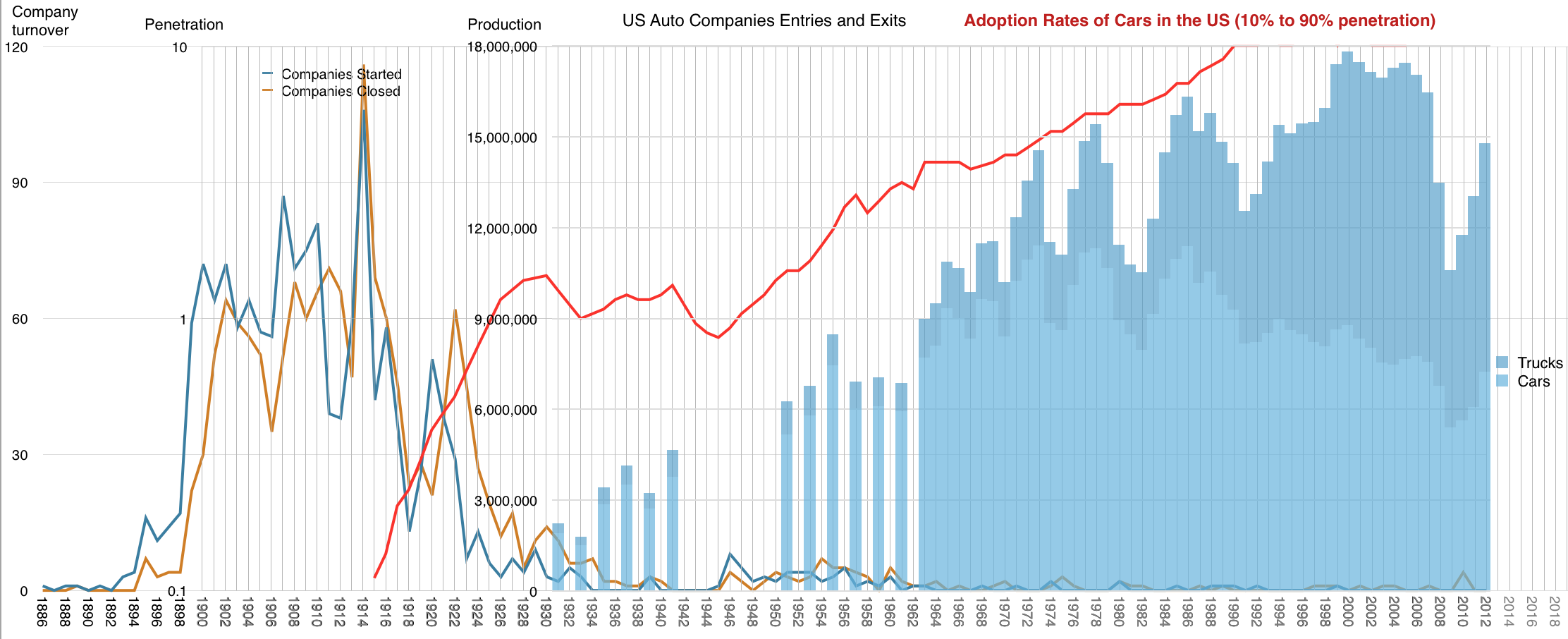
Taking the US as a proxy, here is a graph of the number of new car firm entries (and exits):
The total number of firms ((counted as brands)) that entered the US market is 1,556. The blue line graph shows the entries and the orange line shows the exits. This sounds impressive, but note that the year when the peak of entries took place was 1914, exactly 100 years ago.
1914 was also the year when penetration of the market first reached 10% and the rapid slope of adoption was joined. You can follow this adoption rate as the red line in the graph above ((The line is on a log graph and shows the P/(1-P) where P is the penetration of households)) ((Note that all line graphs have the same x-axis but have different y-axes.))
The first analytical task for the entrant today is therefore to ask why there have been so few others succeeding in the last century. In the last half-century 14 tried and all failed.
One clue is the third set of data plotted above: production figures. The blue area represents the production total for the industry on a yearly basis. ((The graph is split into cars and trucks. You can plainly see the recessions and the patterns of war and peace)). Note that all three data sets have some relationships to each other: Production growth is dependent on new demand growth and that on a household basis demand ceased growing in 1990. Production and penetration accelerated when entries ended. Given the economies of scale in manufacturing, a consolidation occurred and barriers to entry exploded when volumes became significant.
This leads the casual observer to conclude that production is the predominant consideration for participants and that the entire industry revolves around this measure.
Indeed, production is everything. Capacity utilization is the first priority for an auto manufacturer. Capacity is why firms are not allowed to die and entrants are not allowed to enter.
But you don't need the data to tell you this. There are other clues. I will summarize these observations in the following "ten commandments" for the industry:
It's easier ((read: cheaper)) to design and build a Ferrari than a Ford. At its logical extrapolation of this rule one can observe that a Formula One team is a trifling hobby compared to the effort needed to build the shabbiest of hatchbacks.
Low-end disruption happened early in the adoption curve. The very first cars were luxuries, but the Model T from Ford set up the Ford production system as a template for all and it was a low-end disruption. It happened 100 years ago. The Volkswagen Beetle and the Toyota Tercel were also low-end and they built non-US concentrations for production in the 60s and 70s. Same can be said for Mini, Fiat, Renault and Citroen. More recently Korean and Chinese entrants have appeared but they have not been disruptive.
Almost all meaningful innovation occurs in the production system (not the vehicle). The improvements in vehicles are many but they have not been meaningful in the sense of shifting any of the power in the industry. Certainly not to new companies. The production system innovations of Ford, GM and Toyota allowed them to establish what is to date an unassailable power base of production. If you want to find the next "big thing" in automobiles, look for a new production system.
To understand how cars will or won't change, study roads. There were roads before cars, but not paved and not for going far. Road construction and the deep understanding of safety, capacity and economic impact took 50 years between 1920 and 1970 in the US. ((Thanks to Steve Crandall for many of these insights. He further notes via Twitter that ~1.5% of the US land mass is paved for transportation)) The cars pay for the roads and, as a result, they pay for the logistic system that allowed all forms of powerful businesses to emerge. Walmart, McDonalds and Amazon and the entire retail, food and agriculture sectors owe their existence to the roads that car adoption paid for. Furthermore, the real-estate and entire living structure of many countries depends on roads. If you want to change the car you have to also understand how the roads need to change. ((Hint: for cars to improve through the reduction in the need to be driven, an understanding of their environment--roads--is mandatory. This is an information problem mainly but it's also a regulatory and tax problem.))
There has never been a disruption based on drivetrain innovation. Everything to date has been sustaining. Since 1886, the internal combustion engine has been dominant. Even though there have been diesel, natural gas, all-wheel drive, front wheel drive and electric drive, none of these innovations have changed who controls the profits in the industry. Hydrogen fuel cells won't either. The reason is simple: incumbents can easily adopt/buy any improvement/innovation as it sustains their production-oriented profit formula. Entrants with drivetrain innovation can't build a business model moat around the idea without a production base.
China is the largest producing (and consuming) nation. The global center of production shifted over the years and tends to follow consumption. As a new middle class emerges, the fact that China is leading now should not be surprising. As each new producing center was built, it created an opportunity for local entrants, however they did not displace the incumbents rooted in other markets. This is mainly because they were protected and they were protected because of political considerations including jobs, taxes (roads), etc.
Almost all car companies own each other. There is a vast cross-ownership network and a disinterest in independence. This is again due to production-led thinking. The spreading of over-capacity or under-capacity risk leads firms to disregard product or market considerations and enter into joint ventures and partial acquisitions. Portions of manufacturers are bought and sold by competitors almost as regularly as they are bailed out by governments. Competition is therefore perverted if not prevented.
For most motorists, congestion is a bigger problem than any deficiency in the vehicle. We think people want better cars, but they don't. Cars stopped getting "better" and started becoming worse when congestion became common and congestion became common when saturation was reached. We can't build more roads (see Commandment 4) and as populations grow, the traffic becomes unbearable. The vehicle's role switches from freeing to constraining. The industry is adding cupholders to alleviate the problem.
Contract manufacturing is nearly non-existent. Unlike other industries which modularized long before saturation, automobile manufacturing is largely inter-dependent. You can't buy your chassis from one maker, the body from another and fit the electronics, user interface and engine from a few others. All available configurations come from one brand. This is symptomatic of the production system leading to innovation insufficiency.
It's easier to make a car go fast than to make it go far. This rule is partly corollary to the first rule (Ferrari vs. Ford) but it is also alluding to fuel and energy considerations. Fuel has always been seen as a handicap for the industry. Crises of availability have been around since the 20's. Somehow demand has led to supply but there are new, unpriced costs to bear. For the industry to continue it needs to solve its own range problem.
All these topics and much more have been discussed in Asymcar, the podcast for those interested in entering the automobile industry.
As technology companies listen to the siren's song they should contemplate the basis of survival in the industry. Whether your approach and innovation sustains the hegemony or changes it will largely depend on your business model being asymmetric to the incumbent. Determining what is and isn't symmetric should be the first step in your analysis.
Horace presents the next class in The Critical MBA. Having too much of a fundamental footing could be a disadvantage when evaluating what theory might apply to a given situation. Could this be why so many fail to understand Apple? In the second half of the show, Horace and Anders discuss Amazon as retail goes online.
In this special "live" version of The Critical Path, Horace gets the numbers just minutes before Apples January 27th, 2015 earnings call and dissects them live. The show picks up just after the call finishes with a quick recap and discussion of yet another record quarter.