Asymco

Asymmetric Intelligence

Latest from Asymco

  1. The S&P 499

    Research · 68 comments

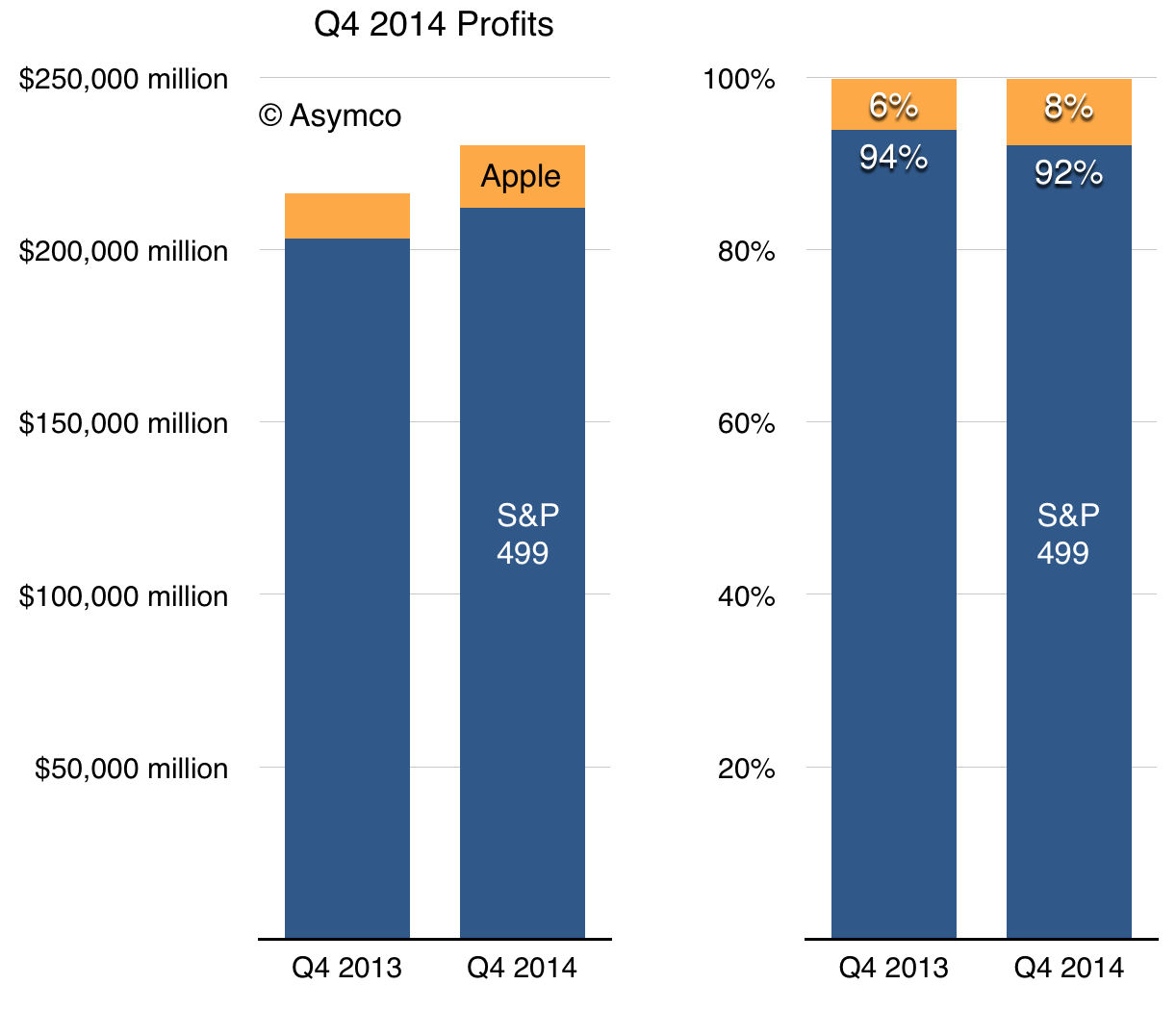
    Thomson Reuters reported that excluding Apple, the entire S&P 500 grew profits at a rate of 4.4%. Including Apple the figure is 6.4%.

    Using one weird trick ((Algebra)) I calculated the value of profits generated by the S&P 499 (i.e.the largest public companies excluding Apple) in Q4 2013 and Q4 2014.

    Apple therefore accounted for nearly 8% of the S&P 500 in the last quarter. A year earlier Apple was a mere 6%.

    Screen Shot 2015-02-08 at 8.43.53 PM


    It should therefore be obvious why Apple's P/E ratio is 16.1 while the S&P 499 P/E ratio is 19.8.

  2. How many iOS devices did/will Apple ship?

    Research · 11 comments

    Last August I wrote:

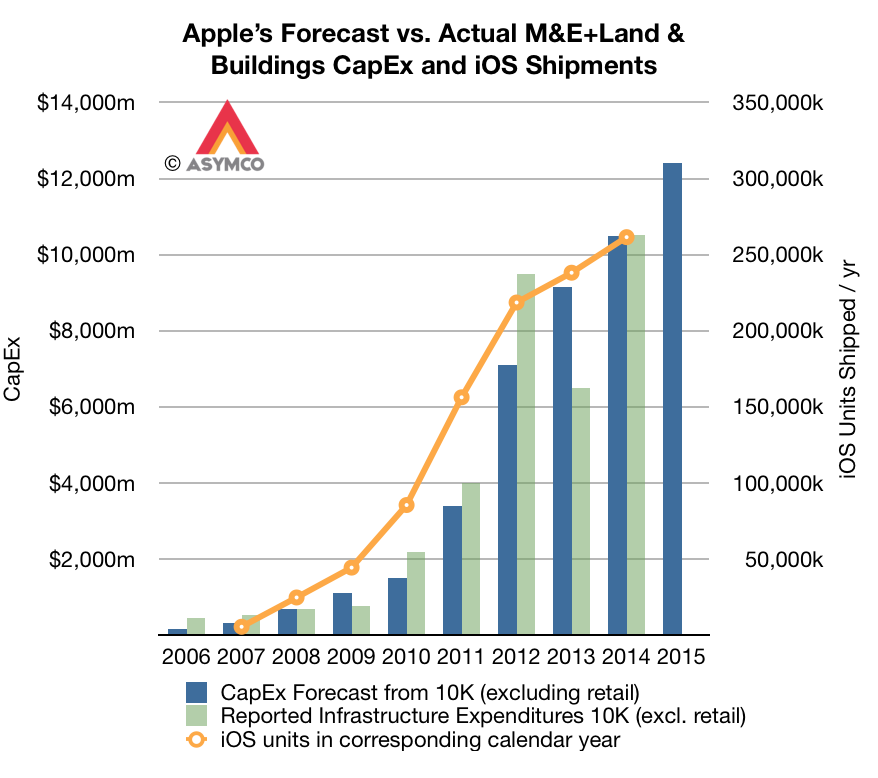
    It’s therefore reasonable to assume that calendar 2014 will see at least 250 million iOS devices sold

    The actual figure was 259.5 million.

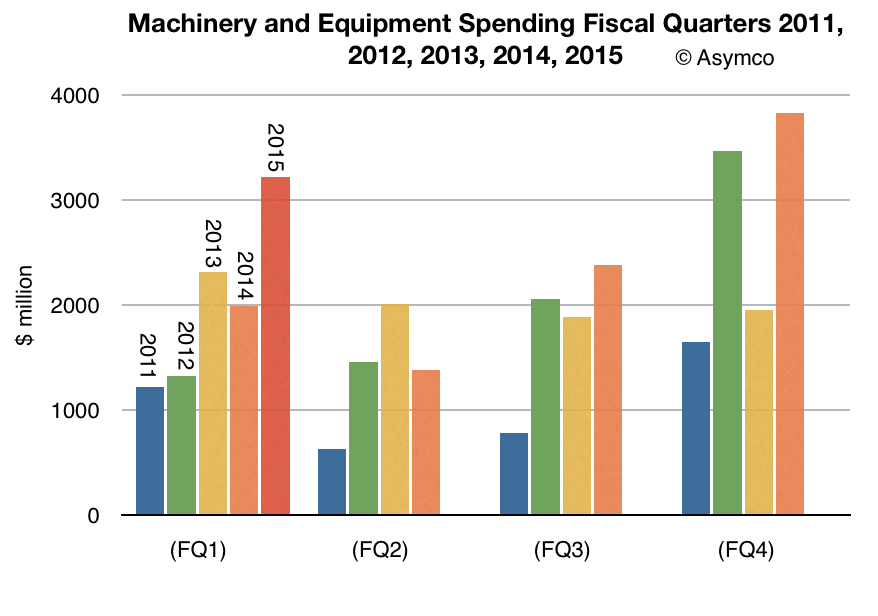
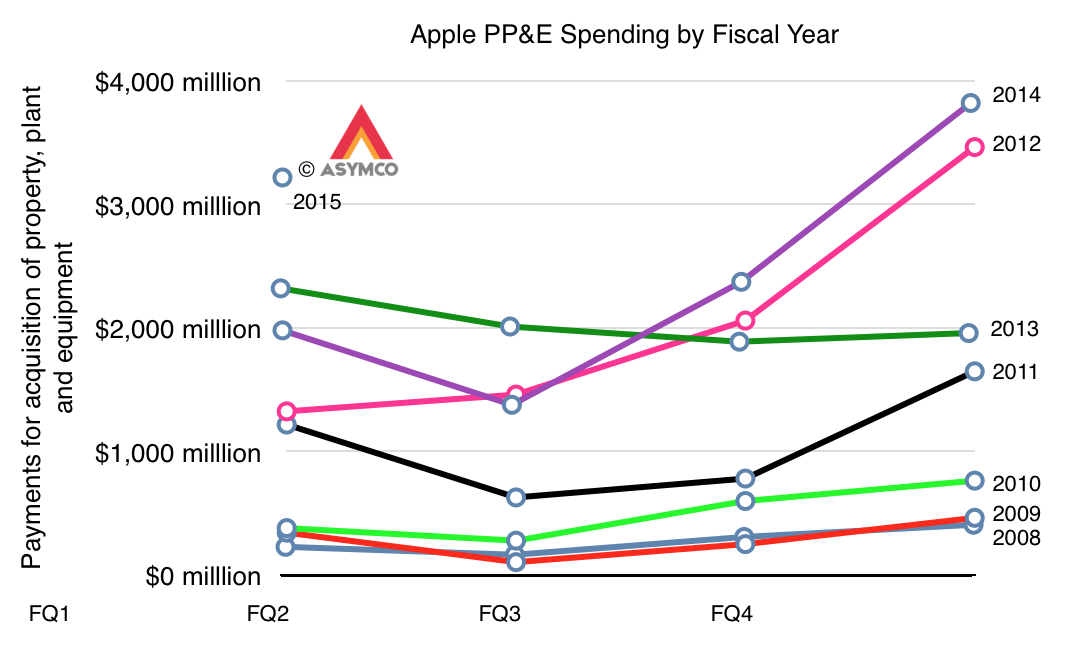
    Looking ahead, the capital spending pattern so far shows a distinct rise heading into Q1.

    Screen Shot 2015-02-08 at 7.33.14 PM

    This could be partly due to the new campus, the new Watch production ramp and perhaps new iPad models.

    Screen Shot 2015-02-08 at 7.33.27 PM

    Nevertheless, I think it's safe to predict that the company is on track to ship 310 to 320 million iOS devices in 2015.

    Screen Shot 2015-02-08 at 7.35.30 PM


  3. Apple's Growth Scorecard

    Research · 26 comments

    Apple's Net Sales grew at the rate of 30% in the last quarter. Earnings per share grew at 47%. Both of these figures are the highest since 2012.

    Screen Shot 2015-02-08 at 5.27.47 PM

    It should be noted that although the rate of growth is extraordinarily high, the company never actually stopped growing in the past three years. As the table above shows, net sales has always had positive growth.

    Compared with the fourth calendar quarter of 2011, Apple's sales are 61% higher and earnings per share are 54% share. ((Some of the expansion in earnings per share is due to the willingness of shareholders to sell their shares to Apple. 10% of the shares around in 2011 have thus disappeared.))

    This degree of growth at this stage in the history of the markets it participates in is a revelation.

    Consider:

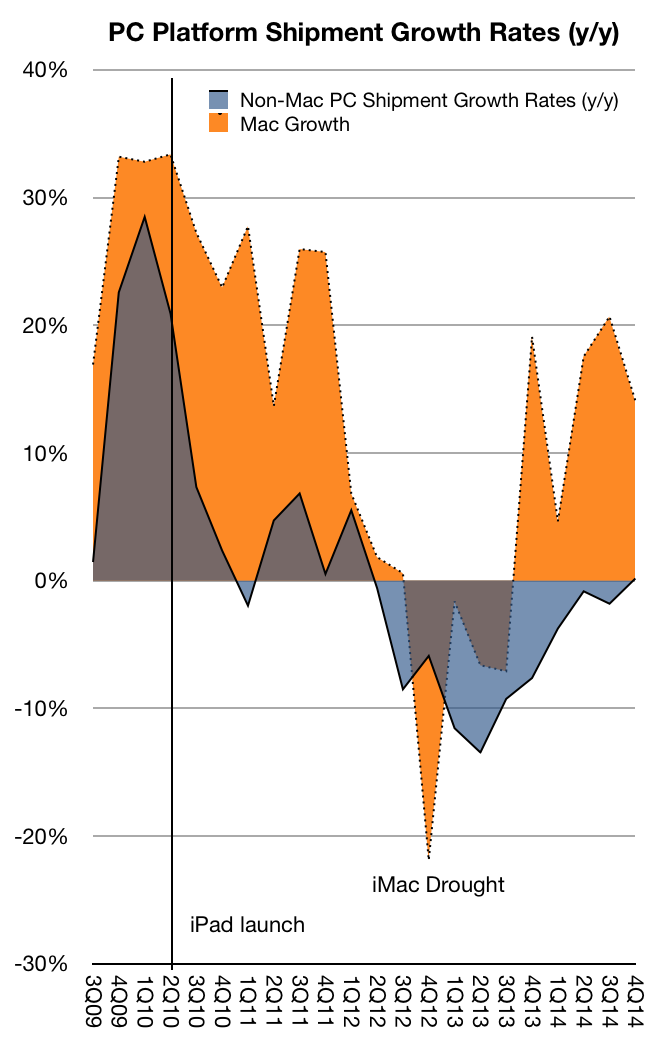
    • The PC market is more than 30 years old. In this mature market the Mac has been outgrowing the Windows platform for 34 out of the last 35 quarters.
    Screen Shot 2015-02-08 at 5.35.43 PM


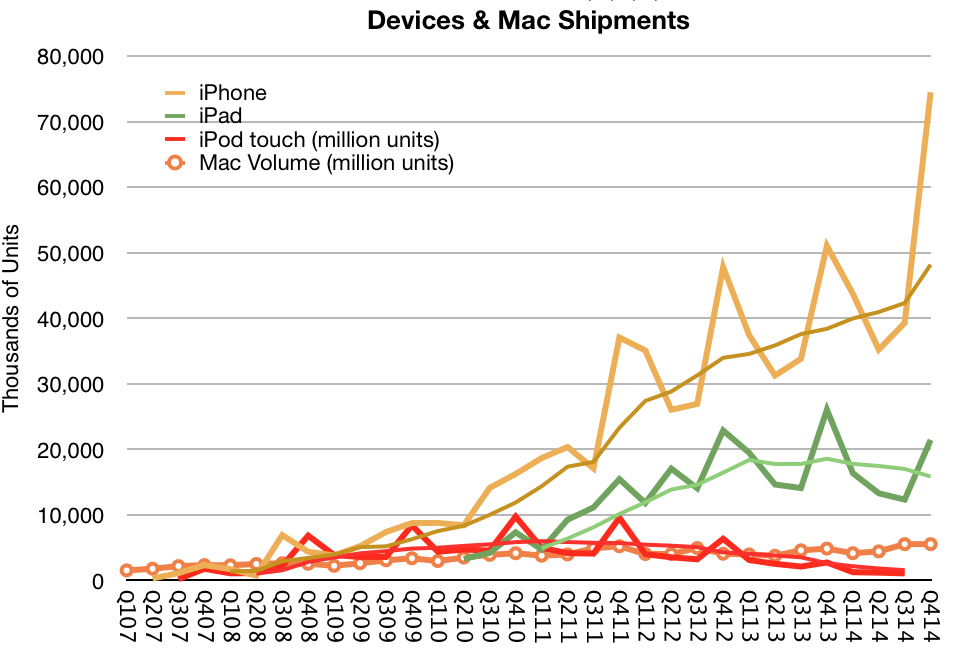
    • The iPhone was announced eight years ago and it still managed to grow at the rate of 57%.
    Screen Shot 2015-02-08 at 5.47.11 PM
    • The market shares of its Mac, iPhone and iPad products are all remarkable only for their paucity.
    • The pricing of all their products is more than double the median for their categories.
    • Regardless of extreme growth, pricing power, headroom and, most importantly, customer loyalty, the company's prospects are seen as dismal in contrast to its underperforming peers. ((As measured by P/E or FCF/EV ratios vs. direct rivals, technology companies or the S&P 500.))
    • Such is the plight of the anomalous.
  4. Asymcar 21: Where we’re going, we don’t need roads

    Research · 7 comments

    Gartner asserts that “connected cars or smart cars are poised to play a pivotal role in the Internet of Things (IoT)”. We say “Hah!”

    Also,

    • Who levies automotive platform taxes?
    • What in the world could “over serving” transportation mean?
    • Using the Automatic app in a Porsche.
    • BMW’s  “sounding the alarm” over tech companies efforts to collect auto data.
    • China’s car industry and other unimportant details relative to declining interest in driving among young people.

    via Asymcar 21: Where we’re going, we don’t need roads | Asymcar.

  5. Haunted Empire

    Research · 67 comments

    The "Stupid manager theory of company failure" (and its corollary, the "Smart manager theory of company success" ((As well as the "Smart/Stupid leader theory of national success/failure"))) remains the most popular, perhaps even the most universally accepted theory of management. Book after book, thoughtful article after article alludes to this theory and whenever a company is perceived to be under-performing, all fingers point to the leadership with demands for blood letting.

    This is not a new phenomenon. When catastrophe strikes, as a thoughtful species, we have always asked for leaders to be sacrificed. In Europe during the Iron age leaders were sacrificed when crops failed. In South and Central America leaders were ceremonially tortured for similar reasons.

    Of course most crop failures were due to weather phenomena and the anointed leadership had nothing to do with these causes. Nevertheless ancient correlation analysis would have revealed the pattern that good leadership meant good weather and bad leadership meant bad weather.

    There was a balance to the downside however. When times were good the leadership enjoyed luxuries and praise. This was the essential deal societies made: we'll keep you in riches and allow you to be idle as long as times are good but ritualistically slaughter you when times are bad. We'll declare you "chief magical officer" and place all our faith in you. But, of course, if you fail, we will will be vengeful.

    And so it goes in today's corporate world. I've often said that corporate governance is medieval, or pre-scientific in its approach to understanding causality. That may be too generous. As far as the reward/punishment system (also known as Human Resources) it's probably pre-neolithic. The luxuries and extravagance which we heap upon the leader provide abundant evidence. Leaders insist on these ironic "pay packages" and boards approve them because they know they can and will be ritualistically sacrificed if and when the mobs turn against them.

    A manager would be a fool to accept even generous pay given the risk, actually near certainty, of ritualistic slaughter. They demand and are unquestionably given absurd pay that has no relationship to performance. Such pay has no relationship to performance because it isn't designed to reward performance but to account for the risk of arbitrary and very public sacrifice. Boards (and hence shareholders) are deliberately hiring a scapegoat for sins as yet unknown. Luxury and violence are thus finely balanced in what is called "Executive Search".

    What allowed civilized society (i.e. that outside of corporations and politics) to move beyond this has been an understanding that our destinies are not necessarily tied to individuals' actions. We don't need to adulate/prostrate/dismember/defenestrate someone if our car does or does not work. People have begun to understand that there are rules about nature beyond the control of known or unknown agents. Complex systems like factories, farm  irrigation and even air traffic can be made predictably reliable without magic.

    Yet we are not willing to suggest that such rules apply to social systems. It's not just laymen who abstain. Historians and social scientists are mortified at the notion that causal statements could ever be made about society.

    Causal statements (beyond good/bad people => good/bad outcomes) are  considered non-credible in the very institutions which harness laws of nature in order to create value. Consider the recent instance of corporate defenestration  directed at Tim Cook. He was accused of failure of magic. I say this because he replaced a previous magician with many powers and the anger at his inability to match this power was at a fever pitch in 2012 and 2013. A book was even written about this failure and titled with the appropriate metaphor (See blog title).

    I know what you're saying: the sad fantasists which subscribe to these theories are wrong. Their theory is disproven almost every day. Even though we reward them as if they did, managers do not possess magical powers.

    But the author of Haunted Empire was surely well rewarded for her accusations. We rewarded her because our search for answers is otherwise unmet. What alternatives do we have?

    Think of it this way: What did ancient people have other than the Anointment/Sacrifice theory of good management? It persisted for millennia. The lack of alternatives means today we still believe as they did.

  6. Bigger than Hollywood

    Research · 72 comments

    Apple paid $10 billion to developers in calendar 2014. Additional statistics for the App store are:

    • $500 million spent on iOS apps in first week of January 2015
    • Billings for apps increased 50% in 2014
    • Cumulative developer revenues were $25 billion (making 2014 revenues 40% of all app sales since store opened in 2008)
    • 627,000 jobs created in the US
    • 1.4 million iOS apps catalog is sold in 155 countries

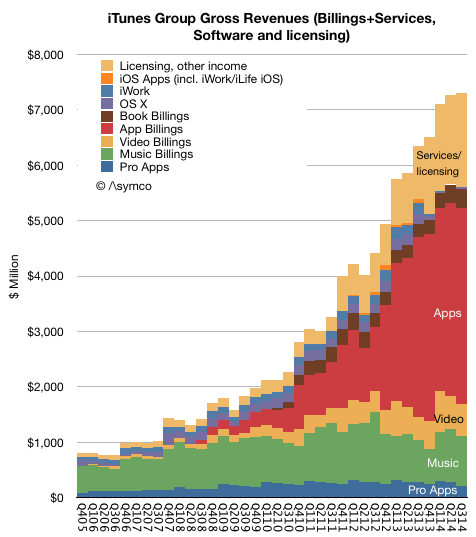
    Putting these data points together with others from previous releases results in a fairly clear picture of the iTunes/Software/Services ((soon to be renamed Services and encompass everything under the heading of iTunes software and services today including content, apps, licensing and other services and beginning Q4 2014 it will also include Apple Pay.))

    Screen Shot 2015-01-22 at 1-22-10.38.39 AM

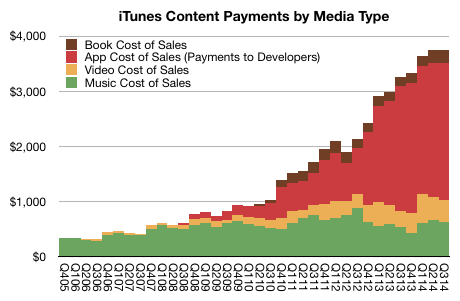
    The App ecosystem billings (what consumers actually pay) is shown in the red area above. 70% of those payments are transferred directly to developers and Apple reports the 30% remaining as part of its revenues. This view of the iTunes ecosystem shows the impact of Apps relative to the other media types. When we measure the payments to the content owners we can see that Apps also dominate: 

    Screen Shot 2015-01-22 at 1-22-10.44.16 AM

    The red area above adds up to the approximately $25 billion total paid to developers. This view of the payments to ecosystem contributors shows how apps are now a bigger digital content business than music (( Music payments due to iTunes Radio streams are not shown as part of Music cost of sales. Streaming revenues are included in the services/licensing income and payments come out that cost structure.)) and TV programs and Movie rentals and purchases put together.

    This is quite a story.

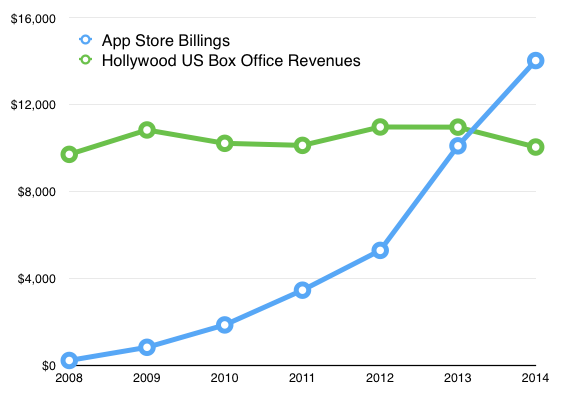
    Put another way, in 2014 iOS app developers earned more than Hollywood did from box office in the US.


    Although the totals for Domestic (US) Box Office are not the complete Hollywood revenues picture, Apple's App Store billings is not the complete App revenue picture either. The Apps economy includes Android and ads and service businesses and custom development.  Including all revenues, apps are still likely to be bigger than Hollywood.

    But there's more to the story. It's also likely that the App industry is healthier. On an individual level, some App developers earn more than Hollywood stars ((so do YouTube stars, but that's another story.)) and I would guess that the median income of app developers is higher than the median income of actors. ((A large majority of actors earn less than $1,000 a year from acting jobs)) The app economy sustains more jobs (627,000 iOS jobs in the US vs. 374,000 in Hollywood) and is easier to enter and has wider reach. As the graph below shows It's also growing far more rapidly.

    Screen Shot 2015-01-22 at 1-22-11.30.06 AM

    The curious thing is that even though the medium of apps is swamping other forms of entertainment in all measurable ways, comprehension of the phenomenon is lagging.

    Information asymmetry is a wonderful thing.

  7. The Monopolist

    Research · 36 comments

    When the Apple Watch will begin sales, there will have been dozens of "smart watches" released. At CES this week at least 56 "wearables" were on display. One could be forgiven for thinking that Apple's Watch will compete with at least that many alternatives. Those alternatives don't even include the entire existing mechanical and electronic watch market, which, surely, is also filled with competitors.

    When analyzing competition, it's easy to get caught up in one-on-one competitive comparisons, each posited as a decisive life-or-death battle. Consider the list of competitors that Apple has been declared as being in a death-match with:

    • Real Networks. Yes, there was a time when Apple's survival depended on success vs. alternative media encoding technologies.
    • Adobe. Remember Flash? No Flash support meant that Apple's fledgling phone would fail.
    • "The Music Industry". Unhappy partners could surely shut down the iTunes music store, and their insistence on DRM would surely cripple the experience.
    • IBM. In nearly every aspect, their business/strategy/inclination and glimmer of intent was an existential threat the Apple.
    • Microsoft. In nearly every aspect, their business/strategy/inclination and glimmer of intent was an existential threat the Apple.
    • Google. In nearly every aspect, their business/strategy/inclination and glimmer of intent is an existential threat the Apple.
    • Samsung. Obviously. But not just phones or tablets. They have control over key components that Apple used in many of its products, before the iPhone even.
    • Palm/BlackBerry/Nokia/HTC/Huawei/Xiaomi et.al. Every phone maker (and every phone) was/is an existential threat to Apple.
    • Dell/HP/Asus/Lenovo et. al. Every PC maker was a threat to Apple. Some of them made MP3 players. Some of them make tablets.
    • Amazon. Obviously. Not only as an iTunes killer but as a device disruptor. They are working on drones, after all.
    • Sony. Remember them? No longer a PC maker but they moved in many circles Apple moved in. While we're at it, add all the consumer electronics companies in Japan.
    • Dropbox. "If Apple can't do iCloud right, they're doomed".

    This is a very short list (feel free to suggest more) and it becomes clear that the total count of competitors that Apple has to counter "or else" seems to number in the thousands. Practically every hardware, software and service company is positioned as an "Apple Killer". in fact, the more interesting question might be which companies are not competing with Apple.

    Another interesting question relates to why there is no transitive property of competition. I.e. if company A competes with Apple and Apple competes with company B then it does not follow that company A competes with company B.

    To wit, whereas HTC competes with Apple and so does Dropbox, it does not follow that HTC competes with Dropbox. So it's entirely possible that it's axiomatic that

    "Most companies compete with Apple but few of them compete with each other".

    Recognizing a pattern, one could build a model of the technology world where Apple is the focus of all competitive efforts. But this starts to sound absurd.

    Indeed, the flaw in the logic is that these competitive pairings are based on the overlap of features of products/services being offered. The features become the attributes of a product which supposedly defines their competitive power. But this is false for the same reason that the attributes of a buyer do not determine their buying behavior. Buyer attributes ((E.g. demographic, sociographic))  are easy to measure and they may correlate to purchasing behavior but they don't cause it.

    Similarly, product or company attributes are easy to measure and they may correlate to competitive behavior but they don't cause the substitution of a purchase.

    Therefore, appealing to Apple to change its strategy, operations or even its core beliefs in response to a competitor's behavior is deeply misguided. The cause of success and failure in the marketplace is based on being hired by the customer to get a job done. Once hired, the chances are that the trust is secured and the relationship continues even if alternatives are available. There is comfort in the knowledge of whom you're working with.

    This aspect of trusted relationship between the buyer and the product and the interweaving of 'brand' (aka intentions) of the hired is the root of loyalty. Of course, loyalties can be betrayed and trust can be lost. But that implies that the primary responsibility of the manager is the creation and preservation of trust. When seen in this light, an alternative axiom becomes clear:

    "Great companies don't have any competition."

    Great companies are "monopolists of customer trust" and are unaffected by alternatives. They are positioned on and nailing the job their products and services are hired for. The alternatives must not only duplicate the exact job (which they almost never do), but they must also overcome the switching costs.

    Remember this when analyzing the impact of yet another competitor and considering the "Apple must fix/do X or else" assertions.