Ruby on Rails Podcast #146: Horace Dediu of Asymco - Open Source Software
Sean Devine has a conversation with Horace Dediu of Asymco about open source software.
via 5by5 | Ruby on Rails Podcast #146: Horace Dediu of Asymco - Open Source Software.
Sean Devine has a conversation with Horace Dediu of Asymco about open source software.
via 5by5 | Ruby on Rails Podcast #146: Horace Dediu of Asymco - Open Source Software.
This week Myke is joined by Horace Dediu. They discuss his work at Nokia and how that lead to starting his blog, Asymco. They also talk about the role and work of an analyst, his presentation series – Airshow – and graphs, naturally.
via 5by5 | CMD+Space #92: A New Lingua Franca, with Horace Dediu.
Research #Theory · 166 comments
Illiteracy is the inability to read and write. Though the percent of sufferers has halved in the last 35 years, currently 15% of the world has this affliction. Innumeracy is the inability to apply simple numerical concepts. The rate of innumeracy is unknown but chances are that it affects over 50% of us. This tragedy impedes our ability to have a discourse on matters related to quantitative judgement while policy decisions increasingly depend on this judgement.
But there is another form of ignorance which seems to be universal: the inability to understand the concept and role of innovation. The way this is exhibited is in the misuse of the term and the inability to discern the difference between novelty, creation, invention and innovation. The result is a failure to understand the causes of success and failure in business and hence the conditions that lead to economic growth.
My contribution to solving this problem is to coin a word: I define innoveracy as the inability to understand creativity and the role it plays in society. Hopefully identifying individual innoveracy will draw attention to the problem enough to help solve it.
One example is in the following quote:
"Lastly, nationally circulating tabloid Ilta-Sanomat gets a look at Nokia’s fabled tablet computer that was developed nine years before the iPad hit the market. According to the paper, Nokia had its own innovative tablet device ready in 2001, but unfortunately it never made it to the shops. A former Nokia expert Esko Yliruusi says that the project was suspended a heartbeat before the tablet hit the market because it was thought that there was insufficient demand for such a device." ((A video showing the device is here, in Finnish.))
To explain what's wrong with this usage we need some definitions.
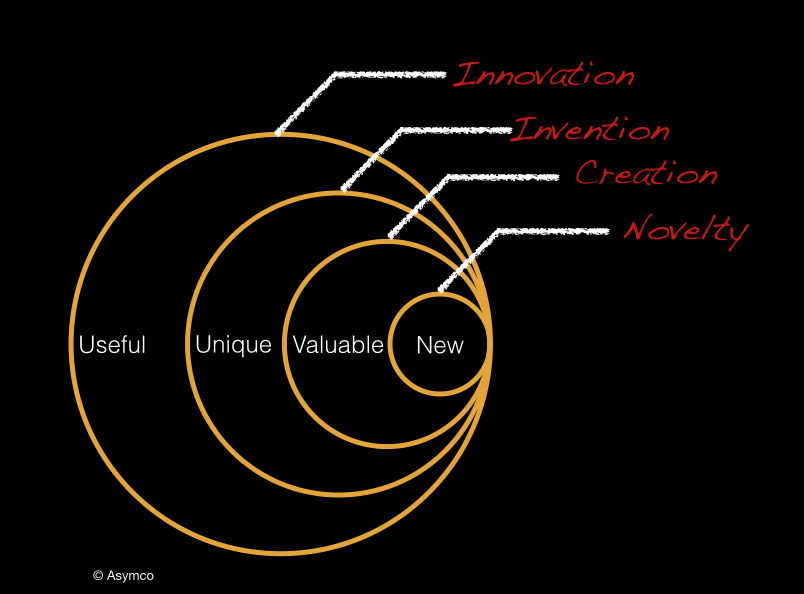
The definition of innovation is easy to find but it's one thing to read the definition and another to understand its meaning. Rather than defining it again, I propose using a simple taxonomy of related activities that put it in context.
The taxonomy is illustrated with the following diagram. The position of the circles shows the embedding of meaning ((The size of the circles also suggests degree of effort required and potential reward. Note that this is not a Venn diagram.))
To illustrate further, here are some examples of the concepts.
The differences are also evident in the mechanisms that exist to protect the works:
Note that the taxonomy has a hierarchy. Creations are novel, inventions are creations and innovations are usually based on some invention. However inventions are not innovations and neither are creations or novelties. Innovations are therefore the most demanding works because they require all the conditions in the hierarchy. Innovations implicitly require defensibility through a unique "operating model". Put another way, they remain unique because few others can copy them.
To be innovative is very difficult, but because of the difficulty, being innovative is usually well rewarded. Indeed, it might be easier to identify innovations simply by their rewards. It's almost a certainty that any great business is predicated on an innovation and that the lack of a reward in business means that some aspect of the conditions of innovation were not met.
The causal, if-and-only-if connection with reward is what should be the innovation litmus test. If something fails to change the world (and hence is unrewarded) you can be pretty sure it was not innovative enough.
Which brings us to the quote above. The fact that the Nokia tablet of 2001 not only did not succeed in the market but was not even released implies that it could not have been innovative. The product was only at the stage of perhaps being an invention (if it can be shown to be unique) or merely a creation (if it isn't.) Furthermore, if the product is so poorly designed that it is literally unusable then it is just a novelty. A design, sketch or verbal description might be novel but it does not qualify as an innovation or an invention or even a creation. How far the depiction went toward making a dent in the universe defines its innovativeness.
Why does this matter?
Understanding that innovation requires passing a market test and that passing that test is immensely rewarding both for the creator and for society at large means that we can focus on how to make it happen. Obsessing over the mere novelties or inventions means we allocate resources which markets won't reward. Misusing the term and confusing it with activities that don't create value takes our eye off the causes and moves us away from finding ways of repeatably succeeding.
Recognizing that innoveracy is a problem allows us to address it. Addressing it would mean we could speak a language of value creation that everyone understands.
Wouldn't that be novel?
We discuss the zeitgeist of automotive decline.
We marvel – again – at the industry’s glacial pace of change and contrast the auto industry’s tiny volumes to smartphones and personal computers.
via Asymcar 12: Cycle Times | Asymcar.
Research #Significant Digits #padcast · 30 comments
Show #1: The Future of the Internet and Everything
Part 1: The Internet is dead, long live the Internet
The data shows the Internet growth will go through an inflection point. Should we panic or celebrate?
In this inaugural episode we open with the biggest question facing the biggest technological innovation of our time: the limit to growth of the Internet. The Internet is the backbone of our post-industrial society as much as the railroad was the backbone of the industrial revolution. Even more so, the diffusion of internet consumption is the fundamental engine of growth at a time when industrial economies are all mired in syndromes of underinvestment and misallocation of resources.
And so it matters greatly if and when the Internet will "inflect" in growth, going from acceleration to deceleration. Mobile computing sustained this acceleration, bringing computing and connectivity to the billions for whom the PC would always be beyond reach. But even with the expansion of device-based usage limits are in sight.
The implications could be profound. Frothy valuations and optimism could evaporate. Venture Capital could find few exits and the "second Internet Bubble" could burst. On the other hand, maybe the data shows that opportunity is largely unmet. Quantity of users is but one proxy. How can growth and business model innovation continue?
To help us think this through I have as my guest Marko Anderson, cofounder of Random ((Run out of Internet to read? Random’s new iOS app is for you )) and a former colleague at Nokia.
Stay tuned for four more parts:
Significant Digits is a talk show where we take time to recognize patterns in the lives of technologies.
Horace and Moisés talk about Amazons acquisition of ComiXology, digging into the very "local" nature of book publishing in general and the extreme regional differences in content popularity and delivery.
Research #Industry #Nostalgia · 23 comments
Philip Elmer-DeWitt cited Piper Jaffray's latest Teen Survey on Device Ownership where ~7,500 teens in the US are asked about their device ownership. This type of data is similar to the method comScore uses to measure penetration smartphones in the US making the two data sets comparable.
The combined data is shown the following graphs.
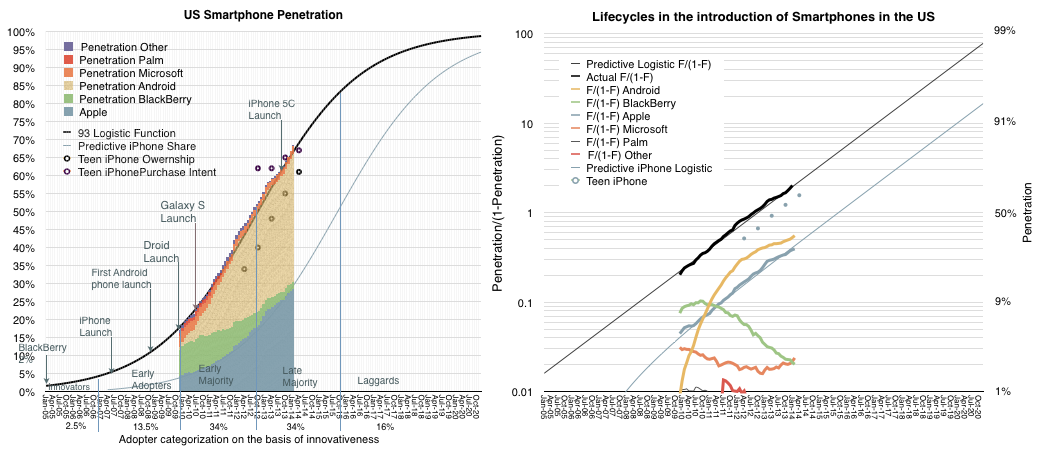
One graph is the penetration data and the other is the ratio of penetration to unpenetrated on a log scale. The PJC Teen Survey data is shown as dots on both graphs. In the spring of 2012 the difference between teen iPhone ownership and overall population iPhone ownership was 20 percentage points. In the fall 2012 it was 22 points. In spring 2013 it was 25 points. The spread increased to 30 points in the fall of 2013.
This implies that the latest sample (April 2014) should have at least a 31 point lead on what comScore will report in another two months. ((comScore reports data during the first week of a month for a period ending one month earlier. So the April release covers a sampling period ending February)) In other words current iPhone penetration in the US is probably 30%. This assumes of course that the relationship between teens and overall population has not changed. But there is consistency in the pattern of iPhone growth for over 50 months.
In addition, the purchase intent data is showing that there is growing interest and that interest reflects demand which has been largely met by a purchase decision.
Teens are leading adoption in this particular sector because the device is very well suited to the jobs that they need to do, mainly social interaction. It's no coincidence that the audiences for the fastest-rising services (SnapChat, WhatsApp, Vine, YouTube, Instagram) consist mainly of teens. They also lead adoption in FaceBook, iTunes, MySpace, etc. In that regard teens are an early indicator of mainstream behavior.
Teens taught the world new habits throughout the 20th century ((An entertaining review of the contribution (and invention) of teenagers in the 20th century can be enjoyed in James May's 20th Century Episode 5)) and they certainly seem to be teaching us in the present.
Research #Industry #Theory · 99 comments
There are 7.1 billion people on Earth. Coincidentally there are also 7 billion mobile connections. Those connections are held by 3.45 billion unique mobile subscribers. ((GSMA)) Unsurprisingly, the largest national mobile markets (by number of subscriptions) correspond closely to the most populous nations.
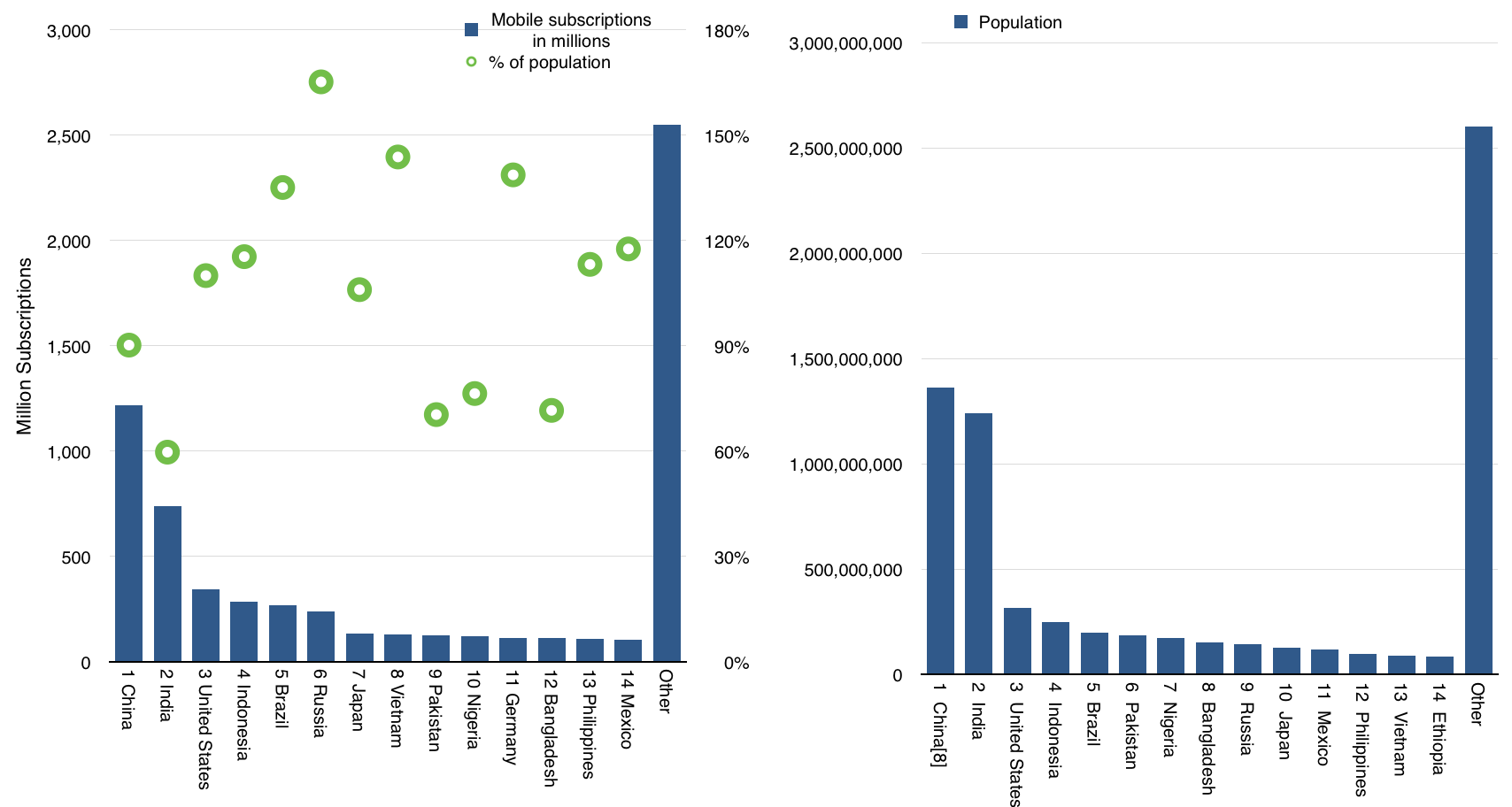
Considering smartphones, last year 1 billion smartphones were sold and the number of smartphones in use is about 2 billion ((There are also about 2 billion 3G/4G connections world-wide))
Given the rapid adoption of smartphones, it's also safe to assume that smartphone penetration will follow population distribution. In the US, where comScore data is published monthly, penetration is following a predictable logistic curve.
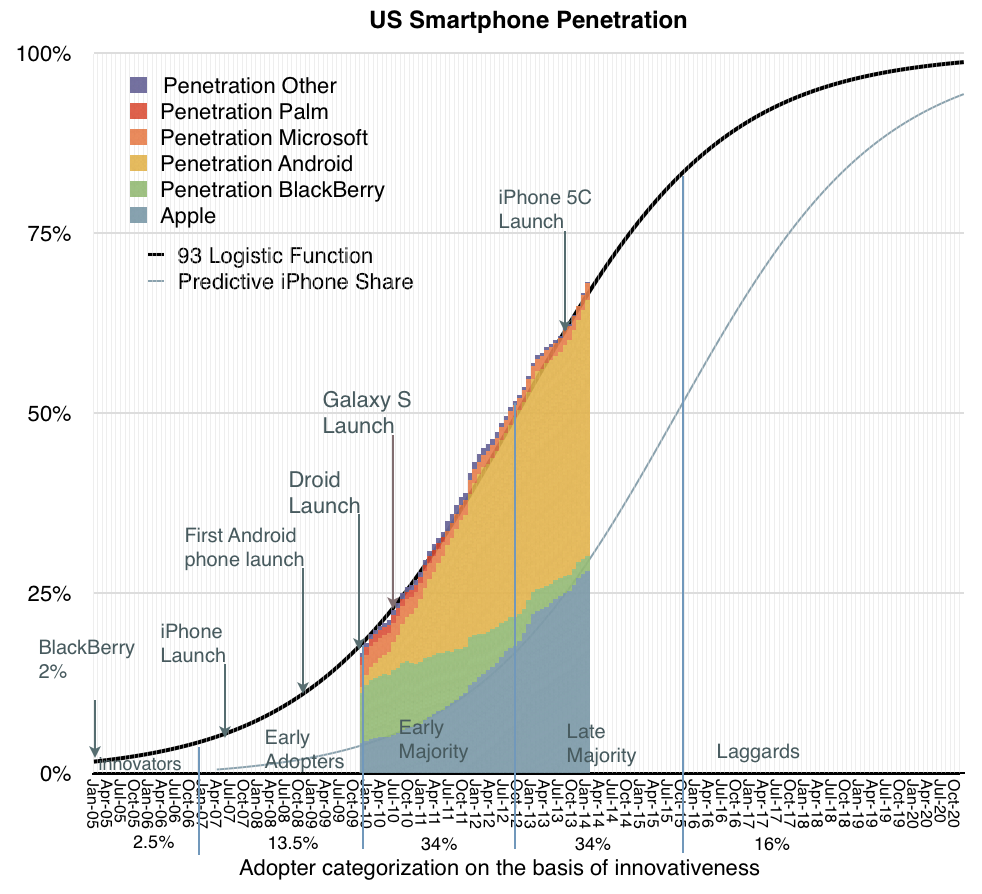
Assuming similar patterns world-wide we can forecast regional smartphone penetration.
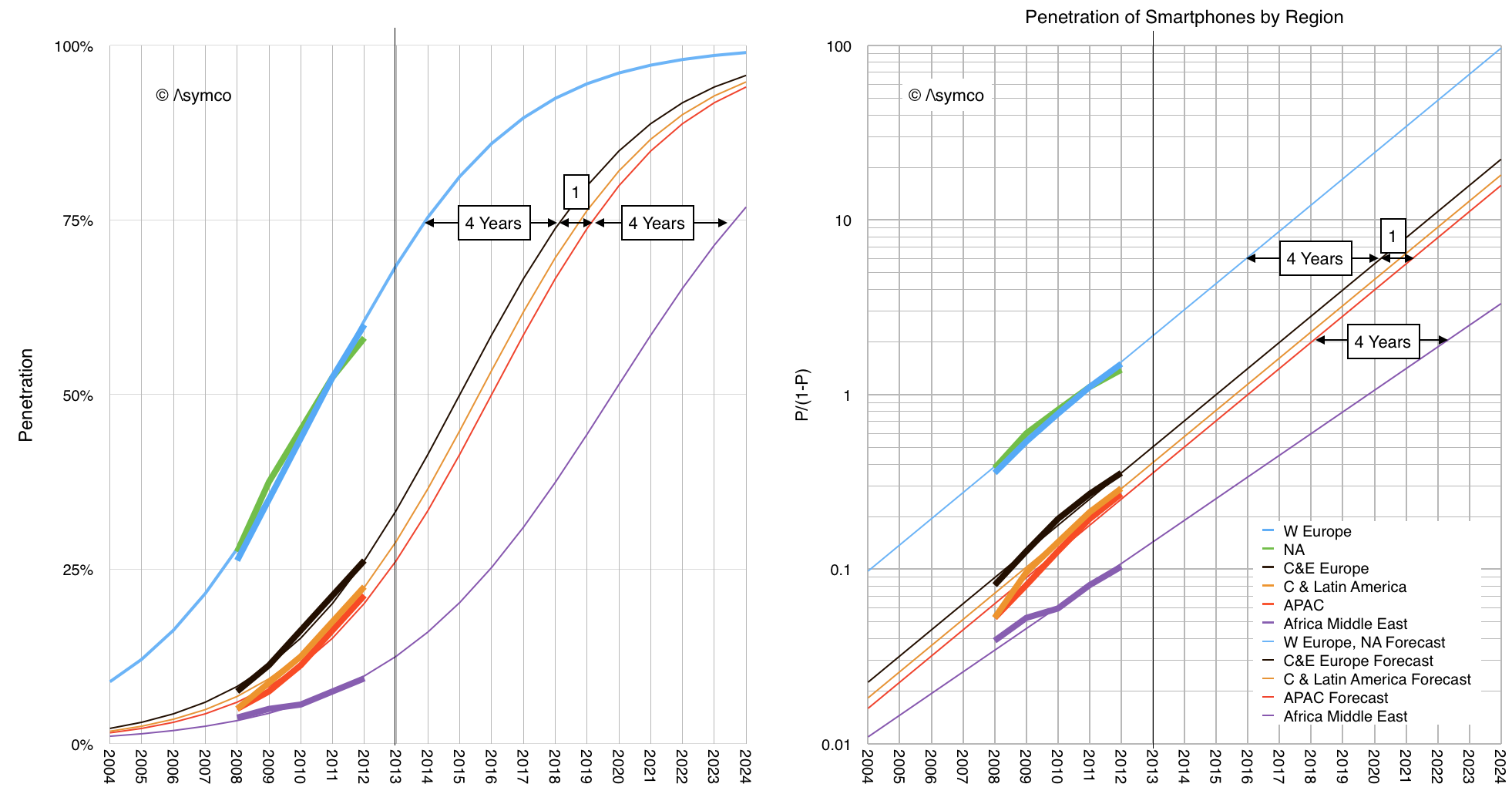
This yields the following forecast for smartphone usage world-wide.
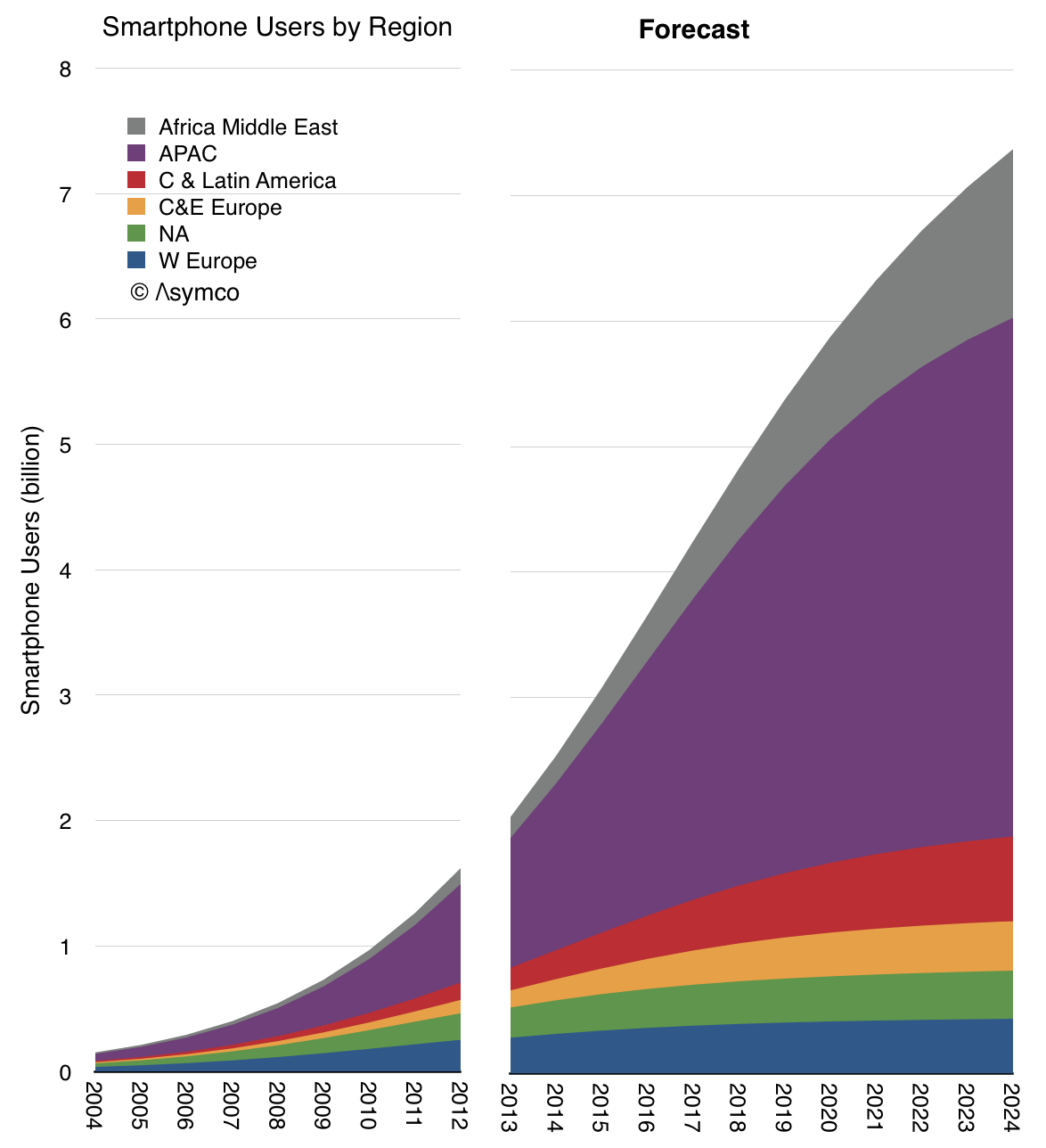
Three years ago the notion of smartphones becoming as ubiquitous as toothbrushes seemed far fetched but it's now gradually being accepted. The smartphone is well on its way to becoming the most successful technology in history.
So what?
What will the smartphone do for us? Does smartphone ubiquity change anything? Besides increasing ARPU slightly in a $1.2 trillion industry? Besides doubling the size of the device business? ((
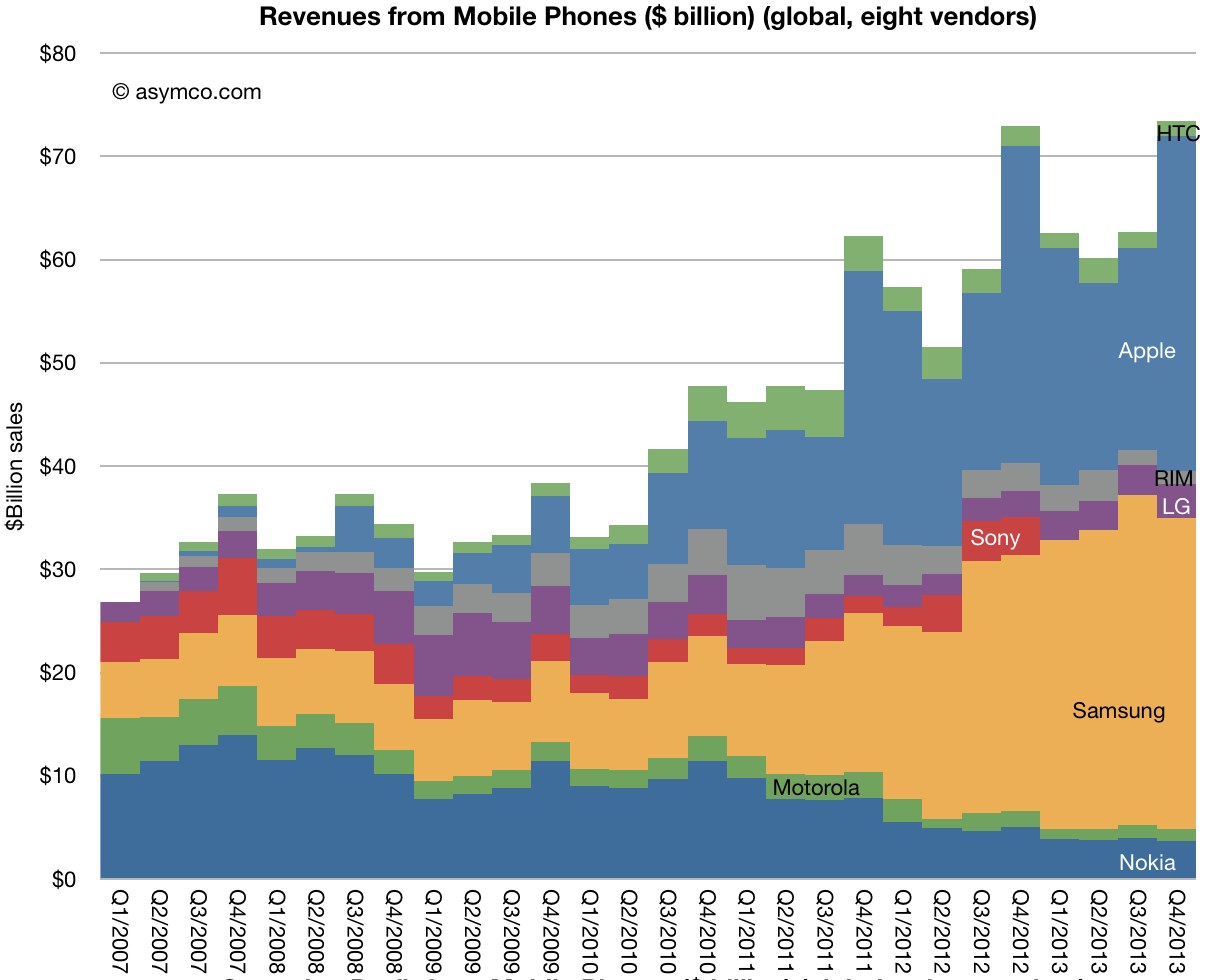
))
Besides creating a $20 billion app industry? How do we assess the impact of having a connected computer in one's pocket? In everyone's pockets? With us all day. Every day.
Before we answer, we have to realize that the smartphone has been disruptive. Which means it has that special quality of not affecting the world in a predictable way. Its growth has been largely unforeseen and has affected the fortunes of the incumbents. As big and ubiquitous as it has become, the companies which were most intimately aware of it, its very own creators, were cursed by it.
The evidence is in this graph:
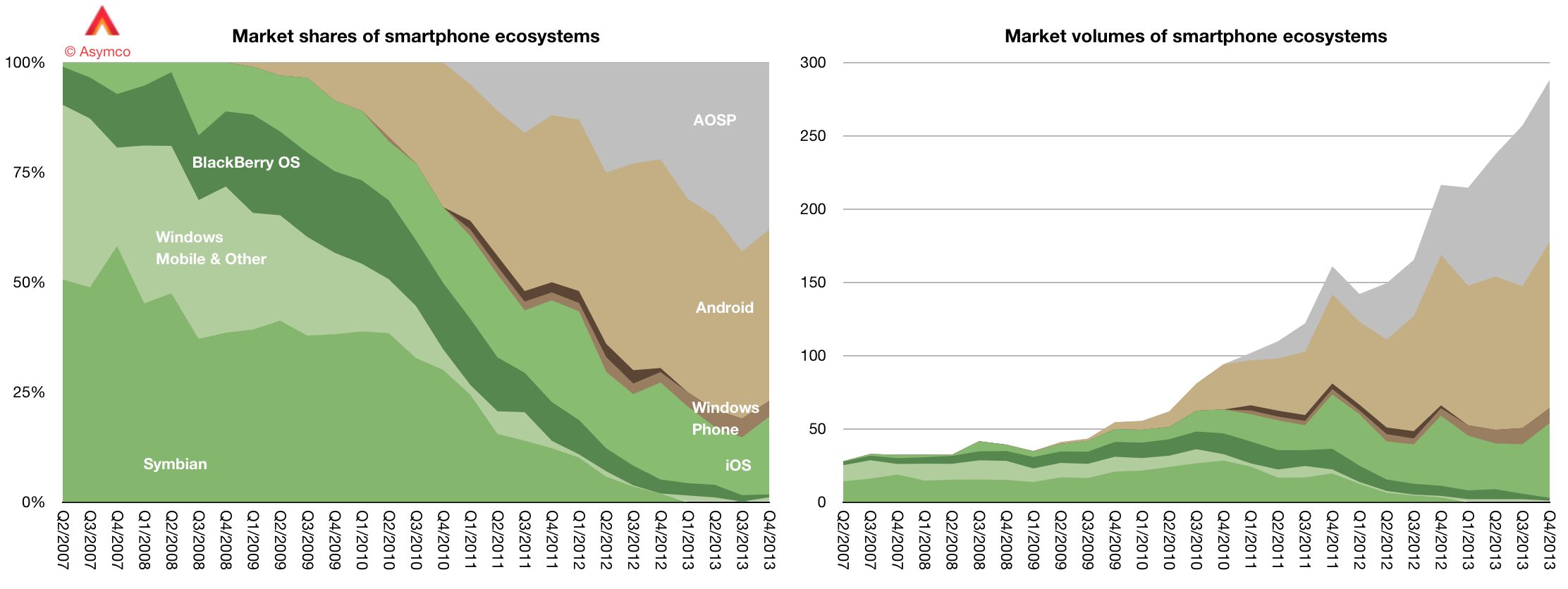
As the market exploded, the incumbent platforms all but disappeared. The innovators fell into the trap of treating the complex new product as a niche whose appeal was for selected "segments" described by the coarse data they were able to gather. Ubiquity itself was asymmetric to the basis of competition they established.
Today we can note how even the usurpers iOS and GMS Android are being swamped by the more modular alternative AOSP. Indeed, if we squint a bit we might notice that the OS/platform churn we see is part of a trend where the value is migrating up the stack from Components and Networks, through Devices and Operating Systems and on to Services and Experiences.
I call these the three mobile eras: (Firm names used are representative of a cohort and are not a complete list of participants.)
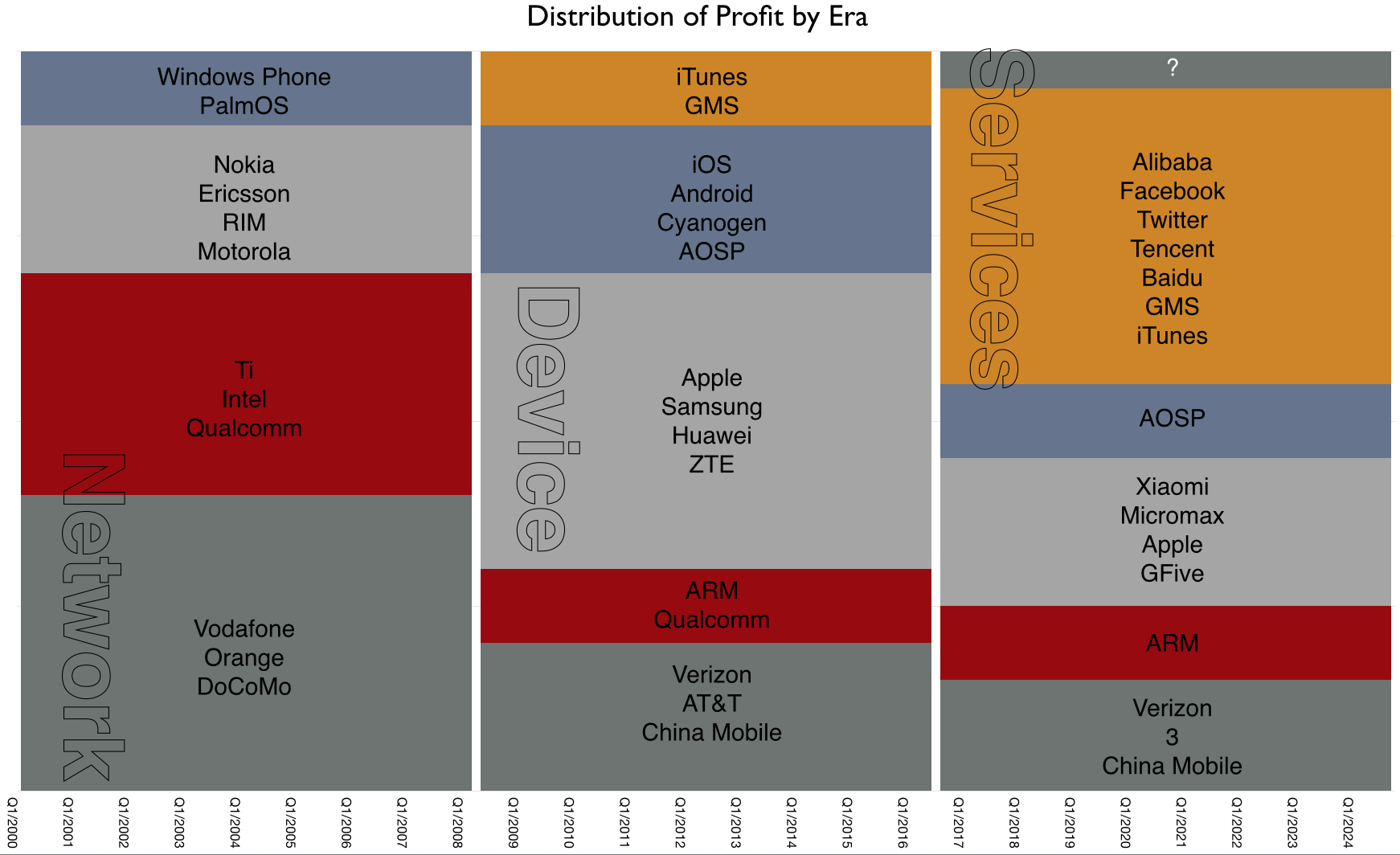
The thesis is based on Value Chain Evolution Theory which states that disruptions cause profits to evaporate from commoditized segments and condense in adjacent spaces, usually toward more modular, more convenient or lower cost innovations.
Note that the eras have specific time spans. If the pattern holds then we can overlay the time frame of smartphone penetration on these eras and even plot ecosystem entrants.
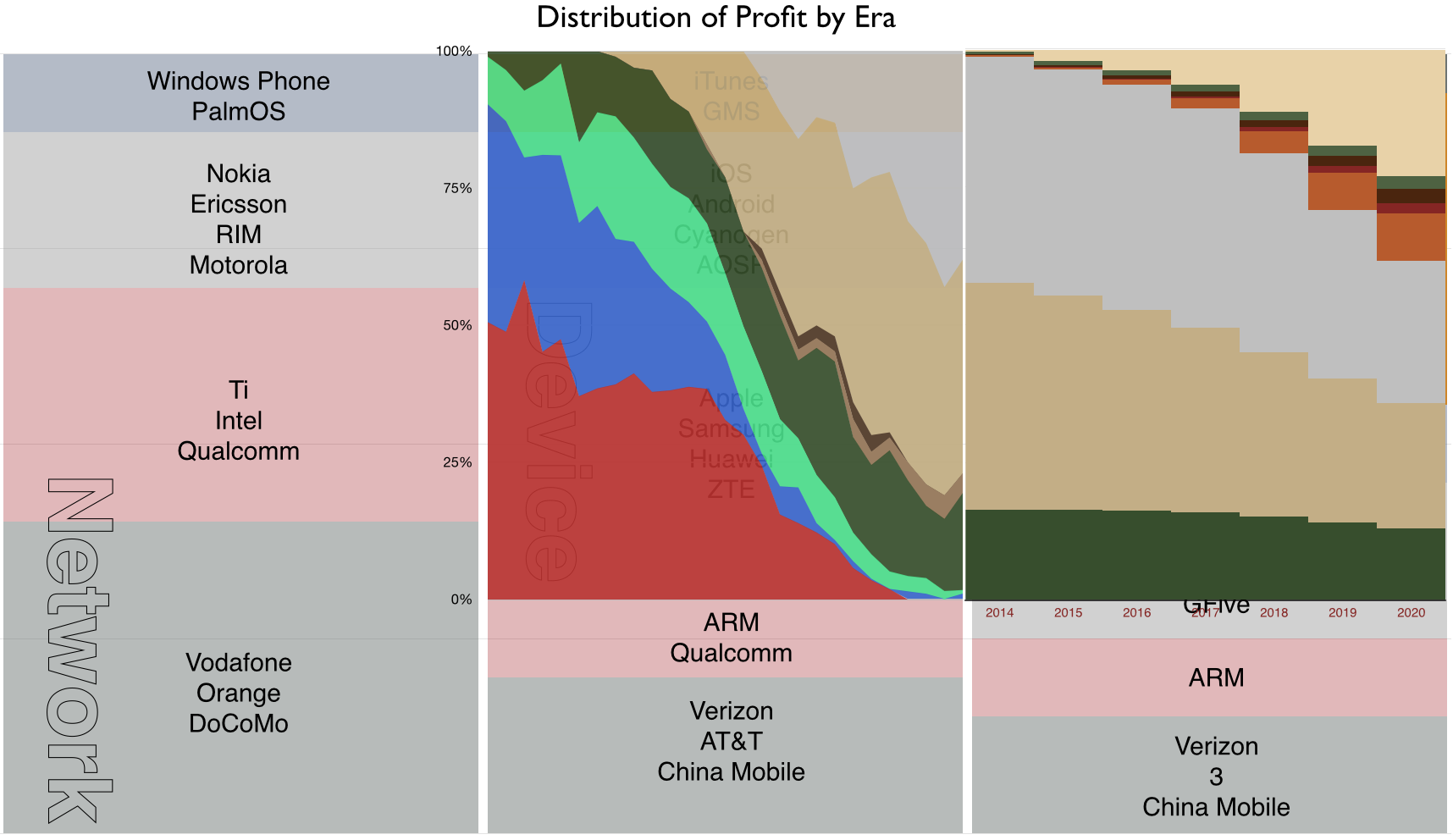
Disruption suggests that we are likely to see yet more shifting of fortunes. It means enabling new ecosystems to take advantage of the modularization of platforms. But how can it happen given the entrenched nature of the incumbent duopolists?
The clue lies in the first graph in this post: It suggests a geographic segmentation. The largest markets are large enough to sustain independent ecosystems. Note that China and Russia have already established alternative local service ecosystems. We may dismiss the possibility of localized Google and Facebooks in emerging markets but China and India are universes in and of themselves. But there are another 10 markets of more than 100 million users. That's another billion users among them.
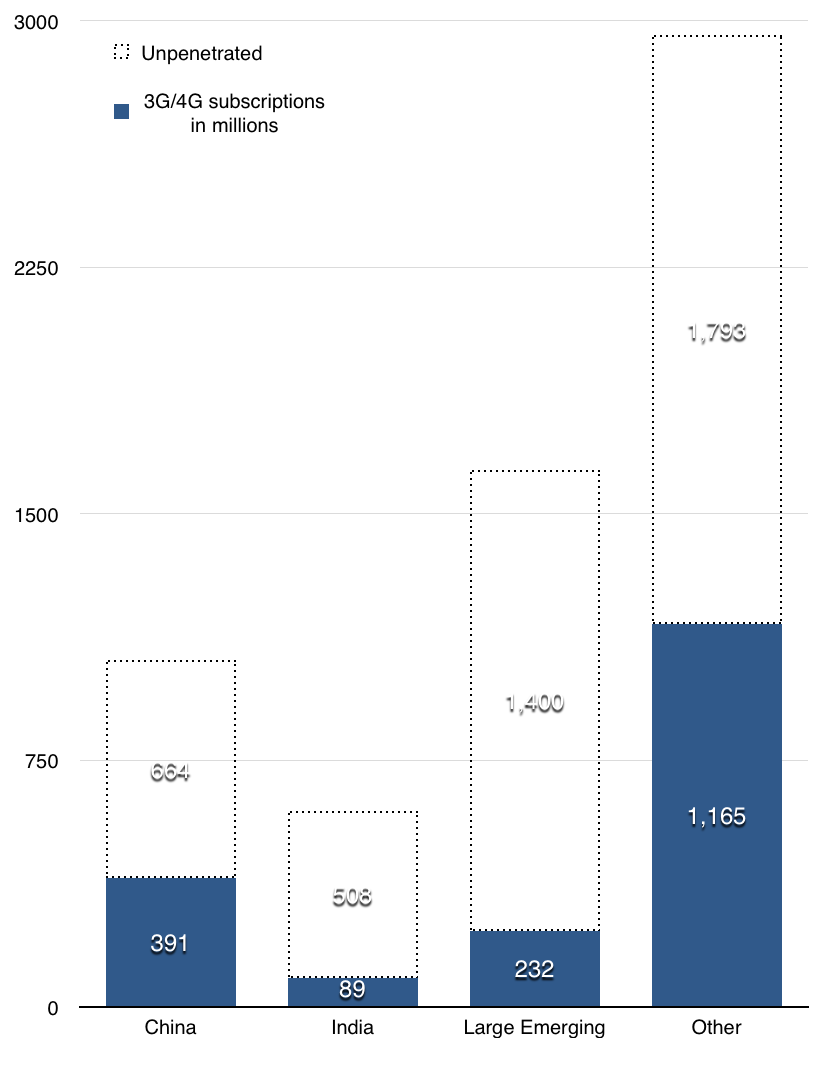
But it's not just the availability of a vast pool of new users. The rapidity of growth of services like WhatsApp and SnapChat and Tencent shows that barriers to entry are low. We see increasing indigenous innovation in payments, logistics and business models in the newest markets. We see no shortage of talent and capital to start these businesses. We see increasing language and culture clustering in social media. We see political resistance to hegemony.
Focusing on the established, highly penetrated markets as an indicator of opportunity would be a mistake. Those markets foretell the rate of adoption but not the evolution of the value chain. Apple and Google will continue to anchor in those markets but there is no reason for the remaining two thirds of the world to follow. Indeed, there are incentives not to.
Incentives exist to localize services. Indeed, service businesses have always been local businesses. There are few global service brands. This has been true in retail, transportation, banking, hospitality, media and communications. Why should we believe that ecosystems can overcome the advantages of localization? Services are local because they are delivered by individuals and have high "touch" with the user.
Fundamentally, ecosystems are social systems and social systems have cultural and political dependencies. ((Post-modernism is a typological world view which sees truth as socially constructed and a rejection of 'totality')) Technology does not homogenize unless it is centrally controlled. The control of mobile computing has already been abdicated by its creators.
We talk about the major triumphs and minor failures of the Veronica Mars campaign on Kickstarter and kick off a series on The Capitalist's Dilemma.
We will be conducting our 9th Airshow event in Vancouver next Wednesday, March 26, 2014.

The purpose of Airshow is to:
The method we devised borrows heavily from the techniques of cinematography and screenwriting to impart meaning to the audience beyond the literal words spoken or images shown on screen. These techniques are demonstrated with "feature presentations" and then deconstructed in interactive lectures. Throughout we also weave Aristotelian rhetorical tips and present from the Asymco repertoire of stories.
Discounted registrations are available for readers of this blog, and students.
Research #Industry · 323 comments
The smartphone market continues to grow. 2013 saw total shipment of around one billion units (up from 683 million in 2012). In contrast, non-smartphone shipments continue to decline, with shipments around 800 million (down from 987 million in 2012).
This pattern is shown below:
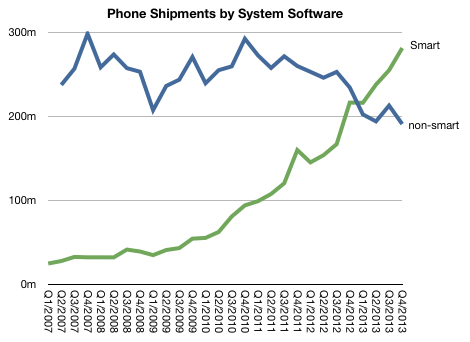
Note that prior to 2012 the non-smart market seemed to be holding steady in spite of the growth in smartphones. The notion that smartphones would become universal was widely dismissed. I certainly heard many objections to my 2010 hypothesis that not only would smartphones become ubiquitous but that it would become increasingly difficult to find anything else to buy. (This in spite of the clearly evident demand for "low-end" non-smart devices.) ((The analogy I used was that of the black-and-white TV market as color TV became increasingly popular. There probably was a market for monochrome screens for a long time after they were discontinued but that is beside the point: the old technology becomes increasingly scarce because of economies of scale))
I also suggested that the notion of distinguishing phones with the"smart" tag would become irrelevant and that we would just call these devices "phones". That is coming to pass, at least among the conversations I'm privy to.
So if the conversation is about "phones" and the expectation that all phones will be smart, what can we observe about the market? The following graphs provide the picture of shipments, revenues and operating margin in absolute and relative measure for the most significant brands.
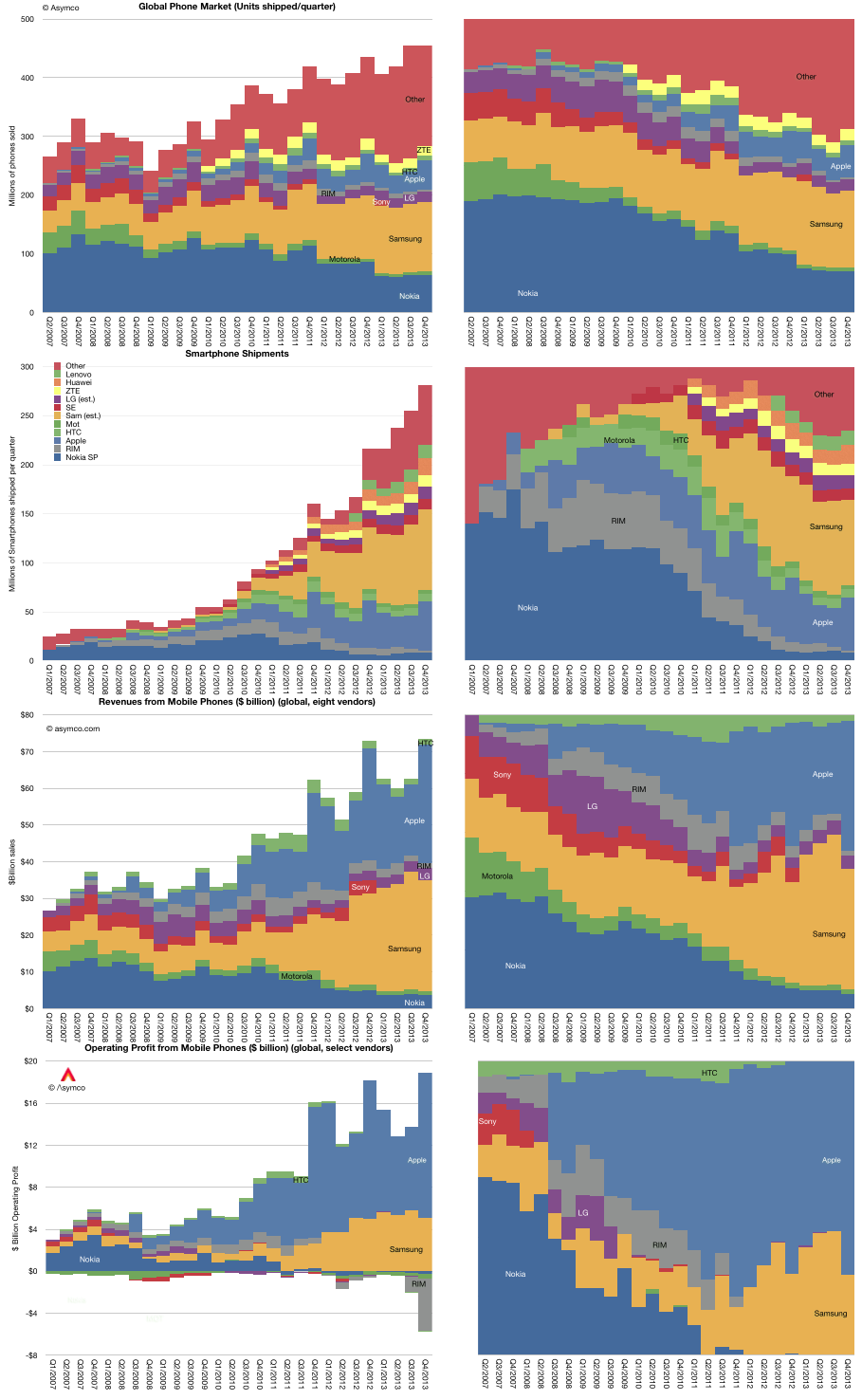
This arrangement shows the disruptive effect of adding "smart" to phones. In only a few short years ((Six shown but the effect was pronounced already in four)) profits have dramatically shifted in the industry.
Indeed, since the launch of the iPhone ((Which I consider to be the start of the current epoch of the industry)) the net profits earned by the collection of protagonists shown was $215 billion (($234 billion of positive operating earnings, offset by $19 billion of operating losses)). 60% has been earned by Apple, a newcomer to the market. That figure is also consistent on an ongoing basis, having reached 60% as early as 2011 and remained in a band around that figure since.
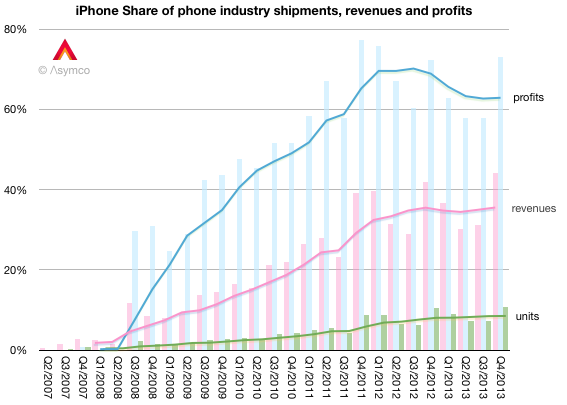
The fact that this happened without corresponding dominance in units shipped shows evidence of something startling: Consistent value creation.
To earn profit is hard, to do so in an outsized way is very hard and to do so with consistency shows a defensibility of market access that is rarest of all. The only cases where this typical is in a monopoly or protected market situation (aka cronyism.) Apple's lack of market monopoly coupled with a (near-) monopoly in profits can only be explained by disproportionate value creation.
The mystery then is how is it possible to build a monopoly in value creation.