We will be conducting our 8th Airshow event in London next Wednesday, 26 February 2014.
The purpose of Airshow is to:
Understand how data can be used to persuade through an appeal to logic as well as through empathy.
Understand the basics of "data cinematicism" including the techniques analogous to cinematography and direction.
Understand story development techniques including how to facilitate the audience's entry into the story.
Learn how to build a cinematic presentation.
The method we devised borrows heavily from the techniques of cinematography and screenwriting to impart meaning to the audience beyond the literal words spoken or images shown on screen. These techniques are demonstrated with "feature presentations" and then deconstructed in interactive lectures. Throughout we also weave Aristotelian rhetorical tips and present from the Asymco repertoire of stories.
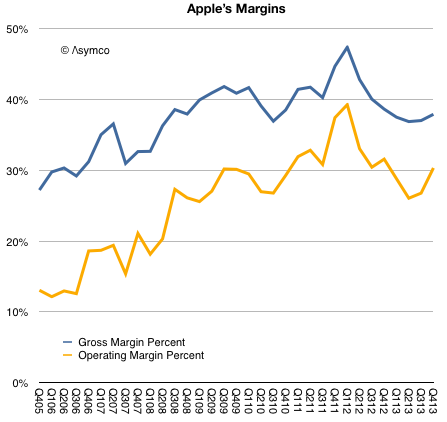
Prior to Apple's earnings report I read at least one article suggesting that the most important indicator to watch was Apple's margin. I suppose this was due to a recent decline in margins from a peak gross margin of 47.4% in Q1 2012 to 36.7%.
As the graph below shows, margins began to recover by Q3 2013 and are nearly on par with year-ago levels.
The guidance for the present quarter is a gross margin between 37% and 38%. This would imply a flat q/q GM line (blue line above.)
This is not quite catastrophic.
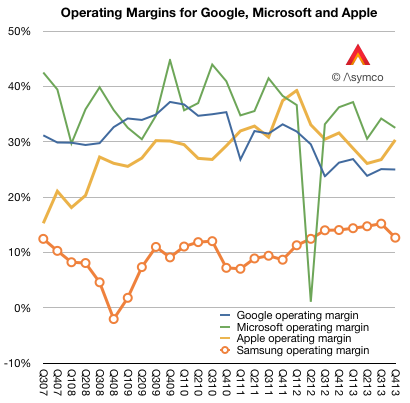
To better understand margins, it helps to compare them with other companies. When Apple reached that peak of near 50% gross margin I noted that such a level was higher than Microsoft's and Google's. The irony being that Apple was nominally an (implied) low-margin hardware company while Microsoft was an (implied) high-margin software company and Google was an (implied) high-margin internet services company.
Here is the picture with the last two years added:
In the last two years Apple's margins have declined but so have Google's. And although Microsoft's fell, they fell less than Apple's and thus overtook it to remain slightly more profitable (32.5% vs. 30.3%) into Q4.
I also added Samsung Electronics' operating margin. ((As a large conglomerate, Samsung will have a lower blended average. Separating the Telecom group's operating profit shows a 16.14% divisional operating margin.))
So although Apple stabilized, it did so at an extraordinarily high level, well out of band for a hardware company. Thus the question remains: Are Apple's margins a fluke? Is the recent rise of margins to levels far above those of a comparable hardware company and into the realm of software and services sustainable?
The simple answer is to assume that the iPhone and iPad, which make the bulk of revenues and which explain much of the rise, enjoyed a temporary buzz which allowed them to be priced at a premium but as that buzz wore off, the pricing and margins would decline. This is common with fads and fashions.
But the situation is far more nuanced. If the margins were due to mere novelty, the effect should not have persisted over so many years. Pricing data shows that the iPhone remains exceptionally valuable and that the iPad, excluding line extensions, has also held the line on pricing.
The missing piece in the puzzle is that the iPhone and iPad and iPod touch and Apple TV are pieces of an inter-dependent network of assets. The iTunes stores, Apple's services and Apple Retail are easily ignored because they are not "profit centers" but I believe they are a key component to the sustainment of these margins.
In other words, the iPhone and iPad enjoy margins not just because they are new and well designed. But also because they form part of a ecosystem. The key word is 'system'. The user buys into a system not just what the device embodies.
This is why I've always said that the iOS product businesses should be thought of as "hardware as a service". The inspiration comes from the notion of "software as a service" which posits the idea that software purchases should be thought of as services and thus recurring revenues.
iOS devices are part of a service matrix: the user experience in the stores, the after-sales support (including the easily ignored Applecare), the broadband supplied through operator service (which is part of a trillion dollars of value), the apps and content that can be purchased (which add up to a mountain of money), the network effects of iMessage and iCloud and now iRadio and Match and Siri.
These services attachments are well understood as great business models and underpin some of the most celebrated businesses to emerge in the last decade including Google, Amazon, Facebook, Box, Dropbox, Windows Live, etc.
It's curious therefore that whereas these other businesses are highly valued as services, in the case when the service is a component within a larger system, the value is missed. In an integrated context the connection between services and high margins is not understood. The reason may be the absence of robust systems analysis and a preference for the facile explanation.
Horace Dediu and Guy English discuss the future of TV, how we consume media, and the fate of console-style devices. From Apple to Nintendo and beyond, is there one box to rule them all, or can there be?
Interview segment: Cinematographer Barry Braverman talks about working with director Wes Anderson (uncut version to be posted as Screen Time #54)
Horace and Moisés discuss the excitement surrounding Microsoft's hire of new CEO/poet Satya Nadella, Apple's recent numbers announcement, and yet more on Google (and their sale of Motorola to Lenovo).
The increase in net sales of iTunes, Software and Services in the first quarter of 2014 compared to the first quarter of 2013 was due to growth in net sales from the iTunes Store, AppleCare and licensing. The iTunes Store generated a total of $2.4 billion in net sales during the first quarter of 2014 versus $2.1 billion during the first quarter of 2013. Growth in the iTunes Store, which includes the App Store, the Mac App Store and the iBooks Store, was driven by increases in revenue from App sales reflecting continued growth in the installed base of iOS devices and the expansion in the number of third-party iOS Apps available. Net sales of digital content, including music, movies, TV shows and books, from the iTunes Store was relatively flat in the first quarter of 2014 compared to the first quarter of 2013.
During the last quarter Apple changed the pricing for iWork and OS X to zero ((OS X server is still priced at $20 and iWork for previously unlicensed devices and computers is still priced above $0)).
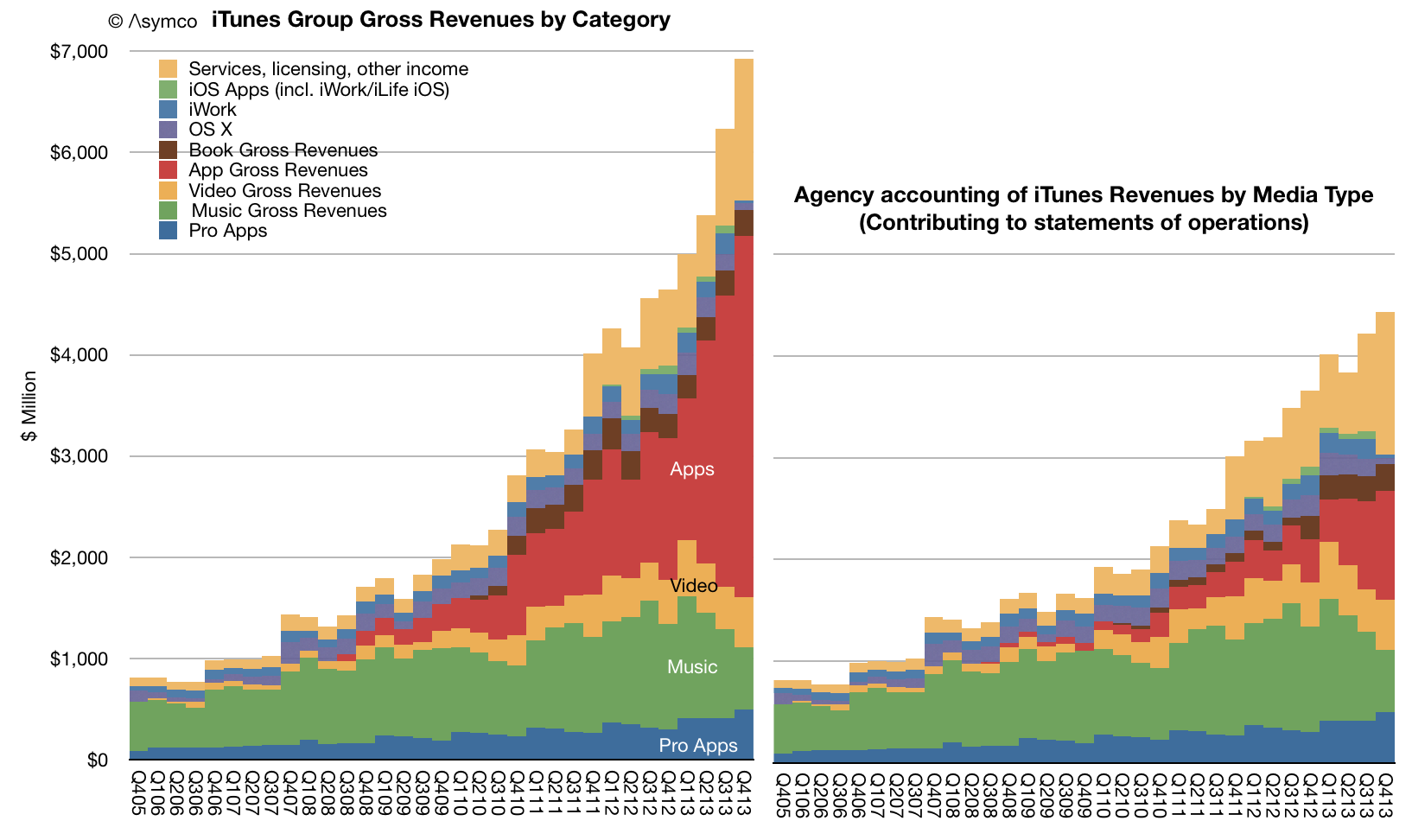
I estimate the net effect to have been a reduction in revenues from those software titles of about $350 million for the quarter. Nevertheless, increases in services and app revenues means that the iTunes total reported revenues increased to a new record.
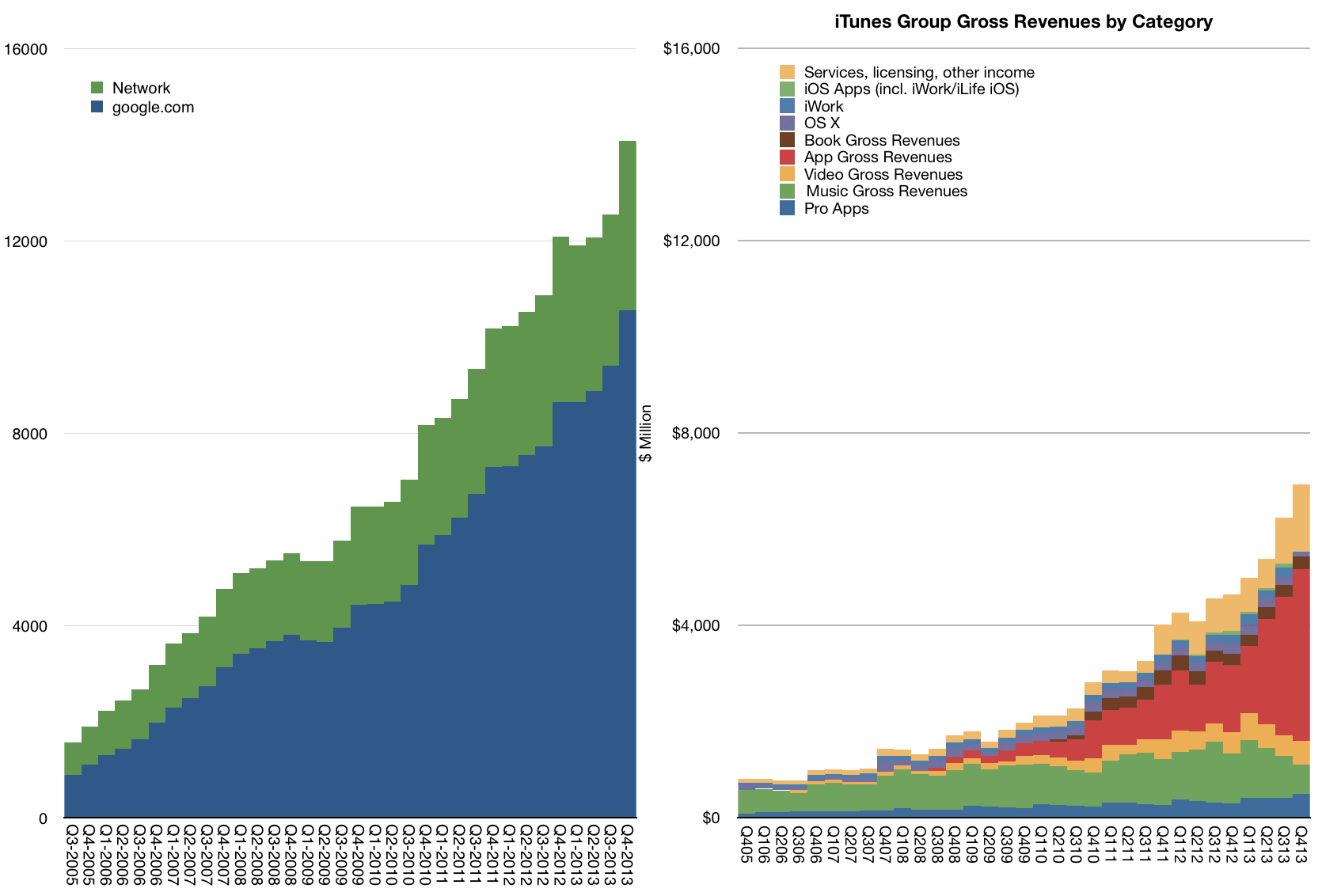
The total with estimated contributions by media and service components is shown below right.
Note that revenues do not reflect total billings. As Apple reports only the 30% of App transaction values, the full iTunes/Software/Services transaction values are shown in the above graph on the left.
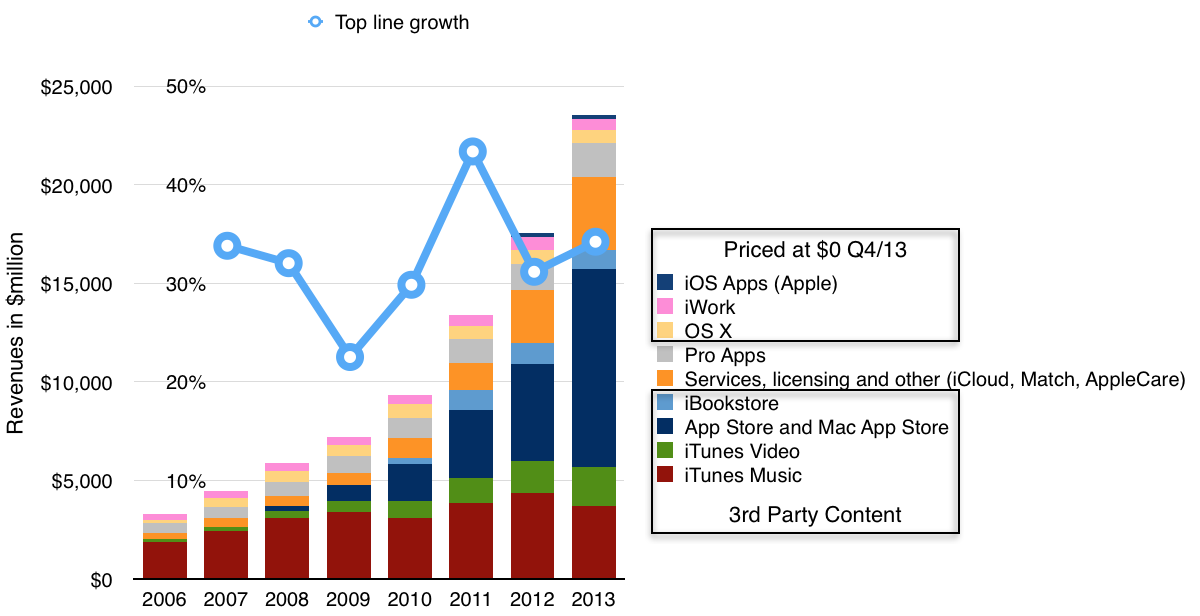
The "gross" revenues are now nearly $7 billion per quarter. On a yearly basis the iTunes/Software/Services group had gross revenues of $23.5 billion with growth of 34% y/y.
Other estimates for full year 2013 growth are:
Third party content +46.6%.
Music downloads -14%
Video +19%
Apps +105%
Books -9%
Services +37%
Pro apps +29%
OS X -8%
iWork and iLife -8%
Although iTunes/Software/Services are not usually included in a "sum-of-the-parts" total contributing to Apple's overall enterprise value, the scale of volume and value of transactions is becoming harder to ignore.
To illustrate this, I plotted the history of gross iTunes revenues vs. Google's search business ((Excludes Motorola and "Other" segments as reported by Google))
On a yearly basis iTunes/Software/Services is nearly half of Google's core business and growing slightly faster.
The iTunes "empire" of content and services would be ranked as number 130 in the Fortune 500 ranking of companies (slightly below Alcoa and above Eli Lilly).
Horace Dediu is an analyst with a focus on the mobile phone industry and especially Apple. Blogging at asymco.com, he often posts surprising facts that confront the conventional "wisdom" of other analysts, who are often predicting doom-and-gloom for Apple.
We asked Horace to share his thoughts on technology, change, and how to anticipate the next big thing.
Apple revenues grew at the rate of about 6% in Q4, while earnings grew at 5%. These were improvements over Q3 and Q2 but the rate of top line growth is has not been this low since 2009. The bottom line is also slower than it's been for the entire "epoch" or era of the iPhone.
The components of sales growth are shown in the following table:
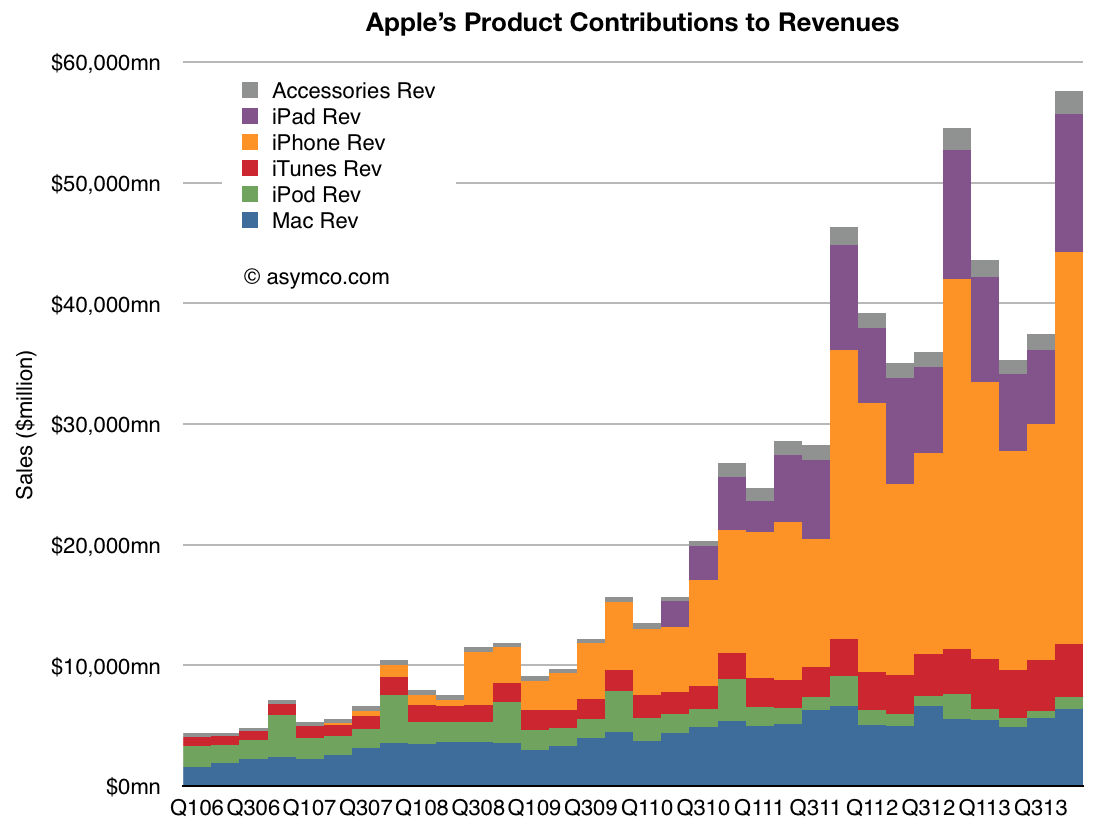
The company delivered performance inline with its own guidance so there should not have been surprises in the top and bottom lines. However, the disappointment might be in the low growth for iPhone (at 6%) and iPad (at 7%). The Mac and iTunes grew at moderate rates (16% and 19% respectively) while the iPod continued its decline with -55% growth and Accessories remained fairly flat.
As the graph below shows, the iPhone and iPad are the bulk of the business so their performance is a large part of what is observed.
The speed with which products are introduced and scaled is phenomenal so it is more important than ever to see beyond the trajectory of existing products into the pattern of the introduction of new product categories.
Markets are effective in anticipating the path of a technology as it ascends into the hands of users, especially if it is destined for ubiquity. But markets are completely incapable of anticipating the emergence of new technologies.
In this regard markets are a reflection of common sense rather than uncommon wisdom.
Horace builds on his discussion of Google from the previous episode in light of the Nest acquisition news. We also look at the relatively unreported news regarding China lifting its 13-year ban on game consoles and the variables it introduces to a "big niche" industry.
On a recent podcast I noted that Google was perceived as invulnerable. In contrast, Apple is seen as temporarily enjoying a stay of execution. ((The list of Apple Achilles' Heels is so long and creatively composed that it would take ages to compile, but here are just a few: the Mac (vs. Windows), Digital Rights Management (which kept the iPod alive), dozens of lawsuits (including from The Beatles), the Mac (when it ran Windows), PlaysForSure, Music Labels retaliation, the Zune, Android and clones, the Kindle and Amazon in general, more Mac, iTunes, iPod and iPhone and iPad killers than can be counted; Steve Jobs is ill, Jony Ive will quit, Tony Fadell quit, Rubinstein quit, Forstall was fired, etc. Feel free to add more through comments. See also Apple Death Knell Counter.)) This is not necessarily a bad thing for Apple. The more gushing the loathing or scorn, the more likely it's a reaction to love and attraction. A brand dies not from hate but from apathy.
But nor is it necessarily a good thing for Google be be seen as invulnerable. There might be no "Google death knell counter". There might not be a "Google is doomed" trope. If an executive from Google quits or is fired there is no investor panic. If a product is withdrawn there is no mourning. There are no journalists pursuing Pulitzer prizes by describing some seamy underside of Google. But there are no overt displays of affection either. Google is seen, on balance, as benevolent and hopeful. The discussion on business robustness is simply missing.
I suspect the absence of scrutiny comes from Google being seen as an analogy of the Internet itself. We don't question the survival of the Internet so we don't question the survival of Google -- its backbone, its index, and its pervasive ads which, somehow, keep the lights on. We believe Google is infrastructure. We don't dwell on whether electric grids are vulnerable, or supplies of fuel, or the weather(!)
Too complex, too pervasive. These are systems, not things. And people are not designed to contemplate systems. We leave that to experts, or better yet, computers.
The reason Apple is contemplated at all is that it's not seen as a system. Even the suggestion that Apple is a system is implicitly treated as an impossibility. Because it's not a system it's fragile. It's a person, or an idea, or a product or a singular "key" to something. It is, ultimately, mortal. The only debate is when it will die and points are earned for calling it sooner rather than later.
But what if Apple were a system? And what if Google were a person (or three?)
In my essay on Google's absence of profit (or income or business) motives questions were raised on the stated absence of hunger for profits from Apple and what difference there might be from Google's philosophy.
Indeed, Jony Ive stated:
"Our goal isn't to make money. Our goal absolutely at Apple is not to make money. It may sound a little flippant, but it's the truth." ((at the British Embassy's Creative Summing in July 2012)).
He was probably repeating what Jobs had previously stated:
"I remember very clearly Steve announcing that our goal is not just to make money but to make great products" ((Walter Isaacson's Steve Jobs))
However, note that both quotes are qualified. In the case of Jobs, he said "not just to make money". Jobs clearly stated that great products lead to money. That great products are causal to money and therefore that if you make great products you make money. One leads to the other.
Ive also continued in this reasoning:
"Our goal, and what gets us excited, is to try to make great products. We trust that if we are successful people will like them. And if we are operationally competent we will make revenue. But we are very clear about our goal."
I would paraphrase the Apple logic as "Great products are the means by which we sustain our business. By focusing on the product, the customer is satisfied and through that satisfaction we create the free cash flows which can be used to fund more products."
There is a difference between Apple's "indifference to money" and the "indifference to business models" that Google exhibits.
Google steps even further away from cash flows. Its goals are to build great things guided by their vision and patterns in the data they collect. The value is in the data itself rather than in any transaction.
As long as the source of money is unfettered, its provenance is uninteresting. A business model is a profit algorithm. It could be linked to the data but it need not be. Markets are messy and imperfect. Data provides much clearer views into value. You could conclude that value itself cannot be trusted to the judgement of the public. Value is to be determined through the recognition of patterns on data privately collected.
So when I say that Google has disdain for market mechanisms I mean that they believe they can do better. Apple still values the user as the ultimate adjudicator of its actions. Google looks past the user and interprets their intentions.