Asymco

Asymmetric Intelligence

Latest from Asymco

  1. Understanding Apple's Organizational Structure

    Research · 56 comments

    Apple has hired a new VP who will report directly to Tim Cook. Paul Deneve is cited as having responsibility for "special projects" and will report directly to Tim Cook.

    The previous roles as a manager in luxury brand companies has led to a great deal of speculation about what new projects Apple could be working on that might also fit this new manager's background and title.

    The most commonly cited speculation is around the iWatch or TV product lines (with some surprised that he will not be heading Retail.)

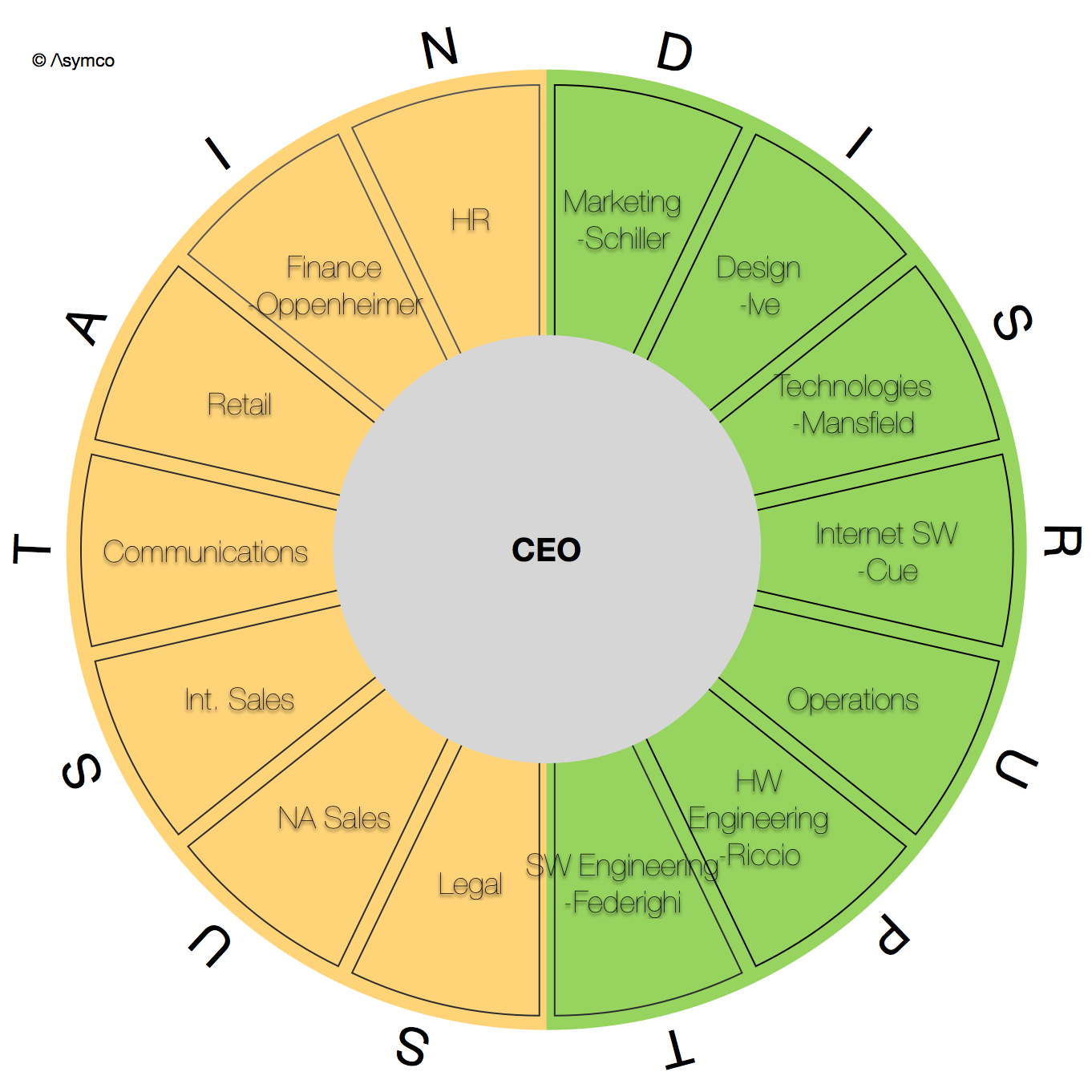
    Although reading "luxury product CEO" and concluding "new luxury products" seems logical, a little knowledge about how Apple is organized dispels this notion. And a little knowledge happens to be about all we have, as Apple's organization is one of its most closely guarded secrets. Even employees at Apple have little idea of how the company is organized. What we do know is summarized into this org chart:

    Screen Shot 2013-07-03 at 7-3-3.37.27 PM

    I've taken the liberty of splitting Tim Cook's direct reports into "Disruptive" and "Sustaining" functions—which I admit is a bit cheeky—but the point is to separate the product creation functions from the management and administrative functions of the organization[2].

    When seen in this light, the first observation is that there is no "product business" ownership. Schiller's Marketing function includes product marketing by product line, but these are not business ownership roles (product marketing mostly deals with how products are positioned, promoted, priced, etc.)

    There is no "head of devices" or "head of iPhone". Put more plainly, there is no organizational consistency with how the company reports its financial performance.

    So it would make little sense to add a new direct report to this chart that did have a specific product ownership (or creation) role. Product is a "horizontal" responsibility for which every function is partially responsible.

    In lieu of this, my reading of the chart shows another function for which there seems to be no leader: brand. Brand management is a crucial function in consumer-facing companies, and many brands-oriented companies orient their organizations (and power) around brand mangers.

    In years gone by I would have said that Brand management was Steve Jobs' direct responsibility. Today I would say that it's something that needs a direct manager. This is something for which Paul Deneve might be well suited.

    ---

    Notes:

    1. The last chart published on this topic is from 2011.
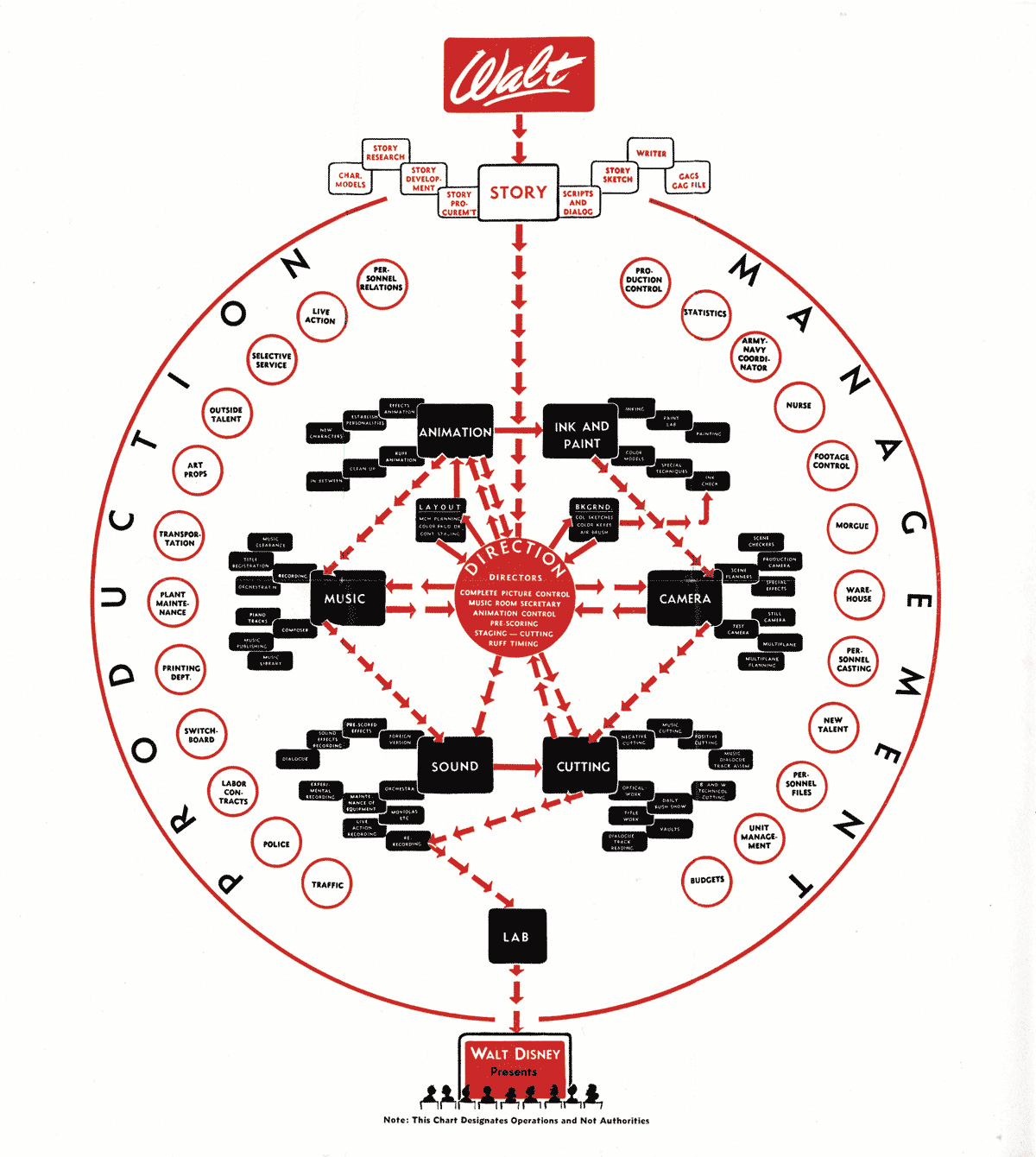
    2. With inspiration from Disney.
  2. What's a BlackBerry user worth?

    Research · 50 comments

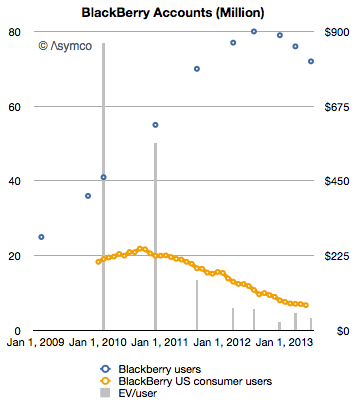
    Last week BlackBerry announced that it had 72 million subscriber accounts. The current market capitalization is $5.4 billion and enterprise value (i.e. excluding net cash) is about $2.8 billion.

    That implies a net present value of about $40 for each account. This is quite a drop from early 2010 when the value was $866.

    The graph of BlackBerry subscriber accounts and EV/account is shown below:

    Screen Shot 2013-07-01 at 7-1-10.09.16 AM

    I've also added a graph showing a derived value of US consumer BlackBerry users (derived from comScore's survey data).

    There are several patterns which intrigue me:

    First, the peak in US consumption seems to have happened about two years prior to global peak (lending credence to the notion that the US is a smartphone market "crucible".)

    Second, that the collapse in value per user occurred in advance to the peak in users. This is, of course, linked to other user base leading indicators such as device sales momentum. But the drop indicates that there was no perceived value in the BlackBerry install base to begin with. As devices went, so did the company.

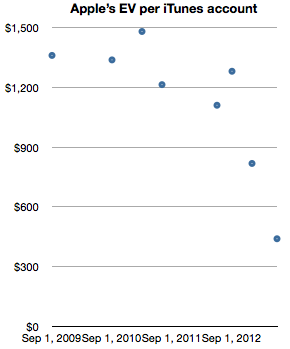
    Third, this same lack of perceived value seems to be present within the Apple ecosystem (see below), where user value was cut to a third within a few months

    . 

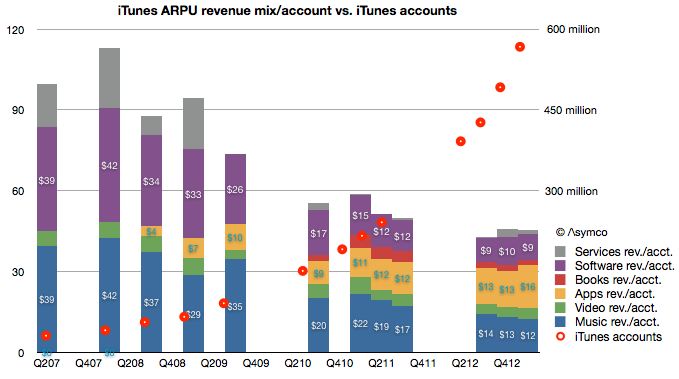
    Screen Shot 2013-06-14 at 6-14-1.13.26 PM

    In the case of RIM/BlackBerry, the drop in value per user accurately foretold the drop in user base. Does the drop in value per user for Apple foretell a reduction in users?

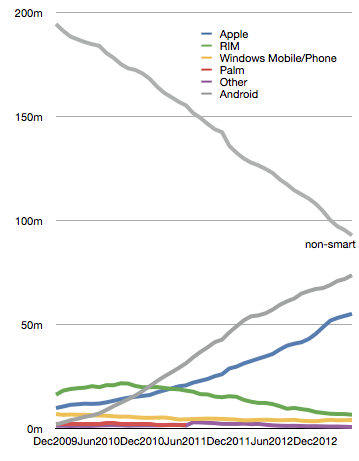
    So far, iOS user base (as proxied by iTunes accounts) continues to expand, even in the US.

    Screen Shot 2013-07-01 at 7-1-10.13.02 AM


  3. The end of the projector

    Research · 18 comments

    After having "taken the show on the road" and spending an inordinate amount of time giving presentations during the last year I came to the conclusion that what remains less than good enough for presentations is the variable quality of projectors.

    The problem is not just quality of image but also the unpredictable size of screen, how far it is from the audience, how poor the contrast or color reproduction might be and to what degree there is support for wireless connections.

    When presenting detailed, information dense graphs, these quality issues become presentation killers and not only do they result in poor retention for the audience but decrease the confidence of the presenter, leading to a vicious cycle.

    The answer is not to lug around your own projector because many times the venue will not accept it, other times the image "throw" is not matched to the screen and it's a pain to set up and transport.

    What I think needs to happen is that the projector needs to be disrupted.

    This is where the iPad and Perspective come into play. When presenting using Perspective we have the ability to "airshow" or present directly to the (iOS) devices that the audience has with them.

    This way not only the presenter's screen is "mirrored locally" but also the direct manipulation and choreography of the data reveal is instantly visible. You can see a fragment of how it works in this test:

    This is the technique we use at the Airshow event and it has proven to work well even with large audiences. To see it in action (and to learn how to develop presentations into cinematic experiences) join us at the next Airshow in Chicago.

  4. Preempting the Praetorian Guard

    Podcast · 51 comments

    The functional organizational structure may be causal to successful disruption. Although this hypothesis needs much more research and testing, there are correlations in the anecdotal evidence. One of the principles of this theory is that functional organizations are less prone to "political infighting" where a powerful division can disable a self-disruption through the wielding of the power of the Profit/Loss statement.

    Under the divisional structure the modus operandi is that once an internal threat is detected, the incumbent division unleashes antibodies to destroy the smaller and less powerful opponent. This is possible because as soon as the threat is perceived, a threat response kicks in and the power to deflect the threat is abundant in the reward and incentive structure. This response mechanism is so common and well understood that it forms the basis of the Innovator's Dilemma.

    My hypothesis is that in the absence of product/divisional level power bases, the threat is not felt and the political power to respond is not available. In a functional organization there is no "business leadership", where the P/L "belongs" to one person. Only the CEO has life-and-death power over products and their decision is "purchased" through discussion with functional heads who stand to benefit as much as to lose from disruptive change.

    This functional organization decision process is typical if not universal in small companies and atypical if not unheard of in large companies. It's one of the reasons small companies are inherently more disruptive. The challenge for a growing company is that functional organizations don't scale well. There are very few and all depend on vigilant, almost maniacal defense of the structure. Divisional organizations are "natural" at scale and the preservation of functional structures is like fighting entropy.

    The organizations which seem to preserve functionality at scale are militaries. This is why I've been thinking about it takes to manage such organizations and preserve their apolitical status.

    As it turns out, militaries are also not immune from the corrosive effects of political power. In fact, the slide into corruption begins with the formation of elite divisions. The rationale is simple: elite soldiers whose loyalty and skill are most valuable are chosen for special roles and status. They begin by usually acting as bodyguards to the leadership or the state.

    Historically the most prominent such politicized military force was the Roman Praetorian Guard. Having started as bodyguards to the field commander, they transitioned into protectors of the state and, eventually, into destroyers of the state.  Their leader, the Praetorian Prefect, became one of the most powerful administrators of the state and his Guard became responsible for numerous coups d'état, assassinations and corruption.

    So-called "Republican Guards" became common in many militaries since then. Napoleon's Imperial Guard, the SS in Nazi Germany, the Iraqi and today's Iranian Republican Guards continue in a political role. In democracies, the politicized military is less common but the threat of their emergence is one states must always remain vigilant for.

    And so it must be for the functional organization. The emergence of an elite which, by its skill and achievement, gains more responsibility and hence more power is the good intention which paves the road to hell. Leading an innovative organization means having a process of denying power to those who are elites. It means preempting the Praetorian Guards.

    Doing so is a dilemma in itself as the elite are not likely to remain loyal if denied their opportunity to power. Managing the motivations of the bright and ambitious is where the art of disruption management lies.

    For a more thorough discussion of this topic, listen to the podcast which accompanies the post:  The Critical Path #90: The Praetorian Guard
     

  5. Measuring the iTunes video store

    Research · 41 comments

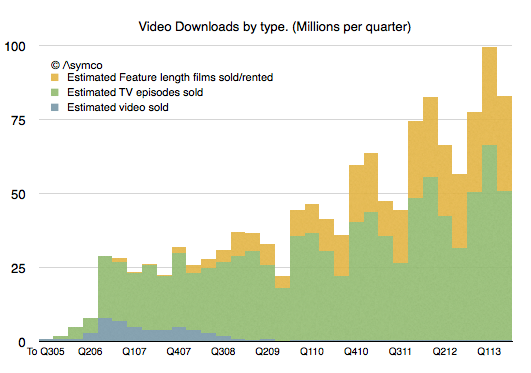
    It's been five years since we had an update on TV show downloads and six years since we've had an update on movie downloads from Apple. In Q3 2008 Apple announced 200 million TV show downloads and in Q2 2007 2 million movies. That's a long period with no information making a tough extrapolation to the present.

    Nevertheless, I tried. My estimates for these two quantities were 963 million TV Shows and 108.2 million movies to date.

    So I was quite surprised to see that figures for both TV show downloads and Movie downloads were published today. The figures were 1 billion and 380 million respectively.

    My TV show forecast has proven to be very accurate but I severely underestimated movie download rates. Apple states that the movie download rate is 350k/day. My estimate  was only about 126k/day.

    After adjusting for the new data, the picture of downloads that emerges looks like this:

    Screen Shot 2013-06-19 at 6-19-6.20.31 PM

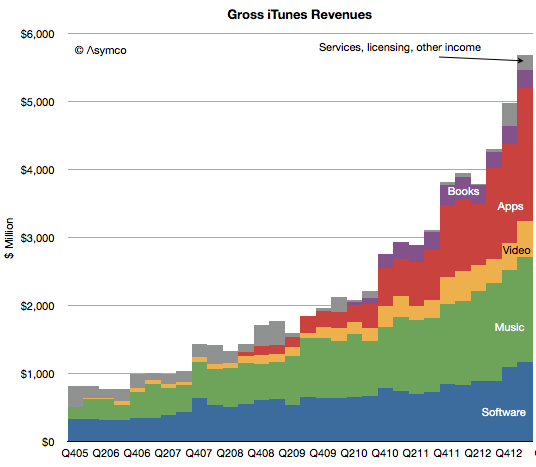
    The overall iTunes gross revenues by sub-component becomes:

    Screen Shot 2013-06-19 at 6-19-6.22.04 PM

    As a result, my new estimate for the rate of spending on iTunes video is about $1.75 billion/yr. This is much more substantial than prior estimates mainly because movies are much more valuable. A tripling of the download rate shows up as a significant rise in the profile of video vis-à-vis the other media types.

    Apps and software are firmly defined and music was somewhat clear. The upward adjustment in Video means that I have to reduce either Music or services. I presently am reducing service revenues but might adjust music as well.

    The overall picture of iTunes is becoming clearer every day. We have more information about number of users (575 million), what they spend on media and software and services ($20 billion/yr.) and, increasingly what they spend on each media type (about $9/yr on Software, $2/yr on books, $16/yr on apps $12/yr on music and $4/yr on video.)

    Screen Shot 2013-06-19 at 6-19-6.34.18 PM
  6. Next Airshow: Chicago, July 13th

    Conference · 4 comments

    airshow_fighters_scramble

    We're excited to bring the second Airshow to Chicago in July. Thanks to Ryan Singer and Jason Fried of 37signals.com for offering to host us this summer.  Their venue is ideal for our particular pedagogy.

    Speaking of which, I should explain what it is.

    Our first Airshow (San Francisco, June 9th) had several objectives:

    • To explain a theory of narration with data, especially big data
    • To narrate this explanation with a tool called Perspective
    • To reveal and test a new feature within Perspective called airshow

    Now that we have revealed the feature (mirror your presentation including your direct manipulation of the visuals to any member of the audience—wherever they may be—on their own device, available in version 3.0) we can talk more freely about the structure of the show.

    It's in three parts:

    1. Performance
    2. Cooking Show
    3. Theory

    The Performance is the "keynote story" whose recipe we show in the Cooking Show and whose motivation and foundations we deconstruct in the Theory. You can think of the sections as as answering "{What, How and Why} make a great story."

    The show is self-referential in that we use the process we teach to do the teaching. In other words, we use a great storytelling tool to tell great stories about storytelling. Furthermore, Airshow, as a show, uses a tool whose feature  is itself called airshow.

    It's not that complicated; at least not if you understand recursion.

    Register here: airshow.asymco.com (Limited to 37, bring an iPad).