Asymco

Asymmetric Intelligence

Apple Management

  1. Will Apple preserve iPhone 18 Pro pricing at 17 Pro levels?

    Nota Bene · 4 comments

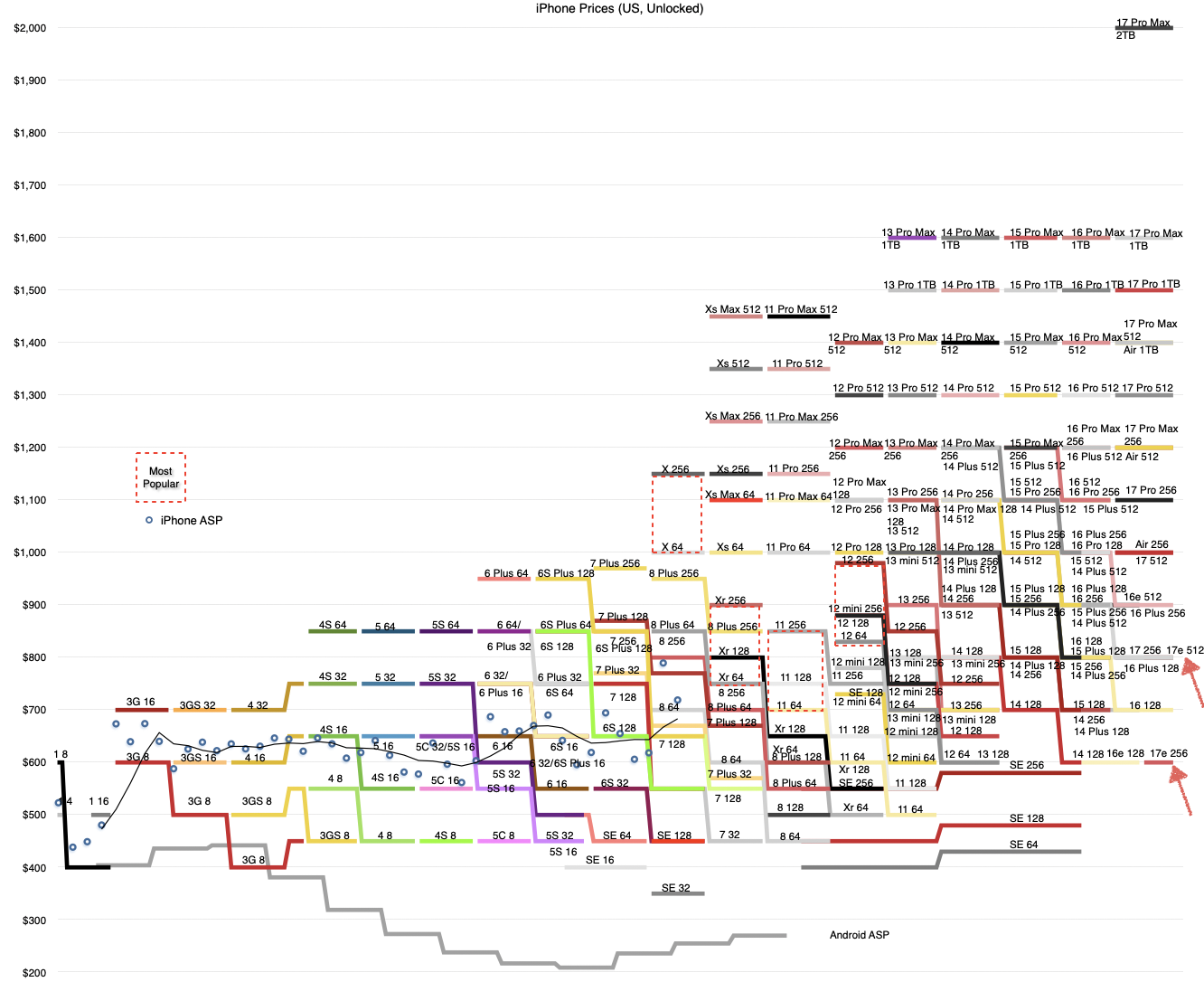
    History says yes.

    The global smartphone market is facing structural pressure from rising memory prices. In particular, the spread of AI technology is sharply increasing demand for high-performance memory, tightening supply and pushing prices up quickly. As a result, some Android manufacturers have raised prices on new products, and low-margin budget models could shrink in the market. The industry also sees the trend as potentially leading to a contraction in the overall Android market size.

    Against this backdrop, Apple has chosen a strategy of keeping prices for its main models unchanged. Pu’s analysis said the iPhone 18 Pro is likely to start at $1,099 and the Pro Max at $1,199, maintaining the existing price range. That would be the same as the previous model. It is interpreted as a strategy to secure price competitiveness even if Apple accepts some margin decline to defend market share.

    Apple is also expected to pursue a two-track strategy that considers both price accessibility and profitability. It would keep base-model prices to lower the barrier to entry, while raising prices for higher-end models with larger storage capacity to offset profits. It has also been suggested that an ultra-premium iPhone 18 Ultra could be added, and the overall average selling price (ASP) is expected to rise.

    Ultimately, Apple’s strategy aims to exploit weaknesses in the Android camp, which is under pressure to raise prices. While rivals face demand contraction from higher prices, Apple could keep prices relatively stable and expand user inflows. A recent rise in demand from Android users switching to iPhones has also been detected, raising the likelihood that Apple will strengthen its influence in the premium market through this strategy.

    Source: 디지털투데이 via Analyst: Jeff Pu

    NB: There is always a huge surprise when Apple does the same thing it always does.

    Rule 1: Pricing choices Apple makes are based on a strategy.

    Rule 2: Apple does not respond to competition with changes in pricing

    Rule 3: Apple does not respond to supplier pricing with changes in pricing.

    Rule 4: The secondary market absorbs low end demand.


  2. The Economist Interview: Hints at the future direction of the company

    Nota Bene · 2 comments

    "Apple’s new boss needs to restore its magic for the AI era"

    If Mr Ternus does “nothing but keep the ship on course”, Apple could almost double its number of devices from 2.5bn globally to 4.5bn over the next 15 years, reckons Horace Dediu, a veteran Apple analyst. That would be a huge platform on which to run—and monetise—AI apps. As users subscribe to ChatGPT or other AI apps, “Apple will just take a cut,” Mr Dediu adds. By one estimate, Apple is close to generating $1bn in ai revenues so far this year via the App Store, despite having no flagship ai product.

    Azeem Azhar, author of Exponential View, another newsletter, adds that to overcome bottlenecks in cloud-based AI, routine queries may be shifted to “edge” devices, creating a big opportunity for Apple. In Mr Azhar’s telling, the future will involve “a combination of the highly portable phone with the persistent desktop or server. Both play to Apple’s strengths.”

    There is, however, a more radical path available to Mr Ternus, which is to develop a new “form factor” beyond the iPhone that is more suitable for the interactive nature of ai than doomscrolling on a touchscreen. Competitors are already trying to turn the smartphone into yesterday’s technology. Meta, the social-media giant run by Mark Zuckerberg, is selling millions of AI-powered smartglasses. Sir Jony Ive, the design guru who helped Jobs create the iPhone, has teamed up with OpenAI to develop a brand new gadget of unknown form. To keep up, Mr Ternus may have to reinvigorate Apple’s product line-up with a determination that eluded Mr Cook.

    Apple’s Vision Pro virtual-reality headset, though an over-priced flop, may help the new boss develop Apple smartglasses. The company is also reportedly working on a wearable AI pin. Mr Dediu says that one of Mr Ternus’s main strengths may be his devoted following among Apple’s engineers, who have been pivotal to the firm’s success. “Ternus will come out as an engineer’s engineer,” he says. “He is hard-core. That might energise the teams.”

    Source: The Economist

    NB: As is often the case, a 45 minute discussion turns into two sentences. The article sadly does not provide hints at the future direction of the company. But we can…

    …What we can foresee with certainty is what I said: the momentum is there for a doubling of the business without any new initiatives. The cultural fit for Ternus is 100%. That is based on the data we have but it is not the limit of what can be done. It is up to Apple to create the future.

    This is not about AI or any new form factors but about harnessing the new technologies with Apple's existing operational capabilities and existing market access in a way that competitors cannot replicate. Thus unforeseen growth can be created and, by definition, it's not possible to tell what that may be.

    But I can foresee that the organization is robust and well managed enough to create this unforeseen growth.