Asymco

Asymmetric Intelligence

Europe

  1. Apple Services in Europe: Scale and Growth

    Research · 7 comments

    Apple offers an answer.

    Since October 2023, Apple has been reporting the average monthly users of the App Store in 27 EU Member States. The reports are updated every six months.

    I took three samples spanning 2023 to July 2024 to observe the evolution of the market.

    A few notes:

    • The list is complete including all member countries, with a combined population of 450 million people.
    • The resolution is 1 million users per country which I assume to be rounding down. That is, if a country has 3.8 million users, it's reported at 3 million and .8 million is reported as "under 1 million"
    • For this reason the error is an undercounting error.
    • Some estimates are made to reflect this error when looking at the trajectory over time.

    The samples I used yield the following user totals:
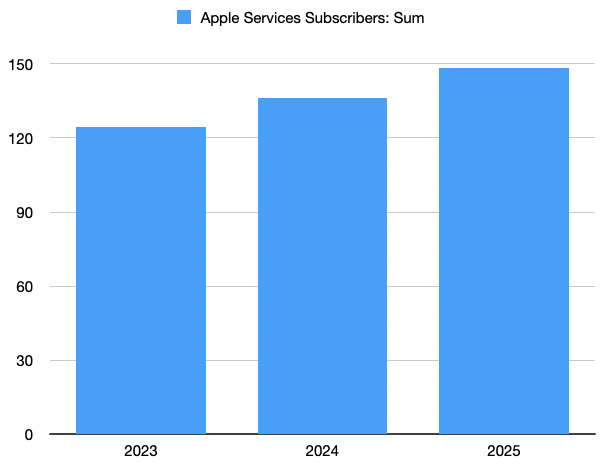
    The totals are in millions.

    Discussion

    The totals are 124.61, 136.27, and 148.23 million for 2023, 2024 and 2025. The growth rate is about 9% for both years. This is significant growth implying a doubling in 8 years. The user population is about 33% of the entire population (year 2025) suggesting a potential doubling is possible though perhaps saturation might be reached before 66% and growth might slow. A 50% saturation point however is certainly possible and that would imply about 225 million users.

    Adoption is highly correlated with income (r-squared = .75)
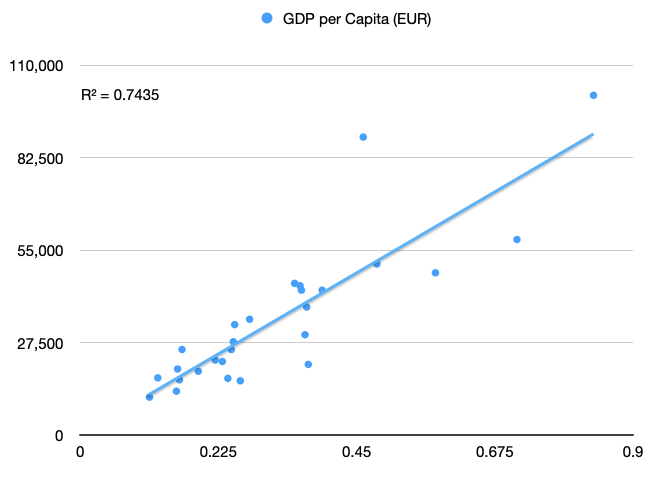
    The EU is a diverse region with 27 distinct countries. How they absorb Apple's ecosystem is quite likely to be a good indicator for other regions. The relationship between income and adoption is certainly worth considering.
  2. Apple in Europe: How many iPhone switchers are addressable in the near term?

    Research · 2 comments

    An update using operating system market share

    Apple's performance in China is often noted and scrutinized. During the last quarterly earnings call Amit Daryanani asked:

    ... the other second question I have for you is maybe just touch on the China strength you folks had. I think this is very close to all-time high revenues you have had in China. What is driving the strength over here?

    To which Tim Cook gave the following answer:

    Greater China was up 38% year on year. It was driven by iPhone, where we set an all-time revenue record. So it was the best iPhone quarter in history in Greater China. It is driven by the customer enthusiasm for the iPhone 17 lineup. And I would tell you that during the quarter, traffic in our stores in China grew by strong double digits year over year. It was a terrific quarter. Our installed base reached an all-time high in both Greater China and Mainland China. And we set an all-time record for the upgraders, and we saw strong double-digit growth on switchers.

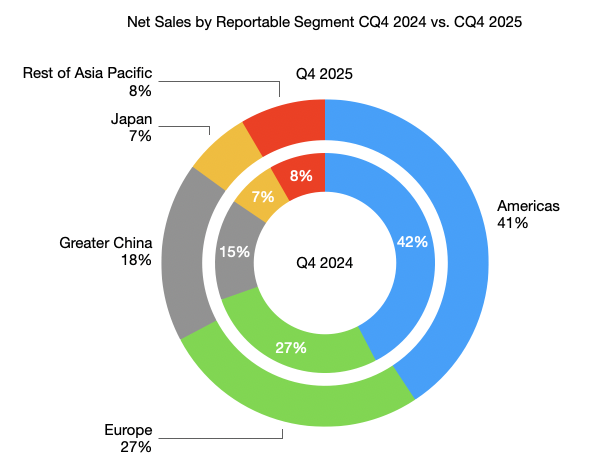
    That's remarkable growth and every quarter we get this sort of discussion. But I don't recall ever there being a similar discussion about Europe. This is strange because, and the following graph shows, Europe is a bigger market for Apple than China.

    Europe also grew, and at 12.7%, grew faster than the Americas and faster than Japan.

    Regional Sales CQ420252024Growth 
    Americas58,52952,64811.2%
    Europe38,14633,86112.7%
    Greater China25,52618,51337.9%
    Japan9,4138,9874.7%
    Rest of Asia Pacific12,14210,29118.0%

    So why is Europe not discussed. Management does offer some mentions:

    iPhone saw strength around the world, reaching all-time revenue records in many of the markets we track, including The US, Greater China, Latin America, Western Europe, The Middle East, Australia, and South Asia, as well as a December record in India.

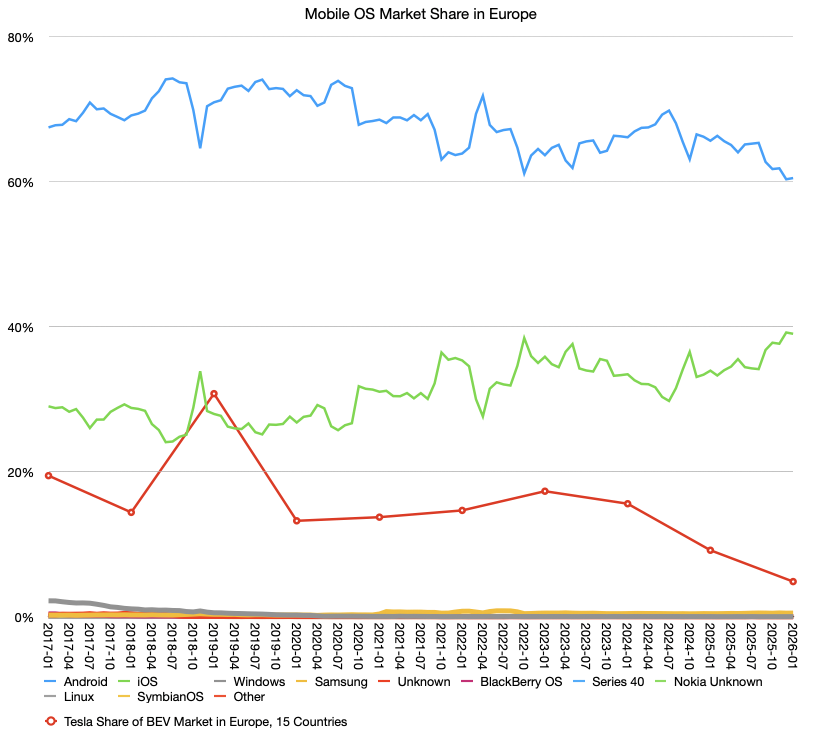
    Perhaps it's because Europe is considered a mature market, though surely China is not exactly emergent, with 114 phone numbers per 100 citizens (vs. 116/100 for the US). Even so, mature markets are still worth looking at. Though we don't have iPhone sales in Europe specifically, we can look at the usage profile of iOS as a proxy of iPhone market share. The following graph (via Statcounter) shows the mobile OS market share in Europe. The green line is iOS and the blue line is Android.

    Apple's share has increased significantly since 2018 when it was at 24%. In January of this year it's was at 39%. Correspondingly, Android fell from 74% to 60%. 15 percentage points is a significant share transfer.

    Europe, I might add, is an even bigger market than the US, with 459 million smartphone users vs. 300 million in the US, 329 million in North America. The opportunity to capture an additional 15% share there is equivalent to almost 70 million new users. The last 15% growth took 7 years so 70 million more in the next 7 would imply 10 million new users per year. That is a significant portion of the global pool

    NB: To contrast this growth, I've also added the market share of Tesla in the battery electric vehicle (BEV) market. Unlike Apple, Tesla is considered a dominant brand in the EV market and yet its market share is dramatically lower, and falling.