Asymco

Asymmetric Intelligence

Industry

  1. On Capital Allocation

    Research · 8 comments

    One of the paradoxes of the "post-industrial" era is the aversion to application of capital to growth opportunities. Generally speaking, capital has become trapped in bank accounts as opposed to equipment which could be used to produce value. This aversion is rooted in many dysfunctions, chief among them being the misunderstanding of the purpose of the firm.

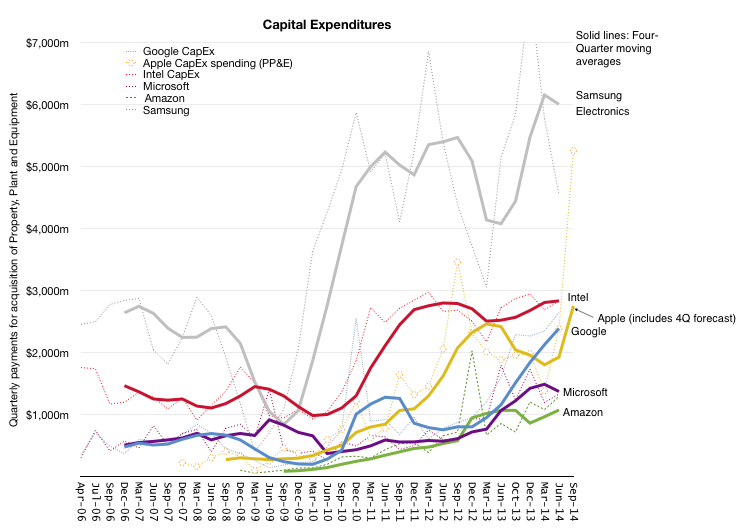
    But there are exceptions. Illustrated below are the patterns of spending in property plant and equipment (capital expenditures) by companies that still recognize that there are opportunities to be obtained by investment in the means of production.

    Screen Shot 2014-08-13 at 11.36.03 AM

    The highest spenders in this cohort are Samsung and Intel, both of whom spend mainly on semiconductor production equipment. Apple has been a big spender on production equipment and, to a lesser degree, on data center infrastructure. As the graph shows, Apple's spending has been nearly at the same level of Intel but with recent volatility, suggesting shifts in production processes ((I'm assuming that the 5S/5 required a surge in spending followed by a throttling back for the 5C with the iPad processes wild cards)).

    Companies such as Microsoft and Amazon have been increasing their spending but since their assets are mostly data centers ((Amazon also accounts for its distribution warehouses and web site development costs as capex)) they have been considerably below the "manufacturing" investment level.

    The interesting story emerging is Google. Its spending must include data centers primarily but the level is now reaching that of Intel and Apple. It actually spent more than Apple for the last four quarters. There might be a lot more need for infrastructure to support its users, but the revenues have not risen as rapidly as this line item

    The question of what Google spends on is interesting. There are many projects which require capital including announced fiber networks but nearly $10 billion/yr. in capex is a staggering amount and I'm curious if its explainable as sustaining their current strategy or something emergent.

  2. Open always wins

    Research · 54 comments

    ABI Research estimates that AOSP (or forked Android) is the fastest growing mobile operating system with a total share of units shipped of about 20%. This is not surprising considering that most Chinese vendors don't include standard Android into their products. Indeed the current leader in China, Xiaomi has its own take on Android and includes a unique UI and set of services. This is also not a new pattern, Amazon's fork of Android has been in development for many years and powers the second most used tablet in the US.

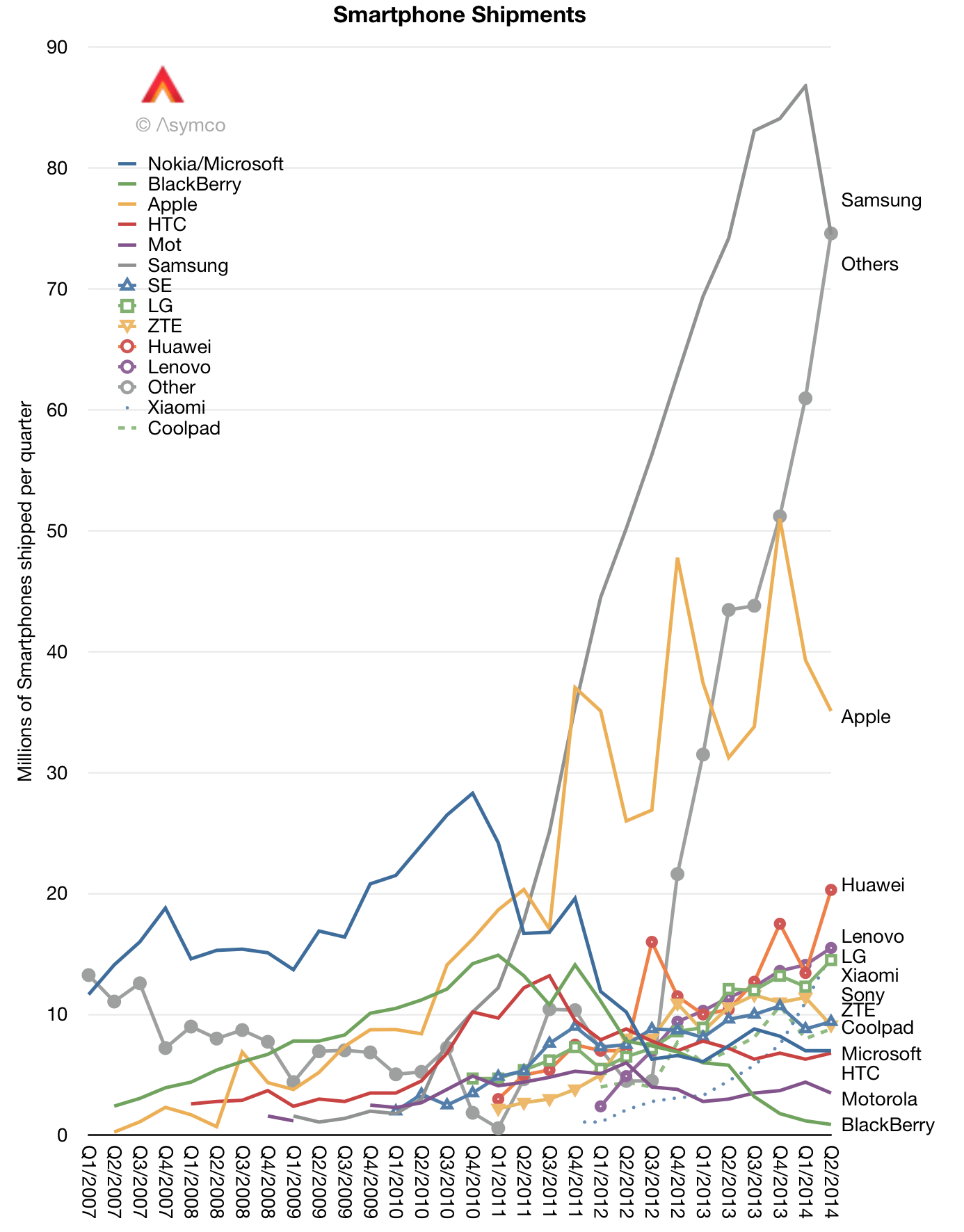
    If one looks at the volumes of smartphones shipped by vendor, the most rapidly growing (Huawei, Lenovo, Xiaomi, ZTE, Coolpad and "others") are likely to be using forked versions of Android.

    Screen Shot 2014-08-07 at 7.06.09 PM

    The reasons for this are many: a reluctance to deal with Google's obligations,  Microsoft's IP licensing costs ((which even Samsung seems to be eschewing)) , potential litigation, politics (including bans on Google services in certain markets), etc. But the most likely reason is flexibility. Vendors competing on price and localization are looking to move quickly against each other and can't wait for blessings from above. Belonging to some "Alliance" and all that it entails is just too much to ask for companies that are, so to say, delicate.

    The result is that the "more open" version of Android is beginning to threaten the "less open" version of Android. China is already lost to OHA but India where penetration is still very low is up for grabs. Into this fray Google launched "One" a more low-end friendly version of sanctioned Android, hoping to retain opportunity.

    The value of a singular Android version is not just being Google-friendly but also being better managed and more BOM-friendly. Google is trying to solve the control issue with ease of use, but still retaining control There will be alternatives however which are both easy and "open" ((or Free as in speech)). It seems that there is an opportunity for a hardware-independent vendor to take AOSP and provide a complete solution to local phone brands so they don't need to expend efforts on integration. A non-Google One, so to speak.

    Why it's likely is that openness in software makes sense when parts of the stack become commoditized. Google took advantage of the commoditization of operating systems (i.e. Linux) to deliver non-open services on top. However, it's inevitable that some of those very services will also be commoditized and therefore that the portions of the stack which sustain Google will be forked as well.

  3. Twenty Questions from Catalin Stelian Andrei

    Research · 17 comments

    Catalin Stelian Andrei, Editor of The Day, INTERNET PROTV asked me twenty questions:

    1. What phone do you have in your pocket right now? Why that model?

    I carry the iPhone 5. The last iPhone I bought was an iPhone 5C which I gave to a family member.

    2. Apple is going to launch, form all we know, an iPhone with a bigger screen, long after their market rivals. Is Apple one step behind, being forced to take this road in the fight with Android and Windows Phone devices? Because many smartphone users were hoping that an big screen iPhone, a redesigned model, will be lauched long time ago, and that didn’t happen.

    Making bigger phones is easier than making smaller phones. First because miniaturization has always been the most difficult engineering challenge, and second, because a smaller phone has a smaller battery making efficiency much more important. The larger the phone, the simpler it is. The third reason smaller is more valuable is that it’s easier to carry and use. The largest phones cannot be put in pockets and cannot be used with one hand. In the history of consumer, electronics size reduction has been the most consistent measure of performance, and the most rewarding. Usually the most exceptional reductions in dimensions create the highest price and profit bands. There have been niches for larger portable devices but they are consistently a small part of the overall market. If Apple were to introduce a larger device I hope they will be able to solve usability problems and make the category attractive to a larger audience.

    3. What do you expect from the new iPhone 6?

    I expect it to run the latest version of iOS and, with the new apps developers will ship, that should make the most impact in people’s lives. I imagine health maintenance and home automation will become valuable new franchises. Of course iOS 8 will also run on older iPhones, but I suspect the newest iPhone will somehow run the new software better and have smoother integration with services.

    4. What’s the “not to do” lesson that Apple needs to learn for the now iPhone from it’s own past experience or their competitors?

    The biggest challenge is to move rapidly with scale. The company has managed to grow from zero phones a year to hundreds of millions. That’s great but it’s still frustrating to wait one year for major improvements. The “cycle time” of innovation for Apple remains one year. I wish it could be faster but perhaps this is also too fast for some. In some services like maps and iCloud and iWork, which are independent of hardware (mostly,) speed is of the essence.

    5. The iPhone is the most expensive smartphone on the market right now. In Romania, it certainly is. But where does Apple gains it’s most money from, selling products to users or selling services, like iTunes, App Store? And having that in mind, what will be their next step: better – breakthrough products or bigger, more complete services?

    The answer to where a company “gets its profits” is best answered by asking where a buyer “gets his value” from the product. For instance you might answer the question of where a car company gets its value by saying that it’s from making people be in more than one place in a day. So the “differentiation” of a car is in answering the question slightly differently. If it’s hard to see a difference to this answer between cars then it’s hard for any one company to make a profit. For a company like Apple, we need to ask what its users value about the experience and why they are willing to pay for that. My hypothesis is that the brand's value is in making life a little bit easier. That’s what Apple competes on. Of course, some people are not willing to pay to have an easier life and some even want to make their lives more complicated so Apple’s proposal to make life easier, for a price, is not accepted by everybody—which is ok by them. But for many, paying for comfort, productivity and ease of mind is worth quite a bit. The reason Apple is able to gain a premium over the competition is that this value proposal (of paying for simplification) is either weak or non-existent for competitors. Indeed, many competitors compete on the basis of making life more complicated.

    6. What does innovation means for Apple right now? What are their options for assuring a next decade of success? A new Steve Jobs person or a Steve Jobs tipe of group thinking. How hard is that to achieve?

    Innovation is meaningful invention—bringing useful creations to a large number of people who then make use of that creation. The interesting aspect of making money from innovation is that it’s a rare phenomenon, requiring many disciplines to work together. It’s like a big movie that somehow works and becomes widely popular but costs little to make. Many movies are made, few are successful and very few of those which are successful are built at low cost. What we know about technology innovation is that it’s a combination that comes together under strong leadership but that leadership alone is not sufficient. The myth of Steve Jobs is that he was both necessary and sufficient to success. The truth is that he was necessary but not sufficient. To make successful innovations requires strong leadership and teamwork and a process of incentives and passion that is hard to create a formula for. How this works at Apple is its biggest secret.

    7. Who are the key Apple employees right now? Do they need another Jobs or do they already have him?

    All Apple employees are key. I would say that’s the magic formula. There is no chief magical officer (and there never was.)

    8. What will be the next best thing for Apple? […]

    I don’t know. It’s probably not knowable.

    … Are they capable of another breakthrough in the market?

    Yes. This is almost certainly knowable.

    9. Is the smart-home project something that will really happen in the next, let’s say, two decades?

    If the project requires replacement of existing infrastructure, it will not happen. If the project allows adding new items to existing infrastructure, it will almost certainly happen.

    10. Growth comes from the middle and low-end smartphones, according to IDC. Would or would not be a good idea for Apple to release a handset cheaper than the 5c?

    If Apple were concerned with growth then they should. But we have to ask why they avoided doing this six years ago. Not only was it obvious to do so but a portfolio strategy was the modus operandi for every competitor and had been for decades. The question isn’t why Apple does not broaden its line-up but why do the others diffuse their efforts and have such poor focus.

    11. What feature or software you think would be the main battleground in the future, in the smartphone market? Apps? Battery? Camera?

    Integration of all the above. When new experiences and services emerge those who are able to make them usable succeed. Usability requires integration.

    12. Who puts more pressure on Apple: Apple itself, Samsung, LG, HTC, Microsoft and Nokia? And how.

    I suspect competition is part of motivation but it’s not the entire story. Let’s not forget that Apple is considered to suffer from competitor pressure from software companies, services companies, media companies, hardware companies and everything in between. For instance, Apple is in competition with Microsoft, Amazon, Google and Samsung but the competition is not transitive. In other words Amazon is not perceived as being in competition with Samsung and neither is Google competing with Nokia. So somehow Apple should be sensitive to every perceived alternative to every aspect of its products. This quickly becomes an absurd idea. Apple is a system of things and systems can’t be compared with components.

    13. What is Apple’s sensitive spot today. What do you believe Apple fears the most?

    Losing people. The problem of retaining talented people is the most difficult challenge, especially when they become very wealthy due to the success of the firm.

    14. In 2012, you described the fall of Nokia in competition with Samsung at the Guardian Mobile Business Summit due to the disruption theory: the launch of the smartphone. Is Apple in danger of becoming a victim of the same story in the near future? What technology could replace the smartphone and when?

    Yes, every company is vulnerable to disruption. The defense is not to protect against it but to self-disrupt or enable self-destruction. Self-preservation is an instinct in humans so this is psychologically very difficult. The crisis comes not from a technology change but a business model change and that implies a cultural change. Companies embrace any and all technologies which sustain their business models and reject, resist and ignore any and all technologies which disrupt their business models. Changing business models is like a brain transplant; it happens so rarely that we can count it on one hand. By the way, because it’s so rare is why companies who attempt it are discounted by the market.

    15. You've been a Nokia executive. From this perspective, how do you see the deal with Microsoft and the future of Windows Phone and the Lumia brand?

    This is a long story. I can’t really do it justice now but I will say that it seems that Microsoft understands that they need to become an integrated systems company and not a component supplier. The same became evident to Nokia so they needed to merge.

    16. You've also worked with people from RIM. Do the have the capacity to innovate?

    Perhaps but scale also matters. RIM and HTC may not have the time to grow.

    17. Let’s imagine that no big company owns my personal information. If I wanted to sell that to someone, what would be the right price to ask? How valuable are individuals in the war for gaining personal information?

    The price of your personal information will be set by auction. It’s up to you to decide if you want to create a reserve price or to let the highest bidder win. As of today most people would trade all their personal information for almost zero price. This will not last and consumers will find out their value over time. I can’t predict how it will change but it will be a combination of offers being made and personal data catastrophes which will act as warnings.

    18. Do you believe in phoneblocks project from Motorola?

    Only people who want more complicated lives will want to build their own products. There are some such people (for example children) but they are not willing to spend a lot for that complication so the overall market for increasing complexity is small.

    19. The last question. What could trigger an Apple fall and when?

    The most common trigger for failure is success. To continue succeeding is very hard because motivation disappears. What can cause a crisis of motivation would be that there is a loss of belief that there are problems left to solve.
  4. Questions for Eddy Cue and Craig Federighi

    Research · 65 comments

    The Re/Code conference begins this week, and Apple executives Eddy Cue and Craig Federighi will be answering questions from Kara Swisher and Walt Mossberg.

    Here are some questions I hope they ask:

    For Eddy Cue:

    1. Why is there no app store for Apple TV? Even though the product is running essentially the same hardware and software as the iPhone and iPad and iPod touch and even though it connects to the iTunes stores, there is no option for developers to build apps for it or for consumers to use their TVs to run iOS apps. I might add that it’s been seven years since the platform launched and that’s a long time to wait.
    2. As Amazon has been granted a monopoly on the distribution of ebooks by the US federal government, why not compete by selling ebooks as apps? Apps were used as ebook containers well before the iBookstore launched and there were tens of thousands of “book apps”. Why not encourage authors and publishers to build apps by offering tools which make it easy to do so? I might add that if you do this for authors, why not do it for musicians and video producers? Why have separate stores for different media when they are all just content?
    3. YouTube is becoming the TV of choice for millions. Before it becomes that choice for billions, what are you doing to encourage user-generated video content distribution through your ecosystem?
    4. Apple’s Services revenues are growing remarkably quickly. The number of users is over 800 million. Do you see an opportunity for services to become a more independent business at Apple? In other words, why not bring iTunes to Android?

    For Craig Federighi:

    1. Marc Andreessen uses the phrase “Software is Eating the World” to describe the disruption that software-enabled businesses are having on those who don’t depend on software. You are the head of software at Apple; what’s on your plate? In other words, what do you see the opportunity for software at Apple beyond enabling device sales? I might add that although you are leading Software Engineering at Apple, Software and Services are part of Eddy’s organization. Does this separation make sense?
    2. It’s likely that iOS will be used by more people than Windows in the near future. What do you see as the obstacles to iOS replacing Windows for what most business users use daily?
    3. If you believe that iOS can replace Windows (at least in some tasks), do you think the iPad will ever replace the Mac?

    This was originally posted on LinkedIn on May 28th.

  5. Think local, act global

    Research · 20 comments

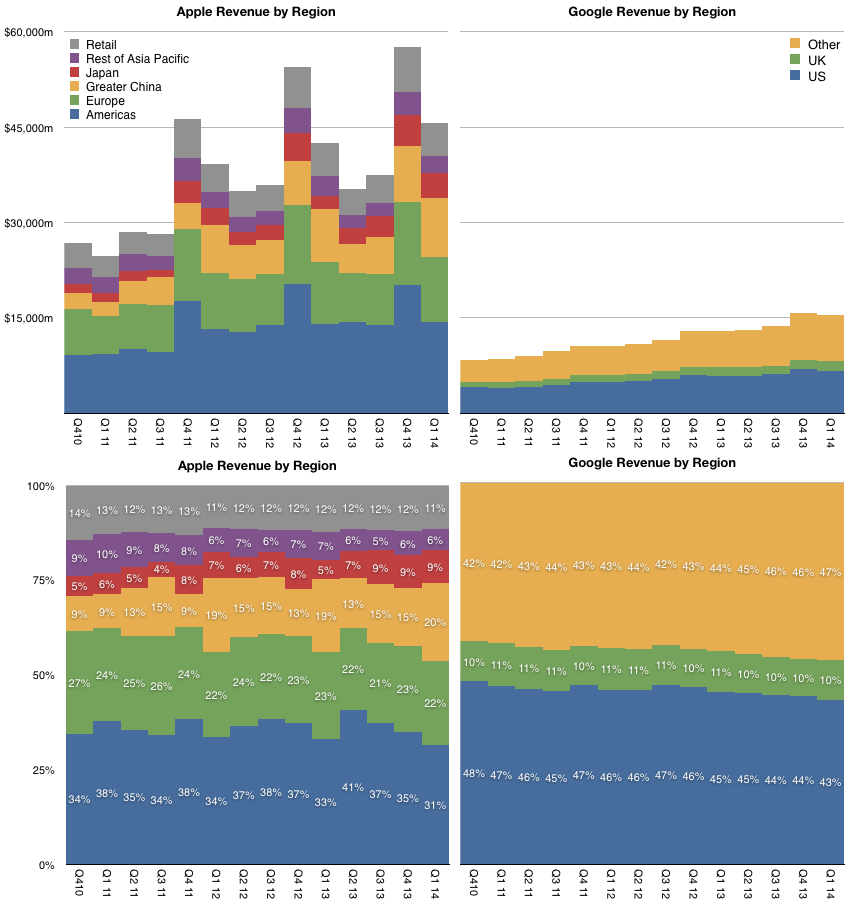
    Three years ago Apple's Greater China Q1 sales were $2.22 billion or 9% of total. This year they were $9.29 billion ((Including China retail, revenues reached "almost $10 billion")) or 20% of total. Over this time frame the growth in China was about 320%. The second fastest growing reporting segment was Japan with growth of 187%. Europe was third with 70% and Americas fourth with 53.5%. Rest of Asia/Pacific had the smallest increase of only 4.1%.

    A graph showing both the absolute and relative sales levels for the reporting regions is shown below.

    Screen Shot 2014-05-19 at 5-19-11.35.17 AM

    As overall sales have increased significantly, the revenues from the Americas and Retail combined (as most stores are in the US) ((60% of all Apple stores are in the US)) went from 51% in Q1 2011 to  42% in Q1 2014. The 11 point increase in share for China can be thus seen as mostly at the expense of the US. As Americas did not decline more appropriate statement would be that China captured much of the growth of the last three years.

    Note that I also included Google's revenue split ((Excludes discontinued operations, namely Motorola)) in the graph above. This is partly to calibrate Apple's mix and to understand if the expansion outside the US is mirrored by other companies.

    Google, in particular, is largely absent from the Chinese market and the only regional detail we have for their revenues is the US, UK and Other. That leaves an analysis of the dependency of each company on the US market.

    Google's US revenue percentage did drop from 47% to 43% but it's worth noting that not only is the drop slower than Apple's, the overall dependency of Google on the US for revenues is higher than Apple's.

    A surprising observation as Apple's concentration of users, measured as market share for various products, is likely to be higher in the US than Google's distribution of users.

    Put another way, Google is broadly popular world-wide (except for search in China, Korea and Russia) but its customers and hence profitability are highly concentrated.

  6. Measuring Not Getting the Cloud

    Research · 137 comments

    This is what "Not getting the Cloud" looks like:

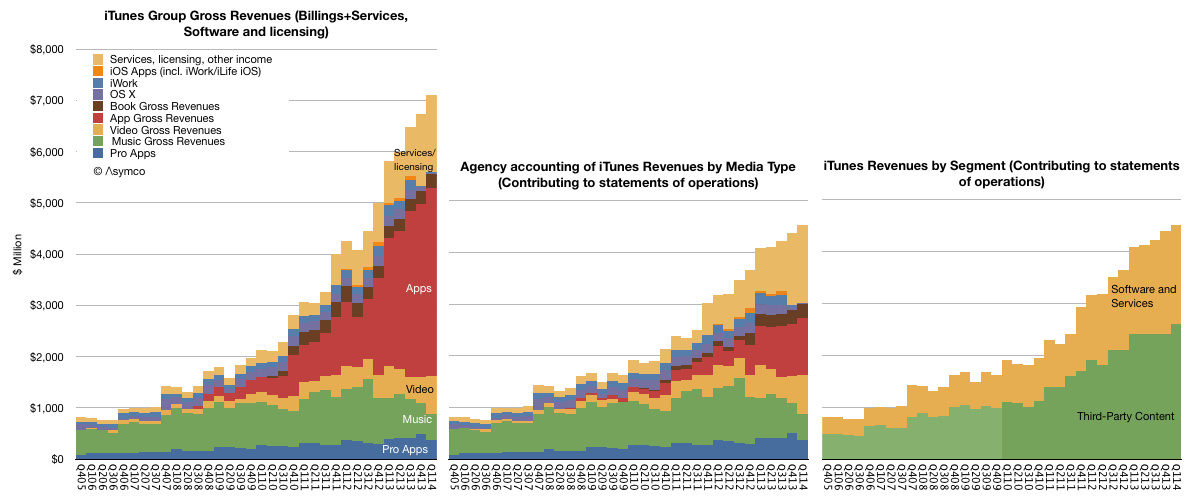
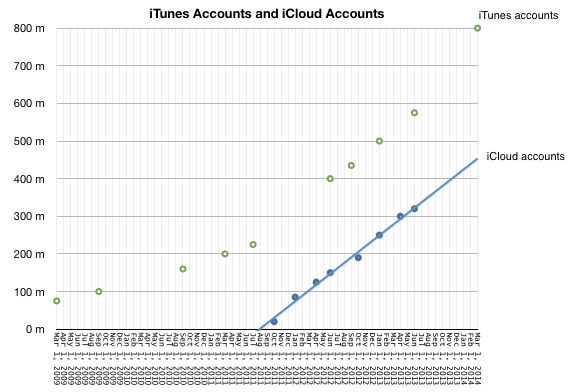
    Screen Shot 2014-05-09 at 5-9-3.30.03 PM
    Screen Shot 2014-05-09 at 5-9-4.04.33 PM


    "Not getting the cloud" means that in the last 12 months Apple obtained:

    • 800 million iTunes users and
    • an estimated 450 million iCloud users spending
    • $3 billion/yr for end-user services plus
    • $4.7 billion/yr for licensing and other income which includes
    • more than $1 billion/yr paid by Google for traffic through Apple devices and
    • $13 billion/yr in app transactions of which
    • $9 billion/yr was paid to developers and
    • $3.9 billion/yr was retained as operating budget and profit for the App Store. In addition,
    • $2.7 billion/yr in music download sales and
    • more than $1 billion/yr in Apple TV (aka Apple's Kindle) and video sales and
    • $1 billion/yr in eBooks sold

    In summary, iTunes, Software and Services has been growing between 30% and 40% for four years and is on its way to $30 billion/yr in transactions and sales for 2014.

    This is what can be deduced from a reading of Apple's financial statements of operations. If there are comparable details for companies which do get the cloud, I'll be happy to tally the comparison so we can calibrate this failure.

  7. How close to saturation is the smartphone?

    Research · 6 comments

    The US is not the market where penetration is highest. However, it is the largest market where we have reliable penetration data (from at least two sources) and the one where penetration is near the top of the range.

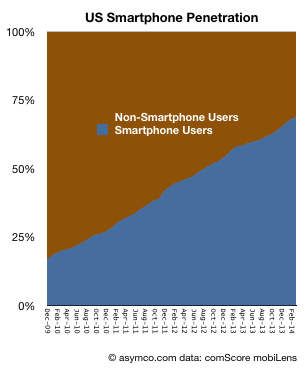
    The graph showing the US ranked against others as of a year ago is here. The US was cited at 56.4% at the time. I keep track of comScore's data and it showed 58.2% at the end of March and 55.3% at the end of January, making the figure very believable.

    The most recent data from comScore shows penetration at 68.8%. In order to understand what the limits of that growth could be it's important to see the longer-term pattern. It would show whether there is a clear point of inflection and thus a predictable "saturation" around an asymptotic value.

    The following graph shows the percentage of smartphone users/non-users since late 2009.

    Screen Shot 2014-05-08 at 5-8-6.13.29 PM

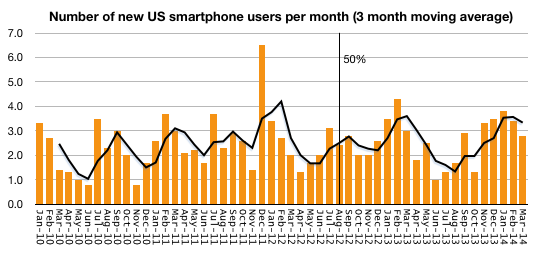
    The following graph shows the rate at which users are being added to the smartphone ranks (measured as new users per month.)

    Screen Shot 2014-05-08 at 5-8-6.14.01 PM


    To summarize, the conversion of users from non-smart to smartphone usage is fairly constant. The March '14 period saw 2.8 million new-to-smartphone users. the March '13 period saw 3.0 million, the March '12 period saw 2.0 million and March '11 saw 3.0 million. There is no discernible slowing of adoption.

    Note that I added a trailing three period average in new users which fluctuates somewhat predictably due to seasonality. Finally, note that the figure of 50% penetration was reached almost two years ago and no noticeable change of adoption has happened since. Cellular phone ownership in the US is still rising (though very slowly) and it now about 90%.

    The only conclusion is that even at the current 68.8% penetration, we are not anywhere near "saturation" of smartphone users in the US, and the US is a leader among "developed markets" so there is little to suggest that saturation has happened anywhere with significant populations.

  8. The iPad discontinuity

    Research · 144 comments

    iPad sales were unexpectedly slow in Q1. Tim Cook explained it as follows:

    iPad sales came in at the high end of our expectations, but we realized they were below analysts' estimates and I would like to proactively address why we think there was a difference. We believe almost all of the difference can be explained by two factors.

    First, in the March quarter last year we significantly increased iPad channel inventory, while this year we significantly reduced it.

    Second, we ended the December quarter last year with a substantial backlog of iPad mini that was subsequently shipped in the March quarter whereas we ended the December quarter this year near supply demand balance.

    We continue to believe that the tablet market will surpass the PC market in size within the next few years, and we believe that Apple will be a major beneficiary of this trend.

    Tim Cook went on to say "over two-thirds of people registering an iPad in the last six months were new to iPad"

    In a later discussion, Luca Maestri said:

    As Tim explained earlier, our iPad results and the comparison to the March quarter last year were heavily influenced by channel inventory changes. Specifically, this year we sold 16.4 million iPad into our channel and sold through almost 17.5 million, reducing our channel inventory by 1.1 million units.

    Last year, we sold over 19.4 million iPads into our channels and sold through 18 million, and therefore increased channel inventory by 1.4 million units. As a result, the year-over-year sell through decline was only 3% compared to the sell-in decline of 16%.

    We exit the March quarter with 5.1 million of iPad channel inventory which left us within our target range of four to six weeks. iPad continues to lead all other tablet by far in terms of user engagement, size of ecosystem, customer satisfaction and e-commerce.

    In a later Q&A:

    Steven Milunovich - UBS Securities: Tim, I understand that the iPad is not as weak as it appears on a sell-through basis, but still it's relatively flat over the last year in terms of sell-through. What are your thoughts in terms of why that is and can that accelerate with Office on the iPad going forward?

    Tim Cook - CEO: It's a good question. Let's talk about iPad a little more than we did in the comments.

    When I backup from iPad, here is what I see. It absolutely has been the fastest growing product in Apple's history, and it's been the only product that we've ever made that was instantly a hit in three of our key markets, from consumer to business including the enterprise and education.

    And so, if you really look at it in just four years after we launched the very first iPad, we've sold over 210 million, which is more than we or I think anyone thought was possible at that period of time. It's interesting to note that that's almost twice as many iPhones that we'd sold in a comparable period of time, and over seven times as many iPods as we'd sold in the period of time.

    So, I think it's important to kind of to put that in perspective. We've come a long way very, very quickly. Looking at it by market a bit, which I think is important. I think Luca mentioned a little bit of this in his comments. In the education market in the U.S., we have a 95% share. So the focus in education is on penetration, is on getting more schools to buy and my belief is the match has been lit, and it's very clear to the educators that have studied it is that student achievement is higher with iPad in the classroom than without it. So I'm confident we've got a really great start in education far beyond the U.S. now. This is happening in many, many parts of the world.

    In the enterprise market, we're seeing virtually all, 98% of the Fortune 500, they're using iPad. We're seeing – according to Good Technology who looks at activations of tablets – the latest data we have from them is that 91% of the activations of tablets in enterprise were iPads. So this is also an astonishing number and many of those enterprises are writing apps that are key proprietary apps for running that business, and this is great for that company because they're more productive as a result of that. So once again, just like in education in a way, what we have to do in enterprise is focus on penetration, it has to be deeper and broader.

    But in terms of having people begin the process, beginning writing apps, we're doing a pretty good job of that. In the retail market, if you look at the U.S. as a proxy, the NPD numbers for March just came out a few days ago and we had 46% share and embedded in that 46%, there's a lot of things in there that I personally wouldn't put in the same category as iPad, and that are weighing the share down. It's certainly a market we wouldn't play in and in a type of product you would never see an Apple brand on. So, we feel like we're doing well there.

    Office; I believe does help. It's very unclear to say how much. I believe if it would have been done earlier, it would have been even better for Microsoft frankly, there is a lots of alternatives out there from a productivity point of view, some of which we brought to the market, some of which many, many innovative companies have brought. But I do see that Office is still a very key franchise in the enterprise, in particular. I think having it on iPad is good, and I wholeheartedly welcome Microsoft to the App Store to sell Office. Our customers are clearly responding in a good way that it's available. So, I do think it helps us particularly in the enterprise area.

    The other things you look at on iPad that are just blow away its customer [satisfaction], is 98 [percent]. There is almost nothing in the world with a 98% customer sat and the intention-to-buy numbers look good with two-thirds of the people planning to buy a tablet or planning to buy an iPad. The usage numbers are off the chart, far and exceeding Android tablets, four times the web traffic of all Android tablets combined.

    So, when I backup from all of these, I feel great. That doesn't mean that every quarter, every 90 days is going to be a number that everybody is thrilled with. But what it means to me is that the trend over time – over the arc of time, that things look very, very good, that iPad has a great future. And of course the thing that drives us more than any of this are the next iPads if you will, the things that are in the pipeline, the things that we can do to make the product even better, and there is no shortage of work going in on that nor any shortage of ideas.

    So when I backup from all of this, I can't help but still be extremely excited about where we are. I think we did a reasonable job of explaining what we think the disconnect was between what we had expected, which we hit it at the high end of our expectation and the street's view of this one. I believe the vast majority of it is that first thing was just channel inventory that maybe we should have been even clearer on last quarter to take into account. But I'm very bullish on iPad.

    That's quite a long set of explanations for was essentially was a flat quarter for the iPad. I can't add more to this, but I do want to focus on the bold part of the quote above. "But what it means to me is the trend over time – over the arc of time, that things look very, very good".

    How can we see the long arc of time?

    The tool I've used for this is the measure of penetration. Historically products which become "mainstream" or widely adopted follow an S-curve during that adoption. The curve is remarkably predictable given a limited set of points. I've discussed how the adoption of smartphones is predictable in the US, EU5 (( And UK specifically and several broader global regions)) and how even particular platforms might be predictable in the context of rates of adoption.

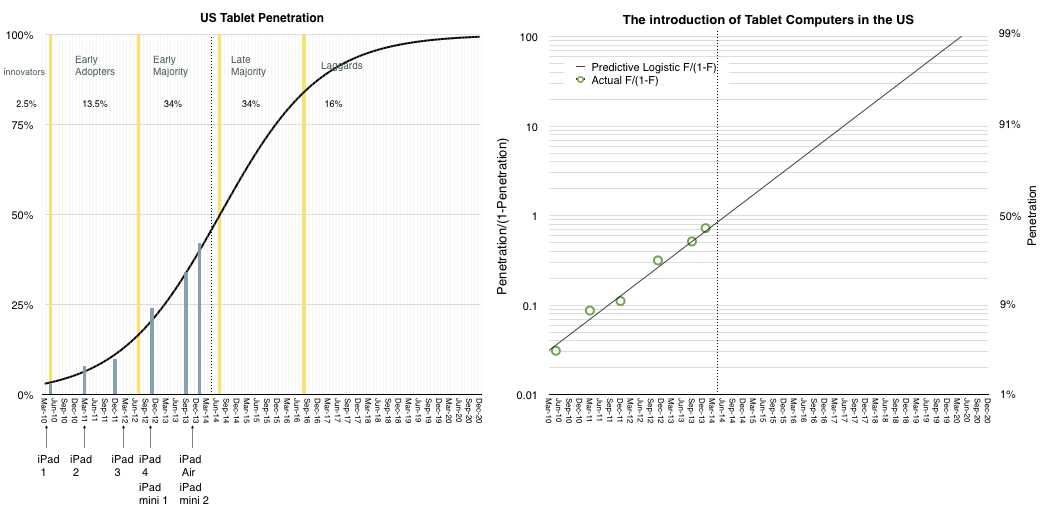
    We are fortunate that data also exists for tablets. The Pew Research Center's Internet & American Life Project has published a short history of tablet adoption in the US. I've plotted this data and imposed an S-curve on the data which fits it rather closely.

    The results are shown below:

    Screen Shot 2014-04-30 at 10.49.58 AM

    In the graph on the left, the blue bars represent actual measurements of penetration (18+) while the black curve represents a best fit for the adoption rate.

    Note that I've added the launch dates of all the iPad models and sectioned the curve into adopter categorization on the basis of their willingness to adopt.

    I've also drawn a dotted line on the point where we are in the present.

    In the graph on the right I've also duplicated the data using the transform of penetration to log scale penetration/(1-penetration). This shows the relative fit of the data in a more visually comfortable way.


    The usual caveats apply:

    • This is US only
    • These are adults only
    • The iPad is not the only competing product

    Nevertheless, this is a fairly strong proxy for the market. First, because the US has been leading adoption of almost all consumer product categories in history. Second because adults are a representative sample of users and third because iPad is market share leader.

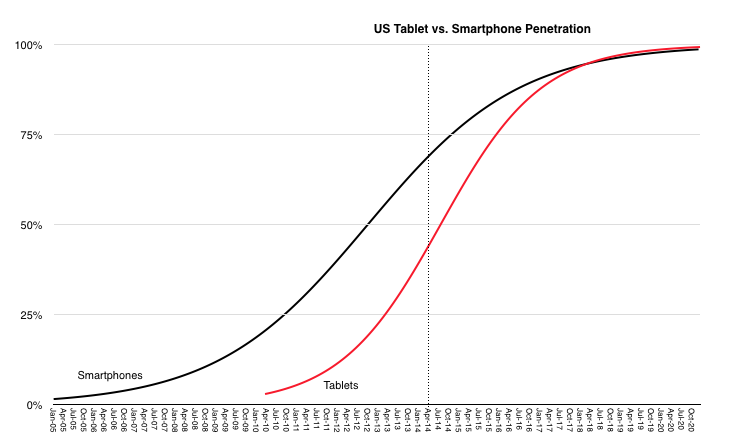
    What the penetration data shows is an extremely rapid rate of penetration. In comparison with the smartphone, the tablet is rising much faster. This is shown below:

    Screen Shot 2014-04-30 at 10.59.16 AM


    They are likely to saturate at around the same time but the tablet started much later.

    So how does this explain the slowing iPad sales?

    It's possible that saturation for tablets could come well below 100% and that we are on a different curve than the model above. However, the ubiquity of the product and broadness of appeal, even within non-consumer (i.e. education and enterprise) makes it difficult to reconcile. In addition, the penetration data is self-evident. It's improbable that penetration goes to 42% as it just did, and then stops suddenly. These decelerations of adoption have been observed historically but they are usually explained by cataclysms such as wars and economic contractions, neither of which are affecting the US right now. If a product solves an important "job to be done" then it gets adopted in a predictable way by a given population.

    The anecdotal evidence provided by the company and others coupled with the survey data collected for the population of US users implies that the iPad is solving numerous important jobs and is therefore continuing on a predictable trajectory and that a discontinuity has not occurred.

    Management started by saying the iPad sales volume was not surprising to them and that they have not changed their long-term expectations. The penetration data seems to support their confidence.


  9. Monthly Apple Users

    Research · 70 comments

    In the postmodern computing world that we live in, the measure of success isn't revenue or profit or units sold but the number of users that an ecosystem can attract. Therefore the monthly active user (MAU) unit of performance seems to be in vogue right now. E.g.:

    • Facebook claims Messenger has more than 200 million MAUs
    • WhatsApp has 500 million MAUs, 48 million of whom are in India
    • Line last month announced that it had 400 million users (active or not)
    • WeChat claimed 355 million MAUs
    • Viber claims 105 million MAUs

    Startups are aggregating these millions of MAUs in order to obtain valuations for raising capital ((It's been said that it's difficult to get funded with only 10 million MAUs)) and the faster the growth in MAUs the more "successful" the company is considered.

    When companies are acquired it's common to take the transaction value and divide it by MAUs to get an idea of "what an user is worth". This is because there are no revenues to measure and MAUs are taken as a proxy. However, the process by which a MAU becomes a dollar of profit is, to put it kindly, circuitous.

    For most (all?) it's not yet clear how it happens especially since not all MAUs are created equal and MAU loyalties can change rapidly and if we added all the projected revenues each MAU will contribute to each app on her device we might reach some absurdity. In actuality, today, for the companies listed above, there are no revenues at all directly from their services.

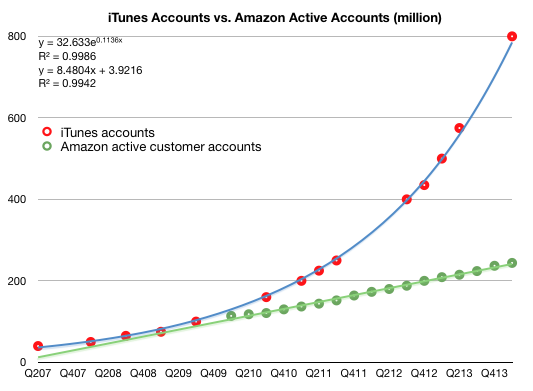
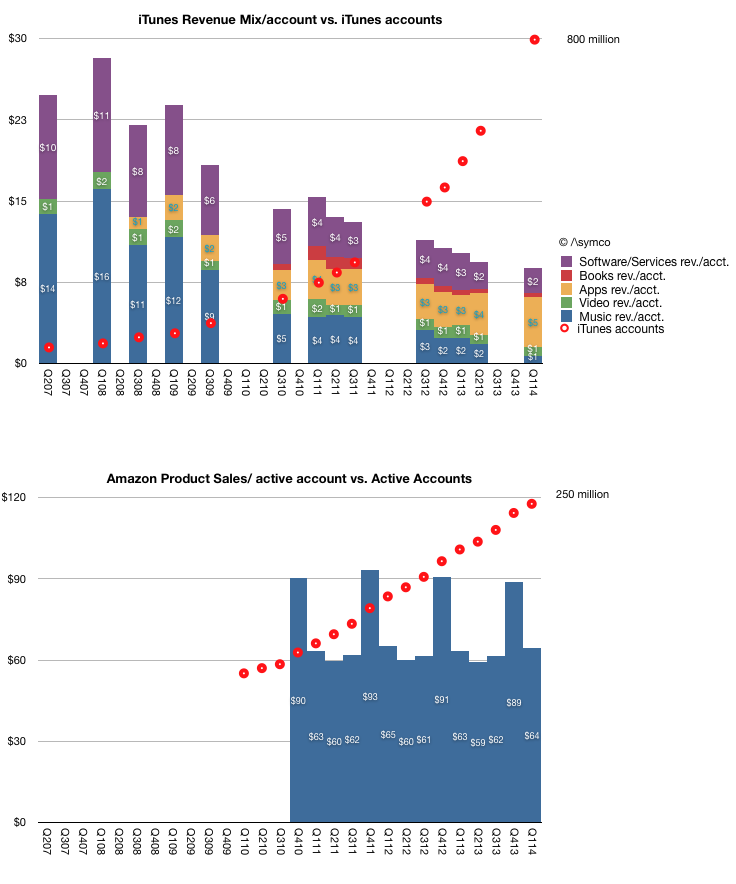
    In violation of this convention, there are some companies which manage to obtain revenues from their users. Two such are Apple and Amazon.  In the last quarter Apple reported having 800 million iTunes accounts. ((adding, for some unknown reason, that most of them have credit cards.))  These aren't MAUs since the activity level is not noted, but we do know how much is spent on iTunes and services. In addition, Amazon cites 244 million active customer accounts  representing accounts which generated purchases within the last 12 months.

    This allows us to compare Apple and Amazon in terms of accounts, revenue per account, and, via some analysis, even profitability per account.

    The following graphs tell this story. First, the total number of accounts:

    Screen Shot 2014-04-29 at 4-29-11.25.29 AM

    Note that I added trend lines to both graphs and their formulas.

    The following are the revenue per account for iTunes (further broken into estimated iTunes segment revenues per account.) and for Amazon. Note that the vertical scales are different.

    Screen Shot 2014-04-29 at 4-29-12.05.06 PM

    This view shows just how different the economic value of users can be. In the case of Apple, it's growing its user base at (literally) exponential rates. The revenues per user does, understandably, decline. This is because new/later users don't spend as much as early users. There might be some stability toward the later stages of adoption in revenue per user. The other point about iTunes data is how the mix of revenues has shifted from music to Apps and Services pointing out how users can be migrated across revenue sources over time.

    In the case of Amazon it's growing its user base at a linear rate (note equation). The revenue per account remains very steady however.

    Broadly speaking, it would seem logical that the speed of user growth has an effect on the quality of those users. This relationship should guide further thinking about the quality of hundreds of millions of users acquired within a few months.

    Apple's user growth is a function of expanding its device portfolio and distribution. Apple has shown that there are limits this type of growth. Achieving 830 million or so iOS device sales within 7 years is an amazing feat and one can forgive not having achieved billions more since they managed to obtain significant hardware and service/content revenues from most of them and that those who reached higher figures more quickly didn't manage the same revenue per user.

    Amazon's user growth is a function of expanding its logistics and merchandise mix. This is also not easy to do globally. Arguably, Amazon cannot scale in the exponential rates seen by Apple or the other MAU aggregators because it has to depend on trucks and roads and regulators to complete most of its sales.

    I suppose, in conclusion, that there is no "right" or "wrong" business model for a user base. Both Apple and Amazon are doing well in building their customer bases and creating loyalties which will serve them well in the future. However whereas there is no right or wrong revenue structure per user, it seems to me that there ought to be some such structure. In most cases this remains a matter of faith rather than reason.

  10. Inventive Teens

    Research · 23 comments

    Philip Elmer-DeWitt cited Piper Jaffray's latest Teen Survey on Device Ownership where ~7,500 teens in the US are asked about their device ownership. This type of data is similar to the method comScore uses to measure penetration smartphones in the US making the two data sets comparable.

    The combined data is shown the following graphs.

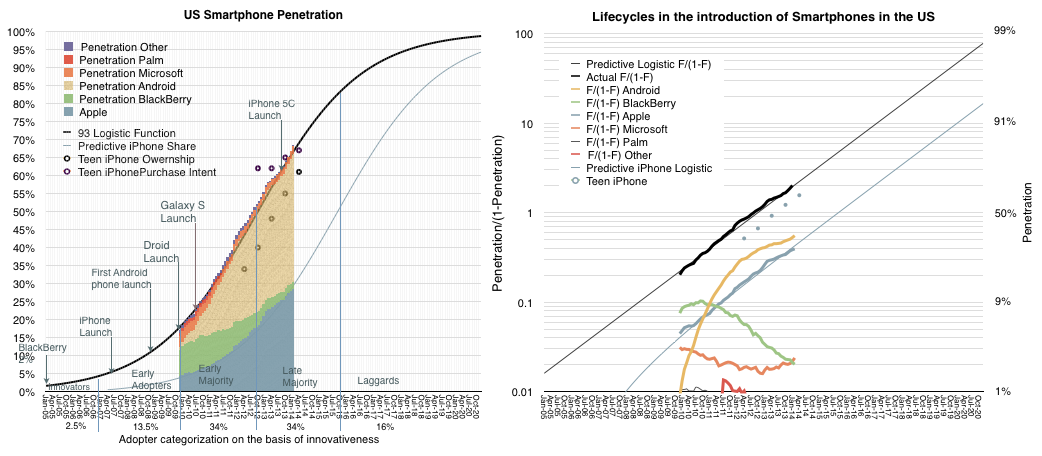
    Screen Shot 2014-04-10 at 4-10-3.07.04 PM

    One graph is the penetration data and the other is the ratio of penetration to unpenetrated on a log scale. The PJC Teen Survey data is shown as dots on both graphs. In the spring of 2012 the difference between teen iPhone ownership and overall population iPhone ownership was 20 percentage points. In the fall 2012 it was 22 points. In spring 2013 it was 25 points. The spread increased to 30 points in the fall of 2013.

    This implies that the latest sample (April 2014) should have at least a 31 point lead on what comScore will report in another two months. ((comScore reports data during the first week of a month for a period ending one month earlier. So the April release covers a sampling period ending February)) In other words current iPhone penetration in the US is probably 30%. This assumes of course that the relationship between teens and overall population has not changed. But there is consistency in the pattern of iPhone growth for over 50 months.

    In addition, the purchase intent data is showing that there is growing interest and that interest reflects demand which has been largely met by a purchase decision.

    Teens are leading adoption in this particular sector because the device is very well suited to the jobs that they need to do, mainly social interaction. It's no coincidence that the audiences for the fastest-rising services (SnapChat, WhatsApp, Vine, YouTube, Instagram) consist mainly of teens. They also lead adoption in FaceBook, iTunes, MySpace, etc. In that regard teens are an early indicator of mainstream behavior.

    Teens taught the world new habits throughout the 20th century ((An entertaining review of the contribution (and invention) of teenagers in the 20th century can be enjoyed in James May's 20th Century Episode 5)) and they certainly seem to be teaching us in the present.

  11. Postmodern computing

    Research · 99 comments

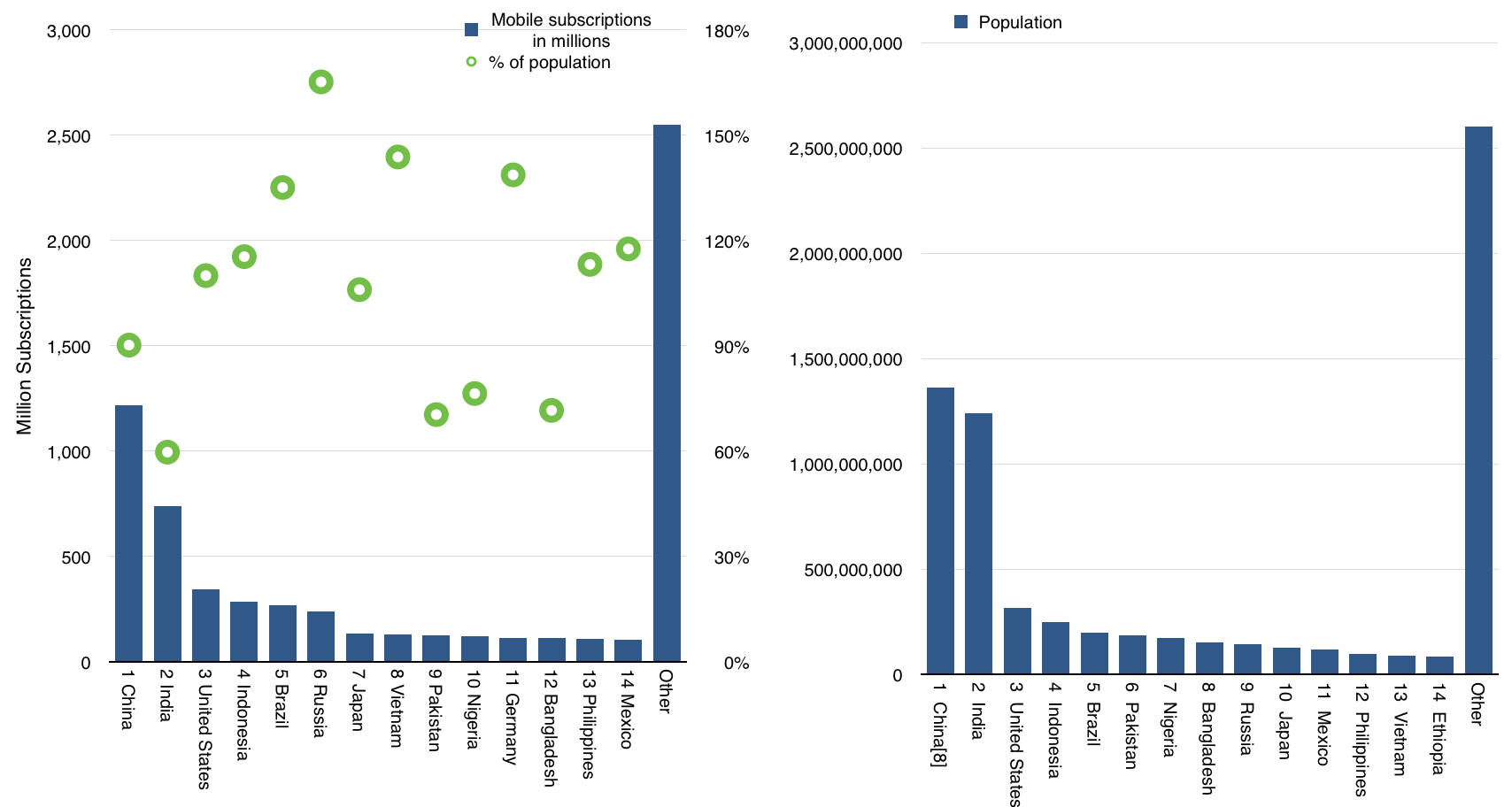
    There are 7.1 billion people on Earth. Coincidentally there are also 7 billion mobile connections.  Those connections are held by 3.45 billion unique mobile subscribers. ((GSMA)) Unsurprisingly, the largest national mobile markets (by number of subscriptions) correspond closely to the most populous nations.

    Screen Shot 2014-04-07 at 7.21.46 AM

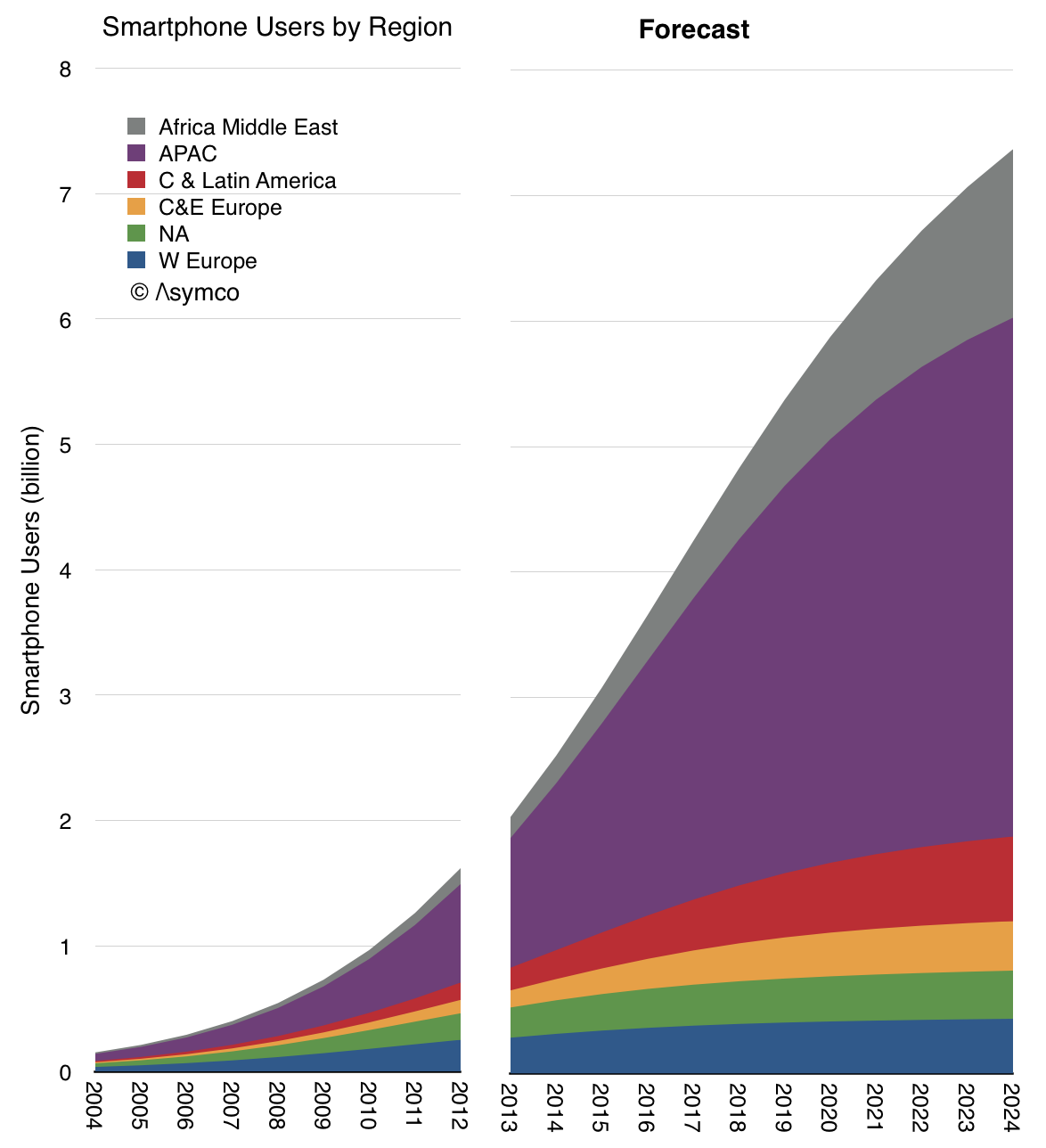
    Considering smartphones, last year 1 billion smartphones were sold and the number of smartphones in use is about 2 billion ((There are also about 2 billion 3G/4G connections world-wide))

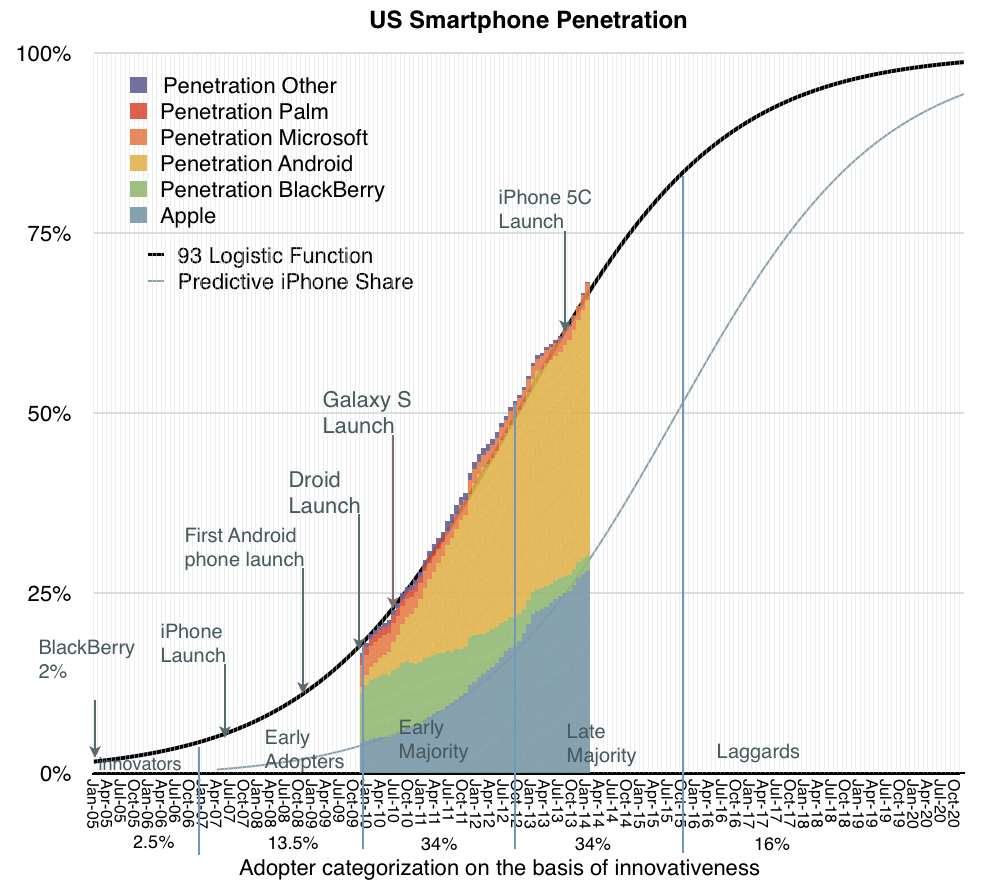
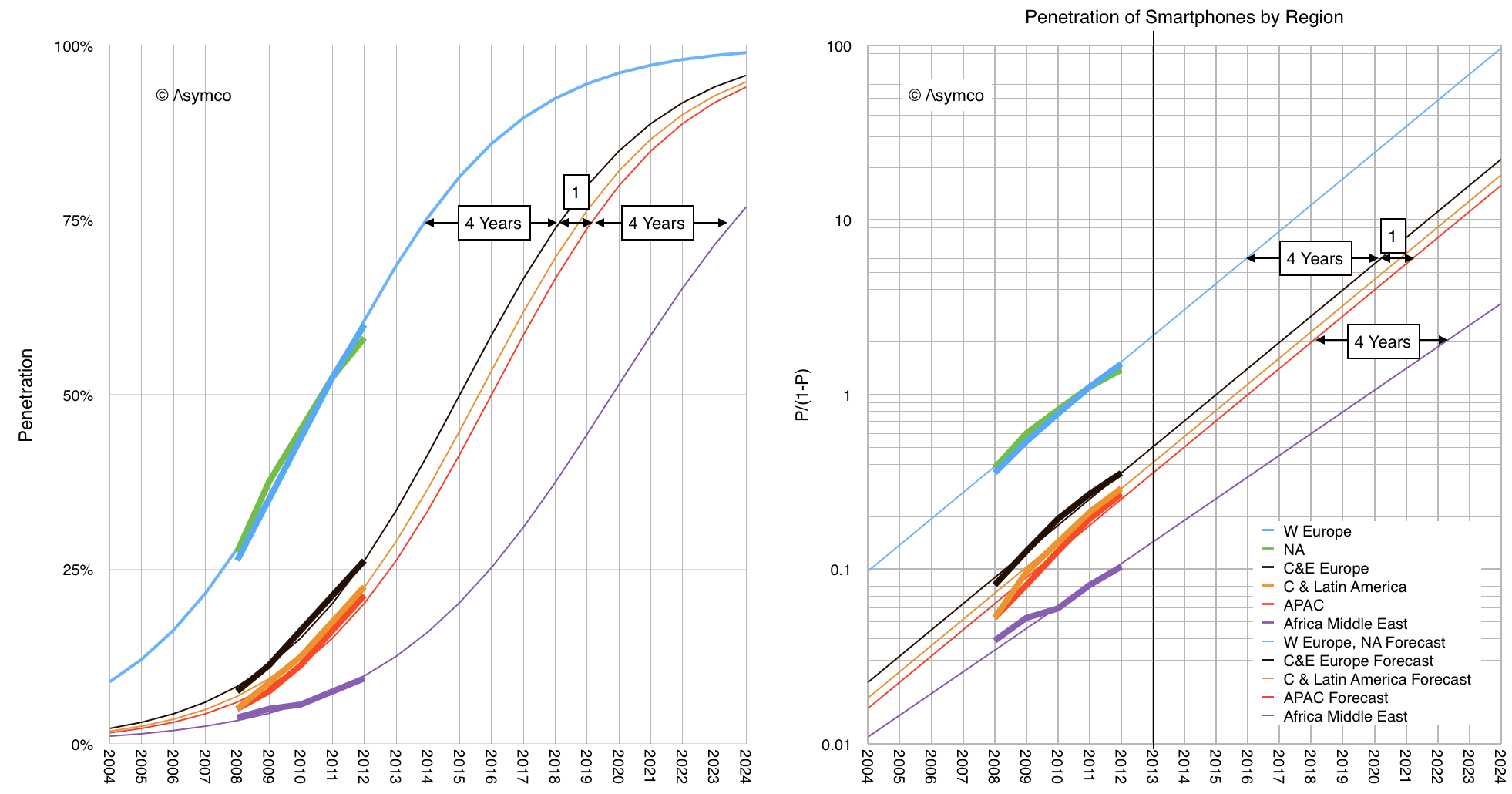
    Given the rapid adoption of smartphones, it's also safe to assume that smartphone penetration will follow population distribution. In the US, where comScore data is published monthly, penetration is following a predictable logistic curve.

    Screen Shot 2014-04-07 at 7.55.13 AM


    Assuming similar patterns world-wide we can forecast regional smartphone penetration.

    Screen Shot 2014-04-07 at 7.56.49 AM

    This yields the following forecast for smartphone usage world-wide.

     alt=

    Three years ago the notion of smartphones becoming as ubiquitous as toothbrushes seemed far fetched but it's now gradually being accepted. The smartphone is well on its way to becoming the most successful technology in history.

    So what?

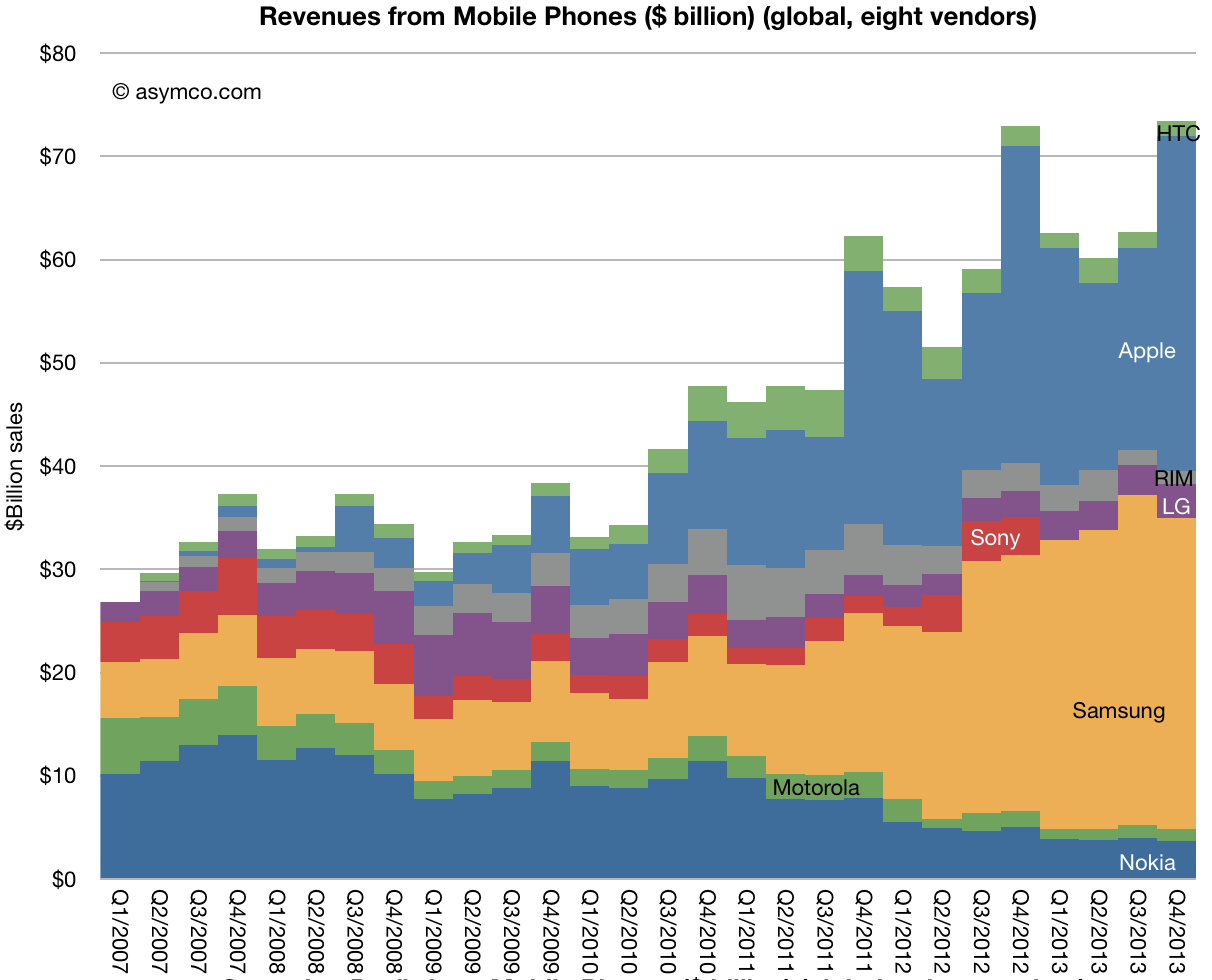
    What will the smartphone do for us? Does smartphone ubiquity change anything? Besides increasing ARPU slightly in a $1.2 trillion industry? Besides doubling the size of the device business? ((

    Screen Shot 2014-04-07 at 8.17.26 AM

    ))

    Besides creating a $20 billion app industry? How do we assess the impact of having a connected computer in one's pocket? In everyone's pockets? With us all day. Every day.

    Before we answer, we have to realize that the smartphone has been disruptive. Which means it has that special quality of not affecting the world in a predictable way. Its growth has been largely unforeseen and has affected the fortunes of the incumbents. As big and ubiquitous as it has become, the companies which were most intimately aware of it, its very own creators, were cursed by it.

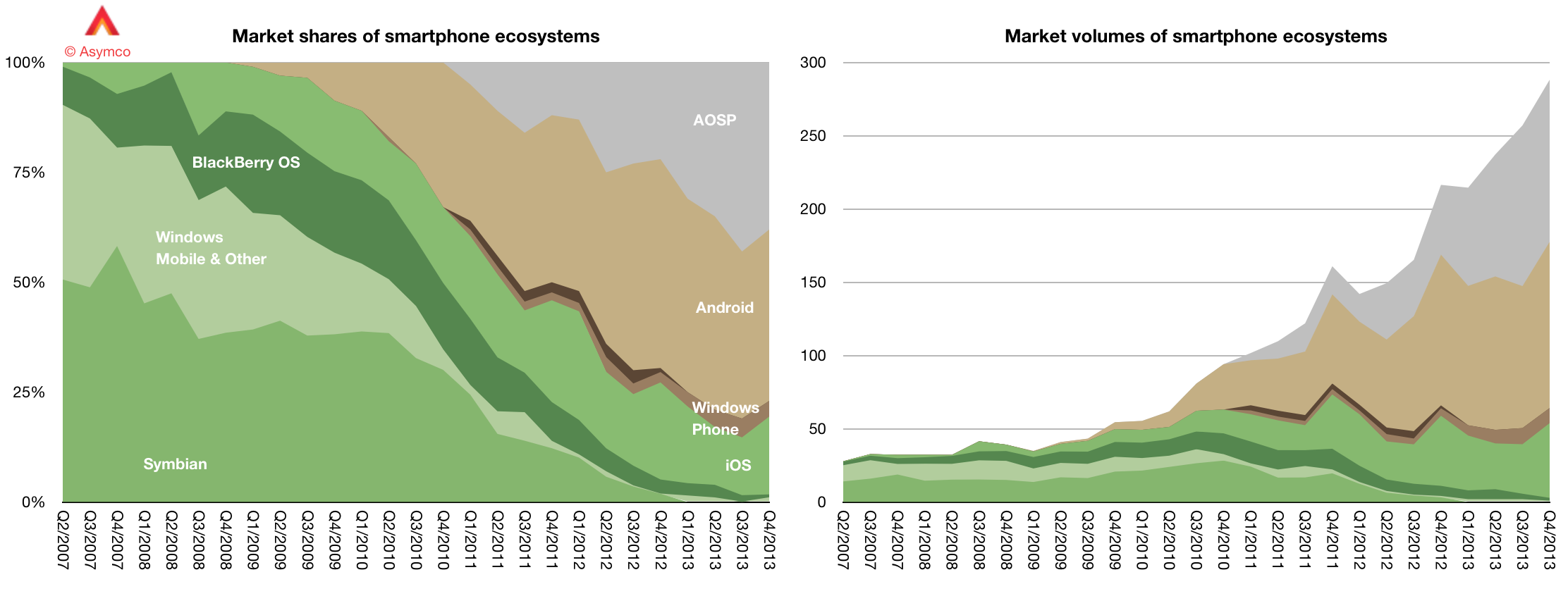
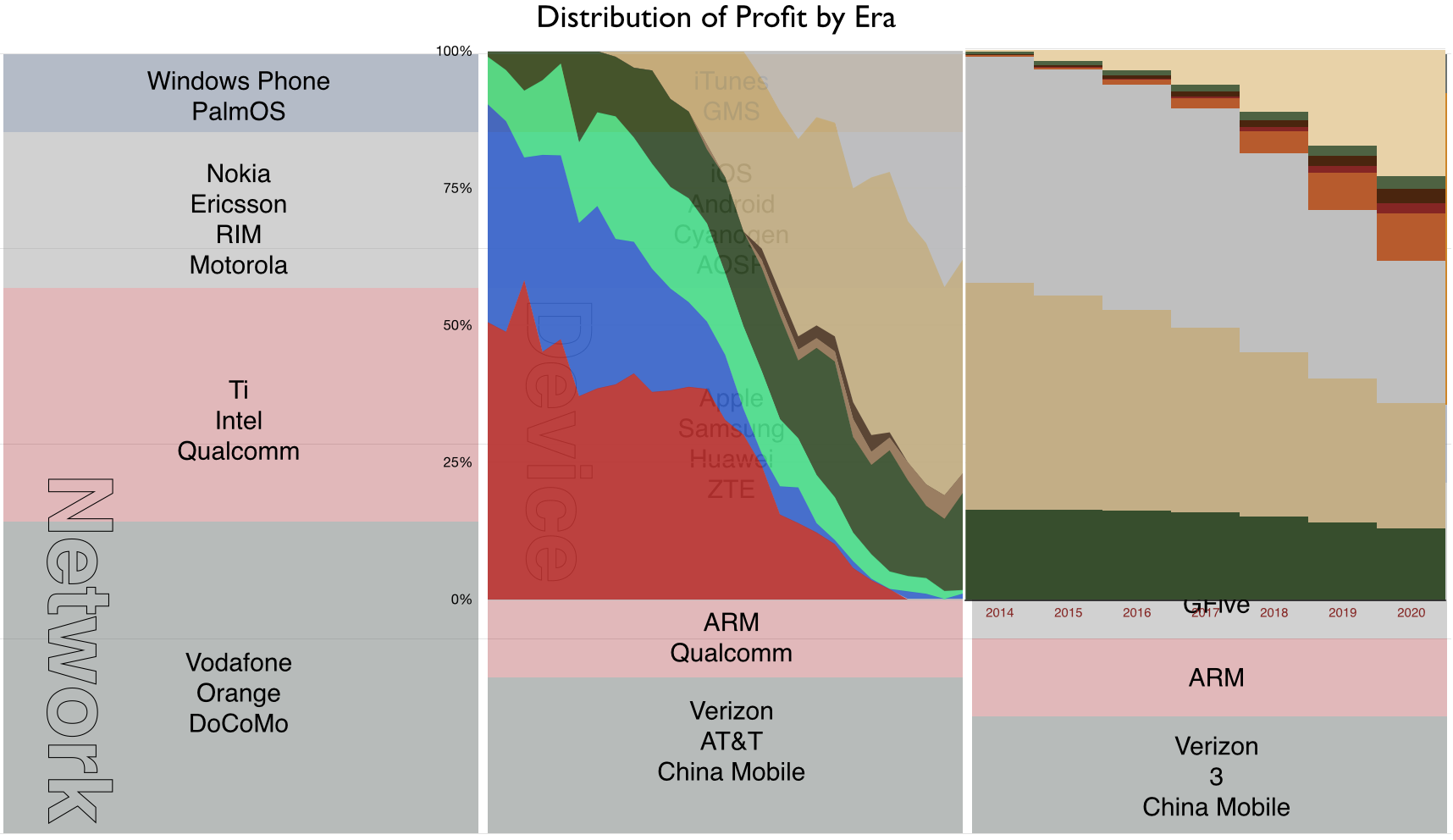
    The evidence is in this graph:

    Screen Shot 2014-04-07 at 8.32.19 AM


    As the market exploded, the incumbent platforms all but disappeared. The innovators fell into the trap of treating the complex new product as a niche whose appeal was for selected "segments" described by the coarse data they were able to gather. Ubiquity itself was asymmetric to the basis of competition they established.

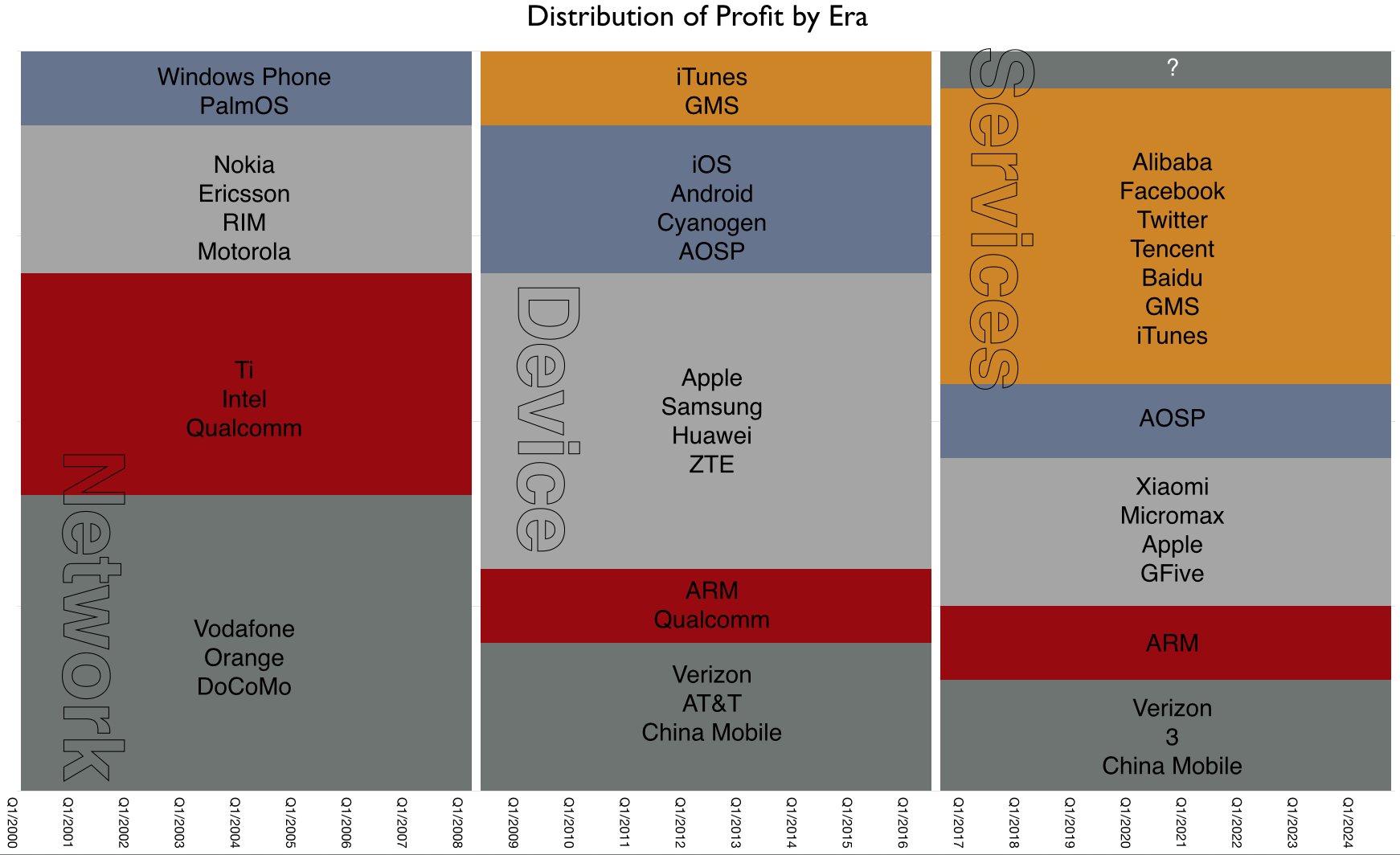
    Today we can note how even the usurpers iOS and GMS Android are being swamped by the more modular alternative AOSP. Indeed, if we squint a bit we might notice that the OS/platform churn we see is part of a trend where the value is migrating up the stack from Components and Networks, through Devices and Operating Systems and on to Services and Experiences.

    I call these the three mobile eras: (Firm names used are representative of a cohort and are not a complete list of participants.)

    Screen Shot 2014-04-07 at 8.51.45 AM

    The thesis is based on Value Chain Evolution Theory which states that disruptions cause profits to evaporate from commoditized segments and condense in adjacent spaces, usually toward more modular, more convenient or lower cost innovations.

    Note that the eras have specific time spans. If the pattern holds then we can overlay the time frame of smartphone penetration on these eras and even plot ecosystem entrants.

    Screen Shot 2014-04-07 at 9.06.55 AM


    Disruption suggests that we are likely to see yet more shifting of fortunes. It means enabling new ecosystems to take advantage of the modularization of platforms. But how can it happen given the entrenched nature of the incumbent duopolists?

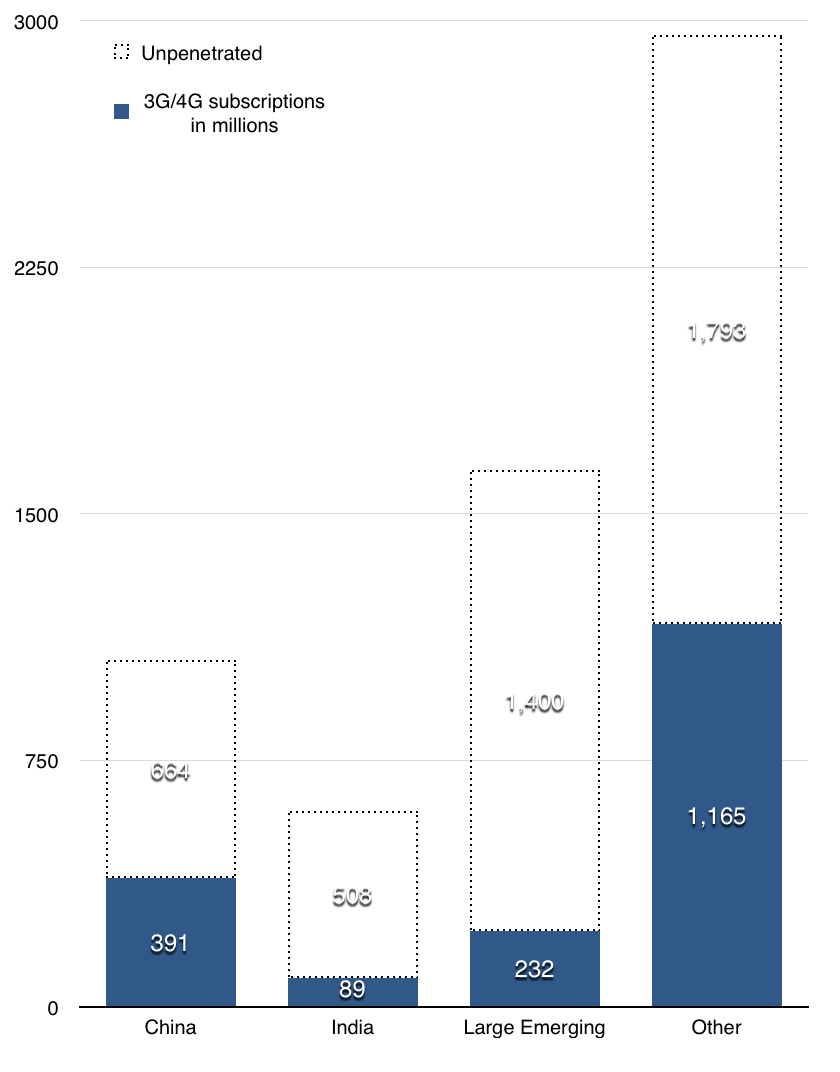
    The clue lies in the first graph in this post: It suggests a geographic segmentation. The largest markets are large enough to sustain independent ecosystems. Note that China and Russia have already established alternative local service ecosystems. We may dismiss the possibility of localized Google and Facebooks in emerging markets but China and India are universes in and of themselves. But there are another 10 markets of more than 100 million users. That's another billion users among them.

    Screen Shot 2014-04-07 at 9.31.22 AM

    But it's not just the availability of a vast pool of new users. The rapidity of growth of services like WhatsApp and SnapChat and Tencent shows that barriers to entry are low. We see increasing indigenous innovation in payments, logistics and business models in the newest markets. We see no shortage of talent and capital to start these businesses. We see increasing language and culture clustering in social media. We see political resistance to hegemony.

    Focusing on the established, highly penetrated markets as an indicator of opportunity would be a mistake. Those markets foretell the rate of adoption but not the evolution of the value chain. Apple and Google will continue to anchor in those markets but there is no reason for the remaining two thirds of the world to follow. Indeed, there are incentives not to.

    Incentives exist to localize services. Indeed, service businesses have always been local businesses. There are few global service brands. This has been true in retail, transportation, banking, hospitality, media and communications. Why should we believe that ecosystems can overcome the advantages of localization? Services are local because they are delivered by individuals and have high "touch" with the user.

    Fundamentally, ecosystems are social systems and social systems have cultural and political dependencies. ((Post-modernism is a typological world view which  sees truth as socially constructed and a rejection of 'totality')) Technology does not homogenize unless it is centrally controlled. The control of mobile computing has already been abdicated by its creators.