The biggest surprise of the MacBook Neo
Research #market share · 2 comments
Remembering the PC market
Almost 10 years ago I said "Managing the Mac product line must be one of the most challenging problems at Apple. That may not be obvious given the product’s success." I pointed out that although the company grew the Mac into a redeemed and prosperous platform, "The big change in computing has not been a growing Mac vs. declining PC. It has been a huge surge in mobile device use vs. a decline in PC use overall."
It's time to revisit this observation.
First, a status update:
- The Mac is in its 32 42nd year of market presence. A longevity that is (still) unmatched by any other PC maker.
- Apple reached a top five four position in the ranking of PC vendors. This was achieved far along in the evolution of the market.
- With about $23 $33 billion in revenues per year, Apple places among the top four three PC vendors in terms of revenue.
- With an estimated $5.5 $13.8 billion in operating margin Apple is the most profitable PC vendor, capturing over 60% of the available PC hardware profits.
- The product has retained an average selling price of over $1200 ($1400 last year) for at least a decade. At the same time the average pricing of Personal Computers has more than halved.
- Volumes increased by about 20% over a decade.
The overall picture of the market is shown the following graphs. First, the overall quarterly shipments.
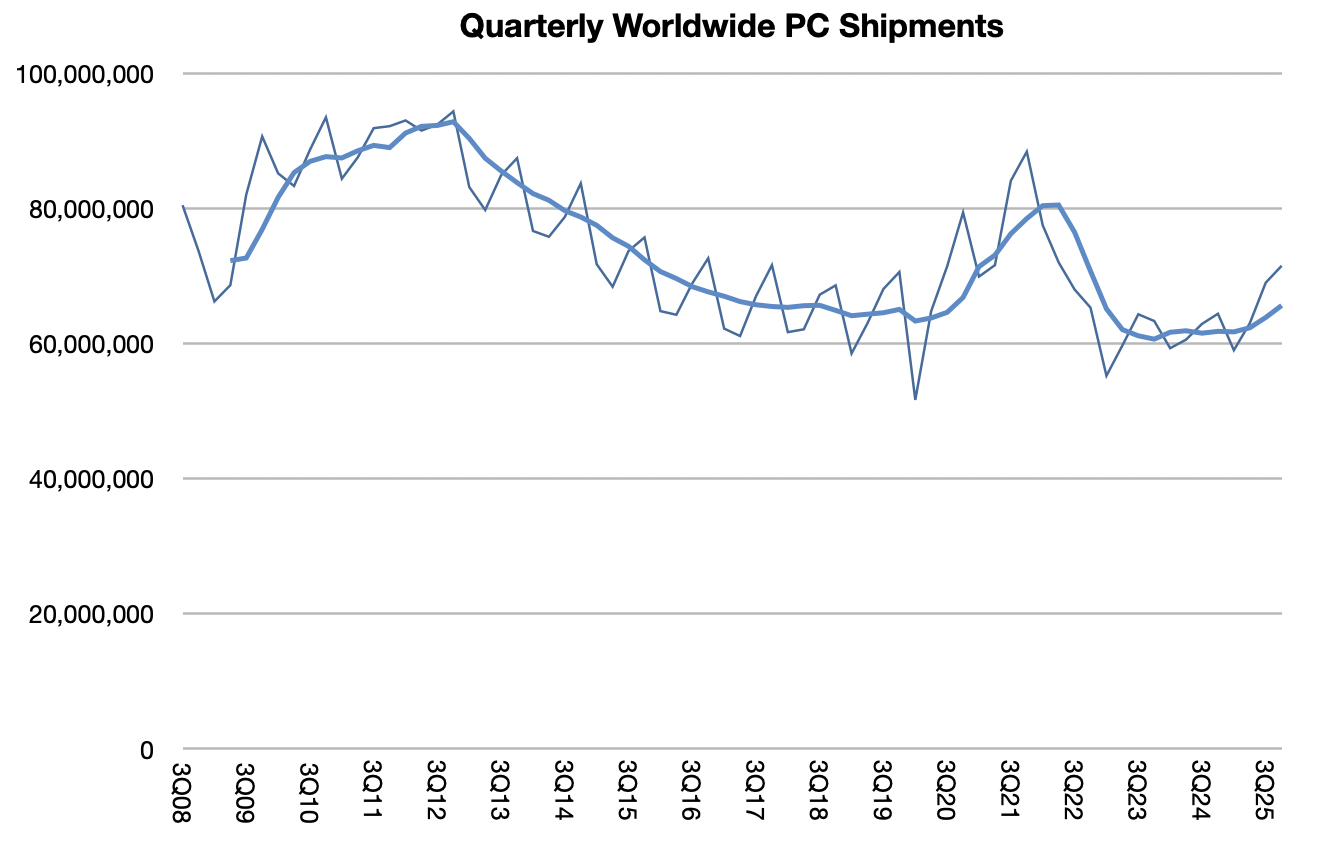
Note the Covid-era surge during 2020 and 2021 but overall decline from peak in 2012. Yearly shipments were 262 million in 2025 vs. 371 million in 2012. The install base of users is largely unchanged. Microsoft has cited "over 1 billion" to 1.4 billion monthly active devices, with figures varying between official statements. My estimate has been 1.2 billion PC users with an additional 250 million Mac users, more about this later.
The shipments data provided by Gartner over the last 17 years is shown below:
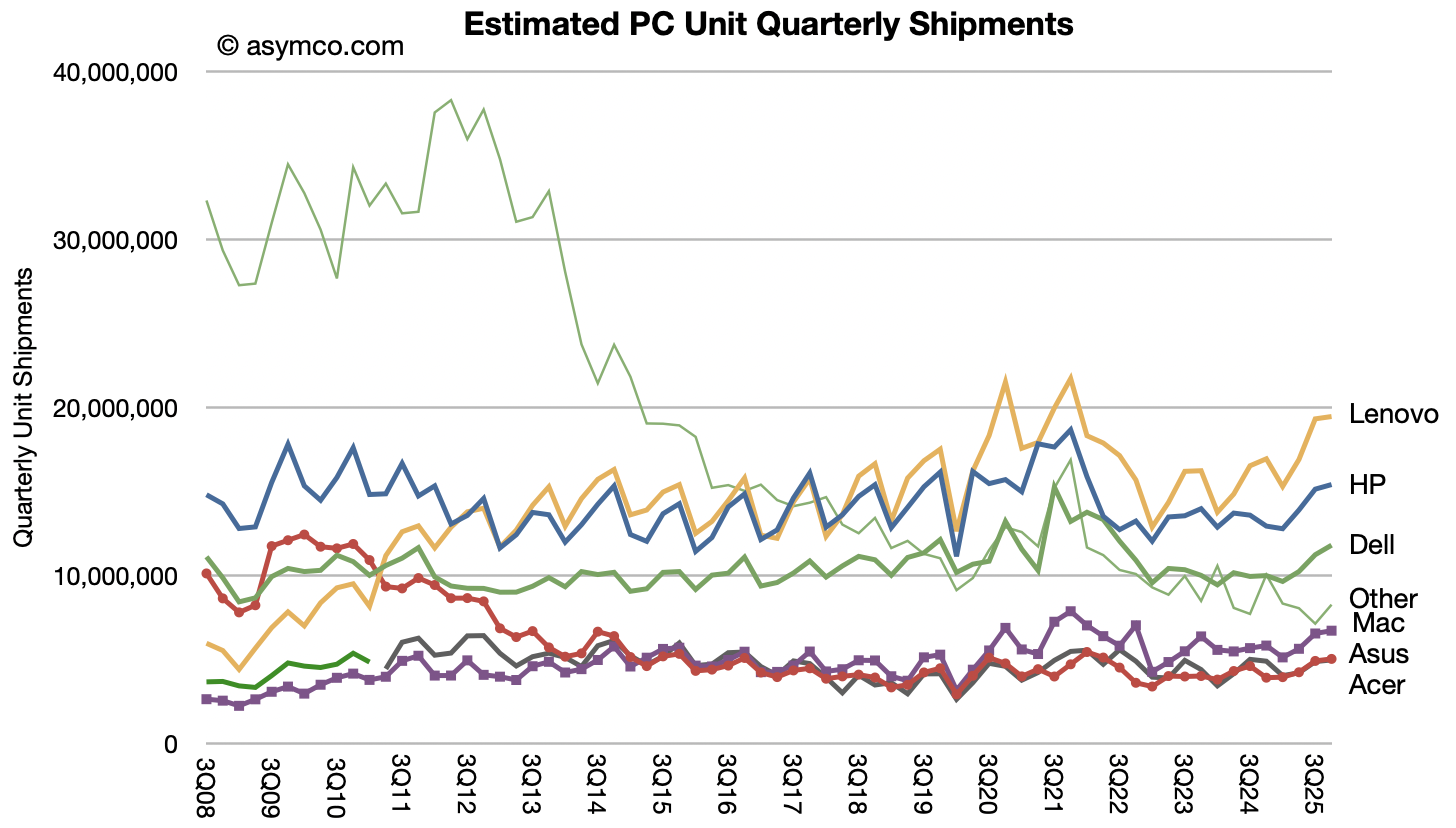
Notable are the declines in "other" vendors and the gains from Lenovo and Apple. Broadly speaking, "other" are assumed to be mostly consumer markets and that has either declined or been captured by Mac with consolidation around Lenovo. Lenovo, HP, Dell are likely to maintain enterprise accounts serving large customers and that has been a steady but low margin business for decades.
Mac has grown to fourth place but still a way to go to third place Dell. Apple may overtake "other" combined in a year or two.
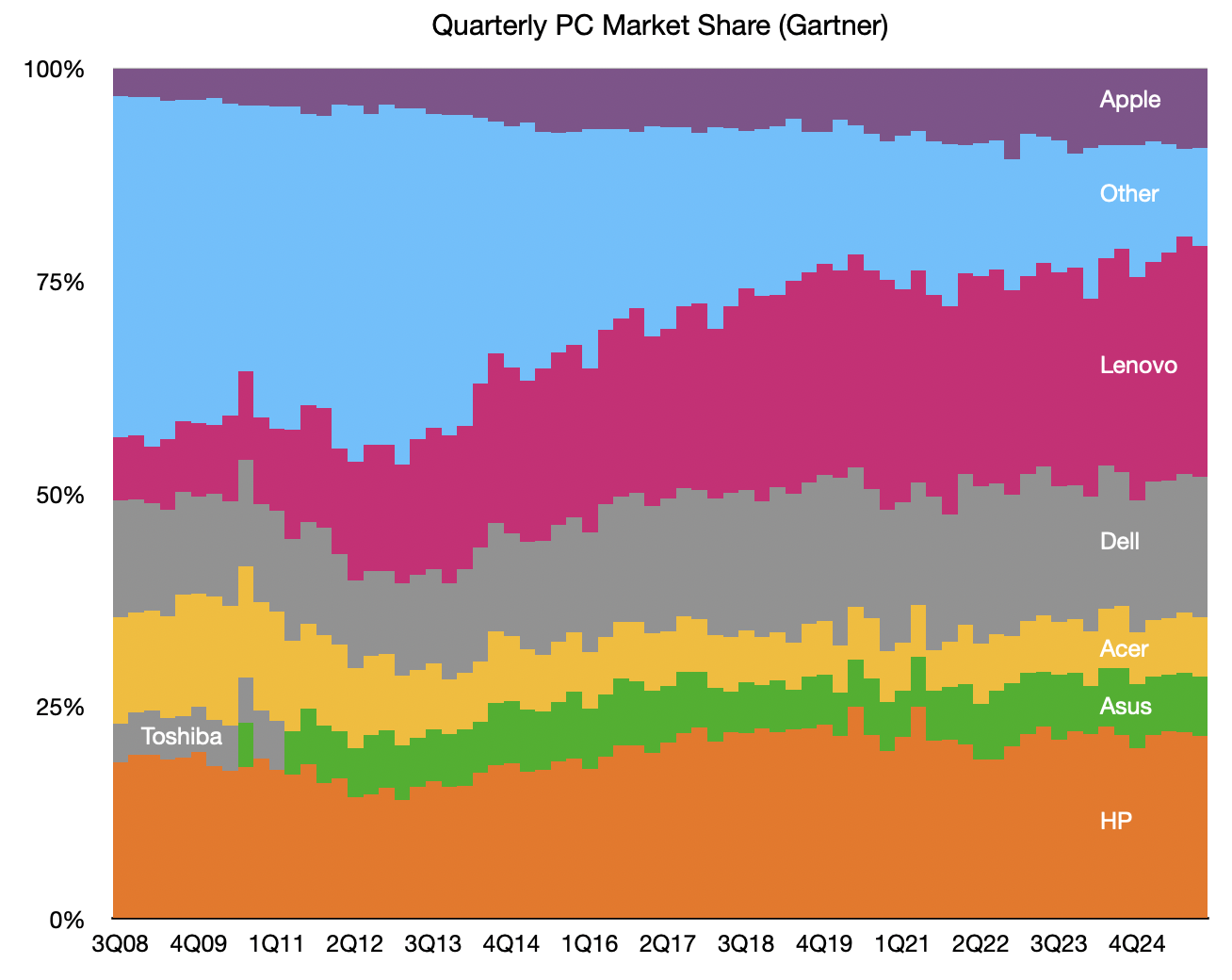
The market share data shows how "other" has been squeezed between Lenovo and Apple while the other players have largely held steady. Acer and Asus somehow managed to survive.
So what does this mean for the future? What is Apple's strategy with the MacBook Neo. Or for that matter, for Studio and iMac and Mac Mini and MacBook Air and MacBook Pro?
The Neo was such a surprise for many given its incredible price/performance ratio and the overall quality and affordability (and distribution potential). I've read many reviews suggesting it will "disrupt" the market and that Windows PCs are just no longer competitive.
Will the MacBook Neo move the needle? Will it take share from the Windows world (or for that matter from the Chromebook and even iPad?)
I have no doubt the Neo will do very well indeed. It's an extraordinary product with immense appeal--I want one even if I am well served with Macs already. It will also be profitable. Even at the lower price point, the use of an A-series processor and memory and packaging which are very economical and iPhone manufacturing knowhow and scale means that it will probably sell in the 10s of millions.
But it's not likely to be hundreds of millions. The problem ultimately is that the MacBook New is still a traditional computer and phones outsell them 10 to 1.
What is more important is that the MacBook Neo will increase the audience or the user base for MacOS and ultimately resonate inside the Apple ecosystem, building momentum for other devices, wearables, home and services.
Let's go back to that total user number. The PC market, with 262 million units per year serves about 1.4 to 1.5 billion users. Of these Apple has about 250 million. Now consider this: Tim Cook has repeatedly said when he talks about the Mac on the earnings calls that "the Mac install base reached another all-time high, with nearly half of the customers who purchased a Mac being new to the product".
If we go back in the last 17 years, if half of the customers each quarter were "new to the product" then 167 million users were "new to the product". Let's be conservative and say 160 million net new users. That would have to be added to an existing install base of about 100 million before 2008 (which is before the iPhone era).
That implies that Apple has about 260 million Mac users and Windows has a base of about 1.2 billion. Total is 1.46 billion and Apple's share is about 18%.
The real target for the MacBook Neo would therefore be to increase this base and share. I doubt that it will grow the overall user base, but moving users to the Mac is very plausible.
So here is a target for the Neo: Grow Mac user base to 300 million and 20% global PC user share.
Not a stretch perhaps but not a "disruption" either. The real disruption already happened. It's in the fact that there are more iPhone users than all PC users, with Windows and Mac combined.
One more thing: Apple's sales of about 24 million Macs for a base of 260 million users implies a life span for Macs of nearly 11 years. However, all the other PCs sold add up to 238 million for a user base of 1.2 billion. That means the life span for the non-Mac PC is only 5 years.
This is, of course, reflected in the price difference but with the MacBook Neo, the potential for a 10 year old life for a $500 laptop puts the Neo price at $50/yr or 14c/day. Based on data for 2025, the average selling price of a new Windows PC is estimated to be $600 to $900 for consumer models. At $700 for a life span of 5 years makes the PC cost $140/yr or 38c/day.
This means that the average PC is more than twice the cost of the MacBook Neo. Now that is a surprise.