More than 400 000 new developers in past 12 months; 92 developers each top 1 million download mark; 1.5 million downloads of Qt software development toolkits
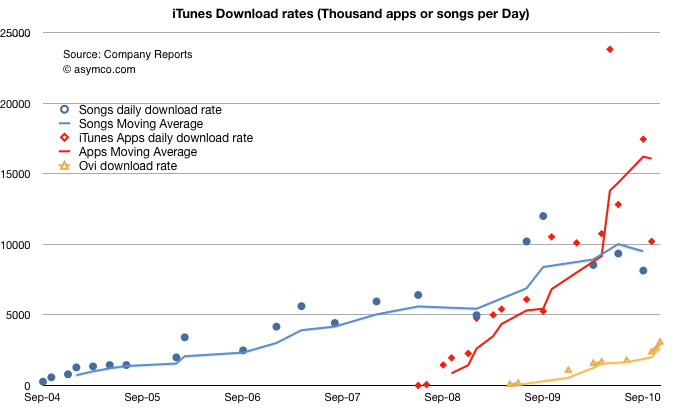
See the following chart comparing Ovi with iTunes Music and iTunes Apps download rates.
The last data point we have for iTunes App downloads was from October 18th when 7 billion total downloads were announced. The last update was around Sept 1st when 6.5 billion were announced. That comes out to about 10.6 million downloads per day. The previous interval suggested about 17.6 million/day.
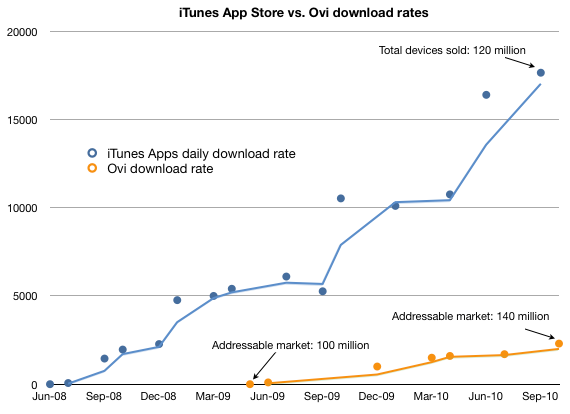
With the number of active Nokia service users now reaching 140 million worldwide, the company today announced that more than 200,000 people are currently signing up daily to Ovi, and that Ovi Store has reached the milestone of 2.3 million downloads per day. Available in more than 190 countries,
Nokia updated its tally of download rates so we can put the numbers side-by-side with Apple's iTunes.
The slope of the Ovi curve does not yet compel one to get excited over the platform's prospects in the near term. However to get a true picture, one needs to not only look at absolute download numbers but also the probability of any one user or device being used to download an app.
For this we need to note how the number of devices relates to the download rate. Apple announced recently that they sold 120 million devices running iOS. Not all those devices are still in use. If we remove 20 million from that total we get approximately 100 million iOS devices. Nokia, on the other hand, specified exactly how many devices can access the Ovi store: 140 million.
Therefore 100 million iOS devices download at a rate of 17.7 million per day while 140 million Symbian devices download at the rate of 2.3 million per day.
That puts the weekly download rate per device at 1.24 for iOS users vs. 0.12 apps (or whatever is the appropriate content item for Ovi) every week for Symbian users.
As the table below details, the rate of downloads per device for iOS is more than 10x higher. This is the more interesting number if you are a developer.
If someone can point me to Android Market download rate (historic and/or current) I can add it to the mix.
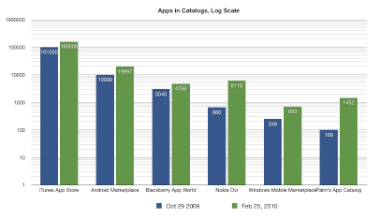
The last four months have seen tremendous app growth. Apple grew by 59k apps while Android added nearly 10k and Nokia added 5.5k apps to Ovi.
As a percent, Palm grew the fastest with 1,352%, followed by Ovi with 827%. The slowest growing was actually Blackberry App World with a mere 56% growth.
More curious is the popularity of certain categories. Games and Books are dominant in the App Store, while Personalization and Music account for more than half of Ovi (ringtones and wallpapers?)
Finally, in terms of catalog ranking overall, Ovi climbed the league table to third spot behind Apple and Android and overtaking Blackberry App World. Palm overtook Windows Mobile Marketplace which is now dead last with 693 apps.