Asymco

Asymmetric Intelligence

Theory

  1. The App Revolution (in Filmmaking)

    Research · 20 comments

    The following article is published in Filmmaker Magazine. Fall 2012, Vol. 21 #1.

    There is a saying I once heard: "Once you change the method of distribution, the product has to change."

    This itself is a take on the idea that distribution defines the product. You see this around you every day in the products you buy. Cars are influenced by the dealership networks that sell them. Phones by the mobile network operators and the choice of computer you use at work by whatever the IT department or value added reseller prefers to work with. Mass market restaurants offer what can be sold by wholesalers--typically frozen, long shelf-life staples. Almost every product category is shaped more by what can be distributed than what can be produced. That's simply because in mature economies distribution is harder than production. In consumer products it requires access to wholesalers who then require access to shops who themselves have access to prime real estate which attracts foot traffic. Production only requires capital. Distribution requires relationships, often exclusive ones.

    This pattern is even more pronounced when looking at media products. Production is arguably easier since it's constrained by talent, which is fungible. But distribution is even harder as it is addressing bigger audiences in shorter time frames. You see this lopsided balance of power in the abundance of books being written relative to those being published. There are thousands of films produced and hundreds get distributed.

    But the saying suggests that if distribution were to change then the product itself would change. Indeed, if you can sell ebooks direct, then they tend to evolve into new genres (e.g. Fifty Shades of Grey). If you can sell cheap adult video online it tends to evolve into new genres as well (I'll leave examples to the imagination.) YouTube videos quickly cluster around "Fail" or "Win" compilations which evolved from America's Funniest Home Videos. They get millions of views. Even before the Internet, the availability of cable created the genre of music video, which created the first music broadcast alternative to radio. And of course, cinema itself redefined theater once it could get shown to millions rather than thousands. The new methods of distribution of media affected what gets produced rather than the other way around. Consider the converse: innovative filmmakers who try new storytelling methods are stymied by a lack of acceptance by existing distributors and find their material languishing in festivals or perpetual cult status.

    So we can re-state the saying to a new "Law of new media": Once you change the method of distribution, the medium itself has to change.

    I gave examples of how Internet distribution changed some media formats. However, the Internet itself has not had any effect on long-form cinema so far. In fact, you would be able to tell if Internet distribution did work by watching if the product would change. So far, it seems, at least to me, that the commercially successful product has not changed. One reason has been that film is still a very difficult product to distribute digitally as most of the world does not have the capacity to buy, consume and enjoy films digitally. Another is that the current distributors have had an allergic reaction to the option. As existing products have been crammed into the new distribution chain (e.g. Netflix) the established distributors are experiencing channel conflict and are raising the costs of digital distribution rights. Netflix has seen its costs triple as it ate into Cable market share. Fundamentally, the incumbent distributors are reluctant to open a channel of distribution which conflicts with or reduces margins of the existing channels.

    This brings up another corollary: fundamentally, you can’t move an existing media to a new network. You have to think of it as a deeply rooted-in system, and it's just not going to like moving to another environment. You have to uproot this huge tree, and it just won’t come out and if it did it will not take root in a new place.

    The only way to create this new value network around new distribution is to plant a new tree.

    This is the problem for the technology industry today. The only way technology companies can solve the “content is king” dilemma (which, by the way, is an euphemism for "Hollywood is king and Silicon Valley isn't"), is by allowing new content to flourish on top of new platforms. It’s not about moving the old content to the new platform. It’s about allowing new content to be created exclusively on the new platforms. This new content will therefore, by our law, be a new medium.

    For me, apps are that new medium. Apps offered a new way to package entertainment for “niche time”. The early fart apps evolved into a whole new genre of games which are now challenging the established game studios. The result is that a generation of developers has moved from building PC or web software to apps with cloud back-ends. The first to switch to this new medium were those with the least to lose and with the most modest of goals. Apps have now a more valuable industry than digital music with over 55 billion installs between the iPhone and Android ecosystems. Consumers are increasingly spending their spare time in front of apps. In the US “app consumption” increased from 43 min/day in 2010 to 94 min/day at the end of 2011. This number already exceeds the time spent in web consumption. I find it difficult to doubt that app time will exceed TV time, especially as TV time is increasingly a dual screen experience.

    (Feels like it needs one sentence explaining why. Is it because of their accessibility to small developers, or their ability to reach mobile handsets natively, or because of consumer trend?) If it’s absolutely impossible to move long-form video or long-form cinema to this new medium in such a way that everyone in the world can consume it on every device, then the app ecosystems will take up that challenge and say, “There’s a job to be done, and that’s to enertain people for an hour-and-a-half with characters, plots and wonderful stories, and we will make that happen, and we’ll call this thing an app.”

    And that app will solve that job for that person. It's what's happening to the game console business. The new game apps are distributed differently, priced differently and produced differently. As a result they are used differently and make a different set of developers thrive.

    The new app media will mean that we’ll just have to live in app universes, and go eat popcorn somewhere else. Microsoft and Google and Apple and Amazon and anybody else whose belly is at the bar has been scratching their heads wondering "How do we move that content over to us?" They've been barking up the wrong tree. The fundamental question isn't how to cram old media into a new shiny screen. It is how do you let developers and artists and creative people create stuff that is new and compatible with this new way of living.

    Think also about the history of media -- movies haven't been around forever; music hasn't existed as a recorded medium forever. Not even books. What did people do before these forms of expression? We think of the use cases of going to the movies, or the use cases of sitting in front of a TV on Sunday night, or playing a console game. These things didn’t get done at some point in time. Nor will they be done at some future point in time.

    In a few years we’ll move on and we won’t do those things. Each person will probably have his own screen in front of them--many already do--and whatever we do together we’ll do through a shared screen. We won’t have communal experiences that we associate with the old media. Certainly not in a theater. Maybe not even in a living room. And that is how we will move into a new value network.

    It is inevitable. As a technology provider, you shouldn’t try to squeeze a 19th-century model into a 21st-century model. Just let it go. Create a platform and give people the freedom to create on it. As a media creator, you should try to learn what the new model demands. New forms of interaction, new story telling opportunities, new ways to communicate with audiences. Create experiments and learn. It's the only way.
  2. The omnivorous app

    Research · 62 comments

    Marc Andreessen famously coined the phrase "software is eating the world." It's an apt observation. If you look back on the history of computing you're likely to measure computers sold or devices sold or users harvested or productivity gained. These things are measured because they can be measured. But the greatest cause of value created and captured has been the development of software. An ephemeral product whose value is often ignored in analytical discourse.

    Software is not easily measured and it's not easily valued due to its intractable nature. Firstly, because businesses that make software tend to have weird cost structures--absurdly high fixed costs and operating margins: They operate without income for years and then suddenly are massively profitable with a minimal set of resources. They have a non-linear, "big bang" trajectory.

    Secondly, software companies tend to capture revenues from something other than the direct sale of the good. Software is rarely sold. Services sometimes are sold on the basis of software but more likely audiences for services are sold to a set of bidders, or revenue is obtained in even more circuitous ways.

    Thirdly, because there are curious multi-sided markets for software platforms. Charlie Kindel hints strongly at how difficult it is to understand the dynamics of software platforms. There is the prospect of lock-in of users and data. There are relationships to nurture with developers and there's the principle of an ecosystem that creates network effects. The virtuous/vicious cycles are non-linear and unpredictable even for the experts who have been at it for decades (e.g. Microsoft).

    Given these difficulties, software is seldom seen as the core value proposition for a particular business. But make no mistake about it, Apple, Google, Microsoft, Facebook and Amazon are all software companies. They "monetize" or integrate software differently but software is causal to their profits. Their use of software has also made them all disruptive. Software enabled the disruption of consumer electronics, retail, computers, advertising and broadcast media.

    But we have not seen anything yet. There is another class of software that is poised to lay waste to a new set of industries. The lowly app coupled with cloud-based services[1] is the termite that is set to eat the foundations of the largest of the industries still standing.

    Consider the following:

    • Games. A software industry in itself, the app versions are attracting non-consumers and eventually will get good enough to absorb all  usage and profits. Games merged with "entertainment" concepts will lead to new models of user recreation leading to new global brands that could challenge even Disney.
    • TV. As apps come to the big screen TV will never be the same. Not only will show creators build directly for an audience but advertisers that currently sponsor shows will produce them instead and package the result as an app.
    • Shopping/dining/entertainment/hospitality are changing with location services and with novel "bits to bricks" purchase options (e.g. PassBook). Increasingly services will exploit handheld devices to enable product discovery--the main job retailers are tasked with.
    • Communications. The observation that "phone" is just an app and that messaging can be done in dozens of ways depending on message, relationship, context or even custom is possible because apps conform to the user's needs rather than the user conforming to the tools they get from the network service provider.

    Although these are enormous opportunities in themselves, this is in addition to several industries that are already crumbling (photography, book publishing, to name two).

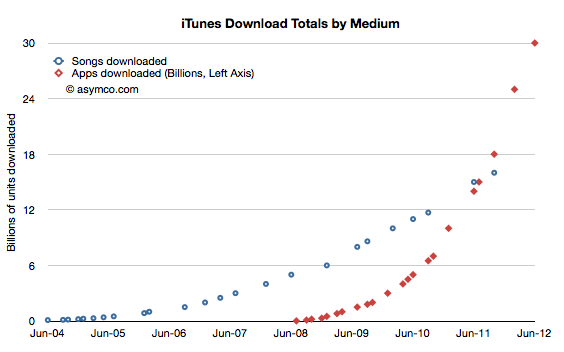
    I don't need to rely on prose alone to make the point. A graph can also lend a hand.

    Consider that Apple's App Store and Google Play together have had over 50 billion installs in less than four years and that the number of users of apps is at least 750 million. Furthermore, consider that apps have moved from a smartphone phenomenon to tablets and even PCs using OS X or Windows. Within one year these software capsules are going to be in use by one fourth of the global population.

    Nothing has this kind of reach or engagement, not even browsers. What makes the app disruptive, even ahead of a browser-based service, is that it includes incentives for developers (or, more precisely, app producers) to get paid and to have a relationship with the buyer. These two value propositions, in isolation or in combination, are available to millions and consumable by billions. The most democratized market that can be imagined. An unbounded set of producers and an unbounded set of consumers and a persistent connection after the purchase with nothing in between them except a payment mechanism

    The world has never seen such an opportunity.

    The consequences are unforeseeable. Apps are a form of software that goes beyond its ancestral "application" as a product and as a business model. It's the software that will take in and assimilate everything in sight.

    ---

    Notes:

    1. I have a simple rule to distinguish between an app and a service. If you have to supply a username and password to an app, it's a service.
  3. Reverting to the mean

    Research · 40 comments

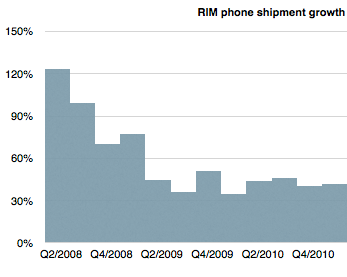
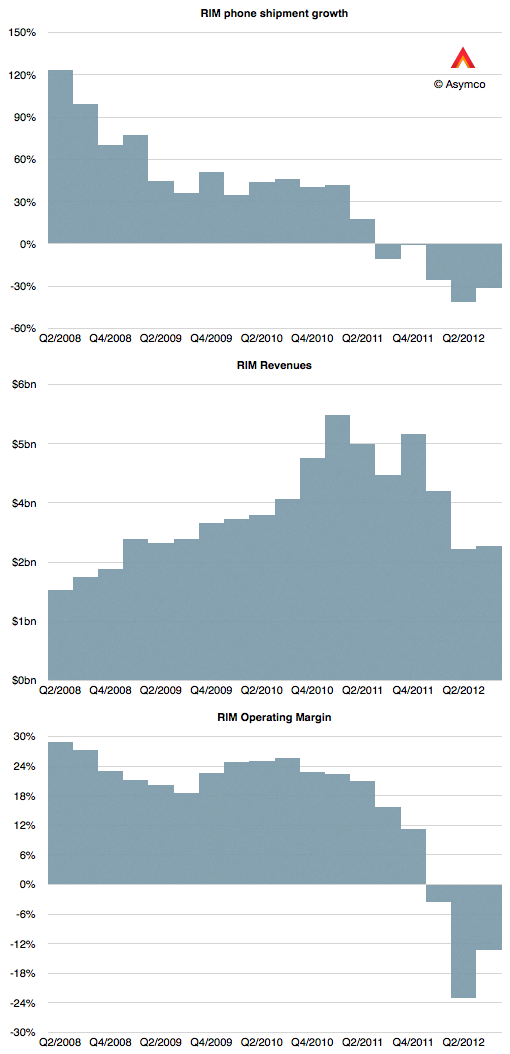
    Quarterly financial data is often a lagging indicator of strategic success. RIM's vital signs were exceptionally strong up until early 2011. Consider the following graph showing RIM's device growth.

    Using language commonly heard among analysts, one would say that the company was "reverting to the mean" and growing nearly in-line with the market. In other words, exceptional growth was over but continuing growth was likely. The company was returning to something "normal."

    However, keen observers of the market would have been hard pressed to find any reason for justifying that performance. Seen through a disruptive lens, it was evident as early as 2008 that RIM's strategy was not sustainable. The company had a very weak smartphone product relative to emergent iOS and Android ecosystems. And yet, the company continued to prosper for nearly three years, through 2008, 2009 and 2010. Those shorting the stock during this period would have been unrewarded.

    But then in early 2011 it fell off a cliff.

    There was no reversion to the mean but an acceleration toward oblivion. The share price dropped to book value or below liquidation.

    This pattern was very similar for Nokia. It too looked fairly strong on paper until early 2011 when it found it necessary to fling itself off a platform.

    This pattern of disproportionate decline is a mirror image of the disproportionate ascent of Apple.

    It might sound like a spectacular story; an anomaly, a once-in-a-lifetime reversal of fortunes. However, the moral of this story is that this is not an exceptional phenomenon. Disruption happens. It happens quickly and perhaps most quickly in this industry, and looking at trailing indicators like revenues and profits is of no help. I've only witnessed sharp expansions and sharp declines. I've never witnessed steady state, quiescent markets in technology. The history of platforms is always virtuous cycles followed by vicious declines. Whatever amplifies success seems to also amplify failure.

    Rather than assuming that businesses are in a state of average growth or in some anomalous state above or below that average (from which they'll recover) we need to think of them being either growing or failing. Going straight up or straight down.

    If this is the case, how can anyone expect to manage this? Orthodox management theory assumes continuity but the world seems discontinuous.

    In a discontinuous framework it's important to look for unfair, unsustainable advantages that can be capitalized. Once exploited the advantage often disappears. The victim assumes it becomes sustainable. The survivor looks for another advantage. Resting is not an option and the mean is only an illusion.

  4. Is the iPhone good enough?

    Research · 172 comments

    We don't want to just make a new phone. We want to make a much better phone.

    - Jony Ive, video at iPhone 5 launch event

    Disruption theory has taught us that the greatest danger facing a company is making a product better than it needs to be. There are numerous incentives for making products better but few incentives to re-directing improvements away from the prevailing basis of competition.

    This danger is more acute for technology companies. Coupling incentives with the speed of improvement in various technologies (aka Moore's law) means that over-service can come suddenly and more quickly than warnings from the marketplace. A product can tip from under- to over-shooting the market within one product cycle. One year the product is under-performing and trying to catch up to the competition and the next it's superfluous and commoditized. The dilemma is compounded by the cycle time of development which can span multiple product cycles.

    Therefore, how to tell whether a product is over-serving a market is one of the most important and frequently asked questions I get asked. It's easy to see over-service in the rear view mirror when looking at a multi-year pattern. The trouble is that by the time you see the data, it's too late. How do you tell you're on the cusp of good enough, subject to imminent disruption before you get there?

    I consider measuring a product's absorbability to be a marketing problem. The marketer's job is to read the signals from the market[1]. Determining absorbability comes down to reading two market signals, both of which must be met before green-lighting an improvement:  (a) a product's improvements must be used and (b) a product's improvements must be valued.

    If a product's improvements are not used and the buyer will not pay more for them then they are not being absorbed and the effort to develop the improvements should be redirected.

    Now the problem becomes one of measurement. Of the two, utilization is easier. Data can be gathered on whether a feature is being used. Research methods exist to tell if a feature would be used even if it's not available[2]

    The more difficult assessment is that of the value of a feature. You can usually only tell value by trying to price it and watching what happens. For example, you add more speed/memory/capacity and try charging more (or the same) for the product. The acceptance will be measured by sales growth and will give you an indication of whether these improvements are valuable.

    If you have to add features and drop prices at the same time then it's likely that the market does not value the improvement.

    But this is extremely risky. You need to wait through a sales cycle and iterate through a development cycle before you have an answer. In a space where competitors are placing opposite bets, the experiment fails even if you get the data.

    How can you structure a value measurement experiment without wasting an opportunity?

    Rather than dealing with hypotheticals, let's use the iPhone as a test case. As Jony Ive states, the focus for the latest iPhone was to make it better. Is this improvement absorbable? What happens if Apple's bet on being better is wrong?

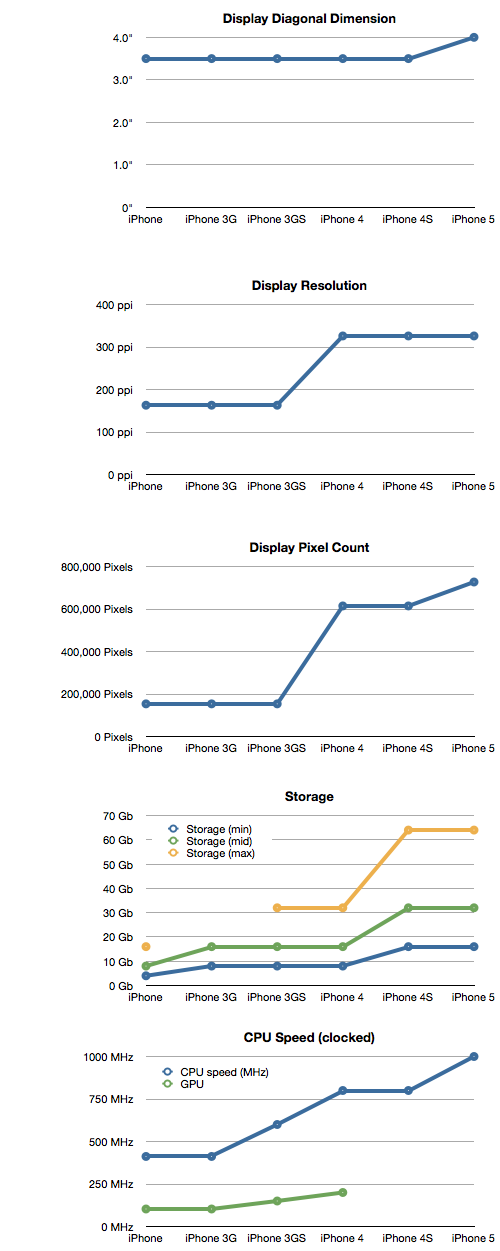
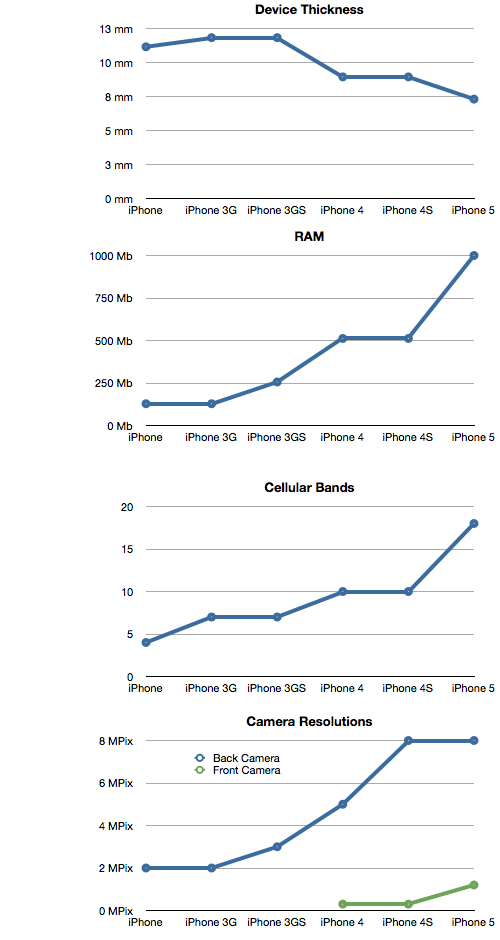
    First, we can confirm that the iPhone has been on a trajectory of getting better and that those improvements have been absorbed so far. We can measure the history of performance of the product (roughly doubling every year) and we can also measure proxies for performance as I have in the following charts:

    As the product has been improved along these dimensions, sales have increased and prices have held steady (even rising occasionally.)

    The question is about the future: what about the latest "5" variant?

    The clue to this experiment is the presence of a control group.  We could test the question of absorbability by keeping a version of the product which did not improve (or got cheaper) and measuring whether it performs better vs. the "improved" version.

    Of course, this is exactly what Apple does with the n-1 generation products. By ranging products which are older and at lower price points it can measure whether the improvements are valued.

    If sales of the n-1 variant were to increase relative to the new version then they can understand when they are at the point of good enough. The experiment is brilliant because the margin on the older products is maintained even at the lower price point.

    We don't have public data on the performance of the old vs. the new but some studies show that, at least in some markets, the older variants have, so far, been a minor part of the sales mix. The CIRP study from early this year showed that about 90% of holiday iPhone sales in the US we for the latest (4S) variant. If this pattern persists globally and for the 5 then the improvements can be said to be valued.

    If the new features (as represented by the metrics charted above) also get broad engagement--data which Apple can easily obtain--then the iPhone 5 can be declared not good enough. The company can then comfortably work on improving it further.

    ---

    1. Note that the marketer's job is to listen not to talk.
    2. e.g. contextual inquiry.
  5. 5

    Research · 59 comments

    It looks like the next iPhone will be called the iPhone 5. What's in a name? As it turns out, quite a lot.

    Every hardware product that Apple has released has had a brand and a sub-brand. Macs for example use the Mac brand and a sub-brand as follows:

    • iMac
    • Mac Pro
    • Mac mini
    • MacBook

    Thus each sub-brand imparts certain meaning to the buyer. i, Pro, mini, book are all evocative. MacBook even has its own sub-brands:

    • MacBook Pro
    • MacBook Air

    These Mac sub-sub-brands of Pro and Air are specifically designed to also distinguish and convey meaning.

    iPods as well use the iPod brand followed by a sub-brand.

    • iPod Classic
    • iPod touch
    • iPod mini
    • iPod shuffle
    • iPod nano

    Note how the mini  sub-brand was retired from the iPod line to be used exclusively in the Mac product line. That may not be specifically necessary or desirable but it is an interesting coincidence. (The Pro sub-brand is shared between different Mac lines)

    However, when we look at the iPhone and the iPad, the nomenclature has been distinctly different. Both products have been using generational naming conventions. This implies no sub-branding as the iPhone and iPad are the only identifiers of brand and hence the only meaning being imparted to the buyer. You either get an iPhone or and old iPhone.

    That changed with the iPad however. The third generation iPad became just iPad. This was deliberate (why would they want to confuse buyers?) I think there is some logic to this.

    Note the parallel to the convention of the original iPod. When the iPod launched it was just the iPod. Subsequent versions were identified by a generation, but not a specific sub-brand. After the third generation iPod (still called iPod), the mini version was launched, creating the sub-brand convention that remains in use to this day. The iPod therefore was born generational but switched to sub-branding in adolescence.

    The possibility exists, therefore, that there will be a sub-brand for the iPad. Perhaps "mini" is being reserved for a new iPad, to distinguish it from the regular iPad (no sub-brand) that is likely to remain in production. The logic is to make room for sub-brands when the core brand begins to cover a wider array of form factors, themselves proxies for separate use cases or jobs to be done.

    So what about the iPhone?

    The iPhone has remained, stubbornly, after five years, stuck with a generational naming convention vis-à-vis the sub-brand convention used in every other mature product line from Apple. (Note that software from Apple adheres strictly to a generational naming convention because there is no "room" for a sub-brand under a software brand. There can be no "iWork Pro" or "Final Cut EZ". [Update: there once was Final Cut Express])

    Prior to today I entertained the possibility that the new iPhone will follow the iPad in dropping generational naming in favor of sub-branding thus implying that the brand would develop into a portfolio of sub-brands (like the iPad seems about to.)

    Alas, that possibility now seems moot. The launch announcement seems to clearly point to "5" being the name of the new iPhone. The brand remains iPhone and there will be no sub-branding.

    This can only mean that Apple intends to preserve a single product strategy for the brand. There will be no "special" iPhone for different (e.g. low-end) markets. There will be no different form factor to accommodate different use cases. There will be no new jobs to be done for the iPhone.

    What a bummer.

    However, there may be something more curious happening. Note all the service brands being launched on the iOS platform. There's Siri, (as yet unnamed) Maps, GameCenter and PassBook. These are not Apps. These are services designed to be unique to iOS, perhaps even unique to the iPhone. The difference with the iPhone brand may not be that it spans a multitude of sub-brands in hardware but that it covers a multitude of new service brands. As brands imply meaning, the iPhone brand may imply that it's a platform in and of itself.

    Now that's an interesting development.


  6. Samsung's basis of competition

    Research · 69 comments

    Samsung has been selling smartphones for a relatively short time. Although the company sold Windows Mobile, Linux and PalmOS during the last decade, it did not gain significant volumes until it began selling Android phones in 2010 with strong operator support.

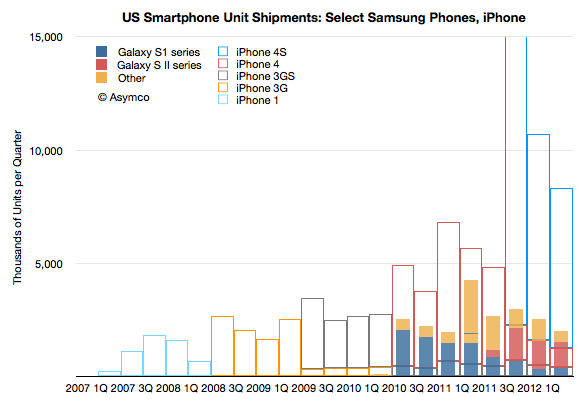
    That support was substantial in the US. The company crashed the Android party in mid 2010 with its Galaxy brand. Trial evidence reveals that the sales level for Galaxy S1 series phones burst out of the gate taking Samsung from 90k units to 2.5 million units in one quarter.

    The following graph shows the unit shipments recorded by Samsung for a set of US smartphones.

    Note that the profile of sales volume shows a cyclicality with respect to product launches. Each new generation overlaps with previous generations and "fills in" while the older generation product tails off in sales. This is standard portfolio strategy. It also shows the cycle time of launches is approximately four quarters. As the S1 was four quarters old, the SII launched and the SIII follows after four quarters of SII.

    What is surprising is that the overall sales volume is not growing. At least for the products catalogued (which exclude the Note) growth for the last four quarters has been: 5%, 34%, 31%, -53%. These are in stark contrast to the iPhone pattern shown in the outline bars behind Samsung's.

    The iPhone ramped slowly in 2007 and 2008 and has been showing remarkable generational growth.

    Perhaps it's still early and Samsung SIII product will ramp up as the contemporary iPhones do, but if it doesn't we have entertain the possibility that the iPhone does not compete along the same basis.

    What does it mean to compete on a different basis?

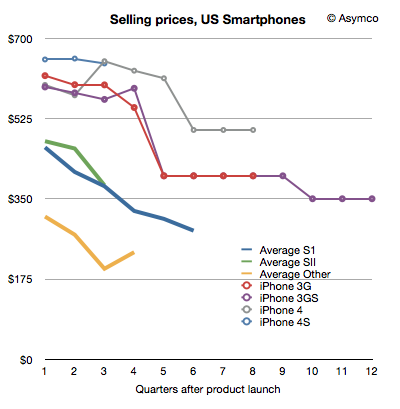
    The basis of competition is the aspect of an offering for which a customer is willing to pay a premium price. It's hard to know (or to put your finger on) what the basis actually is, but we can test whether it's the same by measuring whether two products capture prices the same way. If one product that seems to resemble another can obtain price advantage consistently, then perhaps it's being bought for a different reason.

    To test this, I produced the following chart showing the prices that Samsung's phones have been able to capture through their lifetimes; and the same for the iPhone.


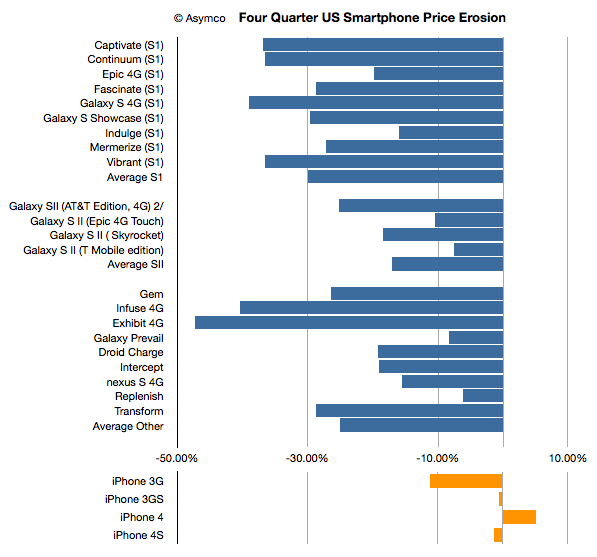
    I've narrowed the analysis to the first four quarters and summarized the price erosion across all the products as well:


    [Note: iPhone 4S, Skyrocket, T-Mobile Galaxy SII showing only three quarters]

    As mentioned, it's still early perhaps, but the pattern for the iPhone has been different.

    Samsung's pattern is not unusual. I've seen similar pattern for almost all Nokia products. Prices drop. It's a standard industry phenomenon.

    Therefore the question is not perhaps what is Samsung's basis of competition: it's the same as the overall phone industry. The question is what is the basis of competition for the iPhone.

  7. Apple Store Operational Economics

    Research · 18 comments

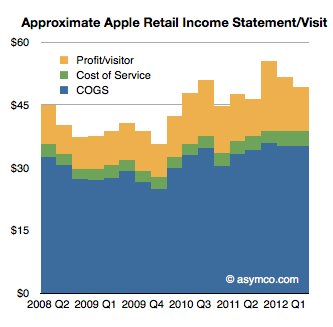
    In a footnote to my last post on Apple Retail (The face and the brand) I used data on operating performance from Apple and an assumption about employee salaries (which turned out to be low) to estimate that about 7% of Apple store sales are spent on "cost of service" or the operational expenses, which consist of mostly employee salaries.

    An updated view of this store income statement (on a per-visitor basis) is shown below:

    To summarize the logic, during the last quarter Apple received $49.2 in store revenues per visitor. Knowing the retail profit ($10.46/visitor) and knowing the time spent per visitor (14 minutes, itself derived from the number of full time equivalent employees--41,000 or 112 per store) and assuming the cost of that time in employee salaries ($15/hr including benefits), gives us an estimate of the service cost ($3.55/visitor) and therefore the cost of goods sold ($35.2/visitor).

    Now I want to focus on this ratio of service cost/sales which turns out to be about 7%[1] and ask whether this is significant or revealing.

    In order to do this we have to understand that most stores, especially electronic goods retailers, don't spend this much on salaries. They do spend quite a bit on commissions however. From a post on the subject, I gathered the following commission rates for various retailers:

    • Phone stores: $25 for activations, 10% of accessory sales
    • Beauty/handbags at department store counters: 3% to 5%
    • Shoes, appliances, electronics: 8 to 10%
    • Furniture: 2% to 6% (low rate includes salary)
    • Real estate: 2.5% to 3% (no salary)
    • Car salesmen: 30% after dealer costs

    Now 7% to 10% that Apple spends on salaries starts to make some sense, economically. It's roughly equivalent to what another retailer might spend out of their sales on the help.

    The difference is that Apple does not pay commissions and that cost is spread over a far larger headcount of staff. Roughly speaking it implies that Apple hires five times as many employees (consider how many people you might see in an Apple store where the average is 112 and in a similarly sized Polo Ralph Lauren outlet) as would be needed to "just sell stuff."

    The trade-off seems to be that Apple will pay a modest wage to a hundred employees rather than a commission to a handful. The trade-off is pretty even since the profits would be the same.

    But they wouldn't be.

    The difference is that what the customer buys is different. Or, put another way, a store bursting with staff is hired by the customer to do a different job than a store filled with a handful of "salesmen".

    Even though the economic ratios are similar, the result is that visitors at an Apple store are made to feel they're getting a service rather than being sold a product.

    And that's the key to there being very many visitors. And, incidentally, they happen to buy more things. And also incidentally they come to value the brand more.

    It also leads to a virtuous cycle. More visitors means more visibility for the store and that leads to more visitors still, and that leads to more employees.

    So a simple decision to hire in proportion of a level of service rather than a level of sales leads to completely different bottom line results.

    That's not to say that this model is transplantable. The entire system depends on having the right goods to sell and the right brand image. But if Apple had all those things and imposed a commission structure in its stores, one can be fairly certain that sales would not be as spectacular and growth itself would suffer.

    ---

    Note:

    1. Again, this is probably quite an under-estimate and the actual cost of service might range up to 10%.
  8. Asymmetric Competition

    Research · 55 comments

    Thanks to Angel Lamuno for sending me to a dry and boring lecture by Dr. Israel Kirzner from Feburary 1988. It got me thinking again about competition and how confusing it can be.

    The lecture was in part about how the word "competition" is used by economists with directly opposing meaning from that of the layman and how that leads to confusion about the role of free markets.

    I won't dwell on that, but instead I want to explain how this word can also be contradictory in meaning when applied in everyday usage in business analysis. Nowhere is this more evident than when we argue whether Apple competes with X or Y or Z.

    Does Apple compete with Android or Google or Samsung? How could Apple compete with Google and yet cause it to be the default search engine in Safari thus enriching their competitors? How could Apple compete with Samsung and yet select their semiconductors for the heart of its most important and profitable product? And how could the people across the table from Apple agree to terms on these deals while being sued by them?

    Some have tried to characterize this situation as "coopetition" or the co-habitation of conflicting strategies for a balanced optimum. I find this characterization uncomfortable and unsatisfying. The balance sought will be very fragile and change daily and no optimization is practically possible. It seems contrived.

    Rather, I think about these situations as examples of asymmetric competition. This is competition where companies are rivals but they have different definitions of the basis of competition. In a way, they are like gladiators who have weapons which cannot be brought to bear or wielded effectively to counter the opponent's.

    Consider the following question: does the iPhone compete with the Galaxy SIII? Well, obviously it does. The products have similar attributes. If we define competition as rivalry in a market for similar products then, by default, they compete.

    But what about non-consumption? What if there aren't enough of either product to go around and people cannot actually face a purchase decision where both products are in front of them at the same time, under identical terms and conditions, waiting for a purchase to be made.

    It gets worse. What if there are network effects related to each product such as brand loyalty, platform switching costs, media and data tied to either one that make them impossible to switch? What if advertising spending is skewing the buyer's knowledge of competing products?

    If a product is unavailable, invisible or requires burdensome switching, does it really compete? When these exceptions are raised, you'll hear people say that Apple (or Samsung) don't compete with X or Y. They compete with themselves or with products outside the category. There may be many ways of rationalizing that  what appear to be similar products don't compete because of "differentiation" or "positioning".

    In fact, jobs-to-be-done theory suggests that the only successful competition is against non-consumption, especially if you're an entrant. Non-consumption is easy to beat (because the alternative is no solution to the job) while an entrenched incumbent is very difficult to beat, and it's often inefficient to even try even if you have the resources. This is what I describe in talks as the "David vs. Goliath" approach vis-à-vis the "Charge of the Light Brigade" approach.

    So the theory that competition exists on the de-facto basis of a similar feature set fails a whole series of tests in the real world. Consumers decide based on complex criteria and businesses actually conspire to make the choices as complex as possible reducing the decision to a single option.

    But I want to step back and think about the situation from the competitors' point of view. In other words, how should management think about competition? Is it possible to develop a competitive strategy or should one even bother with competitive response?

    Let's take a basic question: Does Apple think of Samsung as a competitor? When did it begin to think about it as such? What can it do to win?

    Let me answer this by asking another hypothetical question. Assume it's 2008 and Apple is in the process of planning its product roadmap. Whom would they decide to count as competitors? Android devices have not yet shipped and the gorilla in the space is the BlackBerry with Symbian still overhanging the market with a huge volume lead. Should they then build products to compete with RIM and Nokia?

    Assume further that their decision will define how developers will build apps and content makers will target your product. They have to account for the time scales that developers think about and they have to match hardware innovation to the rate of OS innovation and API innovation and toolchain innovation, etc.

    So did Apple consider Samsung a competitor in 2008? A time when Samsung did not actually make smartphones? It seems hard to believe they did. Now you may answer that things have changed since 2008 and they have. But the decisions made in 2008 regarding the platform remain in place today.

    Furthermore if you happen to look at the dozens of hardware designs that are making the rounds today (as evidence for a trial with Samsung) you'll see familiar designs first penned in 2004 or 2006. You quickly realize that the product design process is lengthy and largely isolated from the froth of main street (or mall) sales fistfights.

    Few people appreciate the disconnect between the design process and competition. This because few people have spent time in an organization building mass market consumer phones. The time scales are staggering. If your product is a platform product you make decisions six years in advance. If you are a "fast follower" you can make decisions six months in advance. This is maddening, asymmetric competition.

    One competitor sees one basis of competition and another sees it completely differently or sees a completely different basis. They are competing with each other but more as a guerrilla fighter competes with a nuclear missile.

    Which brings me to another discipline. In military circles asymmetry has been noted as a valid form of warfare for some time. At least since 1975. It was in use long before it was recognized or studied, (e.g. in the American Revolution.) But the situation now exists where it's taken for granted that modern conflicts are almost always asymmetric. Drones vs. insurgents and citizens vs. armor and, the most sinister of all, unarmed-but-tightly-integrated-through-communication protest against established regimes. The impact of this realization is affecting governments around the world.

    So it's time to elevate our thinking about business competition along the same lines. Yes, Apple competes with Samsung but it does so asymmetrically (as it does against Google and dozens of others). It's a multi-dimensional rivalry and one which requires a different form of analysis. It is something which I do instinctively but it's not something that is easily explained. Disruption theory helps. It turns out that asymmetric competition is the only form of competition that matters in a rapidly disrupting industry.

    It is also why this site is called Asymco.

  9. How many Lumia phones were shipped in the US?

    Research · 41 comments

    The US is a crucial market for both Nokia and Microsoft's strategies. This importance was highlighted during the launch at CES in January when not one but three CEOs (Microsoft's Steve Ballmer, Nokia's  Stephen Elop, and AT&T's Ralph de la Vega) were on stage to launch the Lumia. Knowing how well this strategy is working would be very useful to understanding how this market behaves.

    My first take on this was when I asked the question How many Lumia phones were sold in the US? The answer suggested through the combination of survey data from Nielsen and comScore[1] was 330,000. The figure is quite small compared to expectations. As it's so extraordinary, it should be supported by good evidence. Unfortunately the methodology used is weak. The figure itself is probably close to the margin of error of such sampling techniques. It would be nice to have another way to calculate this.

    Today Nokia offered another set of data which might help determine how many Lumia phones were shipped in the US. (Note the shipped versus sold distinction. Companies report shipments while surveys nominally measure consumption or usage.)

    Unfortunately, Nokia did not offer specific data on US shipments. What they did offer was:

    • Global Lumia shipments were 4 million in the last quarter
    • Global average selling price was €186 for a Lumia phone
    • North American[2] phone shipments were 600k. This includes all phone types and all operating systems.
    • North American sales were €128 million.

    That's all we have. So how can this help with the question of US shipments?

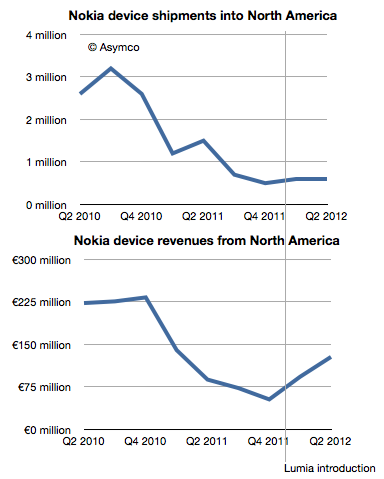
    As often happens, it helps to look at the data historically. The following charts show North American shipments and sales with the Lumia launch date highlighted.

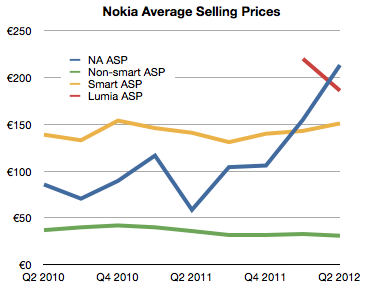
    While unit shipments were flat, revenues increased significantly. This suggests that we could plot the average selling price of phones in North America (NA) specifically. I did that in the following chart:

    Here the effect of Lumia is clear. The average revenue per phone in the US (blue line) jumped dramatically after the launch. So much so that it actually overtook the average global ASP for Lumia.

    What we need therefore is a way to estimate the "mix" or percent of smart and non-smart phones sold into North America and derive perhaps the US portion of that and then finally try to separate the Lumia from all the smart volumes.

    To help, I plotted the historic ASP for Smart and non-Smart devices as provided by the company.

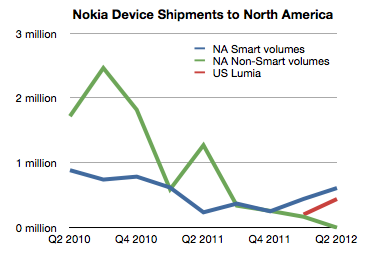
    Using a simple formula[3] it's possible to derive the mix which is shown as Green and Blue lines in the following chart.

    Getting estimates for smartphone shipments (blue line) is pretty close to Lumia shipments, but we still have to correct for US/Canada split (estimated at 90:10) and Symbian/WP split among smartphones (estimated 50:50 in Q1 and 20:80 in Q2).

    The result is the red line showing US Lumia shipments. The sum of the two quarters then comes to 630k.

    This is nearly twice the estimate from consumer survey data however I would not draw too many conclusions from this. Mainly because there are many assumptions place in both estimates, but also because there is the distinction between shipments and usage.

    However, it might be safe to say that US install base is somewhere between 400k and 1 million users. Is this good or bad?

    It's good because it's progress and there is some growth. It's bad because it's frightfully small relative to the competition. Nokia itself acknowledges the challenge and states that "We believe the Windows Phone 8 launch will be an important catalyst for Lumia."

    It seems that what Nokia needs most today is time. That is a very expensive asset. Perhaps infinitely so.

    ---

    Notes:

    1. A practice neither company would condone, principally because they are competitors, but also because they use different sampling methods.
    2. North America I take to mean US and Canada. Although geographically, Mexico is part of North America it's usually grouped as part of Latin America as a category. I'd like to get this confirmed.
    3. There are a few implicit and explicit assumptions: (a) Global ASPs are roughly comparable with NA ASPs but (b) smartphone ASPs are higher in NA by about 30%
  10. Building and dismantling the Windows advantage

    Research · 327 comments

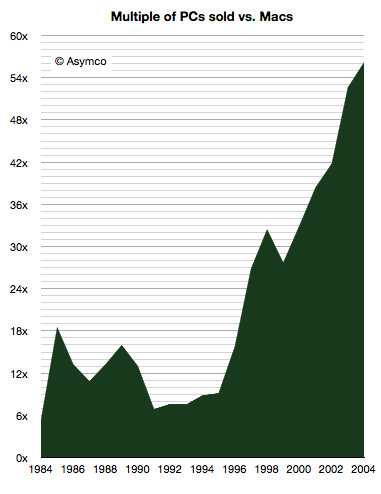
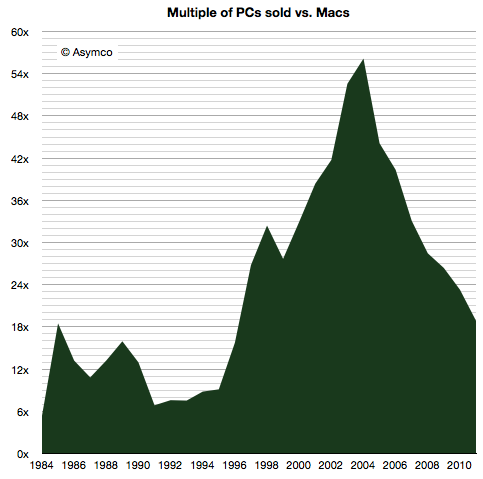
    When the Macintosh was launched in 1984, computers running the MS-DOS operating system were nearing a dominant position in the market. Having launched in 1981 as the IBM PC, they were quickly cloned and four years later "PCs" were selling at the rate of 2 million/yr.  The Mac only managed 372k units in its first year.

    In other words, PC was outselling the Mac by a factor of nearly 6. It turned out to be a high point. The ratio by which the PC outsold the Mac only increased from there.

    When Windows 95 launched in 1995 it negated most of the advantages of the ease of use of the Macintosh and the PC market took off. The ratio reached 56 in 2004 when 182.5 million PCs were sold vs. 3.25 million Macs.

    During the second half of the 90s it was already clear that Windows won the PC platform war. Windows had an  advantage that seemed unsurmountable.

    I should point out that this ratio between platforms is not just an exercise in arithmetic. It's a measure of leverage. The advantage of dominance is realized in an ecosystem which creates lock-in and additional economies in marketing. Ecosystems become self-perpetuating and there is a tendency toward monopoly. The stronger you are, the stronger you get.

     Then, in 2004, something happened.

    Although PC volumes continued to grow, they did so more slowly and the Mac grew faster. What coincided with this was the emergence of portable computing. The MacBook became easily differentiable as a "better" laptop. It was not faster, did not have more storage or any key metrics being used to sell PCs. It was just better as an integrated product. The integration manifested itself through a sense of quality and robustness as well as intangibles like aesthetics and "feel". I wrote about this a few years ago.

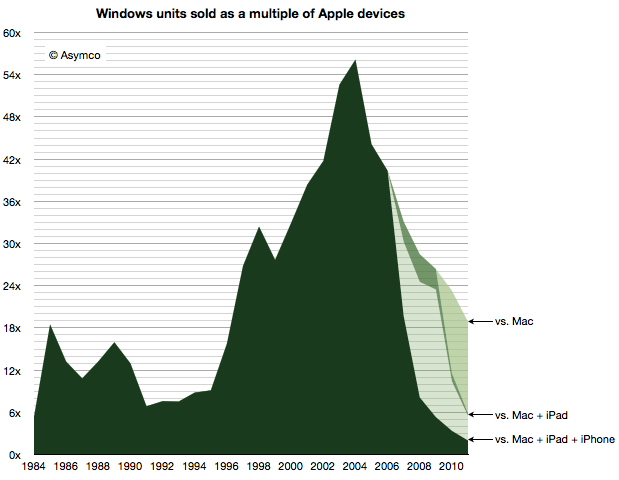
    As a result the Mac began to whittle down the advantage Windows had. The ratio  of Windows to Mac units shipped fell to below 20, a level that was last reached before Windows 95 launched. It's as if the Mac reversed the Windows advantage. This was an amazing turnaround for the Mac.

    But the story does not end there.

    If we consider all the devices Apple sells, the whittling becomes even more significant and the multiple drops to below 2. Seen this way, Post-PC devices wiped out of leverage faster than it was originally built. They not only reversed the advantage but cancelled it altogether.

    Considering the near future, it's safe to expect a "parity" of iOS+OS X vs. Windows within one or two years. The install base may remain larger for some time longer but the sales rate of alternatives will swamp it in due course.

    The consequences are dire for Microsoft. The wiping out of any platform advantage around Windows will render it vulnerable to direct competition. This is not something it had to worry about before. Windows will have to compete not only for users, but for developer talent, investment by enterprises and the implicit goodwill it has had for more than a decade.

    It will, most importantly, have a psychological effect. Realizing that Windows is not a hegemony will unleash market forces that nobody can predict.

  11. Horace Dediu on HTML5 vs. native apps « uniform zulu zero zero

    Research · 8 comments

    This week Mr. Dediu was a guest on The Web Ahead (another 5by5 show hosted by Jen Simmons) where he discussed how the forces of disruption apply to the web. It was an interesting discussion as usual, but if you’re pressed for time you should turn your attention to the bit after the sixty-five minute mark, when Horace volunteers some of his thoughts on the web vs. native application platforms.

    via Horace Dediu on HTML5 vs. native apps « uniform zulu zero zero.

    A fair summary of what I said and rebuttals by @falameufilho