What is an innovation? What is the difference between ideas, inventions, novelties, discoveries and creations?
What is a disruption, formally-speaking? Also, what is it informally speaking? Why the distinction?
What is Performance (or P-space)? How does Performance relate to utility, quantity, price and other microeconomic concepts?
What is a new market? How do we distinguish a new industry from a new market.
Do firms matter? Are firms causal to economic growth?
What is the role of technology in innovation? Can we innovate without technology? Can we fail to innovate with technology?
Do firms have life in the biological sense? If not how do we measure their existence?
What are entrepreneurs? What do they do that’s different than what managers or business leaders do?
How do you navigate P-space? How do you think about your business and economy in performance terms.
What is a diffusion? Is adoption a good measure of technological progress? What is the connection between diffusions and disruptions?
How does Capital map to P-space?
How can we maximize economic growth? Is there a growth algorithm? What is the role of government policy in growth? What about the role of the creation of customers?
What is the difference between consumption and non-consumption? What is non-production?
What are the known forms of disruption? Can there be forms we don’t yet know about?
Why do customers buy solutions? Understanding the causes of purchase decisions.
Are profit motives necessary for growth? What motivates individuals, if not profit?
A merger is the result of two entities in the same business joining forces. It is usually justified through "synergy", a euphemism for removing redundancies from their unity. Arithmetically, the desired outcome is that the resulting organization should be smaller than the individual parts (which is desired if the available market is shrinking.)
An Integration is the answer to the question of "Why two companies in different businesses are better off together." Arithmetically, it suggests that the proposed sum is greater than the individual parts.
The spin-off is the response to a situation where one company houses two unrelated businesses.
For completeness, we can define an acquisition as the purchase of an unequal entity in order to improve the value of the acquirer.
The logic of any of these is that there is a disequilibrium which offers an opportunity to those who can exploit it. What the analysis fundamentally assumes is that the status quo of firm boundaries is not optimal.
Much of the measurement of the balance in the equations assumes that the overall industry is stable and that the problems (technical or market) are largely understood and that there is no learning that needs to happen. Boundaries need to be re-drawn because they are imperfect. Boundaries may have grown imperfect for many reasons: founders/owners were separate, markets and technologies evolve at different rates, resources are inflexible, processes are entrenched and values are outdated.
However, all this arithmetic can be safely thrown out of the window if there is a new industry in the making. If there is no balance to begin with because there is an entirely new problem being posited. That is, not only do we not know the answers to technical or market questions, we don't even know what the right questions are.
When looking at the history of industry creation, the breakthroughs were always about the discovery of the right questions to ask. The early automobile industry was a scramble for solutions to a huge number of technical and market questions: technology, business model, infrastructure, usability, customer segmentation. From 1886 until 1915 there were many grand experiments with thousands of automobile firms springing up. ((Estimated 3000 world-wide))
Early computing, internet, mobile and consumer durables industries went through similar periods of grand experimentation. But the breakthroughs occurred when someone was able to ask (and subsequently answer) a question that nobody had asked before.
Henry Ford asked, "What would enable everyone to have a car". The result was not a better car but a better production system.
Steve Jobs asked, "What would enable everyone to have a computer". The result was not a faster computer, but a more approachable computer.
Akio Morita asked, "What would enable young people to have their own music". The result was not a better audio quality but a smaller audio player.
Kiichiro Toyoda asked, "How can a car be built without faults". The result was not a bigger factory but many smaller ones.
Jeff Bezos asked, "What would cause people to do their shopping online". The result was not a lot of unique sites but one infinite one coupled to a logistics and computing service.
Having great taste in questions turns out to be the principal quality of the successful industrialist: The creation of economic value and power well beyond the boundary of the firm itself.
When the correct question is asked, resources can be efficiently marshaled to answer it. The wrong or incomplete question leads to inefficient resource allocation. And so the architecture of the solution can be built. If the new problem statement is a technical one then an integrated implementation is required. If the new question identifies non-consumption then a modular implementation is required. Each of these approaches suggests different customer sequencing strategies and different application of resources and processes.
There is no right architecture for industry creation. What matters is asking the right question.
So is Elon Musk, today, asking the right question?
The presumptive question seems to be "What would enable everyone to have an electric car?" This is not a great question if it is seen as a continuation of other such questions: "What would enable everyone to have a safe car" or "an efficient car" or "a reliable car" or "a fast car" or "a second car" or "a fashionable car" or "a bigger car", etc.
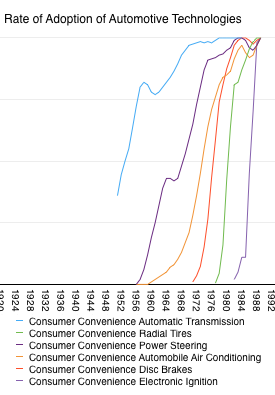
These previous questions were answered by introducing sustaining improvements or modules to the existing production systems. The following graph shows the speed of adoption of various automobile technologies. Hundreds more were introduced and all could be shown to have roughly parallel adoption curves. None of these introductions changed the structure of the industry. ((The industry changed through revolutions in production systems)).
To make electric cars therefore all one has to do is to reduce the cost of electric components for carmakers. They certainly make lots of cars and can make lots more. So why not give them the economic incentives in the form of components to build electric ones? ((Incidentally, hybrid cars are slow to be adopted because the modules are not available as such. Each manufacturer is struggling to match Toyota's solution through internal development—a decade-long process.))
Tesla seems to be an attempt to incentivize carmakers to build electric cars by setting an example. Maybe it will succeed but this is not a reliable or even viable way to build a defensible business. Envy generates the wrong competitive response, usually. If that business cannot be defended then it will perish and so perhaps will the acceleration.
And so we come to the question of whether the defensibility of Tesla relies more on integration. By adding ancillary businesses, can it sustain itself and perhaps eventually pivot away from a commoditizing business (car making)?
Through the addition of a business building batteries and then a business selling home power storage and now adding a business selling home solar power provisioning, the car business becomes a module in a larger system.
So is Musk effectively asking "How to accelerate a global transition away from hydrocarbon energy?"
This gets more interesting as a question. The production, storage and use of energy have been modularized over a century and a half from the wood era through the hydrocarbon era. Perhaps the renewable era will be characterized by integration and de-networking or edge-enabled production. If so the energy problem needs to be solved through a re-integration and a new set of business models. Production and consumption can be coupled and thus production can be decentralized.
But is the answer Tesla+SolarCity? An integrated approach is appropriate if the technical problems are very difficult and cannot be solved through collaboration across firm boundaries and if buyers are eager for great leaps in performance. Join forces if introducing a new measure of performance, solving an unmet job to be done.
A modular approach is appropriate if the problem is one of scale and reach. That is, remain separate if the problems are with finding and building new markets (competing against non-consumption) and if customers are eager for convenience or conformance while being largely satisfied with performance.
This is the crucial dichotomy: The business architecture needs to match the point of time in the evolution of the prevailing measure of performance. Consider this proposed integration an experiment to determine what performance we should measure and thus where we really are.
When Spotify and Pandora were starting their streaming services many were quick to point out that Apple was about to be disrupted. The future, they said, was streaming because (young) people could not be bothered with ownership of music and the limitations of a personal collection. Who would want to pay for a few hundred songs when they could listen to millions for free?
This perception continued and became more vocal over the years. Seven years in fact. Spotify collected 20 million paying subscribers while Apple did nothing. Pandora grabbed 80 million active listeners and possibly 4 million paying subscribers while Apple did nothing. The boat had sailed and Apple was not only not on it but oblivious that there was a boat in the first place.
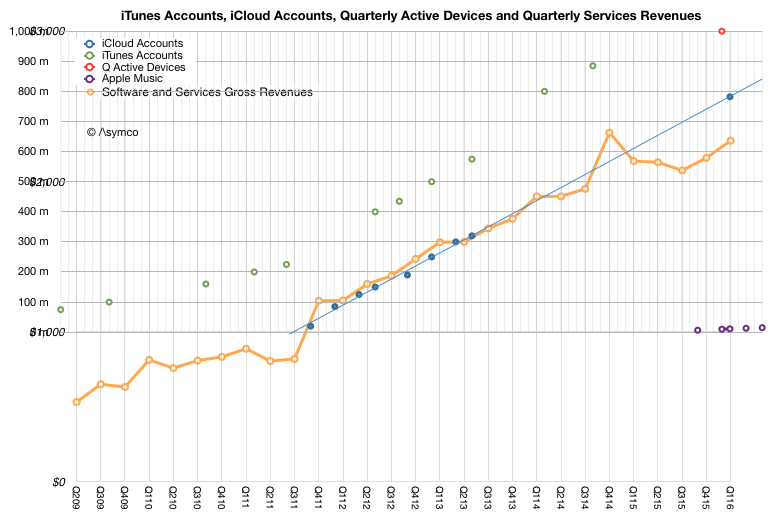
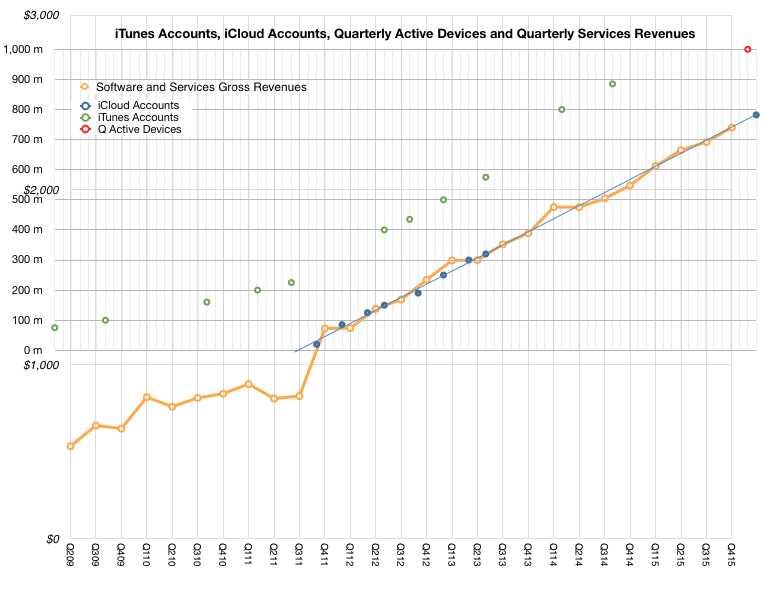
At first Apple launched a half-hearted streaming service and then a paid service finally showed up with Apple Music in mid 2015. Since then the company managed to add 15 million subscribers. A tiny number compared to the 900 million iTunes accounts it had reported a year earlier. Pathetic. The number of music subscriptions relative to iCloud accounts, iTunes accounts and active devices is shown the the graph below.
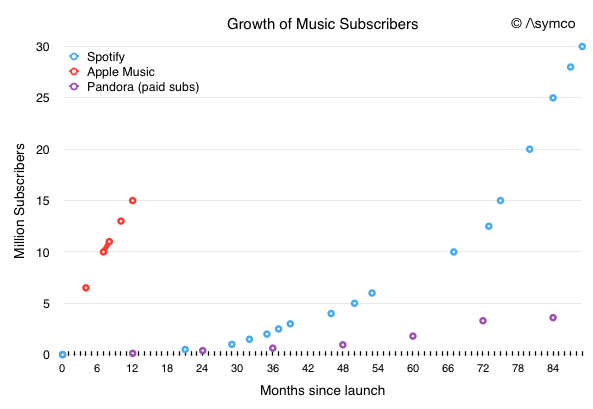
It may be paltry compared to the count of users Apple may have in total, but how does a 15 million user base in 1 year compare with the growth rate for the incumbents Spotify and Pandora?
The following graph shows the ramps for Spotify, Pandora and Apple Music since their moments of market entry. The accumulation of users by Apple looks to be the fastest yet.
This is, of course, due to a maturing use case. Apple did not have to educate people to the notion of music as a subscription. It could just announce it and users would discover it and just sign up, especially if they were already iCloud subscribers and had a credit card attached to their iTunes account.
But that's the whole point. Apple did not have to move first in music subscriptions. It did not even have to move second or third. When it did move it could just skim the market and add to its already healthy Services revenue (orange line in the first graph above.) Missing the boat in music in this case meant capturing all the value quickly and with minimal expense.
Fundamentally, Apple's entry into music subscriptions was a sustaining effort. Streaming sustained Apple rather than disrupting it. The difference may seem merely one of semantics, but it is also the difference between life and death for a challenger. Meaning matters.
This is a cautionary tale for those who would pronounce every new idea as "disruptive" to Apple or anyone else on the basis of novelty alone. The tests for disruptiveness are easy enough and it behooves the analyst to apply them before dropping the d-bomb.
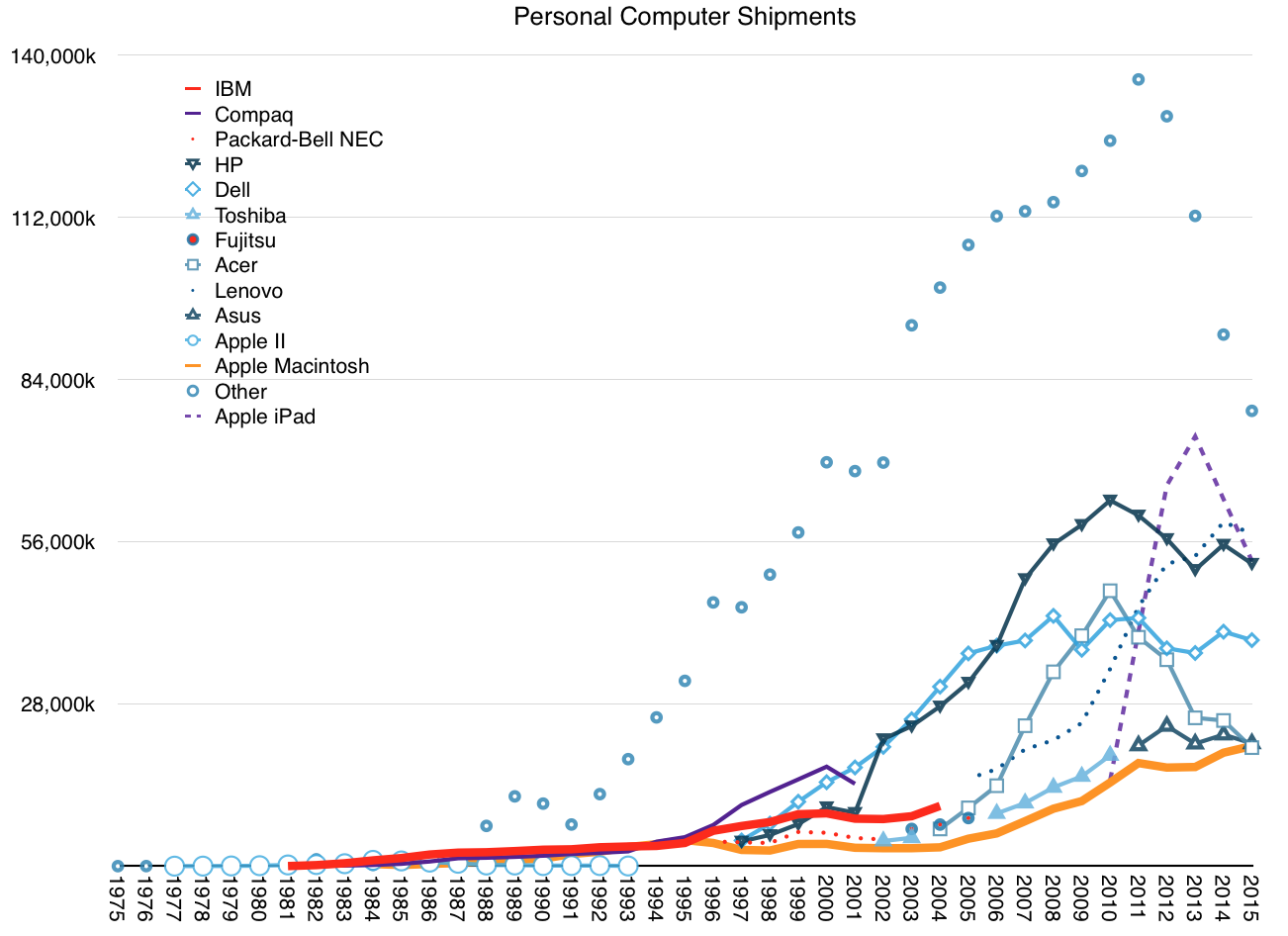
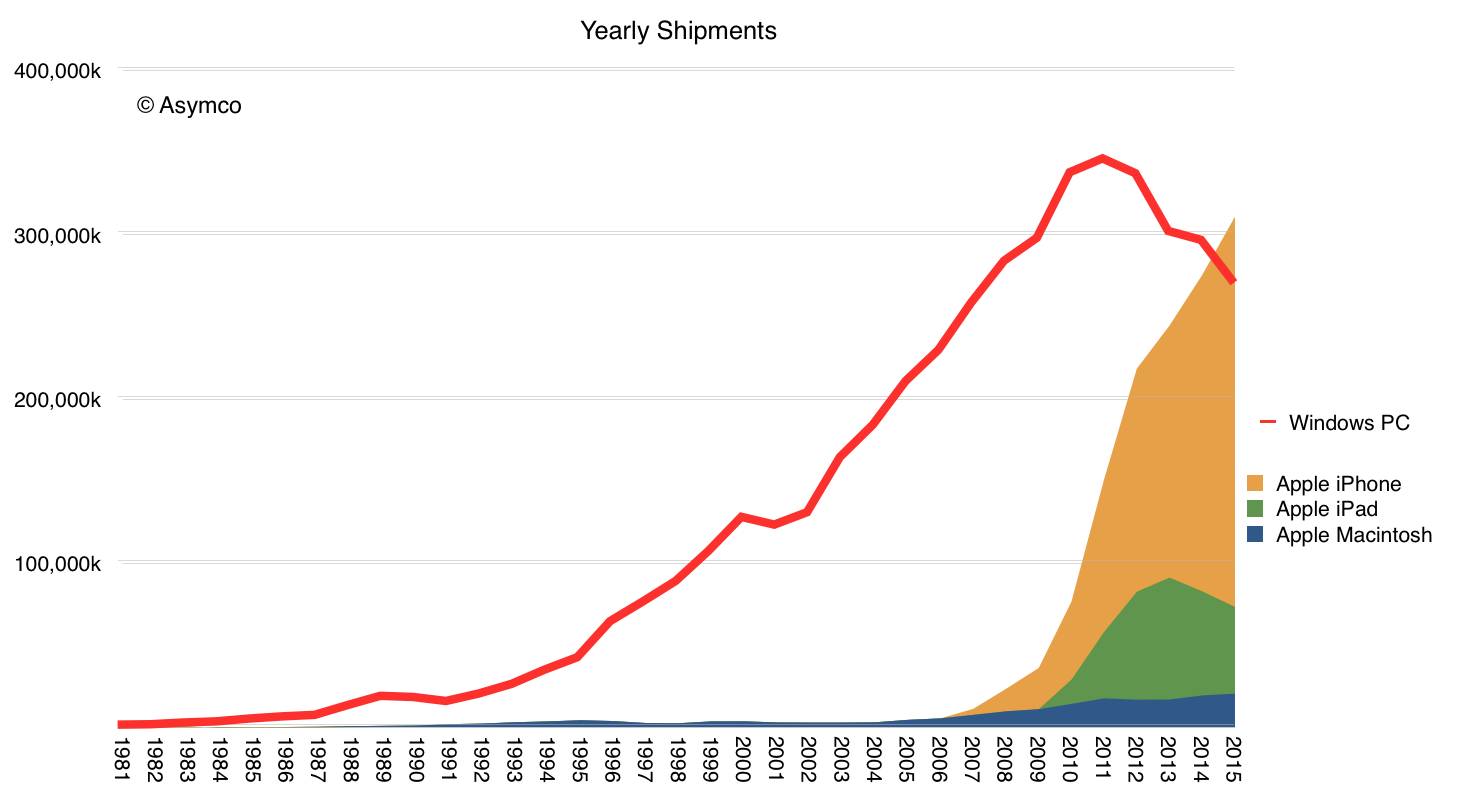
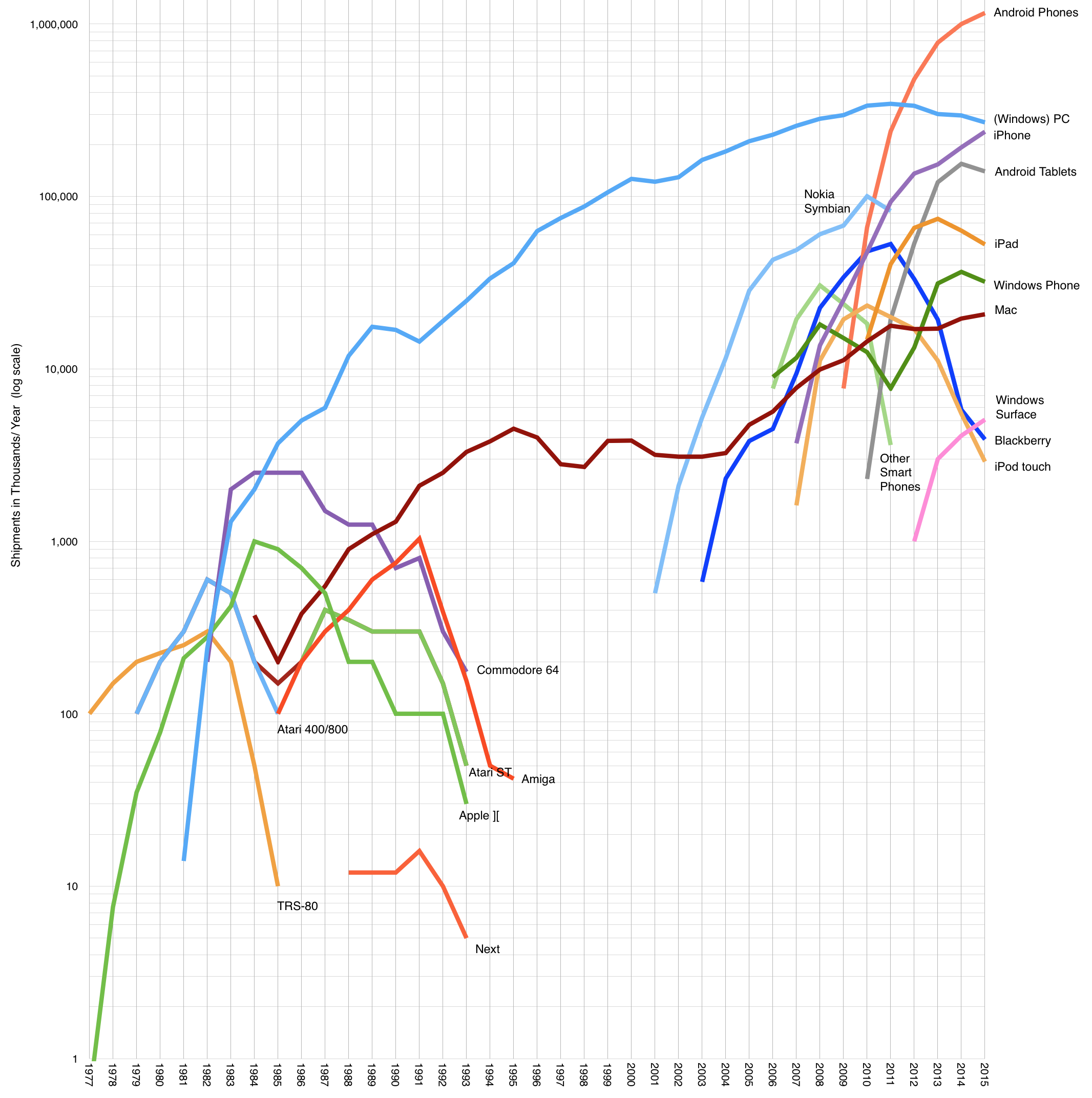
In Apple's first 40 years it shipped 1,591,092,250 computers ((including Apple II, Mac, iPhone, iPad and iPod touch; excluding Apple Watch, Apple TV and other iPods. Includes Q1 shipments estimated at 63,597,000 Macs, iPhones and iPads)).
This shipment total is higher than any other computer company in its first 40 years. Actually there are no other PC makers that are 40 years old. One computer maker (IBM) is older but they only sold PCs for 24 years and what they still sell they don't sell in high numbers.
That does not make it the top seller in a given year. Looking at only the Mac, Apple's traditional form factor personal computer, Apple has only returned to the top 5 last year. Only if including the iPad it was the top computer vendor in 2011 and including iPhone, it was first in 2009.
After having a 40 year run and after selling more computers than all American and Japanese computer companies put together, how should we think about the next 40 years?
First, clearly Apple shifted from being a "computer company". It has already changed its name to exclude the word "Computer" but that has been interpreted as saying that it sells devices (which happen to also be computers.) The word "computer" is already archaic. We stopped using computers to compute in the 40s. We used them to make decisions, keep track of things, speed things up and then to communicate and then to entertain.
Devices, it seems, are what customers mainly use to do, well, everything. Computing has grown to encompass most activities we engage in. So is Apple then a device maker?
More broadly, irrespective of the name, is Apple at 40 still defined as a hardware company? Certainly Wall Street ((i.e. average people)) still think so. The conversations one hears clearly consider Apple's future to be tied to the sales volume of specific products. At one time it may have been the Mac, another, the iPod and now the iPhone. This thinking is again a legacy of where the company was but mainly it's a reflection of how revenues are reported.
We see a line item in the income statement that says "iPhone" and it has a big number next to it so we, of course, fixate on that big shiny number. But if we were to unpack that number and see why it's so big we would discover that buyers are buying something other than what financial statements report.
Buyers are buying experiences, I hear you say. Yes, but more than that. Much more. They are buying safety, comfort, convenience, simplicity, productivity. They are buying modules to combine with other modules that help to do something. Something better. They are buying hope, satisfaction, escape or vanity. In other words they don't know what they want but know when they have it. They trust products unseen which have a reputation of delivering that which they think they might like, without knowing what that is. By employing the product, and a whole lot more—effort, time, mental energy and repetitive actions—they learn to exploit a product to achieve satisfaction.
Products are enablers, as are experiences and software and ecosystems and services. They are modules used in a melee of activity to make the user feel they are making progress. And if that module is better than no module then it will command a price and if it's better than another module or modules then it will command a premium. And if most people agree then it will be popular with many. And only if all these are true will it create a big number on a report.
And so we must search for other names to call a company that delivers an enabler that may lead to progress. Crude categorization like the reporting of finances leads to self-deception and a loss of opportunity to understand. Firms are often victims of this self-deception because they start believing that customers buy the things they sell. They start to believe that what is on their financial reports is a reflection of the value they create. It's a simple mistake to make, but a mistake which leads to catastrophe. If its data is mis-categorized, by chasing numbers the company runs away from opportunity, leaving it to competitors otherwise unencumbered with knowledge of numbers.
Assuming Apple avoids mis-categorizing what it does, will it be a "solutions" or "services" or "brand" company? Is it, as I used to say, a "blockbuster manufacturing line"?
Yes, and still that's not all it could be. Nor is it enough to understand what will come.
My simple proposal is to think of Apple (and actually any company) as a customer creator. It creates and maintains customers. The more it creates, the more it prospers. The more customers it preserves the more it's likely to persevere. This measure of performance for a company is not easy to obtain. It's not a line item in any financial report.
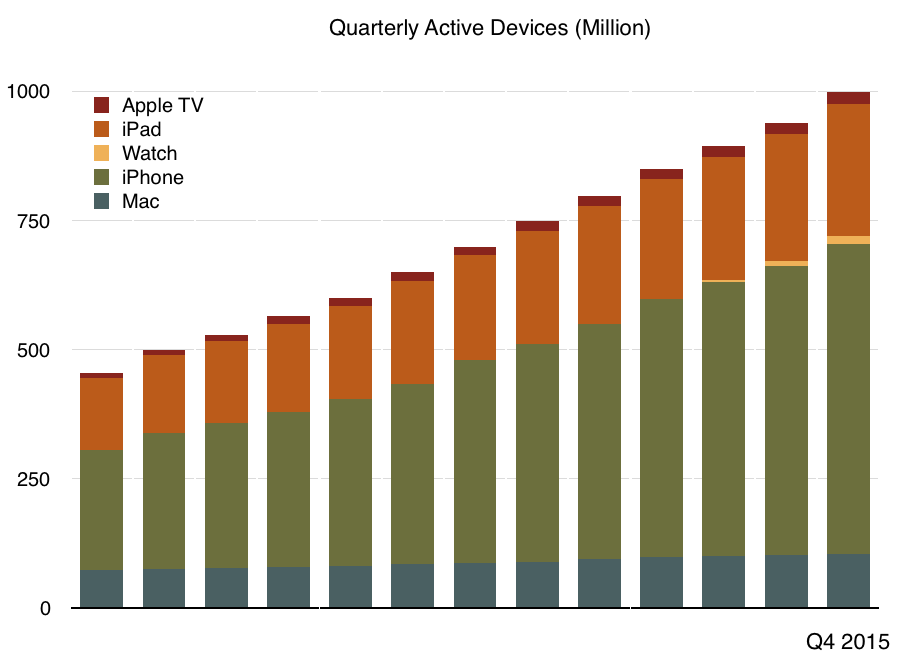
The closest figure we have is that today Apple has one billion active devices in use. We're not told of the total users or total customers because Apple cannot count people or wallets as accurately as it can count active devices. But as imperfect as it is, this number gives us a way to get close to counting customers.
So we know that at least Apple has created a large number of customers. Knowing total devices sold and number in use means that we can be sure that 63% of all the computers Apple sold are still in use. This means that most customers are recent customers. That is not necessarily good news. New customers are not well understood. We don't know how these new customers might behave in the future.
Will they come back for more of whatever Apple makes? If we look at the history of competitors or technology products in general, chances are they won't. The industries Apple has been a part of are filled with one hit wonders. Companies which had parabolic trajectories and built no loyalties. Statistically speaking, success in Apple's markets is always followed by failure.
But what if we did not seek correlation but looked for causation? What if we ignore statistics about companies other than Apple and focus on statistics about Apple's actual customers? Rather than assume all companies are the same, what if we assume that some can be exceptional? What if we we look for the anomalies, not the clusters?
We might want to ask about the causes of success or failure for a single company. We might want to sample its specific customers. We might want to observe how Apple's own customers behaved in the past. We might want to use theories of brand value or theories of network effects or theories of software ecosystems.
These measures, rather than those of "comparable companies" might lead to different conclusions: That customers are loyal, that they will value the brand and that they are invested in a network. In other words, that they will buy from Apple again.
If we then factor in the size and persistence of Apple's audience (customer base) we might conclude that there are factors which will allow it to grow rather than shrink. My analysis based on public data shows that the customer base has been increasing steadily.
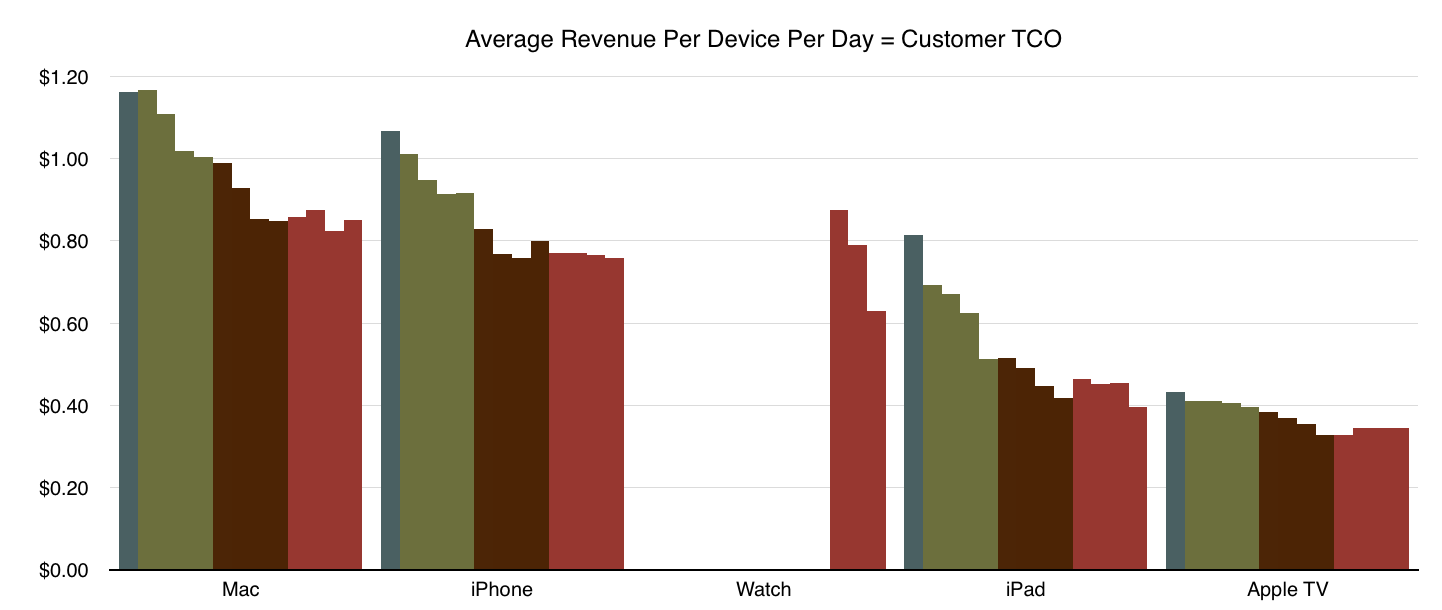
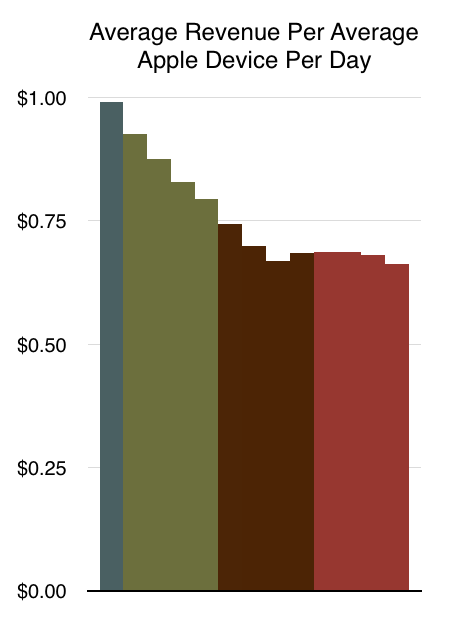
Considering this audience and the revenues generated, we can categorize the revenue by active device as follows.
Each bar represents that product's revenue per day in a given quarter (from Q4 2012 to Q4 2015). Each year is therefore represented by a different color. Dark green for 2012, light green for 2013, burgundy red for 2014 and dark red for 2015. For example, each iPhone in use was generating exactly $1/day in revenues (including services and accessories) during the first quarter 2013.
This allocates all of Apple's revenues to these products and by proxy to customers.
In summary, the "average revenue per Apple device per day" is currently $0.68. If we assume one unique user per device then Apple collects 68 cents from each customer each day. ((In reality the figure may be closer to $1, as there are likely to be more 1.2 to 1.5 devices per person.))
Combining the history of customer creation and customer preservation with the value obtained from each customer implies that the next 40 years will be about creating another large tranche of customers whose willingness to spend on whatever Apple creates will be relatively unchanged.
We don't know the limit. One billion was hard to imagine even one year ago. We might see two billion devices in short order. Perhaps not. Perhaps as we have a multitude of devices about us all day the number will become less meaningful. But if the number of middle class customers grows and as Apple keeps its products within their reach, there is no reason to think that there will be a reversal of the last 40 years in terms of customer acquisition.
This analysis contradicts the current perception of the company as reflected by its stock price. That price assumes the audience will wither ((With a P/E ratio of 11, without a change in revenue per user, the only justification would be the audience shrinking by more than 90% over the next 20 years.)) That is not insanity. It is what we could expect if Apple were unexceptional.
We could surrender to correlation and ignore causation but statistics show that such an approach rarely works.
-------
Incidentally, this and a lot more will be discussed at the next Subscribe conference.
How Apple is managed is one of its enduring mysteries. The idea that a company with $235 billion in sales is managed with a single P/L ((Profit and Loss statement is an income statement usually applied for a subset of a larger company which allows subdivisions to be managed individually.)) is fascinating in many ways. Not least of which is how it allocates resources. The fundamental question of which great idea gets to be funded and which great idea gets to be ignored is the core of every manager's dilemma. The Apple problem is at scale when each decision's consequences are so momentous. In the case of Apple there are so few projects that reach the market and their impact is so great that one wonders how they can be sure they are doing the right thing.
Conventionally, product development is filtered through a sieve of metrics, market sizing and impact on top/bottom income lines. These "financial" measures of success are considered prudent and optimized for return on equity (also known as the maximization of shareholder returns).
But this can be a toxic formula. The financial optimization algorithm always prioritizes the known over the unknown since the known can be measured and is assigned a quantum of value while the unknown is "discounted" with a steep hurdle rate, and assigned a near zero net present value. Thus the financial algorithm leads to promoting efficiency at the expense of creation. Efficiency may be the right priority when times are difficult and resources are scarce but creativity is the right priority in a time of plenty. And abundance is what being big is all about.
To allow for some creation large firms create divisions. Some divisions are tasked with "core products" which are measured by a set of firm metrics and some are tasked with "emerging products" which are given a set of loose metrics. This leads to obvious resentment and war between divisions when resources need allocating.
Ominously, the core divisions tend to always win. At the root of divisional power struggles are measurements--the roots of financial metrics. Managers fight with data. "You can't manage what you can't measure" they're taught. But if you have something that can be easily measured and something that is difficult to measure, won't the easily-measured be managed and the hard-to-measure be ignored?
There is a general principle at work here: Managing by measurement is fraught with the pitfall of measuring the wrong thing. Making sure that you're measuring the right thing becomes the value-adding role of the manager. A role that is increasingly being neglected.
The mass phenomenon of measuring the wrong thing because it's the easiest to measure is called "financialization". Financialization is the process by which finance and finances (rather than creation) determine company, individual and society's priorities. It comes about from an abundance of data that leads to fixation on what is observable to the detriment of awareness of hazards or obstacles or alternatives. This phenomenon is more likely when the speed of change increases and decision cycles shorten.
Financialization is creeping into all aspects of society and the extent to which it infects companies is the extent to which they suffer from early mortality.
So is Apple avoiding financialization? How can anyone avoid the tyranny of mis-optimization?
The unified P/L might be a clue. It obviates the need for divisional rivalry and power-based or financial politics. Without divisional P/L, management can be organized functionally with the obvious benefit of de-politicization. The singular P/L does create another problem however: the absence of an alternative resource allocation algorithm centralizes the decision. By centralizing decisions at the highest level, few decisions can be taken and that means each decision has to be right more often. We swap a distributed but financialized process for a central but capricious one.
So how is the central decision process made fair? What guides the allocation process?
I believe that Apple does not avoid quantified decision making. I believe the logic of their decisions is based on a nuanced quantification of the company's customer base. Opting to think about how many customers they have rather than how many things they can sell could offer the Apple manager a better decision tool, avoiding financialization and mis-optimization.
The guiding principle is putting the customer rather than the firm at the center of the decision process. The idea of this change of orientation extends to a re-definition of the purpose of the firm. Apple calls it its "North Star" and it places "making the best product" at that location.
The challenge is how to measure "goodness" of product. It's easy to overshoot "best" and become too good. What regulates greatness is another measurement: absorption of what you create. The true orientation (which Apple won't confess to) is absorbable greatness.
Absorbable greatness is measured through other proxies: customer creation, customer satisfaction, and customer retention. By adding and preserving great customers you can be sure that what you create is indeed the "best". Setting the goal, and indeed the purpose of the firm, as the creation and preservation of customers seems to be the unwritten constitution of Apple.
The idea that the purpose of the firm is to create and maintain customers is not new ((Customer creation is in contrast to the notion that the purpose of the firm is to maximize shareholder returns. The notion of customer creation as primary purpose was popularized by Peter Drucker. The notion of optimization through shareholder value creation was popularized by Jack Welch.)) but it is relatively rarely practiced. The reason is that the data is harder to obtain. The data that comes from sales is crisp and concrete. The data about customers is muddy and soft. In a world where spreadsheets are used as weapons, the crisper the data, the better the ammunition.
Clarity wins arguments but it may not be where salvation or truth can be found. Good judgement in a cloudy reality is a better compass than a clear road map to a fantasy world.
Optimizing around customer acquisition rather than equity returns leads to a new set of metrics. What would these metrics look like for Apple?
The company publicly offers three separate sets of quantity of customers and quality of customers.
In terms of quantity we have:
Number of iTunes accounts
Number of iCloud accounts
Number of active devices
In terms of quality of customers we have:
Average selling prices for devices (as a proxy for willingness to pay)
Customer satisfaction (as a proxy for loyalty )
Services and accessory revenues (post-sales and recurring value)
The following graph shows the historic data for service accounts and corresponding services revenues.
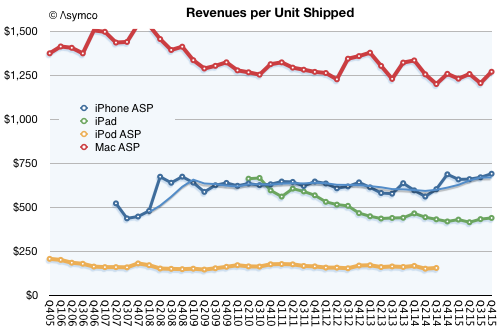
The following graph shows the average price per hardware product indicative of loyalty through stability in the face of growing competition.
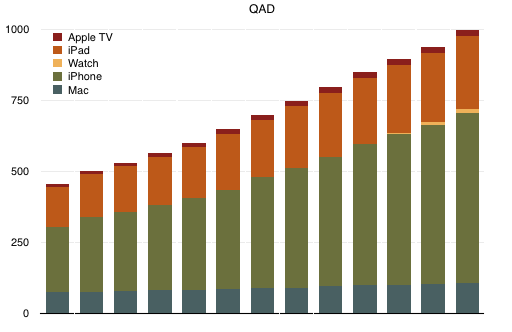
The following graph shows an estimate of growth in active devices as a proxy of customer base.
Unlike product shipments and revenue data which follow rises and falls in individual products due to the cyclicality of technology and adoption, these graphs show a smoothness and predictability of customer base behavior.
Looking at Apple this way gives the impression that the company has a large number (nearly a billion) of repeat (subscribed to service) customers. These customers can be seen to spend a predictable recurring amount (average selling price) on Apple's brand. The repetition of these metrics in public commentary suggests that customer acquisition and retention are among Apple's goals.
The key question is whether this is Apple's primary goal.
Seen this way each centralized resource allocation question can be assumed to be prefaced with "In order to create/preserve customers should we...?"
This leads to answers quite different from questions that start with "In order to sell/profit more should we...?"
For instance, offering education products, retail store experiences, healthcare products, green energy initiatives, accessories, content and services make sense even if they may have poor financial "returns". These initiatives score highly on customer retention and satisfaction. They may lead to engagement and repeat sales. Managers working on these initiatives would gain the respect of their peers, leading to more esteem and higher quality output. Finally, and most importantly, these efforts would be preserved regardless of cyclical downturns.
The assessment of analysts should therefore be couched in similar terms: "What is the impact of a new initiative in customer creation and preservation?" rather than "What is the impact of a new initiative in driving revenues and profitability".
We can see immediately why the second question is popular while the first isn't: it's easier to assess an answer to the second because we have the data that allows for its calculation.
This is why asking the wrong questions is popular.
Since writing Peak Cable six months ago, surveys, research and analysis have contributed to the themes of unbundling the TV package. The data under scrutiny is, as usual, the data that can be gathered. Unfortunately the data that can't be gathered is where the insight into what is happening may lie. For instance, what matters for an entertainer is not how much you're watched but how much you're loved. Measuring love is done poorly with data on payment for subscriptions.
A better proxy might be time. Liam Boluk makes the point in his post that "focusing on cord cutting or even cord shaving largely misses the point." Don't follow the dollars, he says, follow the time or engagement. "Relevance" is what matters.
His data shows how linear TV has fallen by roughly 30% among the young (12-34) in the last five years. The trouble for the TV bundle (and advertisers) is that this is the most culturally influential group. They are also the group which will grow into the highest income group over the next decade. And this group does not love TV.
We have to remember that it was the youth who drove early radio, TV and consumer electronics markets. Those young are now the old which still cling to the old media, served by companies that grew old with them. They are the "high-end" customers with which Nielsen itself has grown. They have the most money to spend and they are the targets for the ads ((no longer the Pepsi generation, they are the Depend and Viagra and pharmaceuticals generation))
Paying $150/month to watch incontinence and erectile dysfunction ads—at a time not of your choosing—is preposterous for the young. They may like the programs but not the way they are packaged, delivered or interrupted. They are not smarter than their parents. They, like their parents, took to new technology more quickly. What makes the technology new is also what lets its makers separate the content from its delivery. These new technologies allow "modularizing" or unbundling that which was was integrated/bundled and thus allow their developers to focus on the customer's real jobs-to-be-done.
Unsurprisingly, incumbents have responded by throttling access to original programming–an asset over which they still exert influence as distributors. Netflix and Amazon are taking the path of responding with their own blockbuster productions. Although Silicon Valley has more capital to deploy than Hollywood this battle of attrition is by no means one that incumbents will win, and generally, it's not going to be pretty.
Tweaking the nose of the incumbent might not be the way to establish asymmetry. The better tactic may be to help the system survive but offer a "short-term alternative". This is how iTunes took on and won Music. When Napster and file sharing created a clear and present danger to the industry, Apple's approach of a controlled alternative allowed the industry to finally move to a digital download model.
An observer in 2004 would have said that Apple was bowing to the industry and providing it sustenance against "disruptive" free music. However, as behavior shifted to an overwhelming preference of iTunes downloads over physical media, the music labels found themselves in an untenable negotiating position. They had to concede on DRM, pricing and bundling itself. The music disruption occurred with a tacit acceptance and collaboration by the incumbents.
Is history repeating? Looking at the situation around TV today, the strategies of the challengers can be summarized in a similar way:
The content low-end: Now, YouTube, Twitch. Then, Napster, Gnutella
The distribution low-end: Now, Netflix, Amazon. Then, incumbent music download sites.
The nominally sustaining: Now Apple TV. Then, iTunes
Apple cannot play an "ignore me" strategy because as much as investors think the company is irrelevant, everything it does is closely watched by anybody who might be even remotely touched by it. Especially in entertainment.
In addition, due to brand considerations, the company cannot ship low-quality or no-quality product, including material that sits on its platform.
They have to do something different. Something more complicated and something that takes much longer.
What Apple best contributes asymmetrically is a new experience. The experience allows new behavior, new usage models and hence new loyalties to emerge. The loyalties create affinity which shifts the "love interest" for the user. The new Apple TV attempts to provide such a contribution. Not only in terms of the experience but also for becoming, finally, a platform for developers, who will try to make the product itself better in collaboration with Apple. Thus the "new experience" flips when bits which are streamed cohabit a device with bits which expect a consumer response.
This "appification" becomes an interesting experiment in behavior alteration. Will "couch time" change from pure passivity to partial interaction?
To the orthodox adherents to the religion of linearity of immersive programming this sounds impossible. But why else should a product deserve to exist? A great product is one which changes the user and for Apple TV to become great it needs to engage us to do something different than we do today. It needs to make us feel we are better for using it.
Is this new Apple TV up to it? We'll have to wait and see. But then again, if not this one, then another one will. TV will not remain unchanged forever.
What makes a product great? I struggle with this question because being great is not just being better than good. Greatness is to goodness as wisdom is to smarts. Just like getting smarter and smarter may never make you wise, getting better and better does not mean ever becoming great.
Greatness is transcendental. It's hard to pin down. It inspires debate. It divides as much as it unites. It creates emotions as much as thoughts. It builds legends. It engages and persists. It lives in memory and penetrates culture. It implants itself in our consciousness persistently, to linger and dwell in our minds while we are bombarded with stimuli.
We use words such as "iconic" or "epic" to capture this permanent "mental tattoo" that we get from greatness. As important as this notion is, we struggle to define it. We don't even have a proper word for it. Perhaps it is what art tries to be, or what drives us to achieve beyond surviving. As vague a notion as it may be, it is one of the most important notions I can think of. Greatness is the cause, perhaps, of our ascent.
In the absence of any measurement of greatness, how do we spot it? It may just be down to "knowing when we see it". But not everybody does. ((Language is another indicator. When people attach brands to entire categories we get an indication of ubiquity and permanence. As much as the brand owner fears it, the genericization of a trademark is very probably an indication of greatness in consumer products. Aspirin, iPod, xerox, jell-o and app are examples where brands became words.))
This quandary came to mind when looking at the performance of the latest iPhone, the 6S. Observing it closely, we lose sight of it. We see only minute changes between versions; marginal changes which can't be weighed. And yet these changes have a more important attribute: they are absorbable. A change that is ignored is not only valueless, it may actually destroy perception of value. It creates clutter and confusion. A change that is absorbable is valuable. It is meaningful.
Looking at new features like 3D Touch, Live Photos, and better cameras, one can observe how easily acceptable and desirable they are to those who first see them. As were Siri, FaceTime, Touch ID and iCloud, making something meaningfully better is a sign of sustaining innovation which does not over-serve.
Paradoxically, the improvements are not usually things that users ask for. Surveys always show that consumers want "better battery life" or a "bigger screen" but delivering something else entirely which nevertheless leads to mass adoption shows an uncanny insight into what really matters. Indeed, those who deliver only what customers ask for end up marginalized and bereft of profit.
To see improvements which lead to ever-increasing success in the marketplace year after year proves that this is not a transient event. This is no flash-in-the pan. This is not a stroke of genius. This is a process, a factory, a machine. The consistency and relentlessness of success is evidence of something at work that is more permanent.
The definition of greatness for products then becomes easier to frame:
Improvements which are not asked for but which change behavior suggest that the product is valued because it changes the buyer. I believe this is what causes us to pause and appreciate them. We feel we have been improved by the thing we bought though we did not ask to be made better by it. Collectively, multiplying by millions, the improvement we feel compels us to anoint the product as great.
Apple is a company that builds greatness because they built a process to make their customers better. They do it without permission and they do it without offense. But when the buyer perceives the change they feel in debt to the object. Getting payments on that debt of gratitude is how Apple is rewarded.
What if Apple did make a car? How significant could their products be? What would it take to influence the industry's architecture?
The global market is forecast to reach 88.6 million vehicles in 2015 and there are many ways to segment it. One could look at geography or at product configurations or the emergence of new powertrain technologies.
One could also look at the participants.
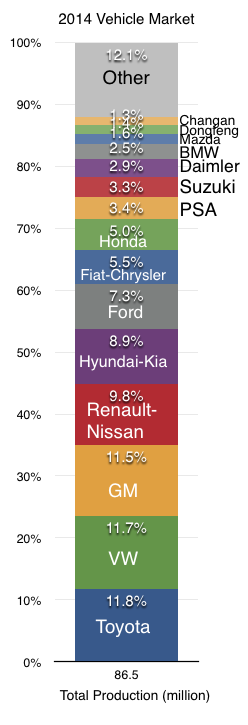
In 2014 Toyota was the top selling automaker with a total sales volume of 10.23 million vehicles. The following graph shows the leading 15 producers and the percent of total production.
One thing to note is the relative balance in market share. The top five vendors have volumes in a very similar range (9 to 12 million). Two vendors are at around 5%. Three are at 3%. To preserve this equilibrium the industry undergoes periodic merging and consolidation. Over the last half-century, there has been room for new entrants. Japanese brands entered between the 1960s and 1970s. Korean entries occurred in the 1990s and Chinese in the 2000s.
Regardless of the entries, the industry has a high degree of centralization. Ownership is often more narrowly controlled through cross-ownership and licensing. French/Japanese, US/Italian/German, Indian/German/UK cross-over ownerships indicate a globalization of financing. Indeed, only a dozen countries account for over 80% of the production (less than 10% of nations produce significant numbers of vehicles).
This structure is driven by the cost structure of volume production. The production system dictates financing and location and time constraints which underpin all deals. None of the entries (Japan, Korea, China) did much to redefine the core industry architecture (resources, processes or priorities).
So how could Apple think different?
First, the model of production could be substituted with a modular approach. This would separate the engine/body/paint/assembly plant into a deeper supplier network where components would be sourced and tooling dependence would be reduced.This speeds up ramps, reduces capital expenditure, increases flexibility, and accelerates the cadence of product evolution. Essentially, the focus would shift away from manufacturing toward design, iteration, customization and experience engineering.
Second, Apple could change the distribution model. Controlling the relationship with the end user could allow a conversation which will reveal new jobs to be done.
Third, Apple could affect the vehicle's lifespan and hence the financing/resale and inherent brand promise of car ownership.
These are fairly obvious business innovations and they are easily foreseen.But are they enough? Would they even "move the needle"?
To break into the top 10 brands would imply a production volume of at least 2.5 million units (about the same as Daimler ships today.) At 2.65 million and a price of $55k/vehicle Apple's revenues from cars would total about $145 billion. This is roughly the sales value of the iPhone business today. Not bad. Maybe that would satisfy a financial analyst. ((Yeah, right.))
Even so, would a top 10 rank in shipments change the industry's structure?
When I first saw the iPhone I knew that nothing would be the same after it and that Apple was poised to dominate the phone business. For the Apple car to do a similar trick in transportation the product itself has to change the perception of what a car is. Today a phone is barely something one speaks into.
Approaching the operations side of the business with a clean sheet of paper allows a fresh and rational attack on the problem. But to really make a dent in the universe Apple also needs to change the product in ways that re-define what it's good for. And this is supposedly why Apple gets into markets. To make a meaningful contribution.
Executives at car companies have suddenly had to answer questions about potential entrants into their business. This is a big change. I don't recall a time when this was necessary for over 30 years. For decades the questions have been about labor relations, health care costs, regulation, recalls and competition from other car makers. To ask questions about facing challengers posing existential questions must seem terribly impertinent.
For this reason, Bob Lutz, in his dismissal of Apple's entry, is not alone. The industry has a century of history and has seen little disruption in the classic sense. I wrote a long piece on the fundamentals of the industry titled “The Entrant’s Guide to the Automobile Industry” which explained why this industry has been so resistant to disruptive change. At best a massive effort over multiple decades usually leads in a small shift in market share.
However, one should read that post as a thinly veiled threat. Just because disruption seems hard does not mean it isn't possible. Indeed, the better you understand the industry the more easily you can observe its vulnerability and the more rigid the industry seems the more vulnerable it may be to dramatic change.
The formula for successful entry is the same for all industries: compete asymmetrically. This means introduce products which change the basis of competition and deter competitive responses by making your goals dissimilar from those of the incumbents. This is classic “ju-jitsu” of disruptive competition.
Here’s how it would work.
Bob Lutz suggests that there is no profit to be gained from selling cars on the premise that costs are very high while pricing will be held down by competition. That may be true but entrants could deploy new processes that lower the costs of production. Traditional car making is capital intensive due to the processes and materials used. There are however alternatives on the shelf. iStream from Gordon Murray Design proposed switching to tubular frames and low cost composites. BMW has an approach using carbon fiber and other composites. 3D printing is waiting in the wings. All offer a departure from sheet metal stamping.
With new materials, costs for new plants can be reduced by as much as 80% and since amortizing the tooling is as much as 40% of the cost of a new car, the margins on new production methods could result in significant boosts in margin.
There is a downside however. What is usually compromised when using these new methods is volume and scale of production. So that becomes the real question: how many cars can Apple target? 10k, 50k, 100k per year? Could they target 500k? That would be 10 times Tesla's current volumes but only a bit more than the output of the Mini brand.
Now consider that the total market is 85 million vehicles per year. For Apple to get 10% share would imply 8.5 million cars a year, a feat that is hard to contemplate right now with any of the new production systems. On the other hand selling 80 million iPhones and iPads in a single quarter has become routine for Apple and that was considered orders of magnitude beyond what they could deliver. Amazing what 8 years of production ramping can offer.
So the answer to the operating margin might be in a combination of new processes and new ramp strategies.
But there are more levers of change. Car making can be revolutionized through modularity: divide the car into subsystems and act as integrator. Electric cars have the benefit of few moving parts, smaller motors, fewer points of failure and wear, lower heat signatures and more interchangeable systems architecture. This allows companies to enter without needing to design their own engines or many other parts.
The fact is that engineering cars is actually fairly easy. Building them is the hard part and the costs of engineering new models that are cited as so extraordinary are because most of the effort is in engineering for production (The maxim is that it’s far harder to make a Ford than a Ferrari). You can see this in the proliferation of “boutique” supercars which have hyper performance but low volumes. McLaren, Bugatti, Pagani and dozens of others are all recent hypercars which show the power of engineering and design without worrying about volumes.
Apple could combine new production methods with modularity in engineering to bring design, integration of experience and iteration to the industry. Not to mention what software could add to that. Couple that with the brand value and Apple’s entry will very likely be hugely successful. I just don’t know if they can manage production at the level of demand that I expect them to create.
I was always bemused by the notion that the Internet was able to exist solely because most users did not know they could install an ad blocker. Like removing Flash, using an Ad blocker was a rebellious act but one which paid off only for early adopters. But like all good ideas, it seemed obvious that this idea would spread.
What we never know is how quickly diffusion happens. I've observed "no-brainer" technologies or ideas lie unadopted for decades, languishing in perpetual indifference and suddenly, with no apparent cause, flip into ubiquity and inevitability at a vicious rate of adoption.
Watching this phenomenon for most of my life, I developed a theory of causation. This theory is that for adoption to accelerate there has to be a combination of conformability to the adopter's manifest needs (the pull) combined with a concerted collaboration of producers to promote the solution (the push). Absent either pull or push, adoption of even the brightest and most self-evident ideas drags on.
Ad blocking offers a real-time example of this phenomenon. On desktop or even laptop computers ads were tolerable and the steps required to naviagate in order to implement effective ((By effective I mean a combination of whitelists and customizations)) blocking were non-trivial. In addition, no platform vendors were keen to promote products which hindered revenues for their most important ecosystem partners.
Ad blocking as an activity had neither the pull nor the push.
However—and there's always a however—as browsing moved to mobile devices and as ad networks hijacked the relationships between publisher and consumer, ads became detrimental to the experiences platform vendors depended on to remain competitive. Apple first (and no doubt others soon) chose to enable mobile browsers to load third party content blocking software. This is a hesitant first step. No major promotional effort and only the most obscure setting was enabled (defaulting to off).
Nevertheless, it's important to see this action as a "push". The bit that flipped was not of the consumer but of the producer. Movement to a new consuming paradigm and the incessant corrosion of the online experience threatened to taint a platform and something had to give.
Thus the "push" signal was sent and the consumer now has to pick up with a "pull" action. We still have to watch how quickly the pull happens and how network effects of users showing one-another the results will accelerate adoption and whether the push intensifies as the solutions improve.
But from this first enablement, the ecosystem, network effects, distribution and value chain leverage could cause gates to open and ad blocking reach majority followed by universal adoption. Measuring the ease of switching, the independence of the solution from other frictions and basing the estimate on historic rates, I could imagine internet ads will become largely invisible in less than five years.
Alternatives will emerge; the written word will find its business model, yet again. But the current model, contemptuous of the reader and disrespecting of the art will not long last.
Apple is categorized as a vendor of consumer electronics. More specifically, a member of the "Electronic Equipment" industry in the "Consumer Goods" sector. If indeed this is what it's thought to be selling, there is a problem because it isn't what its customers are buying.
Apple's customers buy a mix of hardware, software and services under a brand that assures a certain quality of experience. This bundling and integration of otherwise disparate things is why the brand is such a success.
This anomaly between what Apple is thought to sell and what buyers actually buy can leave the casual observer confused. As a result the company's categorization as vendor of hardware deeply discounts its shares. It is, in other words a less valuable business. This is because a seller of consumer electronics does not benefit from "system valuation" since there is minimal loyalty to the product after the sale.
The consumer electronics vendor has no network to leverage, no ecosystem adding value after the sale, no platform and works through multiple levels of distribution to reach the customer. In contrast, a system vendor can expect benefits from network effects, ecosystems, and a coveted relationship with the end user.
The result is that the valuation of a consumer electronics vendor is based on the momentum of individual products. Apple has always been valued this way. Each hit product is considered to be a stroke of luck/genius and the chances of recurring are discounted to about zero. Regardless of the fact that it has a track record of "home runs", Apple's hit rate is not considered sustainable. ((The P/E ratio is the primary indicator in this analysis)). Certainly Apple is not valued as being able to generate reliably recurring revenues.
But what if we were to value Apple on the basis of what people are buying rather than what it's thought to be selling?
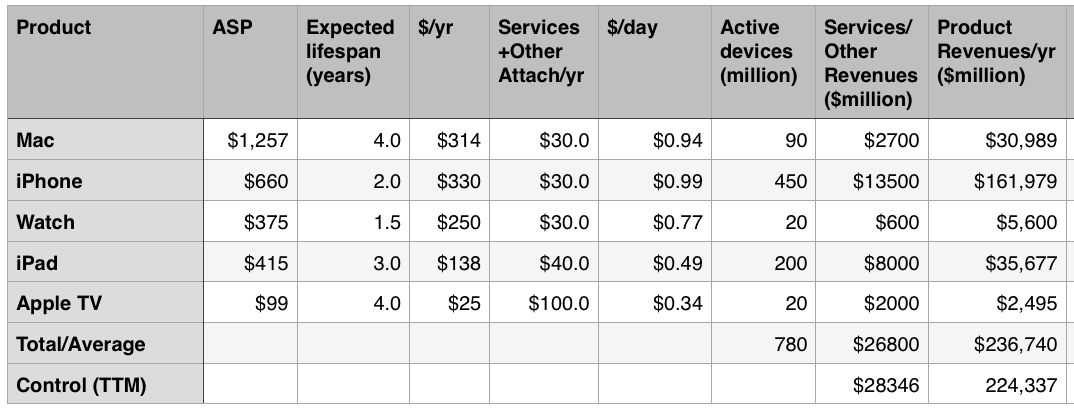
The model is simple enough: determine the number of users, estimate the lifespan of the products, and figure out the services attached to the products; then, given the price, obtain a price per product per day. You then can get a recurring revenue figure.
I did just that and the results are in the following table:
The first column is the product, the second is the Average Selling Price (ASP), the third is the expected lifespan of the product, and the fourth column is a calculation of the end user’s “spending per year” on the product.
The fifth column is an estimate of the revenues from Apple's Services and "Other" groups from post-sale revenues attached to the product. This Services revenue includes AppleCare, iCloud, Music, App Store, other stores, Beats, accessories, iAd, and Made for i (MFI) licensing. It also includes Google traffic acquisition revenues and other licensing.
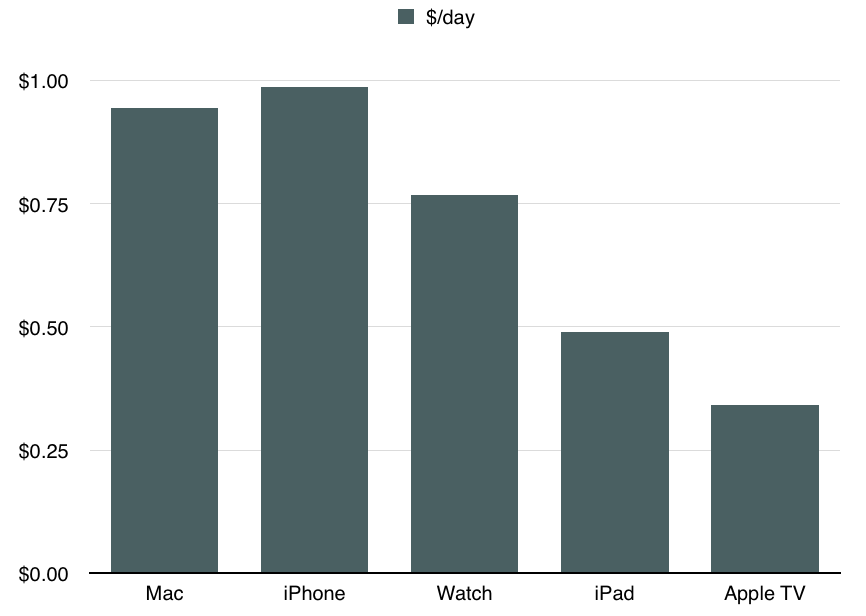
The sixth column is an estimate of the consumer "spend per day" on Apple's product lines taking into consideration Services.
The seventh column is an estimate of the number of active devices in the hands of users. Note that these are expected to change over time.
The eighth column is a calculation of Services/Other income on a per-product allocation. This is a test of the Services+Other estimate and is meant to sum to nearly what Apple currently reports as Services+Other revenues.
The ninth column is a test of overall revenues on a per-product allocation. This should add up to total revenues (estimated for next year.) ((Naturally, the active devices estimate is the most sensitive but it should be tweaked to create a reasonable forecast for next year.))
The bottom line is the following graph which shows the revenue per device per day inclusive of Services and Other income (The sixth column).
This is, in my opinion, a reasonable way to approach valuation of Apple as a business. It's also a way to inspect its strategy.
As a valuation we can easily obtain the net present value. The model gives us sales and by estimating a net margin (which is remarkably steady around 22%) we can get the free cash flow.Iterate into perpetuity with a discount rate, and you can get the net present value of the company. With a modest growth rate leading to a billion active devices in use and a normalized revenue per device of $0.92 you can easily see cash flows equivalent to $1 trillion in present value.
But much more interesting than this value is the notion that Apple is in business to deliver a product/service mix to loyal customers and to preserve their loyalty through constant improvement and innovation. You can see strategic intent in increasing the attach rate of services per device. You can see a strategic intent in building loyalty and the right customer base which is likely to be loyal. You can see strategic intent in the iteration of the product in a way that extends loyalty and expands the solid base but also increases the $/day rate. This analysis correctly informs almost all decisions the company makes.
What we just saw in the launch of a new Apple TV and a new iPad is consistent with this strategy. Apple TV will have a higher service attach rate with apps while keeping pricing well below consoles thus expanding the user base. The iPad is increasing in price and getting more accessories. The developers are encouraged to build richer and more valuable apps that are uniquely enabled by the new device.
The fact that Apple has just launched a subscription service for the iPhone makes what was clearly their strategy all along plain to see however it has been a strategy in effect for decades.
It isn't a difficult idea to embrace. It always surprises me that it's not more commonly held. The reason may be that Apple is mis-categorized.
Or perhaps the entire categorization of industries and sectors is obsolete in what is a new post-industrial age. Some have figured this out already. Others will take longer.