Let's say I offered you the option to invest in a monopoly or in a hit-driven company whose survival depends on always finding the next big thing? Which would you invest in?
Before you answer, let's say I offered you the option to invest in a person who has a large inheritance or a person who is poor but is hustling for any opportunity. Whom would you invest in?
Before you answer, let's say I offered you the option to invest in real estate of a city which depends on a stable, capital-intensive manufacturing base or one where they make nothing but movies. Where would you buy land?
Each of these reflect the same choice: stability vs. instability, the known vs. the unknown.
Historically, capital has always gone toward the stable and away from the unstable. Wealth has gone the other way.
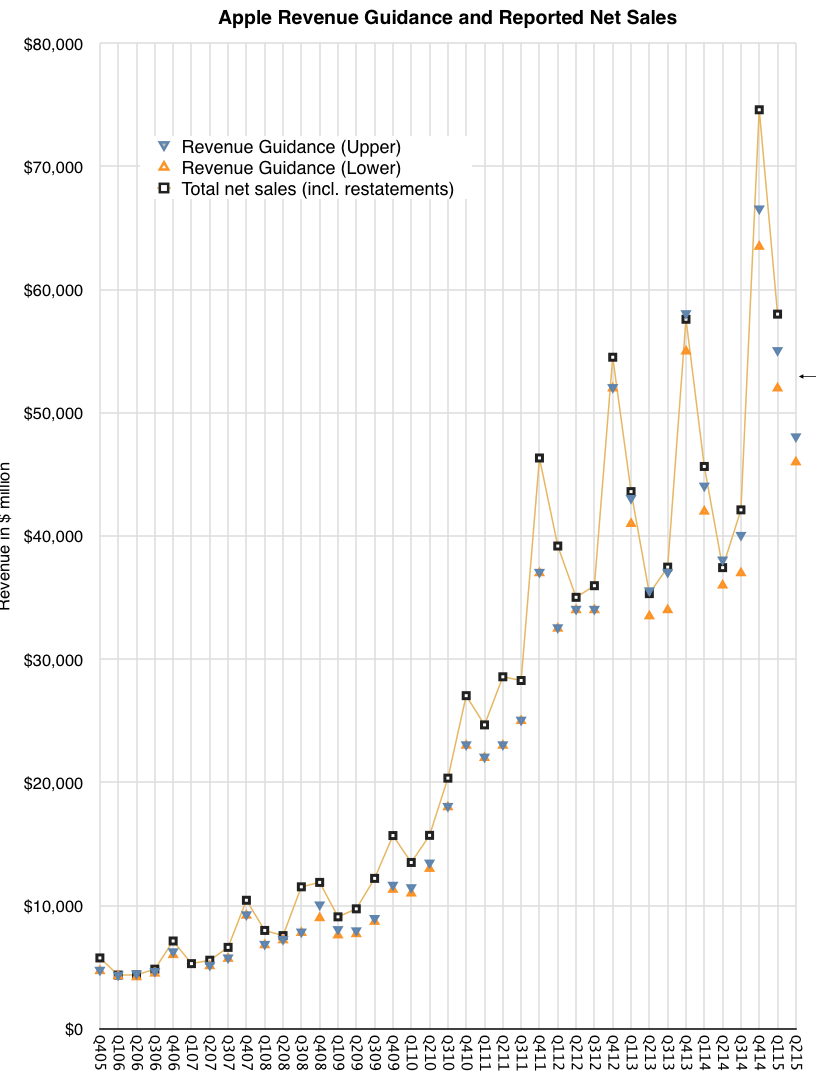
For the first time in many years I feel that there is some potential uncertainty in the results Apple will announce. After a period of excellent accuracy (shown in graph below), the company's guidance has begun to diverge dramatically from reality and the trend might continue this quarter. The cause might be unanticipated demand for the iPhone 6/6 Plus. The growth rate for the product was 46% in Q4 and 40% in Q1. This is unanticipated because growth rates have been below 20% for five quarters and below 50% for eight.
This slowing of growth was explainable given the rate of diffusion of smartphones in the global population. Within the US and some other early adopting economies the market is reaching late stages where most people have switched to smartphones. Globally we are at a more modest 30% or so but in many of the late adopting economies Apple does not have wide distribution.
Of course this thesis is thinly supported. There are many reasons to think that late adopters would still start with iPhone and that earlier adopters of Android would upgrade to iPhone after a few purchase cycles. Thus, the iPhone could prosper in later-adoption or even in post-saturation states of the market.
Indeed, in the post-saturation PC market, Apple is doing very well with the Mac and in the late to post-saturation MP3 player market the iPod did extremely well. This suggests that when it comes to value capture brand, experience and satisfaction trump function, price and share considerations in almost all consumer markets ((Enabled by design for jobs to be done. See non-technology markets for abundant evidence of this. ))
With so many assumptions put asunder the iPhone business suddenly looks downright lively. I adjusted my own growth assumptions and the resulting figures are shown below.
F3Q15
Daniel Tello
Horace Dediu
iPhone
Units
51.0
52.8
Price
626
645
Revenues
31925
34059
iPad
Units
10.0
10.6
Price
428
430
Revenues
4280
4567
Mac
Units
4.95
4.94
Price
1240
1240
Revenues
6136
6129
Services
Revenues
5006
5196
Other
Revenues
3902
3092
Total
Revenues
51249
53043
COGS
30577
31766
GM
40.3%
40.1%
OpEx
5733
5789
OpInc
14939
15488
OI&E
357
350
Pre-tax
15296
15838
Tax
4023
4165
NetInc
11273
11673
Shares
5779
5780
EPS
1.95
2.02
I include for comparison Daniel Tello's forecast as his work carries quite a bit of thoughtful analysis.
The upshot of this is that the company is poised to grow earnings per share at a rate of at least 50%!
That growth rate is astronomical, especially for what is already, by far, the world's biggest company by market capitalization.
This was not supposed to happen because of a so-called "law of large numbers." The "law" is actually a probability theorem which states that the average of experimental results should be close to the expected value given sufficiently large number of experiments. The way it's applied in market analysis (I assume) is that "no company can perform above market average performance for a sufficiently long time".
It implies that there can be no outliers and that all companies "revert to the mean because ..."
Actually, I don't have any idea why they might. The premise that all companies are the same must play into this but companies can only be alike if they have the same processes, priorities and resources. As long as I've been able to observe and as much as I've ever read on the subject I have never encountered any two which had anything in common.
And so the law of large numbers, as applied to market performance is a myth. It is easily disproved with a simple deconstruction into the causes of firm performance, but the empirical data from Apple alone shows how foolish it is to believe it.
At the 2015 WWDC Apple stated that it receives 5 billion requests per week for its maps service. It also said that Apple maps is used 3.5 times more frequently than "the next leading maps app."
These two data points are the total number of data points we have about the global maps market. Neither Google nor Nokia provide usage or share or performance data. Regardless, commentary on the usage, share and performance of Apple Maps has been abundant for the three years since its inception.
The data presented allows us to make a few estimates for the first time and we can hope that additional data can allow a picture to emerge of where maps are going.
With these first two data points we can finally make some estimates. But some assumptions are still needed: We need to assume that the "next leading maps app" is Google Maps. Although there are other maps apps on the iOS platform they are probably insignificant and it's a two-horse race between Google and Apple on iOS.
This means that the 3.5:1 split in usage results in a 78% share for Apple Maps and a 22% share for Google. If we assume that there are about 400 million iOS users of maps ((Note that not all iOS users are maps users. Maps are not used by all users)), it leads to about 90 million Google Maps users on iOS and about 310 million Apple Maps users on iOS. This includes iPad. ((We are excluding OS X use of Maps.))
Given that Google also reported 1 billion downloads in 2014 ((though not necessarily all of these downloads lead to active use, obviously)) we can assume between 25% to 33% Apple Maps "market share" of usage.
At the minimum, 25% share is not insignificant and it's easily sustainable. To understand why, we should note that there is one more data point. In December 2012 I posted an analysis on the the cost of maps. It showed that maintaining maps requires an investment of between $1 billion and $2 billion/yr. With the addition of new features such as 3-D mapping, transit maps and thousands of new cities, the cost is likely to have increased. $2 billion/yr is probably the norm today.
Apple then could be seen as spending about $6.5/user/yr on maps and Google could be spending about $2/user/yr. To be profitable Google would need to find ad revenues of $2/user/yr and Apple would need to find $6 of profit on each phone/yr. Clearly, each of these targets is achievable.
In contrast we can see why Nokia's HERE Maps business is now worth a lot less than it was in 2007. The asset has been for sale for some time and the latest bid has been for $3 billion, making the $5 billion lost in market value and $7 billion of investment since seem like a catastrophe. Without a business model the data is worthless--with only 30 million users the cost per user reaches $66/yr. A buyer needs to find an appropriate model for sustaining a $2 billion/yr burn rate.
So the question of where maps are going depends on the business model for maps. In a world where maps are sustained by device value, 300 million users makes it sustainable. In a world where maps are sustained by advertising, 1 billion users makes it sustainable. What else is there?
How about a world where maps are sustained by transportation services?
Uber's and other auto makers' interest in HERE shows a third business model. Accurate maps are a key to making vehicles autonomous. More so even than the value of the algorithms, precise imaging of roadways enables vehicle autonomy and the value of location gathering systems should grow to meet that future.
It's highly likely that Google's maps efforts are going to continue because they are fueled by a business model. That is also true for Apple's maps efforts, though they are fueled by an entirely different business model. Each of these business models fuels the improvement of the maps product but also of the maps gathering process. As these processes are expensive and licensing options are few there is little incentive to share the data. As a result the processes remain integral to the businesses.
This integrated-while-fueled nature means that maps makers will find it compelling to pursue adjacent business models, i.e. transportation services. It's not a matter of whether they will or won't. It's only a matter of when and where.
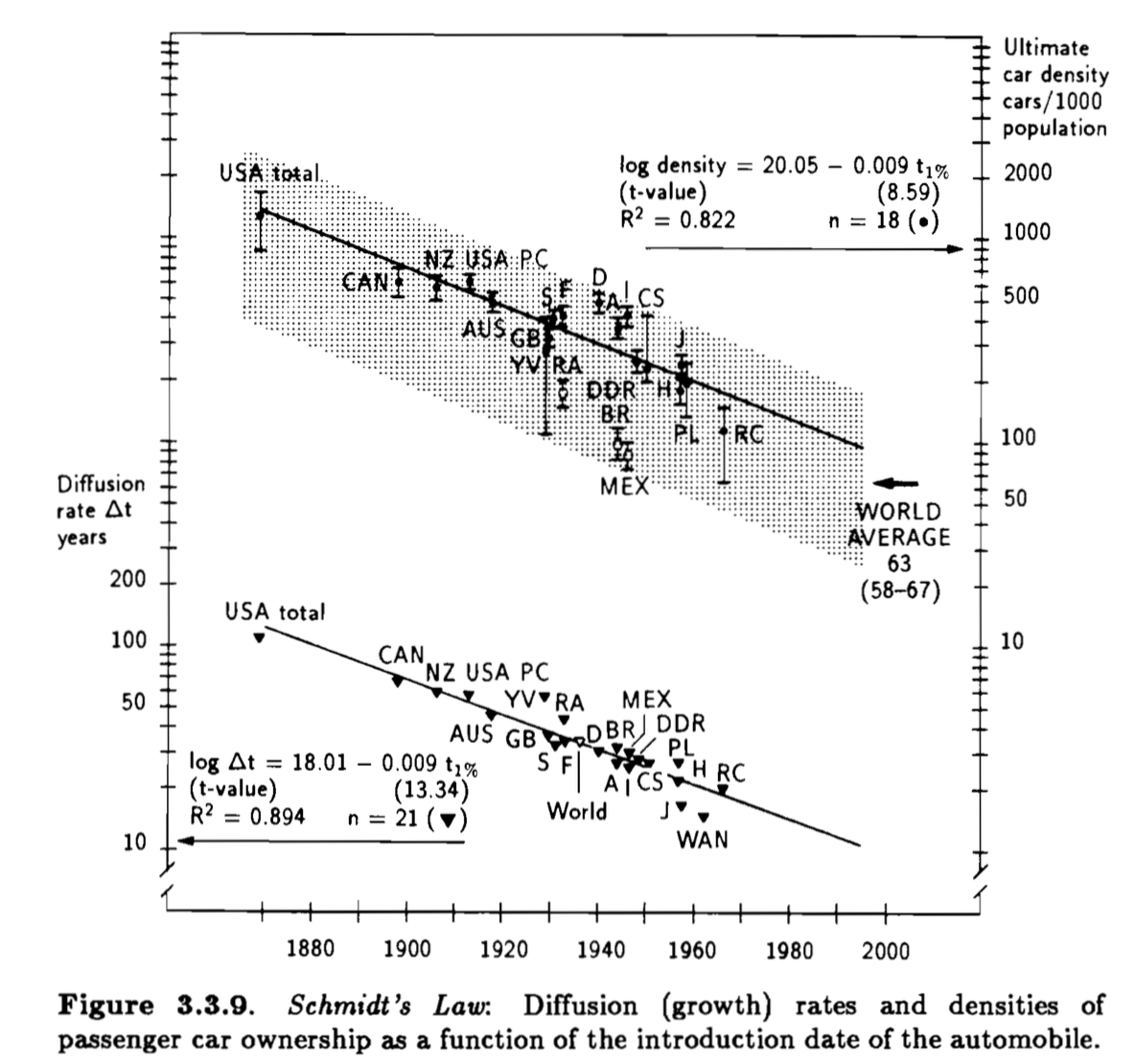
To the analyst, the car industry is a wonderfulstudy. Unlike some other "high technologies," whose market births and deaths are separated by a few changes of the seasons the automobile industry has been around for well over a century. It has been sustained through dozens, perhaps hundreds of innovations. Almost everything about the car of a century ago has been improved.
Not only improvements to the product itself but improvements to the infrastructure that supports it: roads, gas stations, services, insurance, regulation. At the same time, its numbers have increased steadily as the car has spread to all corners of the world through waves of increased production and distribution. Although invented in Europe, the production system that allowed it to reach the mass market took hold in the US. That production system was then exported to Europe then to Japan and then to Korea and now to China.
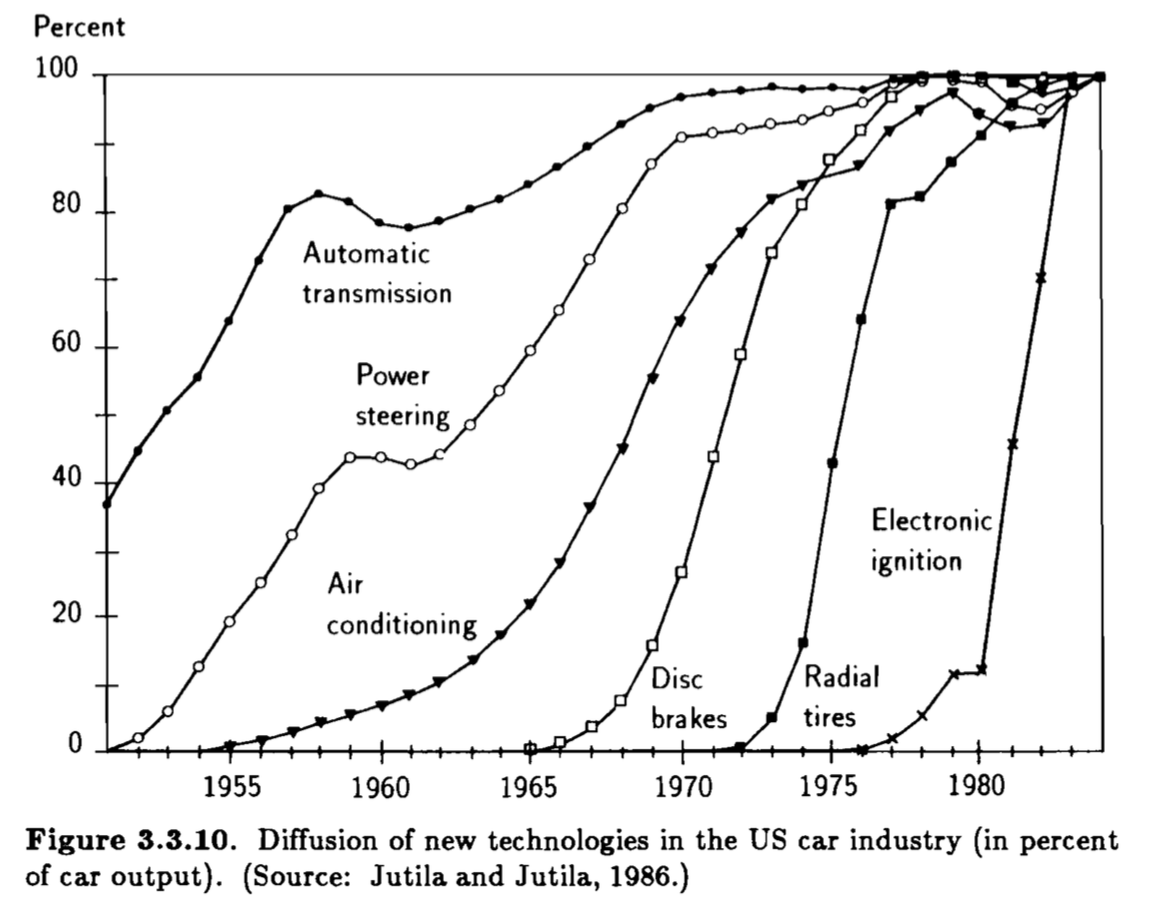
Figures 3.3.9 and 3.3.10 from Arnulf Grubler's The Rise and Fall of Infrastructures
However, throughout this century of improvement, the business structure—the way money is made—has not changed. Even with the arrival of Volkswagen in the 1960s and Japanese automakers in the 80s, the network of incumbents has not been displaced. Newcomers have taken share, but there have been few exits suggesting that classical disruption has not taken place.
When we look at the reasons for the share displacement that did take place, we see innovation in production systems and distribution as the core causes. We see new manufacturing processes and competition against non-consumption. What we don’t see is new technologies. We don’t see diesel engines or anti-lock braking or crumple zones or fuel injection or radial tires or airbags or automatic transmission or air conditioning or electronic ignition or safety glass, or any of the other hundreds of technologies that have been adopted as causing any change in market share.
Every innovation tends to diffuse rapidly throughout the industry, being widely adopted by all manufacturers. Production systems such as the ones from Ford and Toyota have been much slower to be adopted which has offered those innovators an advantage for a few decades, but they too have eventually been widely copied and created normative behavior. The opening of new markets like Asia, Eastern Europe, Latin America, Africa and China have created opportunities for local manufacturers but eventually those advantages too have or will be diminished with time.
So, given this, we have to ask if the the availability of new power storage technologies would allow an early mover to displace and move aside these established makers. To answer in the positive would imply that the challenger has an asymmetric business model—one which causes the incumbents to flee in the opposite direction. But Tesla is manufacturing cars using the same JIT processes and ramping quite slowly. Toyota-style process-driven innovation does not seem to be even in the works. There is no shortage of manufacturing capacity, indeed there is too much.
Furthermore, Tesla is selling cars in established markets competing against existing consumption. Volkswagen Beetle or Model T style competition against non-consumption does not appear to be on offer.
Tesla's product introduction rate is relatively sedate, so a higher rate of product development which might let them “turn inside” the incumbents, does not seem likely.
Finally Tesla is introducing products priced well above average appealing to the wealthiest of customers, again causing us to ask how this might cause a luxury company to look at their solution and exclaim “Not for us!”.
Looking from every angle I am unable to find the way that Tesla is asymmetric. Disruption theory suggests that whatever causes it to survive or prosper will be embraced and extended by competitors precisely because it will also cause those competitors to survive and prosper.
The auto industry may be a lot slower than the computer industry to respond. But once the industry embraces battery-based power, it will convert a world-wide production and distribution system to sustain itself.
That does not mean Tesla is a bad business. They may carry on with Porsche-like or even BMW volumes for a long time. But that’s not a disruptive outcome, it's a niche strategy.
There is one more point. As Tesla has chosen to share its intellectual property and as Elon Musk has stated publicly, they welcome others to build the same cars they do. So by their own admission the company does not seek to disrupt. Disruption is a competitive stance.
Unicorns typically are valued on the basis of number of users. While they are not yet monetizing those users, their growth and engagement metrics are expected to be off the charts. As there are no revenues (or profits) the $billion valuation hinges on a nominal value of $/user. That figure is based on comparable companies (e.g. Facebook) which do monetize their users.
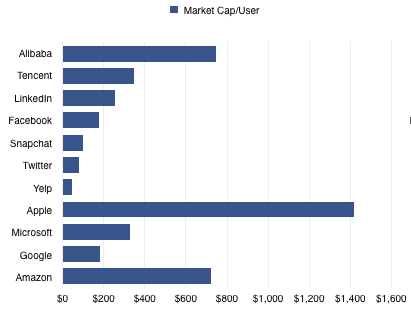
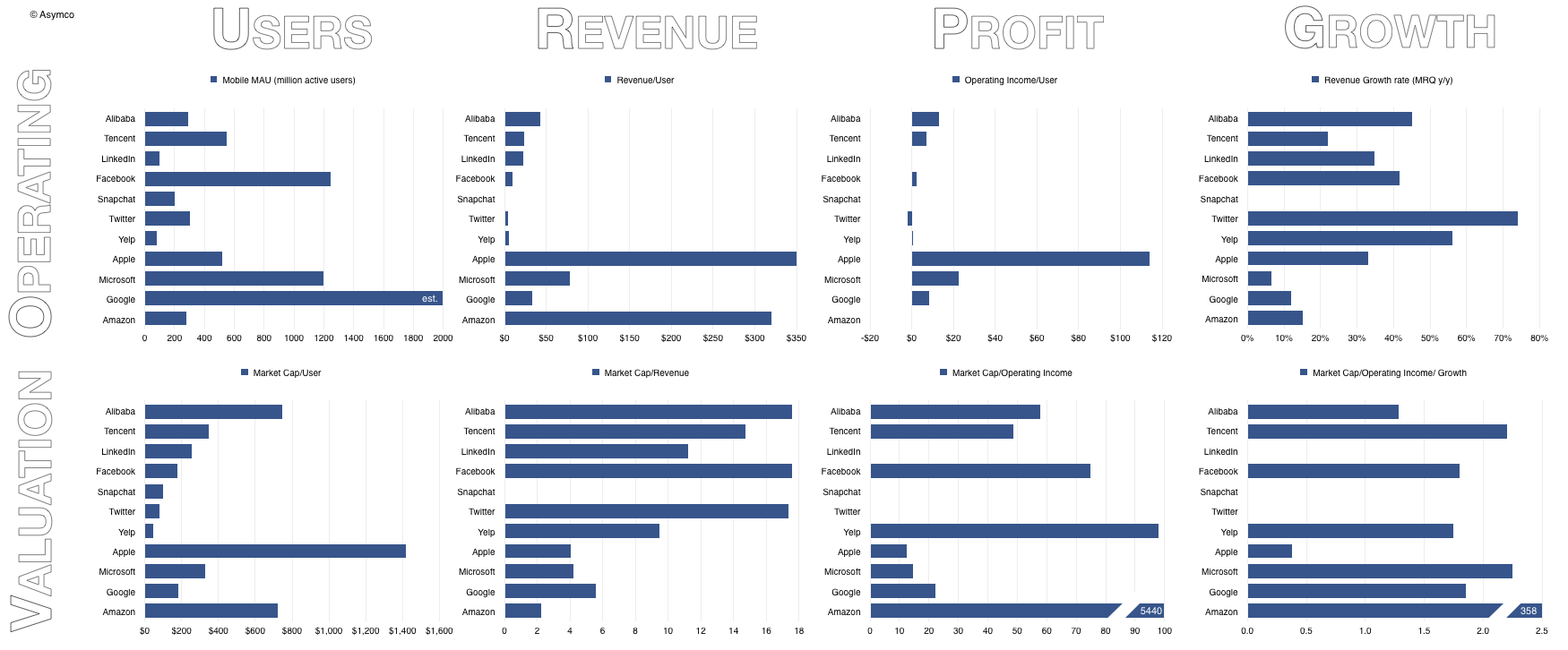
Since the unicorn's capitalization/user defines its valuation, which company should be considered comparable? Unfortunately they range widely. There are many alternatives. The graph below shows a few Market Cap/Mobile User rates ranging from $45 for Yelp to $747 for Alibaba.
Note that I've also added companies which may not be considered as unicorn comparables because they are not usually valued on a per-user basis. Apple, Microsoft, Google and Amazon are priced by product sales, typically. However, most of them operate and self-define as service organizations. Microsoft has been "monetizing users" for decades using a recurring revenue model. It has a "SaaS" business logic for most of its revenues. Google ((Google users are estimated at 2 billion active Android/GMS devices)) likewise. Amazon reports its active users every quarter and obviously is measuring itself by that metric.
Apple ((The assumption here is that Apple has 520 million active users which is based on iOS devices in use estimates)) is the least likely to be seen as a company whose value is a function of user base. Nonetheless it behaves entirely on that basis. The company's entire strategy depends on satisfying its customers and building its brand which can only have one outcome: loyalty and repeat purchases. The services and software they offer can be seen as supporting that brand loyalty which is converted to profit through an above-average selling price.
Being mature of business model therefore does not exclude a company from being valued like all the kids are these days.
So, if we do look at the value/user metric we might as well look at the revenues, operating profit and growth data.
Unicorns are therefore characterized as having negligible revenue or profit but significant growth. The growth of Alibaba, Tencent, LinkedIn, Facebook, Twitter, Snapchat and Yelp should be seen in the 50% y/y range. The growth of mature companies is more modest: Microsoft (<10%), Google (12%), Amazon (15%).
Apple is an exception with recent growth in the 30% to 40% range.
Markets therefore value internet services at multiples of 10 to 20x revenues and 50x at least in terms of operating income. These multiples don't yet apply to Unicorns, since they typically don't have revenues, but the expectations are typically in this range once they do.
Mature product companies are valued more cheaply with 2x revenues for Amazon (a retailer with zero margins) up to Google with near 6x. Apple and Microsoft are in the middle at 4x revenues.
Mature company value as a function of income is also much lower ranking from about 12 for Apple to 22 for Google. Amazon's multiple is astronomical only because it has almost zero income.
Finally, when considering growth and income together ((When seen into the future this is the PEG ratio or Share Price/Earnings/Growth. When seen into the past, this is the PETG or Share Price/Earnings/Trailing Growth)) both emerging services and product companies are priced between 1.3 and 2.5. The outliers are Amazon due to its lack of income (PETG of 358) and Apple with its enormous income (PETG of 0.4).
This last ratio has had a "rule of thumb" of 1.0 being the "fair value" with <1 being seen as under-valued for growth and >1 being over-valued. Alternatively it can be seen as either pessimism about sustainability or optimism, respectively.
Clearly Unicorn Mania (or Unicornia) is a reflection of an optimism around new market disruptions in many industries where software has suddenly become ingestible. Old-school software companies are seen as less exciting in this context. If only they could take part in these new market creating opportunities then maybe they too could benefit from this optimism.
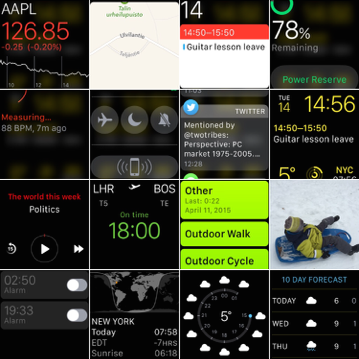
The Apple Watch offers a hierarchy of surfaces onto which software can compete for attention:
The Complication Layer
The Notification Layer
The Glances Layer
The App Screen
These surfaces are arranged in a hierarchy where the highest is the most accessible and the lowest is the least accessible. In a similar fashion we can consider the hierarchy of screens a person could reasonably be considered to be exposed to:
The Watch
The Phone
The Tablet
The TV
The Personal Computer
The Public/Work Computer
Note that this hierarchy is correlated to the size and hence the portability and persistence of proximity to the user. Each of the screens has its own "surfaces" which expose software to the user with various degrees of ease. For instance the iPhone has Notifications, Control Center, Home Screen, etc. The OS X personal computer has the Desktop, Notifications, the Dashboard, the Browser etc.
It follows then that software which is located at the top of each hierarchy on each device will have the greatest exposure to user interaction and that the device which has the nearest proximity to the user will provide the greatest value to software developers.
This implies further that the most valuable "real estate" for software will be the Complication layer on the Watch.
The software which receives either default placement there or which convinces the highest number of users to opt for placement there will have the greatest potential value. As suggested in my post on how the Watch will be valued, how software will be valued will be by the probability of its Settings being enabled for display on the Watch and its presence within Glances.
The jostling for position within the constrained real estate on the wrist will be analogous to the competition for positioning on the phone. You'll note that the winners on the phone were different than the winners on the PC. My bet is that the winners on the Watch will be different than the winners on the Phone.
Before its launch, I said that the Apple Watch would be as much a watch as the iPhone is a phone. Recall that when the iPhone was launched it was anchored on three tentpoles, one of which was being a phone and that when the Apple Watch was launched it was also anchored on three tentpoles, one of which was being a watch.
Realizing that on the iPhone the "phone" is but an app — one which I find populated with FaceTime calls rather than cellular calls and whose messaging history is filled with iMessage threads rather than SMS — I consider it safe to say what the iPhone is today not as much a phone as a very personal computer. And so the question is whether the Watch will quickly leave behind its timekeeping anchor and move into being something completely different.
I had the chance to use the Watch for a few days and can say that timekeeping is probably as insignificant to its essence as it's possible to be. It feels like a watch in the physical sense, looking good in the process (as the iPhone physically felt like a phone, also without being hard on the eyes)
However it does not feel like a watch conceptually. I find myself drawn into a conversation by its vocabulary of vibrations. I find myself talking to it. I find myself listening to it. I find myself glancing at information about faraway places. I find myself paying for things with it. I find myself checking into flights with it. I order transportation, listen to news, check live data streams and get myself nagged to exercise. It tells me where I am. It tells me where to go. It tells me when to leave.
Nothing ever worn on a wrist, or anywhere else for that matter, has done any of these things before. Not only are these things mesmerizing but they are done in a productive way on a wristwatch. In other words they are done in a mindful way.
Cynics may say it does too little. Philistines may say it does too much. But for me it does just what I want it to do when I want it done. The things which are not done stay out of the way. This discretion is just as important as the effectiveness of action.
Even more remarkably, this tasteful minder is offered not to a fortunate few but to millions of people of average means. In the true sense of technological democratization, Apple Watch is a phenomenon for mass consumption.
Its launch needs to be understood as a watershed event. It could be compared to the launch of the Mac or the iPhone but it is different as much as it is the same.
The product has a completely different character. It tries not to do more but to do less. But that which it does is more meaningful, more thoughtful. We talk of computing speeds and network feeds but we spend much more time and money to visit people who have little to say and say it slowly. We value charm and wit more than bandwidth and throughput. We are drawn to beauty more than to speed. This is what this computer captures.
A maxim of the computing of the 21st century is that the closer the machine is to us the more we value it. It does not get rewarded for being fast but for being a companion. It does not get valued for features but for beauty. It does not get hired for power but for control. It does not get worn because it's smart but because it's clever.
People understand these tradeoffs instinctively. They are not concepts that need selling. The product speaks plainly of itself and its success is therefore guaranteed.
It won't be easy. The company will not be reporting the Watch segment revenues or (presumably) unit sales and therefore we won't have an accurate unadulterated view of the business. In addition, the large number of products in the mix and wide price variance means that it will be difficult for analysts to determine demand and price.
There is a hidden benefit to not having this data. All data is a creation and it tends to lead thinking in directions led by whatever is being measured (and whoever chose those measures and their motives). And yet without data there is no evidence and no credibility. In other words: You can't manage without measurement but you can't be sure what to measure.
The analyst is then faced with a requirement to have good taste or at least judgement about what to measure. This judgement is based on experience and good theory. Given that, what could we measure to determine whether the Apple Watch will be a success?
Here are some suggestions:
Language. Measure whether "Watch" will come to mean "Apple Watch". "Phone" has come to mean not only "smartphone" but also all mobile/cellular phones and not just things used for calling but things used for all manner of information. This is a great test because the theft of semantics can only be accomplished through a degree of ubiquity of influential mindshare. Incidentally, the brand may well have been designed to do just that. ((It leaves open the question as to what watches as currently defined will come to be known as.))
A measurable and significant reduction in the use of the iPhone. The Watch peels off uses from the iPhone and therefore the more it peels off, the less remains. However, that which remains will be more uniquely valuable to the incumbent. This is the process of carving and erosion that the PC experienced vs. mobile devices in general.
An increase in the mix of large-screen iPhones. As iPhones are removed from pockets more rarely, the larger version might be more comfortable to carry and more useful to use for the immersive tasks that are outside the scope of Watch.
An overall increase in iPhone sales beyond the foreseeable trajectory. This would suggest switchers from Android would be drawn to the platform purely for the value of the "accessory". Note that this is not inconsistent with the lower usage and higher spec mix measurements.
Apps uniquely targeting the Watch. It's hard to imagine how this will develop as it involves millions of creative minds, but as smartphones created new economic value through the solving of new jobs to be done, the Watch should do the same. As a side-effect it should lead to new empires (or at least Unicorns) being formed around Watch use.
Iteration. How quickly and deeply will the product be improved? Basic accessories like headphones and Apple TV have a leisurely update cycle. Smarter devices are faster. The cycle time of iteration should indicate how seriously Apple takes the platform and that itself should be fueled by positive consumer sentiment for the product.
These indicators are vague and the data will be weakly signaled but in many ways it will be more meaningful than any financial performance figures.
Apple's new watches are priced in a pattern unlike any of the previous pricing models for Apple products.
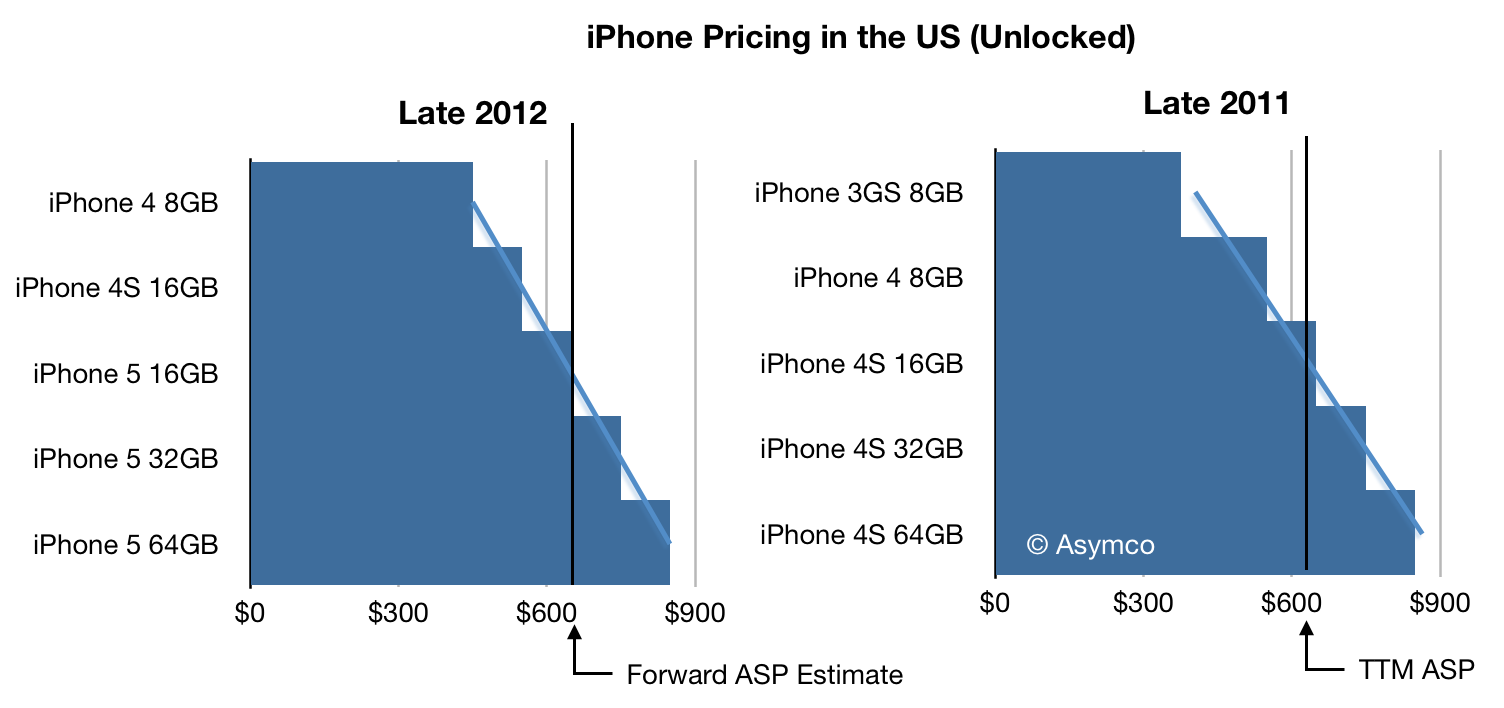
Previous pricing models for iPhone, iPad, Mac and iPod were typically structured around storage differences. The higher the storage, the higher the price. The Mac had a slight variation where processor and graphics offered some additional configuration options. To illustrate, the graph below shows typical price bands for the iPhone (2011 and 2012)
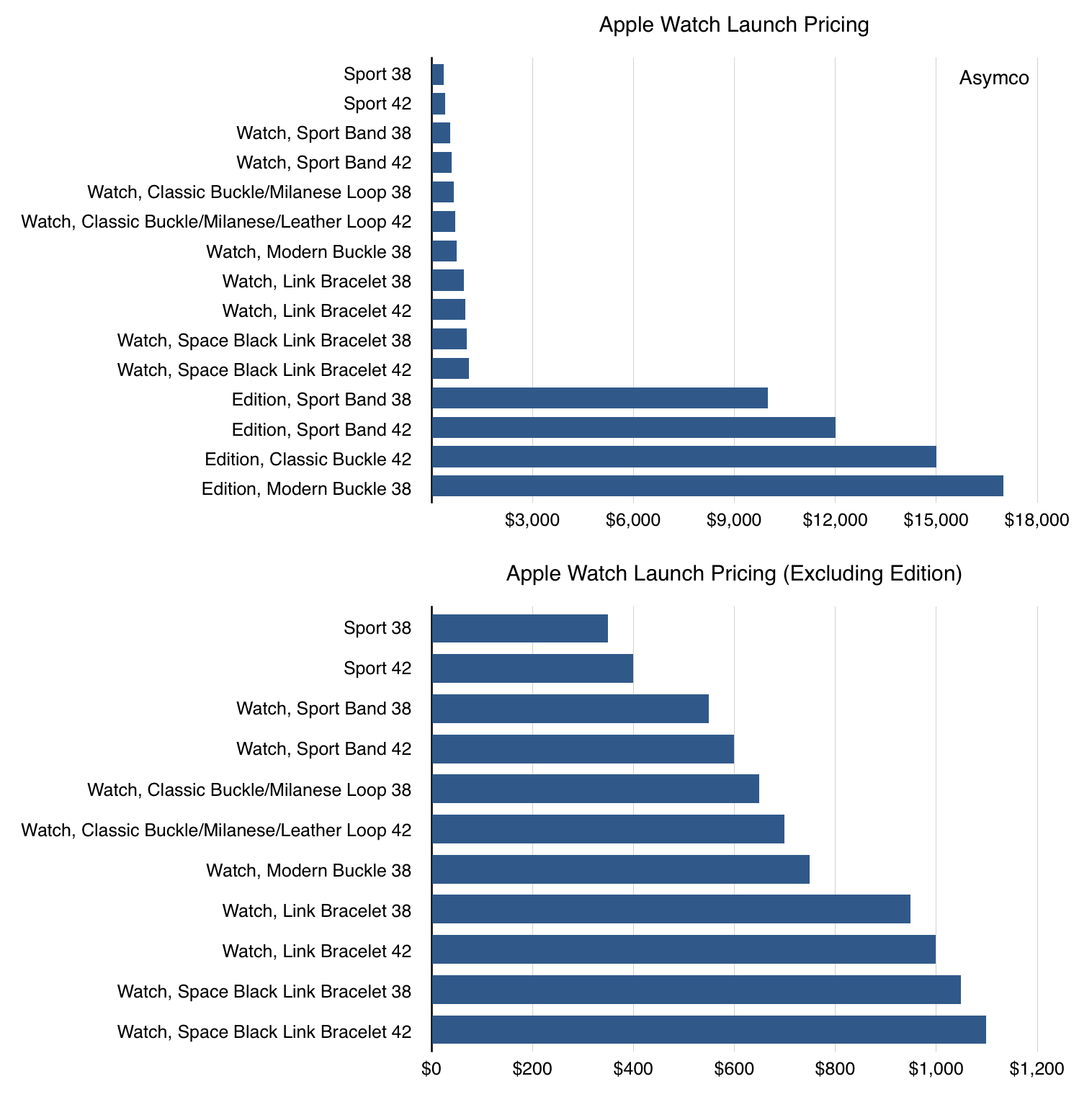
In contrast, the watches are differentiated by size, materials and bands. There are also a total of 38 watch configurations available at launch (SKUs) and another 38 bands that can be purchased separately.
The bands come in four price points and the watches in 15. Of these 15 watch prices, four are dramatically different. The pricing of the watches is shown in the two graphs below (with and without the Edition).
This mix of product makes average pricing estimation more challenging, but the more pertinent question is what does this new pricing model signify? Is it something that Apple can "pull off"? Can Apple actually price not on functionality (or options thereon) but on materials?
It used to be said that Apple's profit engine was fueled by the ability to price memory at a significant mark-up on its cost. The iPod earned the vast bulk of music player profits by offering additional memory increments at significant price increments. Even today, a 64GB iPod Touch is priced $100 higher than a 16GB version. Sounds reasonable, but a quick check shows that 64GB of Flash memory probably costs about $5. This exploitation of pricing/cost differences at the margin allows for great profitability and is rooted in the ways the buyers contemplate value.
Therefore the difference between memory-based pricing and materials-based pricing is only in the choice of how to attach value in the mind of the buyer. In one case it's having the option on storage, in the other it's having the option, perhaps, of more durability, quality or glamour.
The tricky part is understanding just how much the market will bear. What is the right differential for pricing of steel vs. aluminum? Or what makes gold worth so much more?
The cost of these materials (and the processes needed to manufacture them) is not very important. As with memories, the differences are not that significant. It could even be that the Aluminum process is more expensive than the steel process--it depends also on volume.
What matters most is how to gauge the perception of value.
This is where one can take cues from the existing market. Gold is costlier than steel but the pricing difference is greater still. Multiplying $1000 (cost) by 10 (to get a price) yields far more profit than multiplying $1 by 20. This perception of gold as being worth it is far beyond its utility--a perception which has taken centuries to build. What Apple is doing with Watch pricing is simply leveraging existing perceptions of value for materials and using them to capture profits for an otherwise purely functional product.
But that process of using perception to gain pricing advantage for function is how Prestige branding has always worked. The notion that materials, craftsmanship and attention to detail can be priced at huge multiples of cost is possible only with the right brand. That brand, itself built over decades, even generations, gives assurance of quality, perhaps exclusivity and comforts the purchaser in the moment of decision. It also provides assurance after the purchase and preserves the feeling of value well into the future. So-called Luxury brands are those which can impart these qualities on their products and extract the pricing advantage.
Sounds great, so why doesn't everybody do it? The answer is that it takes time and perseverance, with typically low volumes. This is not something technology brands have been able to do. Mainly because the products are perishable but also because they have not been around for long. With technology, the value is high at purchase on a functional basis but diminishes rapidly afterwards. It's as if, in order to preserve notional brand value, a product needs to be a functional commodity, undifferentiated on what it does but differentiated on the way it does it.
This is the unique value of Apple's brand: among technological brands it can stretch to cover the perception of value for design, materials, craftsmanship and prestige. At the same time it offers new experiences and introduces new products for new jobs to be done.
According to Folkore, in 1981 Apple took out a two page ad in Scientific American which explained that whereas humans cannot run as fast as other animals, a human on a bicycle is the fastest species on earth.
Jobs had made the observation that a computer was "a bicycle for the mind" earlier, in 1980, at a time when the decision to purchase a computer was driven by an intellectual curiosity and justified as an improvement or assistant to the intellect. It was to make the lighten the labors of our intellect.
Apple brand at the time as an appeal to the intellect via a humanistic argument. A more emotive positioning of a tool, but a tool nonetheless. This positioning evolved throughout the 80s and 90s into an "intersection of technology and the liberal arts."
We can see how the conversation with the potential buyer was along the lines of appealing to the intellect while offering a humanist sweetener. Humanizing the product allowed it to be accepted into a world that feared the complexity and awkwardness of such a machine.
During the 2000s, with the ascent of iPod, the conversation shifted to prioritizing the emotions more than the intellect. The products had to appeal to those who wished to express and enjoy products of emotional value. Products like music and videos and the output of the arts rather than the sciences. The brand became emotional rather than intellectual. It created an aesthetic, and become culturally iconic.
During the 2010s, with the ascent of iPhone and the emergence of the Watch, the brand speaks a language of instinct, leaving intellect and emotion as secondary or tertiary voices. Instinct is visceral, lust-inducing. It seems to short-circuit any of the rational. Non-rationalism does not mean irrational. It just skips right over the head and heart and hits the gut.
One could argue that during these three decades, the organs the brand was engaging in conversation shifted from the mind to the heart and then to the glands. Those glands which release hormones and are directed by non-rational neurons. The evidence of the conversation would be in resulting products causing pupils to dilate, breaths to be quickly drawn and skin temperatures to rise.
The brand therefore has managed to move from a rational, to a neurological, to an endocrine response.
The curious thing is that during these shifts, Apple's entry into new biological spheres of influence has been largely unchallenged. I suspect this is because emotional or instinctive products are appealing due to their lack of rationalized value. In other words, what makes a product hormonally appealing is a lack of intellectual appeal ((and vice-versa in many cases)). Apple can enter into the world of lustful appeal while lustful brands can't enter into functional appeal.
This is a classic asymmetry which perhaps no other brand can pull off. ((The reason is complicated but stems from the firm having been built to execute nothing but home runs. By shunning portfolio theory, Apple can wander into new categories far from its biological home grounds.))
Understanding Apple’s intentions seems to be a popular parlor game and there are many attempts at divining intention from data and market study. These attempts at market research for answers are futile because Apple does not compete in existing markets but rather it creates new markets. For instance, the market for the Apple II could not have been assessed from research into the computing market of 1974. The intention for Apple to enter into music devices and services could not have been predicted through an analysis of MP3 player market in 2000. The iPhone was also not predicated on the market for “Internet Communicators” in 2006 or 2002 when the iPad was first contemplated. ((The market for phones was large but the iPhone pricing and features made it incompatible with any reasonable segment of it.))
Instead of measuring the size of pre-existing markets, surveying the functionality of existing products, or weighing toxically financialized ratios like margins and market shares, I recall this ad (Our Signature, first seen at 2013 WWDC):
This is it This is what matters
The experience of a product How it will make someone feel Will it make life better? Does it deserve to exist?
We spend a lot of time on a few great things Until every idea we touch Enhances each life it touches
You may rarely look at it But you will always feel it This is our signature And it means everything
My interpretation of these lines, coupled with additional public statements can be used to create a “litmus test” for new product categories:
1. The experience of a product. Read: They will work on things to which they can make a meaningful contribution. To me this means that they will build things which require an integrated approach. As Apple is "the last integrated company standing” it means they will work on problems where the system is not good enough. This means that they will not work on problems where an individual modular component is not good enough. By system I mean, in the largest sense: production, design, distribution, sales, support and services must work in a seamless way. Systems analysis implies a broad understanding of the causes of insufficient performance along the dimensions of “experience”. The experiences are what differentiate the products (and lead to high margins) and these experiences are possible only through the control of interdependent modules.
2. Does it deserve to exist? Read: They will work on very few things. They will say no to many things. It’s still true that all of Apple’s products can fit on one table. That may not be true forever, but their product space will not grow as quickly as sales grow. This means that there is no notion of “marginal value” or portfolio theory where products are added because they can be justified as “moving the needle” or balancing demand. Rather, the few things which will be worked on will address non-consumption. Non-consumption of experiences.
3. Enhance life. Read: The things they release are inevitable even though nobody asked for them. The reason this is possible is that there are unmet and unidentified “jobs to be done” which are powerful sources of demand and whose satisfaction leads to unforeseen rewards. The problems that can be addressed are uncovered through a process of conversation with a few people. They are not uncovered through surveys or large n statistical studies. Without the ability to ask the right questions, big data only leads to big misdirection. In contrast, good taste in questions allows small n to lead to big insight. Apple’s ability for finding the right problem to solve comes from this greatness of taste in questions.
So given this litmus test, will Apple build a Car?
I believe the problem of transportation and its proxy, the automobile, provide all the requisite demand for Apple's attention. Technical questions abound and they may still prove unsurmountable before a launch happens, but there are no doubts in my mind that this is a problem Apple would see fit to address.
Non-consumption of unmet and unarticulated jobs to be done can and should be addressed with systems solutions and new experiences.