Asymco

Asymmetric Intelligence

Theory

  1. Will Apple need to cut margins on the iPhone?

    Research · 39 comments

    Many comments on and off this blog raise the specter of the inevitable decline in Apple's margins due to two forces:

    1. The iPhone begins to reach into more markets or points of distribution without exclusivity.
    2. The Android surge will apply competitive pressure forcing Apple's pricing and hence margins.

    The first claim can be countered by observing that Apple has not cut margins when switching from exclusive to non-exclusive distribution in several markets. In fact, Apple made this information public: When Tim Cook was asked in October 2009 earnings concall “So when you go from exclusive to multiple, you don’t change the charge to the carrier?” Cook answered, “Correct.”

    The second claim can be countered by observing that innovation trumps pricing every time. When looking back at the three years' history of the industry there is a clear but counter-intuitive demonstration of the power of innovation in the market.

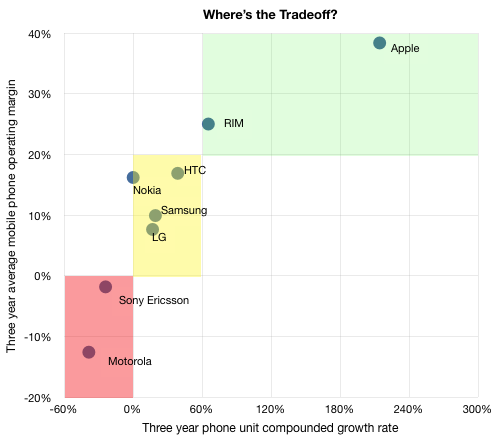
    Whereas one would expect that in a highly competitive market torrid growth would only be possible with lower pricing and hence margins, the opposite is observed in the phone market during the last three years:

    [HTC data is over a two year period]

    The graph shows that companies that grew the fastest had the highest margins, and the companies that grew the slowest had the lowest margins. The trend line in the graph above is precisely orthogonal to what would be expected in a commodity market.

    The orthogonality of growth vs. margin points to the effect of innovation in this market. In a non-commoditized market (i.e. one where usable improvements in a product are quickly absorbed and highly valued) high growth and high margins are correlated.

    In a commodity market (i.e. one where improvements in a product are neither absorbed nor valued) growth can only come at the expense of margins.

    Being able to spot when a market tips from innovation-driven disruption to price-driven commodity sales is an essential skill for both investors and managers. It requires a comprehensive and integrated analysis of technology, finance, consumer behavior, competitive forces and a lot of faith in theory to make the right call.

    As a keen observer I think the market still has a long way to go before it reaches this tipping point. I don't see it happening in the next three years (which is just 2 product cycles--the most an outside observer can hope to roadmap).

  2. Property rights for your living room

    Research · 14 comments

    The new Apple TV has created a cottage industry of pundits debating the future ownership of your living room. This topic of to whom your living room belongs has been around since the 90's when Microsoft sought to plant a flag on your TV set and claim it in the name of Gates with a cable box software platform. A few billion dollars later they came away with not a single deed, not even to your couch.

    Talk of ownership flared up again in the last decade as various game consoles and boxes paraded in front of consumers. There were wars waged over DVD formats, encoding formats and DRM. Then came hulu and Apple TV and roku and who knows what else I missed.

    It's all bound to go badly. Here's why this property will remain off limits:

    • The ownership is not for the space but for the time and attention of the audience. The time spent consuming televised content is what's at stake.
    • That time is increasingly being fragmented. It was first broken into tiny pieces by cable channels that divided audiences into niches.
    • Erosion of cohesive audiences continued with DVD rentals and Netflix. Home theaters ate into both broadcast and outside-the-home entertainment
    • Attention was attacked with PVRs like Tivo.
    • Demographics were exploded with game consoles with age groups separating into different modes of consumption.
    • Migration of other portable devices like laptops, smartphones and iPads into the couch room are now further degrading the value of the "living room" as a significant target for advertisers.
    • Internationally there never was a unified living room. Consumption patterns and even broadcast business models vary widely.

    Ultimately there's really nothing in "the living room" worth fighting for. The disruptive play here is the crumbling of monolithic audiences that used to define "prime time". It's not a new box to take over from another box.

    The technologies that are coming to invade the living room have already broken it into parcels that lack cohesion.

    Just like the division of land among numerous generations of heirs creates land only useful for residential development, it's time to abandon dreams of owning the farm. That farm has long ago stopped being fertile.

  3. The End of Management - WSJ.com

    Research · 6 comments

    When I asked members of The Wall Street Journal's CEO Council, a group of chief executives who meet each year to deliberate on issues of public interest, to name the most influential business book they had read, many cited Clayton Christensen's "The Innovator's Dilemma." That book documents how market-leading companies have missed game-changing transformations in industry after industry—computers (mainframes to PCs), telephony (landline to mobile), photography (film to digital), stock markets (floor to online)—not because of "bad" management, but because they followed the dictates of "good" management. They listened closely to their customers. They carefully studied market trends. They allocated capital to the innovations that promised the largest returns. And in the process, they missed disruptive innovations that opened up new customers and markets for lower-margin, blockbuster products.

    via The End of Management - WSJ.com.

    Here is the book: http://amzn.to/9jycyp

  4. The Android abdication

    Research · 18 comments

    When I wrote about Android's pursuit of the biggest losers, I made the explicit claim, backed by data, that Android was most attractive to device vendors who were in financial distress. Android is a lifeline to sustain failing business models. But underlying that claim was the more sinister implication that Android is sustaining to the incumbent operator business models. That means that Android is subject to operator manipulation and its market access as well as those of competing platforms will be throttled to maintain control.

    The article below makes an even stronger case.

    As a result, we now have a situation where the U.S. telecoms are reconsolidating their power and putting customers at a disadvantage. And, their empowering factor is Android. The carriers and handset makers can do anything they want with it. Unfortunately, that now includes loading lots of their own crapware onto these Android devices, using marketing schemes that confuse buyers (see the Samsung Galaxy S), and nickle-and-diming customers with added fees to run certain apps such as tethering, GPS navigation, and mobile video.

    The dirty little secret about Google Android | Tech Sanity Check | TechRepublic.com.

    I would not say that Android is enabling the consolidation of operator power. I would say that operator power never wavered.

    The article concludes:

    Despite the ugly truth that Android is enabling the U.S. wireless carriers to exert too much control over the devices and keep the U.S. mobile market in a balkanized state of affairs, Android remains the antithesis of the closed Apple ecosystem that drives the iPhone and so it’s still very attractive to a lot of technologists and business professionals.

    But, the consequence of not putting any walls around your product is that both the good guys and the bad guys can do anything they want with it. And for Android, that means that it’s being manipulated, modified, and maimed by companies that care more about preserving their old business models than empowering people with the next great wave of computing devices.

    That sounds about right.

  5. Analysts' categorical failure

    Research · 15 comments

    Gartner explicitly explained so in its press release: "Gartner's PC group does not track media tablet sales in this PC shipment data, so iPad sales are not included in these results

    via Is Apple the real U.S. PC market share leader -- or soon will be? | Betanews.

    The reluctance of  industry analysts to measure the iPad as a computer is a fascinating and vivid symptom of how analysts conspire with their customers to smother visibility of impending failure.

    Before we dive into the motivation to ignore iPads, we need to understand how analysts in general and companies in particular group products into comparable piles. This process of grouping is called categorization. It should be distinguished from segmentation which groups buyers in a market. Categorization is essential for competitive analysis and measurement of the performance of a product (relative to other products).

    Categorization is a challenging problem for most companies. To illustrate why, consider four possible methods for categorizing products:

    1. By product attributes. The assumption here is that products with similar attributes compete in the same market. As an example hard disk drives might be categorized by dimensions of the cases and sub-categorized by capacity and perhaps transfer speeds.
    2. By user attributes. This method is similar to segmentation where products are grouped by the type of buyer. Magazine titles might be properly categorized by the age and gender of the readers. This can also cover geographic data.
    3. By user behavior. This method, sometimes called psychographics is a more advanced method than demographics where user personality, values, attitudes, interests or lifestyles are measured. You might have seen examples where users are defined with a "prototype" person and the products are attached to this prototype. This is a common way to categorize mobile phones (Nokia is a known leader in this method).
    4. By modes of consumption. Determine what products are hired to do the same job. In this case you have to have real insight into what people actually do with their products and try to look broadly at what they substitute. The classic example of this is to understand that a power drill competes with products what make holes in walls not just with other drills.

    When reading this list, it's easy to see that it's ranked in order of difficulty. The easiest thing to do is group according to things you can measure easily. Products are easier to measure than demographics which are easer to measure than psychographics and that's easier to capture than observed behavior.

    Consider how you would structure a study to capture this data.

    1. In the first case, you need an analyst to collect products (or just their descriptions) and record values in a spreadsheet.
    2. In the second case, users need to be surveyed for basic data. This is hard because you have to find users and then you have to get a statistically significant unbiased sample.
    3. In the psychographic study you need to ask a lot more questions about lifestyle in your survey and hope that the subject answers honestly. You still need a large sample.
    4. In the case of consumption analysis you need to observe a subject use a product for a prolonged period of time in the usual context where the product is used and be able to interject questions when certain behavior is encountered. The observation of one person can take one research person-day per subject. To get statistically significant data requires literally man-years of work.

    Now it should be clear why an analyst will only categorize according to product attributes. It's not only economically and temporally expensive to perform research on methods 2 to 4 but it also requires interpretation and insight into study development.

    A few companies go beyond buying analyst market data and do their own research. As far as I know user studies are more commonly done by consumer products companies. But it's extremely rare to see this research done by low-margin technology companies. They don't have the budgets or skill sets to do any research.

    However, in my experience, nobody performs the fourth, most difficult, form of categorization.

    The result is that good, smart managers trained to always base their decisions on hard facts, pick up these lowest-deonominator analyst reports to help decide which products to develop. And it should be obvious why they are surprised when products that did not show up on any market study suddenly take all their profits away.

    Thanks Gartner.

  6. Dell's running

    Research · 6 comments

    Once the pride and joy of the world's largest computer systems builder, consumer products now make up just 18% of Dell's total sales. That's probably a good thing in the long run, because this segment is notoriously margin-poor when compared to the less price-sensitive corporate computing market. I can't blame IBM for giving up on consumers years ago, and I think Dell should follow suit.

    via Make a Hard Left, Dell! (AAPL, CTXS, DELL, HPQ, IBM, MSFT, VMW).

    That's right. Flee upmarket Dell. Run, run.

    Quoting from the gospel:

    Step 2: Entrants grow and improve; incumbents choose flight. As disruptive attackers follow their own sustaining trajectories, they make inroads into the low end of the market or begin pulling less demanding customers into a new context of use. What happens when the disruptive entrant begins to make inroads? [...]

    Incumbents naturally choose flight. What looks highly attractive to the entrant continues to look relatively unattractive to the incumbent. The asymmetric motivation leads to incumbents naturally fleeing the low end. They cede that market to the entrant. [...]

    Remember, incumbents focus on delivering up-market sustaining innovations that allow them to earn premium prices by reaching undershot customers. They view flight as a positive development.

  7. Talk of mobile dominance is bunk

    Research · 25 comments

    I've been asked in comments on this blog who will win the "mobile war".

    I use two analytical tools to answer this question: (1) history (2) value chain analysis.

    History shows that operators are very important and hence very powerful in this market. That makes sense on many levels. They control what phones you get to buy, they decide the pricing and they decide frequently how you can use the phone. This is because the networks are expensive to build and maintain and there is an implicit bargain struck that the user and device should conform to the operator.

    Value chain analysis tells me that as networks are not good enough, tight integration of the business models of the phone vendors and the operators is necessary to climb up the trajectory toward good enough as quickly as possible.

    Therefore, given the distribution of value/bargaining power in the chain, it’s reasonable to assume that it’s operators who will decide which platforms win/lose and to what degree.

    That simply means that no single platform can win a disproportionate share because it would threaten the balance of control the operators require. So talk of “dominance” of one platform or another is hyperbole. The most likely scenario is an even distribution of share between 4 or 5 competitors, so I expect iPhone and Android to get 20% share each.

    This is not “fair” or economical or efficient, but it’s the way it’s going to be for a long time. If you're a fan, don't despair. In a few years, it still means hundreds of millions of units a year for each platform.

    If you want to dream or hope for a more efficient outcome, you’ll have to look outside the cellular network model. I.e. think how iPod/iPad and Android tablets will evolve into communications products.

    (thanks to M for asking).

  8. Android's Pursuit of the Biggest Losers

    Research · 170 comments

    The mobile phone market is intertwined with the telecommunications industry which is vast and there are numerous competitors which are much more dynamic and better capitalized than the moribund PC or music player vendors. It’s also a regulated and fragmented global market with 1.2 billion units and 5 billion consumers—far greater than any of the markets Apple played in for its first 30 years.

    Nevertheless, the iPhone has had a huge impact on the industry. To show just how much of an impact, I dove in and pulled over 500 data points on three years’ financial performance of seven competitors responsible for 80 percent of units being shipped today. The time frame covers the iPhone’s participation in the market so it allows for “before-and-after” comparisons.

    I divided the findings into five articles:

    1. Unit Volumes. The evolution of market share.
    2. Revenues. The shift in where dollars are spent.
    3. Selling prices. The tale of ASP erosion.
    4. Operating margin. Profitability ratios over time.

    Now I turn my attention to draw a bottom line from all the data above, namely the operating earnings (EBIT or Earnings before Interest and Taxation).

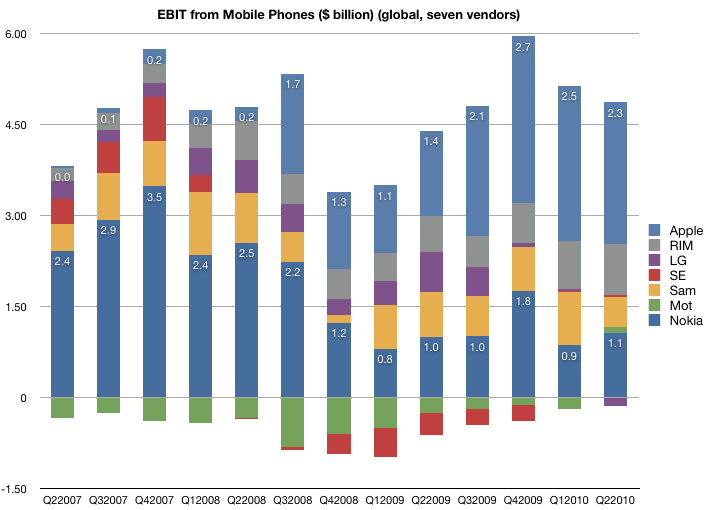
    The first chart shows the EBIT from the top seven vendors of mobile phones since the quarter when the iPhone launched. I annotated Nokia and Apple's bars to give perspective.

    The total available profits in the industry dipped to a bit under $4 billion at the trough of the recession, and have recovered to nearly $6 billion in the holiday quarter last year. However, not all vendors are profitable. As you might expect from looking at the operating margins, Motorola and Sony Ericsson have been generating losses for most of this time period. They have both reached profitability in the last quarter, though at very low levels and after having lost a large part of their sales. LG has turned negative this past quarter after being a modest earner for some time. Samsung has maintained a fairly even consistency in its profit capture, though with its expanding market share, it seems to have come at the cost of pricing.

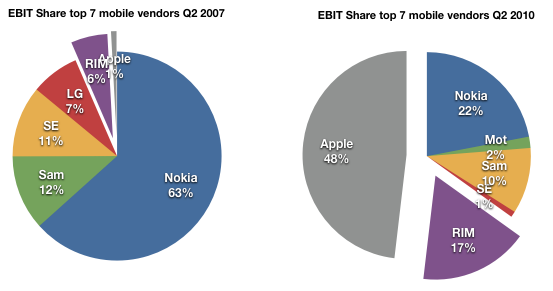
    Finally, looking at the pure smartphone vendors RIM and Apple, the picture is nothing short of astonishing. This before-and-after share-of-available-profit chart shows that the two entrants went from about 7% profit share to 65% in three years.

    Apple in particular is capturing about half of the available profits with three percent of the units. It dwarfs all the other vendors, more than double the nearest (Nokia). All that in three years and with the added burdens of only three models, a recession and limited distribution.

    What does it all mean?

    Here are my conclusions, enumerated:

    1. The lack of a real response. The recurring theme in this series of articles has been that giant multinational incumbents in a vast and rapidly growing industry, enjoying all the advantages that size and incumbency, have had their profits taken from them. And they don't seem to have put up much of a fight.
    2. It's all wealth transfer. Note the total amount of profit available has not increased markedly; this is not about incumbents growing the pie. Two thirds of what should have rightly been theirs moved from the incumbent shareholders to the entrant shareholders.
    3. Speed. This shift of profit occurred over an unprecedentedly short period of time.  Three years is no more than two product cycles in the industry and it's an order of magnitude faster than what happened historically to other industries.
    4. Disruption is the diagnosis here. The incumbents were caught in the headlights. Disruptive innovation leads to asymmetric competition and this is what we just witnessed. History has shown that the shift of profits is usually the last stage of disruption and is usually irreversible because the change in business models cannot happen at the rate of change of profit transfer.

    Which leads me to one final point.

    When analyzing the potential for challengers to the new winners, the most cited is Android. Can Android affect this redistribution of profit once again? And to whom?

    If Android is to become the dominant platform, does it depend on the success of its licensees? Who are these licensees and what are the chances that they will be able to align their businesses to what Android offers (a new revenue model based on services and advertising).

    One problem I see is that Google is making a bet on those same vendors who are now squeezed in the middle of that last pie chart: Samsung, LG, Motorola and Sony Ericsson. Nokia, Apple and RIM will certainly not take the OS over what they already have as it dilutes their differentiation and margins. That means Android is aligned with the biggest losers in the industry.

    So how likely are these disrupted ex-giants to recover and take Android forward? My bet: slim to none. Android does not offer more than a lifeline. It is not a foundation for long-term profitability as it presumes the profits accrue to the network and possibly to Google. Profit evaporation out of devices to Google may be a possibility at some time in the future, but only if the devices don't need too much attention to remain competitive. But because they're still not good enough (and they won't be for years to come), it's certain that attention to detail is what will be most important to stay abreast of Apple.[1]

    So here we have the real challenge to Android:  partnership with defeated incumbents whose ability to build profitable and differentiated products is hamstrung by the licensing model and whose incentives to move up the steep trajectory of necessary improvements are limited.

    In other words, Android's licensees won't have the profits or the motivation to spend on R&D so as to make exceptionally competitive products at a time when being competitive is what matters most.

    [1]: I would argue the same lack of symmetry with licensed software vendor Microsoft is what led the the failure of the same incumbents to make a dent in the industry with Windows Mobile [2003 to 2010].

  9. The near-death experience prerequisite

    Research · 3 comments

    All phone vendors saw smartphones coming.  They hired all the right market research companies and spent lavishly on analysts to confirm that phones with operating systems were imminent.

    Nokia was one of the early movers, establishing its own software platforms group as early as 2002 while others like Samsung licensed Windows Mobile or PalmOS as early as 2003. Yet not much happened to sales. The number of smartphones units sold as percent of total has been fairly low.

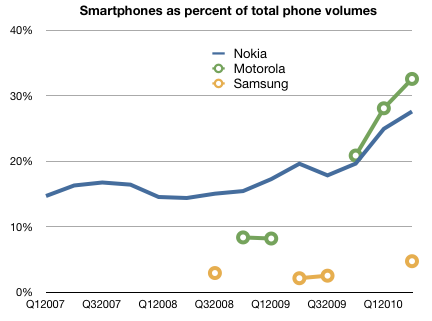
    The following chart shows the number of smartphones sold as a percent of all phones sold for the top three vendors (as of the time when the chart starts early 2007). Note that the percent of smart products shipped did not accelerate or grow dramatically for the largest two vendors even into last year.  It's still a pittance at Samsung (<5%) and even less at LG.

    The one vendor that did stage a shift was Motorola. (and Sony Ericsson, though later and softer) Both converts did this shift when faced with near-death experiences of sequential earnings losses and catastrophic market share collapses.

    Nokia is showing signs of a secular shift to smartphones but it's been a decade-long process so far, a slowness that ripped shareholder value to pieces.

    So is the precondition for a shift to smartphone focus a collapse in the core business?  It certainly seems so from the data. Motorola first, Sony Ericsson second, Nokia presently and Samsung and LG later.

    Each of these decision points reflect precisely the timing of pain points with the core businesses.

    Why this asymmetry? At first glance, the smartphone business should be sustaining and an attractive option to be exercised as soon as possible.  It offers better margins, better prices and a better return on capital.

    So why is there this disconnect? As regular readers of this blog can probably guess, my hypothesis is that the smartphone business is disruptive.  Incumbents are motivated to ignore this business because it makes money in ways they cannot control. More importantly, their best customers are signaling (in non-transparent ways) that they don't want their top vendors to participate in this market.

  10. The parable of the transistor

    Research · 6 comments

    This weblog could be read as a diary of the disruption of the mobile industry. There is lots of topical analysis and opinion, but sometimes I'll post on the "theory" which describes what's going on in a more abstract, and long-term, level. Theory is like a bullion cube: savory, but too concentrated to be enjoyed undiluted. For this reason, the most palatable way of administering theory is through example. So we kick off with an example of what happened to another technology industry as a result of the emergence of a disruptive technology.

    The following is a draft article I wrote describing the "electronics industry" for POSTWAR AMERICA: AN ENCYCLOPEDIA OF SOCIAL, POLITICAL, CULTURAL, AND  ECONOMIC HISTORY. It is itself based on a presentation by Clayton Christensen at the Open Source Business Conference in 2004.

    ----

    The consumer electronics (CE) industry began in 1920 when radio broadcasting commenced in the United States. Radio technology sustained a growing electronics business throughout the 1930's and 1940's, however, the electronics industry underwent a major transformation after the war. The critical development came after 1948 when the transistor was first invented. The transistor and the subsequent development of solid-state semiconductors dramatically and profoundly changed the industry. The change the transistor brought was not just evident in measures of technical performance but also in the economics of the industry and the business models required of its participants

    "Electronics" has a precise definition: technology based on the controlled flow of electrons. Prior to the transistor, the control of electron flow in a system was through a component called the electron tube (or vacuum tube). The tube in its simplest form is a gas-filled glass cylinder, much like an incandescent light bulb, with two electrodes or terminals inside. When the negative terminal is heated it emits a cloud of electrons which the gas inside the tube carries to the positive terminal. This device allows current to flow in only one direction since the positive terminal is not capable of emitting electrons. It is called a diode and is simply a one-way current or conduction valve. Hence the "semi" in semiconductor. Semiconductors can be designed into complex products that amplify, store and communicate; the core applications of CE devices.

    The transistor is significant because it is a "solid-state" semiconductor. Solid-state means that it is composed of solid components, unlike tubes which required a sealed gas to operate. The consequence of this shift from gas to solid components completely changed the industry and created unforeseen growth, wealth and societal change.

    NEW ECONOMICS

    The invention of solid-state semiconductors allowed new economies of production: components were smaller, cheaper and could be produced with a process closer to printing than to assembly manufacturing. Because of the subsequent advances in assembly, the cost of electronics products decreased even as quality and reliability increased. Power requirements and physical dimensions were also reduced, allowing greater portability.

    These implications might have seemed foreseeable to the engineers and businessmen of the 1940s who first looked at a transistor, but what happened is something completely unexpected: almost all the companies dominant in the electronics industry in the 1940s and 1950s who spent huge fortunes to perfect the transistor for their products went out of business or withered away to insignificance. New, giant CE companies emerged in Japan who perfected new product categories rather than challenge the incumbents and their existing products.

    The emergence of Japan as a powerhouse of CE has been debated as a motivation for changing US industrial policy toward a more interventionist model. Transistor technology was seen as a strategic national defense asset and the innovations and production associated with it were not to be allowed out of US control. Additionally, American politicians argued the case that it was US taxpayer-funded defense, educational and space efforts which produced these innovations, hence they "belonged" to the United States government, and future innovation will similarly need taxpayer funding. Unless something is done, Japan would dominate American industry.

    What happened in fact was far more mundane. The transistor disrupted the industry. Small upstarts were able to take the invention, wrap a new business model around it that motivated the current players to ignore or flee their entry. They thus successfully displaced the entrenched incumbents even though the incumbents were investing heavily in the technology and the entrants weren't.

    THE INDUSTRY THAT EMERGED

    The postwar half-century began with the radio as the center of the CE world. It ended with the television dominant, alongside a whole galaxy of mobile devices.  All employed the transistor, which itself underwent dramatic increases in power and equally dramatic decreases in size. Some of the significant breakthroughs along the way are listed in Table below. Note in the table the absence of any companies which dominated the CE industry before the transistor (RCA, GE, Zenith, Westinghouse, Philips, Magnavox, Curtis-Mathes, ITT, Packard-Bell, Philco, Siemens, Sylvania, Western Electric).[3]

    • 1957 Sony TR-63 Transistor Radio. Portability enabled privacy which allowed young people to listen to Rock-n-Roll.
    • 1960 Sony portable TV. Made a second television in the bedroom possible.
    • 1962 Sony CV-2000, first home videotape recorder. The concept of "time-shifting" was born.
    • 1970 Olympus Zuiko Pearlcorder Microcasette recorder. Audio recording became a discrete affair.
    • 1972 Pulsar Quartz Digital Watch. Quartz meant cheap but accurate watches for everybody.
    • 1972 HP-35 Pocket Electronic Calculator. The end of the slide-rule.
    • 1976 Atari Pong Game. A new use for TV: interactive games.
    • 1976 JVC HR-3300 VHS VCR. Mass-market cartridge-based video recording. Video rentals took off.
    • 1977 Atari 2600 Game Console. Game cartridges added a new category of content consumption.
    • 1979 Sony Walkman. Portable high fidelity music for your ears only.
    • 1980 Sony Boom Box. Portable high fidelity music for you and your neighborhood.
    • 1983 Sony CDP-101 CD Player. Loss-less audio reproduction for all.
    • 1984 JVC Camcorder. Home videos were born.
    • 1986 Motorola Bravo Pager. Contact somebody even if they are not near a phone.
    • 1996 Toshiba SD-3000 DVD Player. Loss-less video reproduction for everybody.
    • 1998 Nokia 5100 mass-marketed phone. Easy to use, customizable cheap mobile phone.
    • 1998 Diamond Multimedia Rio. Mobile digital compressed music consumption.
    • 1999 Tivo Series1 Digital Video Recorder. Skip commercials and freeze real-time video.
    • 2001 Apple iPod. All your music with you all the time.

    DISRUPTIVE IMPACT

    When the transistor was introduced in the late 40s and early 50s, most designers considered it inferior to existing vacuum tube technology as far as performance was concerned; transistors could not handle the power that was required to be used in the main CE products popular at the time, notably, the big tabletop radios and floor standing televisions. The transistor could not amplify sound as well as a tube, but it was small, solid, and used low power. Therefore, RCA, Zenith, and Westinghouse looked at the transistor as a electronics component with great potential, but one needed to be improved to match the tube as an amplifier before it could be used as a substitute.

    Every CE company was required to receive a license for the transistor from its creator AT&T, before they could put it in their products. But they took out these licenses in order to experiment with the new technology, hoping they themselves could improve it sufficiently for use in the CE products.  Altogether, these CE companies spent an aggregate $2 billion (in today’s dollars) trying to make solid-state electronics good enough that they could make popular high-end CE products with them.

    And while tube companies were trying to fit the transistor into large products, other companies, especially in Japan, were developing the first transistor-based products.  One critical one was a transistor hearing aid, first marketed in 1952. While hearing aids were a tiny market in comparison to radios and televisions, it was a market that valued the miniature size and low-power requirements of the transistor. In 1955, Sony introduced its first pocket radio. The sound quality and reception of those radios was very poor relative to the "console" systems available in living rooms. But Sony chose to sell the pocket radio to teenagers. Teenagers were delighted to have a product that was inexpensive and that they could carry with them, allowing them to listen to the rock and roll music their parents may have disapproved of.

    Thus, a booming new market emerged based on a hitherto neglected feature that transistors made possible: portability. Meanwhile, the existing big American CE companies felt no need to change their business plans because the new products, in their opinion, were going to new customers not existing customers. Had Sony tried to sell its pocket radio to the parents, the product would have been judged to be inferior because they had the alternative of a high quality vacuum tube radio in their homes. Then in 1959, Sony introduced its first portable television, and again, the portable television was marketed to a whole new cohort of consumers who could not afford expensive, tube-based consoles. Since the alternative for these consumers was no TV at all, they were willing to accept a product with a somewhat inferior picture and reception.

    By the 1960s, solid state electronics had become capable of handling the power required to make larger CE products, making it possible for the big American CE companies to incorporate solid state electronics in the big home products area that they dominated.  And, indeed, by the end of the decade all of the products for the mainstream living room market were using solid-state semiconductors. However, they were largely being made by Japanese companies. The Japanese perfected the semiconductor components through their foothold markets to such an extent that the American offerings were not nearly as good. The venerable vacuum tube companies were doomed.

    THE CYCLE REPEATS

    The table ends with four company names that are distinctly non-Japanese. The phenomenal process of innovation-based disruption is under-way again. This time, the incumbents are the same Japanese companies that used the transistor to disrupt the previous incumbents while the new entrants are small companies focused on microprocessor-enabled digital media or communications. In a cruel irony, the incumbents framed the innovation of digital media products as not good enough for the living room while the entrants saw it as good enough for a new, non-consumptive mobile or time-shifted usage. The existing customers saw the digital products as inferior while the new customers saw portability as a fair trade-off for quality.

    A future article will discuss how the telecom industry saw voice mobility as sustaining but data mobility as disruptive.
    ----

    REFERENCES

    1. Electronics (2nd Edition), Allan R. Hamley, Prentice Hall, August 3, 1999.
    2. The Innovator's Solution, Clayton M. Christensen, Michael E. Raynor, Harvard Business School Press, September 2003.
    3. "The Top 100 Gadgets of All Time", Chris Null, Mobile PC, March 2005.
    4. Sony, John Nathan, Mariner Books, April 2001.
    5. The Road Ahead, Bill Gates, Nathan Myhrvold, Peter Rinearson, Viking Press, November 1995.