Asymco

Asymmetric Intelligence

Theory

  1. Why Apple's cash is worth more than Microsoft's cash

    Research · 11 comments

    My recent exposé of Apple's cash (and cash equivalents and long-term securities and short-term securities) drew quite a bit of attention, which is good. Because it needs to be demystified. However, the story does not end there. Part of the problem of cash is that the liquid stuff can often itself change in perceived value due to mis-management.

    Cash has to be valued on the basis of what's to become of it. So what can become of it?

    The value in liquid assets can be returned to shareholders in the form of a dividend, which means double taxation on profits; not the best idea usually. Or it can be returned in the form of share re-purchase which tends to have only a temporary effect on share prices, again not a great return. The value can also be increased by means of investment in projects that return higher than what investors expect their cost of capital to be. This is the best option but investment is difficult when the amount involved is so big that no project or set of projects could possibly cost enough to employ the capital. Finally, the value can be completely destroyed through large acquisitions.

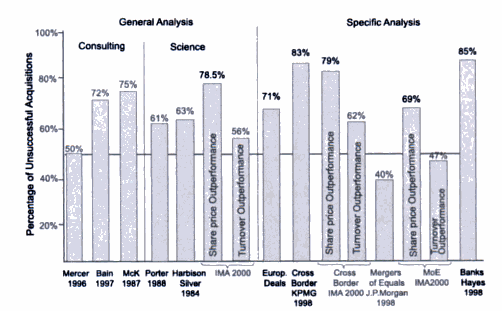
    I say destroyed because the history of large acquisitions is almost universally known to be value destructive (1). The urge to M&A is why cash on the balance sheet for large companies is usually discounted and share prices "get no credit for it." This is plaguing Apple with a P/E ex-cash in the teens.

    Is this fair?

    Companies faced with low growth are more likely to blow their cash on desperate acquisitions than those with high growth, but the best way to judge the probabiliy of cash evaporation is by looking at management track records.

    Which leads us to Microsoft.  Their pursuit of Yahoo shows how desperate they had been in trying to catch Google and how poorly that would have turned out. Having failed only because Yang refused to sell, Microsoft would have gone through a large part of its cash and even raised debt to finance a dud.  With this propensity, it's no wonder that Microsoft's cash is considered an endangered quantity.

    Microsoft used to have the largest cash position in tech. They still have $44.5 billion--a mere billion or so less than Apple. Some of the value already evaporated on dividends and medium sized acquisitions ($500 million for Danger that ended up as Kin(dling)). The chances that they'll blow billions again on desperate means to chase competitiveness are high. I would say it's a certainty.

    On the other hand we have a high growth company like Apple that has not traditionally spent money on business acquisition. (They do spend on asset acquisitions--IP, code, developers but not on new business models.) Thus, on reputation alone, Apple's cash can be considered "safer" and hence worth more than Microsoft's.

    Whether Apple can expose that cash to risk that enhances its value is another matter, but their CEO is on the record stating that "it's not burning a hole in their pocket" and the CFO repeats every quarter he is intent on its preservation.

    This, in my opinion, makes the difference between Apple's $45 billion and Microsoft's $44 billion a lot more than $1 billion.

    (1) Various studies have shown that at least 50% of acquisitions have been rated as failures. See failure rates by various studies charted below. Source: Prof. Dr. Thomas Straub (2007) "Reasons for frequent failure in Mergers and Acquisitions"
  2. Apple vs. Correlation fatigue and the ETF bubble

    Research · 6 comments

    Recent commentary in financial press (e.g. FT Alphaville » Lost in correlation fatigue and The Herd Instinct Takes Over, Amber Waves of Pain)  points out how the markets have become insensitive to fundamentals or valuation itself.

    Symptoms of this are:

    • Global markets trading in lock-step.  In an apparent blindness to any local differences, markets from emerging economies to Japan and to London trade in perfect correlation.
    • Crude oil and other commodities are mis-priced due to HFT or algorithmic trading which ignores underlying supply and demand fundamentals.
    • Value investors find that there is lack of dispersion among stocks.
    • Component stocks' correlation to the S&P 500 is at highest level since '87 crash, reaching a high of 83% vs. average of 44% since 1980.
    • ETFs (exchange traded funds) maintain (or freeze) over- and under-valuations.

    Structural changes such as the proliferation of exchange-traded funds and super-rapid computer-based bloc trading, activities that are totally unconcerned with valuation metrics and/or long-term trends, are still taking place and there is little or no prospect of this development coming to an early end.

    • Adam Smith’s invisible hand has for the time being, been handcuffed.

    It means you can’t trust any valuation. I could have valued a subprime CDO better on May 6 than any equity. And it’s almost the same thing all day long. Valuations and prices have been divorced for a while. Just look at the volatility. It’s not like traditional trading. No wonder there are such increased correlations.

    What this has to do with mobile computing?  Interestingly, I find that Apple is not just a victim of this de-coupling of fundamentals from valuation. I hold out hope that the stark facts of its performance might actually pop this correlation bubble.
    The hope comes from the fact that trading strategies have finite lives.  As soon as a strategy develops to a point of being widely used, it makes sense for a contrarian to "short" or bet on the reverse of that trend, taking advantage of the tendency to overshoot. I don't have a strong handle on this phenomenon, but the chances are that value/fundamental investment will be back with a vengeance and Apple might just be the leader, by sheer weight of numbers.

  3. Apple's supply problem

    Research · 12 comments

    With the iPad still unavailable three months after its launch and with only 1.7 million iPhones available for purchase in the first three days, Apple's inability to meet demand is surfacing as its most immediate and glaring problem. This problem merits the deployment of some of the cash Apple is hoarding.

    As I wrote in May, Apple's next billion users are in waiting. However, to serve them in a timely manner requires a new approach to product launch and ramps.

    Apple has imposed upon itself a yearly product cycle for the iPhone and the iPod [and, probably for the iPad].  This is a brilliant move because it keeps the product fresh without having it seem disposable.  It also keeps competitors within its turning radius. However, the challenge is that the distribution network has to be filled rapidly and drained rapidly to maximize availability. This gets harder and harder as the volume grows. Imagine having to manufacture and ship into the channel a billion devices in less than a quarter.

    This year's iPhone 4 launch was heavily over-subscribed.  If Apple had enough supply, launch sales could have gone as high as 2.5 million, one analyst believes. Apple admitted mis-diagnosing demand and problems arose during the reservation process. There were insufficient units for pre-order, never mind for users walking into stores.  The shocking thing is that three months on, the iPad is still unavailable to impulse buyers who might want to pick one up with their iPhone.  This despite the fact that most of the world does not have any purchase option.

    Now I ask what will happen next year?  Supply may balance with demand by October and strains will show again around Christmas.  Then what?  The iPhone 5 will be getting prepared with another 50% to 100% growth in demand.  How will June 2011 and June 2012 look?  Will Apple have 4x the supply of iPhones and iPads needed to maintain growth?

    There are various solutions possible, but if Apple wants to maintain the product cycle, the event marketing and the "reveal" that builds brand value, it needs to change the way it manufactures.  By investing in automation, locating plants near to buyers and by integrating suppliers into production, it can get the quantum leap in supply it needs.  These are capital-intensive solutions, but Apple's capital is underemployed.  I see no better use for the rapidly-building cash pile.

  4. PCs are going to be like trucks

    Research

    Best Steve Jobs quote from D8

    7:06 p.m. PDT: Is tablet eventually going to replace laptop, Walt asks.

    7:07 p.m. PDT: Jobs: "When we were an agrarian nation, all cars were trucks because that's what you needed on the farms." Cars became more popular as cities rose, and things like power steering and automatic transmission became popular.

    7:07 p.m. PDT: "PCs are going to be like trucks"

    7:07 p.m. PDT: "They are still going to be around...they are going to be one out of x people."

    via: CNET

    iPad is a product competing along a new basis; that of convenience and simplicity.  The PC vendors are motivated to serve their most demanding customers who expect loads of features and the highest specs. Most people who write about technology for a living will also side with the "truck drivers" because they "know more about transportation than anyone else".

    When you hear someone say that the iPad is just a toy or that it's only for consumption and not creation, think about that professional truck driver's bitterness at seeing cheap consumer vehicles cluttering up the roads, doing nothing but serving the unproductive whims of an uneducated population.

  5. People are using apps way more than they are using search

    Research

    Steve Jobs On iAds:

    [It's to] make developers more money.... People are using apps way more than they are using search. So if you want to make developers more money, you’ve got to get the ads into apps. But the mobile ads we’ve got today rip you out of the app..." Apple has figured out a better way.

    This is pretty much the same as his statement on the iPhone 4.0 launch: asymco | On a mobile device Search hasn't happened.

  6. Who benefits from the shift from business to consumer drivers for technology?

    Research · 3 comments

    Consumer tastes have overtaken the needs of business as the leading force shaping technology.

    via New King of Technology - Apple Overtakes Microsoft - NYTimes.com.

    Why is it that other "consumer-oriented" companies like Sony, Nokia and Phillips have not benefitted from this shift?  As far as I can tell they are no better off (and sometimes quite a lot worse off) than Microsoft has been during this transition.

    Clearly, although the paradigm did shift to consumers, simply being consumer focused is not enough to benefit from this shift.

    Conversely, simply being Enterprise focused (like Cisco or Oracle) has not caused dramatic loss of shareholder value.

    Thus focus is not causal to fortune.

    From personal experience I can also recall that precisely at the time when the shift was beginning (think back to when "IT does not matter" was published) at least one of these companies was looking for ways to create "Enterprise Solutions".

    This hints at the cause rooted in strategy, or, more precisely, priorities and the courage to lead.

  7. The Next Billion Users

    Research

    Five weeks ago Apple forecast 100 million iPhone OS devices will be sold by summer. This was fairly easy to predict but the question comes up: when will the next 100 million be sold? And what about after that?

    The iPhone OS three-legged platform is now the fastest growing platform ever and enjoying network effects which naturally accrue to platforms under solid custodianship. However, I am observing signals from Apple that they intend this platform to become the global standard for mobile computing, which, in today's world, means targeting 1 billion users. Here are the signals that I'm noting:

    1. Geographic and cultural universality. What plays in Peoria should play in Beijing.  As it has shown by being big in Japan, the iPhone crosses over cultural idiosyncrasies. Not long ago it was taken for granted that "mobile tastes" differ and "one size does not fit all" in mobile phones hence the need for hundreds of phone models in every portfolio. Apple has completely destroyed this myth. (One could ask why should mobile computers be polymorphous when their slightly larger cousins the laptops are rigidly monotonic?) By broadening the platform with multiple screens and connectivity options, Apple is cleverly spanning the jobs that he platform can be hired for.
    2. Avoidance of a pricing umbrella.  Note that this does not mean being low prices, but rather, the protection of their franchise through pricing. Apple has developed a way to stretch a single product across multiple price bands, and carefully builds product to price and margin targets that have strategic placement.
    3. Product cycles and product ramps. Apple has imposed upon itself a yearly product cycle for the iPhone and the iPod.  This is a brilliant move because it keeps the product fresh without having it seem disposable.  It also keeps competitors within its turning radius. However, the challenge is that the distribution network has to be filled rapidly and drained rapidly to maximize availability. This gets harder and harder as the volume grows. Imagine having to manufacture and ship into the channel a billion devices in less than a quarter.

    I would point out that all these are marketing, not technical challenges. They are thinly disguised questions about product placement, portfolio, pricing, production and distribution--classic Marketing 101. (Promotion, which is what most people equate with marketing is not particularly challenging, especially for Apple who mostly does it through PR).

    It is comforting perhaps to know that Apple is the best marketing organization in the industry today. So to answer the question, 100 million is in the rear-view mirror, 200 million will come up in no more than 2 years and 1 billion will take 5 to 8 years.

  8. Will Apple rule the iPad market? (part II)

    Research · 12 comments

    Continuing from Will Apple rule the iPad market? | Asymco.

    The first claim is that

    it is unclear if [Apple] will end up dominating the market the way it has come to rule the digital music player market with the iPod.

    After hearing a thousand voices cry out that the iPad is nothing more than a bigger iPod touch (which, plainly, it is) it's amusing to read that its similarity with a sibling ends when it comes to market performance.

    Let me make one claim up-front: the iPad is more of an iPod than the iPod.

    The original iPod was successful because it had a significant integrated value chain bolted on. Apple disrupted music with a value chain, not a product. It changed the way music is bought, consumed and even how it is produced. It changed the economics from retail down to songwriting.

    This is why it came to dominate its market. Every competitor that took a run at it did so with a partial solution to the value chain. Often it was nothing more than a music player, and in some cases (e.g. Zune) it was bundled with some other pieces of technology, but poorly executed and too late.

    The iPad comes with an even bigger value chain bolted on: the App Store. Apple is flogging not just an "app player" but also a new way to develop and distribute software. If you cut "music" and paste "apps" you see the immediate parallel between iPod and iPad. The app ecosystem will quickly grow to be larger than the music ecosystem with the mobile software business already eclipsing the music business.

    A competitor launching a tablet device will have to somehow overcome the momentum of billions of downloads fed by hundreds of thousands of apps built by tens of thousands of developers for hundreds of millions of users.

    The iPod juggernaut pales in comparison to the iPad supernova. The iPod had no apps or dedicated developers. Its ecosystem consisted of a handful of music companies. The only thing that made it "sticky" was the tie-in with one type of content.

    The iPad on the other hand has a thousand other jobs to do for its users. It has a rich tapestry of functionality and a multi-dimensional (literally) user experience.  It's a platform. It's even powerful enough to impose new standards on the web itself and to suggest that search is a bygone activity.

    So to suggest that Asus or Dell will somehow build "iPad killers" sounds asinine. These competitors don't even grasp what the product is and what it's for.  Sony said they don't see a market for it. Microsoft, trapped in the innovator's dilemma and overshooting the market by miles, said they don't understand what the point is because users want full PCs.  Google asked what's the value of a big iPod. I could go on, but there was not a single company in the industry who recognized what they were looking at in January. Apple keeps a tight lid on new products so that competitors don't get a head-start on copying, but in the case of the iPad, advance knowledge would not have had any impact. Competitors look at the iPad and see nothing.  They'll only react once the market explodes and they start to feel belated pain.

    If, and it's a big if, they do recognize what an iPad is, their response cycle is going to be measured in years. On hardware, they were blown away with a product that had twice the power, half the bulk, twice the battery life with half the price of what they had on the shelf. They may catch up on hardware in a year or two and launch some sort of iPad-like assembly of components, but that is like making the first iPod killer in 2002.

    Then there is software. Their software supplier (Microsoft of Google) will have to build a platform that works. That will take years. Years during which the iPad will penetrate every geography, demographic and vertical market.

    Google might move more rapidly than Microsoft, but they will produce an open source poster child of a platform. Fragmented and rough around the edges to the point of looking like a hobby project. Their flea market store will also have the smell of fresh glue about it. Microsoft is so far behind the curve that I don't even think they will try to move the tiller.  Their view of the market was betrayed by the recently knifed Courier demoware. To suggest a challenge to the PC/Windows model inside Microsoft is a career-limiting move so don't expect their brightest to be lining up to propose new platforms to management.

    What about HP? Assuming they overcome the pitfall of NIH that kills 80% of integration efforts, they will still need to perform an enormous amount of heavy lifting to get WebOS to be a competitive experience on a tablet. Most opinions were that Palm came pretty close with a smartphone, but that was nowhere near enough to stay alive, never mind challenge iPhone.

    Then there is the ecosystem. Building it is just not something I can even begin to roadmap. What about developer tools, SDKs, frameworks and evangelism? With a Palm division, HP is the best positioned of the PC vendors but it has a chance at being a player as much as Creative did vs. the iPod, or needless to say, Palm vs. the iPhone.

    So the iPad challengers face five daunting obstacles:

    1. Recognition of a threat from a seemingly benign product
    2. Execution on hardware against the best integrator on the planet
    3. Execution on software against a new UI metaphor fortress surrounded by a patent moat
    4. Integration of hardware and software to a sublime whole
    5. Re-building a value chain for which they have no handle vs. a broad and deep existing universe of app/content creation distribution and consumption enjoying logarithmic network effect value.

    That does not even touch the logistics, sourcing, margin and pricing challenges of world-wide distribution of the whole value chain. Nor does it cover the lock-in of advertisers to new tools for creatives or the billions of daily views from a platform that is blindingly dazzling.

    To put it in the language of disruption, by the time the competitors launch symmetric attacks on the iPad, Apple will be the incumbent. And we all know that symmetric attacks never work against entrenched incumbents who have all the levers of power at hand to deploy in a withering counter-attack.

  9. Will Apple rule the iPad market?

    Research · 1 comment

    This question sounds like a tautology. It's like asking "Will Apple rule the iPod market?" But redundancy has not stopped WSJ journalist Benjamin Pimentel from asking. His answer to the question is below:

    But while Apple apparently has the edge in the emerging tablet war, it is unclear if the company will end up dominating the market the way it has come to rule the digital music player market with the iPod.

    Gartner's Fiering said the iPad has "raised the bar and suppliers are now scrambling to make sure they get it right."

    IDC now projects 6 million tablet devices to ship this year, including 4 million iPads, Shim said. But while Apple has taken the lead, he added, the company faces the "burden of lifting or defining this entire new market," because there are no other competitive devices available.

    "In the iPhone market, they learned from everybody else," he added in a video interview. "In this new space, there's nobody else to kind of bounce ideas of so to speak."

    But Apple may not have to feel so alone for long.

    Fiering specifically pointed to H-P's as the best positioned challenger, given its scale, reach and its upcoming merger with Palm.

    "There are not too many suppliers that can pull all those pieces together," she said. "H-P could if they integrate the Palm acquisition properly."

    Another IDC analyst, Crawford Del Prete, agreed saying, while the "buzz" from H-P had generally been defensive in relation to the iPad, "the longer term story is far more interesting."

    "Given H-P's massive scale, I think they have the ability to drive new price points for this kind of product," he said. "With a lower price point, the category becomes far more interesting."

    via PC Makers Look To Challenge Apple's IPad - WSJ.com.

    Before diving into the statements above it's worth noting where the journalist went to get opinions to fill his column. He called Gartner and IDC. Quoting industry analysts is a standard operating procedure to fill column-inches with material that does not offend. But how good are they?

    In my years of watching those who watch markets I formed a ranking of analyst types and their likely accuracy with respect to prognosticating a market shift. In order from most accurate to least accurate:

    1. The most accurate are rank amateurs (deagol, Muller, et. al).  Independent bloggers who do some fact checking tend to make the boldest but most accurate forecasts.
    2. The next most accurate are sell-side analysts (purveyors of analyst reports from established brokerages).  They follow financials for individual companies.  You might think their record is quite poor, but in fact they are much better than..
    3. Industry analysts (like Gartner, IDC).  Their forecasts and sensitivity to disruption are often off by an order of magnitude.  This is partly because they forecast a bit further out than Wall St. but also because they are closer to their industry clients-- the source of their ideas.  They spend a lot of time talking to the least accurate forecasters...
    4. The corporate analysts.  They are typically hired to advise management in the incumbent companies. These are people who have the most information about the way the industry is performing on a daily basis.

    You might notice a pattern here: the closer you are to the market, the less likely you are to observe how that market is crumbling around you. You cannot see the forest for the trees.

    How could this be? How can having more access give you a poorer picture? The answer lies in the asymmetry of a disruptive attack. The more you know about how things are the less you know about how things could be.

    In practice, the analyst information value chain works like this:

    Corporate analysts feed information to management that management is comfortable digesting. Those managers then hire industry analysts to validate their opinions. Industry analysts are keen to maintain a relationship with those firms and so they listen carefully to the prejudices of their clients. They then hold up a mirror to those myths and consolidate those opinions for wider distribution and quotation by journalists at respectable publications.

    Stock analysts listen with one ear to the chatter but with the other to the way the wind blows with the stock market. Sometimes they actually sample the data in the value chain directly by calling acquaintances in the market and hire interns to watch what's happening in the shops. They then build an opinion that has some level of surprise but that they hope will not stray too far into controversy so that they can keep their jobs in case they are wrong. The safe bet is always to say that things will stay mostly the way they are, but to say it in clever ways.

    So that just leaves only one group of analysts with independence from a paycheck who can make an opinion on the basis of facts alone.

    This post has become longer than I planned, so I'll dive into the exact answer to the article claims in part II.

  10. Sony would say No to Walkman today

    Research · 1 comment

    Sony is “not convinced there is a large enough market to justify bringing out a tablet,”

    via Sony Considering Developing Tablet Computer to Compete With Apple's IPad - Bloomberg.

    I wonder what current Sony management would have said when the Walkman would have been presented to them in 1978 by audio-division engineer Nobutoshi Kihara.

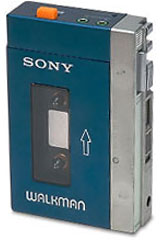
    The Walkman TPS-L2 from 1979:

    The original Sony Walkman

    The Walkman introduced a change in music listening habits by allowing people to carry music with them.

    There was a tiny market for such implements in 1978, promoted to professional journalists.  Sony even had a product called the Pressman and marketed it exclusively to reporters. These recorders lacked stereo sound and were very expensive. They also used (typically) microcassettes, which had no support from record companies.

    With the limited choices presented to consumers, the most popular cassette tape players were either home stereos or car players.

    I'm sure Sony's current management  would also have been unconvinced that there was a large enough market to justify bringing out a consumer-grade portable cassette player.