Asymco

Asymmetric Intelligence

Theory

  1. The Innovator's Curse

    Research · 108 comments

    When Clay Christensen discusses innovation (for example his talk at BoxWorks here) he puts forward theories on the causes of success and failure of innovation. Through a repertoire of case studies evoking David vs. Goliath he offers a convincing alternative to the management orthodoxy which prevents innovation, especially the meaningful disruptive kind, in established organizations. More importantly he asserts that innovation is not something that happens randomly or only through the incantations of a Chief Magical Officer. There is a process and even perhaps a repeatable process for successful innovation.

    But one assumption that underlies this narrative is that innovation is good. Or more precisely, that innovation is rewarded--making its goodness desirable through market mechanisms. The happy ending to the story is that the innovator solves the dilemma, delivers the great innovation, perhaps more than once, and then basks in glory.

    But my observation is that the way markets behave often contradicts this measure of worth of innovation.

    Here's the problem: If a company produces a string of successes, the conventional wisdom is that the chances of another success are precisely zero.  A company is valued based on its cash flows and foreseeable improvements to them. What it's not valued on is its innovation flows (and foreseeable improvements to them).

    In other words, if you've succeeded in the past, the only certainty is that you will not be able to succeed again. This assumption exists even if you've succeeded more than once. The wisest will offer as many excuses for being lucky more than once as they will for being lucky once. In fact, just as the illusion of a run of heads means the next coin flip must surely be a tail, a string of random successes is deemed to increase the probability that the next attempt will end in failure.

    This discounting of repeatable success means that the reward for a process of innovation is zero and therefore that innovation itself is a priori value-free.[1]

    This means that an innovator not only has to struggle with getting an organization to create something new (the gist of The Innovator's Solution) but also to do so without the benefit of capital markets. When trying to raise financing for a sustainable innovation engine, the markets speak unanimously: you haven't got a chance.

    Therefore the only way an innovator can finance the next innovation is to use proceeds from a previous innovation, having faith in his engine of creation. Listening to the market would only convince the innovator that the new thing is pointless. In fact, the best idea is to stop trying.[2]

    I call this The Innovator's Curse: that building repeatable innovations provides the innovator no respite. There shall be no basking in glory, only expectations of imminent failure and attribution of success to good fortune.

    When I first realized this I thought I chanced upon a remarkable paradox. That this must be some new insight into human nature. That realizing this will change everything.

    But just like Disruption Theory is beautifully illustrated through the ageless David vs. Goliath parable, The Innovator's Curse is but a retelling of this fable:

    A cottager and his wife had a Goose that laid a golden egg every day. They supposed that the Goose must contain a great lump of gold in its inside, and in order to get the gold they killed it. Having done so, they found to their surprise that the Goose differed in no respect from their other geese.

    Even if the cottagers were naive enough to have faith in the replicating miracle of golden egg laying geese, wise men would quickly advise them to kill it and get the gold more quickly. The Goose is doomed no matter what.

    --

    1. A company will be priced according to products it created in the past, and that price might be significant, but as competitive pressures increase, the value itself is discounted. What is certain to be worthless however is the ability of any company to come up with something new.
    2. When managers give in to the temptation to stop trying they build great sustaining companies which are subject to disruption and invariably fail.
     

  2. The Meanings of Appleiness

    Research · 212 comments

    I've never worked at Apple and know very few people who did. Nevertheless, I read Adam Lashinsky's book and enough Folklore.org that I think I can get away with replying to the Meaning of Googliness with the following:

    Googliness meansAppleiness means
    Doing the right thingDoing the best thing
    Striving for excellenceStriving for greatness
    Keeping an eye on the goalsKeeping both eyes on your task
    Being proactiveBeing obsessive
    Going the extra mileGoing to the moon
    Doing something nice for others, with no strings attachedDoing everything for the user
    Being friendly and approachableKeeping your mouth shut
    Valuing users and colleaguesValuing functions other than your own
    Rewarding great performancePunishing failure
    Being humble, and letting go of the egoKeeping your mouth shut
    Being transparent, honest, and fairKeeping your mouth shut
    Having a sense of humorNever writing a post on what Appleiness means
  3. It's a wonder

    Research · 3 comments

    My responses to questions from Juliette Garside of The Guardian newspaper:

    Q: Will noise from Icahn distract the Cook from focussing on product?

    A: Investors may think that they can influence management but they do so only when companies are in distress. It’s only then that shareholders can affect some change with their votes as they have a common purpose. The voice of investors carries little weight or distraction when a company is successful. At first glance it seems that Icahn thinks he can unlock value in Apple by getting management to accelerate share buybacks. That’s a modest goal and not one which needs to distract managers.

    Q: What will do most for the share price – a buyback or a blockbuster new device?

    A: Neither. What will do most for the share price is a change in the perception that Apple is not going to survive as a going concern. At this point of time, as at all other points of time in the past, no activity by Apple has been seen as sufficient for its survival. Apple has always been priced as a company that is in a perpetual state of free-fall. It’s a consequence of being dependent on breakthrough products for its survival. No matter how many breakthroughs it makes, the assumption is (and has always been) that there will never be another. When Apple was the Apple II company, its end was imminent because the Apple II had an easily foreseen demise. When Apple was a Mac company its end was imminent because the Mac was predictably going to decline. Repeat for iPod, iPhone and iPad. It’s a wonder that the company is worth anything at all.

  4. The Anti-Apple

    Research · 268 comments

    Building a successful business is hard. Many try, few succeed and those that do tend not to thrive for long. So success in business it should be respected. Especially in highly competitive industries like technology. The fragility of success however should also give one pause to think about how delicate a business model is.

    The presumption that companies can shift business models at will is usually false. Businesses are balanced on a knife's edge of dependency on multiple variables. Almost all resources are expended on preserving this balance.

    This being my observation, I take issue with assumptions that large companies can "pivot" on a dime or that they can change their business models "when conditions are right". Consider Microsoft's dilemma. They have all the resources in the world and yet they could not pivot to take advantage of a change so mundane as a low power microprocessor (which enabled a mobile computer and hence a new ecosystem and profit model for software.)

    Or consider the dilemma of Apple which after building a successful computer business which included system software, could not pivot to license that system software so others could build computers with it.

    Or consider the dilemma of Nokia which had an early and large leadership in smartphones including having its own OS and platform and large volumes and users bases. It could not pivot to allow into an ecosystem and had all its advantages disappear.

    Each company thought they could manage change but none of them actually did.

    It's with this thinking about inertial navigation that came to consider the idea that Amazon has a flexible business model which, though unprofitable today, will be profitable some day.

    The premise that Amazon can, on a whim, change its business model from selling other people's products at a razor thin margin while investing in capital-intensive distribution to selling other people's products at a large margin while not investing in capital-intesive distribution is not credible.

    I would argue that Amazon's existing business model is a direct consequence of the market it's in: that it could not be anything else given the circumstances it finds itself in. Enlightenment may be an illusion.[*]

    That's not to say that there is no wisdom in the management of Amazon. Quite the contrary; recall the respect that's called for in creating a great business. Managing the business to this point was a work of decades of vision and creativity.

    What I take issue with is the premise that Amazon is the "anti-Apple" in its hunger for growth and patience for profits. Apple has its own "Amazon-like-business": iTunes has been growing at a steady 25% or more and it also has its ancillary zero-profit hardware analogue to the Kindle called Apple TV.  iTunes is a great business in the Amazon vein, harvesting hundreds of millions of users (and their credit cards.) Presumably iTunes could also some day "flip the switch" and become profitable, but something magical needs to happen. Something like becoming a payments processor or retailer of other things. Analyst beware however. There might be conditions that make such switch flipping extremely difficult.

    At an even deeper level, Apple and Amazon are much more alike than they are different. They are both hired for similar jobs (convenience, ease of use and a controlled, predictable environment for average users interacting with technology). They both focus on delighting customers and controlling all the variables which come into contact with that delight. They both have long-term views and are driven by vision rather than competition.

    Where they differ is in others' perception of sustainability. Whereas Apple is perpetually given an expected lifespan of less than a decade, Amazon is expected to have an indefinite lifespan. This is because Amazon is seen as having no competition and Apple is seen as having infinite competition. In other words, Amazon is perceived as a monopoly and Apple is perceived as the  innovator that is in a permanent state of being disrupted by the low end.

    I disagree with both assumptions. I've always thought Apple fragile but dedicated to moving into new markets as older markets are disrupted. It's a tough strategy and one which (literally) nobody believes possible. But I've also thought Amazon's monopoly status fragile. This too is not a popular idea but the company depends on many variables.

    Retail is hard and it is being disrupted by technology wielded well by Amazon. But it's also subject to further disruption. Amazon's job to be done can be done by alternatives. Buyers are typically hiring Amazon for convenience, not just price and ease of use is where the value is. But again, new information technology which makes shopping, discovery and delivery of products directly from the vendor, bypassing the aggregator (i.e. retailer) could shift value along the value chain yet again.

    By the time Amazon reaches some point of monopoly in distribution it could be too late to make the switch to profit generation.

    I don't want to suggest that failure is inevitable, but I want to point out that success is not certain by any means. Disruption happens.

    --

    * It's possible that Enlightenment is also an illusion at Apple. Even if they once had it, there are forces which act on companies that make them lose their wisdom.

  5. Understanding Apple's Organizational Structure

    Research · 56 comments

    Apple has hired a new VP who will report directly to Tim Cook. Paul Deneve is cited as having responsibility for "special projects" and will report directly to Tim Cook.

    The previous roles as a manager in luxury brand companies has led to a great deal of speculation about what new projects Apple could be working on that might also fit this new manager's background and title.

    The most commonly cited speculation is around the iWatch or TV product lines (with some surprised that he will not be heading Retail.)

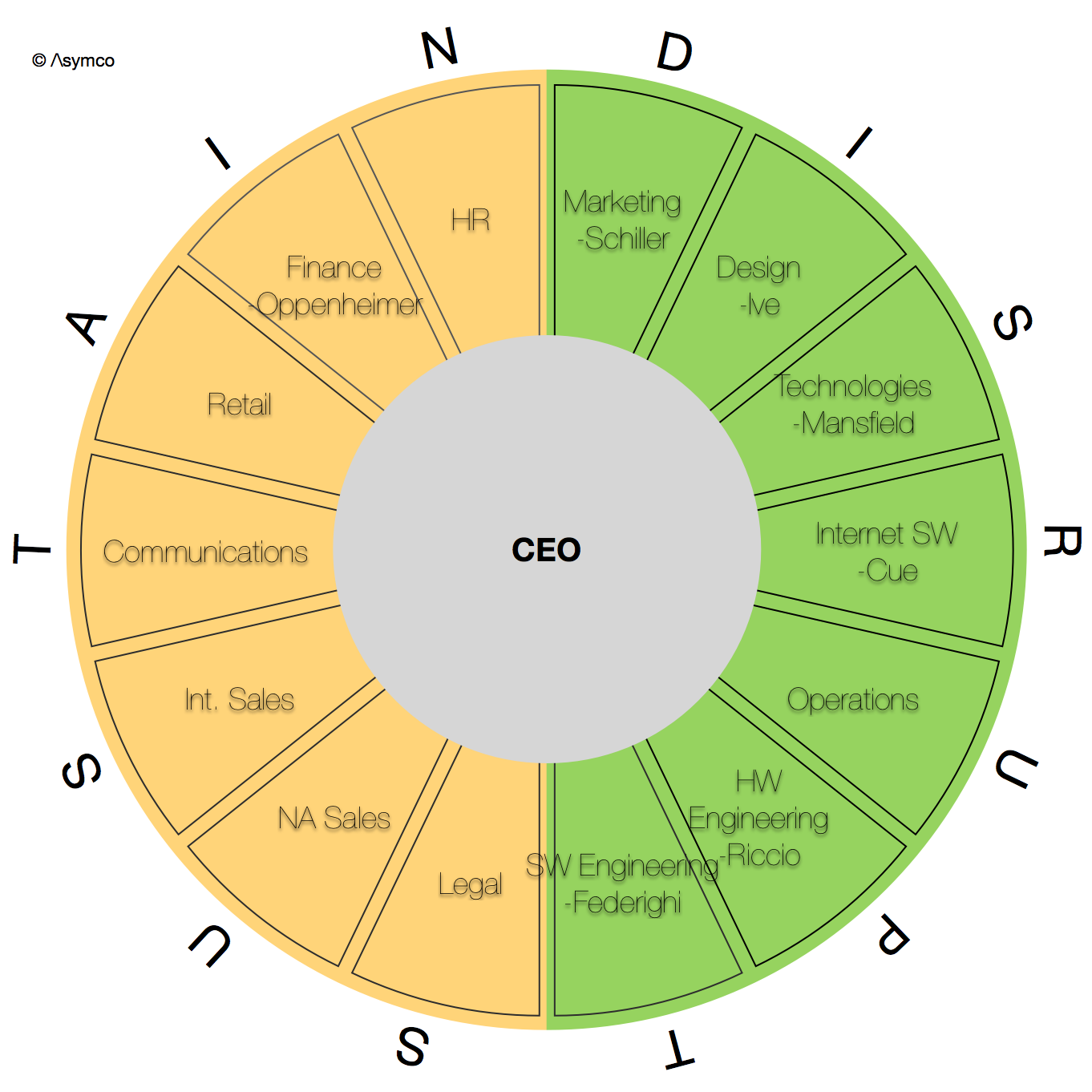
    Although reading "luxury product CEO" and concluding "new luxury products" seems logical, a little knowledge about how Apple is organized dispels this notion. And a little knowledge happens to be about all we have, as Apple's organization is one of its most closely guarded secrets. Even employees at Apple have little idea of how the company is organized. What we do know is summarized into this org chart:

    Screen Shot 2013-07-03 at 7-3-3.37.27 PM

    I've taken the liberty of splitting Tim Cook's direct reports into "Disruptive" and "Sustaining" functions—which I admit is a bit cheeky—but the point is to separate the product creation functions from the management and administrative functions of the organization[2].

    When seen in this light, the first observation is that there is no "product business" ownership. Schiller's Marketing function includes product marketing by product line, but these are not business ownership roles (product marketing mostly deals with how products are positioned, promoted, priced, etc.)

    There is no "head of devices" or "head of iPhone". Put more plainly, there is no organizational consistency with how the company reports its financial performance.

    So it would make little sense to add a new direct report to this chart that did have a specific product ownership (or creation) role. Product is a "horizontal" responsibility for which every function is partially responsible.

    In lieu of this, my reading of the chart shows another function for which there seems to be no leader: brand. Brand management is a crucial function in consumer-facing companies, and many brands-oriented companies orient their organizations (and power) around brand mangers.

    In years gone by I would have said that Brand management was Steve Jobs' direct responsibility. Today I would say that it's something that needs a direct manager. This is something for which Paul Deneve might be well suited.

    ---

    Notes:

    1. The last chart published on this topic is from 2011.
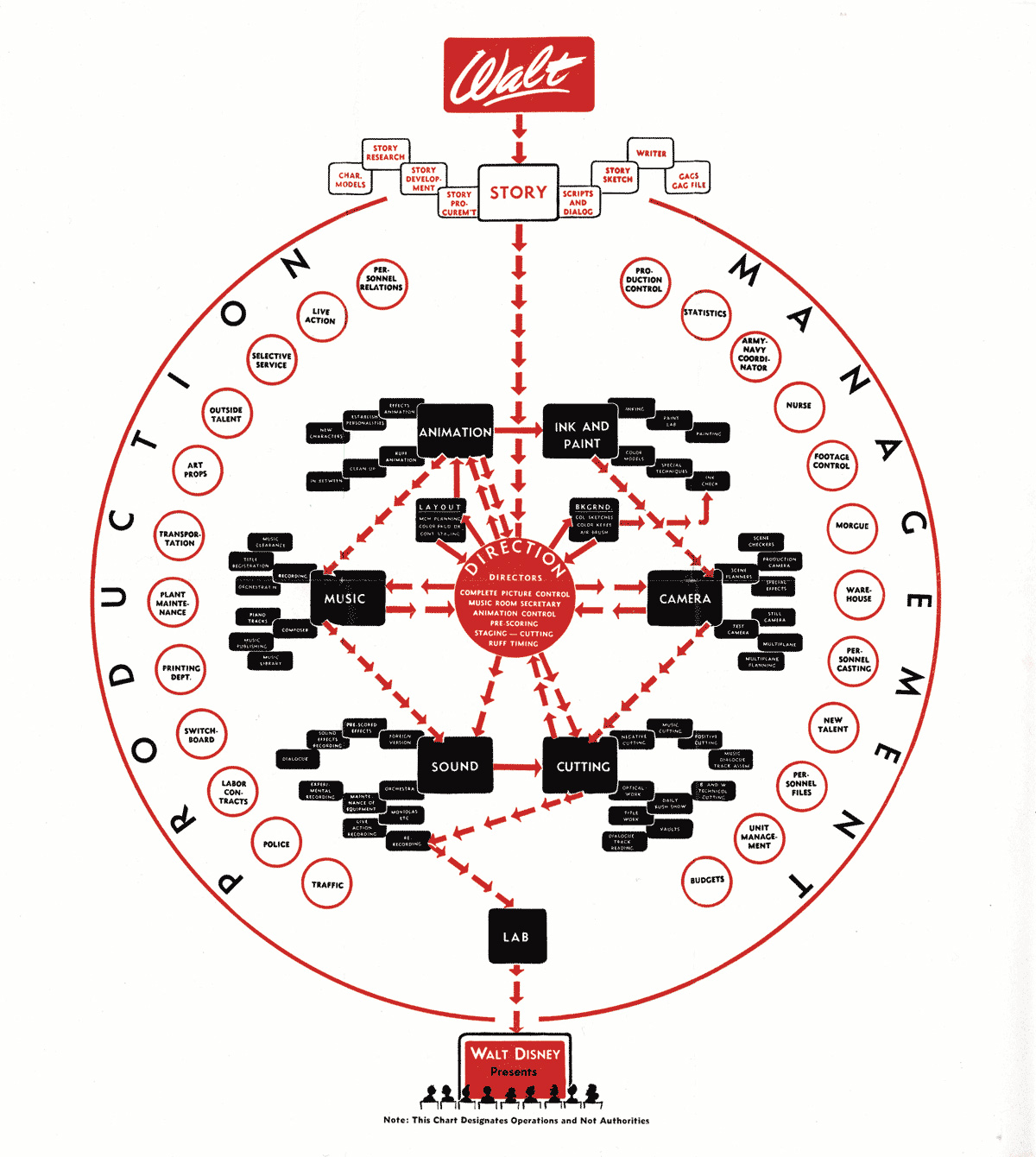
    2. With inspiration from Disney.
  6. Preempting the Praetorian Guard

    Podcast · 51 comments

    The functional organizational structure may be causal to successful disruption. Although this hypothesis needs much more research and testing, there are correlations in the anecdotal evidence. One of the principles of this theory is that functional organizations are less prone to "political infighting" where a powerful division can disable a self-disruption through the wielding of the power of the Profit/Loss statement.

    Under the divisional structure the modus operandi is that once an internal threat is detected, the incumbent division unleashes antibodies to destroy the smaller and less powerful opponent. This is possible because as soon as the threat is perceived, a threat response kicks in and the power to deflect the threat is abundant in the reward and incentive structure. This response mechanism is so common and well understood that it forms the basis of the Innovator's Dilemma.

    My hypothesis is that in the absence of product/divisional level power bases, the threat is not felt and the political power to respond is not available. In a functional organization there is no "business leadership", where the P/L "belongs" to one person. Only the CEO has life-and-death power over products and their decision is "purchased" through discussion with functional heads who stand to benefit as much as to lose from disruptive change.

    This functional organization decision process is typical if not universal in small companies and atypical if not unheard of in large companies. It's one of the reasons small companies are inherently more disruptive. The challenge for a growing company is that functional organizations don't scale well. There are very few and all depend on vigilant, almost maniacal defense of the structure. Divisional organizations are "natural" at scale and the preservation of functional structures is like fighting entropy.

    The organizations which seem to preserve functionality at scale are militaries. This is why I've been thinking about it takes to manage such organizations and preserve their apolitical status.

    As it turns out, militaries are also not immune from the corrosive effects of political power. In fact, the slide into corruption begins with the formation of elite divisions. The rationale is simple: elite soldiers whose loyalty and skill are most valuable are chosen for special roles and status. They begin by usually acting as bodyguards to the leadership or the state.

    Historically the most prominent such politicized military force was the Roman Praetorian Guard. Having started as bodyguards to the field commander, they transitioned into protectors of the state and, eventually, into destroyers of the state.  Their leader, the Praetorian Prefect, became one of the most powerful administrators of the state and his Guard became responsible for numerous coups d'état, assassinations and corruption.

    So-called "Republican Guards" became common in many militaries since then. Napoleon's Imperial Guard, the SS in Nazi Germany, the Iraqi and today's Iranian Republican Guards continue in a political role. In democracies, the politicized military is less common but the threat of their emergence is one states must always remain vigilant for.

    And so it must be for the functional organization. The emergence of an elite which, by its skill and achievement, gains more responsibility and hence more power is the good intention which paves the road to hell. Leading an innovative organization means having a process of denying power to those who are elites. It means preempting the Praetorian Guards.

    Doing so is a dilemma in itself as the elite are not likely to remain loyal if denied their opportunity to power. Managing the motivations of the bright and ambitious is where the art of disruption management lies.

    For a more thorough discussion of this topic, listen to the podcast which accompanies the post:  The Critical Path #90: The Praetorian Guard


  7. Measuring the latest iOS accessory market

    Podcast · 45 comments

    One of the most startling announcements during the WWDC 2013 was iOS in the car. The mockup that was shown seems to indicate the use of the car's in-dash display as an "external monitor" for an iOS device while control would come from inputs using Siri.

    The technical details were not released so it's hard to know the protocol used to accommodate this interface. However it seems that it will be generic enough that a number of launch brands signed up for the launch. The list includes Honda, Mercedes-Benz, Nissan, Ferrari, Chevy, Infiniti, Kia, Hyundai, Volvo, Acura, Opel and Jaguar.

    Is this a significant opportunity?

    Before we get excited, it's important to note that this will likely take a very long time. It won't even begin until 2014 and the number of new models may trickle into showrooms quite slowly. Consider that the time it took for automakers to universally support external audio input (mostly the trivial line-in) was about a decade.


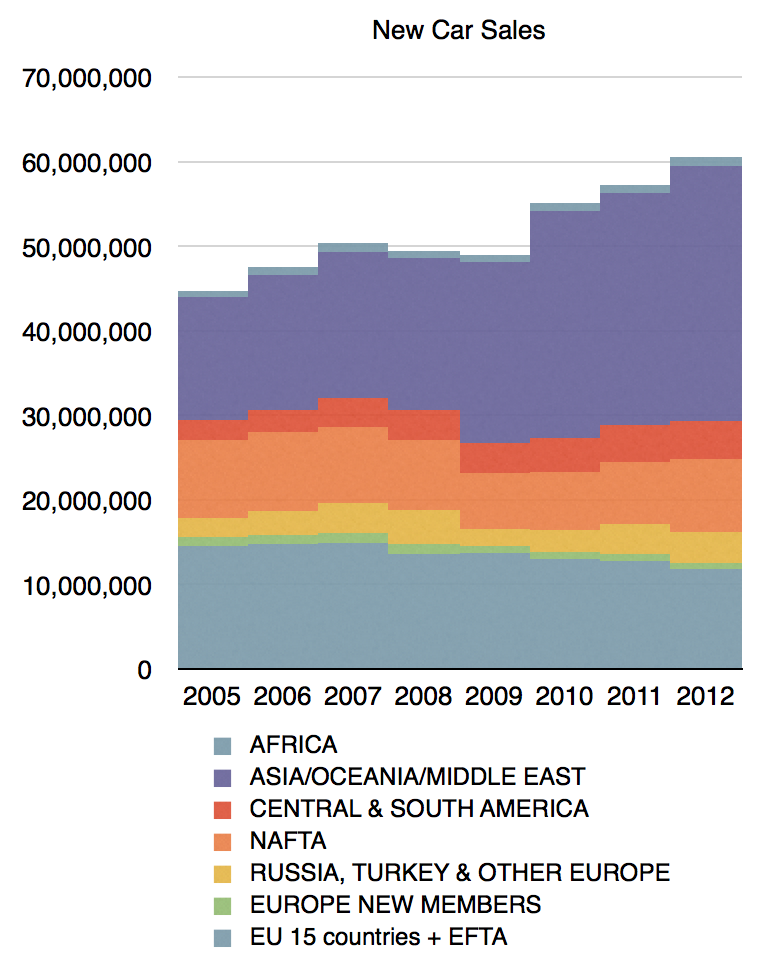
    To also curb our enthusiasm we need to realize that the car industry does not produce many units. In 2012 there were over 60 million cars produced (with the following regional mix:)

    Screen Shot 2013-06-11 at 6-11-6.02.32 AM

    In contrast, 60 million is about the number of phones sold every two weeks. In 2013 there will be more iPads sold than cars.

    In particular the companies mentioned had the following production figures in 2011:

    • Honda (including Acura): 2.9 million
    • Mercedes Benz (Daimler): 1.44 million
    • Nissan (including Infiniti): 4.5 million
    • Fiat (Ferrari parent): 2.4 million
    • GM (Chevy, Opel parent): 9.1 million
    • Kia: 1.6 million
    • Hyundai: 6.6 million
    • Volvo: 315k
    • Tata (parent of Jaguar): 1 million

    Including the parent companies and all vehicle types they produce, the total is about 30 million units, or about half of the world-wide production. Obviously, not many of the cars produced will have iOS in the car capability.

    Therefore the total unit opportunity is not very significant, perhaps less than 10 million a year. Is there a per-unit cost that compensates for this?

    This is harder to answer. The way Apple has been licensing accessory makers is through the MFi (Made for i) program. There used to be a flat 10% fee off of the retail price of the accessory sold. However, there may have been changes. The licensing fees are not public and it's quite possible that the price is a flat amount per unit and that it's a negotiable. It's hard to know what terms are being negotiated with automakers but my bet is that it's not likely to be a significant source of revenue per unit.

    So the total revenue from licensing the "Made for iPhone" trademark to automakers won't be significant.

    But it is significant for the car industry. The significance is that cars have finally risen to the role of being phone accessories. They have acquired the ability to participate in a computing ecosystem. During all these decades when the world has embraced the information society and intelligence has been embedded in the fabric of life, automakers have resolutely avoided being a part of it. Automotive information, connectivity and user experiences have remained in a Galapagos Syndrome-like isolation from reality. The reasons are rooted in the crisis of rigidity that plagues the industry, something I've touched on briefly in The Critical Path podcasts (e.g. Asymcar).

    So this is a hopeful development. If.

    If it actually moves at a slightly-faster-than-glacial speed.

    If sufficient cars get display systems (billions are produced for the pockets of  young and old, poor and rich; but cars have to be considered "luxury" to be graced with an LCD)

    If standards are adhered to.

    If all brands (which operate individually as autonomous divisions irrespective of group-level strategy) accept the notion.

    If these and many other conditions are met, it would allow, finally, the migration of autos to the status of information appliances and, eventually, to being hired for jobs that are currently left undone.

  8. The allure of iTunes

    Research · 130 comments

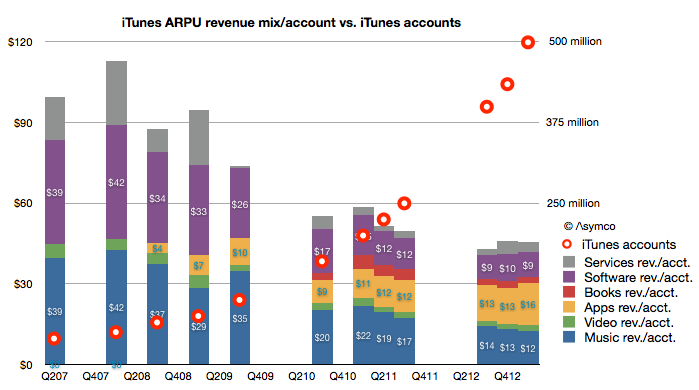
    My estimate of last quarter's iTunes gross revenues suggested a spending rate of $40 per iTunes account. It would make sense to consider how that figure changed over time. The following graph shows the pattern:

    Screen Shot 2013-05-14 at 5-14-9.49.40 AM

    You can read each bar in the graph as the total "ARPU" or average revenue per iTunes user[1].

    I overlaid a graph showing the total number of accounts as reported by Apple to the (retroactively) estimated revenue structure. Account totals are measured with the right axis and ARPU with the left.  Note that I also broke down each component of iTunes as currently defined (Music, Video, Apps, Books, Software and Services.)[2]

    The time frame covered is from Q2 2007, or the quarter prior to the iPhone launch. A few patterns emerge:

    • When there were no iOS devices (and hence no iOS apps) the revenues of iTunes consisted mostly of music sales. Those revenues were, on a per account basis, roughly comparable with Apple's Software revenues.
    • As iOS devices proliferated, the number of accounts (and users) grew. They doubled in the first two years (2007 to 2009) and doubled again in the following year (2010) and doubled again the following year (2011) and doubled again in the following 18 months. This rate of growth was accompanied by a reduction in the iTunes ARPU of about 50% (from $99 to about $45).
    • The reduction in ARPU has moderated in the last few quarters. ARPU fell 10% from $50 to $45 during the last doubling of accounts (from 225 million iTunes accounts to  500 million accounts.) In contrast ARPU fell 20% from $74 to $58 during the penultimate doubling (from 100 million to 200 million)
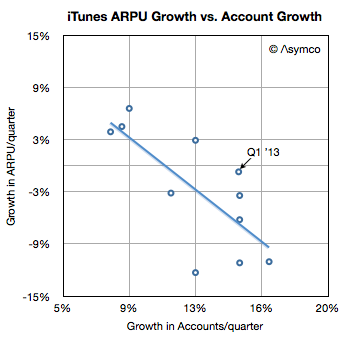
    • However, growth in accounts is broadly inversely proportional to growth in ARPU. In other words, the faster the growth in users the faster the decline in ARPU. The recent moderation in ARPU erosion is also coupled to a moderation in user growth (most recent doubling took 18 months vs. 12 months for previous doubling.) This is as would be expected as a broader, later user base tends to consume less than a narrow, early base. This can be seen in the following scatter plot:
    Screen Shot 2013-05-14 at 5-14-10.35.02 AM
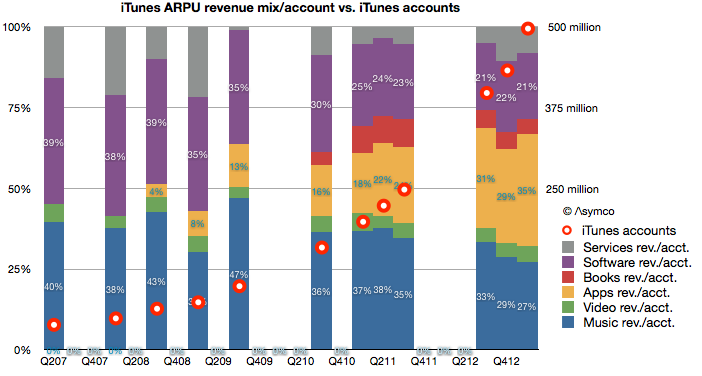
    • When seen as a percent of mix, Apps have grown to be the largest component of iTunes spending. Apps have 35% "share of wallet" while music has dropped steadily from 40% to 27% (or $39 to $12/yr.) This is shown in the following graph.
    Screen Shot 2013-05-14 at 5-14-10.34.45 AM

    As apps have grown to consume more and more of users' time it stands to reason that they should consume more and more of users' wallets.

    And as accounts reach one billion, we can begin to think about the disruptive impact on other media types. Whereas video, books and music are targeted to smaller user bases, apps are broadly consumed. Developers like Rovio or Supercell can offer their products to billions while TV producers can only hope for millions. Apps are becoming the universal medium for entertainment and iTunes the universal distributor.

    Talent is catching on to this faster than those who manage and distribute their work. The inevitable result will be a mass migration of talent away from the established content industries. Old media won't fade due to a loss of users. It will fade due to a loss of talent.

    --

    Notes:

    1. An account is not necessarily a user so perhaps more appropriately the acronym should be ARPA (average revenue per account). Unfortunately that acronym is taken.
    2. The complete model is available for purchase through Asymco Store.
  9. The next Asymco Workshop: Airshow. June 9th, WWDC, San Francisco

    Conference · 5 comments

    8667040424_ba8e4a40c5_b

    I join forces with Pixxa, makers of Perspective, to present a workshop on the future of presentation.

    After giving dozens of talks in the last year using an iPad with Perspective I've learned a few things. Having also spent years using Powerpoint to try to do the same thing, I've experienced first hand how slideware has gotten in the way of great storytelling.

    So we teamed up to understand how stories come alive using data and drew inspiration from Aristotle, Welles, Tufte and Rosling to build a new theory of presentation.

    We believe that we have summoned up enough cohesion in the theory to put it forward to an audience and tell the story of storytelling; practicing what we preach, so to speak.

    Here are some of the questions we are putting forward:

    • How and why are presentations different from one-on-one interactions?
    • Can mobile technology help tell stories better than the Powerpoint metaphors?
    • Is motion and interaction effective, and if so how can it be choreographed and directed?
    • Does "camera position" affect the focal point of a story? In other words, should the presenter think of the camera as a character in the story?
    • Can presentations be built more quickly and can the presenter obtain confidence without rehearsal?
    • What are some of the constraints of venue and legacy AV equipment that perpetuate ancient dogma? How can the presenter eliminate or mitigate these constraints?

    At a minimum, the workshop is designed to recruit and equip a new cadre (no more than 50) with a new algorithm of presentation built on rhetorical, theatrical and cinematic foundations.

    We call the workshop Airshow. June 9th, 10am to 4pm, the day before WWDC, in San Francisco. Sign up here.

  10. Martin Bryant of The Next Web Interview

    Research · 22 comments

    "So paradoxically, the opinion of those who are highly paid should be treated with suspicion while the opinion of those subject to peer review should be treated with respect. It brings to mind the difference between highly paid fortune tellers and pundits whose methods are obscure vs. poorly paid graduate students whose methods are open to all. Whose opinion is worth more?”

    To read more see Horace Dediu on the bad habits of Apple analysts and why Tim Cook shouldn’t be fired - The Next Web


  11. Spaceship

    Research · 60 comments

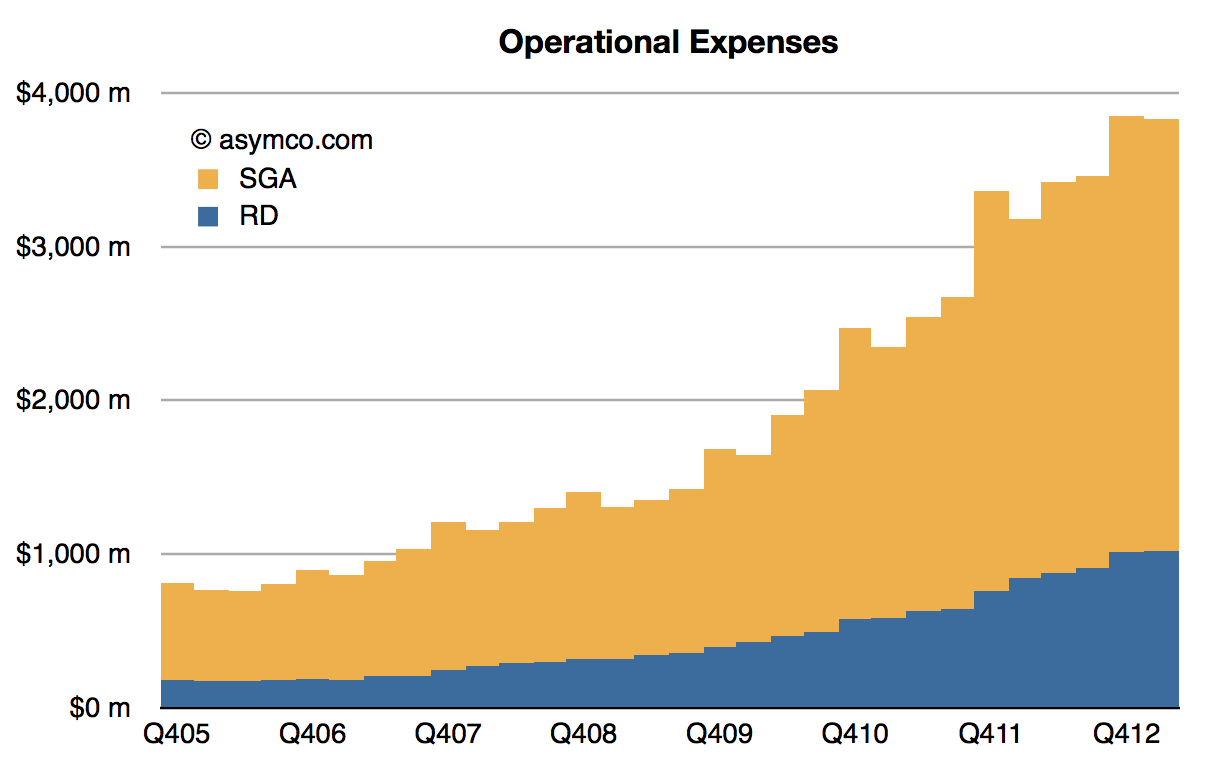
    To anyone who has visited the current "campus", it's obvious that Apple has outgrown it some time ago. It's also obvious given the increase in headcount and operational expenses over time as can be seen below:


    Screen Shot 2013-04-15 at 4-15-12.27.57 PM

    (I added Q1 2013 estimate based on company guidance.)

    One can understand why, from a practical point of view, they want to consolidate what amounts to at least twice as many people back into one place.

    But there is also a more subtle reason and it has to do to a fundamental distinction: Apple is a functional organization. Unlike almost every other large company it's not organized in "divisions" which have responsibility for "a business" in the sense of profit or loss. At Apple most people or teams are assigned a function like "design", "engineering", "sales" etc. When a product is being built, they are assigned to that effort. When the product is complete, they go to another product.

    This is not a matter of hypothesis. Not only have we heard rumors of how one product was delayed (e.g. OS X) because the teams were busy finishing another (iOS), but Adam Lashinsky's work (sanctioned by Apple as it was) revealed the structure almost two years ago.

    This structure may seem obvious to those working in small companies, but it's completely unheard of in large companies. The nearest comparison to this structure is a military organization. There you have Infantry, Armor, Aviation etc. These groups are assigned (in a combined fashion) to a particular effort or battle and then go back to the barracks when done.

    Another example is the way movies are made. Disney famously built his company around the same principle.

    Seen from this perspective, the architecture of their proposed campus makes perfect sense. If it was a divisional structure then each division could live in its own building or campus. In fact, each division would not have much to talk about to any other division. But as a functional organization Apple needs to move people quickly between projects. It needs to re-configure itself frequently. Being in the same building means they can do this much more efficiently.

    This is why there needs to be one building and this is why the shape chosen is probably optimal: each point within can be reached with minimal routing. The fact that it's aesthetically pleasing is a coincidence.

    Or perhaps not. Some say that in beauty there is truth. At least to me, the design looks to be pure logic.