Cinematic is to film as Literary is to prose. It's not a measure of quality or of beauty. It's mainly the application of technique to impart an additional layer of meaning to the writing, performance and direction of the medium. Cinematic technique lifts the viewer to another, more profound point beyond the literal.
Whether it's film, literature, verse, stagecraft or other visual arts, techniques vary but they have the same purpose. They make the audience feel more than what is said.
The quality of a good work of art is that it tells a truth without saying it.
And this, I believe, is what the analyst should also strive for. It is at least what I try to do and, having practiced for a while, I think I can convey some of the techniques I learned.
We don't have a better word for describing these techniques than "cinematic". They allow the presenter of complex and rich data to convey meaning with an economy of rhetoric. They draw the audience into completing the picture thus making it their own. They persuade without pleading. They teach without lecturing. They create, in a way, a poetic language for data that combines techniques from several arts, especially cinema.
The means for teaching this is a workshop called Airshow.
Together with IBM, we are proud to bring Airshow to Boston, New York and Helsinki this year.
The most interesting juxtaposition in market data happened this week.
Apple announced 9 million units of the iPhone 5s/c sold in their opening weekend while BlackBerry recognized 3.7 million smartphones sold in the three months ended August 31.
I will state these data points with a different emphasis: while Apple explicitly reported, both in a press release and in an SEC filing, Sales of 9 million units, BlackBerry reported recognition of revenues on 3.7 million units. At the same time BlackBerry also reported sales to end users of 5.9 million units.
So, did Apple sell 9 million iPhones in three days? What about units ordered and not delivered? Which of these units will show up in the company's income statement? Conversely, did BlackBerry sell 3.7 million or did it sell 5.9 million smartphones in three months?
The answer is dependent on what constitutes a sale. I suggest re-reading the Sold and Shipped: A Brief Introduction post from last year. Understanding is complicated by many factors, not least of which could be intentional signaling by management. We may never come to a perfectly matched comparison of the two companies' situations but our job as analysts is to see through the signals and obfuscating language and interpret a pattern. A pattern that extends over a time and helps us learn.
My observation is one of contrast. The juxtaposition this time is that Apple emphasized sold and not shipped while BlackBerry sold more units to end users than it recognized revenue. These signals reflect precisely the inverted fortunes of the two companies.
For BlackBerry the higher sold than shipped recognition was due to a product launch failure. Units which were shipped (and recognized as revenue) last quarter did not sell and the company is not only writing off the inventory but has drastically reduced its deliveries of new units in order to drain inventory. The company explains:
During the second quarter the company recognized hardware revenue on approximately 3.7 million BlackBerry smartphones. Most of the units recognized are BlackBerry 7 devices, in part because certain BlackBerry 10 devices that were shipped in the second quarter of fiscal 2014 will not be recognized until those devices are sold through to end customers. During the quarter, approximately 5.9 million BlackBerry smartphones were sold through to end customers, which included shipments made prior to the second quarter and which reduced the Company's inventory in the channel.
The company is essentially saying that due to the unusual circumstances of a product launch failure, they will change how they account for their business. They don't have the confidence that units shipped will actually sell and will not recognize them since they fear they will have to write some off. They are signaling: They are being far more conservative, not reporting shipments alone because those shipments could essentially be value free.
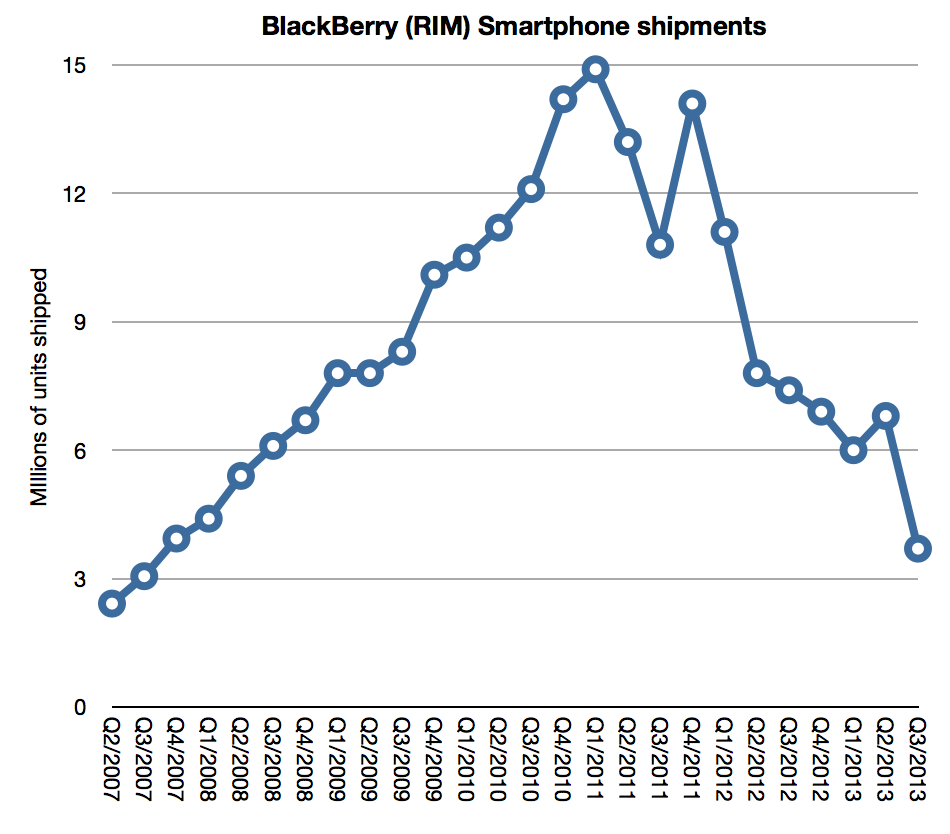
When seen as a pattern, the new figure on recognized revenue units needs to be shown relative to the history of recognized revenue units.
You can see the instability in volume recognition in the graph as a clue. Product launches cause erratic changes in what was previously a seasonally stable business. This is, essentially, the company being thrown onto its back foot. It is staggering from an unexpected blow and resetting expectations.
Now note the contrast with Apple. Apple provides every quarter shipment data on all its products. This is consistent with generally accepted accounting principles and consistent with reporting from other companies. ((Though many, e.g. Samsung, Google, refrain from reporting shipments any shipment data at all.))
Apple also offers "channel inventory" data on select products. This inventory data, when coupled with shipment data, offers insight into how many units are actually purchased by end users. If Apple runs a tight ship then its inventory is relatively low but if it has a reliable customer base that of its channel is also low. Moreover, if it can predict sales well then it avoids overfilling the channel and having to take a hit while draining it.
In that context the way the company reported the 5c/s launch is signaling optimism:
On September 23, 2013, Apple Inc. […] announced that it has sold over nine million new iPhone 5s and iPhone 5c models, just three days after the launch of the new iPhones on September 20.
Apple expects total company revenue for the fourth fiscal quarter to be near the high end of the previously provided range of $34 billion to $37 billion, and expects gross margin to be near the high end of the previously provided range of 36% to 37%.
The SEC filing language above refers to the following press release:
Apple® today announced it has sold a record-breaking nine million new iPhone® 5s and iPhone 5c models, just three days after the launch of the new iPhones on September 20
“This is our best iPhone launch yet―more than nine million new iPhones sold―a new record for first weekend sales,” said Tim Cook, Apple’s CEO. “The demand for the new iPhones has been incredible, and while we’ve sold out of our initial supply of iPhone 5s, stores continue to receive new iPhone shipments regularly. We appreciate everyone’s patience and are working hard to build enough new iPhones for everyone.”
The reporting of sales after a launch weekend has been a staple of Apple's communications about product for a long time. Therefore the evaluation of this performance should be made in comparison with previous launches.
But it's not necessarily a statement of end user purchases. Nor is it a statement purely of shipments. The term "sold" as used in a press release is not an accounting term and it is not something which is meant to be audited.
However, none of that matters. The signal is what should be observed. By deliberately and repeatedly using the word "sold" Apple is expressing confidence that demand for its products is strong. Sure, there is channel inventory in that 9 million unit number but there are also ordered devices which have not been shipped and thus are not counted as sales. There are also depleted store shelves and people angry about not getting their desired phone model. Apple knows this, Tim Cook is making it clear they know this. They have excellent visibility into the distribution of their products. They have excellent inventory management. They are typically conservative in their financial reporting.
So why would anyone interpret Apple's release as a negative signal? If you want an example of a negative signal, look at how BlackBerry reported its launch performance.
When interpretation of a signal is very different from the literal statement, it says more about the interpreter than about the company.
My thanks to Eric Jackson for his thoughtful questions and post on Forbes.com. You can read full interview here but I repeat a few non-biographical questions and answers here for discussion:
Q: Turning to Apple, where is it at right now as a company in this post-Steve Jobs period?
A: Still too early to tell. They seem to be cooking a lot of things and the great experiment of whether a company can be Jobsian without Jobs is still going on. I have been trying to put together a picture of how it operates. It’s hard because that’s their biggest secret. It’s also a picture that few people have ever seen, even those who worked there a long time. The glimpses so far are tantalizing but there is so much we don’t know and thus can’t assess how robust it is. One thing that is clear to me is that there is no absorption by mainstream observers of what makes Apple tick. It’s hiding in plain sight because what it is isn’t anything anyone can recognize. Case in point is the functional and integrated dimensions. It’s the largest functional organization outside the US Army and more integrated than Henry Ford’s production system. Just describing it sounds medieval and it’s so far outside convention that it’s not something reasonable people are willing to believe actually exists.
Q: Is Tim Cook the right CEO for the company at this time?
A: I hold the belief that he’s been CEO for much longer than it seems. Jobs was not a CEO in any traditional sense. He was head of product and culture and all-around micromanager. He left the operational side of the company to Cook who actually built it into a colossus. Think along the lines of the pairing of Howard Hughes and Frank William Gay. What people look for in Cook is the qualities that Jobs had but those qualities and duties are now dispersed among a large team. The question isn’t whether Cook can be the “Chief Magical Officer” but rather whether the functional team that’s around Cook can do the things Jobs used to do.
Look at it another way: I subscribe to the idea that any sufficiently large company is a system and needs to be analyzed using a lost art called “Systems Analysis”. This is a complete review of all parts and the way they inter-relate. However, since for most of its life Apple was personified as an individual, what came to pass for Apple analysis was actually the psychoanalysis of that individual. It makes for great journalism and best selling books. It’s also banal and almost certainly wrong. The proof is in the vastness of complexity and number of people involved. Engineers tend to think about constraints and the constraints on companies are innumerable.
Q: You’ve written extensively on the post-PC period, when will we come to the post-phone period – if ever?
A: I think less than 10 years. Maybe even five. A wristband today can have more processing power than the original iPhone. An iPhone has more power than a desktop did 4 years ago. The speed of change is incredible.
Q: What’s going to be the “next big thing” for Apple? Watches, TVs, something else?
A: I segment along “jobs to be done” which are basically unstated and unmet needs. Unstated because they are usually so deep and so pervasive that they’re taken for granted. We have the need to feel good about our lives, to be healthy and to be connected in meaningful ways to others. These jobs are very poorly served by technology today and there are many non-technology products that are hired as poor proxies to help. The speed with which technology changes means that the trajectory of improvement will undoubtedly intersect that of the job. Even a small job like losing weight and eating well is probably worth as much as half the mobile phone market. Imagine if someone gives us a magic tool that does that for us. How much would you pay? How many of us would pay? There are so many next big things that I cannot choose. (By the way think of the job Facebook is hired to do: make me feel good about myself because I can show others how good I am. Boom!)
Q: What’s your take on how they’re handling their expansion into China, India, and other emerging markets?
A: It’s depressing how slow things are moving on that front. We can draw lines on a graph but we don’t know the constraints. Again, the issue with adoption is that the timing is so damn hard. I was expecting smartphones to take off in mid 2004 and was disappointed over and over again. And then suddenly a catalyst took hold and the adoption skyrocketed. Cook calls this “cracking the nut”. I don’t know what they can do to move faster but I suspect it has to do with placement (distribution) and with networks which both depend on (corrupt) entities.
Q: As you look at the rest of the mobile internet competitive landscape, do you expect any big surprises from other players (good or bad) in the next 5 years?
A: The big question in my mind is the sustainability of the arbitrage models which underpin pretty much every internet business plan. Essentially we have two markets: one where everybody consumes but pays in metadata and another where everybody consumes aggregated analytics but pays in cash. An internet business is the arbitrageur who takes advantage of the inability of each market to price the other. History shows that arbitrage markets tend not be stable as information begins to leak across markets. Therefore what would blow the internet up is if consumers could become wiser about what they are giving up and advertisers would become wiser about aggregating consumer data. I imagine a system where each individual would allow bids on their consumption and a market mechanism where bidders competed for that data. This of course depends on users taking control and ownership of their own data. What might help is the realization of what mass state surveillance can do and the realization that internet giants have more information about us than the government could ever hope to possess.
It would create a new era which will have political dimensions. I imagine we’ll need an internet citizen’s bill of rights or some such movement which will reset expectations. Economically, could bode well for those who position themselves as protectors of the individuals and be a crisis for those who take advantage of consumer ignorance.
I recently tweeted that any discussion related to wearable technology needs to begin with a description of the job it would be hired to do. Without a reason for building a product, you are building it simply because you can.
The reason a product deserves to exist is that it can do a job that needs doing and that few, if any others can also do it. This happens when the job is unstated and difficult to perceive. Put another way, the difficulty behind jobs-to-be-done based design is that jobs are never plainly evident. In contradiction to invention, where the problem being solved must be as clearly stated as its solution, value-creating innovation meets new and unarticulated needs. Even when created, the value is more subtly perceived, often only after prolonged use.
Which brings me to the M7. Apple chose to highlight a component (curious in itself) which it bills as a "motion coprocessor". It claims to be measuring motion data via accelerometer, compass and gyroscope and processing the information in some way. By bundling the sensors and their management into one integrated chip battery consumption is reduced and these motion monitoring functions are performed more efficiently.
But what for? The examples given during the presentation for an iPhone with M7 don't add up to a lot of benefit. An iPhone could be used as a fitness companion but it would not a very good one. Compared with, for example, a Nike FuelBand, an iPhone could not track your activity well. It's often not moving, sitting on a desk or in a purse or pocket while you are doing exercise. It's too big to take into a basketball game. It can't "observe" your activity because it's not worn during many activities and if it is worn it is in a position which does not inform much about what you're doing. Phones are too big to be used as physical activity monitors.
Hence the question of what is the M7's job to be done. As part of an iPhone, it does not seem to have one. Saving a bit of battery life is not a job, and certainly not one that needs to have billing in a media special event. The answer must be that the M7 was developed for some other, as yet unstated reason.
When the A series chips were created Apple leveraged the in-house design and cost reduction to make a wide range of products with more than 700 million examples built. Designing a chip needs a broad application domain.
Perhaps this is why Apple chose to describe the iPhone 5s as "forward-thinking". The M7 and the Touch ID are like research projects whose actual value will be realized at some future time, in probably different contexts. The M series of chips may become Apple's "low end" microprocessor as the A series climbs the trajectory into core computing tasks (read: phone, tablets, TV, laptops).
M might be the chip for the wearable segment, woven into a whole new fabric of uses and jobs to be done.
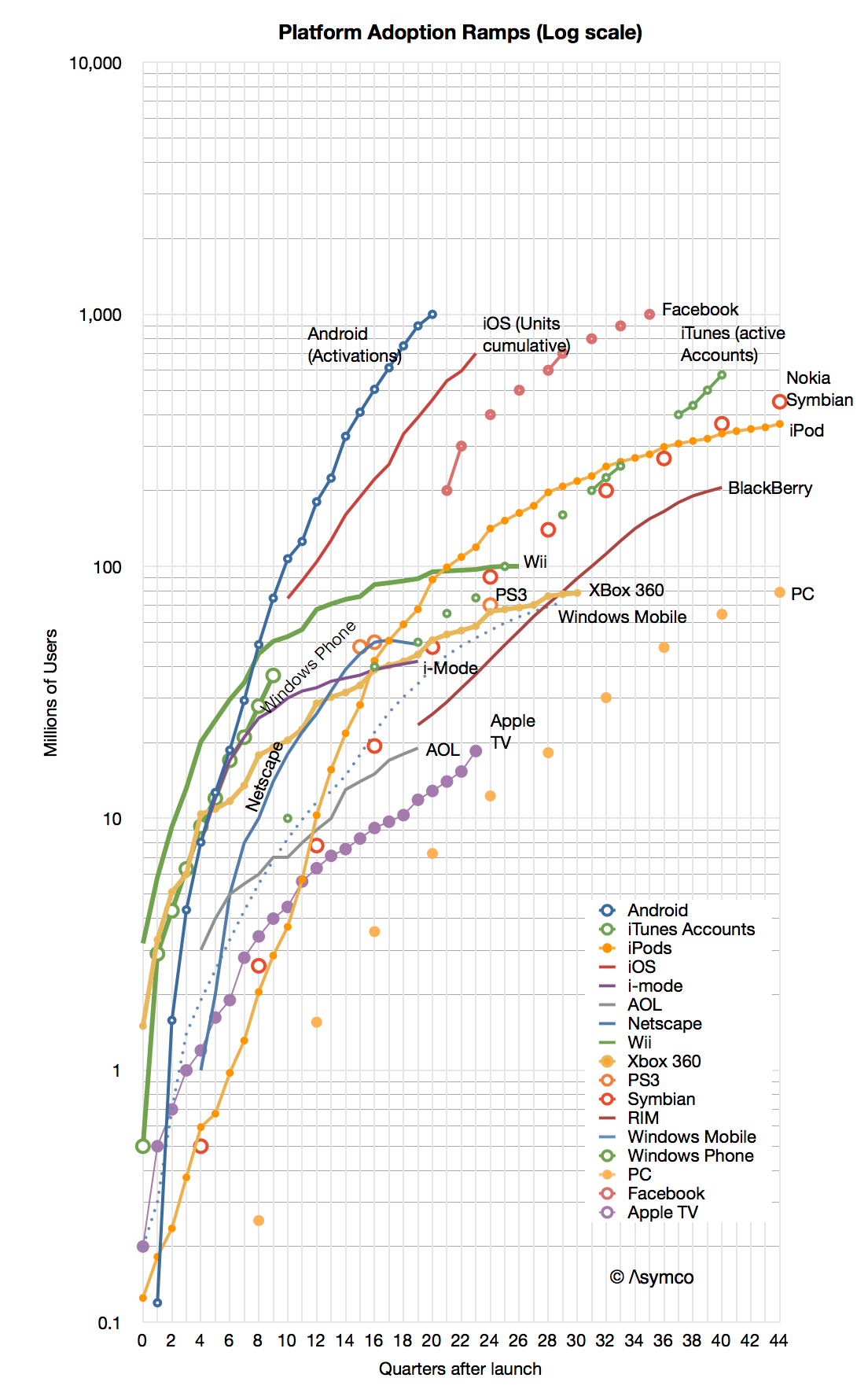
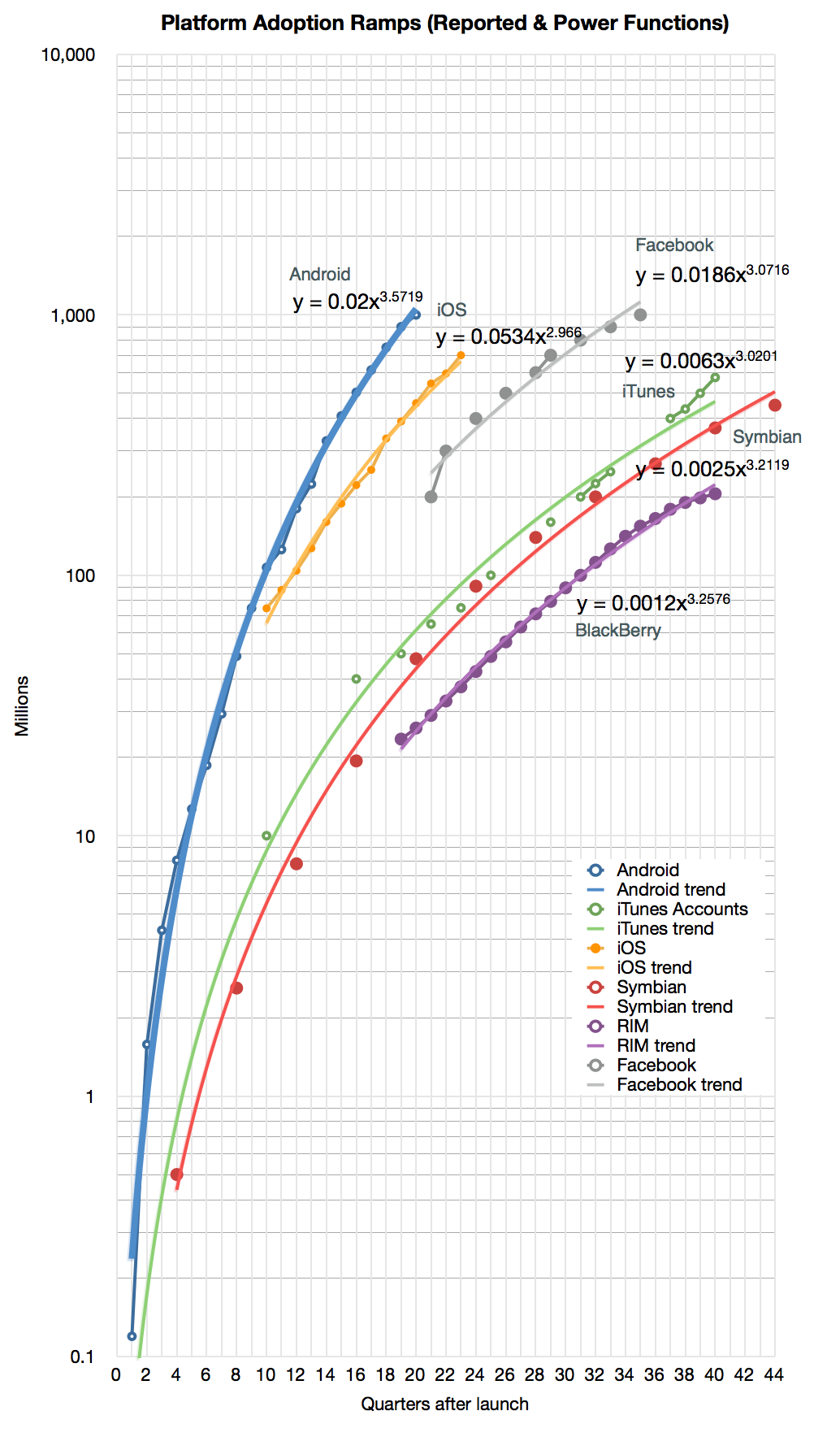
When looking at the Race to a Billion data I noticed that some platform adoption ramps look quite different from others. It's not just a matter of "slope" or rate of growth but a distinctly different shape.
If you look at the graph below you might see the difference yourself.
First, note that the graph is logarithmic. A straight line on a log chart implies exponential growth (the y values are a constant to the power of the x value). However, none of the graphs show straight lines. None of the platforms follow exponential growth ((Except perhaps in the very early periods)).
Second, we can eliminate linear or logarithmic functions. They simply do not fit.
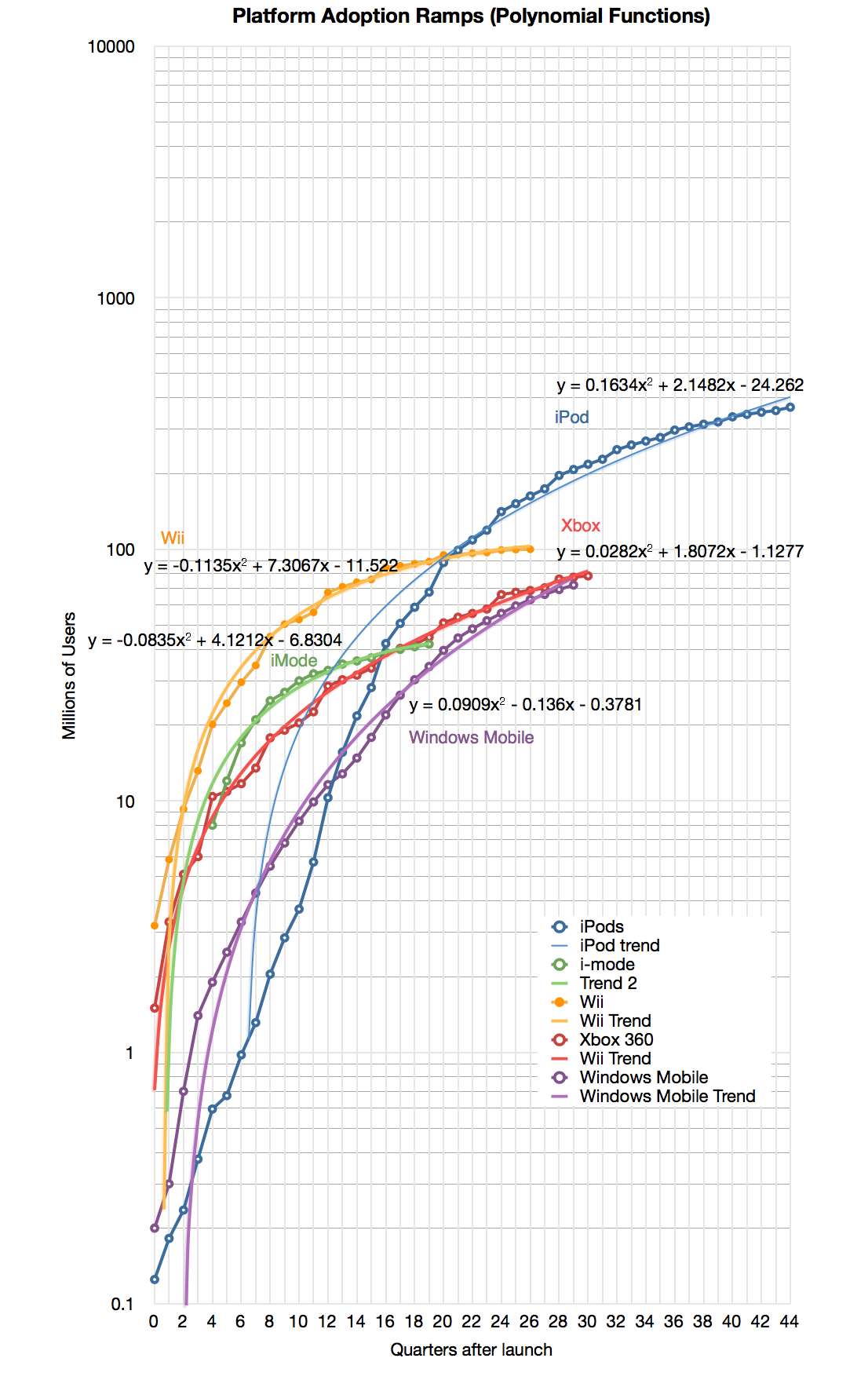
That leaves: polynomial or power. It's easy to test these alternatives for all the functions and it becomes clear that most of the platforms split into one of these two classes.
Here are the classes ((Some of the platforms had to be dropped because there was no easy fit. My observation is that some of these platforms went through some crisis or change in strategy during their history which caused the pattern of growth to change)):
Note that I added the formulas for the selected platforms.
I named these classes after their function types: "Power platforms" or "Second Order platforms" ((Note that all Polynomial functions found above are second order)).
This classification has two benefits:
It allows a clearer distinction in scope. Both may exhibit signs of network effects, but Power platforms seem to exhibit "global" or unlimited reach while Second Order platforms may have a strong upper bound on reach.
It allows more reliable forecasting. If a platform classifies as Power, the forecast could be created with fewer data points.
It allows us to guess at the causes of entry into each class for any potential platform challenger.
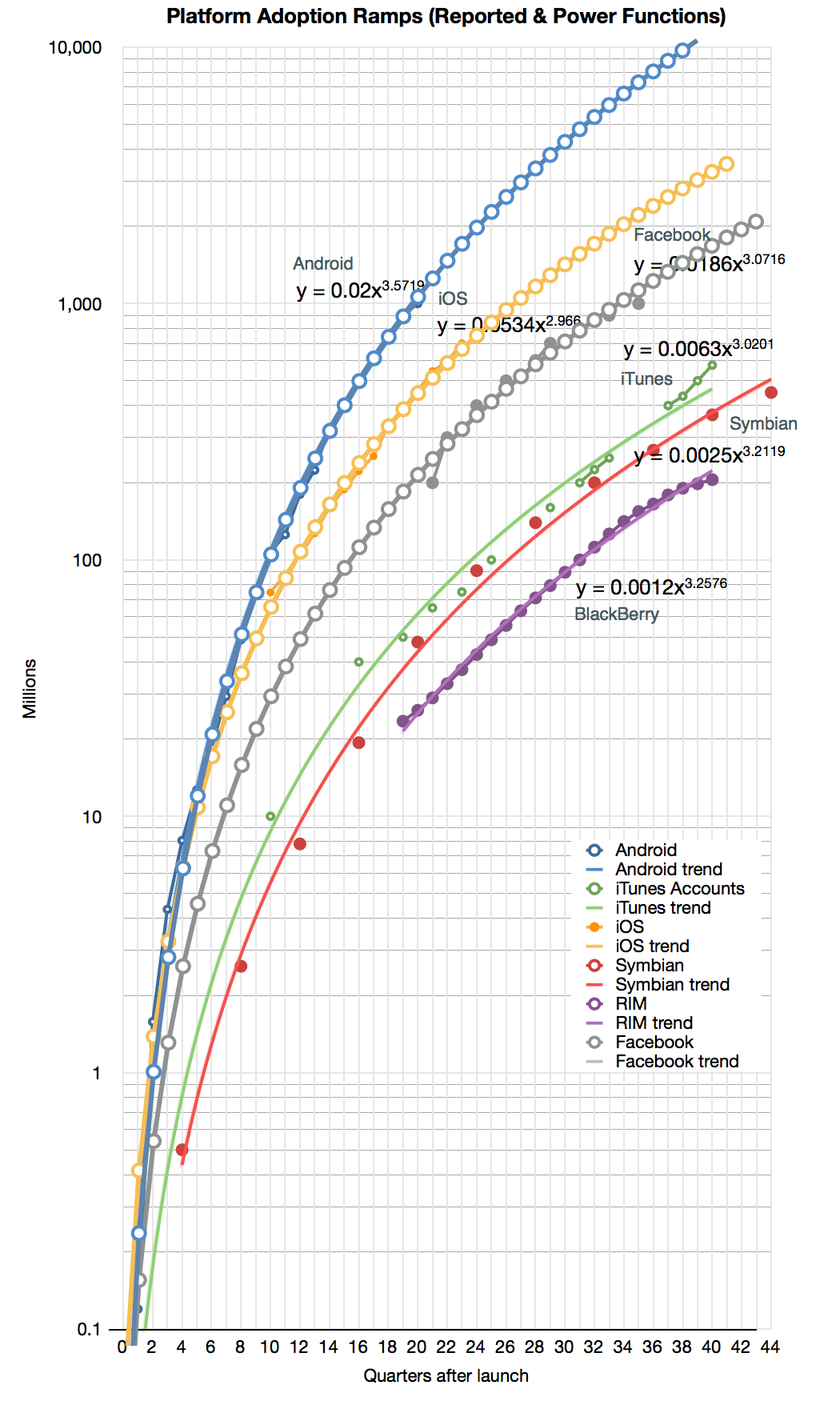
To illustrate the second benefit, I took the Android, iOS and Facebook power functions and modeled (i.e. extrapolated) them for a few quarters into the future. The result is shown below:
The forecast shows the following:
Android will reach 10 billion activations 10 years after its release (mid 2018)
iOS will reach 1 billion units sold by end of next year and 3 billion units by its 10th anniversary in 2017.
Facebook will reach 2 billion users by 2015 after the end of its 10th year.
One of the enduring mysteries of the iPhone has been its lack of a portfolio. After six years it seems that Apple has finally acquiesced that there should be one, albeit currently limited to two items. The second enigma is related to the price, namely why does Apple ask so much for its phones? At an average sales price of $600 it's a shocking premium to the average phone, and with a six year run, a shocking resistance to the corrosive effects of competition.
The obvious answer to why Apple asks so much is because it can. Anybody would if they could. That's a poor question. So the right question should be: why does anybody pay this much? One could answer that few do and it's not a mystery that some feel better paying more simply because they can. But those who pay Apple's prices are, mainly, not consumers. They are operators. Exactly 270 of them.
So then let's re-ask the question: Why do so many operators pay so much for Apple's phones? We can't answer that with the psychological slurs usually directed at the brand. Surely Operators aren't competing in beauty contests or need to soothe their collective egos. The decisions operators make on whether to range a phone are driven by hard economic realities: ARPU, churn, network costs, depreciation, ROI, etc. Some clearly can't make the iPhone fit their economic models and indeed about two thirds of them don't. But the most prominent ((Arguably the most important)) do. DoCoMo, the largest in Japan just did after holding out for five years. Verizon held out for years, as did T-Mobile. China Mobile's acceptance also seems imminent.
But that still leaves the question of why are those operators who do carry the iPhone willing to pay so much for it? I only assume that their decision process is likely to be rational. Mainly because we have a large enough sample but also because there is a lot of money at stake requiring quite a bit of internal consensus and vetting before committment. We have to conclude that operators place the orders because they obtain value from the iPhone even when it's priced at a premium to the average alternative.
The question which follows then is how do they obtain value? I've argued that this follow-the-money process leads one to conclude that the iPhone helps in moving users to higher revenue data services. These are more profitable services for operators and the subsidy model creates more loyalty and thus reduces churn and creates a stable cash flow which can then be leveraged through debt to upgrade networks and attract yet more loyal iPhone users.
Therefore the iPhone is "a data service salesperson" receiving a large commission (in the form of a price- and hence margin premium) for doing what few others can do. In that sense the iPhone is hired by the operator to do a unique and valuable job and is paid well for doing it.
This answers the question of why Apple can get away with charging so much for its phone: because operators love it. The entire product depends on a reward system and for years we've heard fears that it's going to end. But it hasn't. Operators love subsidies and they've been honing them for long before the iPhone showed up. ((Recall that the first iPhone was sold without subsidy and with a separate, secret revenue sharing plan. It did not last because it was cumbersome and because operators convinced Steve Jobs that their way was better.))
But this is not the end of the money trail. The premium is initially paid by the operator but they tend to get most of that payment back from the consumer. In other words the subsidy that inflates the iPhone price is at least partly if not mostly paid by the consumer in the form of a higher phone bill.
You won't see it itemized on your bill, but it's likely that $10 to $15/month from a subsidized phone service plan goes toward paying for your phone.
So in a way, Apple has managed to place itself on many people's monthly phone bills. It's a nice place to be. It's nice for the same reasons operators like post-paid customers: predictability. It's also nice because recurring services are a better business model than products; they have higher levels of loyalty and are more "sticky".
But this placement is not transparent. It smacks of misdirection. The link is not made in the mind of the consumer that they are paying for a phone through their service plan and many see it as a thinly veiled con. The value of the iPhone to the user may be evident through its use but the payment for that value is not.
But in many ways this is similar to how many services are valued: through bundling. We pay for the value of a great retail experience through a higher price on items purchased. But we still associate that price with the good sold not with the place where it was bought. We get great value from Google's services but don't know how to quantify the cost of their peering into our minds. In fact the whole Internet and all business plans that are built on it depend on a subtle "something for nothing" type of misdirection. The Internet runs on the arbitrage between a consumer service market where everybody consumes but nobody pays and a separate data market where nobody consumes and everybody pays.
The iPhone could thus be finally understood as a complex service business. It captures value through the phone bill but delivers value through a screen. A misdirection magic trick which many have tried to pull off. It's essentially tapping into the $1.3 trillion communications market, skimming profits by delivering the "content" which lights up the wires.
It's great except it does not work everywhere. Not yet at least. The complexity of services means that they are usually found in more advanced so-called service economies and rare in less developed so-called goods economies.
Economists have observed this process and even have a name for it: servitization: The process whereby almost all sufficiently advanced products are indistinguishable from services.
As a service, the iPhone's strengths are easier to understand. Its weaknesses as well. Services simply don't work in economies which don't have robust institutions of credit, capital intensive infrastructure and distribution networks.
It's also the reason why Apple is so slow to penetrate all markets. It's not in the business of selling phones. It's in the business of enabling and creating services.
My assumption going into this, sixth iteration, of the iPhone was that we would see the expansion of the iPhone into two distinctly positioned products: a low-end C and a high-end S. The assumption was based on what what we saw with the iPad: the regular iPad and the mini iPad.
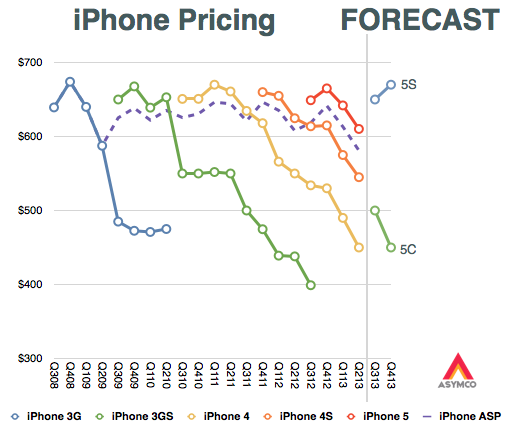
By using the iPad as a template, my exercise in August was to forecast what the pricing ((Revenue/unit to be more precise)) might turn out to be for such a split-personality product.
I expected the 5C would replace the "low end" n-2 variant ((Older by two generations as the iPad mini replaced the iPad 3)) and the 5S would continue as the core product. This is reflected in the original graph as devised in mid-August:
The surprise was that the 5C was not "low end" in any way other than having a plastic case. It has a minor spec increase over the 5 but is otherwise a 5 feature set in a plastic skin. It also is priced as if it was the continuation of the 5, with a modest reduction in ASP.
In addition, the continuation of the 4S and 4 (in China at least) means that the old strategy continues more-or-less unchanged.
Knowing the line-up and pricing all that remains to understand is the positioning, or how the products are defined relative to each other.
This is where there might be a shift happening. Under the old model the n-1 variant was meant to be a modest volume contributor to the portfolio, being essentially a cognitive illusion which encouraged buyers to stick with iPhone n at the expense of competitors. However, the new n-1 product (the 5C) has a distinct positioning that makes it seem fresh and not a lesser, stale version of the flagship. It is designed to appeal as a legitimate upgrade for iPhone 4/4S users. It is, in other words, not meant as an illusion, and not focusing attention on the flagship ((It might still be an illusion for many but I'm suggesting that it won't be for most.)). Rather, it is meant to be a genuine, core product.
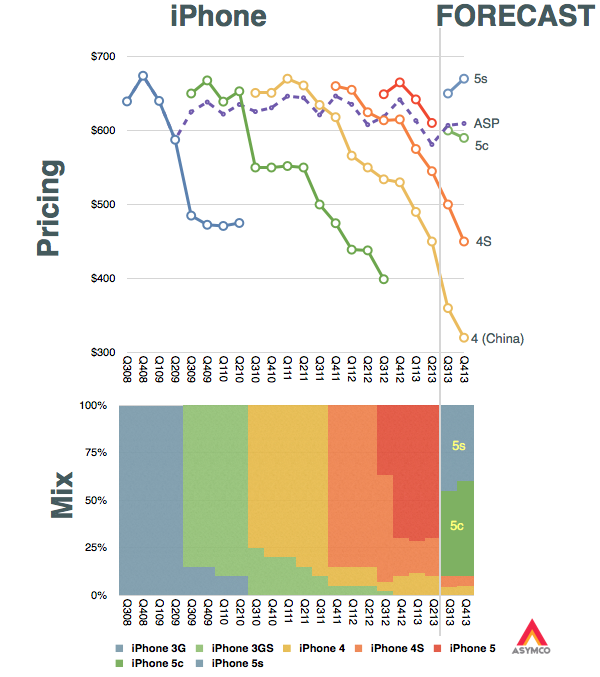
As a result, I expect the mix of iPhones to be more evenly split between the C and S variants. I expect the C to even become the most popular version in the mid-term. My expectations are shown in the following graphs.
There are several implications for this shift in positioning:
Apple is recognizing that the market is actually "segmentable". This is the notion that one size does not fit all--a radical idea for the brand. Its mechanism to address it is a "good+better" portfolio. Note that this is not at all like the iPad where the Mini is actually suited to different tasks. The iPad can be thought of as a "small+big" portfolio. The iPhone shows a clear delineation within the same product.
It is signaling that the premium may be more than what the mainstream needs. This is a corollary to the segmentation implication above but stands on its own because it also implies that the iPhone C is "good enough" and the S is more than good enough (or, to spin it another way, it is for "more demanding" customers.) It also implies that the premium "S" version will be a lower volume contributor.
The third implication is that the basis of competition is shifting. ((It has always been expected to shift, but the timing is where all the value is captured)) The shift is toward competing for late adopters in advanced markets and with early adopters in trailing markets. The new C model is still not suitable for trailing markets as it still over-serves and is over-priced ((This post deals with the iPhone portfolio structure or the placement of iPhone models relative to one another. It does not deal with a separate question of why the overall pricing is so high. That question needs to be dealt with as a discussion about the jobs iPhone is hired to do and by whom. I'll re-visit this job-based segmentation of the market in a future post.)), but it is at least signaling the "end of the beginning" phase in the smartphone market.
In summary I'd say that the C signals the beginning of the "good enough" phase which was also evidenced by the increasing mix of the older models during the last year. Financially it shows up as lower ASP, which, as the graph above implies, I expect to drop to $600 and lower during the next year. Margins may not be affected much as the C is still very highly priced relative to its cost of production.
Finally, if the good enough alternative is being "pinned" by Apple as the mid-range it also begs the question of why there isn't a specific "low end" version. It took six years for Apple to fork the product into two variants. Maybe it will take another year for it to stretch to a third. ((For more on the subject see S is for Service.))
Put another way: Why is it that everyone wants to copy Apple’s products but nobody wants to copy being Apple?
Being Apple means, at least:
Insourcing all aspects of operations which affect the customer experience. Increasingly that has meant insourcing everything, a toxic idea to every MBA-trained professional since forever.
Organizing functionally and having no product level P/L responsibility. That also means removing almost all incentives for employees to climb ladders and thus prove their worth.
Developing products using integrated "heroic" efforts which shun every best (or even adequate) process for product development.
I asked somewhat rhetorically because it's an open question. Apple's operating model and devotion to integration have been asymmetric to technology dogma for decades. To the casual (read: naïve) observer, pursuing the Apple way seemed also to be tied to one individual. You could not "be Apple" unless you were also Steve Jobs and there was only one of him.
But it seems I did not give enough credit to other observers.
According to Microsoft, they began negotiating the buying of Nokia assets in earnest (coincidentally) in February. It has, also since February, been planning a massive re-organization along functional lines. Thus, by owning significant hardware operations and organizing functionally, Microsoft might go about two thirds toward "being Apple-like". The development process is the final hurdle and it may be a bridge too far, but my thesis that nobody wants to copy Apple is now in tatters.
And it gets worse. We can see a similar, though far weaker, example in Google's approach to integration. Their purchase of Motorola did not result in an integrated business, with Motorola being kept at arm's length and allowed to wither on the vine. Crucially, while Google bought Motorola's IP, Microsoft only licensed Nokia's. Microsoft clearly valued Nokia for something different than what Google valued Motorola for.
Nevertheless there is a semblance of similarity. We can generalize enough and say that Apple (iOS), Google (Android/Chrome) and Microsoft (Windows (Phone)) are all becoming near facsimiles of each other. They are all producers of Software, Services and Hardware. Each came from a different basis but expanded into areas which were missing.
Google started with a service, expanded into systems software and bought into hardware.
Apple started with hardware running its own software, expanded into application software and is developing services.
Microsoft started with software, expanded organically into services and bought into hardware.
All three major platform companies are now racing to offer that which completes them as an integrated producer and eliminates the dependencies on others as a modular producer.
This is re-integration of the computing industry--a reversal of the dis-integration brought about by the personal computer. Mobility, it turns out, was as important to the evolution of the computing value chain as microprocessors were to the previous era. It just had the opposite effect.
I should point out that Apple was more lucky than enlightened through this sea change. Having always been integrated, Apple was out of favor during one period of the computing epoch, but, simply by surviving, its model came back into favor in the next. I don't think anybody there foresaw just how dramatic the shift would be and how important their structure was to being successful.
But there is one company which seems left out of this discussion. Samsung is absorbing a large part of the available profits in computing today and it's not an integrated hardware/software/services player. Does this mean that there is room to be a module in an interdependent world?
I argue that no, there isn't. Samsung must either stretch into becoming one of the ecosystem contenders or be relegated to a commodity hardware company--a path clearly visible when looking at Chinese entrants. Samsung itself benefited from disrupting from below and should be aware of the threat it faces as it races up-market. More importantly though there is the ability of creating new markets altogether. This new market creation and rapid iteration due to integration is what the Google/Microsoft/Apple trio are seeking.
Without the components of software (ecosystems included[1]) and services, Samsung will depend on the good graces of suppliers. They may not be as keen to share when profits accrue to the whole rather than the part.
When a prosperous company buys a struggling company you have to wonder what they're really buying.
Here's how to think about it. A company is defined as the sum of three values: resources, processes and priorities (RPP). Everything of value can be classified into these three categories.
When one company buys another it's the equivalent of one set of RPPs trying to engulf or swallow another set of RPPs. The simplest (naïve) interpretation is that an acquisition is the purchase of Resources in terms of customers, sales, profits, etc. It might be of assets like employees, intellectual properties, brand etc. I say this is naïve because Resources are the easiest to value because they can be measured and valuing only what can be measured while ignoring what can't be measured is deeply mis-pricing.
So most people look for the "R" value or the value of Resources in an acquisition. It's may be naïve but it is what markets typically value because it's what they can price. But what happens when the "R" is flimsy or fleeting?
The answer has to be that it's the processes or even priorities which are valued by the acquirer.
These are difficult to value which, as I've argued in The Innovator's Curse, is why they are not reflected in a share's price. When there is a price paid for these fuzzy assets, they are often interpreted as a "premium" to the market price. But that may not be the way a buyer sees it.
When buying a set of Processes, a buyer may see a bargain because their costs for building a similar process could be enormous, even infinite. In the case of Nokia, the process of building hardware may be infinitely valuable to Microsoft as they have had dreadful luck doing it themselves. But they're seen as value free to the market because it seems that there are many others who are building hardware.
The trickiest thing to perceive though is the value of a set of Priorities. Priorities are the answers to the "Why" question as much as Resources are the answers to the "What" and processes are to the "How." If you were to think in terms of software engineering Priorities are the "Specifications" where the Resources are the data and Processes are the algorithms. They determine the direction and reasoning of why a company even exists. If you have bad specs, it never matters whether the algorithm is efficient and you have all the data: you are building the wrong thing.
Acquiring Priorities is also fundamental in that they are usually exclusive. A company typically only has room for one set. If there are conflicting priorities, they need to be sorted out else the company can end up in a state of internal conflict and dysfunction. So if you're acquiring a set of Priorities, it's likely that you'll have to discard your own. It makes most sense when a company which might otherwise be prosperous needs to change direction.
So, in a way, an acquisition of Priorities is almost a reverse acquisition. The acquired is actually "buying" the acquirer. The acquired company's Priorities (and hence Processes and Resources) become the guiding principles in the acquirer. It's what happened when Apple bought NeXT and may have happened when Disney bought Pixar.
Some companies are "Resource-heavy", some are "Process-heavy" and some are "Priority-heavy". Great companies tend to have great sense of priority. They may also have greatness in the other asset classes but it's rare to find a great company without a great sense of purpose.
So the question for the Microsoft Nokia deal is what is Microsoft buying?
Resources? Sure, there is IP and a team. But the chances are that not all the team members will be kept on. See what happened to Motorola after it was acquired by Google.
Processes? Absolutely. Microsoft needs device development processes desperately. They may seem a commodity but it turns out that running great hardware businesses is hard, very hard.
Priorities? Here we have to pause. To acquire Nokia's priorities means acquiring its business model; its belief system. Perhaps they will be discarded and they're not valued. Perhaps, as is often the case, the acquirer becomes allergic to the new priorities.
But Microsoft has made it clear that they are now a "Devices and Services" company. As much as Apple changed its name to exclude "Computer," Microsoft is almost changing its name to exclude "software". It will still make software, to be sure, but for it to get paid it needs to integrate that software into hardware and services.
My first thought on this is that Nokia's priorities are not sufficient for the company that Microsoft wants and needs to become, but there are some priorities which are necessary and which it values.
It may be too much to say that with respect to Priorities, Nokia acquired Microsoft, but insofar as Microsoft is having to transform its business model, what Nokia devices brings is an integral component of the new.
In the Innovator's Curse I reflected on the fact that a serial innovator cannot be efficiently financed or even rewarded for having figured out how to repeatably create. If anything, a serial innovator has to suffer a discount to peers who do not habitually (or ever) innovate. The innovation process is the proverbial goose that lays the golden eggs but is destined to perish due to the lack of faith in its existence.
So how can I back this up?
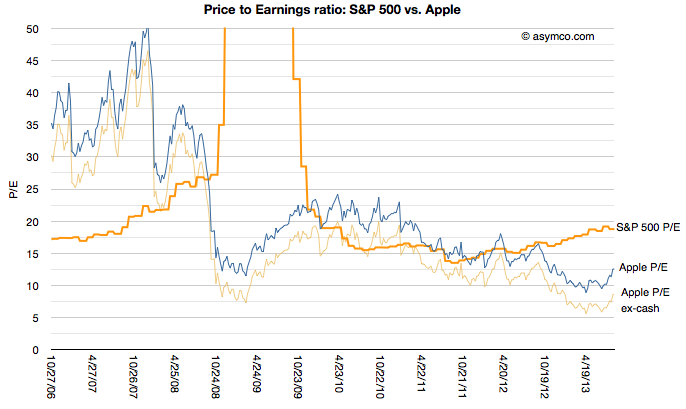
To start, this is partially evidenced in this graph of Apple's price to earnings ratio since 2006 vs. the S&P 500's. The S&P reflects the 500 largest companies in the US and is thus a proxy for the "average" company.
[I added Apple's P/E excluding cash for additional perspective.]
The graph shows that during the period of time when iPhone and iPad changed computing and telecommunications, Apple was mostly held in contempt: the profits it was generating were not considered of "sufficient quality" relative to an average company. Since markets look forward, not backward (one assumes), the vote cast is decidedly that success cannot be repeated. Put another way: you can trust that a soft drink maker like Coca Cola (P/E of 19) or a utility like ConEd (P/E of 18) will continue in the manner we've seen them perform in the last year more than Apple (P/E of 12) will.
I can offer yet another way to consider this curse. Apple's iOS business is designed to capture profits through the sale of hardware. That hardware is manufactured through a process where, while not being the manufacturer, Apple purchases tooling in a capital-intesive strategy to control the means of production. I've discussed this at length before.
But Apple's business is more complex than just enabling manufacturing. Tooling allows for production and production allows for supply but supply is nothing without demand. And demand of the product is driven by investments in software and services and design and marketing and countless details.
In other words, for Apple's modus operandi, if anything should correlate with value it's opex, not capex. It's the investment in the people Apple employs not in the tools it buys.
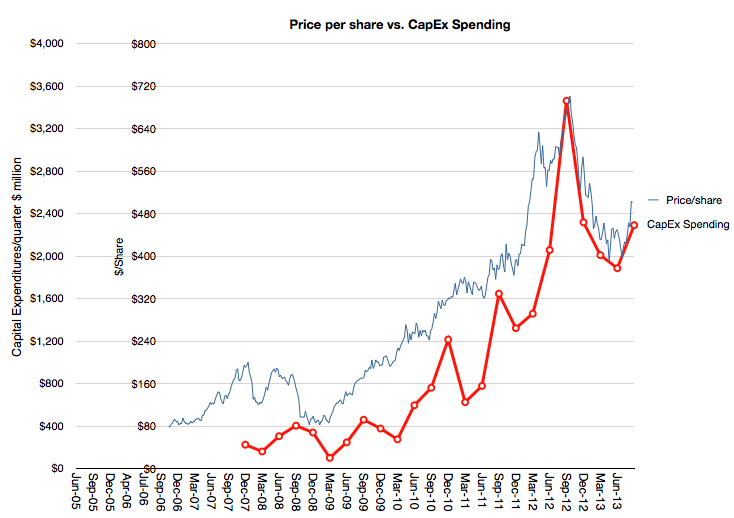
And yet consider this graph:
It shows how the market (though its pricing of Apple shares) values the company overlaid with a Apple's spending on capital equipment (PP&E capex).
The relationship is uncanny. I'm not suggesting causality—that capex (which is publicly pre-announced) determines the share price level—but I am suggesting that there is a valuing of Apple as a producer of goods (for which tooling is a handy proxy). There is no sophistication to this formula. The more iPhones are built, the more the company is valued. Obvious.[1]
But it's not obvious that prior to the iPhone there was iPod, which was a different business (and prior to it was the Mac, ditto.) The stock did not reflect the transitions nor does it assume that anything else will follow. It is, in other words, looking backward, not forward.
--
Notes:
One could suggest looking at CapEx months in advance and predict the stock price, but who would believe such an absurd idea?
The most common, almost universally accepted reason for company failure is "the stupid manager theory". It's the corollary to "the smart manager theory" which is used to describe almost all company successes. The only problem with this theory is that it is usually the same managers who run the company while it's successful as when it's not. Therefore for the theory to be valid then the smart manager must have turned stupid at a specific moment in time, and as most companies in an industry fail in unison, then the stupidity bit must have been flipped in more than one individual at the same time in some massive conspiracy to fail simultaneously.
So the failures of Microsoft to move beyond the rapidly evaporating Windows business model are attributed to the personal failings of its CEO. The calls for his head have been getting loud and rancorous for years. Taking this theory further, now that he's leaving, the prosperity of the company depends entirely on the choice of a new (smarter) CEO.
It's all nonsense of course.
Microsoft is composed of people, processes and priorities. And nothing else. The CEO is but one person, admittedly one with a high degree of authority. However, that authority is not unlimited. A change of leadership in a company may have some impact on a larger set of people, at least in the short term, but the bulk of existing resources, institutionalized processes, and priorities set by customers and cash flows limit what any one person can do.
What really causes a company to fail is disruption. The business model around which all products, customers and priorities are built; the culture, the skills and "DNA" of the company; is vulnerable. This vulnerability is why companies have considerably shorter lifespans than the people who work there. They are one of the most fragile of organisms: high infant mortality, with short, unpredictable lives.
Microsoft ascended because it disrupted an incumbent (or two) and is descending because it's being disrupted by an entrant (or two). The Innovator's Dilemma is very clear on the causes of failure: To succeed with a new business model, Microsoft would have had to destroy (by competition) its core business. Doing that would, of course, have gotten Ballmer fired even faster.
Steve Ballmer's only failing was delivering sustaining growth (from $20 to over $70 billion in sales.) He did exactly what all managers are incentivized to do and avoided all the wasteful cannibalization for which they are punished.
If anything, Steve Ballmer avoided The Innovator's Curse. Being successful with new market innovations would probably have led to an even shorter tenure. Destroying prematurely the pipeline of Windows in favor for a profit-free mobile future would have been a fireable offense. Where established large companies are concerned, markets punish disruptors and reward sustainers.
Steve Ballmer will not be remembered as favorably as the man who created Microsoft. But at least he won't be remembered as the fool who killed it. That epitaph is reserved for his successor.