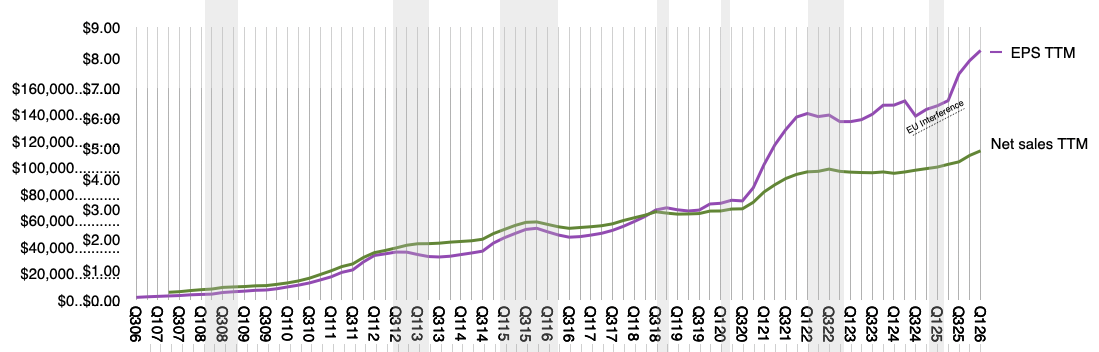
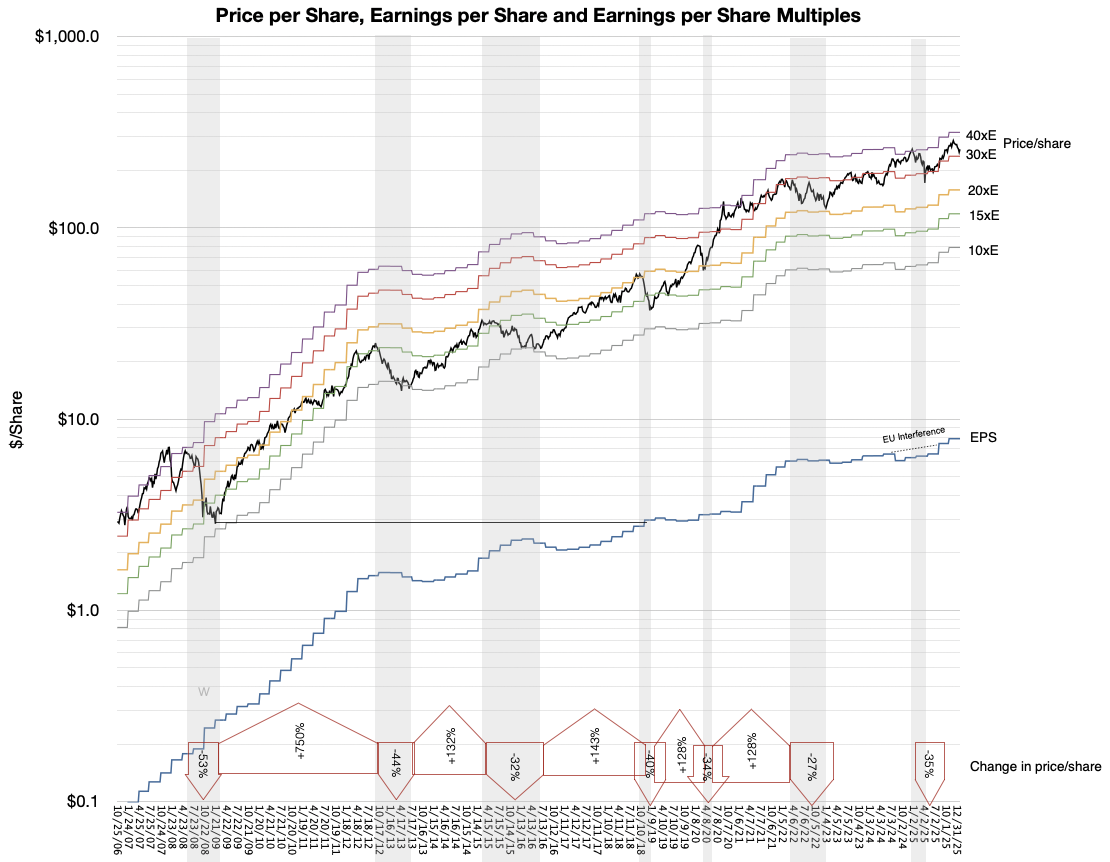
Over the past 20(!) years, Apple net income has grown at a compounded annual growth (CAGR) of 26.6%, Revenue growth has compounded at 21.5% and share price has compounded at at 27.7%. That means the company has been doubling at least every 3 years for more than 20 years.
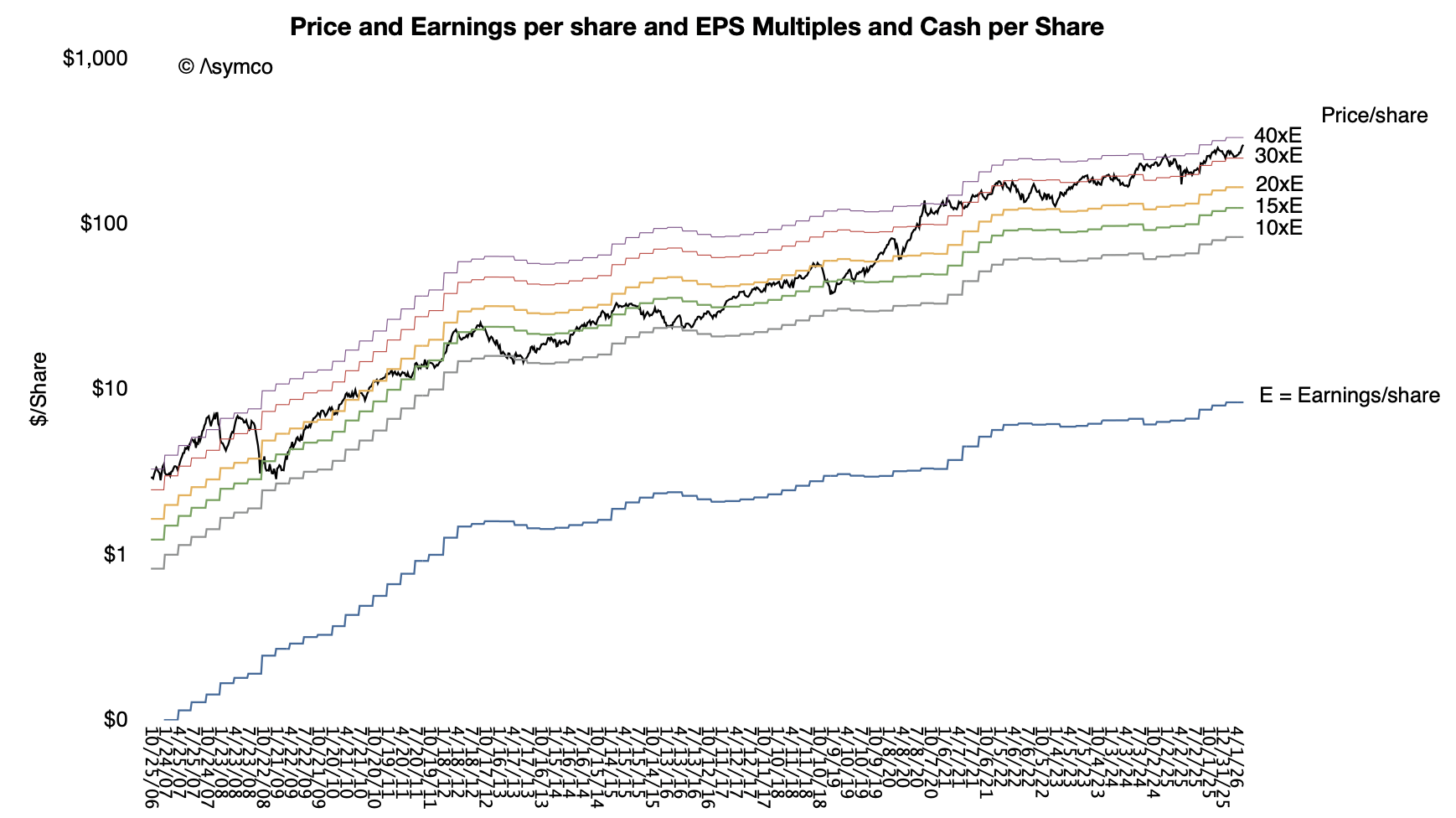
The graph below shows share price and yearly earnings (and multiples of those earnings) since 2006. Note the vertical scale is logarithmic. The Price line has been growing at 27% or doubling every 2.6 years. The exercise of predicting the share price based on extrapolation is left to the reader.
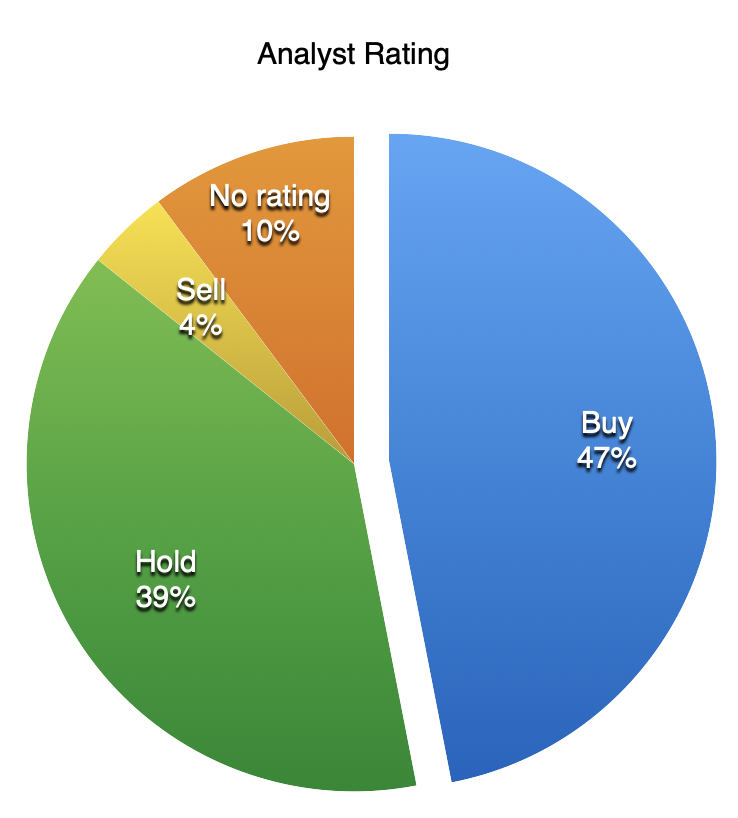
In spite of this, data shows that 21 out of 49 analysts who follow Apple have the equivalent of a "Hold" or "Sell". An additional 5 follow it but have no opinion.
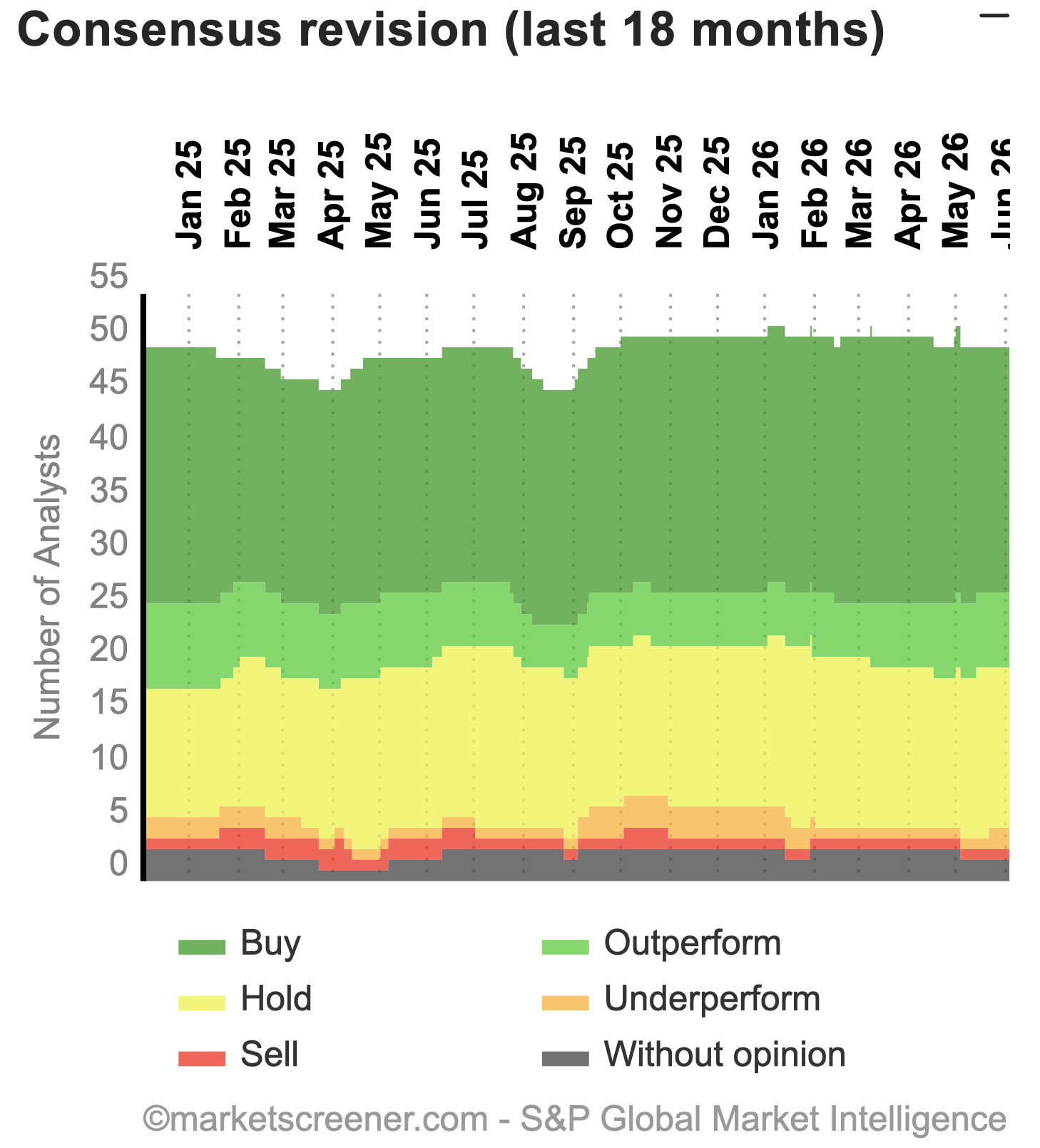
It takes significant courage to predict a reversal of a 20 year trend. That a majority of analysis implicitly or explicitly believe Apple is on the precipice of failure may come as a surprise given the recent rise in price and optimism around AI. The graph shows the percent of Hold/Sell/Underperform/no opinion has been rising.
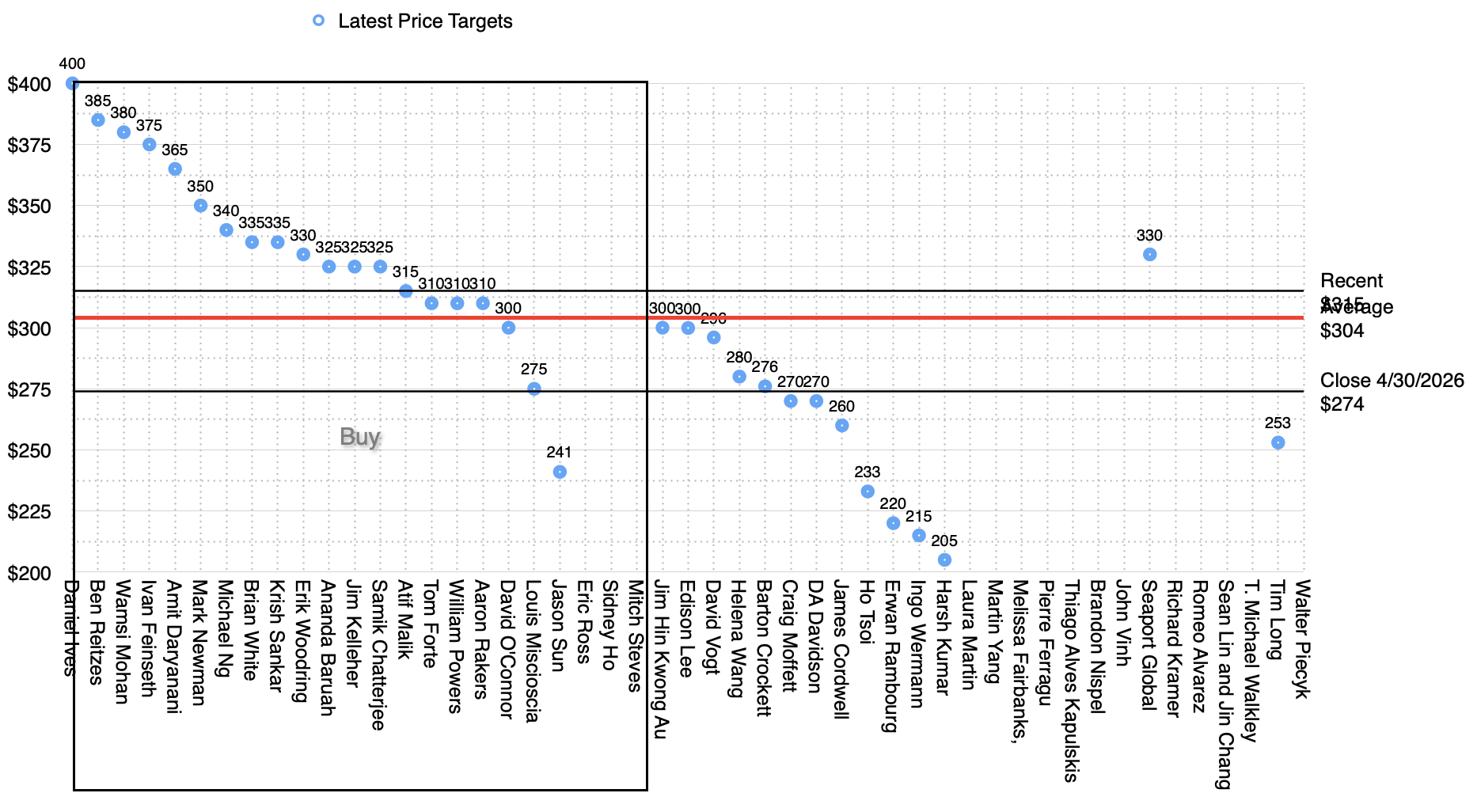
The graph below shows the targets published recently.
The targets are sorted by rating and then value. The "Buy" rated are encapsulated, the rest have all the other ratings. The Red line is the average of all ratings. Some of the ratings and targets, especially the lowest, are out of date.
We will be discussing this and other Apple-related topics at our upcomingJune Office Hours on Tuesday, June 9th, 2026 (day after the WWDC'26 keynote.) Sign up today!
TD Cowen analyst Krish Sankar reiterated a Buy rating and a $325 price target on AAPL stock. He expects Apple to report over 15% year-over-year revenue growth for the March quarter and to guide June-quarter revenue up about 10% year-over-year, driven by healthy iPhone 17 demand and the new MacBook Neo.
Key watch items: Apple’s ability to manage memory cost inflation and the launch of a compelling AI‑powered Siri. Sankar believes Apple will continue gaining share in both smartphones and PCs, with sentiment already positive heading into earnings.
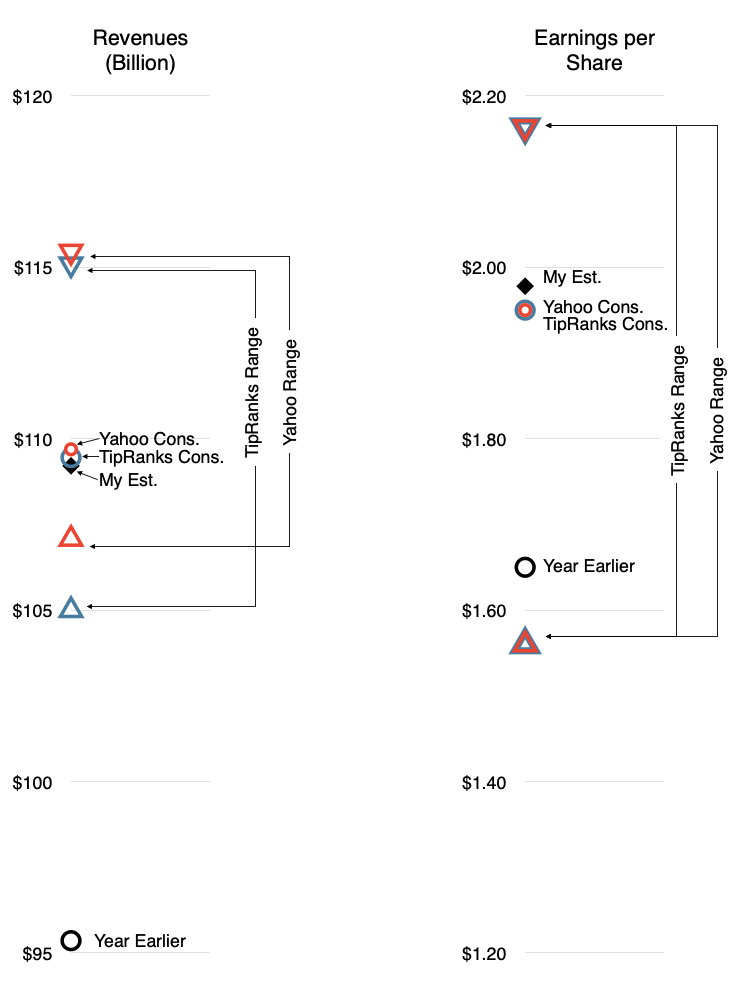
Apple is set to report earnings on April 30. Currently, analysts expect AAPL to post revenue of $109.45 billion in fiscal Q2, up from $95.36 billion in the year-ago quarter. Further, the company is expected to report earnings of $1.95 per share, compared with earnings of $1.65 in the prior-year quarter.
A part of Horace's interview with Asahi Shimbun on the 50th Anniversary of Apple's founding. The portion here discusses management succession and occurred on April 1. Apple announced the succession of Tim Cook as CEO to John Ternus last week. This analysis of Apple leadership decisions focuses on culture and attributes of the firm rather than attributes of the persons leading it. It may prove a more reliable predictor in future leadership changes.
…, the speculation is John Ternus is the next in line. I think that's a very plausible hypothesis. And one reason, by the way, is I always maintain if you study the company from a cultural point of view, you'll realize that there are people who cannot be CEO. You may not know who it's going to be, but I can tell you who won't be. Many people over the years suggested candidates, and I would say no, never. And here are examples. Johnny Ive would never be CEO. An external hire would never be CEO. Even a head of marketing would never be CEO. Many people think that Apple is a brilliant marketing company. No, it's an engineering company. It's a huge secret out there. →
Writing the story of John Ternus' tenure as Apple CEO from April 21, 2040. What changed and what didn't.
It’s been 15 years but John Ternus has finally stepped down as Apple CEO. Analysts described the transition as expected rather than disruptive, noting that investors had long anticipated Ternus’ eventual departure. Nevertheless, he leaves with many questions still unanswered about Apple’s long term strategy. Apple incoming CEO faces a defining challenge: Fixing the company’s Services dependence. It’s been a tumultuous tenure for Ternus but he is leaving with significant accomplishments: John grew Apple devices to 4.5 billion from 2.5 billion when he took over in 2026. Many have pointed out that he has been building on… →
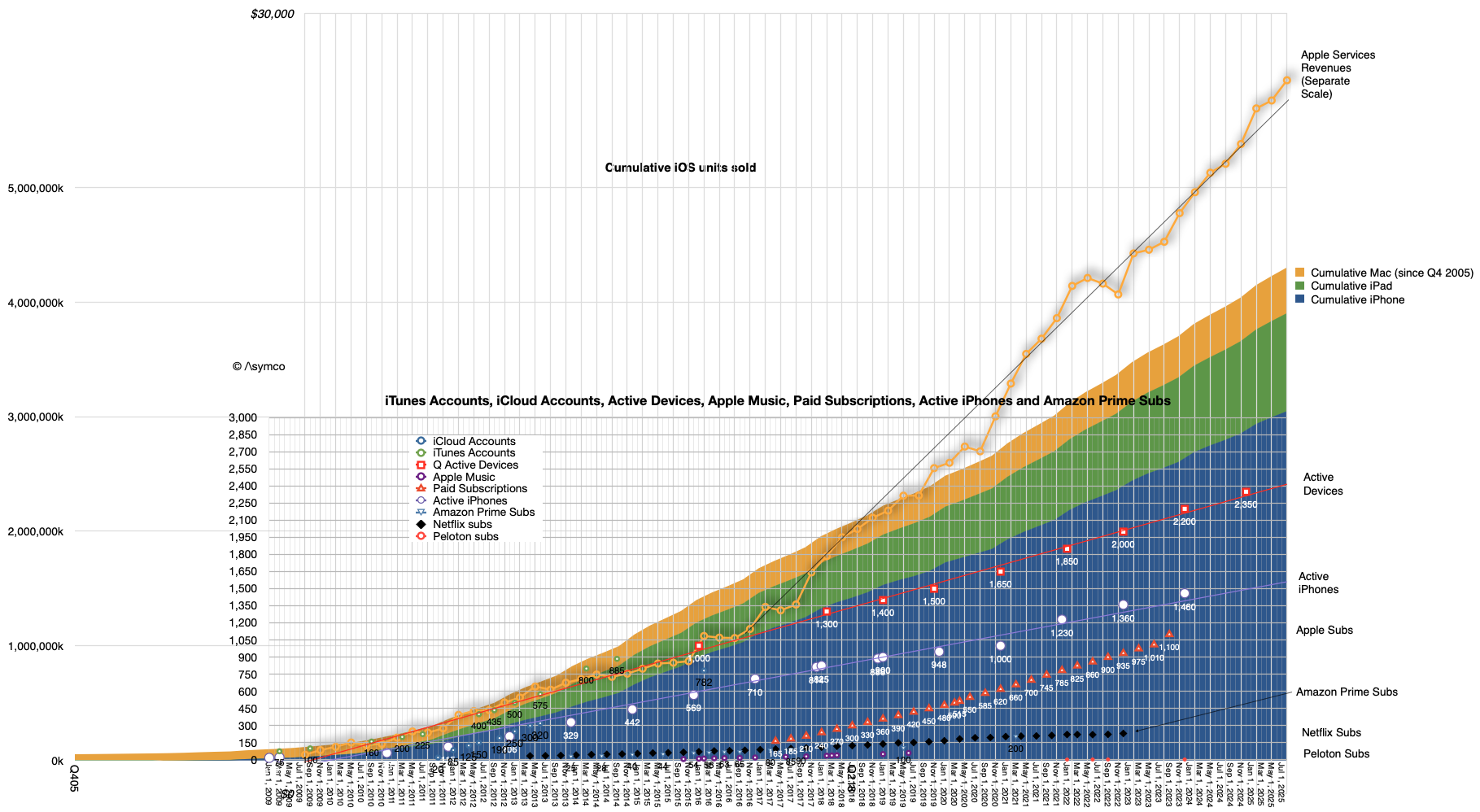
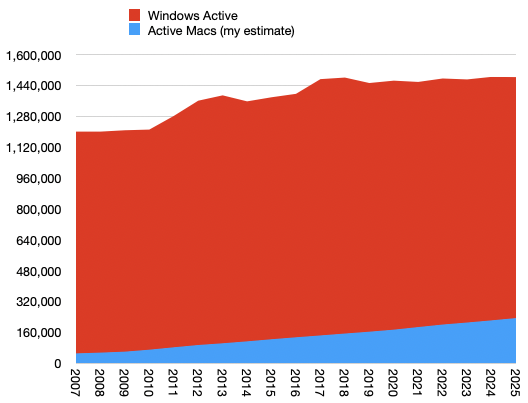
In January this year Apple reported that there were 2.5 billion active Apple devices in use. This figure has been getting updated for years and I’ve been reporting its trajectory and other measures that are correlated to it. For instance the number of Apple subscriptions, Apple Services revenues and other historical indicators such as iCloud accounts and Apple Music.
Simplifying, I published the “ACTIVE” model which makes some basic projections of this total device count and it’s shown below” One element of the analysis that has eluded me was the more precise composition of this total “devices”. →
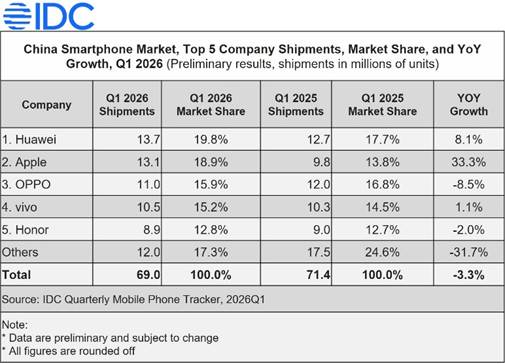
Both researchers say Apple share in China is about 19%, nearly tied with Huawei at 20%…
Some analysts are increasing their targets finally realizing that the memory supply crisis might be beneficial to Apple. This should have been noted already three months ago when Apple provided extraordinary guidance for the March quarter. →
MacBook Neo Sold Out Through April → Despite high demand and stockouts, Apple's strong brand and competitive pricing could turn challenges into opportunities for market expansion.
Microsoft’s cheapest laptop is three times more ex…
As I will argue in a further post perhaps this is one of those pivotal moments. →
Goldman forecasts fiscal second-quarter EPS of $2.00 → Goldman Sachs remains bullish on Apple, forecasting $2.00 EPS driven by strong iPhone and Services growth, dismissing overly pessimistic sentiment as the company consistently gains 100 million new customers annually.
My target of $1.98 seems amiss.…
What is always happening, the reaction that is always ongoing, is the creation of 100 million new customers every year. Accelerating this process is not a matter of just new products or change in sentiment with AI. Much of this rate is due to overall global economic and demographic change. →
What’s the consensus on $AAPL? → Apple's strong analyst backing with a 15:1 Buy:Sell ratio and $315 target contrasts its 39% year-to-date rise, overlooking potential future growth.
The consensus is positive though share price target does not consider significant share gains and service growth acceleration into 2027.
NB: The consensus is positive though share price target does not consider significant share gains and service growth acceleration into 2027. →
Apple 3.0: JP Morgan expects that Apple will beat its own guidance next week → Analyst Samik Chatterjee projects Apple's EPS to rise to $2.05 from $1.96, driven by strong iPhone and Mac demand, with a revenue boost to $112.7 billion, while I estimate a slightly lower 20.2% EPS growth, anticipating guidance will be met.
Read the original for a more detailed commentary from Chatterjee. He implies Apple will grow EPS 24%…
…My own estimate is about 20.2%. I look forward to a lively quarterly update. The primary source of growth must be the iPhone and I have that growing at 19% revenue growth. Last quarter the growth was 23%. Perhaps Chatterjee is assuming a similar growth rate into March quarter. That is not impossible but I am assuming guidance will be met rather than exceeded. →
From a note to KeyBanc clients that landed on my desktop Monday.
"We remain SW AAPL. Our KFLD shows Indexed Spending +37% m/m, which is above the three-year average of +12% m/m, and +11% y/y vs. +4% y/y in Feb. We think the inflection was likely driven by products launched in March. Our broad checks suggest demand remains strong and builds are increasing, and we are adjusting our estimates. We expect F2Q results in line with consensus, and F3Q guidance above, though with AAPL trading in line with its 3-year averages and a wide spread to the Nasdaq/S&P 500, we view AAPL as fairly valued."
Apple may not have a clear trigger to push the stock higher right now, according to top KeyBanc analyst Brandon Nispel. He reiterated a Sector Weight (Neutral) rating on the stock, saying recent spending data and current valuation leave limited room for near-term upside.
KeyBanc’s consumer spending tracker showed indexed spending down 9% month over month in February, worse than the three-year average decline of about 4%. On a yearly basis, spending rose 4%, slightly above January’s 3% growth. Nispel said the data from January and February remains mixed, making it difficult to draw firm conclusions about Apple’s demand this quarter.
KeyBanc also updated its forecasts after Apple’s recent product launches. The firm now expects Apple’s Fiscal 2026 revenue to reach about $466.5 billion. It also raised its Fiscal 2026 earnings estimate to $8.52 per share and Fiscal 2027 earnings to $9.11 per share. For the second quarter of 2026, KeyBanc estimates revenue of about $108.7 billion, which would represent roughly 14% year-over-year growth.
With Apple trading close to its historical valuation levels, Nispel said he does not see a “clear near-term catalyst” that could push the stock higher.
Turning to Wall Street, analysts have a Moderate Buy consensus rating on AAPL stock based on 15 Buys, nine Holds, and one Sell assigned in the past three months. Furthermore, the average AAPL price target of $305.18 per share implies 17% upside potential.
Following earnings growth of 68%, after hours trading of AAPL at $300/share shows a P/E of 19.8. The company added over $5 billion in cash for a total of $51 billion or $52.9/share.
Excluding cash from the price of $300 leads to an enterprise value of $249 and a trailing twelve months earnings of $15.15. The ex-cash P/E is therefore 16.44.
P/E/trailing Growth is 0.29.
My guess is that this is keeping AAPL cheaper than the S&P 500 on both P/E and P/E/G.
Apple just reached a new all-time closing high. It's remarkable that so soon after a recession the stock is enjoying new highs. The Dow would have to gain 40% to make the same claim.
So some may ask whether Apple's stock is getting ahead of itself. Perhaps it's showing signs of "irrational exuberance".
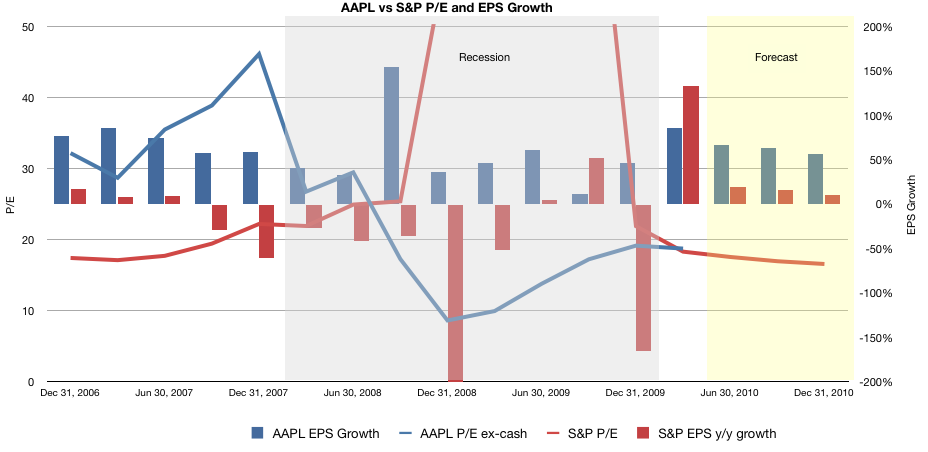
This is not the case. In fact, the stock is showing signs of irrational despondency. This is demonstrated with the following graph.
It shows AAPL Price (ex-cash) over Earnings vs. S&P P/E (blue and red lines respectively on the left scale) overlaid with AAPL and S&P EPS growth (blue and red bars respectively on the right scale). I added grey shading to represent the recession period and yellow shading for the forecast period.
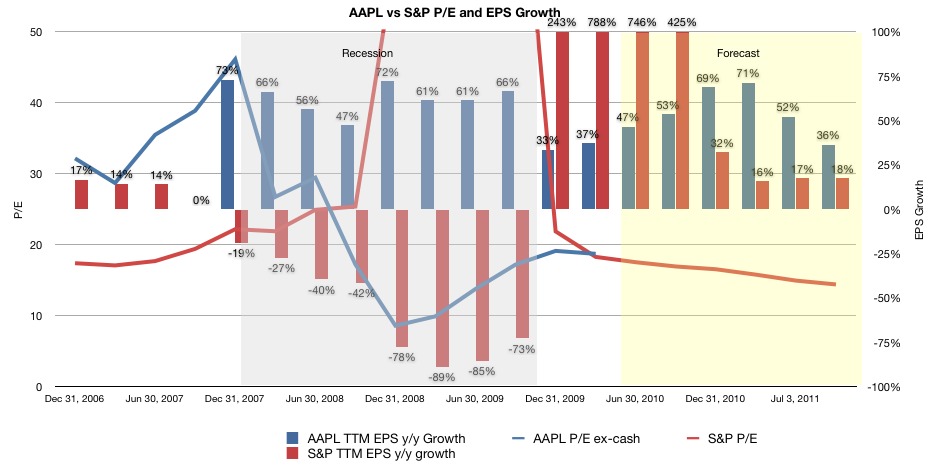
[Updated] The same data is shown in the following graph where I used a 12 month rolling window (trailing twelve months) for the year-on-year growth to smooth out quarterly anomalies as per suggestion from Deagol in comments.
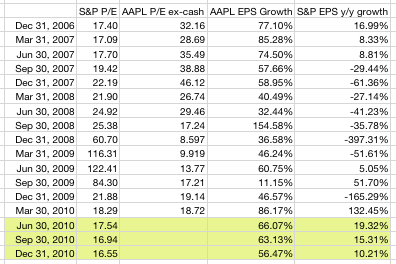
Note how S&P earnings were indeed in a state of severe decline during the recession, and how the P/E gyrated wildly as a result. (I've had to clip the actual values in the graph for clarity but I include all the data in the table at the bottom of this article). Post-recession S&P P/E began to return to normal at the beginning of this year and is forecast (by S&P) to align once again with the pre-recession growth in earnings.
Now compare with what happened to Apple's stock. Pre-recession the stock enjoyed a significant premium for growth. The blue bars are significantly higher than the red bars in the 2006/2007 period and the blue line is naturally higher than the red line in the same period.
During the recession, Apple continues to grow but the P/E drops to remarkably low levels (10). Although Apple's earnings growth does diminish, it never goes away. The anomalous growth in the third quarter of 09 is 11% due to the huge spike the year earlier with the launch of iPhone 3G. Overall, the company continues growing at a good clip.
Not so for its P/E however. Even after the recession ended and AAPL accelerated growth to above 50% again, the P/E remained around 20. I left out the forecast from the AAPL line so that readers can imagine their own.
The bottom line is that at the new all-time high, Apple's shares are trading at a discount to their growth. Not only lower than than Apple has enjoyed historically, but lower than the average of 500 of the largest companies in the US. Those companies having earnings growth in the teens have recovered their valuation. Apple with growth returning to above 50% hasn't.
Closing in on ten weeks since Apple's last report where they "cleared up" any confusion about accounting rules, most financial sites still show incorrect data on their profiles for Apple.
Out of the 14 major sites I looked at, just 5 have managed to update their historical financials with the retrospective amendments freely available from Apple's Investor Relations site.
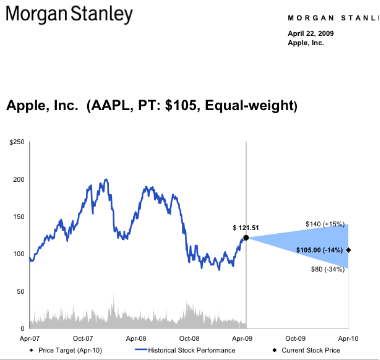
10 months ago Ms. Huberty released her price target for April 2010 (see graph) at between $100 and $105. The stock was trading at $121 then and her forecast was for a 14% decline.
She wrote:
Investment Conclusion: The combination of a March quarter beat and positive management tone is likely to keep AAPL shares in its recent trading range. Valuation is not stretched by any means but at 21x our adjusted C09 EPS, the market already assigns AAPL a 16% premium to RIMM which credits AAPL for lower risk given its large cash balance and a more diversified revenue model. We remain Equal-weight AAPL shares.
We note that the stock is currently trading above $200 at a P/E of 19x. She had forecast a price of $100 on a P/E of 21x Calendar 2009 Earnings Per Share. The implication is that EPS would have been $100/21 or $4.7 for calendar 2009.
She already had one quarter of data ($1.79 for CQ1) therefore she forecast $4.7-$1.79 = $2.97 for the remainder of the 2009 calendar year.
In reality, Apple earned $10.24 for 2009 and $8.45 for CQ2 through CQ4. That makes her error ($8.45-$2.97)/$2.97 = 184%.
We see today that she has a new forecast for $225 a share which leads us to conclude that she still has a job.