According to The Economic Times, citing unnamed sources, "Tata Electronics has expanded its workforce to 75,000, surpassing Taiwanese rival Foxconn's headcount in the country, making it Apple's largest contract manufacturer by headcount currently." The report added that the expansion has been driven primarily by its large-scale Hosur facility in Tamil Nadu.
Supply-chain sources said the company's workforce growth marks a sharp increase from about 15,000 in 2023, reflecting an aggressive scaling strategy supported by major capital investment, factory acquisitions, and rapid capacity buildout. The expansion includes its 500-acre Hosur campus, which has become the core hub of iPhone assembly in India.
Tata Electronics has combined acquisitions of Taiwanese contract manufacturers' Indian assets with greenfield investment to accelerate entry into Apple's supply chain. It acquired former Wistron(3231.TW) and Pegatron(4938.TW) facilities, while simultaneously expanding its Hosur plant, which began iPhone assembly operations in 2025.
In addition to assembly, the company is also moving upstream into semiconductor assembly and test (OSAT) and component localization, supported by large-scale funding injections in recent fiscal years. These investments aim to build a vertically integrated electronics manufacturing base spanning assembly, packaging, and supply chain services.
The reported figure of 75,000 employees reflects both direct and acquired operations across Tata Electronics' manufacturing footprint in southern India. One source noted that the rapid scale-up has enabled the company to meet Apple's production requirements while overtaking Foxconn(2317.TW) in local headcount, although industry participants expect rankings to fluctuate as other facilities ramp up.
Amazon said on Tuesday that it’s agreed to acquire satellite company Globalstar, a major step for the e-commerce business as it works to build out a space-based Wi-Fi service through its Leo initiative.
Amazon also announced that it signed an agreement with Apple to provide satellite connectivity for current and future iPhone and Apple Watch features. The partnership was made possible via an existing deal Apple already had with Globalstar.
Amazon said on Tuesday that it plans to work with Apple on future satellite services. “Amazon will continue to support iPhone and Apple Watch models currently using Globalstar’s existing and planned upcoming low Earth orbit satellite constellations, being manufactured by MDA Space, and collaborate with Apple on future satellite services using Amazon Leo’s expanded satellite network,” a news release read.
Are Apple and Google competitors or are they partners?
Prior to the launch of the Android operating system, Apple and Google collaborated on many projects. Google Search was predominant on Apple products including the (at the time) new iPhone. The iPhone also launched with support for Gmail and had native Google Maps and even YouTube. Google was a cornerstone supplier for the new smartphone.
After the launch of Android only a year later, the relationship changed. The two companies came to be viewed as mortal enemies. The perception that Android was disruptive to Apple—insofar as it undercut the pricing power of the new touch-based user experience—was universal. The "zero price" of Android and its licensing by all other phone makers suggested a competitive collapse was imminent for the fledgling iPhone. Android phones were far cheaper and "good enough." If not immediately, then with the resources of all phone makers and Google itself, Android would surely soon overtake the iPhone in performance along all dimensions. It took a great deal of courage to argue otherwise.
But, over time, the notion that the iPhone would continue to exist became more widely held. Holding on to a "premium" positioning, iPhone seemed to be have pulled a rabbit out of a hat, perhaps because of Steve Jobs' reality distortion field or because of magical marketing. Nonetheless, doubts over long-term growth persisted.
Having survived Android, Apple was still seen as vulnerable to a multitude of Google initiatives including Chrome and Chromebooks, a range of Google Pixel phones (enabled by the acquisition of Motorola and HTC.) The entry of Google wearables (enabled by the acquisition of Fitbit), Glasses, the Play Store, YouTube content, Google productivity apps, Google cloud, Google TV, Nest, Google Assistant and numerous other services were all cited as nails in the iPhone coffin. This is all before the age of Crypto a new generation of AIs came into fashion.
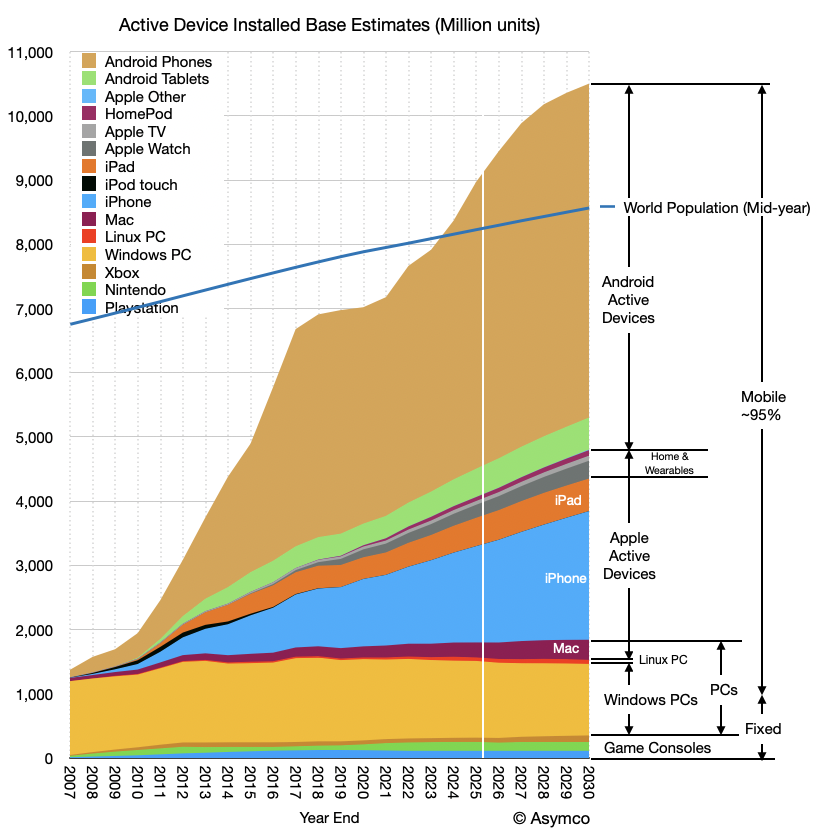
Throughout this period the iPhone continued to increase its audience, growing its base of users not only from smartphone non-users but also from so-called "switchers", that is, those who moved from Android to iOS. Apple has benefitted from this net positive switching for at least five years now as most of its addressable market has already adopted the smartphone. There are about 1.2 billion iPhone users and it's far more likely that a new iPhone user today arrives from the 3.5 billion Android users than from the 3.2 billion people who don't yet have any smartphone. That is because those who don't yet have a smartphone today are also likely to not yet have access to electricity, cellular networks or money.
Indeed, it is Android that seems to be in a precarious position. The ecosystem is bleeding not just high-end users but also from fragmentation. Chinese OEMs in particular deliver their own experiences and code bases, eschewing Google services altogether. Large OEMs such as Samsung are seeking to differentiate with their own experiences and ecosystems and accessories and chafe against Google's hardware offerings. Upgrade rates to new Android versions are poor. Support of hardware beyond a few years is lacking. But, most fundamentally, Google has not developed a business model that directly fuels development of Android.
Put simply, Android is not a profitable product. It's not designed to create revenues. It's designed to reduce costs.
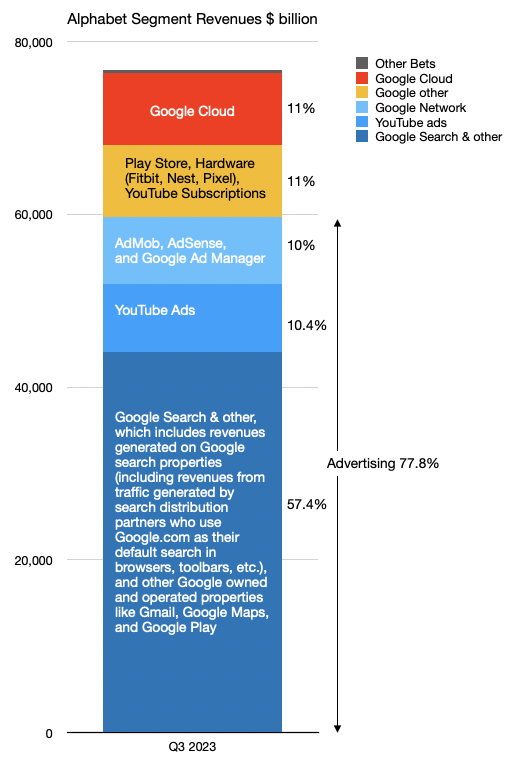
To understand this, we have to understand Google's business. It's not very complicated. Google's revenues in the last quarter are segmented as follows:
The colors above indicate the major categories. Blues are Advertising, yellow is "Other" and red is Google Cloud. Other Bets, consisting of research projects, is a 0.4% rounding error. Apart from Search which is about 60%, each major category is about 10%. Advertising as a business model is about 78%.
To Alphabet's credit, Advertising as a business model has been reduced from 94% a few years ago. Much of that credit goes to Cloud which is a B2B business and has completely different resources, processes and priorities than Search. The "one trick pony" label is less applicable to Google today.
Search however, and the ancillary properties, are still, by far, the largest sources of revenues and profit. Note that Android itself is missing from this mix apart from Play Store which is a direct Android extension. Play does contribute somewhat as part of "Other" but the OS itself is an enabler across all these categories.
While not directly producing revenues, what Android does is perhaps even more important. It helps reduce the amount Google has to pay to access its customers. Think of Search as a system which takes queries in and puts results out. These results are what advertisers pay for and the queries are what Google pays for. The output depends on the input. That input is harvested from many users. Access to those users is not free. The cost can be paid by building access directly (Android) or by paying for access to someone else's property (Apple, Windows, or Firefox). In old-school business terminology this is called distribution.
Distribution is often ignored or considered a superfluous "middleman" to be bypassed. But distribution is foundational to any business. It is, effectively, other people, outside your company, helping you sell your product because they have access to the customers. They get paid for that access, often with a percent of sales. Stores are distribution. Wholesalers are distribution. Resellers are distribution. Without distribution scale cannot happen. Distributors help both producers and consumers by creating access.
Access is also provided by what we call infrastructure. Just like you can't travel by car from your house to your destination without roads, all access to products and services is effectively infrastructure. If you own the infrastructure then you have to pay to build it and maintain it. If you don't own it you have to pay to use it. All infrastructure has value and all infrastructure has costs.
This all makes more sense when recalling the historic birth of Android. At the time (2006 to 2008) the worry for Google was that Microsoft's mobile operating system (Windows Mobile née Windows CE) would be licensed as was Windows. That is to say that all phone OEMs would take a license for a nominal fee and build Windows Mobile phones. Microsoft would thus dominate the mobile computing market the way it dominated the PC market (with market share above 95%). Microsoft would then ensure that Bing search was the default on all devices running Windows and Windows Mobile, thus blocking access to what was expected to be the next 3 billion users while capturing all search ad dollars ad infinitum.
If Windows Mobile were to dominate, Google would be denied distribution, at any price. It would thus be relegated to, at best, 10% market share of mobile search. This would be an existential crisis.
In this setting, Apple was an ally for Google. Apple was not a search engine provider and was very welcoming of Google search on a nascent Safari browser. Whereas Explorer would block Google search, Safari would offer default placement. Not for free, but for a reasonable cost. Google was a "go-to-market" partner for Apple and it was a symbiotic relationship.
However, the expectation of Google at the time was that Apple would be no more successful with iPhone than it was with the Mac: A fringe of "creative" or "fanboy" quirky oddballs. This was not just Google's expectation. It was everyone's expectation.
Android was built to counter a Microsoft mobile OS monopoly with a "zero cost" option vs. Microsoft's end-user-license model. Microsoft made money selling software. Both system software (Windows) and application software (Office.) Google would give away system software (Android) and services (Gmail and Docs) but make money on advertising.
A genius move. Phone OEMs would much rather pay zero of the OS on their phones than for the non-zero Windows Mobile license. [On a $200 retail cost phone (and thus $90 bill of materials) a $8 OS license is a huge cost.] Google's Android did indeed block Windows Mobile from getting a foothold in the post-PC era.
But it did so by taking some short cuts. Android itself was an acquisition in 2005 (for $50 million, with a keyboard interface) and, in response to the iPhone, a new touch user interface was developed. It so happened that this interface copied as closely iOS as Windows had copied the original Mac. This perceived theft was such an affront to Steve Jobs that he declared war on Google.
It was important to ask (as few did) why did Google need to develop an OS, only to give it away. Was its business that robust if it needed to expend enormous energy and capital to build an enabler? The answer is, of course, distribution.
Google was initially not paying for distribution as most people just typed "google.com" into their browsers. As the URL field became a search field, Google could still expect PC users to make Google.com their search bookmark, one click away.
But on mobile devices, the friction of the constrained interface meant that defaults mattered. Mobile was going to require new distribution economics. Devices were going to be in the hands of many more people, who, since they did not have full-size keyboards, would type less and who would interact in new (and very succinct) ways. One click away was one click too far.
With Android (and Chrome) Google set defaults for its services across the platform. If Android was the OS then Chrome would be the default. If Chrome was the default, then Google Search would be the default. For these Android-sourced queries, Google would not pay for distribution. Or, more precisely, would only pay to build and keep Android. Thus the more Android there was, the cheaper it was to obtain search queries for Google. Google had built its own highways: it owned the infrastructure that connected users to its services. These roads were for Android users. And what about iOS users?
Over a 15 year period the smartphone went from essentially zero to 5 billion users. It became so important to those 5 billion people that they keep it with them every waking moment, use it 100 times for a total of 5 hours each day. That adds up to 182,500,000,000,000 interactions a year and, as a result, it has changed behavior, politics and humanity itself.
Throughout this period, the relationship between Google and Apple changed. From being allies, to mortal enemies to, as we shall see, partners. We have to understand this new relationship that has emerged and its consequences.
The next post will explore the relationship in detail using the lens of the deal structure that exists. A deal which is not public and largely unexamined.
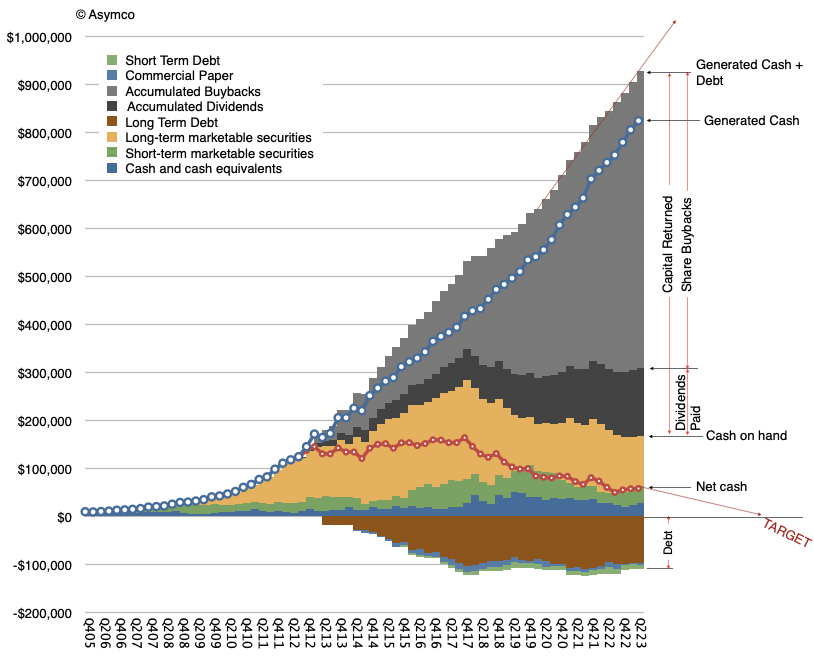
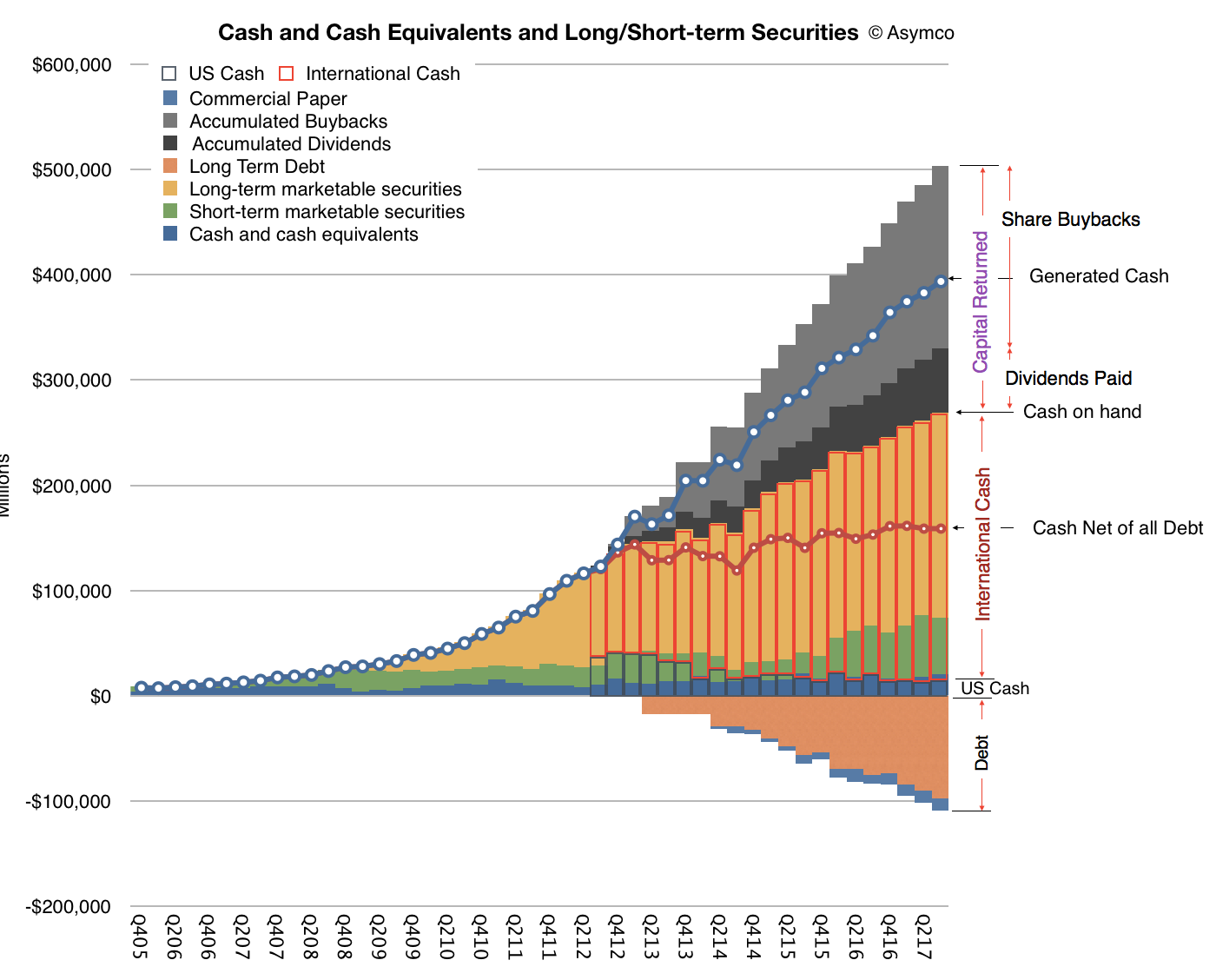
Apple has so far returned $761.5 billion to shareholders. 143.3 billion in accumulated dividends and $618.2 billion in share buybacks. These are the gray areas in the graph above. The question that often comes up is: isn't this capital return program a misallocation? In particular isn't buying back shares and retiring them a waste of money?
By definition, it cannot be. The mechanism of buying shares and retiring them is a process of returning retained capital to shareholders. The other ways this can be done are through dividends (periodic or one-time) or the sale of the company (liquidation). Ignoring the liquidation option which does not make sense for viable companies, the decision between dividends and buybacks comes down to a tax efficiency question.
The result is, however, roughly the same: retained earnings, which are stored by the company as cash typically (net value for Apple today is $57.2 billion), are an asset balanced by a liability to the shareholder called Total Shareholder Equity (valued today as $60.3 billion.) As such, the retained earnings belong to the shareholders. It's why they own the company. It's what their cash share of the value in the company is.
It's also surplus to the company's needs. Had the company needed this cash, it would have spent it on building the products and services it sells or operations that maintain or grow the business. Those expenses appear in cost of sales (COS) or cost of goods sold (COGS) or in operating expenses Sales, General and Administrative (SG&A) or Research and Development (R&D). If it's not spent this way then it drops to the net income line and, crucially, is subject to taxation (about 12% to 15% for Apple). After taxation, once returned, it's taxed again as either capital gains (in the case of buybacks) or dividend income. These rates vary on the jurisdiction of the owner and the current tax policy.
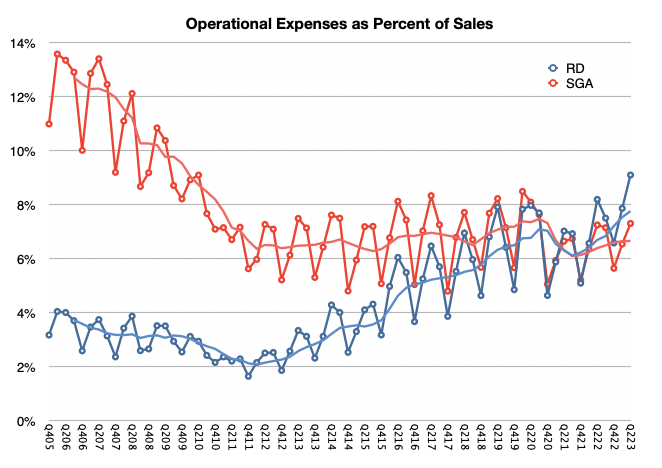
Note that the spending on R&D includes development of future projects which are not directly related to current products. Engineering of current products is expensed against COGS. R&D for Apple ($29.4 billion in last 12 months) is significant, having grown to 9% of sales, as the graph below shows.
For the company to decide to return capital it really does mean that it has no good ideas on how to spend it given what the company knows it can and cannot do. It's a judicious decision and one which honors the relationship between owner and manager with fiduciary responsibility to the owner.
Still, doesn't that mean it's wasted?
No. Giving it to the shareholder means that the company says "It belongs to you, I don't know what to do with it on your behalf, so here, you figure out what to do with it." The shareholder can then make an allocation decision that suits their sense of what is valuable or useful. The return is a deferral of decision to the owner rather than their agent.
To the extent that once returned, the capital is misspent, that is on the spender, not on Apple.
Consider the alternatives. Instead of returning capital, what some managers decide to do is to re-allocate those retained earnings to acquire other companies with the promise of value creation through synergies. However these are often huge wastes of money. The new asset is recorded as "goodwill" on the balance sheet, offsetting the retained shareholder equity. As the synergies fail to materialize, the asset (goodwill) is written off, and shareholder equity decreases accordingly, and so, value evaporates or is transferred to the owners of the acquired company who cash out above market value.
Acquisitions are a process of picking the pocket of shareholders.
The alternative might be to spend heavily on R&D. That is more admirable but the amount involved is enormous and it's very difficult to find enough people and projects worth pursuing without turning R&D into an academic organization. Remember that with R&D at $7.4 billion per quarter, the company is spending 41 times more than it did in 2006.
And doubling or tripling R&D, even if possible, would impact margins to such an extent that Apple's profitability would show very poorly indeed. That would collapse share prices and decrease share-based compensation, limiting the possibility of recruiting talented engineers. It would bring quite a lot of negative consequences.
Another exercise to undertake would be to ask what would happen if the mechanism of share buybacks were made illegal. It was not always legal anyway. That is left as an exercise to the reader.
Every October, at the end of its fiscal year, Apple files its Form 10K or annual report. In this report the company includes a section titled "Capital Assets" which details expenditures for capital equipment. This is last year's entry:
The Company’s capital expenditures were $14.9 billion during 2017. The Company anticipates utilizing approximately $16.0 billion for capital expenditures during 2018, which includes product tooling and manufacturing process equipment; data centers; corporate facilities and infrastructure, including information systems hardware, software and enhancements; and retail store facilities.
Note that there are categories of spending detailed and that their order might indicate the degree of such spending, suggesting that product tooling and manufacturing equipment is likely to be the costliest category.
After this report, during subsequent quarters the company may update this forecast of spending. In the last (third fiscal) quarter the entry was as follows:
The Company’s capital expenditures were $11.1 billion during the first nine months of 2018 . The Company anticipates utilizing approximately $17.0 billion for capital expenditures during 2018, which includes product tooling and manufacturing process equipment; data centers; corporate facilities and infrastructure, including information systems hardware, software and enhancements; and retail store facilities.
Note that the forecast of $16.0 billion was updated to $17.0 billion and the first 9 months' expenditures were $11.1. Since there is only one quarter remaining ((and since at the time the quarterly report is filed, only about 2 months remain in the quarter)) it's reasonable to assume that the company's forecasts are more likely to be precise and that therefore the difference between total expected spending and already spent, i.e.f $5.9 billion remains to be spent.
The actual spending is not recorded quarterly but an approximate value is reported in the Cash Flow statement as "Payments for acquisition of property, plant and equipment". That can be tracked but it does not equal exactly the capital expenditure. For example, the quote above says expenditures were $11.1 billion through first 9 months but the total of all payments for acquisition of PP&E is $10.272 billion.
Minor ((To the extent that $1 billion can be considered minor)) differences, aside, this forecast and actual spending and payments data is significant because it is highly correlated to Apple's overall business. Assuming that the spending on manufacturing equipment and information systems hardware (i.e. data centers) is in support of the iOS device sales and services we can try to show how sales correspond to spending with the following graph:
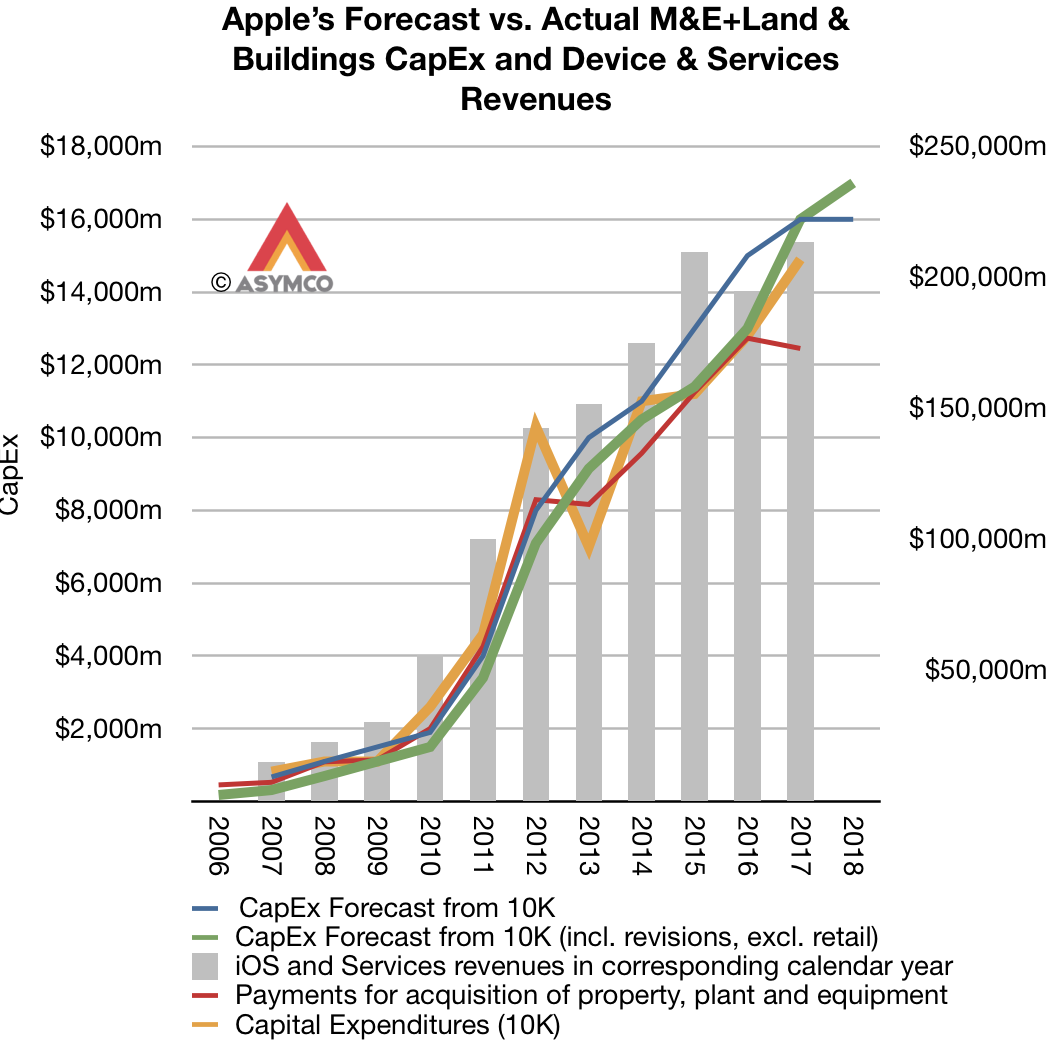
Here sales are shown as a bar graph and the various spending forecasts and actual payments are shown as lines. Also note that the spending and sales are offset by one quarter. The fiscal year is used for spending and the calendar year for sales. The reason is that spending is presumed to lead sales by approximately one quarter.
There are some notable discrepancies, especially with the 2012/2013 period when spending was brought forward a quarter thus showing a surplus to forecast in 2012 and a deficit in 2013. But apart from that, there is a broad correlation between spending and sales.
This means that the CapEx forecast in October is a good indicator of sales in the following year.
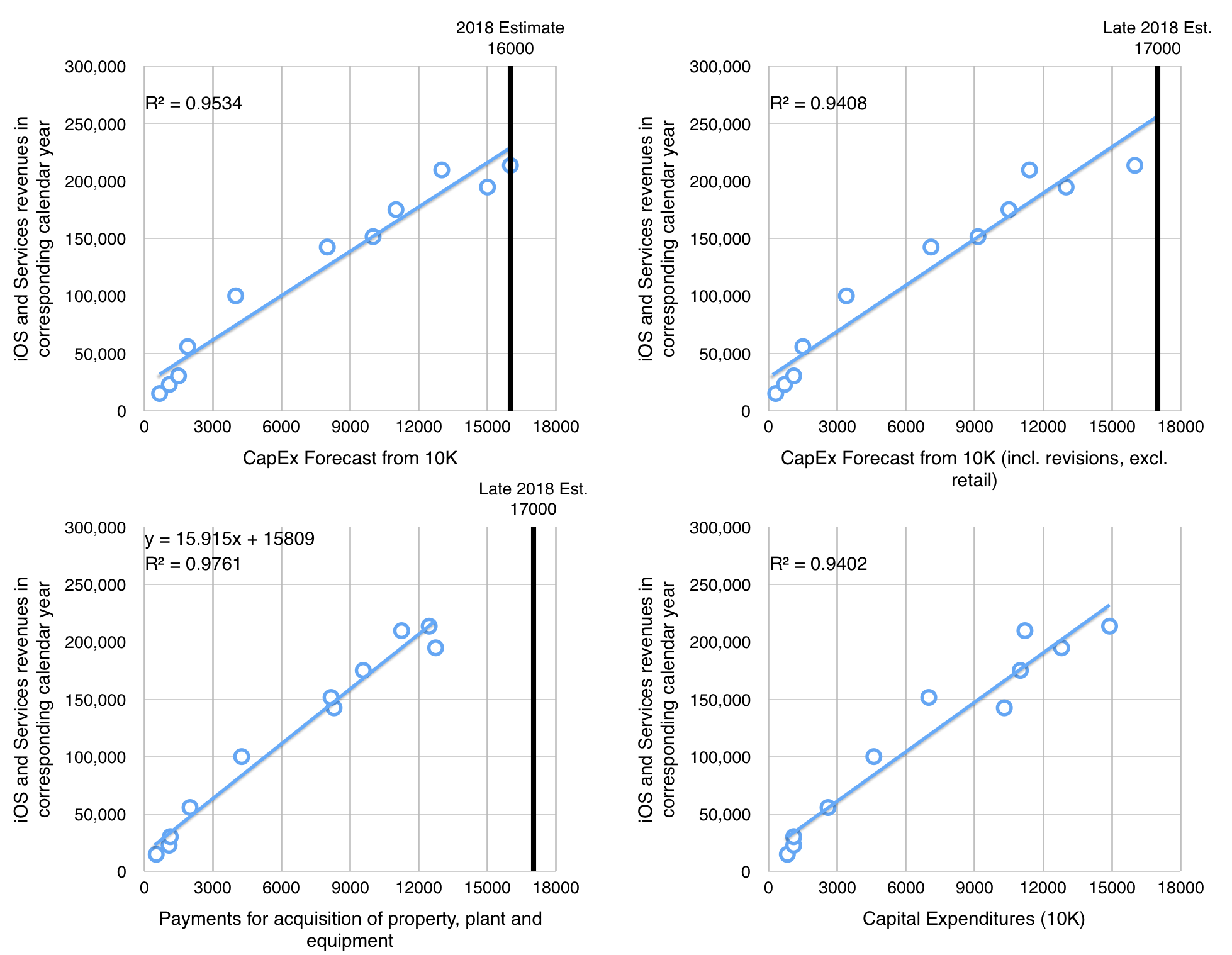
In fact, the relationship is can be shown with four scatter plots, one for each of the published figure:
I caution that this is a yearly forecast and it is revised through the year on a quarterly basis, sometimes up, sometimes down. It's therefore not a perfect indicator and of course the relationship between sales and spending is not perfectly predictable. Note that there are four types of spending that can be measured, two are forecasts (one year and revised) and two are actuals (cash flow payments and reported total expenditures)
We can measure the best variable that fits the sales data through the coefficient of determination or R-squared. The best fit seems to be with Payments for acquisition of property, plant and equipment (R-squared of 0.976).
This gives the formula for yearly sales as 15.915x + 15809 where x is the expected total spending. That spending to date has been $10.272 billion and it's probably going to exceed $16 billion for the year.
Using $16 billion spending total, we can calculate iOS products and services for calendar 2018 of $270.45 billion.
iOS and Services sales to date have been $103.2 billion with an estimate for next quarter of about 54.3 billion (based on guidance) and thus a total through Q3 of $157.5 billion. Subtracting this from the $270.45 billion expectation from the calculation above gives a fourth calendar quarter iOS revenue of $113 billion.
Adding $7 billion for the Mac results in a total net sales of 120billion. This therefore is what I'd put forward as a reasonable target for CQ4.
Note that this is equivalent to a growth of 36% from the 2017 fourth quarter.
[UPDATE: Original version used total sales rather than iOS related products and services (i.e. excluding Mac). The text has been edited to reflect the correct figures.]
To the nearest million, as of the end of September 2017, Apple's cash and investments totaled $268,895,000,000. Note that this includes investments in the form of short- and long-term marketable securities. Long-term marketable securities are not always accounted as "cash" because strictly cash is considered a liquid asset and some securities may not be sufficiently so. Nevertheless, most analysts would agree that Apple's securities are sufficiently liquid to qualify as cash. Note that for archaic reasons this cash is separated into US and non-US holdings with $17 billion located in the US.
Most businesses keep very little cash on their books. Why does Apple have so much cash?
Indeed Apple's cash is extraordinary. It amounts to about 30% of its market capitalization. One reason is that Apple has taken many loans, totaling about $100 billion.
Whoa! Why would Apple need to take out loans? Does it have problems with cash flow? ((Companies often borrow because they need to plug gaps in profitability, best measured as "free cash flow".))
Quite the contrary, Apple's operating cash flow is eye-watering. In the 2017 fiscal year (ending September) Apple generated $63,598,000,000 from operations. The loans are not needed to operate. They are used to pay shareholders.
Why does Apple need to pay shareholders?
Because it's their money.
Wait, I thought you said this was Apple's cash.
Apple is holding it for them but if it has more than it needs it's obligated to return it. You see, If you were to look for "cash" in financial statements you find it on the balance sheet as an asset. Since it is growing and since a balance sheet has to balance, there has to be a liability that grows in proportion to offset the cash asset. That liability is called Shareholder's Equity. This is a "debt" the company has to shareholders. If it pays out cash to shareholders then it zeros out an asset and a corresponding liability. The net is zero as far as Apple is concerned but shareholders get something in return for giving Apple money in the first place.
So hold on, it takes out loans to pay shareholders because it "owes them money" while it has too much money? This makes no sense.
Yes, welcome to tax laws. Although it generates more money than it can use, and that money should thus be returned to shareholders, some of the money is collected outside the US. US (and US only as far as I know) tax laws have a "repatriation tax" that is levied on money coming into the country. This has nothing to do with corporate taxes which are levied on earnings. So after paying shareholders with the cash it had in the US, Apple had to borrow money to pay shareholders money they had outside the US.
Why not just pay the repatriation tax?
Because then shareholders would get less than 70% of their money. They would probably complain and blame the managers for being incompetent. Such blame usually comes with a lawsuit attached.
What about the new tax law that lowered the repatriation tax rate?
Now Apple has no option but to pay the tax and repatriate the cash. It's still a tax. The amount will be about $38 billion or about 15%. Previous repatriation "holiday" levies were around 10%.
How exactly does the company give money to shareholders?
The payments are called "dividends" and shareholders must treat them as income--a form of double taxation because these funds are after the company paid earnings tax and possibly repatriation tax. Apple does pay dividends regularly but because of tax inefficiency (i.e. because government policy discourages dividends) the company mainly buys its own shares and retires them.
Huh?
Yes, it makes little sense but the math is simple. If the company buys its own shares and makes them disappear then existing shareholders will end up owning more of the company, making their shares more valuable. They can realize the gain if/when they sell the shares (and pay capital gains tax instead of dividend income tax on the already (double) taxed profits.)
Does that mean that it is going private?
No. The owners of the company remain the same: whoever owns shares owns the company and they can be traded in public exchanges. In theory they could reduce the share count to a single share and there would presumably be a single shareholder who would own the company, making it "closely held" but the company's managers are still required to report and act as if it was public. Going private usually means a set of shareholders agree not to allow the shares to float on the open market and thus to also keep the affairs of the company out of public eye. It reduces liquidity and is generally harder for shareholders to exit their investment. This has nothing to do with reducing the number of shares in circulation--which is what Apple is doing.
But buying shares does not seem to affect the share price so the shareholders are not benefiting from the repurchasing. Isn't this a waste of cash? Aren't the shareholders being robbed?
The share price is an argument between shareholders and potential shareholders on the value of the company. It should reflect reality but many times it doesn't. Over time however the math catches up with sentiment. In other words realization that there are fewer and fewer shares available compels people to not sell them, increasing the price. Short term investors tend not to pay attention to this but they are not the shareholders who Apple wishes to pay back anyway.
Why doesn't the company spend the money on other things? You said they return what they can't use. Why can't they use it?
Simply, because it's more than can be spent wisely. The company considers its mission to be very narrow: add value in specific areas where they can create tremendous value uniquely and under conditions (technologies and business models) they can control. Many such projects don't require capital. Manufacturing, data centers and Apple stores require capital but R&D and sales not so much. Creating products is very cash efficient. For example, the iPhone--the most successful product of all time--cost almost nothing to develop; certainly nothing that required Apple to dip into its cash. Funding for the type of product development Apple does comes from existing cash flows and mostly consists of salaries for their employees.
What about acquisitions? Why not buy other companies?
It buys companies but usually small ones which are essentially acquisitions of teams and their intellectual property. Apple does not buy "business models" or customers or cash flows which is what large companies are valued for. Operationally, it's also because Apple has a strong culture and it wishes to preserve it. Acquisitions dilute culture which is why integrations often fail. Statistically, large acquisitions are value destructive and the larger they are, the more likely they are to fail. Incidentally, when a company is acquired with cash that hole in the balance sheet is filled with something called "goodwill" which reflects some intangible value of the new asset. If and when the acquisition is deemed to have failed the goodwill is written off and so is shareholder equity. That's how shareholders are robbed.
What about keeping it? Doesn't having lots of cash make Apple more powerful?
As individuals we think that having lots of cash makes us rich. For companies it's the opposite. Cash is a liability. If you come across a company that is cash rich and has nothing else, its enterprise value will be zero. Companies are valued on their future cash flows, meaning their ability to generate cash, not how much they managed to keep. In other words, cash is a measure of past success and investors are interested only in future value. That future value comes from the intelligent allocation of resources toward a valuable goal. A company rich in cash but poor in vision is likely to be taken private or broken up and shut down. Cash is an IOU to shareholders with a thank-you note for the support through the years.
How Apple is managed is one of its enduring mysteries. The idea that a company with $235 billion in sales is managed with a single P/L ((Profit and Loss statement is an income statement usually applied for a subset of a larger company which allows subdivisions to be managed individually.)) is fascinating in many ways. Not least of which is how it allocates resources. The fundamental question of which great idea gets to be funded and which great idea gets to be ignored is the core of every manager's dilemma. The Apple problem is at scale when each decision's consequences are so momentous. In the case of Apple there are so few projects that reach the market and their impact is so great that one wonders how they can be sure they are doing the right thing.
Conventionally, product development is filtered through a sieve of metrics, market sizing and impact on top/bottom income lines. These "financial" measures of success are considered prudent and optimized for return on equity (also known as the maximization of shareholder returns).
But this can be a toxic formula. The financial optimization algorithm always prioritizes the known over the unknown since the known can be measured and is assigned a quantum of value while the unknown is "discounted" with a steep hurdle rate, and assigned a near zero net present value. Thus the financial algorithm leads to promoting efficiency at the expense of creation. Efficiency may be the right priority when times are difficult and resources are scarce but creativity is the right priority in a time of plenty. And abundance is what being big is all about.
To allow for some creation large firms create divisions. Some divisions are tasked with "core products" which are measured by a set of firm metrics and some are tasked with "emerging products" which are given a set of loose metrics. This leads to obvious resentment and war between divisions when resources need allocating.
Ominously, the core divisions tend to always win. At the root of divisional power struggles are measurements--the roots of financial metrics. Managers fight with data. "You can't manage what you can't measure" they're taught. But if you have something that can be easily measured and something that is difficult to measure, won't the easily-measured be managed and the hard-to-measure be ignored?
There is a general principle at work here: Managing by measurement is fraught with the pitfall of measuring the wrong thing. Making sure that you're measuring the right thing becomes the value-adding role of the manager. A role that is increasingly being neglected.
The mass phenomenon of measuring the wrong thing because it's the easiest to measure is called "financialization". Financialization is the process by which finance and finances (rather than creation) determine company, individual and society's priorities. It comes about from an abundance of data that leads to fixation on what is observable to the detriment of awareness of hazards or obstacles or alternatives. This phenomenon is more likely when the speed of change increases and decision cycles shorten.
Financialization is creeping into all aspects of society and the extent to which it infects companies is the extent to which they suffer from early mortality.
So is Apple avoiding financialization? How can anyone avoid the tyranny of mis-optimization?
The unified P/L might be a clue. It obviates the need for divisional rivalry and power-based or financial politics. Without divisional P/L, management can be organized functionally with the obvious benefit of de-politicization. The singular P/L does create another problem however: the absence of an alternative resource allocation algorithm centralizes the decision. By centralizing decisions at the highest level, few decisions can be taken and that means each decision has to be right more often. We swap a distributed but financialized process for a central but capricious one.
So how is the central decision process made fair? What guides the allocation process?
I believe that Apple does not avoid quantified decision making. I believe the logic of their decisions is based on a nuanced quantification of the company's customer base. Opting to think about how many customers they have rather than how many things they can sell could offer the Apple manager a better decision tool, avoiding financialization and mis-optimization.
The guiding principle is putting the customer rather than the firm at the center of the decision process. The idea of this change of orientation extends to a re-definition of the purpose of the firm. Apple calls it its "North Star" and it places "making the best product" at that location.
The challenge is how to measure "goodness" of product. It's easy to overshoot "best" and become too good. What regulates greatness is another measurement: absorption of what you create. The true orientation (which Apple won't confess to) is absorbable greatness.
Absorbable greatness is measured through other proxies: customer creation, customer satisfaction, and customer retention. By adding and preserving great customers you can be sure that what you create is indeed the "best". Setting the goal, and indeed the purpose of the firm, as the creation and preservation of customers seems to be the unwritten constitution of Apple.
The idea that the purpose of the firm is to create and maintain customers is not new ((Customer creation is in contrast to the notion that the purpose of the firm is to maximize shareholder returns. The notion of customer creation as primary purpose was popularized by Peter Drucker. The notion of optimization through shareholder value creation was popularized by Jack Welch.)) but it is relatively rarely practiced. The reason is that the data is harder to obtain. The data that comes from sales is crisp and concrete. The data about customers is muddy and soft. In a world where spreadsheets are used as weapons, the crisper the data, the better the ammunition.
Clarity wins arguments but it may not be where salvation or truth can be found. Good judgement in a cloudy reality is a better compass than a clear road map to a fantasy world.
Optimizing around customer acquisition rather than equity returns leads to a new set of metrics. What would these metrics look like for Apple?
The company publicly offers three separate sets of quantity of customers and quality of customers.
In terms of quantity we have:
Number of iTunes accounts
Number of iCloud accounts
Number of active devices
In terms of quality of customers we have:
Average selling prices for devices (as a proxy for willingness to pay)
Customer satisfaction (as a proxy for loyalty )
Services and accessory revenues (post-sales and recurring value)
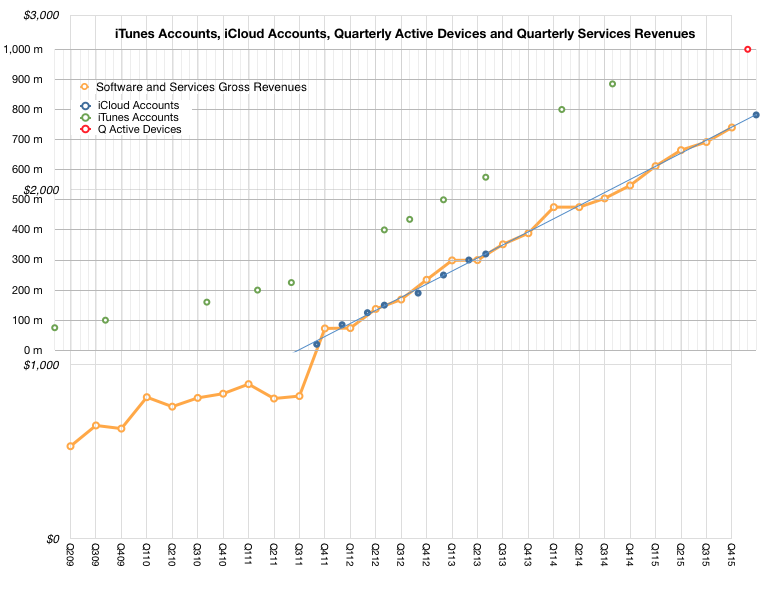
The following graph shows the historic data for service accounts and corresponding services revenues.
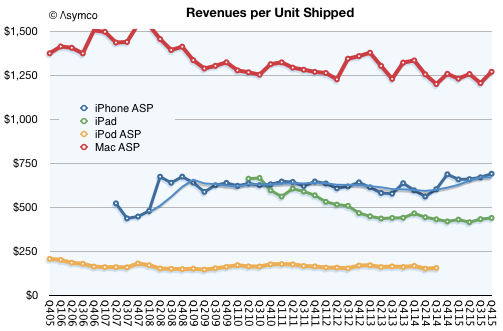
The following graph shows the average price per hardware product indicative of loyalty through stability in the face of growing competition.
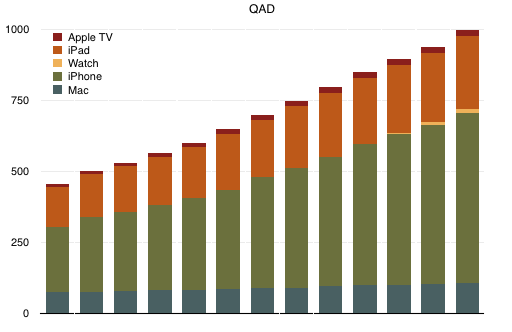
The following graph shows an estimate of growth in active devices as a proxy of customer base.
Unlike product shipments and revenue data which follow rises and falls in individual products due to the cyclicality of technology and adoption, these graphs show a smoothness and predictability of customer base behavior.
Looking at Apple this way gives the impression that the company has a large number (nearly a billion) of repeat (subscribed to service) customers. These customers can be seen to spend a predictable recurring amount (average selling price) on Apple's brand. The repetition of these metrics in public commentary suggests that customer acquisition and retention are among Apple's goals.
The key question is whether this is Apple's primary goal.
Seen this way each centralized resource allocation question can be assumed to be prefaced with "In order to create/preserve customers should we...?"
This leads to answers quite different from questions that start with "In order to sell/profit more should we...?"
For instance, offering education products, retail store experiences, healthcare products, green energy initiatives, accessories, content and services make sense even if they may have poor financial "returns". These initiatives score highly on customer retention and satisfaction. They may lead to engagement and repeat sales. Managers working on these initiatives would gain the respect of their peers, leading to more esteem and higher quality output. Finally, and most importantly, these efforts would be preserved regardless of cyclical downturns.
The assessment of analysts should therefore be couched in similar terms: "What is the impact of a new initiative in customer creation and preservation?" rather than "What is the impact of a new initiative in driving revenues and profitability".
We can see immediately why the second question is popular while the first isn't: it's easier to assess an answer to the second because we have the data that allows for its calculation.
This is why asking the wrong questions is popular.
In the postmodern computing world that we live in, the measure of success isn't revenue or profit or units sold but the number of users that an ecosystem can attract. Therefore the monthly active user (MAU) unit of performance seems to be in vogue right now. E.g.:
Facebook claims Messenger has more than 200 million MAUs
WhatsApp has 500 million MAUs, 48 million of whom are in India
Line last month announced that it had 400 million users (active or not)
WeChat claimed 355 million MAUs
Viber claims 105 million MAUs
Startups are aggregating these millions of MAUs in order to obtain valuations for raising capital ((It's been said that it's difficult to get funded with only 10 million MAUs)) and the faster the growth in MAUs the more "successful" the company is considered.
When companies are acquired it's common to take the transaction value and divide it by MAUs to get an idea of "what an user is worth". This is because there are no revenues to measure and MAUs are taken as a proxy. However, the process by which a MAU becomes a dollar of profit is, to put it kindly, circuitous.
For most (all?) it's not yet clear how it happens especially since not all MAUs are created equal and MAU loyalties can change rapidly and if we added all the projected revenues each MAU will contribute to each app on her device we might reach some absurdity. In actuality, today, for the companies listed above, there are no revenues at all directly from their services.
In violation of this convention, there are some companies which manage to obtain revenues from their users. Two such are Apple and Amazon. In the last quarter Apple reported having 800 million iTunes accounts. ((adding, for some unknown reason, that most of them have credit cards.)) These aren't MAUs since the activity level is not noted, but we do know how much is spent on iTunes and services. In addition, Amazon cites 244 million active customer accounts representing accounts which generated purchases within the last 12 months.
This allows us to compare Apple and Amazon in terms of accounts, revenue per account, and, via some analysis, even profitability per account.
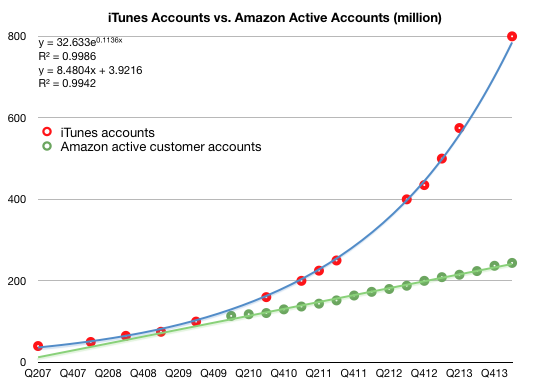
The following graphs tell this story. First, the total number of accounts:
Note that I added trend lines to both graphs and their formulas.
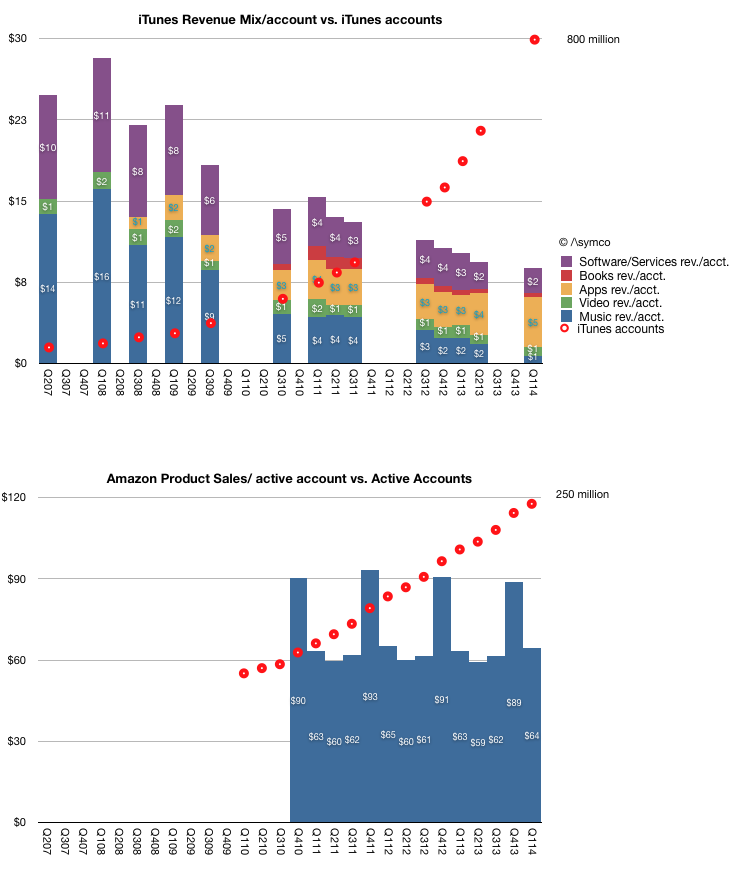
The following are the revenue per account for iTunes (further broken into estimated iTunes segment revenues per account.) and for Amazon. Note that the vertical scales are different.
This view shows just how different the economic value of users can be. In the case of Apple, it's growing its user base at (literally) exponential rates. The revenues per user does, understandably, decline. This is because new/later users don't spend as much as early users. There might be some stability toward the later stages of adoption in revenue per user. The other point about iTunes data is how the mix of revenues has shifted from music to Apps and Services pointing out how users can be migrated across revenue sources over time.
In the case of Amazon it's growing its user base at a linear rate (note equation). The revenue per account remains very steady however.
Broadly speaking, it would seem logical that the speed of user growth has an effect on the quality of those users. This relationship should guide further thinking about the quality of hundreds of millions of users acquired within a few months.
Apple's user growth is a function of expanding its device portfolio and distribution. Apple has shown that there are limits this type of growth. Achieving 830 million or so iOS device sales within 7 years is an amazing feat and one can forgive not having achieved billions more since they managed to obtain significant hardware and service/content revenues from most of them and that those who reached higher figures more quickly didn't manage the same revenue per user.
Amazon's user growth is a function of expanding its logistics and merchandise mix. This is also not easy to do globally. Arguably, Amazon cannot scale in the exponential rates seen by Apple or the other MAU aggregators because it has to depend on trucks and roads and regulators to complete most of its sales.
I suppose, in conclusion, that there is no "right" or "wrong" business model for a user base. Both Apple and Amazon are doing well in building their customer bases and creating loyalties which will serve them well in the future. However whereas there is no right or wrong revenue structure per user, it seems to me that there ought to be some such structure. In most cases this remains a matter of faith rather than reason.
A company is nothing more (and nothing less) than three things: people, processes and purposes. In the language of the software engineer these would be inputs, algorithms and specifications. In the language of classical business analysis they are assets (or resources), organization structures and business models. In military theory, these are logistics, tactics and strategy.
This is the trinity which allows for an understanding of a complex system: the physical, the operational and the guiding principle. The what, the how and the why.
When approaching any analysis problem, these questions form the foundation of causal inference. What is it, how does it work and why does it exist?
When analyzing nature the sciences often help with the what and the how but rarely address the why. ((Religion attempts to answer the whys which science leaves as unanswerable.)) In contrast, man-made systems (e.g. systems of law, religion and commerce) require an answer to the why as there is a presumption of a will in their creation and preservation. The why allows ultimate judgement on the merit of an enterprise. The why may escape us but it's assumed to always be there. For instance, in criminal law the motive is often a crucial piece of evidence but it's not always found. In business, the motive for action or for organization is a crucial piece of the puzzle which often explains the what, who and how, but here the ultimate why is usually profit. This the characteristic of a for-profit business, the purpose is explicit.
Some companies try to define their purposes beyond profit but they are often too vague or merely speak of values represent a quality not causality.
This is the case with Google. The problem isn't only that "don't be evil" isn't a priority or a purpose, but also that its resources are not applied to cohesive goals. In fact, there seems to be no interest in pursuing a direction aligned with generating income.
This is not in itself a bad thing. The notion of operating as a learning (vs. a deliberate) organization, informed but not driven by a goal, is the best approach when seeking new markets or discovering new needs and new business models. The difference with Google is that there seems to be no expectation of business model discovery. In other words, that the learning is not for any purpose other than learning itself.
This might be noble but learning for its own sake has not been attempted by public, for-profit organizations ((The Bell Labs story in an interesting possible exception but on deeper inspection it was the by-product of a government sanctioned monopoly and hence a ward of the state)) since there is an implicit fiduciary responsibility to generate profit and unrestricted experimentation, unguided by profit, is unlikely to ever learn the needs of markets.
The evidence I note supporting this is in the persona the company maintains, both internally and externally. There is no representation of themselves as a "business seeking profit" or even as a commercial entity. It's not simply because their business model is embarrassing. It's because all business models are embarrassing.
The representation is one of a research laboratory succeeding against difficult problems. Very similar to a successful academic or industrial laboratory sustained by grants from a benevolent (but messy) organization. Google becomes the embodiment of "big science" and "the world's laboratory" unfettered by politics and unsoiled by commercial interests.
There is a business in Google but it's a very obscure topic. The "business side" of the organization is only mentioned briefly in analyst conference calls and the conversation is not conducted with the same team that faces the public. Even then, analysts who should investigate the link between the business and its persona seem swept away by utopian dreams and look where the company suggests they should be looking (mainly the future.)
There are almost no discussions of cost structures (e.g. cost of sales, cost of distribution, operations and research), operating models (divisional, functional or otherwise) or of business models. In fact, the company operates only one business model which was an acquisition, reluctantly adopted.
It's as if the management is not only uninterested in its own profit model but deeply scornful of it. For all the technology innovations the company can claim, it has not had one internally sourced business model innovation.
But is this wrong? Again, we need to ask if Google breaks with convention then maybe convention needs to be broken. This is the radical bet underlying the Google thesis: are business models necessary? This is in fact a bet many VCs are implicitly placing within the current start-up culture. The notion of making a profit or even having an interest in doing so seems passé. This notion is directly traceable to the Google ethos as it acts as the source of acquisition funding and is driving the agenda of VCs and entrepreneurs. This is leadership by example and the example is one of blissful ignorance of market constraints.
But we have to go back to the profit model, even if analysts, observers and the company itself sweep it under a rug. The reason is that this laboratory runs only as long as the grant money keeps coming. No bucks, no Buck Rogers. So far the money rains down from heaven, but that rain is not infinite nor permanent. The answer seems to be diversification, even the creation of a conglomerate. In other words, the answer seems to be that if enough great technology is developed or acquired, then a business model will appear (think about it as a probability problem) and the vulnerability of revenue sources is managed. Clever? Convenient? We'll see.
But that's not the only problem. The deeper problem is in us knowing their intentions. The absence of a purpose rooted in profit makes Google resistant to analysis. There might be a purpose, known only to the founders ((or not known at all)), but it's one that is potentially naive, amoral or too abstract to be useful. Shareholders are aware of this and have agreed to entrust control to only three individuals. The purpose of the organization is in their hands alone and reflects their priorities. Bearing in mind that the road to hell is paved with good intentions, they must be brave indeed.
This would not be too troubling if the effect would be restricted to the company stakeholders. The trouble lies in that organization also having de-facto control over the online (and hence increasingly offline) lives of more than one billion people. Users, but not customers, of a company whose purpose is undefined. The absence of oversight is one thing, the absence of an understanding of the will of the leadership is quite another. The company becomes an object of faith alone. Do we believe?
When a prosperous company buys a struggling company you have to wonder what they're really buying.
Here's how to think about it. A company is defined as the sum of three values: resources, processes and priorities (RPP). Everything of value can be classified into these three categories.
When one company buys another it's the equivalent of one set of RPPs trying to engulf or swallow another set of RPPs. The simplest (naïve) interpretation is that an acquisition is the purchase of Resources in terms of customers, sales, profits, etc. It might be of assets like employees, intellectual properties, brand etc. I say this is naïve because Resources are the easiest to value because they can be measured and valuing only what can be measured while ignoring what can't be measured is deeply mis-pricing.
So most people look for the "R" value or the value of Resources in an acquisition. It's may be naïve but it is what markets typically value because it's what they can price. But what happens when the "R" is flimsy or fleeting?
The answer has to be that it's the processes or even priorities which are valued by the acquirer.
These are difficult to value which, as I've argued in The Innovator's Curse, is why they are not reflected in a share's price. When there is a price paid for these fuzzy assets, they are often interpreted as a "premium" to the market price. But that may not be the way a buyer sees it.
When buying a set of Processes, a buyer may see a bargain because their costs for building a similar process could be enormous, even infinite. In the case of Nokia, the process of building hardware may be infinitely valuable to Microsoft as they have had dreadful luck doing it themselves. But they're seen as value free to the market because it seems that there are many others who are building hardware.
The trickiest thing to perceive though is the value of a set of Priorities. Priorities are the answers to the "Why" question as much as Resources are the answers to the "What" and processes are to the "How." If you were to think in terms of software engineering Priorities are the "Specifications" where the Resources are the data and Processes are the algorithms. They determine the direction and reasoning of why a company even exists. If you have bad specs, it never matters whether the algorithm is efficient and you have all the data: you are building the wrong thing.
Acquiring Priorities is also fundamental in that they are usually exclusive. A company typically only has room for one set. If there are conflicting priorities, they need to be sorted out else the company can end up in a state of internal conflict and dysfunction. So if you're acquiring a set of Priorities, it's likely that you'll have to discard your own. It makes most sense when a company which might otherwise be prosperous needs to change direction.
So, in a way, an acquisition of Priorities is almost a reverse acquisition. The acquired is actually "buying" the acquirer. The acquired company's Priorities (and hence Processes and Resources) become the guiding principles in the acquirer. It's what happened when Apple bought NeXT and may have happened when Disney bought Pixar.
Some companies are "Resource-heavy", some are "Process-heavy" and some are "Priority-heavy". Great companies tend to have great sense of priority. They may also have greatness in the other asset classes but it's rare to find a great company without a great sense of purpose.
So the question for the Microsoft Nokia deal is what is Microsoft buying?
Resources? Sure, there is IP and a team. But the chances are that not all the team members will be kept on. See what happened to Motorola after it was acquired by Google.
Processes? Absolutely. Microsoft needs device development processes desperately. They may seem a commodity but it turns out that running great hardware businesses is hard, very hard.
Priorities? Here we have to pause. To acquire Nokia's priorities means acquiring its business model; its belief system. Perhaps they will be discarded and they're not valued. Perhaps, as is often the case, the acquirer becomes allergic to the new priorities.
But Microsoft has made it clear that they are now a "Devices and Services" company. As much as Apple changed its name to exclude "Computer," Microsoft is almost changing its name to exclude "software". It will still make software, to be sure, but for it to get paid it needs to integrate that software into hardware and services.
My first thought on this is that Nokia's priorities are not sufficient for the company that Microsoft wants and needs to become, but there are some priorities which are necessary and which it values.
It may be too much to say that with respect to Priorities, Nokia acquired Microsoft, but insofar as Microsoft is having to transform its business model, what Nokia devices brings is an integral component of the new.