Asymco

Asymmetric Intelligence

Android

  1. iOS vs. Android: the tale as told by Wall Street

    Research · 90 comments

    Yesterday I wrote about the growth in Android vs. iOS. The two platforms' can be said to be enjoying healthy growth, though in markedly different patterns.

    The consequences of this growth are being felt across the telecom and computing industries. There are almost 300 million platform devices in use today that were not even dreamed of three years ago. Operators are transporting petabytes more data and dozens of phone vendors are scrambling to meet demand. There are tens of billions of app downloads and hundreds of thousands of apps being sold by tens of thousands of new app publishers. There is a lot of hay being made while the sun shines.

    But what about the poor saps that are funding the development? What about the shareholders of the companies behind these platforms. Are they being rewarded or punished?

    The following charts tell the story:
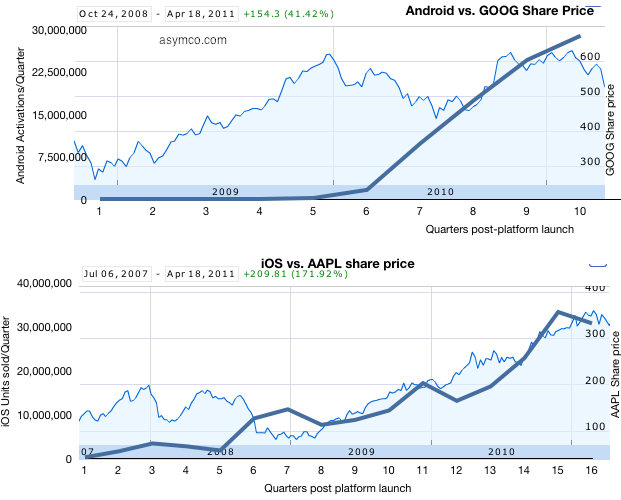
    I took the platform growth data published yesterday and overlaid it on the share price data (source: Google finance). Each plot begins at the point in time when the respective platform was available in the market and ends today. There are two vertical axes: the left side axis shows "activations" or units sold and corresponds to the thick blue line; the right side axis shows share price and corresponds to the area chart. Overall date range and growth in share price is shown in the upper left corner.

    What can we interpret from this superimposition?

    1. Both Apple and Google shareholders saw share price appreciation during the two platforms' histories. Apple shareholders benefited more (+172% vs. +41%)
    2. Apple's share price appreciation seems highly correlated to iOS growth but Google's doesn't. Google share price had dramatic growth during 2009 while Android was moribund and was flat to down during 2010 when Android growth was explosive.
    3. We can also interpret the difference as Google's fortunes being far less dependent on mobile platforms than Apple's. Google has been subject to selling pressure this year due to corroding cost structures irrespective to platforms growth. Conversely, Google may not benefit from mobile computing as handsomely as Apple.

    Correlation is not causation and clearly there are many factors at work in share price changes but I think it's fair to say that Apple is obtaining fuel for growth with iOS while Google is in a more precarious situation with mobility--partly benefiting but partly threatened. The market behaves in bizarre ways in the short term but in the long term one can see logic and reason.
  2. The Android step function

    Research · 40 comments

    There is precious little data on Android units sold. There are estimates but no actual summary. Google themselves don't seem to know as they don't report sales, preferring to report "activations."

    Assuming that activations means "unique activations of new devices" then we can draw some equivalency between Google's reports and the reported units of iOS sold. There is some uncertainty with respect to iPod touch units, but that is not very big (estimates are drawn from Apple's reporting of overall iOS units at several points in time.)

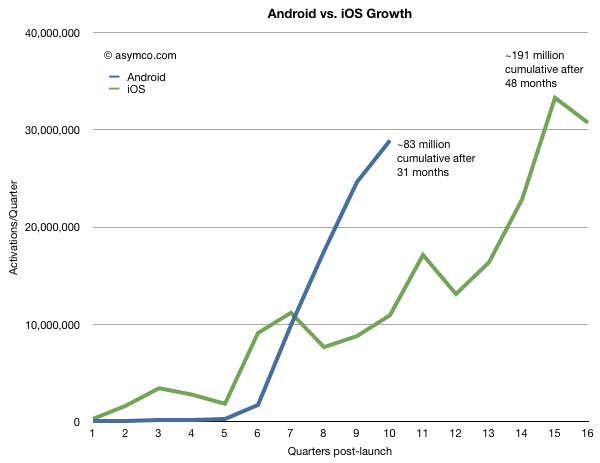
    To estimate Android, I took the download rates currently available and placed them in the month when they were published. I then interpolated the data monthly and quarterly.

    To make the comparison more valuable, I chose to index the starting point at the launch of each respective platform and plot quarterly units (or activations). This way we can observe how the platforms ramped in growth and where they were at similar points in their lifetimes.

    The following graph results.

    There is likely to be more seasonality in Android data than is shown, but the impressive thing is that Android is running at three times the equivalent adoption rate for iOS at similar points in time. In fact Android is being "sold" as rapidly as iOS today even though iOS has been in the market about 15 months longer.

    Overall, cumulative units sold for iOS are still about twice as many but if Android will continue to grow as rapidly as it does now, it will likely overtake iOS in installed base in less than a year.

    One should be careful about drawing conclusions that this implies effective competition. Both platforms are growing very quickly. iOS is growing at at least 100%/yr and Android's second year was 65x bigger than its first. iOS growth is limited by the ramp rates of a limited portfolio of products. Android growth is limited by how quickly vendors can bring out products. Neither platform is demand constrained and hence they are competing for share of growth not for share of a fixed pie.

    Extrapolation is a dangerous game, but the chart above shows some predictability in Apple's curve whereas Android has a "step function" or discontinuous feel to it and that's a curious thing.

    Not so much for its lack of predictability but because it's so asymmetric to iOS.

    A dictum of classical physics states that in nature everything is continuous. However, in quantum physics everything is discontinuous. Both models of the physical universe have their uses.

    It should be noted that both business models represented above can also co-exist, at least for the foreseeable future.

  3. HTC and self-determination

    Research · 74 comments

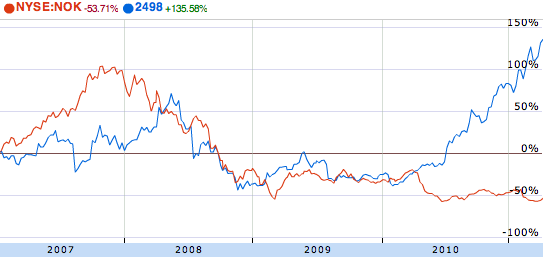
    HTC's market cap has just overtaken Nokia's. While market capitalization is a fickle thing, shifting with sentiment, this is still a remarkable feat. Nokia's market capitalization has almost halved in the space of a year while HTC has more than tripled from $10 billion to over $33 billion.

    If you roll back to 2007 and the start of the modern era of smartphones, you can see how the two companies stocks traded places:

    (source: Google finance)

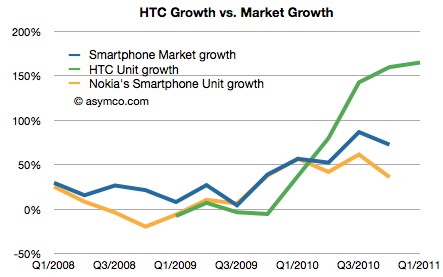
    The recession was hard on everybody but HTC soared during 2010 while Nokia never recovered. Markets reward unforeseen growth and typically that means above-market growth.

    That's reflected in the following chart (admittedly units and not profits, but pricing and margins for both have remained relatively steady.)

    As Nokia's growth lagged the market the stock was punished. As HTC's growth exceeded the market's growth, the stock was rewarded.

    But there are a few more observations to make:

    • HTC's smartphone business was under-performing the market for most of 2009. In fact, it was even in negative growth for three quarters.
    • The surge in growth coincided with HTC adding Android to its portfolio and given no other changes, seems to be causal.
    • Although not within the time range of the charts above, HTC had another period of rapid growth in the mid 2000s.

    A year ago HTC was making excuses and apologizing. Today they are more valuable than the largest phone vendors. All thanks to Android.

    But why no thanks to Microsoft?

    HTC was the primary Windows Mobile vendor a few years ago. They claimed at one point to have shipped over 80% of all Windows Mobile devices. They were also the leader in the Pocket PC franchise as they were the ODM behind the iPaq brand from HP/Compaq. HTC would not exist today were it not for Microsoft.

    The relationship is such that HTC is paying Microsoft for protection from (potential) Android IP infringements. HTC has also licensed Windows Phone though the relationship between Nokia and Microsoft must give them pause.

    But that's the whole problem. Those who live by the sword shall die by it. HTC was a Microsoft dependent and now they're a Google dependent. As the basis of innovation shifted, HTC was agile enough to make the transition. Perhaps they can execute a portfolio switch yet again as their upstream suppliers change whims or business models.

    But then again, as we saw with Windows Phone, perhaps not.

    If HTC wants to control its destiny it needs to control its suppliers. Now that its power and brand have grown, it needs software because in their market software is self-determination.

  4. Google vs. Android Part V

    Research · 145 comments

    When I began the series of posts on Google vs. Android I put forward some questions about the business logic of Google becoming an operating system supplier, especially as that role can be seen as being counter-productive to Google's strategy.

    I noted three strategy costs associated with a zero priced systems software bundle.

    1. A opportunity cost with other platform vendors, namely Apple who might retaliate against Google's core business.
    2. Versions of the software being usurped and modified to provide distribution to Google's competitors.
    3. Damage to Google's brand and positioning and negotiating power in relation with other members of their value chain.

    More fundamentally, Google-as-systems-software is asymmetric to Google-as-cloud-software and contradicts the value proposition that Google enables value in the web not in accessing the web. Android appears to be a nod in the direction that systems software still matters.

    In my numerous posts on the need for integrated development in the era of mobile computing, I also criticized any device vendor that chose to rely on a software stack from an external supplier as foolish. I claimed that they would end up creating uncompetitive products. I thus labeled Google's pursuit of them as ultimately futile.

    More than a year has passed since I began this critique of Android. It seemed quixotic as Android volumes exploded and a mad rush to the platform spun it into becoming the biggest mobile platform by units.

    However those costs did not go away. As the platform grew, they compounded. At first I wondered whether Google management was seriously considering the cost or whether it was giddy with the semblance of success.

    Well, finally, it seems that Google management has begun to acknowledge that these costs exist. In a recent Bloomberg story there are many claims that Google is reversing many of the operating principles of Android. Namely:

    • Restrictions on who gets what version of software when
    • Restrictions on what changes can be made to the software
    • Requirements for approval for source code changes

    These changes, if feasible, will affect the ecosystem dramatically. It will also reduce the second type of cost associated with the platform (the cost of enabling competitors.)

    Good news for Google then.

    There are still the other problems (disconnect from business model, loss of goodwill, damage to negotiating power). But there is actually a more sinister new problem brought about with the new crackdown: Android will no longer be disruptive.

    I also wrote a few posts (e.g. What has Android done for Apple?) where I claimed that Android has the power to accelerate smartphone adoption, especially in the "Wild East." The power of Android was with the little vendors--the ZTE and Huaweis of the world. They could finally make smartphones cheaply--almost as cheaply as voice phones--and not have to negotiate licenses and pay for software IP.

    It would be these smaller "unbranded" vendors that would really disrupt and, with them, Android would become ubiquitous for the billions of mobile broadband non-consumers.

    However, with the new policies, it's much harder for this to happen. Smaller vendors will look at the new hoops they have to jump through and probably say "no thanks." In a beauty contest, they don't look so good next to the big brands.

    They may turn to homebrewed versions of Linux or new forked Androids. This redefinition of openness will essentially remove Google from the disruptive trajectory of mobile computing.

    So we're back to the old question: Google vs. Android, who wins? If Android still has hidden costs to Google and, with its sheep's clothing cast aside, no longer offers significant distribution to the low end then how will Google benefit? The answer that there will be additional ad revenue does not cut it. That revenue would have come from placement deals with other incumbent platforms (just like Google manages to compete on PCs without having to provide its own OS).

    As Google figures this out, its licensees are at the mercy of the ensuing decision. Good luck with that.


  5. The controversy of playing it safe: What's IDC's Smartphone Market Message?

    Research · 53 comments

    IDC released a new forecast for the worldwide smartphone market which included a long range forecast--all the way to 2015.

    Most people fixated on the share data in 2015. Not hard to do since whoever wrote the press release highlighted this flashy headline. Putting aside the three significant digits of accuracy on every data point and the hard to swallow declaration that a painfully underperforming (in more ways than one) Windows Phone will overtake iOS and BlackBerry to become the second largest platform by units/year in 2015, there is much more to the report.

    Using only the public data from the press release we can put together a pretty good picture of the transition being forecast and determine some of the (unstated) assumptions being made. It's these assumptions about the underlying market dynamics which illuminate far more than the falsely precise share data.

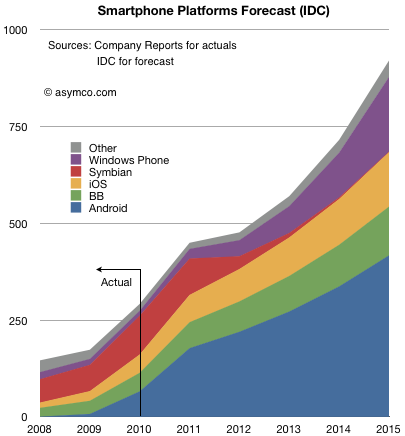
    The following chart shows both historic platform performance (which is detailed in the Asymco Interactive data sets on a quarterly basis) and the forecast based on the given compound growth rate published.[1]

    I see three main assumptions being made:

    1. Nokia (or more precisely Symbian) share will be swapped for Windows Phone. The transition period 2011 to 2015 shows approximately 150 million Symbian devices will be sold which is the stated goal for Nokia. IDC is making an assumption that the hardware vendors will roughly maintain their respective shares irrespective of platform dynamics and that Nokia will switch its share of users from one platform to another in a predictable way.
    2. iOS and BlackBerry will maintain share. Presumably this is also driven by hardware channel dynamics and relationships with carriers.
    3. Android will grow share slightly but the vast bulk of growth will come from market growth.
    4. Market growth is strong but undramatic.

    Overall this is not a controversial set of assumptions.

    Except perhaps that it assumes that the basis of competition in the market is unchanging. Of course it's well understood that the basis has shifted during the tumultuous 2007 to 2010 and forecasts made before the iPhone was launched sound absurd today.

    But IDC says that the unpleasantness won't happen again. From listening to the conversations going on today on this blog and elsewhere, their assumption that things will not change (again) is fairly deeply ingrained, indeed conventional wisdom. In that sense IDC is not taking any liberties with the future. The projections of current realities onto the future leads to this type of forecast and status quo defenders should be satisfied, if not rejoice.[2]

    However, there are a few more consequences of even this uncontroversial forecast which should make keen observers sit up and notice.

    If we look at more than the before and after snapshots and comfortable pie-splitting sound-bites there are some profound seismic things being implied.

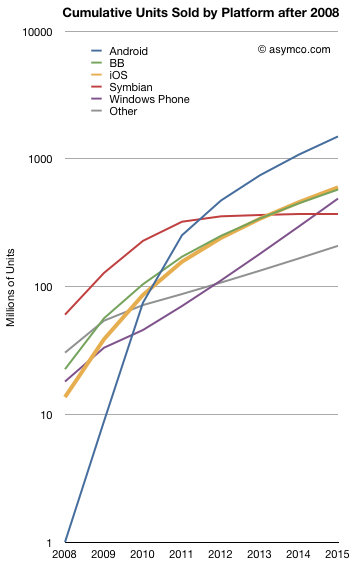
    For example the entire market will be nearly 1 billion smartphones a year (in four years!). Even more startling, considering the "race to a billion" discussion we've been having, some of the platforms seem to be reaching that threshold rather quickly. The following chart shows the cumulative unit sales for the candidate platforms on a log scale:


    Android is considered likely to break one billion units in five years post-launch. Windows Phone will sell nearly half a billion units and Blackberry will be well over that number.

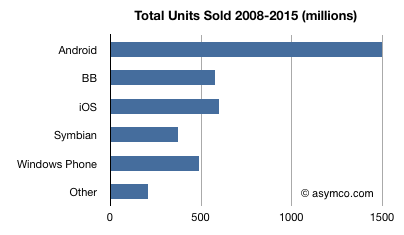
    I tallied the cumulative platform unit totals below:

    No less than four platforms will have sold half-billion units by 2015. The suggestion that Android will "win" by having the most units sold seems as hollow as the suggestion that Symbian "won" by having the most users in 2008. Not so much because it will go on to lose them, but because there were plenty of viable alternatives for users to buy and developers to build for. Half a billion users cannot be easily ignored.

    So even "safe" assumptions can lead to astonishing results in this market. Namely, IDC is saying that the smartphone market will not have any platform losers.

    There is one more thing the report implies. If you look at the ranking of leading platforms (by units/year) in 2008,  2015 and, with a little extrapolation, 2016/2017 you get:

    Rank in 2008Rank in 2015Rank in 2016/2017
    SymbianAndroidAndroid
    OtheriOSWindows Mobile
    RIMRIMiOS
    Windows MobileWindows MobileRIM
    iOSSymbianOther
    AndroidOtherSymbian


    In other words, there is a complete reversal being projected. An almost perfect flip: those on top end up at the bottom and those on the bottom end up on top. That's about as controversial as it gets. Pretty impressive for a set of safe assumptions.

    --

    Notes:

    1. You should ignore the shape of the curve between 2011 and 2015 as it assumes the CAGR is applied to every year. Although the press release shows a CAGR, the actual report may include various fluctuation in yearly growth. The starting point of 2011 and the end result in 2015 however should be the same.
    2. If, on the other hand, you believe that exponential growth, rapid gains in communications speed, new breakthroughs in interaction with devices, and entrants winning with new business models are causes for a disruption, then perhaps extrapolation may not be the way to forecast this market.
  6. Understanding RIM's tablet platform app strategy

    Research · 135 comments

    Yesterday RIM reported their quarterly earnings. The results were mixed to slightly negative and the shares were down 10% in after-hours trading.

    I'll work through the smartphone market data at a later time but for now what I want to focus on is RIM's strategy which really means understanding RIM's intentions or their approach to the market. For that we have to go straight to the source: what management actually says. Trouble is, management often speaks in a jargon that is unfamiliar to people (sometimes unfamiliar to anyone outside the company).

    Strategy analysis involves translation. So here follows the interpretation of Jim Balsillie's remarks during the conference call (transcript sourced from Businessinsider.com).

    What Balsillie SaidMy interpretation
    First of all, what we announced is Gingerbread. This is not Honeycomb. I don't know what the number of Honeycomb apps is, but it's not very many. Whereas Gingerbread they've got lots of them.RIM will support Android apps in the PlayBook tablet. As there is not one Android, I need to clarify that RIM will not support Android tablet (Honeycomb) apps but Android phone (Gingerbread) apps. So RIM's tablet will support Android phone apps even though our tablet does not actually have a phone in it, but requires tethering to a BlackBerry for cellular data.
    You've got the volume of the handset apps, so if you're looking for the tonnage of apps, or some kind of long tail stuff, you've got it.This support means there will be many apps including apps that are not very popular. We don't like supporting unpopular apps. We like a few good quality apps but this approach allows us to offer all kinds of apps.
    At the end of the day, people are going to want performance.However, many apps will not run smoothly.
    You're just not going to get things like gaming and multimedia, you're not going to get the speed going through a VM interface. If you want content, or Flash type stuff, or you're looking at AIR-type, evolving web-type assets, that's what you're going to do.Games and graphics will not run well through emulation. For processor intensive experiences we will have native execution options or browser apps.
    There's no compromise here. You've got the tonnage of apps. And you've got the performance. Do I think the tonnage is overplayed? Yes.By supporting emulation of Android apps we can offer a large catalog of so-so apps while having a small portfolio of high quality native apps.
    But if you think it's about having a couple hundred thousand apps, there you goFor people who value large selections, they can go to one store.
    Do we believe it's about super high performance? YesBut for those people who value quality, they can come to our store.
    I'll just offer that observation that today broadly in the world without any specific comment on us or our competitors, there are multiple ecosystem patterns that need to be consideredBeside emulation and native we also think there are many other ways to deliver applications.
    Do we believe it's about full web fidelity? Yes.For example, Flash.
    These are concepts that were really relegated as not technically possible, which we're doing here. This is a no compromise environment.Because of Moore's law, Flash is becoming viable on a mobile device.
    If you want to work on Android, great. Do we think people will want to migrate web assets? YesThen there are browser apps.
    Do we think they're going to want super high performance native assets with the SDK? AbsolutelyWe will have our own native SDK.
    You think they're going to want to use their Flash based stuff for an offline Flash/AIR type environment? YesAnd support Flash.
    I'm just not interested in these sort of religious application tonnage issues.  I really think we put that issue to bed.We have a new platform but catalog sizes can no longer be used against us.
    And if you think the whole world's going to want to develop for Gingerbread, fine. Do I think that's going to happen? Then why is there a different environment for a tablet? And you know about the performance issues and you know about the app volume issues, cause it's tough. And that's why QNX mattersGoogle's ecosystem is fragmented, Android apps are not able to rely on competitive hardware and there is too much competition. That's why developers should target QNX (which is unfragmented, built on fast hardware and there are few apps on it).
    Is this stuff going to go more in the browser and HTML 5 and more native? These are going to be strong trends. But if you want these app players for different VMs -- and don't forget we have 25,000 BlackBerry 6 appsBrowser apps will increase in value and we also have legacy BlackBerry apps.
    So, at the end of the day, we believe this is going to be about performance. It's going to be about enterprise greatness.But we believe in a future with native applications running on QNX.
    Things like multi-threaded capability, symmetric multiprocessing. We believe it's about an uncompromised web. We believe it's about enterprise security. True multitasking, not with suspension -- and that matters because you're going to want to run these things in the background.Because QNX is a robust operating system with PC-like performance. It also supports a good browser.
    But I'm out of the religious war on tonnage, which I'm delighted.However, before QNX takes off, we will provide access to catalogs of apps which are built for other platforms.
  7. Which mobile users will platforms harvest first?

    Research · 23 comments

    When tallying up the race to a billion users, I noted that both iOS and Android seem to have the potential to reach that size of user base. However, that raises the question of where those users will come from. We have to note the fact that there aren't a billion users to be captured today.

    If not today, then how soon, and where are they?

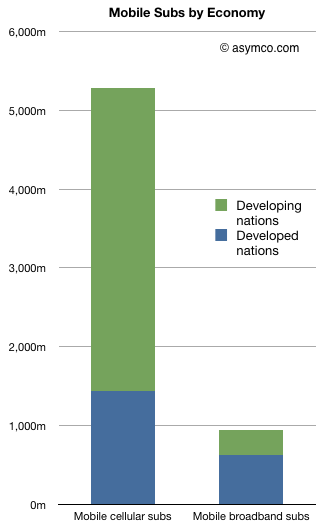
    The first question is who is addressable. If we stick with mobile cellular subscribers, there seem to be plenty of users (at least 5.3 billion as of October 2010 according to the ITU). However, the number of "mobile broadband" (i.e. 3+G network subs) is about 940 million. The chart to the left shows the difference and adds the subdivision between developed and developing economies.

    Over half (51.1%) of developed nations' populations have signed up for mobile broadband while only 5.4% of developing country populations are on 3G. And whereas developing countries have added 2.6 billion mobile subs in 5 years, they added only 293 million mobile broadband (MB) subs. Developed nations added 574 million MBs in the same time frame.

    As a result, two thirds of mobile broadband subscribers reside in developed nations as of 2010. This number will decrease rapidly as MB penetration reaches saturation in developed countries, however the race to a billion is being run in these markets first.

    Which leads back to the question of platform potential. Platforms that target developing nations have the challenge of low broadband availability in the near term in addition to the challenge of device pricing. There are still 800 million developed country subscribers who have yet to upgrade to mobile broadband.

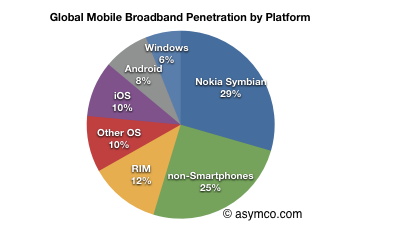
    At the time these statistics and knowing the platform sales histories, my estimate is that only 18% of mobile broadband subscribers were using either iOS or Android. 25% were not even using a smartphone and 29% were using Symbian. (See pie chart).

    But existing smartphone users are not the most attractive market to target with a new platform device.

    A new smartphone user could come from the following groups of users:

    1. Existing smartphone users:  700 million. This is tough head-to-head competition for every new user.
    2. Existing mobile broadband users who are not smartphone users: 240 million. The easiest group to switch to using smartphones.
    3. Developed nation mobile subs who don't have mobile broadband or smartphones: 800 million. This seems very attractive since they can be mostly upgraded using subsidized phones into an available 3G network.
    4. Developing nation mobile subs who don't have mobile broadband or smartphones: 3.5 billion. This is a very tough market because the availability of 3G will take time and until it appears, the buyers are unlikely to adopt devices that are useful only though a 3G data plan. They are also a difficult market to target with high ARPU phones/plans.

    To assess the timing, one could assign some probability weights to these categories to create various scenarios for adoption. My own guess is that the next 500 million smartphone users are easily within reach in the next two years without a significant amount of inter-platform rivalry (See stacked bar chart to the left).

    Only after two years will existing smartphone users become attractive for poaching and even that assumes that developing nation networks will still be largely unaddressable.

  8. Ads for ads: The ad-supported app bubble

    Research · 25 comments

    By one estimate (Gartner), about 81% of apps downloaded today are free. The way free apps are able to generate revenue is through advertising. 16 percent of application store markets' $5.2 billion revenue was generated from advertising.

    But advertising what?

    It seems that most of the ad dollars spent on in-app ads are spent by developers to promote other apps. I'd like to get hard data to prove this, but assuming it's true, we have to ask if the apps being promoted through ads in apps are free apps seeking more revenue from ads...from other apps.

    To put it bluntly, the $816 million that "comes from advertising" is not coming from consumers but churning around the ecosystem like a hot potato. This figure is said to triple this year.

    It's arguable that this is only logical. App users are pre-qualified as app downloaders so it makes sense to target them through apps for more apps. But where does value actually flow into the ecosystem from consumers? This problem of commerce through apps being nothing but virtual app goods implies that there is a bubble forming. This is more likely to be a problem for Android as the ratio of advertising to purchase of Android apps is higher than on iOS, but it's a problem for all app advertising.

    It's even more ironic that the developer looking to create revenues through their app is promoting competing apps seeking the same user.

    I don't see how this can end well.

    The only way ads really work is for users to transfer cash for underlying value. Aside from paid apps which have entertainment or functional value, how much spending from traditional ad buyers (brands) is targeting apps? Perhaps transitioning ad buyers is what Apple had in mind a year ago with iAd. Signs so far are not encouraging that their approach is working. That may be bad news for Apple, but it's worse news for AdMob.

  9. The Race to a Billion

    Research · 22 comments

    I last looked at the race to a billion in September 2010. I've now added a few more data points to the tracked platforms and also added points for the major console game platforms and Symbian.

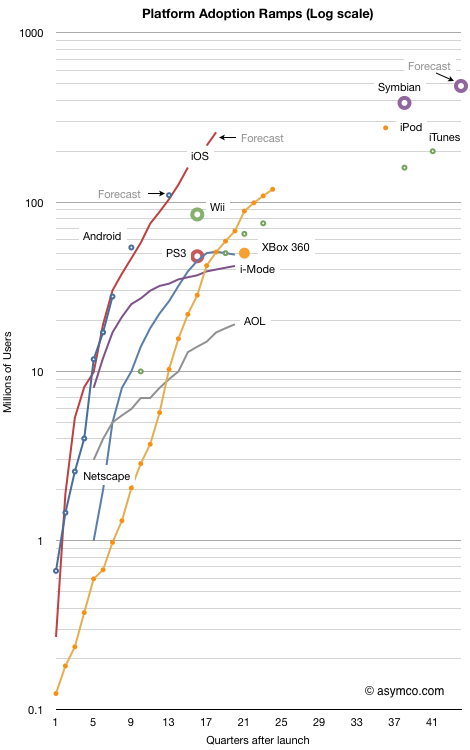
    The chart shows the cumulative number of users (approximated by units sold) for 11 platforms indexed to the same starting date. The horizontal axis is the number of quarters since a platform launched. Every fourth quarter is numbered so each number on the axis represents a new year. The last number on the axis represents 10 years.

    The vertical axis is the cumulative number of users on a logarithmic scale. Each number of the vertical axis is 10x more users than the previous number. The top of the graph represents a billion users.

    The overall chart shows how quickly a platform has grown and is bounded by a billion users and a decade of usage.

    When judging the performance of a platform, the adoption slope and sustainability over time is perhaps the most interesting measure.

    One can see how many platforms slow down before reaching 100 million and so far none have hit the billion mark (Windows has but not in the 10 year time frame of this chart.) Looking at game consoles also shows the limits of a narrowly focused platform. They performed better than i-Mode and Netscape but not as well as iTunes or iPod which themselves have growth limits.

    If you're looking for the "fastest growing" title, it's a toss-up. Both iOS and Android are following almost identical trajectories.[see Notes]

    The absolute highest cumulative sales total is Symbian, though now that it's been deprecated, it's set to be bypassed.

    It does appear that Android and iOS each have the potential to reach a billion users in less than a decade. Perhaps Android will do so faster but the mobile computing platform race will not play out as the personal computing platform race did.

    ---

    Notes:

    1. For Android I used my own summary data for historic performance except for the last estimate and forecast which came from IMS Research.
    2. iOS forecasts are my own.
    3. Symbian data comes from VisionMobile. Forecast is based on Nokia's 150 million additional sales prediction.
    4. Game console data is current as of end of 2010 via Wikipedia.
    5. Other data sourced from Morgan Stanley.
  10. Disney (still) loves Android

    Research · 51 comments

    We removed the malicious applications from Android Market, suspended the associated developer accounts, and contacted law enforcement about the attack.

    via An Update on Android Market Security - Official Google Mobile Blog.

    It's great to see that Google is quick to call law enforcement to prosecute those who took advantage of its open(!) market. Now I wonder what Google will do about policing copyright infringement on the same market .

    In September I wrote a note about how some of the top applications in the Market seemed to be infringing on copyrights (and attempting to hide the fact). Today I went back and searched for "Disney". I was offered about 350 apps and I am pretty sure that none one of them is endorsed by Disney.[1]

    While there is a vast amount of copyright infringement on YouTube, Google is actively working with video content publishers to either compensate them or to take unlicensed content out. This after extensive legal maneuvering.

    I'm not sure how policing or licensing deals will be struck for content on the Android Market. Apps are content, but of a different sort. It's not so easy to scan for infringements. It's not easy to draw up a compensation contract. The revenue model is ad-based (by and large.)

    The fact that there seems to be little activity[2] to filter the material today indicates that it's not a burning issue for Disney. Could it be because Disney is unaware of the success of Android Market, or could it be that Android Market is not big or successful enough to become a priority at Disney legal?

    ---

    1. You can do the same search in iTunes and get about 120 iPhone apps, though at least half are clearly sanctioned with most of the rest being related to the parks franchise.
    2. There might be activity to police the copyrights as, unlike in September, there don't seem to be many infringing apps in the top seller or featured sections.
  11. On Android [Updated]

    Research · 43 comments

    Demonstrating the value of openness and broad support from partners:

    In terms of openness and broad support we've done very well... Literally available on over 150 different handsets. It's available from over one hundred different mobile operators around the world. We will probably license about 20 million devices this year which is really quite dramatic at least among smartphone systems. So we have great momentum. We've brought [a new version] to market. We're driving forward on our future releases. We'll have to see what [the competition] does. Right now they have a press release [...] We have many many millions of customers, great software, many hardware devices and they're welcome in our world.

    Inspired by a tweet from Charles Arthur.

    [Update]

    The quote is Steve Ballmer speaking in 2007 soon after the announcement of Android and in response to a question of what he thought about Android. The source video is here.