Asymco

Asymmetric Intelligence

Android

  1. Flummoxed, again

    Research · 184 comments

    The last time I took a snapshot of the iPad death watch it was March 9th, 2010. Almost a year ago. The now-classic quotes are reproduced here.  Last May I wrote:

    Apple keeps a tight lid on new products so that competitors don’t get a head-start on copying, but in the case of the iPad, advance knowledge would not have had any impact. Competitors look at the iPad and see nothing.  They’ll only react once the market explodes and they start to feel belated pain.

    I thought that would be that. As the success of the product would become self-evident, predictions of imminent demise would trail off. The pain of share loss would prompt a wave of challenger copycats. Imitation would be the the best form of flattery.

    But no.

    Critics were not silenced. One year, 15 million units, and $9.2 billion later I went back to the source of the quotes and found the following (published quotes dated after March 9th 2010). (Cited from aaplinvestors.net with some editing for brevity and relevance):

    “Problematically, the Android competition is just as expensive as the iPad lineup, so Apple obviously feels free to continue gouging consumers on iPad pricing.” Paul Thurrott, Windows IT Pro, 3 March 2011

    “Apple’s iPad 2 might be ‘magical’ but it still should’ve been better ... It needs more G’s. It’s still just a toy” Zach Epstein, Boy Genius 2 March 2011

    “11 reasons NOT to buy an iPad 2 ... Reason 5: Competition David Gewirtz, ZDNet, 23 February 2011

    “Given what I’ve seen of Honeycomb and Motorola’s excellent tablet, Cupertino will have some serious catching up to do with their iPad 2.” J.P. Mangalindan, Fortune, 4 February 2011

    “We very carefully chose our tablet processor, the Nvidia Tegra 2, and to really compete it will take [Apple] some time. You know, [Nvidia] is well known for graphics.” Jonney Shih, Asustek Computer, 3 February 2011

    “If you were to ask me in two years time, will Apple have less than 50 percent of the global tablet market, I think that’s a certainty. Neil Mawston, Strategy Analytics, 31 January 2011

    “We have an extreme focus on the innovation of LePad and LePhone because these products will dominate the future market. Though Apple is winning a significant share in the Chinese market, it has not gained a clearly leading position yet. Our advantage is we know this market better.” Liu Chuanzhi, Lenovo, 27 January 2011

    “The iPad may still be the lone leader, but with 100+ competitors on the way, it won’t likely keep its majority market share unless the pending next generation iPad really addresses all the complaints about the current version, like a missing camera and a lack of a USB port, and the company has to add those features without a major price increase - a tall order, to be sure.” James Brumley, Investopedia, 13 January 2011

    “Hands-on PlayBook demonstrations at CES showed its differentiation in multitasking and performance, which may be difficult for Apple/Android to rival.” Mike Abramsky, Royal Bank of Canada Analyst, 11 January 2011

    “Apple Inc.’s popular iPad is getting its strongest competition thus far as consumer-electronics manufacturers unveil tablet computers with bigger screens, front-facing cameras for video chatting and more.” Rachel Metz, AP Technology Writer, 3 January 2011

    Apple may be simply trying to get in ahead of Research in Motion’s aggressively priced PlayBook or combat the early success of Samsung’s Galaxy Tab.” Rick Aristotle Munarriz, The Street, 29 December 2010

    4. Competitors are coming. Brett Arends, Wall Street Journal, 22 December 2010

    Reason 6: WiFi is still unreliable David Gewirtz, ZDNet, 16 December 2010

    “I can’t imagine anyone under the age of 30 wanting an iPad. A PS3, Wii, GameBoy, or even a useful laptop maybe, but an iPad? Furthermore, I do not recall ever seeing anyone under 30 actually using an iPad.” John C. Dvorak, PC Mag, 13 December 2010

    “We hope our tablet PCs can reach a global market share of 10-20% initially, and become the market leader in two to three years.” Gianfranco Lanci, CEO and President, Acer, 26 November 2010

    “It’s a nice-to-have product, for those of us who don’t have a budget, but is it a must-have product? I don’t think so.” Ashok Kumar, Analyst, Rodman & Renshaw LLC, 12 November 2010

    “Steve Jobs never says anything without thinking through it carefully. But I think in this case he may be a little afraid of this category. And he’s finding whatever he can to attack because he sees [seven-inch tablets] as a challenge to the dominance of the iPad.” Adam Hanin, VP Marketing, Viewsonic, 1 November 2010

    “There could literally be millions of first-generation iPads gathering dust in people’s home offices already. This product is the tech industry’s biggest MacGuffin yet.” Paul Thurrott, Windows IT Pro, 23 October 2010

    “I cannot see a need for the thing.”John Dvorak, MarketWatch, 22 October 2010

    ”For those of us who live outside of Apple’s distortion field, we know that 7″ tablets will actually be a big portion of the market and we know that Adobe Flash support actually matters to customers who want a real web experience.” Jim Balsillie, Research In Motion, 20 October 2010

    “iPhone and iPad have been amazing products that have opened new markets. But I do not think they will own either market in a few years. Android will.” Fred Wilson, AVC.com, 18 October 2010

    “The constant search for an ‘iPad killer’ and the sheer multitude of tablet computers launching in the next 18 months should make Apple aware that its competition is fierce and will only become tougher.” Barbara E. Hernandez, PCWorld, 5 October 2010

    “HP’s New Tablet Could Be an iPad Spoiler HP’s decision to bundle a tablet computer with its new $399 printer could make trouble for competitors.” Cliff Edwards and Aaron Ricadela, Bloomberg Businessweek, 23 September 2010

    “Our tablet will be better than the iPad.” Chang Ma, VP Marketing, LG, 20 August 2010

    “Not only is Apple typically lost in the enterprise, but it focuses very little of its time there. And with a new, potentially more compelling tablet coming — the Cisco Cius — the iPad’s success in the corporate world could be short-lived. Here’s why:... 10 The power of Windows” Don Reisinger, Channel Insider, 5 August 2010

    “I don’t think there is one size that fits all…I’ve been to too many meetings with journalists who spent the first 10 minutes of the meeting setting up iPad to look like a laptop.” Steve Ballmer, Microsoft, 29 July 2010

    “ [...] It still isn’t the device that I’d take to a meeting because it has no input.” Bill Gates, Microsoft, 2 June 2010

    “Which means I end up on the iPad — and tablets more generally — where I started. Tablets will not create a new category, but will supplant (or merge with) one or more of the current substitutes: smartphones or netbooks.Here I am less optimistic about the iPhone and webOS than I am about Android. ” Joel West, professor of Innovation & Entrepreneurship, College of Business at San José State University, 30 May 2010

    “The iPad is useless. Beautiful, but useless. The iPad is too heavy. It’s awkward to hold and view in public. It’s fragile. It requires expensive accessories to protect it and extract more functionality. ”Josh Belzman, MSNBC.com, 20 May 2010

    “Mum, the iPad is not ‘amazing.’ It’s just marketed very well, both by Apple and its culpable partners in mainstream media. ” Paul Thurrott (in response to comment by Mum), Paul Thurrott’s Super Site for Windows, 26 April 2010

    “In short, I don’t get the ‘magical and revolutionary’ vibe that Apple chief executive Steve Jobs touted at the iPad’s January unveiling.” Rob Pegoraro, Washington Post, 9 April 2010

    “The first troubling sign is the fact that you can still get an iPad today. They didn’t sell out. The pure slate form factor has failed all these years because, other than for vertical applications, people want and/or need a keyboard for regular use. The fact of the matter is that a touch screen or bluetooth keyboard just doesn’t compensate.” Jonathan Yarmis, Ovum, part of Datamonitor Group, 6 April 2010

    “I don’t get it. It costs $500 for the basic model, when you could get a laptop with a lot more functionality for about the same price. The iPad hype machine has been in full effect this week, and I still think it’s just that—hype. ” Alex Cook, Frontier Outlook, 3 April 2010

    “As far as what this means to Apple, one thing to keep in mind: Even if the iPad sells more than the iPhone did in its first year, it’s still only around 5% of the company’s revenue. So it’s a very small slice. From there, it probably doesn’t grow as large as the smartphone market. So, if you’re buying under rumors, keep perspective in mind. The iPad’s a great product, but it’s probably not a game-changer.” Eric Bleeker, Analyst, Fool.com, 31 March 2010

    “The iPad will remain an expensive, niche device compared to all-purpose netbooks.I think that one of the iPad’s most important uses will be for reading ebooks and publications. Even so, though, when it comes to the marketplace, netbooks will sales still far outstrip those of the iPad.” Preston Gralla, PC World, 30 March 2010

    “Don’t Believe the iPad Hype. Apple has sold out pre-orders of the forthcoming device, but it could all be a marketing tactic. By not manufacturing enough iPads for the initial launch date, is this a case of Apple shooting itself in the foot?” Mike Schuster, Minyanville.com, 29 March 2010

    “‘iPad Killer’ May be Palm’s Last Hope”Tom Bradley, PC World, 20 March 2010

    “Even if your company has relented and now supports the iPhone, as growing numbers of businesses do (70% of the Fortune 100 are at least testing it, says Apple) you’ll want to say “No” to the iPad and other tablets. Here’s why: 8. Speaking of money, there is no money in the company budget to pay for iPads. 9. Not supporting iPad will be the enterprise norm. Robert McGarvey, CIO Update, 16 March 2010

    “This morning, the fool’s parade gets started. Apple is taking online “pre-orders” for its iPad tablet, which is supposed to begin shipping on April 3. Buying a new kind of product sight unseen is foolish. Especially given how mysterious Apple has been on what the iPad can do and what restrictions on capabilities and media access it will place on users and content providers.” Galen Gruman, InfoWorld, 12 March 2010

    “The recent launch of Apple, the iPad tablet, has won the award for the second edition of Fiasco Awards delivered this Thursday in Barcelona. From the more than 7,000 people who voted via the website www.fiascoawards.com, 4,325 have considered it the fiasco of the year. Fiasco Awards, 2010, 11 March 2010

    “I think I’ve mentioned this once or twice before, but it bears repeating until it sinks in: the Apple iPad is not unique, nor necessarily the best of breed in the media tablet sector it is spearheading. And it ain’t gonna help Apple shareholders any.’” Anders Bylund (TMF Zahrim), 11 March 2010

    From this critical review, it looks like 2011 will indeed be the year of the iPad 2.
  2. Android vs. Windows Phone: Which vendors benefit?

    Research · 32 comments

    Who is Winning the U.S. Smartphone Battle? | Nielsen Wire.

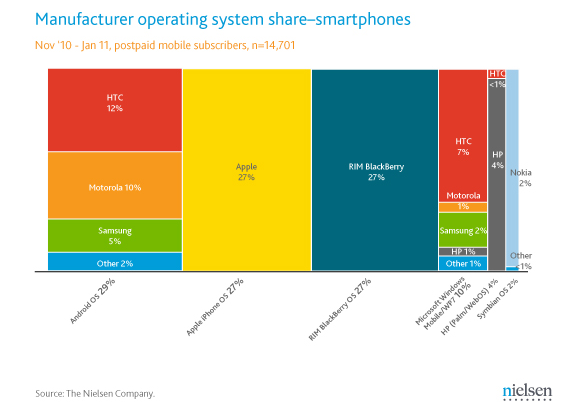
    This is a great chart from Nielsen showing the split in manufacturer share by OS in US installed base. What I consider significant is how the modular software platforms Windows Mobile and Android worked out for the licensees.

    Whereas in the case of Windows Mobile HTC took a significant, nearly dominant share, the Android ecosystem was more balanced between HTC and Motorola. However, HP and Motorola left the Microsoft camps, Motorola going exclusively for Android and HP buying Palm. That leaves Microsoft with HTC, Samsung and Other (mainly LG I presume).

    The question of how Windows Phone will shape up vs. Windows Mobile and Android remains. Motorola has signaled they are not interested in WP7 for the time being and so it's likely that they will stick with Android. Samsung is always hedging its bets so it will probably balance its portfolio. One could conceive of Nokia stepping into the US with significant WP volumes, but there are many hurdles on the way.

    One can see the challenge individual modular vendors have to edge the overall volumes of the integrated vendors. As Nielsen points out:

    But an analysis by manufacturer shows RIM and Apple to be the winners compared to other device makers since they are the only ones creating and selling smartphones with their respective operating systems

    Not only are the volumes higher, but so are the margins and hence profit share.

  3. Lookout ZTE and Huawei: Here come NEC, Sharp and Kyocera

    Research · 29 comments

    Sony Ericsson, NEC and Kyocera are among the other Japanese handset makers also betting on Android as their path to international sales.

    via Japanese Phone Makers Look to Ride Android’s Surge - NYTimes.com.

    The Japanese positioning is based on the notion that current Android phones are not good enough and that they can bring "great hardware, great R&D and great engineers" to solve the existing problems with Android portfolio phones.

    That's an interesting observation by Google's own director of Android Global Partnerships. The idea that the market can still reward hardware innovation would also imply that Apple could benefit from that demand.

    So is the message that there is still room for device innovation?

    Perhaps not. Perhaps Android's pursuit of Japanese vendors (and vice-versa) is just evidence of the rush into smartphones by those possessing excess hardware R&D and manufacturing capacity and a deficit of software assets.

    It's still striking that there are hundreds of hardware vendors and supposedly "only two" platforms.

  4. The platform as a promise

    Research · 39 comments

    In a recent answer on quora, I wrote that I did not believe developers are tempted primarily by economic incentives when choosing which platforms to work on. I suggested that they hire platforms because of their star-making potential and that star-making value is not a something that money can buy. Using Hollywood as an example I suggested that subsidies decrease the perceived value of a talent-oriented platform.

    The notion that a platform signals meaning to developers led me to think about how mobile platforms signal meaning to consumers. I have a hypothesis that platforms can and should be treated as brands. This point of view allows platform orchestrators to develop a comprehensive market-driven strategy for platforms that transcends technical debate.

    First a word about what a brand is.

    Brands are vaguely defined. They are identities, names, symbols or attitudes or all of the above. Marketers struggle to define brand value because they are trying to encapsulate what they sell into a single symbolism. The problem is that there are vast varieties of things being sold. Every product or service has different meaning to buyers and it cannot be captured the same way. Because I cannot rely on a single definition I have to create a specific definition of brand to the context of mobile platforms.

    I choose to define brand in this context of platforms as the "promise of the platform". A platform is a promise that the products will function in ways beyond what's "written on the box"; that the product is extensible and has value provided by an ecosystem bigger than the original vendor.

    For example, although the iPhone is based on iOS platform, iOS is not the brand. "iPhone" encompasses the platform brand and it's a promise to users that they can expect apps and content and an extended flow of innovation to continue well beyond the initial purchase of the device. This brand value is attached to iPod touch and iPad even though it's not communicated as a unified platform. In other words, consumers don't look for "iOS inside" but the implicit value of "there's an app for that" covers all the products.

    When looking at platforms as promises or brands, we can observe how some are more powerful than others.

    Symbian or Series 60 was never marketed as a brand and Nokia users are generally unaware of what OS or platform their phone runs. Does Symbian make a promise of an "extended flow of innovation to the device" after the time of purchase? It's hard to make that promise when you can't communicate clearly anything but device specs.[1]

    Conversely, Android has become a strong brand. The Android label (and mascot) is frequently used by device vendors to signal platform brand value.

    How did Google achieve in a year this value with Android while Nokia continued to squander any brand goodwill around Symbian for a decade? The answer lies in marketing decisions. Nokia wanted to focus on the hardware as value (and the Nokia brand as the way that value is encapsulated). Google and Android OEMs wanted to lift their own device brands into becoming smartphone brands and attached the value of Android branding to them.

    Which brings me to the question of how to design platforms as powerful brands. Creating awareness of extensible value is the way to signal to developers and all members of an ecosystem that a platform is valuable. Apple did this very well with their iPhone ads which focused on the app value of the product. They showed the product in use and did not rely on metaphors. Developers saw other specific apps being advertised by Apple and it engendered huge star value in the platform. Every developer wanted a shot at being featured in an iPhone ad. The iPhone could and did make stars.

    But you can't make the great promise of the platform without the ensuring consistency, reliability and longevity. Fragmentation, malware, copyright infringement and arbitrary termination amount to the confiscation of platform value by the orchestrator. Poor custodianship results in the destruction of both ecosystem and end user value.

    --

    Notes:

    1. The lack of platform promise for Symbian may also explain why Nokia believes they can sell 150 million Symbian devices which have a deprecated platform. Those devices could be sold as feature phones, not platform products. The challenge for them will be to get a smartphone price for a feature phone product.
  5. Google and Apple as mobile co-belligerents

    Research · 94 comments

    The relationship between Google and Apple is an interesting one. It's enticing to declare them "at war" with one another, but that type of relationship does not account for the collaboration and partnerships they enjoy. To wit:

    • Google pays Apple for default Search placement on Safari. This means that Google treats Apple as a distributor.
    • We can presume that there is a deal between the two over Gmail and Maps on the iPhone as well.
    • AdMob is available on iOS without hindrance.

    The business relationships between the two companies are self-evident. However, I would suggest that there are more important strategic reasons why Google and Apple are in fact implicitly collaborating against a common goal.

    The concept of "co-belligerence" may describe the relationship: The state of fighting against a common adversary without a formal alliance and without a guarantee of non-agression against each other.

    The common adversary is the telecom industry. It's an industry being undermined by the technological change of mobile computing and its profits are up for grabs. Apple and Google have different approaches in implementing this change but in the end they dismantle and absorb profits from the same target.

    They are also benefiting each other. Apple benefits Google by creating user experience innovations which Google can rapidly copy. Google benefits Apple by increasing smartphone consumption--educating markets to the value of mobile computing and crippling the profitability (and thus the ability to innovate) of Apple's direct competitors.

    If I may belabor the point, it's like the concept of fast food. One company invents the fast food franchise process, another popularizes it and creates demand. Finally, the innovator comes in with a premium brand to split the market.

    Apple innovates in product innovation with Google as a fast follower. Google then innovates on distribution and penetration enabling Apple to follow with a skimming strategy.

    The end result is a more rapid and thorough profit evaporation from incumbents with corresponding condensation around the entrants.

    To visualize it further, consider what the market would look like if one or the other of the co-belligerents was not participating. Could Google have developed their software without the iPhone as a reference design? At the same time, as Android eliminates the opportunity for alternative software investments by competitors[1] could Apple have remained the only integrated vendor with a uniquely high profit margin?

    Of course, this is not a guarantee of success. New platforms may still take root and integration by HP may actually pan out. But the point I'm trying to make is that, for the time being, Google and Apple are not so much adversaries as comfortably busy winning against a rather weak common target.

    ---

    Notes:

    1. Consider how hard it is for OEMs to justify investing in their own OS post-Android. Consider the desperate status of Nokia who abandoned a broad ecosystem and the paucity of alternatives.
  6. Platform sunk (cost): What is the value of a quarter billion Symbian users?

    Research · 38 comments

    In the quarterly smartphone summary published here, I noted the significant acceleration of Android sales at the expense of "other" and Windows Mobile/Phone. Some share was also lost to Symbian. This might be seen as justification for the "platform jump" that Nokia undertook.

    In a second discussion, I published the history and life cycles of the smartphone platforms, identifying 10 platforms (out of 16) still in the market. This challenged the view that it was a two horse race today and that it will become no more than a three horse race in the future.

    Questions came up about the "quality" of these platforms. Clearly some are barely viable while some are thriving. To explain the value of a platform, one metric we can use is the cumulative sales which allows us to derive the installed base.

    The following charts do just that.

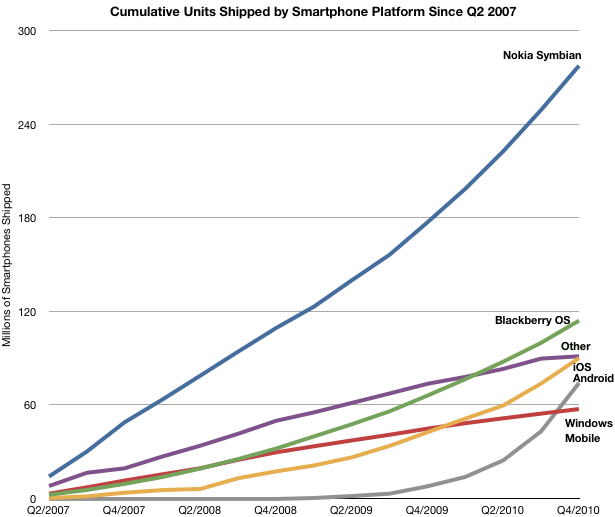
    This first chart shows the cumulative total of units sold since Q2 2007. This is the sum of all smartphones sold in the last 3.5 years. There are some interesting patterns here, but right now we want to focus on the installed base.

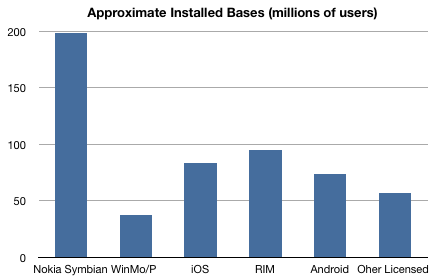
    3.5 years of cumulative sales is an upper bound on the installed base. We can get a better estimate the phones in use by subtracting from the base phones older than 2.5 years. This is shown in the second chart below:

    As of the last quarter, Nokia's Symbian is likely to have 200 million in use. Apple may have about 85 million iPhones in use (this excludes iPod touch and iPads) and Android about 75 million. RIM is around 95 million and Windows Mobile less than 40 million.

    What's interesting is that of these installed bases, the largest is the one that's just been abandoned, and the smallest was chosen as its replacement. Even that's not quite fair since Windows Mobile is not a valid replacement. It's Windows Phone that was chosen and that probably has an installed base of about 1 million [Unlike the measurement of units shipped, Microsoft reported two million licenses were sold to OEMs who had to build those into phones which would be shipped to carriers and distributors. One million may be a generous estimate.]

    The bottom line is that there are about 5 Windows Phone users for every 1000 Symbian users. In other words, Nokia jumped from the "burning" 200 million user Symbian platform to the "ice cold" 1 million user Windows Phone platform.

    The disposal of such a large installed base must count among the largest divestitures in technology history and, when coupled with the adoption of the least-tested alternative as a replacement, elevates platform risk-taking to a new level. It may seem bold, but there is a fine line between courage and recklessness.

    I'll do my own "dive" into the possible justification for this in a future posting.

  7. In memoriam: Microsoft's previous strategic mobile partners

    Research · 223 comments

    Microsoft's new "strategic partnership" with Nokia is not its first. For a decade the software company has courted and consummated relationships with a variety of companies in mobile and telecom. Here are the ones I can remember:

    • LG. In February 2009 Microsoft Corp. signed a multiyear agreement for Windows Mobile to be included on devices from LG Electronics Inc. LG would use Windows Mobile as its "primary platform" for smartphones and produce about 50 models running the software.

    What happened? LG made a few Windows Mobile devices but with WinMo uncompetitive, they abandoned the platform and moved to Android losing years of market presence and all their profits.

    • Motorola. In September 2003, Motorola  and Microsoft announced an alliance. "Starting with the introduction of the new Motorola MPx200 mobile phone with Microsoft Windows Mobile software, the companies will collaborate on a series of Smartphone and Pocket PC wireless devices designed to create a virtual "remote control" for the Web-centric, work-centric, always-on-the-go mobile professional." In addition, the alliance includes cooperation on joint marketing and wireless developer programs.

    What happened? Motorola launched a series of Windows Mobile phones culminating in the Motorola Q "Blackberry killer". As Motorola hit the rocks in profitability new management reached for the Android liferaft. The company now relies exclusively on the Droid franchise.

    • Palm. In September 2005 Palm and Microsoft announced a strategic alliance to "accelerate the Smartphone market segment with a new device for mobile professionals and businesses. Palm has licensed the Microsoft Windows Mobile operating system for an expanded line of Treo Smartphones, the first of which will be available on Verizon Wireless’ national wireless broadband network."

    What happened? Palm shipped a few Windows Mobile, famously dismissing Apple's potential entry as something "PC guys" could never achieve. A new CEO, a private placement and an acquisition later the company is a division of HP making its own operating system.

    • Nortel. When Steve Ballmer was famously laughing at the iPhone and saying that he likes the Windows Mobile strategy "a lot" he was sitting next to the then-CEO of Nortel (Mike Zafirovski formerly of Motorola) with whom the company had just closed a strategic deal.  "an alliance between Microsoft and Nortel announced in July 2006 ...  includes three new joint solutions to dramatically improve business communications by breaking down the barriers between voice, e-mail, instant messaging, multimedia conferencing and other forms of communication".

    What happened? Nortel declared bankruptcy two years later.

    • Verizon. In January 2009 "Verizon Wireless has selected Microsoft Corp. to provide portal, local and Internet search as well as mobile advertising services to customers on its devices. The five-year agreement will go into effect in the first half of 2009 when Microsoft Live Search is targeted to be available on new Verizon Wireless feature phones and smartphones." The deal would ensure Bing distribution to all of Verizon's smartphone customers.

    What happened? Bing did ship on some devices but in October 2009 Droid came to Verizon.

    • Ericsson. In September 2000, "Ericsson and Microsoft Corp. today launched Ericsson Microsoft Mobile Venture AB. This previously announced joint company will drive the mobile Internet by developing and marketing mobile e-mail solutions for operators. The first solutions are expected to be on the market by the end of the year. The company is part of a broader strategic alliance between Ericsson and Microsoft"

    What happened? Ericsson divested itself of the mobile division forming a joint venture which would go on and make more strategic alliances with Microsoft over Windows Mobile culminating in a loss of profits and eventual flight to Android.

    • Sendo. In February 2001, Microsoft announced a partnership, in which Microsoft bought $12m of Sendo shares and a seat on the board. Sendo was to be Microsoft's "go to market partner" for the Stinger smartphone platform that would become Smartphone 2002.

    What happened? Sendo after litigating IP issues with Microsoft went bankrupt in 2005.

    And finally,

    • Nokia. No, not this OS deal, but in August 2009 "The worldwide leader in software and the world’s largest smartphone manufacturer have entered into an alliance that is set to deliver a groundbreaking, enterprise-grade solution for mobile productivity. Today, Microsoft Business Division President Stephen Elop and Nokia’s Executive Vice President for Devices Kai Öistämö announced the agreement, outlining a shared vision for the future of mobile productivity. This is the first time that either company has embarked on an alliance of this scope and nature."

    The plan was to bring "Microsoft Office Mobile and Microsoft business communications, collaboration and device management software to Nokia’s Symbian devices."

    What happened? One and a half years later the same Stephen Elop announced that Symbian will be deprecated.

  8. Two turkeys don't make an eagle, but no penguin will ever soar.

    Research · 155 comments

    Vic Gundotra of Google tipped off the world two days in advance that on Feb 11 Android would play no part in Nokia's strategy. To be sure, Elop said that Nokia didn't choose Android because of "differentiation challenges and commoditization risk" (begging the question of how these challenges and risks are mitigated by licensing another openly available OS).

    But I won't weigh the merits of one module vs. another. Rather, the more pertinent discussion should be on why license instead of build. Clearly, Nokia threw in the towel. Not because they could not build, but because their building processes could not create greatness.

    But can greatness ever come from modularity? I've argued that it can't. I'll maintain that argument as long as what is being built is not good enough. In other words, as long as innovation remains relevant, improvements will be absorbed and rewarded. Once innovation exceeds what can be absorbed, the basis of competition will shift to convenience and price which are best served with a modular business architecture.

    Android is a fast follower. The first Android prototypes looked like Blackberries because that was the input paradigm of 2006. When capacitive touch was shown to be a better input method, Android reacted swiftly. When app stores created a new medium Android reacted swiftly. When the iPad demonstrated that computing can be done in new settings, Android reacted. At such time when there will be nothing to follow Android will be the king of the last commoditized innovation, but as long as there is something worth inventing Android will be there to reproduce it.

    This is not a judgement, but an observation: Nokia and Microsoft may not make an Apple but neither will Android ever create the future.

  9. Android and iPhone: Conquistadors or pioneers?

    Research · 93 comments

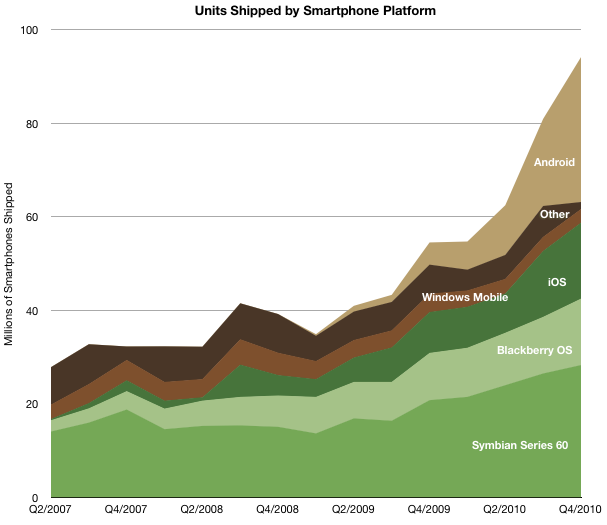
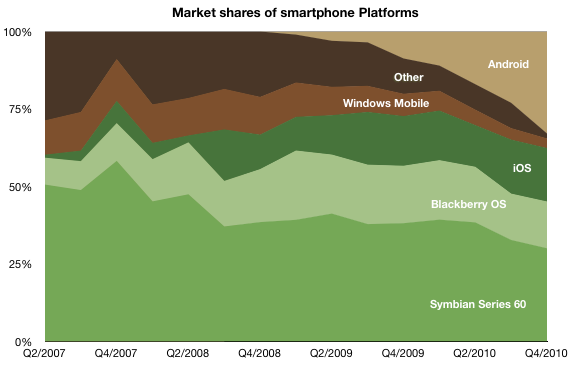
    Picking up the discussion of vendor share, I used Canalys estimates of platform shares to visualize the effect of Android on the smartphone market:

    Not wishing to belabor the point, but Android and iOS are less than 2 years old as platforms. In that time frame these two johnny-come-latelys have taken 50.2% of the most competitive technology market on the planet.

    Here is the share data:

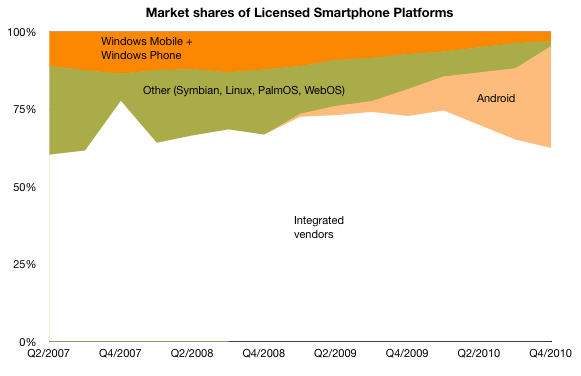
    Since the market is not a zero-sum game, I prefer the first chart, but this second view stresses the transition away from incumbent "others" / Windows Mobile toward Android in the licensed OS market.

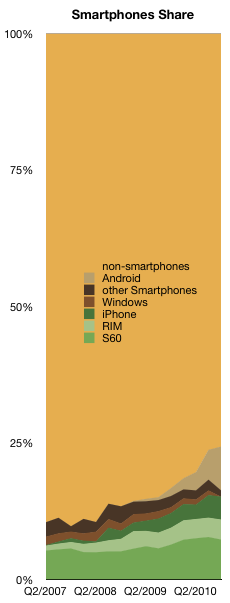
    The final chart shows the competition against smartphone non-consumption. I like this chart best of all as it shows the effect of Android in growing the entire pie for smartphones.

    What would have happened without Android is anyone's guess but my bet is that the market would not have grown as quickly. Apple is producing iPhones at capacity and RIM is growing into new markets. Symbian's strongest markets also do not overlap (much) with Android.

    However, the trend seems to be for consolidation of platforms (fragmentation within platforms notwithstanding). This trend, however, is over a very short time span. The smartphone industry started a decade ago and the time frame shown in these charts is a mere 3.5 years.

    The question remains whether the headroom visible in this chart still allows for new entrants or whether the platforms we see today are the last we'll ever see in mobile computing.

    I'm still willing to bet that there is room for innovation and for new platforms. Just like the two newcomers that came to conquer half the market emerged seven years after its inception, new contenders like Windows Phone, Bada, MeeGo, WebOS can still make an impact.

    The conquerors came with new business models and a focus on computing not telephony. Can factor innovation and the ubiquity of mobile broadband keep this market open to newcomers?

  10. Smartphone users still prefer branded phones

    Research · 23 comments

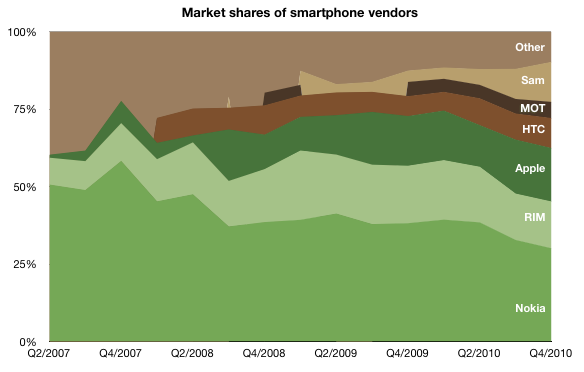
    The smartphone market has grown threefold in the span of three years. However, as noted previously, the share of units running a licensed OS has not grown dramatically. The following chart shows the vendors' shares with the same brown/green dichotomy between licensed and unlicensed OS's.

    In order to gain some insight into this licensed OS area (and who the "others" are) we need some visibility into which OSs are being licensed and what their shares are.

    The following chart shows the share of the various licensed platforms[1]. (I blanked out the Integrated vendors.)

    Before we dive in to understand the effect of Android, we have to understand the licensing of OSs in 2007.

    The chart shows Windows Mobile and "Other" splitting the market. Windows Mobile is rather easy to understand. It was still growing as a platform and Ballmer was famously quoted in 2007 as saying he liked their strategy "a lot".

    But "Other" is something of a mystery. What "Other" actually mostly meant was Symbian[2]. But not only the Symbian that Nokia was shipping and licensing to some vendors. At the time, Symbian also had a version called MOAP "Mobile Oriented Applications Platform" which was in use in Japan (somewhat analogous to the variants of Android now in use in China).

    Fujitsu, Mitsubishi, Sony Ericsson and Sharp developed phones for NTT DoCoMo, using an interface developed specifically for DoCoMo's FOMA "Freedom of Mobile Access" network brand. This UI platform was based on the UI from earlier Fujitsu FOMA models[3]. The user could not install new C++ applications and therefore these were not platform devices, however the industry still included these units as "smartphones" .

    So what we've witnessed in the last two to three years is the replacement of MOAP and Windows Mobile share with Android TAPAS and OMS.[4]

    But, more significantly, when looking at the rise of Samsung and Motorola and HTC we were also witnessing the demise of Palm, Fujitsu, Mitsubishi and Sharp (plus a myriad of Windows Mobile licensees even larger than the Android army).

    The significance here is that "other" in smartphones is still mostly about branded vendors. This is in stark contrast to the low-end of the phone market where “others” are quickly replacing branded vendors.

    So we can conclude that the smartphone market is so far showing a distinct preference for branded vendors. The value of the brand is still evident. But ZTE and Huawei are quickly developing Android competencies. How long will it be before the branded vendors feel the pressure from the upstarts?

    ----

    Notes:

    1. The Other category includes WebOS which was not licensed during this time frame but is not material enough in terms of share.
    2. A few million units running flavors of Linux were also on the market in 2007/2008.
    3. FOMA was also implemented with a Linux OS and the same UI.
    4. It should be noted that except for Windows Mobile, all the licensed mobile OSs including LiMO and Symbian are now open source. Android's success is not therefore due to being the only OS that is "open".
  11. Calling the end of innovation in mobile computers

    Research · 72 comments

    People are lining up to call the market for mobile phones. Analysts and amateurs alike are connecting points on charts and predicting with confidence the future of mobile platforms. Consensus is forming that there is no future but a quiescent state. By the acclamation of pundits, the survivors are declared to be iOS and Android. They are also predictably arranged in a way similar to OS X and Windows. End of story.

    Except for one thing.

    3.5 years ago neither of these platforms existed.  In fact, it was only two and a half years ago, in mid 2008, that one of the finalists even became a platform with the launch of an app store. The other "winner" only launched in a handset later that year and had no significant volumes until a year ago. In other words, these suddenly predictable platforms have been in existence for less than the life span of one device that runs them.

    To point out how extraordinary this claim is, if we look back to the history of computing, could we have declared the PC industry future cut and dried in 1978, two years after the founding of Apple? What about 1983, two years after the emergence of the IBM PC? What about 1986, two years after the Mac? Or maybe 1990, after Windows was born? Maybe the writing was on the wall in 1997, two years after Windows 95 caught up with the Mac's UX. That would be 21 years after Apple's founding. Some would argue that even today the story of desktop or portable computing is far from over.

    Sure, times have changed. Things move much faster now. But markets are also much bigger and take a long time to penetrate. Mobile channels are bounded by provincialism and parochialism.

    What's more, it's not like there haven't been platforms before these two upstarts came along. I've seen 9 mobile platforms in 9 years (PalmOS, Windows Mobile, Symbian, Java, WebOS, Windows Phone, iOS, Android, RIM Blackberry). New platforms are still emerging and evolving (e.g. MeeGo, Bada, LiMo, QNX and Tapas).

    So the existential question is this: If you were to draw a time line, would a mark in early 2011 signify the end of mobile platform history? The point in time when unforeseeable change will cease to happen?

    Let me offer a hint as to why not: every major platform battle has been sparked by an innovation built around a new input method. The keyboard integrated into a personal computer in the 1970s, the mouse in the 1980s, the stylus in the 1990s and the fingertip in the 2000s. Each of these input methods created new platforms (DOS/Apple ][, MacOS/Windows, PalmOS/Windows CE, iOS/Android), new ecosystems, new industries, new competitors and new platform battles designed to enrich forecasting pundits. I won't even try to go back to the changed in the half century of computing prior to the PC.

    So here's my challenge to the prognosticators: If you are willing to draw a line in the calendar now and say that no input methods will ever emerge in mobile computing after this point in time I'll buy the thesis that it's over and we can count our chips.

    If you think that out of the hundreds of user experience patents being filed, and hundreds of prototypes being slaved over in labs throughout the world, not a single new product will emerge with a new way of interacting with a computing device, then it's time to move on to something other than what can be declared a commodity market.

    But if you believe that, as happened four years ago, a new input method, previously only in the realm of mockups and movie magic, suddenly was shown, in a working product, on stage, then this business still has a chance of staying interesting.