In a recent tally of mobile OS market share estimates from Canalys, the market was organized by OS vendors. The number of devices sold by operating system vendor includes as many OS's as each vendor may supply.
For example, Microsoft licensed two different OS's during the period: Windows Mobile 6.5 and Windows Phone 7. Nokia also offered multiple versions of Symbian, which have varying degrees of inter-operability.
Google's offerings include (as per footnote) OMS and Tapas platforms in addition to Android.
Fragmentation is not a new subject as OS licensing models have been ripe with it for as long as they existed.
What I want to draw attention to is the concept of Google as "vendor."
A vendor in the traditional supply chain model is a supplier that sells to an up-stream value-adding stage of the value chain. The word itself has as its root the word "vend" which means to sell.
But we know Google does not sell Android. And it's not just that Google builds a product and ships it for free.
There are no contracts associated with the transaction of downloading the Android source. No contract means no obligations, no warranties, no terms and no conditions. The product is not indemnified against litigation. There are no licenses, no support, no copyrights and no patent license granted.
The contract-less nature of Android makes it easy to distribute. It's one of the key reasons why distribution can grow at 600% a year--there is no distribution in the classic sense. The real disruptive advantage for Android lies in the removal of distribution costs (not just development costs). Google themselves admit that they have no idea who implements the software and how it's used.
Which makes the classification of Google as a "vendor" a misnomer. The notion of 'vending' something implies a contract. What Google does is write code and place it on an FTP server.
It's a wonderful way to save on SG&A (there is no sales, general or administrative expense.) But as everyone knows, there is no such thing as a free lunch.
By avoiding any contractual engagement with the authors of the source code, implementors are subject to independent litigation for IP violations. This is why HTC and Motorola are targets for Apple and not Google. Google is no more liable for writing Android than the author of a book on bomb making is liable for the bombs put into use [1].
Patent violation rests with implementation, not the writing of the idea itself.
Furthermore, Google cannot ensure Android users have any specific experience. They can't encourage upgrades, service models or any form of common UI. The experience, like the protection of property is the responsibility of the implementor.
Can Google change this approach with Android? Not as long as Android is open source. Can Google change Android from being open source? No, they don't own the source to Android. Nobody does.
---
Notes:
If the bomb making book was a copy of another, then the author is liable, which is the case being made by Oracle.
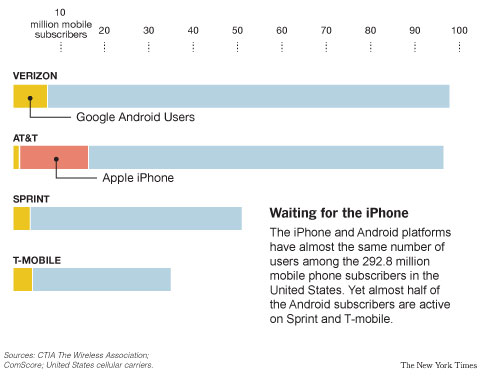
Although the population of Android users is near in size to the population of iPhone users, the concentration in one carrier shows how distribution agreements hamstring platform choice.
The chart also shows how the iPhone had a huge effect on smartphone adoption at AT&T and how it sucked the oxygen out of the segment for competitors.
It is possible that we'll see more Android at AT&T and a lot more iPhone everywhere else, but on balance, the chart shows how exclusivity distorted the market.
It sounded like Tim Cook was really relieved to announce in the earnings conference call that:
We are not under a contractual exclusivity now in any country in the world. The last one was the United States. We have moved away from those.
...
What I've said before and we have seen this in every case, literally, that we've done, is where we've moved from an exclusive carrier arrangement to a dual- or multi-carrier arrangement, our growth has changed significantly and our market share has increased.
Thanks to David Chu for forwarding the data that made this possible and reader Narajanan for spotting the divergence in platform efficiency.
iOS and Android are both growing rapidly. According to Gartner, during the first three quarters of 2010, about 44 million iOS devices and 36 million Android devices were put into use. That's 80 million devices. An amazing achievement for two platforms that did not exist 3 years earlier.
But obviously not all devices are used the same way. Devices which have unused capabilities limit network effects for a platform and for the category of product in general. Question is: how can we measure the "smartness" of a device; how much more likely is a device to be used as a mobile computer vs. being a regular phone?
The best proxy I can think of is a measurement of browsing use. The smarter the device, the more browsing is a joy and the more it is actually done. Browsing leads to more data load on the network and creates a virtuous circle of revenues for the mobile computing value chain.
If we could measure the increase in browsing generated by each additional phone, we could compare whether one platform is better (specifically, more efficient) at generating value asymmetric to voice.
Fortunately we have data from Netmarketshare.com (see sources below) which attempts to track browser consumption and hence allows us to measure this variable. What we need to pair that with is the incremental increase in the installed base of devices.
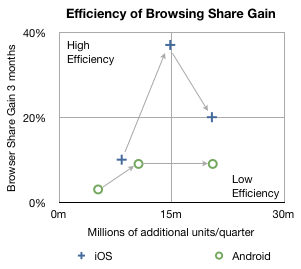
In the chart below I plotted how much browsing share increased for every phone sold by platform over the first three quarters of 2010.
The arrows indicate the sequence in time from Q1 to Q3. The vertical axis shows gain in share three months after the corresponding number of units shipped in the previous quarter on the horizontal axis. So, for example, the second circle means that in the second quarter approximately 10 million new Android devices created a gain of about 9% in browsing share. In the same quarter, 14.8 million iOS devices created about 37% gain in browsing share.
In the third quarter approximately the same number of iOS and Android devices shipped (iOS including iPads and iPod touch) but the browser gain was 20% for iOS vs. 9% for Android.
A line drawn diagonally from lower left to upper right (0,0 to 30m,40%) could represent the average gain in share per units sold--the sort of measure we're looking for.
Measuring that slope tells us that, on average, every million devices sold should generate a gain of 0.75% share[1]. I took the additional step of labeling two quadrants which are orthogonal to the expected trend. If browsing increases dramatically faster than 0.75%/million units then I call those devices sold as creating "highly efficient" browsing gain. If browsing increase lags dramatically below 0.75%/million units then those devices added share with "low efficiency".
So four data points follow the trendline down the middle of the chart, however, there are two notable outliers. Finding the causes for these outliers gives clues to what's happening with the platforms.
I believe the explanation for iOS's second quarter's extraordinary efficiency is that was the quarter when the iPad launched. It seems to have yielded a very strong spike and the trajectory of iOS improved even into the next quarter as those iPads continued to be in use. iPad seems to be a very effective way to gain browser share.
I also believe that the cause for Android's fall in efficiency in the third quarter was that it began to be sold in large quantities in the developing world. The third quarter saw a rapid acceleration of sales without a proportional increase in what was measured as sales in the US (and Europe).
Interpretation
If this trend continues, and there is no guarantee that it will, then a question could be raised about Android's value to, of all people, Google.
The core value of Android to Google is the increased use of browsing and hence search. All the other Google services and in-app ads are tiny opportunities in comparison to the potential of search on mobiles. One could argue that the raison d'être for Android since day one was to create browsing consumption. In that regard it's not as good at doing that as iOS is.
Perhaps Google can justify the under-performance of consumption of browsing (and hence search) on Android devices as benign since there is no marginal cost added to supplying Android to non-consuming devices.
But I wonder. There is the problem of opportunity cost: Those iOS devices that create more browsing activity are going to take more share. The more they do that the more Google will have to pay Apple for placement as the default search in mobile Safari.
It may be a stretch, and perhaps the data is wrong, but that's what this exercise is all about: how much can we learn from fragmentary data? Without a hypothesis there is no discovery.
-----
Notes:
Since these platforms have very low shares (less than 2% for iOS and 0.3% for Android by November) almost all the gains can be assumed to be against other browsers (e.g. Internet Explorer) and not against each other.
Update: the original Unit estimates excluded iPad and iPod touch which have since been added.
According to GfK data in Denmark, during the first quarter of 2010 29% of phones sold were smartphones. In the second quarter, the share grew to 37%. In the third quarter, 51% of units and 71% of sales value was captured by smartphones.
Looking at September alone, Apple's share of the smartphone market was 34%. In terms of value share, 51% of all the dollars that consumers spent for smartphones, was spent on the iPhone.
In other words, in September in Denmark, iPhone captured 34%*51% = 17% of all units and 51%*71% = 36% of all mobile phone sales.
Rob adds:
iPhone 4 is now available on all (4) major networks in Denmark. iPhone 4 has not been advertised very heavily, whilst Android has received a lot of advertising. My experience travelling on public transport in Greater Copenhagen is that iPhone is everywhere, whilst Android and Blackberry is less prevalent.
To get a sense of how that compares with the global average, in the third quarter Apple's unit share was only 4.1% while sales share comes to about 17%. Seems like there is plenty of room for growth.
While Denmark is a small country (population: about 5.5 million) and it's not likely to reflect global patterns, it has been rated the happiest place on Earth.
In a recent but recurring lament I asked why Apple shareholders are not being rewarded for the company's growth. I pointed out that there is no fundamental reason why the company should receive such a low P/E multiple (about 18 ex-cash trailing and 10x forward while maintaining 70% earnings growth for over a year).
There were many objections in the comments. Most of them dealt with recent reasons why doubts might have arisen among investors: Android hegemony or some perceived lack of competitiveness leading to margin compression or some macro hangover from the recession.
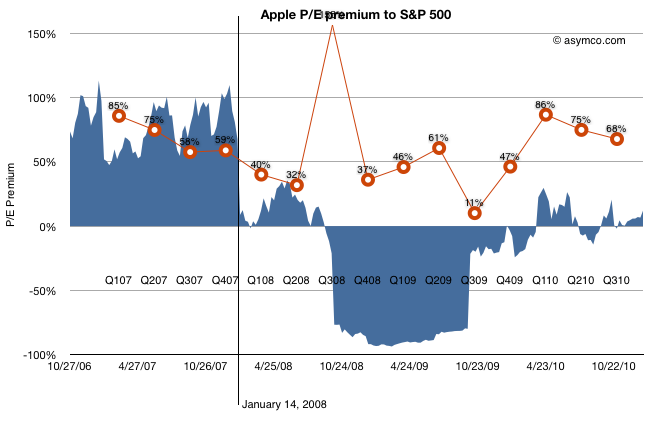
In this article I argue that none of these objections hold water. My argument hinges on the fact that there is a precise date when Apple ceased being seen as an exceptionally valuable company and that date precedes any of the causes being suggested.
The day of disillusionment was almost exactly three years ago: January 14th, 2008.
How to pin down the date of disillusionment
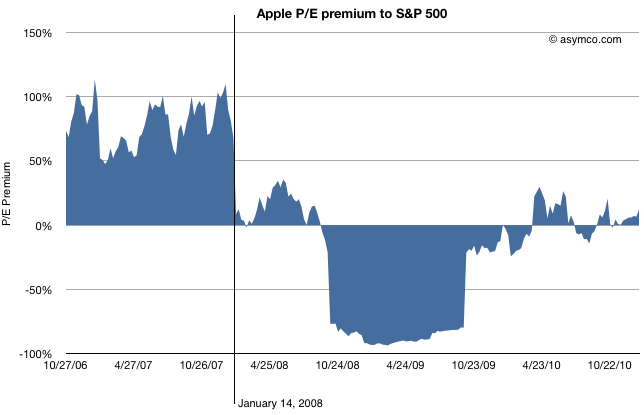
Consider the following chart.
The blue area represents either a premium (above 0) or a deficit (below 0) of Apple's P/E (ex-cash) relative to the S&P 500 P/E. This is a re-imaging of a chart, first introduced in June 2010 when I first pointed out that Apple was being discounted relative to the S&P 500.
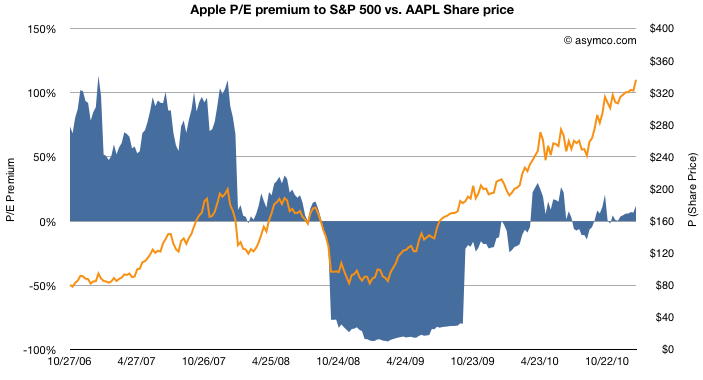
By measuring P/E I am focusing not on the stock price, which has grown nicely, but the ratio of the price relative to earnings, which hasn't (see the next chart below). P/E is a fundamental measure of potential (its reciprocal is the stock's earnings yield.) It is usually highly correlated to the company's growth. If that P/E is uncorrelated to past growth, there is some significant discounting of future growth. It's the most significant (and simplest) measure of "faith" in a company.
By measuring the company's P/E relative to an index of other large companies (S&P 500 P/E) we can assess whether the company's potential is being valued as extraordinary or whether it's being valued as ordinary. In other words we are measuring whether a company is "special".
The chart shows that until January 14th, 2008 the company was valued at a significant earnings premium--a P/E consistently 50% higher than the norm.[1]
Following the collapse (about 40% drop in share price but 100% drop in P/E premium), there was a small recovery followed by a huge trough in valuation. During the recession quarters Q308 to Q309 S&P earnings fell to zero or below. As a result of S&P earnings collapse the S&P P/E shot up astronomically (as E approaches zero, P/E approaches infinity). Apple's earnings dropped as well but remained positive throughout that period bottoming at 37% growth(!) in Q408. As a consequence Apple's P/E fell as low as 11 while the market's went well above 100 (122.41 peak). The P/E deficit for Apple went 80%: Apple was valued as basically worthless (3x cash).
After the earnings recession, the S&P P/E recovered close to historic levels but Apple's P/E did not. It's in-line with the S&P but does not obtain the 50% premium preceding the recession.
So we can establish that the day that Apple's potential was discounted was nearly six months before the onset of recession.
What other discounting factors can we discard?
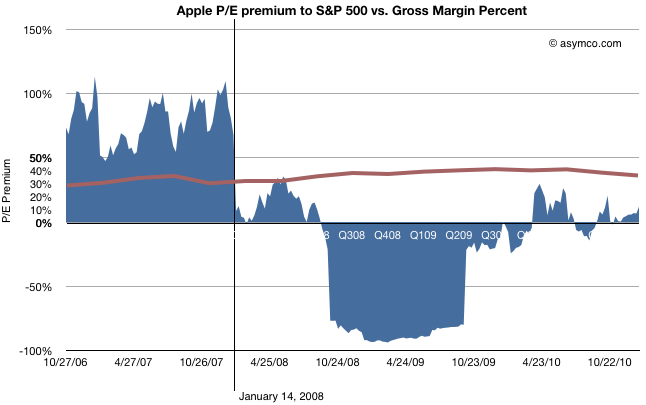
How about earnings growth itself? Did the collapse foretell an earnings collapse?
The chart above shows the P/E premium vs. earnings growth (in red). Although earnings growth began to slow soon after the 14th (earnings for CQ407 were not yet announced at that point), growth recovered six months later after the launch of the iPhone 3G[2]. Growth continued throughout 2009 and 2010 reaching new heights last year of 86%.
Still, the company received no premium to the S&P 500 P/E. Companies in the index averaged, at best, a quarter of Apple's growth in earnings.
What about Android? The first Android device did not ship until October 2008 (HTC Dream or T-Mobile G1). There were no appreciable Android volumes until 2009, one year after the drop in relative value and no talk of a threat until 18 months later.
The last objection to be put aside is that of margin compression.
This last chart shows how margins (in brown) behaved during the same time period. They went up. The only slight decline took place during the last few quarters, after the launch of the iPad, long after the collapse.
Regardless of the adjustments with product launches, Apple's GM is the envy of the world and is not at all correlated with the loss of faith in the company.
So What happened on January 14, 2008?
Having led you this far in the story, I'm afraid I'm going to let you down at the end: The cause for the loss of faith is a mystery to me.
There is only one noteworthy event that took place on that date: Macworld 2008 (January 14-18). During the keynote, Steve Jobs introduced the Macbook Air (and Time Capsule and Leopard and pre-announced the iPhone SDK which, six months later led to the app supernova). I remember that day and I remember that the stock began selling off exactly at the point when the Air was mentioned. It has never been the same since.
Obviously, correlation is not causation. The Macbook Air need not be the cause for the loss of faith in Apple as an investment. Or can it? I'm hoping someone can explain this because to me it makes no sense. The product was not a home run but it did not do badly either and its current incarnation seems to be a hit. Whatever sins the original Air may have had have surely been expurgated by now.
Regardless the cause, the bottom line is that, in the eyes of investors, Apple stopped being "special" that day. Its valuation dropped to in-line the S&P and, given its growth, well below what a large growth company should be worth. The company's shares went into the bargain bin and are still there today.
---
[1] I should point out that the P/E ratio is based on post 2009 re-stated earnings. The restatement changed the P/E as the "E" changed. This was based on the abolition of subscription accounting for the iPhone. Although it may seem unfair to hold the market to this standard, restatement did not actually change cash flows which were transparent and visible to all, even to amateurs such as myself and the other unaffiliated analysts that published throughout this period. Earnings may be an opinion but cash flow is a fact. Valuation on the basis of cash flow should have yielded the same results as shown above.
[2] That quarter showed a y/y growth of 150% while the stock was in freefall. In fact, it was during that earnings day that Steve Jobs came on the conference call and pointed out the astronomic iPhone cash flow to an audience of analysts more concerned about their own jobs.
Given new information on subscriber growth and the relationship between Verizon and Apple, it's time to look back and assess how the conclusions are standing up.
The conclusions I drew were that Verizon had three strikes against them:
The iPhone has stolen their growth
They are facing the prospect of a single OS platform supplier
Android is not competitive vs. iOS
Did iPhone really hurt Verizon?
I pointed out that based on retail sampling data from ITG and what we know from AT&T own sales data, that iPhone at AT&T was outselling Android at Verizon by a ratio of 2.5 to 1.
The latest comScore data closely matches the assumed units of Android shipped by Verizon. Here's why: The comScore data shows the number of active users of each platform. So, for example, as the number of Android users at Verizon grew, it follows that the new users had to buy new Android phones. However, you can also sell more phones than just those for new users. Some phones are going to go to replace those of existing users.
When it comes to Android however, all the Verizon Android devices are pretty new, having been purchased less than a year ago. Replacements would only be sold for damaged or lost devices not covered by warranty.
So from comScore the change in subs at Verizon comes out to about 2.2 million and my original estimate was about 2 million. That's pretty close.
On the other hand, if you look at the chart, you'll notice that the number of iPhone users at AT&T grew by a similar amount (about 2 million). However, AT&T activated over 5 million. That means that about 3 million devices were upgrades. This makes a lot of sense since we know that iPhone is the bulk of AT&T smartphone users.
This is highly supportive evidence that iPhone at AT&T did indeed outsell Verizon Android by at least a factor of 2. Each of those phones came with a 2 year lock-in so indeed AT&T did manage to "steal" growth from Verizon.
Another data point in support of this conclusion was provided by Turley Muller in a comment. AT&T smartphones make up a significantly higher proportion of contract subs at 44% vs Verizon at 23%. Effectively, as a result of their sweetheart deal with Apple, AT&T got double the penetration of smartphones than Verizon since these devices are targeted only to contract subscribers. Those are high ARPU customers that either moved from regular voice plans or switched from other carriers.
So far, the first conclusion seems to be holding up pretty well.
Was Android a strategic constraint to Verizon?
Verizon revealed that they had been negotiating with Apple at least since 2008 and that they were testing the phone for a year. This is not as big a surprise as it may seem. Deals of this kind easily gestate for years. The commitment may not be made until the last minute.
Nevertheless, my point was about the fact that Android was making up to 75% of Verizon's smartphone volume in Q3. This might be a strategic constraint. But "so what?" you may say: AT&T's dependance on iPhone was even greater.
That's precisely my point though. As we've seen with the shift by Apple to multi-carrier distribution, AT&T is now facing serious constraints on growth and the share price is suffering. Although Verizon did not deal with Google as a direct supplier, they were at risk of having much of the IP on their network at least orchestrated by a company that was not always aligned with their strategic goals. Much the same predicament AT&T is facing now.
The tale of AT&T and iPhone does lend support to the premise that Verizon felt a bit too constrained by Android hegemony on its network.
Is Android Competitive with iOS?
This last point was supported by the data showing a widening higher sell-through rate for iOS vs. Android on comparable addressable markets. Although the data has been confirmed with survey data, there are issues with this interpretation. First, because the addressable base for iPhone is higher at AT&T with the post-paid contracts being more popular there, iPhone had an easier time getting sold. Second, because 3/5 of the phones were upgrades.
The jury is still out but the apparent pent-up demand (admittedly anecdotal) for iPhone on Verizon does seem to show that given similar pricing, and a similar demographic/geographic addressable market, people do prefer the iPhone.
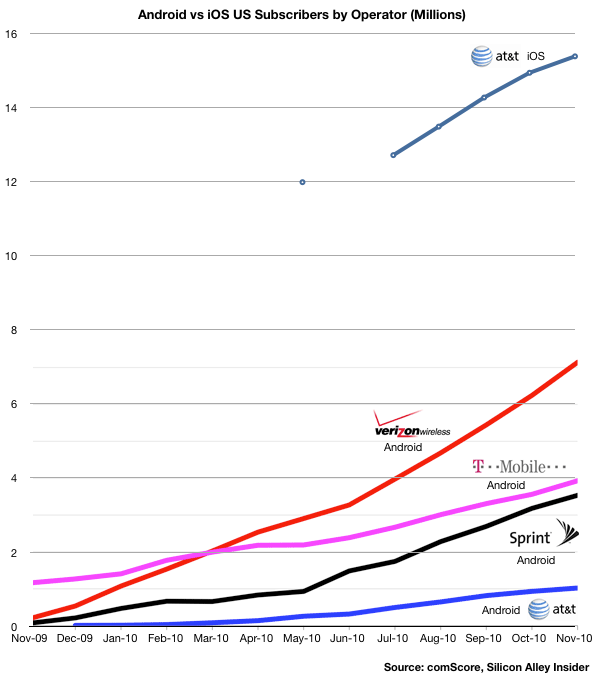
The following chart uses comScore data to show the relative consumption of Android vs. iOS by the subscribers of the four major US operators. I modified an original chart published by Silicon Alley Insider.
A few observations:
As of November, the ratio of iOS to Android users was more than 15 to 1 at AT&T.
iOS at AT&T has twice the users as Android at Verizon
Although T-Mobile had the Android franchise to itself for all of 2009, it was overtaken by Verizon within four months
T-Mobile Android consumption has also been nearly matched by Sprint within a year
The rapid eclipse of T-Mobile smartphone penetration makes one wonder how effective Android is as a differentiator for carrier and device vendor alike. It also explains their new pricing model.
The data also gives clues to how iOS at Verizon will grow.
Since Verizon and AT&T have nearly the same number of subscribers, excluding RIM ,which is common to both, AT&T has a far larger penetration of smartphones (16.5 million vs. 7 million.) Is the cause iOS itself or the delay with the timing of Android launch at Verizon?
Other data from comScore shows that much of the gains for Android at Verizon have been at the cost of RIM, so Android has not been entirely additive. Will there be a similar platform switching going on or will iOS be additive to the Android base?
On one hand, the potential exists for a similar number of touch smartphone users at Verizon as at AT&T (15 million as of November). On the other, Verizon is "half-penetrated" with Android. How many will switch (as they did with RIM) and how many will be new users?
I'm not going to make any predictions yet but I would not be surprised if Android at Verizon will flatline if not drop while iOS at Verizon will jump quickly to make the sum of both equal to AT&T iOS in about twelve months. That would imply about 10 million new Verizon iOS users by 2012.
If Verizon users start to switch from Android to iOS, iOS could add as much as 15 million users. It seems that 10 to 13 is a reasonable estimate.
Motorola—like HTC—is thus a bellwether for makers of Android phones, whose sales have now caught up with those of the iPhone—about 300,000 a day worldwide. Some industry analysts doubt that it will be able to create a big market for its devices and make enough profits before cheaper providers move in. If they are right, the smartphone market may eventually become like that for personal computers: a handful of huge competitors with tiny margins. The difference will be that these firms will hail from around the world rather than being mainly American.
When I argued that the meek shall inherit Android, the profitability data was the core evidence. That argument, made in August, was:
So here we have the real challenge to Android: partnership with defeated incumbents whose ability to build profitable and differentiated products is hamstrung by the licensing model and whose incentives to move up the steep trajectory of necessary improvements are limited.
In other words, Android’s licensees won’t have the profits or the motivation to spend on R&D so as to make exceptionally competitive products at a time when being competitive is what matters most.
The surge in emerging market Android entrants has been the latest setback for branded Android vendors. What should be the long term strategy for companies like Motorola and Samsung?
Paradoxically, Motorola, being the weaker, has the best chance for successful recovery. The clue lies in both what Palm (now HP) and Microsoft did: starting with a clean sheet of paper and building their own platforms.
This might seem futile given the network effects that current platforms are gaining, and there is a big execution risk, but the alternative is no alternative at all. The big incumbents cannot fight against the clone makers.
Technically, building a new platform is not as daunting a challenge as it used to be. Palm, a small company, managed to do it in about 2 years. Microsoft, a large company, took 18 months. Google built theirs in about 2 years.
They all took advantage of existing code bases (Linux or Windows CE). They also rely on web standards for their APIs (.NET or Java or HTML5).
The challenge is bigger in attracting developers, though again, some core set of apps and developers can be obtained on the promise of brand power alone. Intel and Nokia is using this power for MeeGo.
Motorola's advantage today is its new autonomy and singular focus on mobility. It has hit the reset button. There is no better time to be courageous and there are no sunk costs to confuse investment priorities. Android was a necessary stop-gap measure and the Droid timing was very good (before the clones and before iPhone distribution expanded). However, now would be a good time to start building a Motorola platform for the future.
There is an assumption floating around the debates in this and other forums that the "battle" between mobile platforms is a land grab. The unspoken implication of this assumption is that once a user is captured she is permanently locked into the chosen platform never to move to another again as long as she lives.
many people's first smart phone will be android. android can take them "cradle to grave." android will be there with a higher end solutions when they can afford it
This is a strong but untested claim. It may be true but we owe it a bit of thought.
A long time ago I tried to model platform growth is by using a version of Metcalfe's law. I suggested that the value of a network is proportional to n log (n) where n is number of nodes in that network[1]. This was somewhat based on common sense as it measures the possible links between n nodes with degradation due to the limits of social graphs.
The value the network creates is what developers as well as all the other participants in the ecosystem are able to tap into. The platform vendor gets to capture a share as well of course. As the value grows it tends to create network effects or a self-reinforcing cycle.
What I'm saying then is that we can treat a platform as a network, where each node is linked to another node by the commonality of experience.
The proxy of the model was Windows. Twenty years ago, having Windows meant that you could exchange files with other Windows users simulating a sort of network protocol. You could also ask your peer group for help and get software tips and new consumption ideas. So the more people used Windows the more likely it was that you also had to use it. Avoiding Windows limited your ability to be part of productive society (this is no longer true by the way, which is one reason Microsoft is in trouble).
If we fast forward to the mobile post-PC world, when it comes to platforms the shared experience is that of apps. People can communicate their app experiences and their usage better if they have the same platform. They can also learn from each other how to better use the products and how to solve problems. The more people that use a mobile platform, them more value it generates for platform participants.
The other factor determining value is that a platform also creates sunk costs. Usually called "investments" by users these are costs that are incurred and have a potential for future value. This means that the apps purchased and time spent learning and adjusting to the platform are sunk costs which users are reluctant to abandon. (Notwithstanding the fact that as sunk, these costs should be ignored when comparing the value of another platform,--psychology is what keeps users loyal even if it's not in their best interest.) This "sunk" factor of value is not as powerful as the sharing of experiences value since it does not scale with the number of users. That cost is a constant multiplier on top of the n log (n).
So the overall "value" of a platform is K n log(n). Where K is the stickiness of sunk costs.
Can this be stated plainly without the math?
When you compare two platforms you have to ask how contiguous users (n) grows and how stickiness (K) grows. The issue with fragmentation is that it actually cuts n. Many people won't be able to share experiences if their devices don't work the same way. Same with geographic density of a platform. If, as was the case with Symbian, there are few segments that became saturated with the platform then n is reduced.
The issue with a lack of paid or compelling apps is that it cuts stickiness, so that you don't have any sunk costs. Similarly the presence of ported or common apps means that K is reduced for any single platform. Nokia's Symbian has a serious problem with both consistency and with commonality of experience. RIMM depends too much on the commonality of messaging which is quickly becoming a commodity due to portability of the experience.
So in the end it's not just about how big the user base n is (which is the only thing that is measurable). It's how contiguous n is and how compelling the content.
This is too sketchy a model to be practically applied but it offers a thought experiment: does any given platform have
A large, contiguous user base with strong concentrations of users in the same demographic or psychographic segments?
A significant set of unique content (apps) which require costs from the user (in terms of data, time or cash)
It's not a clear cut case in my mind that Android benefits from these as much as iOS does. If that's the case, users are more likely to be moving on a one-way street between these two: from Android to iOS and not vice versa. The same thought experiment can be engaged in between any two platform contenders.
---
[1] Metcalfe's law is actually an n*n growth curve but recent research indicates that social networks scale in value as n log (n).
[Samsung] said it has sold around 4 million Galaxy S smartphones in North America, 2.5 million in Europe, and around 2 million in South Korea in the past seven months.
Samsung's US Android sales are very similarly allocated to Apple's iPhone sales: 40%. But at 20%, South Korea represents a very large portion of their sales (2 million phones sold in 7 months into a country of 48 million). This is understandable given Samsung's distribution power in its home country. However it also implies that Samsung's [high end] Android sales in Asia excluding South Korea are tiny. Only 1.5 million were allocated to outside Europe, US and South Korea--a market that includes the whole of Asia, Africa, Middle East and Latin America.
If we believe that Android is activated at the rate of 300k units per day, then Samsung represents around 40k of that. (10 million over seven months, linear extrapolation.) So where are those remaining 260k units/day going? Gartner calculated that in Q3 Samsung was the leading Android brand (about one third of all units). The Samsung figures make these share numbers very obsolete because 40k/300k is only 13.3%.
It's hard to pin down the market because the share shifts are dramatic and the market's growth is not linear. Nevertheless, intuition and guesswork leads to me believe that Android activations are to a large degree (perhaps two thirds) in Asia. This in turn implies that Samsung is not a major participant in that market.
Since neither LG (who does not have a strong Android portfolio) nor Sony Ericsson or Motorola which have low volumes, (nor obviously Nokia, RIM or Apple) are supplying the Asian Android market, the question is who is? Only HTC remains a contender but it's not big enough to account for the difference and they too are focused on the established Western markets (except for a modest presence in China).
We are left again with circumstantial evidence that "Other" lower tier vendors are carrying the Android torch in Asia. Pdadb.net shows 277 Android models available. Brands like ZTE, Huawei, Acer, Notion Ink, Linx, TMN, FirsOne, Ziss, Kogan, Highscreen, Saygus, Haier and Forsa are selling Android devices (though not all in Asia).
Not that there's anything wrong with that
If there is a worry it is perhaps that Samsung might find it hard to maintain the top spot in supplying Android once the unbranded vendors make it through the distribution obstacle course (as HTC did when it reached 80% of the Windows Mobile share.)
If one is to argue that Android empowers the desperate incumbents, then one has to also agree that it also empowers the more nimble entrants--inevitably leading to even more desperation.
[Updated: thanks to reader @UVStaska who noticed on glaring error in the analysis. I had failed to see the "S" in the original quote and been assuming the 10 million figure represented all Samsung Android sales. The Galaxy brand is the Android brand but the "S" model is only one product within the line-up. Samsung Android sales are likely much higher than the 1.5 million I assumed.
Back to the drawing board with the question of Samsung's strength in Asia. One does still wonder how well they are doing relative to entrants.]
Since I spend most of my time thinking about what will happen, at the end of each year, rather than looking forward I like to look back to see how wrong I've been. The great thing about being wrong is that you learn something. Especially if you use a foundational theory to tie concepts together. Theory building is all about finding anomalies that adjust and improve it.
Fortunately, exactly one year ago, on December 30 2009 I wrote an article asking if Android was disruptive. It turned out to be the right question to ask for 2010.
What have I learned since?
My main argument in late 2009 was aimed at the reaction of the recently launched Nexus One. A product hailed as disruptive to mobile operators. I did not see it that way. In that respect I was right. The distribution juggernaut any phone platform faces stopped the Nexus One dead in its tracks.
I wrote:
Here’s the problem: since mobile broadband is by all accounts not good enough, it cannot be disrupted. Operators are very critical in building out this new mobile computing future and they are investing and will reap rewards. Bitpipe models will only emerge after 4G when there will be ubiquitous high speed networks and competition will shift away from coverage and more to price and convenience of plans.
What is happening instead of operator disruption is that mobile voice which is more than good enough is being disrupted. Businesses built around mobile voice (e.g. handset vendors who have not developed a viable business model around data) will simply evaporate and their profits will condense around entrants who have mobile computing platforms.
So the operators are as strong as ever. But the Android platform lived to fight on, regardless of the Nexus one. And it grew in ways I did not anticipate. I had expected integrated players to maintain a large share because they would be able to improve the product more rapidly than modular vendors (and assuming that the product needed improving).
Google is moving on this opportunity but they are not executing in a way that ensures they control the future platform due to the their being on the wrong side of the modular/integrated dichotomy.
So Android grew but it's not yet creating profits. It is perhaps laying the foundation for future profits and defending existing profits for Google but it is not yet a big profit center[1]. That is a cause for worry. Disruptors need to be hungry for profits and patient for growth.
I concluded:
Android will disrupt but I expect it will take 10 to 15 years. The life cycle of a new global network generation rollout is about 10 years. We’re in the middle stage of the 3G cycle that traces its beginnings to early this decade. 4G will take another 10 years.
Given what's happened this year does this forecast still hold?
Mainly yes. I stand by the notion that operators will be in the driver's seat for a few years to come. However Android has grown in an unexpected way: adoption by unbranded or relatively unknown vendors selling in emerging markets.
The Grey (market) Elephant in the room
Until 2010, it was very difficult to sell a phone without a recognizable brand. This is because brands helped overcome purchase anxiety for those buying a device for the first time. Brands mean trust and the lack of brand meant risk. Those who cannot afford to make purchase mistakes are more likely to lean on brands than the affluent.
But 2010 has seen a shift away from device brand value and more toward platform and function value. This shift was largely unforeseen and is very disruptive.
All those vendors are likely to adopt Android and in doing so will explode the low end of the market. They may even crush the branded voice-oriented market.
This growth can be slowed by operators but market forces will be very strong. These devices sell in grey markets and are often unlicensed, unbranded, untaxed and unregulated (and may even be illegal due to the absence of IMEI numbers).
So this is the real wild card for 2011: unbranded devices running Android could be the PC clones of the post-PC era. Will this phenomenon last or will the brands fight back? If they fight, the only weapon they could wield is innovation.
---
[1] Mobile efforts at Google are generating over $1 billion in revenues per quarter however these efforts include various other assets including AdMob which was acquired for $750 million. Furthermore, the headcount for Android and these other efforts is not small. I've heard as many as 3000 people are devoted to Google's mobile efforts.