Asymco

Asymmetric Intelligence

Apple Intelligence

  1. Apple confirms not using Google models, apps or search in Apple Intelligence
    Nota Bene · 5 comments

    One Foundation Model runs on Nvidia GPUs hosted in Google’s cloud and some Google proprietary model data used to refine Apple's Models.

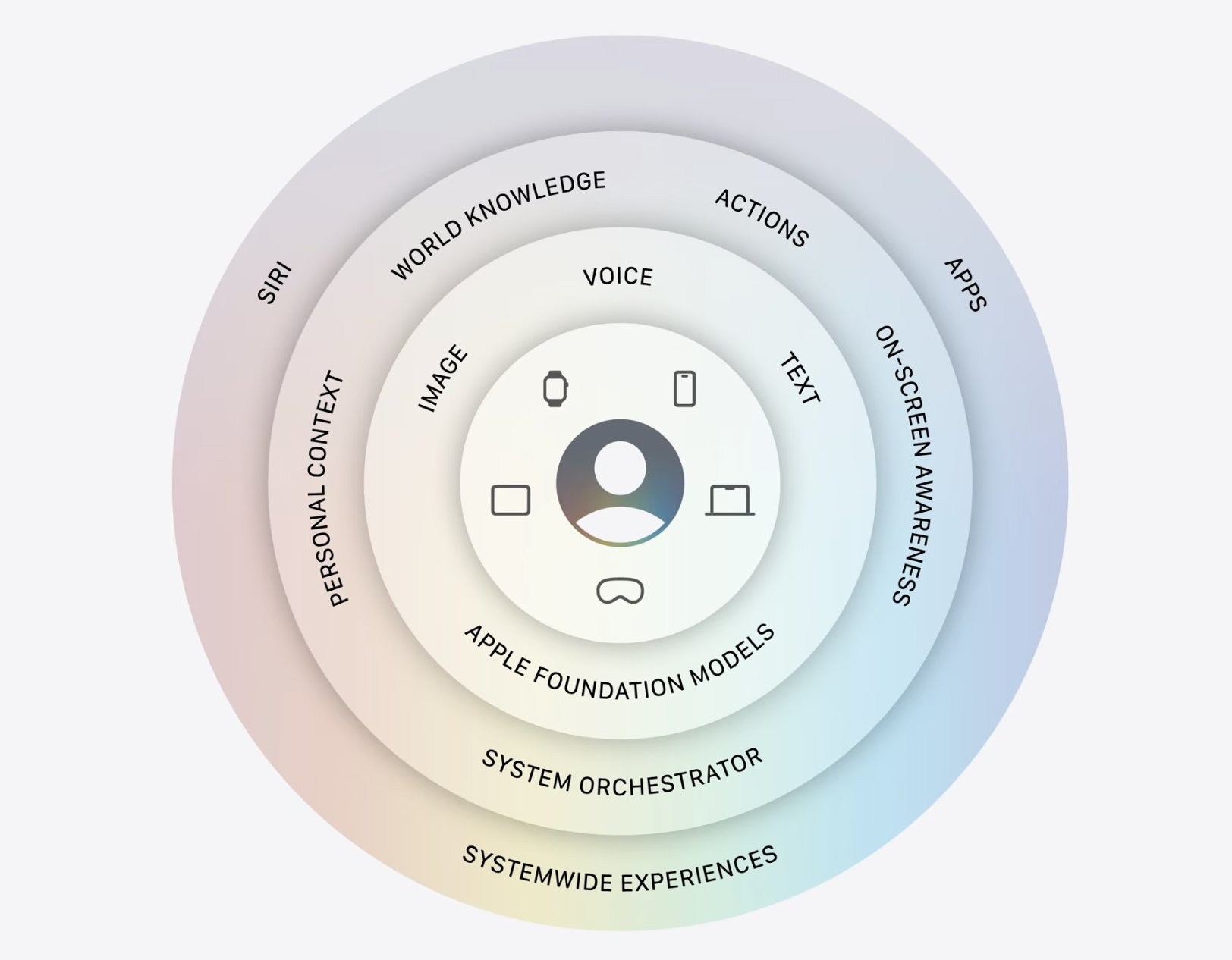
    Apple has shared new details about the technology behind its latest Apple Intelligence platform, explaining how its new Apple Foundation Models (AFM) work and clarifying the company's relationship with Google. During a post-WWDC technical discussion, Apple executives said the company does not use Google’s Gemini models, Google Search, or Google Assistant infrastructure to power Siri or Apple Intelligence

    Craig Federighi, Apple’s Senior Vice President of Software Engineering:

    “Of course, we don’t have the Gemini app as our app. In fact, none of that client code is part of how we run on iOS. For these models, we use none of the models that Google deploy to their customers, nor do we use the infrastructure and means by which they deploy models to their customers. And then, when it comes to the knowledge base, we of course don’t use Google Search or anything like that as the foundation of our system. So I hope that’s clear. The amount of the Google Assistant we use is none.”

    Source: The Mac Observer

    NB: Apple introduced five foundation models.

    • AFM Core (used for expressive voices and invitation capabilities on device)
    • AFM Core Advanced (on device)
    • AFM Cloud
    • AFM Cloud Image image generation and editing tools, including spatial reframing
    • AFM Cloud Pro complex reasoning and agentic actions; Nvidia GPUs hosted in Google’s cloud

    These models are custom-built for Apple Silicon, trained using proprietary data, and refined using outputs from Gemini frontier models. The company emphasized that there is no direct use of Gemini itself.


  2. Morgan Stanley reiterates $330 price target with bull-case $440

    Nota Bene · 3 comments

    AI or bust

    Morgan Stanley analyst Erik Woodring believes Apple’s upcoming Worldwide Developers Conference could begin to change that perception. The 5-star analyst reiterated his Overweight rating and $330 price target, arguing that a successful AI strategy could unlock a higher valuation for Apple stock, with a bull-case scenario reaching as high as $440 per share.

    He noted that Apple’s recent strength has been driven by its products and services business rather than AI. However, companies viewed as “AI winners” have often earned higher valuations over the past two years, and Woodring believes Apple could soon be seen as one of them.

    Why WWDC Could Be a Turning Point for Apple

    Woodring believes Apple now has more of the tools needed to compete in AI. He pointed to Google’s Gemini models supporting Apple Foundation Models, Apple’s strong focus on privacy, and what appears to be a renewed push around Siri and Apple Intelligence.
    Unlike many of its rivals, Apple is not spending heavily on building AI infrastructure. Instead, the company can use its massive base of iPhone, iPad, and Mac users to bring new AI features to consumers. That approach could help Apple grow its AI offerings without the huge costs faced by some competitors.

    The analyst also sees an opportunity for Apple to help ease some of the industry’s AI capacity constraints. A more capable Siri and improved Apple Intelligence platform could bring AI tools to millions of users through Apple’s existing ecosystem.

    For investors, the bigger story may be valuation. Woodring believes that if WWDC shows a clear path for Apple’s AI plans, the stock could earn a higher multiple. In that scenario, he sees shares reaching $365 to $385, with a bull-case valuation of as much as $440.

    Source: TipRanks Financial

    NB: Not much new here but a $330 target is not much above the $315 high recently reached. Perhaps this is his foreshadowing of upgrades post WWDC…

  3. Morgan Stanley has a stark message for investors in Apple

    Nota Bene · 1 comment

    Run for the hills

    Morgan Stanley just published survey data that makes a strong case for owning Apple stock. The firm's AlphaWise Global Smartphone Survey was released March 22. It shows iPhone upgrade intentions hitting an all-time survey high.

    The data support the bank's above-consensus iPhone forecast. Morgan Stanley keeps its overweight rating and $315 price target unchanged. The stock closed at $247.99 on March 20. That target implies roughly 27% upside from that level.

    The headline number is a blended global iPhone upgrade rate of 37%, up 2 percentage points year over year. That is the highest reading in the survey's history. The driver is China, where upgrade intentions surged 9 points year over year to reach their own all-time high in the survey.

    On the switching side, Apple's net switching rate improved to 11%. That is a five-year high. Apple was the only major smartphone brand in the survey with a positive and improving net switching rate.

    Samsung, Xiaomi, Huawei, and others were all negative. That positions Apple to gain market share in 2026 even as the overall smartphone market faces pressure.

    Together, these data points support Morgan Stanley's FY26 iPhone shipment forecast of approximately 260 million units, which sits 3% above Street consensus.

    The most surprising result in the survey may be the level of interest in a foldable iPhone. Morgan Stanley found that 27% of global iPhone owners are “extremely interested” in paying for one. In China, that figure rises to nearly 40%.

    Morgan Stanley expects Apple to more than double the global foldable smartphone market within 18 months of launch. The base case puts foldable iPhone revenue at approximately $40 billion. The bull case reaches $60 billion.

    The foldable iPhone is expected to launch in fall 2026 alongside the iPhone 18 Pro lineup. If the survey data translates to actual purchases, the FY27 revenue impact would be significant. Morgan Stanley's FY27 iPhone revenue estimate is already 14% above Street consensus. The foldable is a big reason why.

    Apple Intelligence ranked seventh globally as a reason to upgrade to an iPhone.

    Willingness to pay for Apple Intelligence fell. Respondents said they would pay approximately $8 per month for an unlimited subscription, down from roughly $9 per month in the prior year's survey.

    Morgan Stanley flagged this as a risk worth watching. AI features remain important to smartphone buyers broadly. But Apple appears to be lagging Android competitors in consumer perception of its AI capabilities.

    Morgan Stanley laid out the key variables investors should watch this year:

    iPhone upgrade cycle. Record upgrade intentions suggest the aged iPhone installed base is beginning to refresh. Replacement cycles are expected to contract by 0.2 years in 2026, which supports shipment volumes.

    Foldable launch execution. The survey demand signal is encouraging, but first-generation foldable adoption is inherently uncertain. The revenue upside is large if execution is strong.

    Memory cost impact. Unprecedented memory price inflation is expected to push global smartphone prices higher. Morgan Stanley sees this as a bigger headwind for Android competitors than for Apple, given Apple's pricing power. But the June quarter gross margin guidance will be the first real read on how Apple is managing the cost pressure.

    Apple Intelligence revamp. The 2026 Siri upgrade needs to meaningfully improve consumer perception. The current trajectory is moving in the wrong direction.

    Morgan Stanley's $315 price target is based on 8.5x EV/Sales on FY27 estimates. That implies approximately 32x FY27 EPS of $9.74. Its revenue forecast sits well above the Street even as its EPS estimate is broadly in line with consensus.

    The survey does not guarantee an upgrade supercycle. But the data points in that direction. An aged installed base, record upgrade intentions, strong switching dynamics, and a new form factor in the back half of the year make for a compelling setup.

    Morgan Stanley thinks the market is not fully pricing that in yet.

    Source: TheStreet

    NB: the byline: Morgan Stanley just changed the Apple conversation …

  4. Apple's services continue to see increased engagement, spending

    Nota Bene · 1 comment

    3500 users surveyed

    In surveying roughly 3,500 smartphone users, the average monthly spend of a user has increased to around $13, up from the three-year average of roughly $9, “driven by broader application adoption and mix shift toward higher-value offerings,” analyst Amit Daryanani said. 

    Delving deeper, the survey indicated that roughly 63% of respondents now have AppleCare or Apple One, up from the three-year average of 44%. Apple Pay usage has increased as well, as roughly 40% of respondents said they use it, compared to roughly 30% for the three-year average. Other services also saw increases when compared to the three-year average, including iCloud (only 15% have no usage, down from the three-year average of 24%, while 28% say they now have 2 TB worth of storage, up from roughly 11%); Apple Music (roughly 61% compared to approximately 44%); and Apple TV, which roughly 54% of respondents said they used, compared to the three-year average of about 34%. 

    Additionally, Apple TV (formerly known as Apple TV+) is now the second most watched streaming service in the survey, surpassing Amazon Prime Video, Daryanani said.
    Aside from Apple's paid services, the survey indicated that Apple Intelligence is seeing some traction, though it was described as “muted.” 

    “Upgrade intent remained muted, with ~44% of users indicating willingness to upgrade for AI features, a ~2pt decline from our prior survey,” Daryanani added. “We think users are underappreciating the potential of Apple Intelligence 2.0 and 'AI Siri,' particularly as new capabilities are rolled out later this year, which will include Gemini model integration. Importantly, we see early signs of monetization, with underlying demand for premium features, as ~61% of respondents indicated willingness to pay for a personalized 'AI Siri' subscription.”

    Source: Seeking Alpha

    NB: The AppleCare number is interesting.…

  5. Does Apple's AI Opportunity Outweigh Component Cost Inflation?

    Nota Bene

    Apple's cost pressures are real, but the growth story is bigger

    Apple’s latest Wall Street price targets

    Wedbush:$350 (outperform).
    Goldman Sachs:$330 (buy).
    JPMorgan:$325 (overweight).
    BofA Securities:$325 (buy).
    Morgan Stanley:$315 (overweight).
    Sources: Yahoo Finance, Investing.com

    Despite memory cost inflation being a big deal, it still doesn't fundamentally impact Apple’s tremendous earnings power, Bernstein’s Mark Newman shared in a CNBC interview.

    That’s not to say he doesn’t expect iPhone production costs to rise, though.

    Heightened component costs could push iPhone prices up by as much as 15%, Newman added, while bumping the overall average selling price by nearly 12% as some customers trade down to cheaper models.

    That increase is substantial, and it comes down to a staggering 237% surge in mobile DRAM contract prices since Q2 2025, along with a 70% jump in NAND.

    Despite the pressures, Newman feels that Apple separates itself from the pack through its superb execution.

    He says Apple is “managing better than competition,” led by unmatched scale advantages, supplier leverage, product mix, and durable pricing power.

    To his point, Apple has evolved into a powerful platform company with a walled-garden ecosystem that locks users in.

    That matters a ton when costs spike.

    That’s why even with the memory pressures in play, Bernstein’s modeling points to iPhone gross margins dropping by nearly 1.5 percentage points by Q4 2027.

    Though that’s meaningful, Newman believes the EPS impact will be substantially offset by higher-margin services revenue, mix shift, and aggressive cost management.

    Apple’s AI ambitions outweigh rising costs

    Newman’s bullish take on Apple centers around AI.

    Instead of AI technology showing up just as a chatbot, Newman says Apple is deploying it as a system-level layer, making its ecosystem stickier.

    What makes this possible is a hybrid design that handles as many requests on the device and reroutes the heavier ones (advanced reasoning) through Private Cloud Compute using Google’s Gemini.

    That robust setup ensures Apple’s privacy positioning remains firmly intact, while delivering cutting-edge responses and features.

    Unlike many of its peers, Apple isn’t in the race to win AI benchmarks or translate those gains into tangible financial gains. It just needs those features to change behavior and pave the way for healthier services revenue.

    In fact, some of the earlier modeling supports that logic.

    Morgan Stanley’s April 2025 survey, as reported by Investing.com, was an early “tell” that Apple’s AI pitch would likely move the needle.

    At the time, 51% of iPhone owners said they were “extremely likely” to upgrade in the next 12 months. More importantly, those respondents, compared with those in the previous fall, showed a 12% higher willingness to pay $9.11 per month for Apple Intelligence.

    For perspective, the significant Siri 2.0 (the next phase of Apple Intelligence) is reportedly set to launch in spring 2026, according to Mac Rumors.

    Ironically, Apple stock was initially blasted for lagging in the AI realm. However, as we’ve gotten deeper into the cycle, Newman argues that investors have actually felt a lot “more comfortable” amid the AI wars.

    Source: TheStreet

    NB: A 237% surge in mobile DRAM contract prices since Q2 2025 is spot pricing. Apple does not buy on the current market but what is effectively on a futures market. It would behoove the reader to calculate the quantity of orders for e.g. SoC and Memory Apple places vs. hyperscalers. If "51% of iPhone owners said they were “extremely likely” to upgrade in the next 12 months" that's 850 million people worldwide.