Nokia reported 21.5 million converged devices sold in Q1. The units, share, ASP, Revenues and Operating Profits are compared in the following table.
It's once again evident that Apple captured more profits from the iPhone than Nokia did from all its devices and services operations.
With respect to converged devices, Apple also generated more sales and had nearly triple the ASP. Unit shares remained almost the same sequentially. Nokia did suffer more from ASP erosion sequentially as the converged ASP dropped by 24% vs. a 2.5% drop for Apple.
What is interesting from a growth perspective is that Apple's #1 position in the share of profits from mobile phones was acquired with such a low market share. Analyst Brian Marshall said the most interesting part of Apple's story is the international growth of the iPhone. He believes that Apple has only acquired about 1.5 percent of its international carrier partners' total postpaid subscription base of 525 million. For comparison, its penetration in the U.S. peaked in Sept. 2009 on AT&T with 5 percent.
Smart phones sold to retail customers totaled 408,000 units, down 15% from a year earlier and 29% sequentially
By some estimates, Apple pre-sold more iPads online in one week than Palm sold smartphones through Sprint and Verizon stores in 3 months. What's more remarkable is that year-on-year decline implies Palm sold more Windows Mobile devices than WebOS which was not on the market a year ago.
The company said there are over 2,000 apps in the Palm App Catalog.
ASP was $367, down from $375.
Almost all volume was from WebOS products (Windows Mobile devices are gone)
For Q4, the company expects revenue to be less than $150 million.
Q4 gross margin likely in the mid-teens.
Guidance for $150 million in revenue, down 57% sequentially.
After hours market cap for Palm is about $833 million down 13%. Expected revenue and ASP imply about 410k units will be sold into the channel in the following quarter.
Sony Ericsson shipped 14.6 million phones at an average selling price of EUR120 in the fourth quarter, down from 24.2 million units at an average selling price of EUR121 a year before. Net sales fell to EUR1.75 billion from EUR2.91 billion, in line with market expectations.
We will see next week, but by my reckoning, Apple sold more iPhones and iPod Touch units last quarter than Sony Ericsson sold of all its phones.
The ASP is also likely to higher at maybe 400 EUR blended average, for a total sales of 6 Billion EUR vs. 1.75B for SE. That's more than 3x the sales level.
Next year we might see >50% growth from Apple which would imply Apple overtaking Sony Ericsson in the phones market share race.
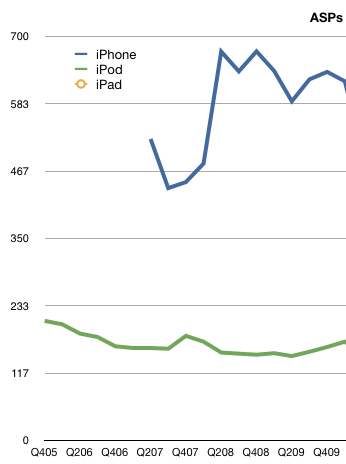
Peter Oppenheimer, Apple's Chief Financial Officer, said that the Average Selling Price of iPhones in the quarter "was just over $600. This reflects both high mix of 3GS sellthrough and benefits of rebalancing the ending channel inventory toward the 3GS."
An astonishing admission from Apple who has never revealed their iPhone ASP. Previous analyst estimates had the iPhone ASP at $550. If this is true, then Apple has violated one of the cardinal mobile industry rules: "Thy ASP shall always erode". Given what is known about the components, iPhone gross margin is likely to be above 50%. The gross margin, or what you are able to capture in value above the bill of materials, isthe primary indicator of value creation in the device business. Apple's number is astronomical vis-a-vis the competition. Stay tuned as this gets scrutiny.