Asymco

Asymmetric Intelligence

asset

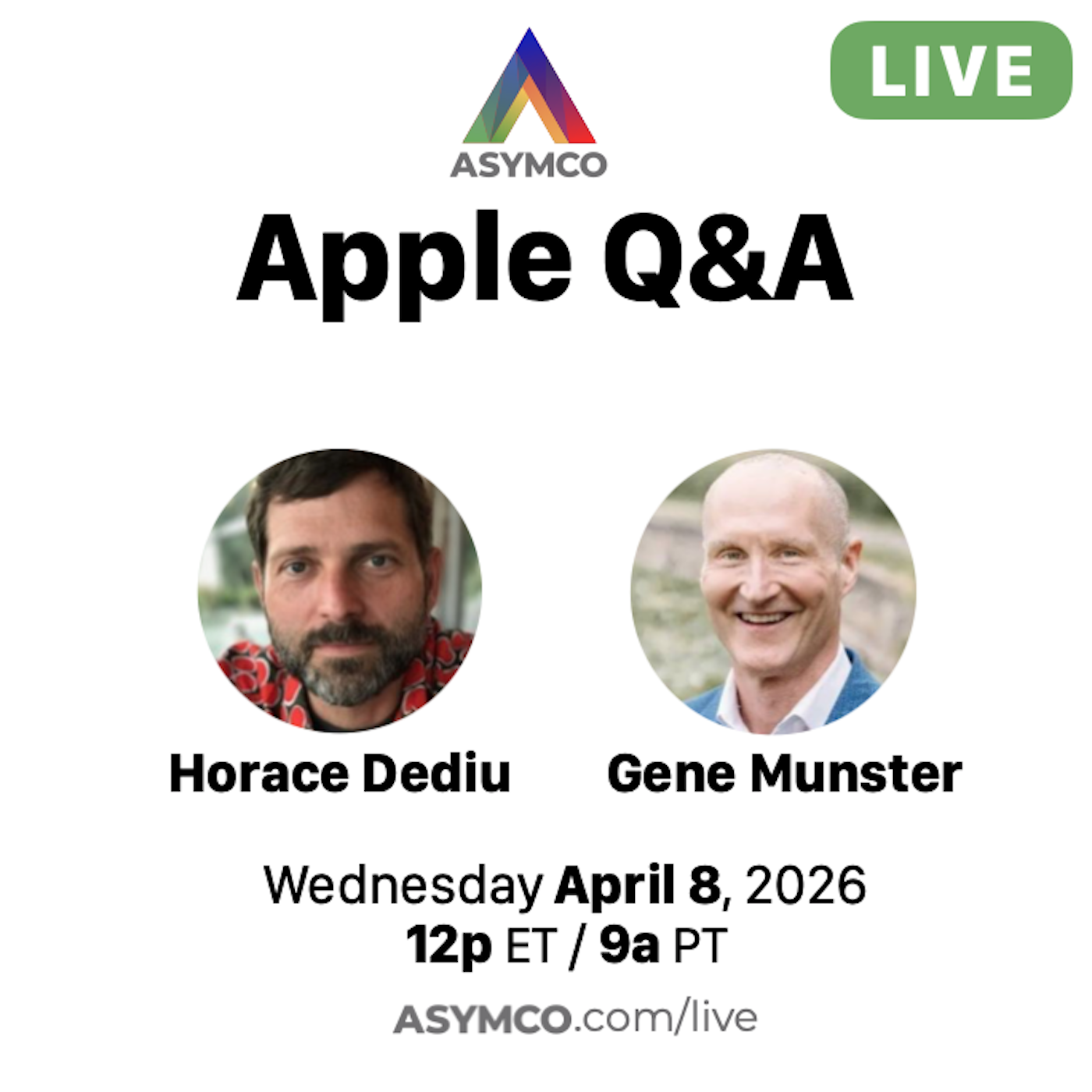
  1. Asymco One Office Hours Live Q&A with Horace Dediu & Gene Munster: April 8, 2026

    Office Hours

    A lively discsussion of Apple topics such as:

    • Geopolitics: China concentration; Taiwan tail risk
    • Financials: Solid near-term growth
    • AI: Critical narrative shift; to be proven
    • Growth Strategy: User expansion
    • Business Model: Evolution: hardware → services → Personal AI platform
    • Moat: Privacy + integration; trust

    Non-Subscribers:

    Join Asymco One as a Subscriber to participate OR

    Just Register to Watch live.

    Contact us at events@asysmco.com if you have any questions.

    For most up-to-date information, see

  2. Warren Buffett tries to justify his hypocrisy

    Nota Bene · 5 comments

    Shameful.

    "I sold it too soon. But, I bought it even sooner, so," Buffett told CNBC's Becky Quick in an interview Tuesday on "Squawk Box" .

    Apple remains Berkshire Hathaway's largest holding even after the conglomerate trimmed its stake to $61.96 billion at the end of last year, according to InsiderScore.

    However, Buffett said Tuesday that he would continue to add to the position if it gets cheaper. He said the iPhone maker is not yet attractive even after falling more than 14% off its recent high, and dropping more than 6% this month. That's amid turmoil in the broader market, with both the Dow Jones Industrial Average and the Nasdaq Composite in a correction.

    "I'm very happy to have it be our largest holding," Buffett said. "I was not happy to have it be as large as almost everything else combined."

    "It's not impossible that Apple would get to a price, we would buy a lot of it," he added. "But not in this market."

    Buffett said the firm has made more than $100 billion in the stock pretax, and was favorable in his comments regarding Tim Cook's leadership of the firm over Steve Jobs.

    "Tim Cook has done better with the hand. Steve Jobs — he couldn't have done what Steve Jobs did — but Steve Jobs handed him a hand that Steve would not have done as well," Buffett said.

    "Tim was a fantastic manager, and he's a good guy, and somehow he gets along with everybody in the world," he added. "That's a technique I wouldn't have, for example, certainly my partner, Charlie Munger, wouldn't have had it."

    Source: CNBC

    NB: Warren Buffett said he sold Apple stock too soon but clarified he has no actual regrets. Buffett said it is better than any business Berkshire owns outright including its railroad, which is worth more in dollar terms but earns nowhere near the return on capital that Apple does. He also said his railroad might last longer than Apple.

    He said if Apple ever got cheap enough, he would buy a lot more of it. He owned a lot more of it priced a lot lower than what he would have to buy it back at. Complete nonsense.

    Also Warren Buffett:

    Quote: "Our favorite holding period is forever". Action: Trade Apple to realize gain.

    Quote: "Price is what you pay, value is what you get". Action: Trade Apple to make $100 billion pretax, mention that price determines decision.

    Quote: "At a healthy business, cash is sometimes thought of as something to be minimized as an unproductive asset that acts as a drag on such markers as return on equity" Action: Sell Apple and other equities and move $300 billion into unproductive cash.

    Quote: "Investors, of course, can, by their own behavior, make stock ownership highly risky. And many do. Active trading, attempts to ‘time’ market movements..." Action: time decision to trade Apple for cash on the basis of price, tax and market conditions.

    Quote: Apple is "probably the best business I know in the world," "we like to own businesses not stocks". Action: Convert Apple ownership into cash.

    Quote: "I'd love to own 100 percent" of Apple. Action: Sell 60% of Apple holdings.

    Quote: "I don't think of Apple as a stock. I think of it as our third business" Action: Sell Apple, move into unproductive asset cash.

    Quote: "I sold Apple too soon". Action: Also say that you don't regret it.

    Actions speak louder than words. The results will be felt by his shareholders.

  3. Are Share Buybacks a Waste of Money?

    Research

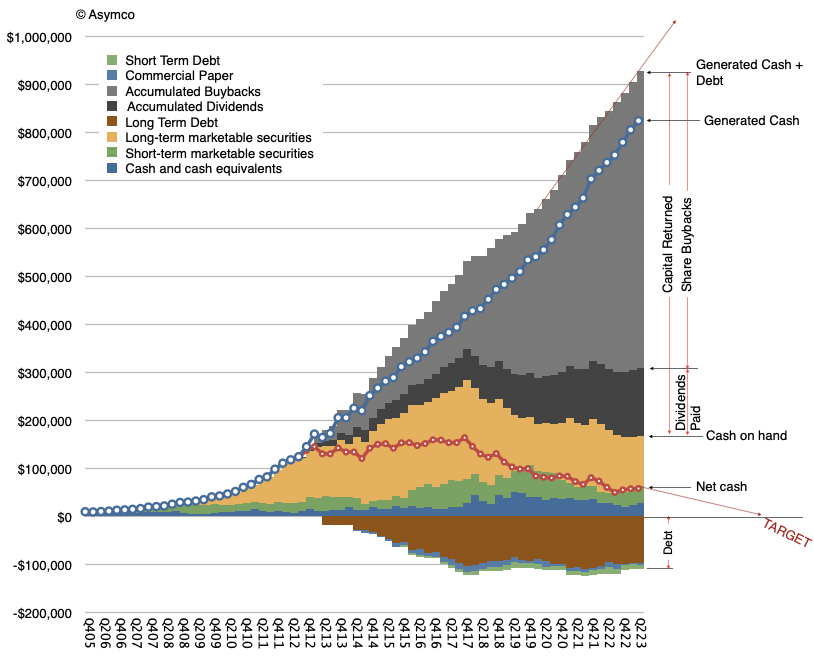
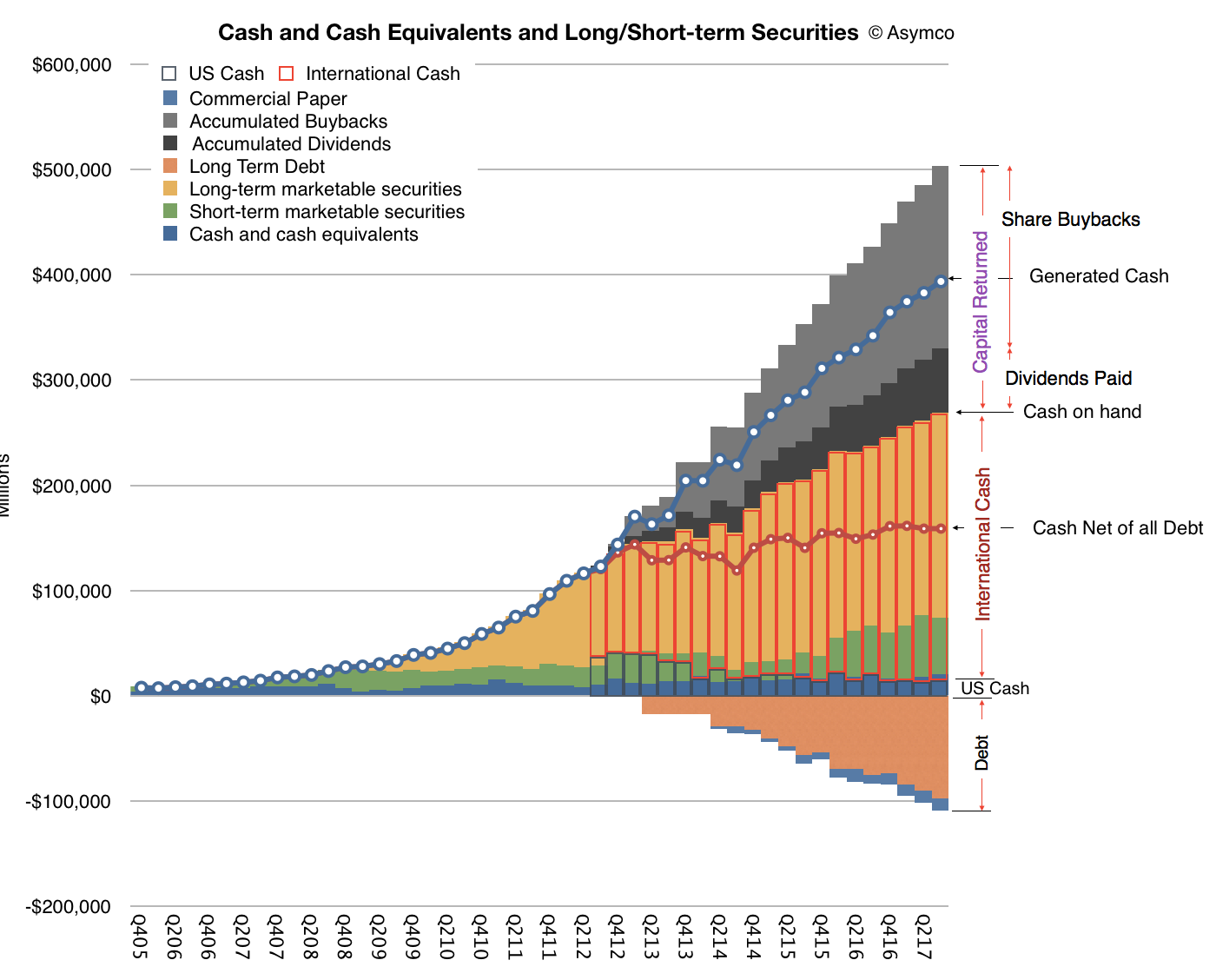
    Apple has so far returned $761.5 billion to shareholders. 143.3 billion in accumulated dividends and $618.2 billion in share buybacks. These are the gray areas in the graph above. The question that often comes up is: isn't this capital return program a misallocation? In particular isn't buying back shares and retiring them a waste of money?

    By definition, it cannot be. The mechanism of buying shares and retiring them is a process of returning retained capital to shareholders. The other ways this can be done are through dividends (periodic or one-time) or the sale of the company (liquidation). Ignoring the liquidation option which does not make sense for viable companies, the decision between dividends and buybacks comes down to a tax efficiency question.

    The result is, however, roughly the same: retained earnings, which are stored by the company as cash typically (net value for Apple today is $57.2 billion), are an asset balanced by a liability to the shareholder called Total Shareholder Equity (valued today as $60.3 billion.) As such, the retained earnings belong to the shareholders. It's why they own the company. It's what their cash share of the value in the company is.

    It's also surplus to the company's needs. Had the company needed this cash, it would have spent it on building the products and services it sells or operations that maintain or grow the business. Those expenses appear in cost of sales (COS) or cost of goods sold (COGS) or in operating expenses Sales, General and Administrative (SG&A) or Research and Development (R&D). If it's not spent this way then it drops to the net income line and, crucially, is subject to taxation (about 12% to 15% for Apple). After taxation, once returned, it's taxed again as either capital gains (in the case of buybacks) or dividend income. These rates vary on the jurisdiction of the owner and the current tax policy.

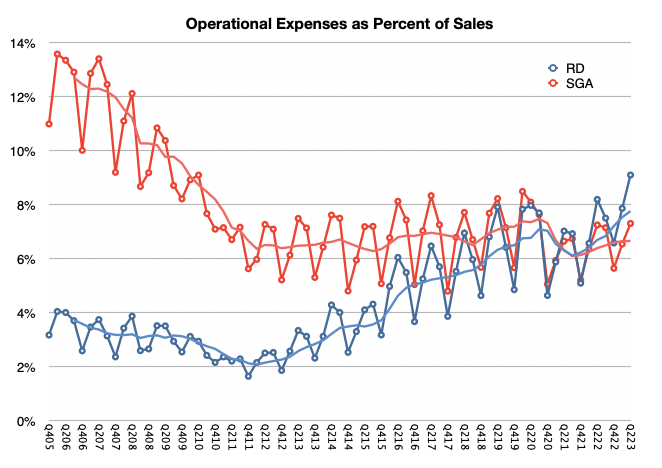
    Note that the spending on R&D includes development of future projects which are not directly related to current products. Engineering of current products is expensed against COGS. R&D for Apple ($29.4 billion in last 12 months) is significant, having grown to 9% of sales, as the graph below shows.

    For the company to decide to return capital it really does mean that it has no good ideas on how to spend it given what the company knows it can and cannot do. It's a judicious decision and one which honors the relationship between owner and manager with fiduciary responsibility to the owner.

    Still, doesn't that mean it's wasted?

    No. Giving it to the shareholder means that the company says "It belongs to you, I don't know what to do with it on your behalf, so here, you figure out what to do with it." The shareholder can then make an allocation decision that suits their sense of what is valuable or useful. The return is a deferral of decision to the owner rather than their agent.

    To the extent that once returned, the capital is misspent, that is on the spender, not on Apple.

    Consider the alternatives. Instead of returning capital, what some managers decide to do is to re-allocate those retained earnings to acquire other companies with the promise of value creation through synergies. However these are often huge wastes of money. The new asset is recorded as "goodwill" on the balance sheet, offsetting the retained shareholder equity. As the synergies fail to materialize, the asset (goodwill) is written off, and shareholder equity decreases accordingly, and so, value evaporates or is transferred to the owners of the acquired company who cash out above market value.

    Acquisitions are a process of picking the pocket of shareholders.

    The alternative might be to spend heavily on R&D. That is more admirable but the amount involved is enormous and it's very difficult to find enough people and projects worth pursuing without turning R&D into an academic organization. Remember that with R&D at $7.4 billion per quarter, the company is spending 41 times more than it did in 2006.

    And doubling or tripling R&D, even if possible, would impact margins to such an extent that Apple's profitability would show very poorly indeed. That would collapse share prices and decrease share-based compensation, limiting the possibility of recruiting talented engineers. It would bring quite a lot of negative consequences.

    Another exercise to undertake would be to ask what would happen if the mechanism of share buybacks were made illegal. It was not always legal anyway. That is left as an exercise to the reader.

  4. On knowing the value of everything and the price of nothing

    Research · 52 comments

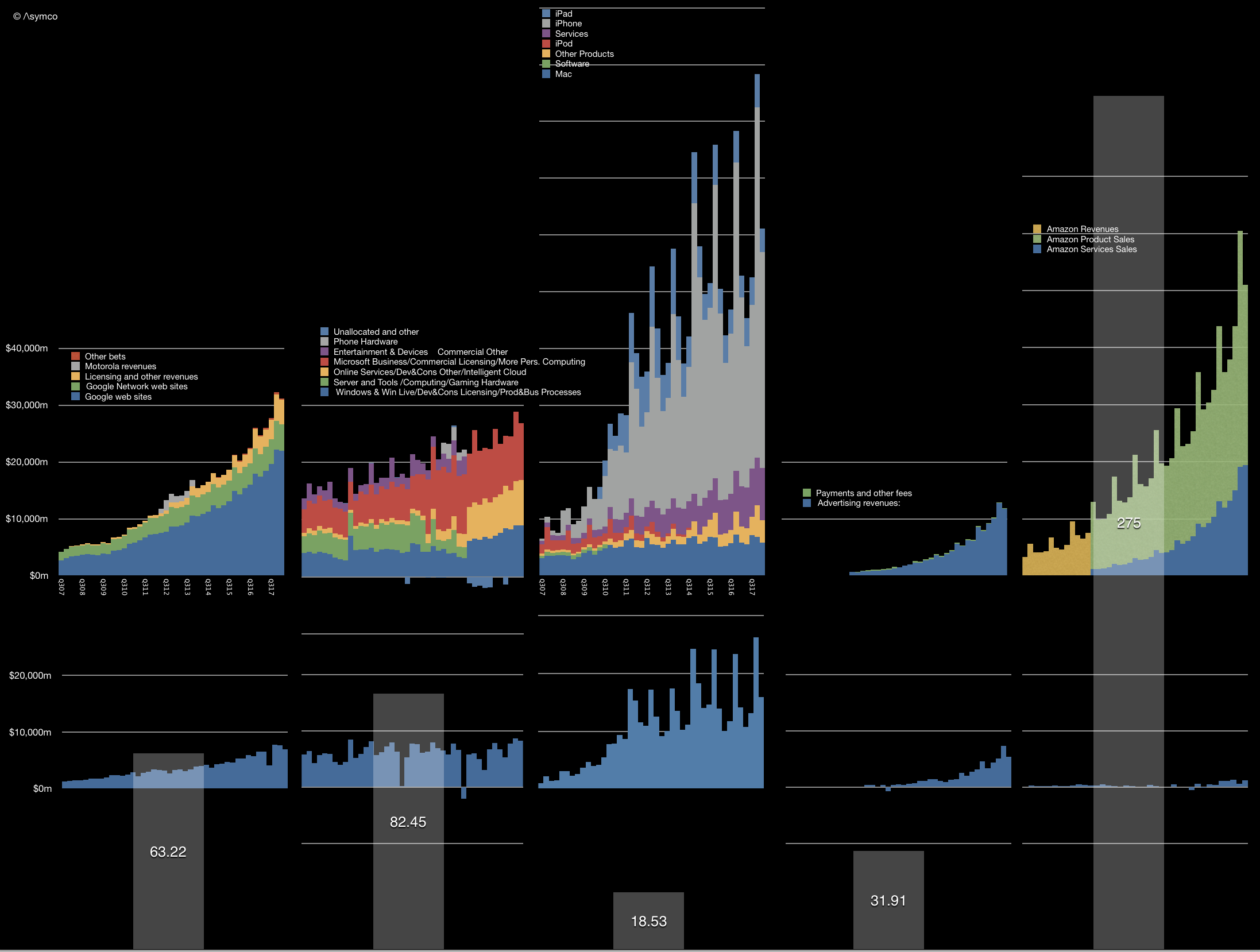
    At the latest Apple Summit in Los Angeles the question of Apple's valuation was foremost on many minds. The illustration I used there to discuss valuation is shown below.

    It shows the history of revenues (by reported segments) and gross margin for the five largest companies in the world by market capitalization. I have been publishing this illustration for five years ((initially with Samsung rather than Facebook because it was originally a set of "challengers" to Apple. The fact that with only one substitution the illustration turned into a view of the five largest companies in the world was a welcome surprise.)) in order to contrast the growth and perception of value between companies that might be considered comparable with Apple. Thus the graphs show the top and (near) bottom lines of the companies over an epoch of about a decade. ((This being the iPhone epoch))

    In contrast with the histories above, there is a price set on the equities today. These prices are captured by the market capitalizations as follows:

    Current market cap (billion) Peak market capitalization (Billion)
    Apple$918$955
    Amazon$844$856
    Alphabet$810$825
    Microsoft$780$789
    Facebook$584$589


    Market capitalizations are interesting because they show perceptions of value. The traders in the equity are negotiating with each other on what the shares are worth and, as a voting system in a liquid public asset, share pricing is very representative of the perceptions about that asset. Representative because there are literally millions of decisions being made on a daily basis which determine this price.

    The sales and profit data in the illustration above is about the past. In contrast the market engine is voting about the future. Any student of finance knows: the value of a company is the net present value of all future discounted cash flows (plus any current assets.)

    So what would history have to do with it? What use is the trajectory?

    This goes to a deeper question: How does history inform the future? What is the value in knowing previous performance when thinking about future performance? The common caveat in mutual fund prospectuses is "Past performance is no guarantee of future results". We are repeatedly warned of this because it is within our nature to look at history and recognize patterns. But beware! At least beware those whom you might entrust with your fortune.

    But consider that it's conventional wisdom to also say that culture and preparation are the best ways to ensure a prosperous future. Ask athletes or coaches and they will say that practice and dedication lead to success.  Sports fans know that a team or player with a record of success is more likely to succeed in the future. In this way sport is, in many ways, a simulation of reality. Which is why it's so popular: a metaphor of life teaches as well as entertains.

    Knowing how to read ability as well as conscientiousness are keys to scouting talent. Again, it's not a guarantee, but in various fields of human endeavor the past does predict, with high accuracy, the future.

    This relationship between past and future is what education is based on. We spend our lives preparing and training ourselves and our children and their children with the implicit hope that this leads to better outcomes for everyone. We establish a pattern of success because it is the best predictor of future success. Practice, learn, commit, defer satisfaction, trade time for knowledge, fight, lose and try again. These are the qualities we look for in the past of individuals when assessing their potential for the future. Culture is everything, we are told. Build a track record, we tell the young.

    So what does this have to do with valuation?

    We can't easily measure the cultures of persistence and perseverance in companies. Grit, guts, stoicism, fortitude, courage, the Finnish "sisu". These are not measurable in financial reports. Yet our language is as filled with words to describe character and our financial reports are empty of them.

    It's left to investors to work it out. The exercise of relating the future to the past is the calculation of the ratio between Price (future) and Earnings (past). A high P/E ratio suggests repeated success from past success. A low P/E is a disbelief in a future repeating the past.

    The P/E ratio thus allows us to say to what degree recent past performance is repeatable. I.e. how many `last years' can we expect in the future. A P/E of 1 means a company is worth what it earned last year. A P/E of 10 means it is worth ten years' proceeds. ((We could easily calculate P/E for more than one year but the default is one year.))

    This P/E ratio is shown for the five companies above as the overlaid bars in the graph above.

    Sure, you say, but it depends on the industry and circumstances. A future divorced of the past is more likely in an environment where there is rapid, chaotic change. The more volatility in fundamentals, the more uncertainty. Technology is changing rapidly and therefore it's quite possible that Apple's low P/E reflects this disconnect.

    If so then what about its peers? Why would Apple be subject to different technological risk than other technology companies? All of the top five companies are considered "tech". Indeed, Apple is perhaps the least technologically oriented as it has a brand and consumer orientation. It operates hundreds of stores, and sells design as much as it sells algorithms. It fundamentally tries to deconstruct human needs and package those needs in products.

    Alphabet, Microsoft and Facebook primarily don't "sell" to end-users. The revenues come from businesses in the form of advertising or licensing. They don't have support staff, interacting with people who buy what they use. They need to understand needs but they trade other things. And Amazon offers AWS to enterprises as its own unique product. Other than AWS it operates a marketplace, acting as an intermediary.

    Apple is a consumer company depending on consumer tastes as a brand. This is more typical of a non-tech company in a boring business of consumer brands.

    But it's not valued as either a tech company or a consumer company. Both have typically higher P/E ratios. In fact, Apple's P/E ratio is lower than the S&P 500 and has been below that level for almost the entire history of the iPhone, regardless of growth rate.

    A track record of hit products and the stability of a brand seem to be of no value. Perseverance, consistency and stability are not valued. If it were an athlete with a track record of world-record performance and a spectacular reputation with the public, it would not be granted an above-average pay for its performance.

    In the past I've argued anti-fragility as a cause. In the context of the other companies, Apple is at the center of perceived vulnerabilities and is thus perceived as vulnerable . The other four are at the center of no competition and perceived as invulnerable. And yet Apple, so far, has survived. So have the others, but apart from Microsoft, they are much younger. I argued that Apple exhibits anti-fragility and has unrecognized robustness. Perhaps Warren Buffet now agrees and this is encouraging to the thesis.

    Yet, at an even deeper level, in Apple's valuation we see how culture is not valued. How the idea of character assessment is not applied to businesses. How ethos is unquantifiable and thus discounted. How markets, accustomed to weighing things, reflective of collective human judgement, demonstrate that we are woefully incapable of valuing that which matters most.

    Oscar Wilde famously said that the cynic knows the price of everything and the value of nothing. Here's to the sentimentalist, because at the end of the day those who change the world know the value of everything and the price of nothing.

  5. The Apple Cash FAQ

    Research · 123 comments

    • How much cash does Apple have?

    To the nearest million, as of the end of September 2017, Apple's cash and investments totaled $268,895,000,000. Note that this includes investments in the form of short- and long-term marketable securities. Long-term marketable securities are not always accounted as "cash" because strictly cash is considered a liquid asset and some securities may not be sufficiently so. Nevertheless, most analysts would agree that Apple's securities are sufficiently liquid to qualify as cash. Note that for archaic reasons this cash is separated into US and non-US holdings with $17 billion located in the US.

    • Most businesses keep very little cash on their books. Why does Apple have so much cash?

    Indeed Apple's cash is extraordinary. It amounts to about 30% of its market capitalization. One reason is that Apple has taken many loans, totaling about $100 billion.

    • Whoa! Why would Apple need to take out loans? Does it have problems with cash flow? ((Companies often borrow because they need to plug gaps in profitability, best measured as "free cash flow".))

    Quite the contrary, Apple's operating cash flow is eye-watering. In the 2017 fiscal year (ending September) Apple generated $63,598,000,000 from operations. The loans are not needed to operate. They are used to pay shareholders.

    • Why does Apple need to pay shareholders?

    Because it's their money.

    • Wait, I thought you said this was Apple's cash.

    Apple is holding it for them but if it has more than it needs it's obligated to return it. You see, If you were to look for "cash" in financial statements you find it on the balance sheet as an asset. Since it is growing and since a balance sheet has to balance, there has to be a liability that grows in proportion to offset the cash asset. That liability is called Shareholder's Equity. This is a "debt" the company has to shareholders. If it pays out cash to shareholders then it zeros out an asset and a corresponding liability. The net is zero as far as Apple is concerned but shareholders get something in return for giving Apple money in the first place.

    • So hold on, it takes out loans to pay shareholders because it "owes them money" while it has too much money? This makes no sense.

    Yes, welcome to tax laws. Although it generates more money than it can use, and that money should thus be returned to shareholders, some of the money is collected outside the US. US (and US only as far as I know) tax laws have a "repatriation tax" that is levied on money coming into the country.  This has nothing to do with corporate taxes which are levied on earnings. So after paying shareholders with the cash it had in the US, Apple had to borrow money to pay shareholders money they had outside the US.

    • Why not just pay the repatriation tax?

    Because then shareholders would get less than 70% of their money. They would probably complain and blame the managers for being incompetent. Such blame usually comes with a lawsuit attached.

    • What about the new tax law that lowered the repatriation tax rate?

    Now Apple has no option but to pay the tax and repatriate the cash. It's still a tax. The amount will be about $38 billion or about 15%. Previous repatriation "holiday" levies were around 10%.

    • How exactly does the company give money to shareholders?

    The payments are called "dividends" and shareholders must treat them as income--a form of double taxation because these funds are after the company paid earnings tax and possibly repatriation tax. Apple does pay dividends regularly but because of tax inefficiency (i.e. because government policy discourages dividends) the company mainly buys its own shares and retires them.

    • Huh?

    Yes, it makes little sense but the math is simple. If the company buys its own shares and makes them disappear then existing shareholders will end up owning more of the company, making their shares more valuable. They can realize the gain if/when they sell the shares (and pay capital gains tax instead of dividend income tax on the already (double) taxed profits.)

    • Does that mean that it is going private?

    No. The owners of the company remain the same: whoever owns shares owns the company and they can be traded in public exchanges. In theory they could reduce the share count to a single share and there would presumably be a single shareholder who would own the company, making it "closely held" but the company's managers are still required to report and act as if it was public. Going private usually means a set of shareholders agree not to allow the shares to float on the open market and thus to also keep the affairs of the company out of public eye. It reduces liquidity and is generally harder for shareholders to exit their investment. This has nothing to do with reducing the number of shares in circulation--which is what Apple is doing.

    • But buying shares does not seem to affect the share price so the shareholders are not benefiting from the repurchasing. Isn't this a waste of cash? Aren't the shareholders being robbed?

    The share price is an argument between shareholders and potential shareholders on the value of the company. It should reflect reality but many times it doesn't. Over time however the math catches up with sentiment. In other words realization that there are fewer and fewer shares available compels people to not sell them, increasing the price. Short term investors tend not to pay attention to this but they are not the shareholders who Apple wishes to pay back anyway.

    • Why doesn't the company spend the money on other things? You said they return what they can't use. Why can't they use it?

    Simply, because it's more than can be spent wisely. The company considers its mission to be very narrow: add value in specific areas where they can create tremendous value uniquely and under conditions (technologies and business models) they can control. Many such projects don't require capital. Manufacturing, data centers and Apple stores require capital but R&D and sales not so much. Creating products is very cash efficient. For example, the iPhone--the most successful product of all time--cost almost nothing to develop; certainly nothing that required Apple to dip into its cash. Funding for the type of product development Apple does comes from existing cash flows and mostly consists of salaries for their employees.

    • What about acquisitions? Why not buy other companies?

    It buys companies but usually small ones which are essentially acquisitions of teams and their intellectual property. Apple does not buy "business models" or customers or cash flows which is what large companies are valued for. Operationally, it's also because Apple has a strong culture and it wishes to preserve it. Acquisitions dilute culture which is why integrations often fail. Statistically, large acquisitions are value destructive and the larger they are, the more likely they are to fail. Incidentally, when a company is acquired with cash that hole in the balance sheet is filled with something called "goodwill" which reflects some intangible value of the new asset. If and when the acquisition is deemed to have failed the goodwill is written off and so is shareholder equity. That's how shareholders are robbed.

    • What about keeping it? Doesn't having lots of cash make Apple more powerful?

    As individuals we think that having lots of cash makes us rich. For companies it's the opposite. Cash is a liability. If you come across a company that is cash rich and has nothing else, its enterprise value will be zero. Companies are valued on their future cash flows, meaning their ability to generate cash, not how much they managed to keep. In other words, cash is a measure of past success and investors are interested only in future value. That future value comes from the intelligent allocation of resources toward a valuable goal. A company rich in cash but poor in vision is likely to be taken private or broken up and shut down. Cash is an IOU to shareholders with a thank-you note for the support through the years.

  6. Gravity

    Research · 39 comments

    Apple is doomed. So are you. As mortals we are used to the idea of death. We do not dwell on it even though it's inevitable. We do know that we'll die but what we don't know is when we'll die. That certainty/uncertainty makes us, more or less, do everything that we do. And so we carry on. But companies die too. And when they die is also a mystery but it's not at all clear that their inevitable demise determines what they do. If you think you're immortal you may live dangerously. Perhaps as a result they live shorter lives than we do.

    Life expectancy for humans has been rising but for companies it has been declining. Even more curiously, the richer you are the more likely you are to live longer but the wealthier a company, the more likely it is to keel over at any time. The longest lived small businesses live over 1000 years but the longest-lived large business is probably the East India Company that made it to the ripe age of 274. But that was before 1800.

    In the modern, industrial era there are very few corporations that survived over a century and the Fortune 500 shows a turnover in inhabitants that resembles that of a plague-infested medieval inner-city. In contrast to their conservative, geriatric organic owners, synthetic companies are more likely to behave like live-fast, die-young punk rockers.

    So it's no surprise that Apple, at age 40, is seen as being well past its sell-by date. And yet it seems to be saying, somewhat faintly, "I'm not dead yet". By generating more cash than can be comprehended by human observers and by controlling assets that are well beyond the means of many countries, they (it?) is confusing us with its persistence.

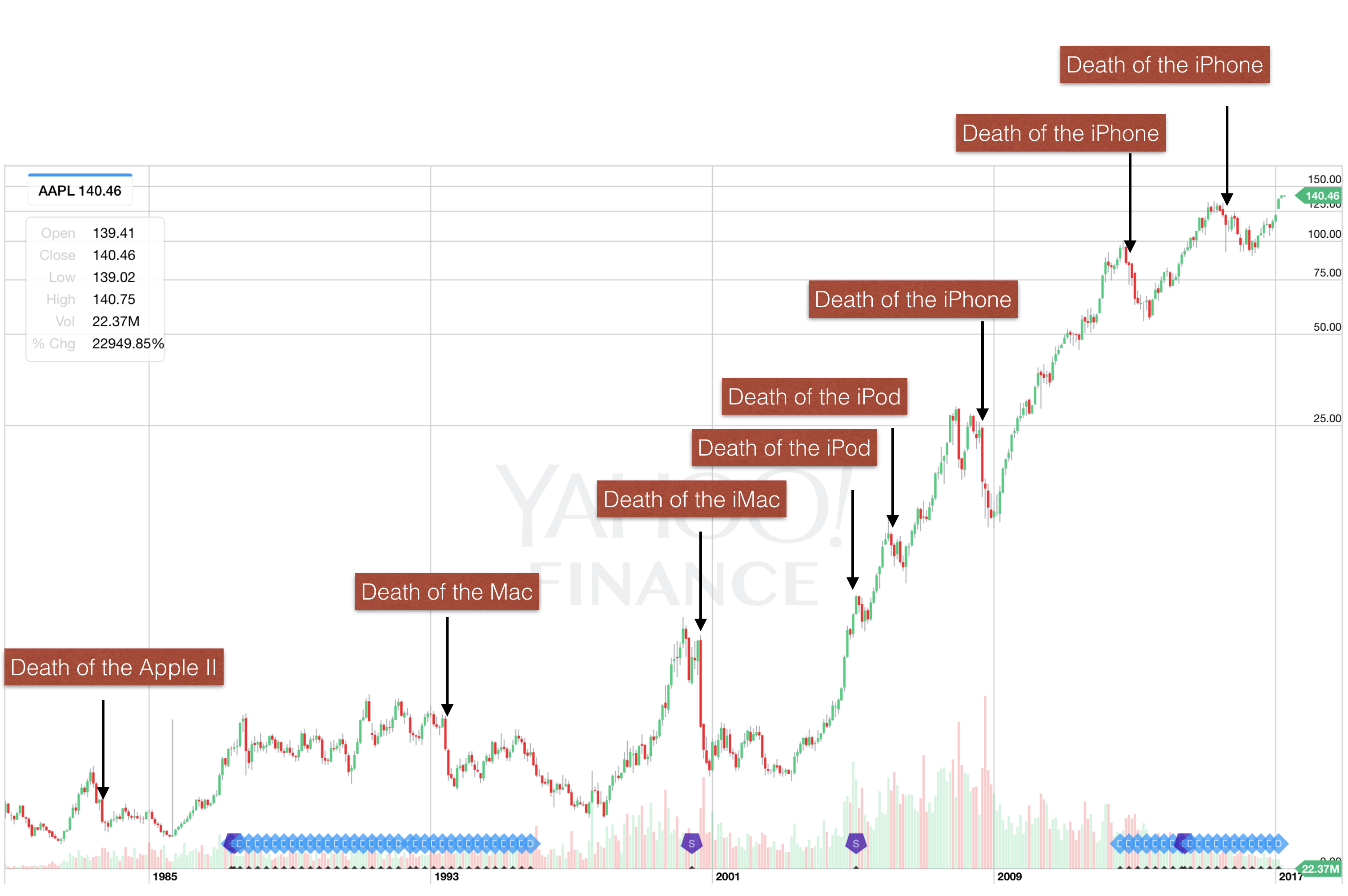
    The confusion is exhibited in the following graph which shows the crises in confidence by that wonderful reflector of human perception--the stock market. By voting millions of times a day, the market shows us with great precision the totality of human emotion with regard to an asset. That emotion turns rapidly negative on Apple with surprising frequency.

    Screen Shot 2017-03-16 at 2.32.03 PM

    There have been over 8 bouts of collapsing confidence (exhibited by 40% drops in value) for Apple's shares. Consider the latest where we've seen a 40% drop followed by 57% increase in share price over the last 12 months. 57% might not seem extraordinary for a small company but for the world's largest market capitalization with the corresponding colossus of cash that it straddles, the robustness of brand and the loyalty of customers, the mind boggles.

    The same thing happened in 2012 and 2008 and as far as I can tell the company has not changed one iota during that time. The same people, mostly, are in charge. With the same mission statement, and even the same product line. The resources, processes and priorities--the only determinants of the essential value of a firm--have not shifted.

    One could try to suggest that even if Apple is unchanged, the world around it has changed. But if anything the world has come to match Apple's own view: more mobile vs. fixed, more design vs. generic, more integrated experiences vs. more modular DIY.

    The ethos of Apple is rigid so why is perception about the company so fickle?

    If the graph above reflects perception about a constant entity then perhaps it charts how the world has changed rather than how Apple has. Perhaps perception revolves around a center of gravity far heavier and permanent. Perhaps the tug-of-war between fear and greed reflects more upon us that it does upon the object being observed.

  7. How many iOS devices will Apple Ship in the next six months?

    Research · 11 comments

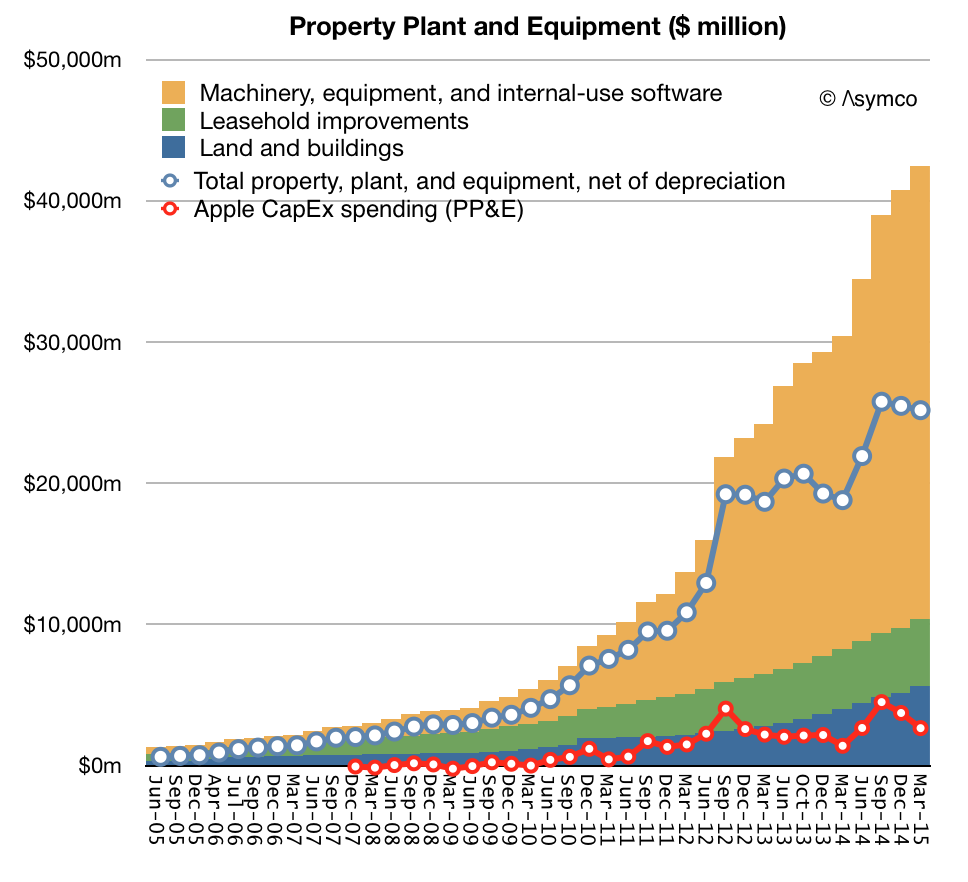
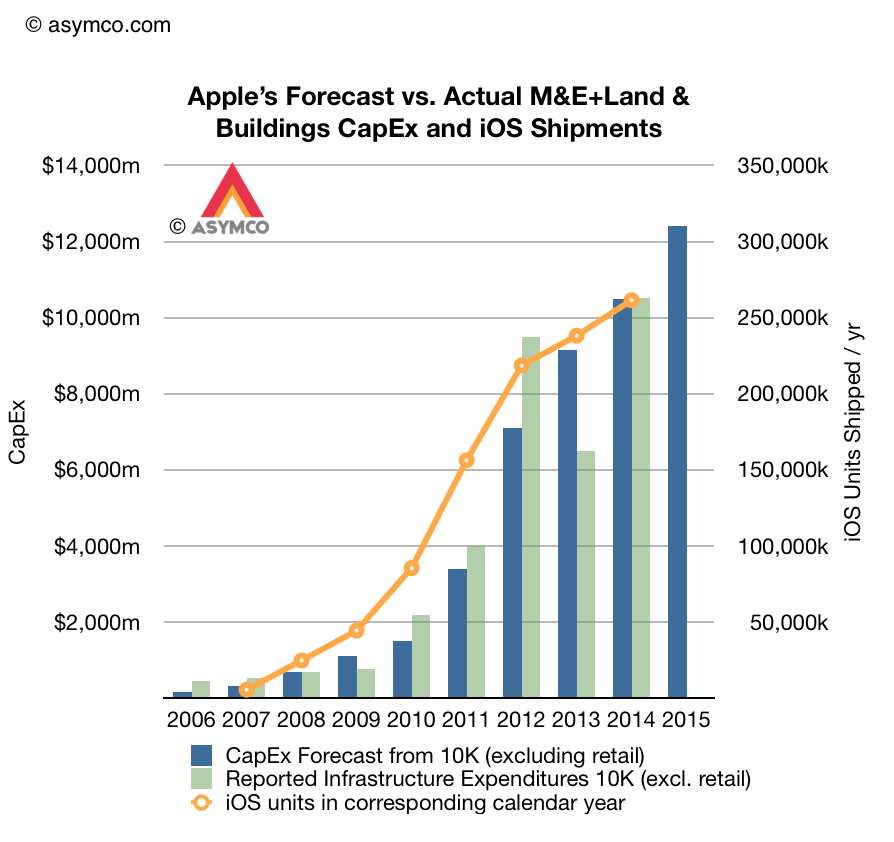
    Of the $42.5 billion Apple spend buying capital assets ((Includes land and buildings $5.6b, Machinery, equipment and internal-use software $32.1b and Leasehold Improvements $4.7b)) more than half was acquired in the last three years. Net of depreciation these assets are currently worth $20.1 billion and the spending rate is about $12 billion per year.

    This strategy of spending on capital assets is primarily in support of its particularly integrated approach to its product strategy. The purchasing of tooling for product manufacturing gives many benefits, including ability to deliver uniquely differentiated hardware, a predictable ramp and availability of parts throughout the product lifecycle.

    Screen Shot 2015-05-05 at 3.02.04 PM

    One additional benefit (for us) is that we get to inspect the allocation of resources prior to production and therefore we can more easily forecast the product's supply. Spending on tooling happens in advance of production and the company also provides full year predictions of its spending.

    The fiscal year forecasts relative to actual spending is shown below. Note the correlation with iOS units shipped one quarter after the spending was booked.

    Screen Shot 2015-05-05 at 3.08.24 PM

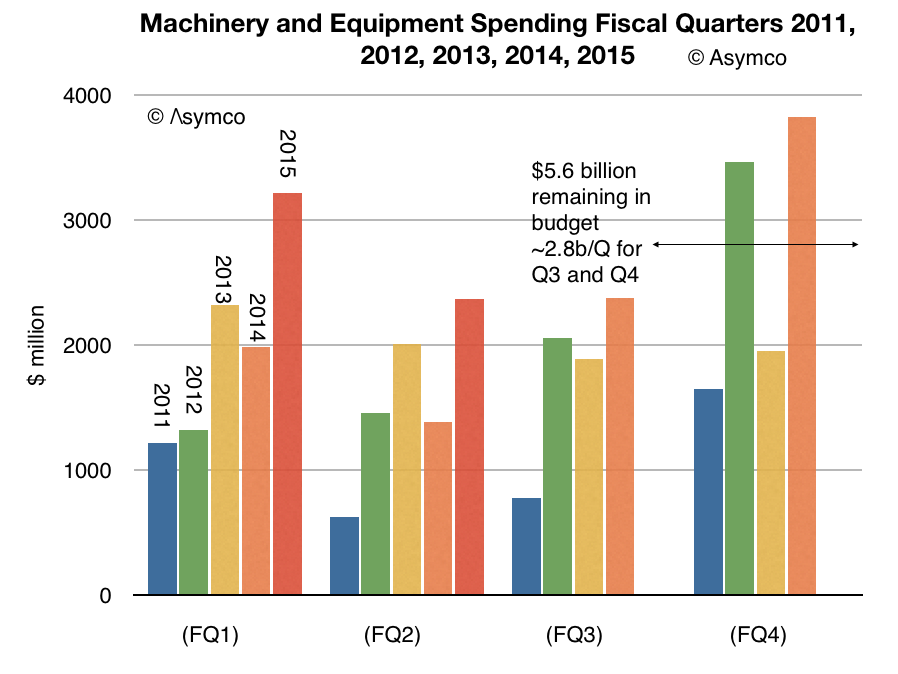
    After reporting its second quarterly earnings, we received an update on what amount to half of the full year's spending giving us only two more quarters of variability. The current projections for the next two quarters imply about $2.8 billion per quarter spending.

    Screen Shot 2015-05-05 at 3.05.29 PM

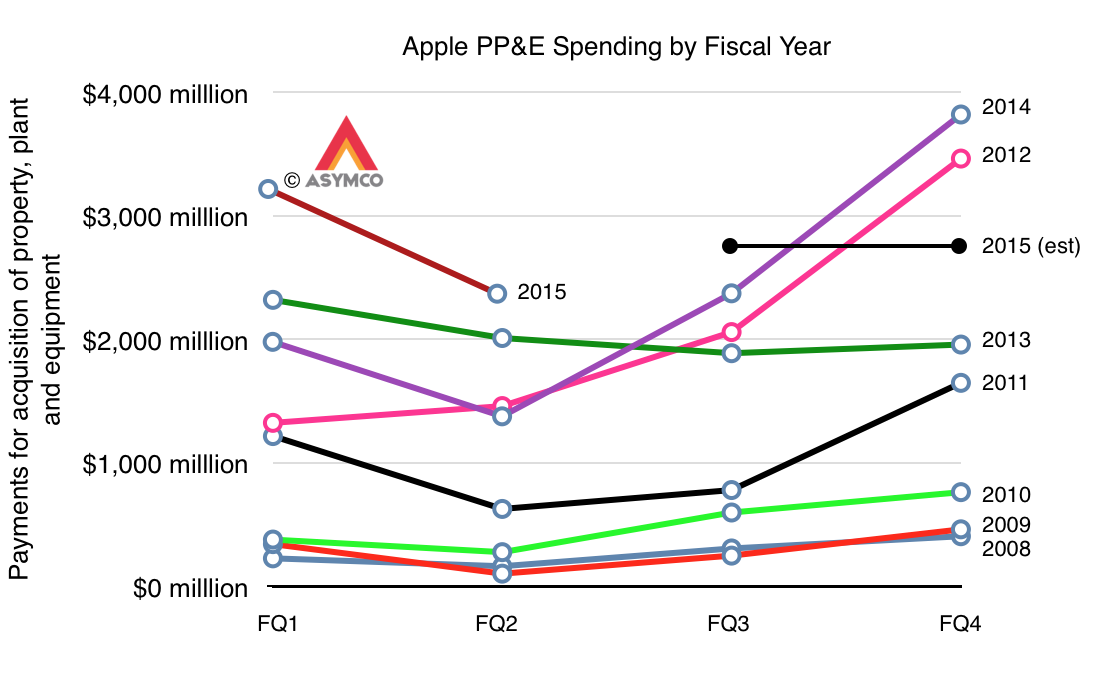
    The pattern from previous years is shown below for comparison. Note the Even/Odd year patterns.

    Screen Shot 2015-05-05 at 3.05.35 PM


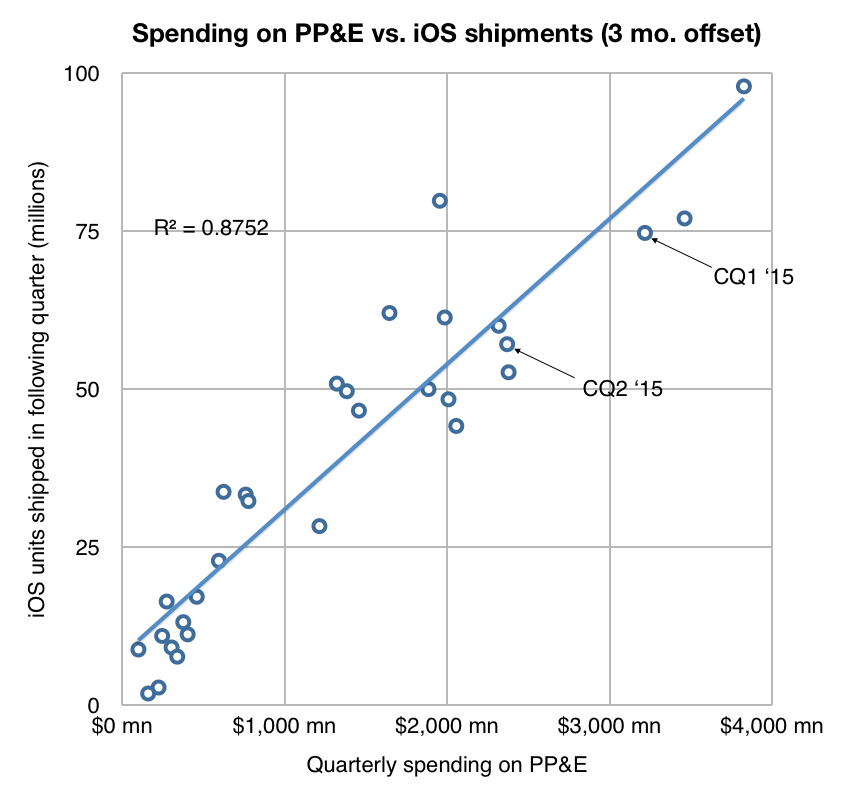
    The company also offered revenue guidance for FQ3 and therefore we can even make an educated guess on the next data point (57 million iOS devices) on the following graph:


    Screen Shot 2015-05-05 at 3.20.52 PM


    The result is likely to be 120 million shipped between April and September.

    It's remarkably predictable.


  8. The newly integrated company

    Research · 25 comments

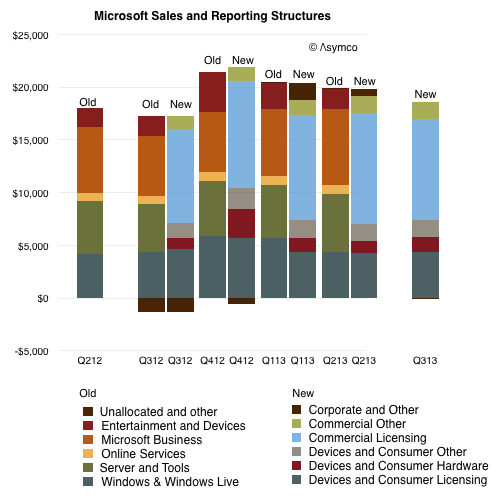
    During the first quarter of fiscal year 2014, we changed our organizational structure as part of our transformation to a devices and services company. As a result of these changes, information that our chief operating decision maker regularly reviews for purposes of allocating resources and assessing performance changed. Therefore, beginning in fiscal year 2014, we are reporting our financial performance based on our new segments; Devices and Consumer (“D&C”) Licensing, D&C Hardware, D&C Other, Commercial Licensing, and Commercial Other.

    The previous reporting segments were:

    • Windows & Windows Live
    • Server and Tools
    • Online Services
    • Microsoft Business
    • Entertainment and Devices
    • Unallocated and other

    The new are:

    • D&C Licensing: Windows OEM licensing, Consumer Windows, Consumer Office, Windows Phone (including related patent licensing)
    • D&C Hardware:  Xbox 360, second-party and third-party video games, and Xbox LIVE subscriptions; Surface; PC accessories
    • D&C Other: Resale, including Windows Store, Xbox LIVE transactions, Windows Phone Marketplace; search advertising; display advertising; Subscriptions including Office 365 Home Premium; Studios including first-party video games; retail stores.
    • Commercial Licensing: Windows Server, Microsoft SQL Server, Visual Studio, System Center; Windows Embedded; volume licensing of Windows; Microsoft Office for business (Office, Exchange, SharePoint, and Lync); Client Access Licenses;  Dynamics, Skype.
    • Commercial Other: Enterprise Services, including Premier product support services and Microsoft Consulting Services; Cloud Services, comprising O365, other Microsoft Office online offerings, Dynamics CRM Online, and Windows Azure.

    From Microsoft's FY14 Q1 10Q via Microsoft Investor Relations - Press Releases

    The mapping between the old and new is not straight forward. There is overlap between D&C Licensing and the old Windows and perhaps between Entertainment and Devices and D&C Hardware but there are many gaps. There is also some overlap between the old "Business"/"Server" segments and the new "Commercial" but, again, they cannot be matched.

    I show the difference between the two structures in the way revenues are allocated below, using color to try to show similarities.

    Screen Shot 2013-10-25 at 10-25-11.25.07 AM

    Given the re-stated quarters it's possible to compare one year's historic performance at a segment level. For example, the company states that "Devices and Consumer revenue grew 4% to $7.46 billion" while "Commercial revenue grew 10% to $11.20 billion".

    Since we don't have data older than one year, our ability to assess the company over longer time periods will be drastically reduced and a new picture will take a long time to emerge.

    There is however one aspect of the new structure that needs to be appreciated right away: the allocation of costs has changed fundamentally. The company explains:

    Cost of revenue is directly charged to the D&C Hardware segment. For the remaining segments, cost of revenue is directly charged in most cases and allocated in certain cases, generally using a relative revenue methodology.

    We do not allocate operating expenses to our segments. Rather, we allocate them to our two segment groups, Devices and Consumer and Commercial. Due to the integrated structure of our business, allocations of expenses are made in certain cases to incent[sic] cross-collaboration among our segment groups so that a segment group is not solely burdened by the cost of a mutually beneficial activity as we seek to deliver seamless experiences across devices, whether on premise or in the cloud.

    [my emphasis]

    In that brief paragraph Microsoft has formally and in a financially binding way declared itself to being a functional organization. ((Welcome to the club.))

    The mechanism seems banal: operating costs are no longer assigned to product divisions but to two large buckets. In practice this means that profitability (P/L) cannot be assessed or assigned to individual managers. The lack of P/L responsibility means that incentives from top to bottom have to be re-engineered. If this goes wrong, the Assets ((read: people)) of the company could evaporate.

    If the assets go, then processes and priorities are for naught.

    In other words, what the company is undertaking is a priority shift (to a  functional structure to create integrated experiences) which requires a process change (whereby employees work according to new incentives) while preserving the fragile assets the company depends on (a motivated and skilled base of employees.)

    This makeover is as ambitious as a re-org gets and the context, scope and target are as difficult as they can be. This is, after all, the largest software company operating the the most dynamic industry whose multi-sided markets are notoriously volatile due to disruptive forces.

    The challenge also suggests why Ballmer left and who should replace him. A priority transplant operation requires a different set of skills than those held by the manager who created the processes for the previous set of priorities. That's the manager's dilemma: even if you foresee the changes needed and push for them to be enacted, your reward might be to be replaced by someone who can make the changes happen.

    Those who envision and persuade for change are rarely allowed to enact it.

  9. Who's buying whom?

    Research · 116 comments

    When a prosperous company buys a struggling company you have to wonder what they're really buying.

    Here's how to think about it. A company is defined as the sum of three values: resources, processes and priorities (RPP). Everything of value can be classified into these three categories.

    When one company buys another it's the equivalent of one set of RPPs trying to engulf or swallow another set of RPPs. The simplest (naïve) interpretation is that an acquisition is the purchase of Resources in terms of customers, sales, profits, etc. It might be of assets like employees, intellectual properties, brand etc. I say this is naïve because Resources are the easiest to value because they can be measured and valuing only what can be measured while ignoring what can't be measured is deeply mis-pricing.

    So most people look for the "R" value or the value of Resources in an acquisition. It's may be naïve but it is what markets typically value because it's what they can price. But what happens when the "R" is flimsy or fleeting?

    The answer has to be that it's  the processes or even priorities which are valued by the acquirer.

    These are difficult to value which, as I've argued in The Innovator's Curse, is why they are not reflected in a share's price. When there is a price paid for these fuzzy assets, they are often interpreted as a "premium" to the market price. But that may not be the way a buyer sees it.

    When buying a set of Processes, a buyer may see a bargain because their costs for building a similar process could be enormous, even infinite. In the case of Nokia, the process of building hardware may be infinitely valuable to Microsoft as they have had dreadful luck doing it themselves. But they're seen as value free to the market because it seems that there are many others who are building hardware.

    The trickiest thing to perceive though is the value of a set of Priorities. Priorities are the answers to the "Why" question as much as Resources are the answers to the "What" and processes are to the "How." If you were to think in terms of software engineering Priorities are the "Specifications" where the Resources are the data and Processes are the algorithms. They determine the direction and reasoning of why a company even exists. If you have bad specs, it never matters whether the algorithm is efficient and you have all the data: you are building the wrong thing.

    Acquiring Priorities is also fundamental in that they are usually exclusive. A company typically only has room for one set. If there are conflicting priorities, they need to be sorted out else the company can end up in a state of internal conflict and dysfunction. So if you're acquiring a set of Priorities, it's likely that you'll have to discard your own. It makes most sense when a company which might otherwise be prosperous needs to change direction.

    So, in a way, an acquisition of Priorities is almost a reverse acquisition. The acquired is actually "buying" the acquirer. The acquired company's Priorities (and hence Processes and Resources) become the guiding principles in the acquirer. It's what happened when Apple bought NeXT and may have happened when Disney bought Pixar.

    Some companies are "Resource-heavy", some are "Process-heavy" and some are "Priority-heavy". Great companies tend to have great sense of priority. They may also have greatness in the other asset classes but it's rare to find a great company without a great sense of purpose.

    So the question for the Microsoft Nokia deal is what is Microsoft buying?

    Resources? Sure, there is IP and a team. But the chances are that not all the team members will be kept on. See what happened to Motorola after it was acquired by Google.

    Processes? Absolutely. Microsoft needs device development processes desperately.  They may seem a commodity but it turns out that running great hardware businesses is hard, very hard.

    Priorities? Here we have to pause. To acquire Nokia's priorities means acquiring its business model; its belief system. Perhaps they will be discarded and they're not valued. Perhaps, as is often the case, the acquirer becomes allergic to the new priorities.

    But Microsoft has made it clear that they are now a "Devices and Services" company. As much as Apple changed its name to exclude "Computer," Microsoft is almost changing its name to exclude "software". It will still make software, to be sure, but for it to get paid it needs to integrate that software into hardware and services.

    My first thought on this is that Nokia's priorities are not sufficient for the company that Microsoft wants and needs to become, but there are some priorities which are necessary and which it values.

    It may be too much to say that with respect to Priorities, Nokia acquired Microsoft, but insofar as Microsoft is having to transform its business model, what Nokia devices brings is an integral component of the new.


  10. How much do maps cost and what are they worth?

    Research · 68 comments

    How much does it cost to have the world's best maps?

    The answer may seem simple: $8.1 billion.

    That was the cost to Nokia in cash for buying Navteq in October 2007. It would seem that buying that asset (or another one like it) is a cut-and-dried solution to anyone needing a mapping "solution". But it's not an answer that is either complete or explanatory of how mapping solutions are valued.

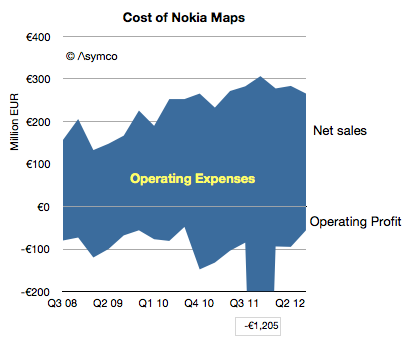
    Navteq was not priced as a database for an app. It was a business which was expected to create licensing revenues and profits[1]. The actual price for this business net of cash was $7.7 billion but the following graph shows the net sales and operating profits since Nokia began reporting its performance:

    Screen Shot 2012-12-18 at 12-18-3.13.12 PM

    The blue area represents the difference between sales and costs and hence the operating expenses--the payments needed to "keep the lights on".

    These total expenses over the 4.25 year time frame totals €6.5 billion. The total operating losses equal €2.6 billion. Therefore, as far as Nokia's shareholders are concerned, they paid $11 billion for Nokia maps, to date.

    What do they have to show for it?

    Nothing. The entire company is now worth only about $15 billion. It's hard to imagine maps being worth 73% of Nokia. What Nokia hoped to get for the product was some value in its devices. As other issues intruded, that value has not been realized. Nor has any external licensing revenue been realized. Net external licensing revenues are actually decreasing.

    The situation looks even even uglier when the maps asset can be seen as costing €1.5 billion every year. Why would anyone want to be in this business?

    I bring this up because, apparently, everyone wants to be in this business.

    Via Twitter I received a suggestion (rumor?) that Google spends about $1 billion every year for maintaining their maps. (Using a conversion from Euros to Dollars yields a Nokia maps burn rate of nearly $2 billion/yr.) Furthermore, there seems to be a burning desire for Apple to also burn this money.

    If so, then Apple might have to start spending $1 to $2 billion/yr to merely maintain a data set. That would be a minimum of an additional 7% in operating expenses.

    Why would they do that?

    If Apple cannot buy or license quality data, there may be no choice. Maps have become a hygiene factor for a platform. Not having them makes a platform repulsive but having them offers no attraction.

    Another way of looking at the maps asset is like a component in a phone. A vendor needs a certain class of processor, memory or screen or battery. Not having a minimum level of functionality makes the product uncompetitive but having it does not guarantee success.

    What's worse, the market may have been cornered—there may be no suppliers. Unlike hardware components, the maps component is not a commodity with a market of suppliers. The work needed to maintain the maps is a commodity but the aggregation and consolidation of the data is valuable and those who have gained control over the data and they are not likely to license it to any competitors for strategic (i.e. political) reasons.

    So we have a perverse situation of a very costly, unprofitable asset requiring duplication of maintenance effort by politically motivated actors imprisoned by their own strategic interests.

    If so then it fits perfectly with the mobile telecom industry. Like mobile networks, maps are very expensive and worth very little.

    ---

    Notes:

    1. The revenues that Navteq was obtaining during the 2008/2009 time frame included that from customers such as Verizon, Garmin, Advertising, Traffic services, Microsoft Windows Live services. For the six months ended on December 31, 2008, Europe accounted for 44% of NAVTEQ’s net sales, North America 43%, Middle East & Africa 8 %, Asia-Pacific 2 %, Latin America 2% and Greater China 1%.

    —

    If you want to learn more about how to analyze technology industries and the evolution of value chains, consider participating in Asymconf.

  11. The real threat that Samsung poses to Apple

    Podcast · 430 comments

    [The following is a post written by James Allworth.

    James is the co-author of How Will You Measure Your Life?. He has worked as a Fellow at the Forum for Growth and Innovation at Harvard Business School, at Apple, and Booz & Company. It follows and builds on a discussion we had on the 56th Critical Path podcast.

    You can connect directly with James on Twitter at @jamesallworth -ed]

    A lot of ink has been spilled in the wake of the recent Apple Samsung patent disputes, and the legal wars see no sign of abating any time soon. The rise of Samsung's phone business has been meteoric, and Apple is right to be concerned. But the real threat that Samsung poses to Apple has very little to do with the copying (or not) of Apple's designs. The lawsuits have simply been a convenient (if expensive and risky) way to attempt to quash a threat that is of Apple's own making. While there's no doubt that Google has played a key role in Samsung's success by handing out a free mobile operating system to pretty much anyone who wants to build one — it is actually Apple, more than any other company, that is responsible for Samsung's present success.

    How? By outsourcing as much work to Samsung as they have. And it's impossible not to wonder whether Tim Cook's announcement yesterday on bringing back Apple's manufacturing to the USA is the beginnings of an attempt to rectify the problem.

    But first, I want to establish why copying is actually less of a threat to Apple than you might think. Daring Fireball's John Gruber wrote last year on what he termed "The New Apple Advantage". Like most people who appreciate Apple and its products, the starting point for Gruber's appreciation of Apple is its design — he says as much in the article. But the realization that Gruber has in the article on Apple's true competitive advantage is what's really interesting:

    So let’s be lazy for a second here, and attribute all of Apple’s success over the past 15 years to two men: Steve Jobs and Tim Cook. We’ll give Jobs the credit for the adjectives beautiful, elegant, innovative, and fun. We’ll give Cook the credit for the adjectives affordable, reliable, available, and profitable. Jobs designs them, Cook makes them and sells them.

    It’s the Jobs side of the equation that Apple’s rivals — phone, tablet, laptop, whatever — are able to copy. Thus the patents and the lawsuits. Design is copyable. But the Cook side of things — Apple’s economy of scale advantage — cannot be copied by any company with a complex product lineup. How could Dell, for example, possibly copy Apple’s operations when they currently classify “Design & Performance” and “Thin & Powerful” as separate laptop categories?

    This realization sort of snuck up on me. I’ve always been interested in Apple’s products because of their superior design; the business side of the company was never of as much interest. But at this point, it seems clear to me that however superior Apple’s design is, it’s their business and operations strength — the Cook side of the equation — that is furthest ahead of their competition, and the more sustainable advantage. It cannot be copied without going through the same sort of decade-long process that Apple went through.
    (emphasis mine)

    The argument is beautifully made. The design part of Apple's equation is to their ability to redefine new industries as they did with the iPhone. Whether they go after the TV market next, or something else, it's this integrated design component that will be crucial to their initial success. But compared to the business side of Apple, design actually generates much less sustained strategic advantage in any one product category, once performance in that category becomes "good enough". The tech industry has always revolved around copying. Once folks work out how it's done, everyone piles on. And at that point, it becomes much less about design than it does about how you operate your business.

    It is the last part of the Gruber quote that really drives things home. "It cannot be copied without going through the same sort of decade-long process that Apple went through". He's right — it's very hard for a competitor to outright replicate what Apple has achieved without going through all the same steps. But it got me thinking of a concept — and a related story — that I learned from someone I was fortunate enough to have as a teacher: Clayton Christensen. Perhaps a competitor didn't have to copy Apple.

    What happens if Apple had already taught them?

    Christensen first wrote about the dangers of outsourcing in The Innovator's Solution, explaining how seeking to maximize efficiency by employing third party vendors to do the "low value-add" work for you can be a lethal strategy. In the Solution, Christensen and Michael Raynor gave the example of two fictional corporations—"Component Corporation" and "Texas Computer Corporation". I had the good fortune to work with Clay on his most recent book, How Will You Measure Your Life?, and we recount a similar story; only without any of the players being disguised. The story is that of Asus and Dell, and how by outsourcing its work—starting with just basic circuit boards—Dell equipped a competitor:

    Asus came to Dell and said, “We’ve done a good job fabricating these motherboards for you. Why don’t you let us assemble the whole computer for you, too? Assembling those products is not what’s made you successful. We can take all the remaining manufacturing assets off your balance sheet, and we can do it all for 20 percent less.”

    The Dell analysts realized that this, too, was a win- win...

    That process continued as Dell outsourced the management of its supply chain, and then the design of its computers themselves. Dell essentially outsourced everything inside its personal-computer business—everything except its brand— to Asus. Dell’s Return on Net Assets became very high, as it had very few assets left in the consumer part of its business.

    Then, in 2005, Asus announced the creation of its own brand of computers. In this Greek-tragedy tale, Asus had taken everything it had learned from Dell and applied it for itself. It started at the simplest of activities in the value chain, then, decision by decision, every time that Dell outsourced the next lowest-value-adding of the remaining activities in its business, Asus added a higher value-adding activity to its business.

    There are two sides to this story: the part that relates to Dell, and the part that relates to Asus. Dell, in its quest to maximize its financial efficiency, continued to outsource way beyond manufacturing components and assembly. They outsourced a long way up the value chain. But there's also the side of the story that relates to Asus — a small components manufacturer that was, in effect, nursed to success by Dell. The extent of the schooling delivered by Dell to Asus was pretty profound, given how far up the value chain Dell outsourced its operations.

    But here's a question: at what point did Dell seal its fate? When was it that Dell had outsourced enough that Asus, with a desire to simply get out of the low-value work, could have made it all the way to the point that it did? I'm beginning to wonder whether just component development and assembly was enough. In the case of Samsung, it seems that everything else they needed to learn, they did by entering the emerging market, which Apple has largely left alone.

    Now, it's obvious that there are some very clear differences between the decisions that Apple have made in terms of outsourcing, and the decisions Dell have made. Dell outsourced its business all the way up to the design of its products. In many respects, Apple is doing the opposite — going so far as to even bring chip design in house. Horace has done some fantastic work detailing the extensive amount of investment Apple has made in its supply chain and it's clear that they've spent a lot of money investing in equipment used in production.

    But there's also no denying that Apple has begun to rely extensively on a network of suppliers across Asia.

    It's when you start putting the two arguments together that you realize that Apple may have a more serious problem on its hands. I want to again recount the final two lines of Gruber's argument:

    It’s their business and operations strength — the Cook side of the equation — that is furthest ahead of their competition, and the more sustainable advantage. It cannot be copied without going through the same sort of decade-long process that Apple went through.

    He's right — generating that scale requires a long gestation period — one that Apple went through. And it can't be copied without significant time and effort on the part of a competitor. But there's one big implicit assumption here — that suppliers won't turn around and start developing their own offering. Because when Apple went through this transformative process, where the design whittled down the broad range of offerings to just a few, and they generated the scale on the business side that accompanied that — they weren't actually the only one to go through that process. Apple's partners — their suppliers — went through it with them. And they've got very big, and very good at what they do. Samsung, obviously, is among those partners.

    Now, the response I often hear to this line of reasoning is: Apple hasn't outsourced anywhere near as much as Dell has. How are the situations analogous? But I think it's actually the wrong question. Instead, the question is: has Apple already outsourced too much?

    For all intents and purposes, we're at a level of maturity in the smartphone market where I believe design — particularly on the hardware side — has largely become commoditised. Performance is now "good enough". Whereas it was not so long ago that consumers sat on the edge of their seats to find out what the new iPhone had to offer ("please, fix the battery life", or "please, make it faster") the recent release of the iPhone 5 seemed not to generate the same intense reaction. Now, I'm not saying it won't sell well — in fact, it will probably become the best selling phone of all time — but people aren't making these decisions based on huge design differences between the devices. The basis of competition has shifted. HTC recently learned this the hard way when it introduced the One X — a phone that, to the critics, at least, was considered the best Android phone available — "a masterpiece",  "one of the best mobile devices I've ever used". Yet it has been absolutely crushed in the marketplace by Samsung.  How? Well, Samsung used its business scale to, as Horace put it on Twitter, "invite operators to a better party with an eye-watering marketing budget". This has nothing to do with Samsung making a better phone (they probably didn't), or Samsung copying Apple (indeed, HTC may have just done a better job of copying Apple). Instead, it has everything to do with the fact that Samsung has had its business sucked along in Apple's slipstream.

    There's another way of seeing just how deep the problem lies. Jobs promised "thermonuclear war" on the copied devices, and so far, the biggest target of Apple's many legal warheads has undoubtedly been Samsung. Getting a $1 billion judgement certainly proves Apple was serious about it. But doesn't it seem strange to you that the target of such a devastating strategy on the legal side, just so happens to be… one of the most important suppliers for Apple's new phone?

    The problem that Apple is facing right now has nothing to do with their designs being copied. There is a long history of copying in the tech industry; patents being deployed in lawsuits by giants often signify desperation more than anything else. Rather, the problem that Apple faces is that it now is going up against at least one competitor that has been a beneficiary of the scale that Apple has achieved on the business side. Samsung has clearly demonstrated that, like Asus, it was not satisfied being a low-margin ODM — of doing all the menial work while somebody else made the big bucks. Suing Samsung over Android patents isn't going to change that — if Google's operating system gets too expensive to use, there'll be a switch made to Microsoft. Or to another operating system altogether. It doesn't really matter, because design in the smartphone space has been commoditized. It's good enough. Manufacturers are now creating performance that most consumers aren't able to absorb. Instead, as we've moved into a world where performance is now "good enough", the world has flipped into one where it's the business side — operational scale — that matters most.

    Apple have taken steps to minimize the ability of competitors to duplicate their business advantage. There's a great post here on Quora describing how Apple has used its supply chain as a competitive advantage and how competitors end up subsidizing Apple's use of the technology. But the approach of "locking in" key new technology so nobody else can get them works best in a world where consumers need more performance from their devices — a world is rapidly slipping away.

    So, what's Apple got to do? In so much as it is able to trust its suppliers of key components not to become competitors, it can continue to use them. But where it can't, or where those suppliers have already become competitors, it has only one sensible choice — replace them. It has two choices here: the first (and obvious one) is with another supplier. But that risks the same thing happening all over again — Apple nursing another supplier into a competitor. The second choice: for components and services that are critical to maintaining competitive advantage in the markets which Apple plays, Apple needs to build the components themselves.

    Most companies wouldn't be in a position do that. But Apple is almost already there. I also hear that there might be a country out there with relatively high unemployment rate, looking for some jobs to be brought back home. Funnily enough, it seems that's just what Tim Cook is doing right now. This approach might just be a good way of on-shoring some of those untaxed offshore profits (I imagine the tax benefits for building a few factories in the US would be quite high), all the while taking away business from competitors — both current and future.

    But there's one question that still remains. In the instance of the threat that Samsung poses to Apple: is it already too late?

    –

    Looking for more information on the renaissance of production and its effect on the technology industries? Then come to Asymconf and take part in the debate.