Asymco

Asymmetric Intelligence

battery

  1. Apple's R&D investments top 10% of sales as AI race creates 'sense of urgency'

    Nota Bene · 3 comments

    Don't confuse R&D with CapEx

    Apple’s R&D spending hit 10.3% of revenue in the March quarter, as the the tech giant ramps up investments in artificial intelligence.

    The increase puts Apple closer to the rest of megacap tech on R&D, though the iPhone maker is still taking a very different approach when it comes to capital expenditures, according to CNBC. R&D spending was up from 7.6% in the prior period and 9% in the same quarter a year earlier. While sales jumped 17%, the fastest rate of growth for any quarter since 2021, R&D climbed twice as quickly, increasing almost 34% from a year prior, according to CNBC.

    “That’s a sign that Apple is seeing a sense of urgency around new AI products,” said Gene Munster, managing partner at Deepwater Asset Management.”

    Horace Dediu, founder of Asymco, agreed that a major question is where all that spending is going. Much of the increase, he said, is likely tied to talent, teams and experiments in training and modeling, rather than the kind of large-scale data center deployment underway at the hyperscalers. But he also said Apple is pushing across hardware, investing in silicon, optics, batteries, materials, sensors and smaller form factors.”

    "AI is an obvious candidate, but R&D is not capex," Dediu said.

    Excerpt From Apple's R&D investments top 10% of sales as AI race creates 'sense of urgency' by MacKenzie Sigalos, Jennifer Elias, CNBC

    Source: CNBC

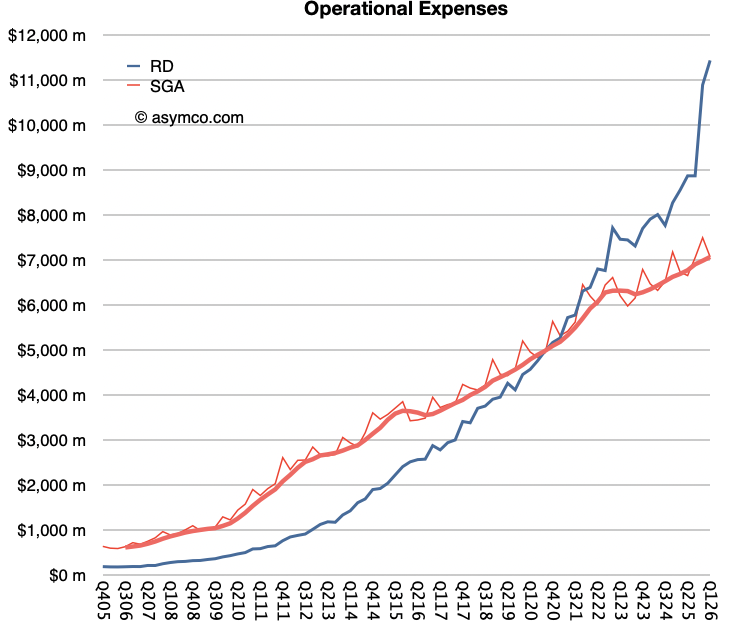
    NB: Apple has been increasing its R&D spending from around 2% to 9% of sales on a 4-trailing quarter basis. It has overtaken SG&A which has remained around 7% since 2011.

  2. Asymco Bulletin 002 / March 1, 2026

    Bulletin

    Asymco Bulletin is a digest of all the work we have published for the week ending March 1, 2026.

    Office Hours

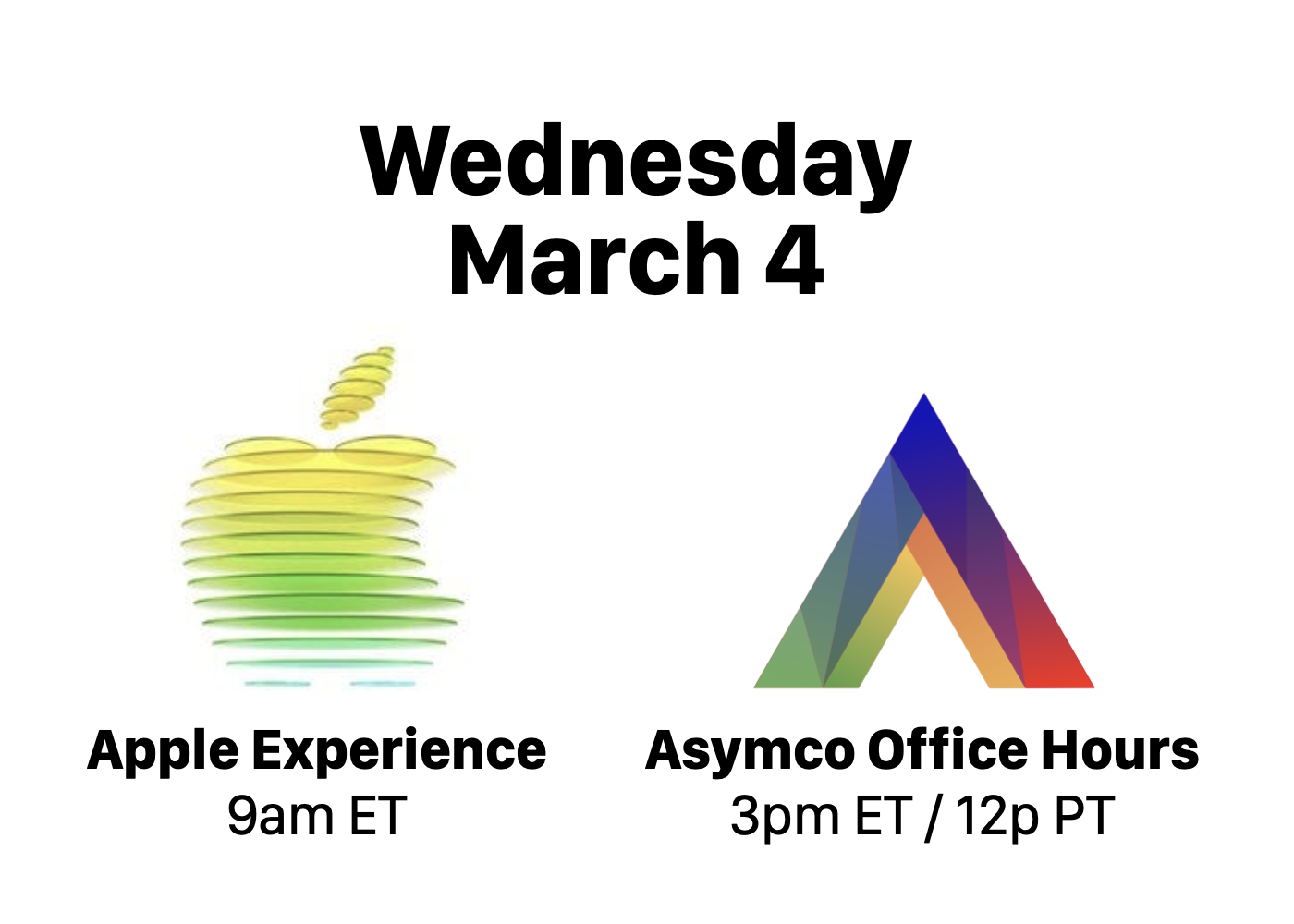
    Our first Office Hours interactive seminar and Ask Me Anything questions/answer session will be on March 4th, after, presumably all the new announcements Apple will be making during the week. I will be broadcasting to you en vivo y en directo from Paris.

    Apple March 4 Special Event – Q&A

    Apple March 4 Special Event – Q&A → Join us for an exclusive Asymco One live Q&A on March 4 at 3pm ET to dissect Apple's latest business moves. →

    Research

    How many Apple users are in China?

    Greater China (GC) is a specific reporting segment for Apple, encompassing Mainland China, Taiwan, Hong Kong, and Macao, with a combined population nearing 1.5 billion. This region is not just a significant contributor to Apple's revenue—accounting for 18% of net sales in Q4 2025—but also a dynamic landscape of technological adoption and consumer behavior. The smartphone user base in GC has surged from 690 million in 2016 to nearly a billion in 2025, with projections reaching 1.08 billion by 2029.

    The iOS ecosystem within GC exhibits varied dynamics across its constituent regions. While Macao maintains a steady iOS share of around 60%, Mainland China and Taiwan show different trajectories. Analyzing these trends through mobile OS share data reveals iOS's ascent, suggesting robust potential for further penetration and user engagement. As Apple navigates this complex market, understanding GC's historical growth patterns and future prospects is crucial for capitalizing on emerging opportunities and sustaining its competitive edge. →


    Nota Bene

    Apple #1 phone vendor in Europe → Apple leads Q4 2025 with a 7% YoY shipment rise driven by iPhone 17, while Samsung follows with 4% growth; Xiaomi faces a 6% decline amid shifting regional dynamics. →

    Are Solid State Batteries Finally Here? → Donut Lab has partnered with VTT for independent battery tests, with full reports and videos to follow. →

    iPhone becomes India’s top single export item → In 2025, Apple's iPhone exports from India, driven by Tata and Foxconn plants and a robust supply chain, reached $23 billion, making smartphones the top export category. →

    Apple’s App Store growth is reaccelerating → Apple's Services, beyond just the App Store, are poised for robust growth, driven by global market expansion and strong hardware demand. →

    Here’s why demand for Macs has spiked → Mac lead times have surged to multi-year highs due to increased demand, notably impacting models like Mac Studio, MacBook Pro M4, and Mac Mini. →

    A resource for AVP news → "AVP VIP offers a weekly, ad-free digest of tech news and insights, accessible to Asymco One members." →

    Apple to Start Assembling Mac mini in the United States This Year → Apple revamps the Mac mini with M4 chips and boosts U.S. chip sourcing, starting at $599 without display, amid rising demand. →

    Apple Pay Aiming Launch in India This Year → Apple Pay aims to launch in India by late 2026, pending regulatory approvals and fee negotiations with card issuers. →

    iPhone and iPad approved to handle classified NATO information → Apple's iPhone and iPad achieve unprecedented NATO compliance, marking a pivotal shift in secure mobile technology acceptance. →

    Eddy Cue says Brazil is Apple TV’s second-largest market, talks Netflix-Warner merger → In an interview, Apple's Eddy Cue highlighted Brazil as the second-largest and fastest-growing market for Apple TV subscribers, while noting potential impacts from proposed streaming regulations and a possible Netflix-Warner deal. Specific user and device numbers were not disclosed. →

    DRAM Shortage Will Cause ‘Seismic Shift’ in Smartphone Market, But Apple Will Be Less Affected → A looming DRAM shortage due to AI demand will slash smartphone sales by 13% in 2026, forcing a market shift towards pricier devices, with relief not expected until mid-2027. →


    Asymco One gives you full access to our research, analysis, and commentary. Subscribe with code BULLETIN for a discount.

    Feedback: Have questions or comments? Reach out to us at contact@asymco.com. We’d love to hear from you.

  3. Are Solid State Batteries Finally Here?

    Nota Bene

    Do I Believe?

    Donut Lab has commissioned the internationally renowned VTT Technical Research Centre of Finland to conduct independent measurements of the battery’s performance and key characteristics. Unless otherwise stated, all tests presented here have been conducted by VTT. Full reports will be published alongside detailed video documentation that walks through the procedures, showcases the test setups, and explains the results.

    Source: https://idonutbelieve.com

    NB: I happen to know of VTT Technical Research Center ...

  4. Post PC

    Research

    Remember the Post-PC era?

    The term Post-PC was first coined by MIT scientist David D. Clark in 1999 and was quickly adopted by both Microsoft's and Apple's former CEOs. Jobs popularized the term "post-PC" in 2007 (the launch of the first iPhone), and in 2011 when he launched iCloud, a service enabling Apple devices to synchronize data through cloud services, freeing them from dependency on a PC.

    The Post-PC era was posited during the late 2000s and early 2010s presupposing a decline in the sales of personal computers (PCs) in favor of devices, phones, tablets, wearables, IoT, etc. These devices were mobile first (i.e. battery-first as opposed to plug-first), connected second and cloud-powered third. They were designed to run "apps" not "applications" and had new ecosystems with millions of developers selling through online-only stores, priced often as subscriptions rather than seat licenses.

    In the last decade or so, the PC did endure an overall decline in sales while phones, tablets and wearables climbed to at least 10x volumes of the PC. But the last few months have shown a resurgence in PC sales. Certainly the necessity of working from home is the reason but will this last?

    The fact is that the PC did not disappear. It certainly is still in use and there are buyers for it. There just isn't a lot of growth or energy. There hasn't been for a decade. The software and hardware efforts are uninspiring because the talent has moved elsewhere. The creativity, R&D budget have gone the same way.

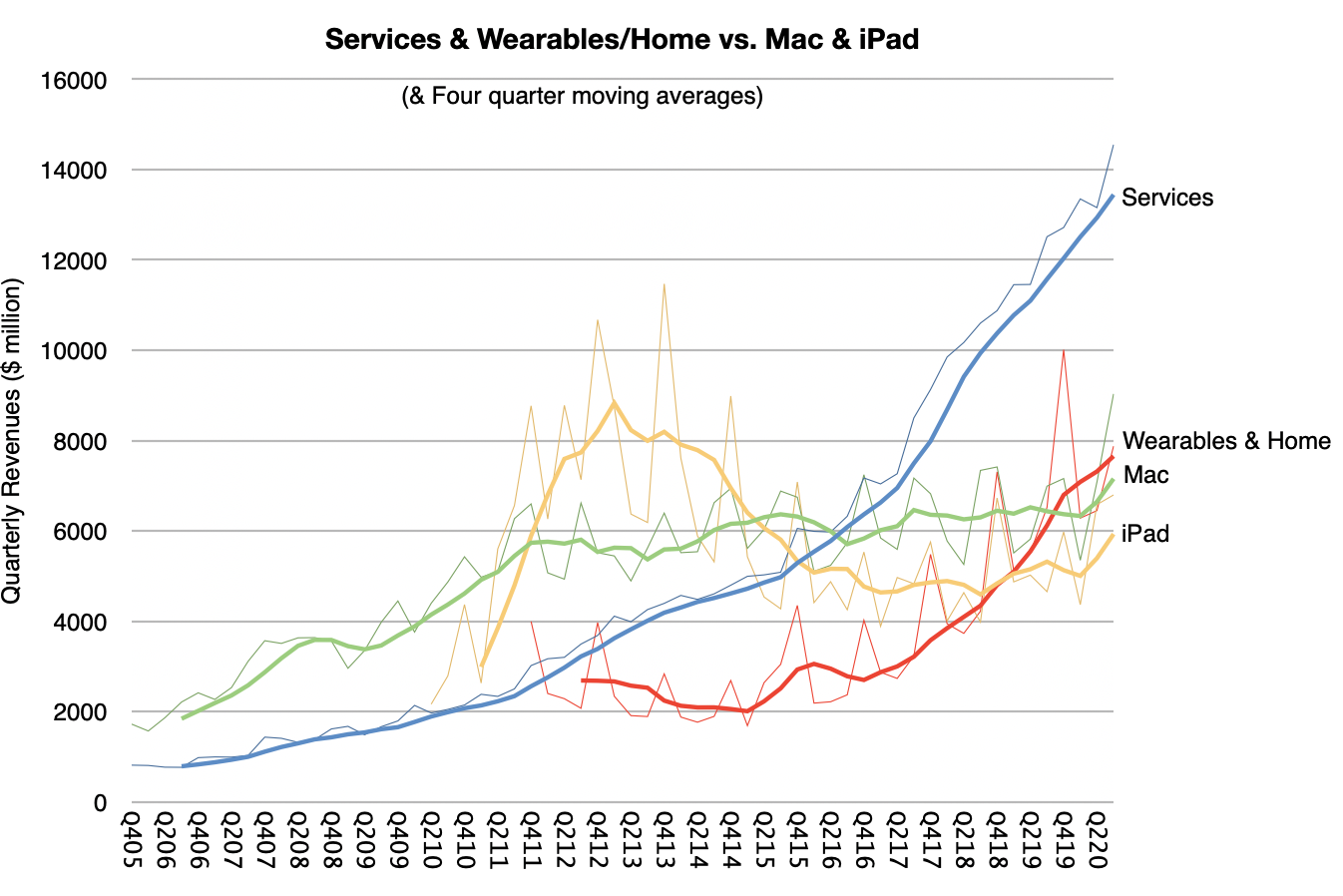
    But what about the Mac? The Mac is the PC from the company that more or less defined the Post-PC era. Would it not be the first to be sacrificed for the new future? As it stands, as the graph below shows, the Mac today is double the business it was decade ago and although it has been overtaken by wearables, it has kept ahead (after a time) of the iPad.

    As it turns out the Mac is doing just fine.

    The trouble with PCs, including the Mac, is that they are stubborn in how they define themselves. Like the power user, they see performance along certain dimensions. They also don't see performance along new dimensions which devices offer with glee. For example connectivity to cellular networks (still missing in even the fanciest laptop but available on my watch.) Then there are the sensors which measure my heart rate, activity level, location, altitude, etc. Then there are cameras which on phones now boggle the mind. PC cameras are comical in comparison.

    Then there is portability and usability without being plugged in.

    Well, it was. With the M1, Apple has finally delivered the always-on feel of a tablet or phone and the more-than-one-day battery life. It also added a lot of neural engine horsepower and a lot of on-chip memory. Apple is delivering a system on a chip which makes the Mac more device-like in its integration. And sales are likely to rise, on the back of a great 2020 for the Mac. The form of the machine might even change with new designs being made possible by the lower heat profile and space savings.

    And so I'm writing this post on a Mac. The graph you see above was created on the Mac. It's possible to do all this my iPad and even on my iPhone but it would be harder. But I'm also willing to bet you're reading this on a phone.

    And that's the crux of it. The PC is still the machine of choice for authoring while the device is the machine of choice for consuming and consuming will always be more popular. What the iPad has done is taken a share of PC use and in my case I do use it for some tasks like email a lot more frequently. The theory would suggest that the iPad will continue its upward trajectory while the PC would abandon the low end.

    This disruption has already happened but it hasn't been complete. The median performance band now belongs to devices but the professional will always ask for more of the performance which they see as productive while the consumer will always ask for more of the performance which they see as convenience. Here the market bifurcates.

    What has been problematic with the smaller of the two markets has been the vicious cycle of lack of investment due to decreasing margins, commoditization and talent flight. What Apple is doing once again is ratcheting up the bar for the PC to make sure it's the top choice for creative professionals. And as long as they are productive, the consumers will keep them employed if not in riches.

  5. S3X Appeal

    Research · 22 comments

    On July 3rd, Elon Musk handed over the first 30 Model 3s and tweeted

    "Production grows exponentially, so Aug should be 100 cars and Sept above 1500."

    He added,

    "Looks like we can reach 20,000 Model 3 cars per month in Dec".

    In 2016 he stated

    "So as a rough guess, I would say we would aim to produce 100,000 to 200,000 Model 3s in the second half of [2017]. That's my expectation right now."

    He confirmed this estimate early in 2017

    "Our Model 3 program is on track to start limited vehicle production in July and to steadily ramp production to exceed 5,000 vehicles per week at some point in the fourth quarter and 10,000 vehicles per week at some point in 2018.”

    Overall 2018 production guidance has been 500,000 units and 1,000,000 units in 2020.

    The company shipped 220 Model 3s in the July, August and September months. This is well below the expectation of 75,000 that the 2016 guidance would suggest ((100,000 to 200,000 for the second half of 2017 suggests an average of 150,000 for the six months or 75,000 per quarter)) or the 1,630 that might be suggested by the "production grows exponentially" July proclamation.

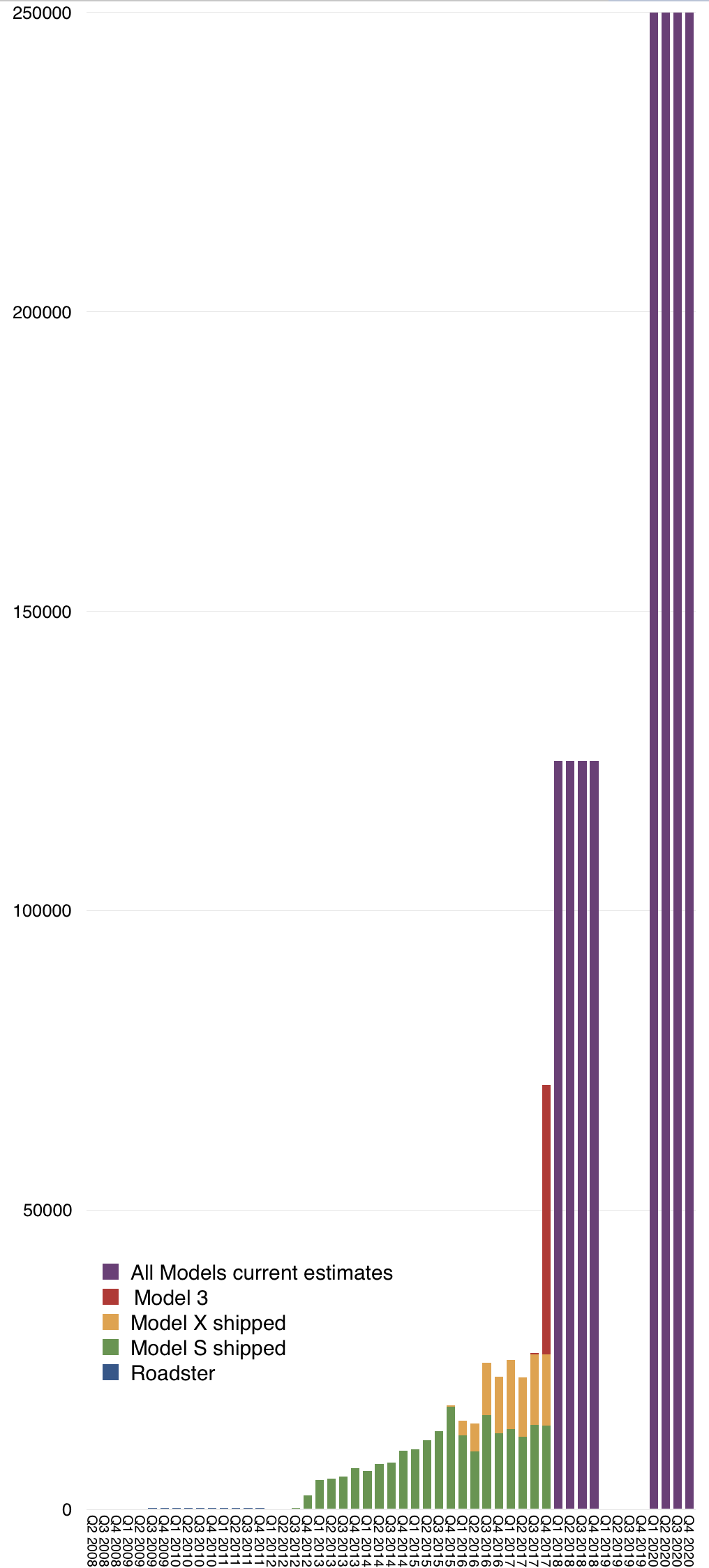
    I entered the Q3 production data and kept the previous run rate predictions for Q4 and 2018 and 2020 in the following graph.


    Note that the graph includes all previous shipments of Tesla cars throughout its history.

    The red bar represents an estimate consisting of the sum of 10,000 Model 3 in October, 15,000 in November and 20,000 in December. This is consistent with reaching the target production of 20,000 in December.

    The purple bars are distributing the planned production evenly throughout the 2018 and 2020 calendar years.

    Before asking whether these predictions can be relied upon, I'd like to focus on the history of Model S and X production/shipments. Specifically the last five quarters.

    • Q3 2016: 24,500
    • Q4 2016: 22,200
    • Q1 2017: 25,000
    • Q2 2017: 22,900
    • Q3 2017: 25,930
    • Q4 2017: 25,845 ((This is an estimate based on another point of guidance: 100,000 models X and S for the 2017 year.))

    Growth in this total figure has been remarkably low. Only about 4% y/y in the last quarter and sequentially the total has bounced in a narrow range.

    This level (about 24,000 units/quarter on average) is a distinct plateau but it's also well above the average of the previous 4 quarters of about 15,000 units/quarter. It suggests that there was a “quantum leap” in production at the end of 2016, to a new plateau.

    So the question is why, with so much pressure to produce cars to meet presumed unlimited demand, is output so limited?

    To see just how limited, consider the rate of output. For the past 15 months and near future, the output is equivalent to 264 cars per day.  If the Fremont factory is running three shifts, 11 cars are produced every hour. This is equivalent to a cycle time or takt time of 5.5 minutes.

    This would be an tragic cycle time.  Most car lines aim for run times between 1 and 2 minutes per station. For example BMW's Spartanburg plant produces 1400 units per day which yields a cycle time of 1 min. ((This assumes one line. The chassis/engine marriage step is clocked at 3 minutes so the worst case is  that there are three lines running at 3 min. cycle time each.))

    This measure of performance is so important that it drives the depreciation and capitalization schedule for tooling and the very lifeblood of the company: capital expenditures. An underutilized factory is a giant hole in a financial statement and destroys value as much as inventory does. Every manufacturer strives for maximum utilization and is sunk if it does not achieve a minimum threshold.

    So why, after a few years of Model S production, is Tesla running at one fifth the speed of a BMW or Toyota plant? One obvious answer is that the company is not running 3 shifts but perhaps 2 or even 1. But why would they shut down the line when demand is infinite? If it is finite, is it really only 25k at most per quarter? That’s a paltry number considering the size of the market they operate in. BMW alone ships 2 million vehicles a year. Tesla X/S topping out at 100k a year suggests a serious limit to their opportunity.

    Another possible explanation is that there aren't sufficient battery deliveries for continuous production. We hear about issues with battery throughput as transients that slow production. But the production data we have spans an 18 month period during which the speed has hardly budged. During this time additional battery capacity in the form of a Gigafactory has been announced.

    If this giant new factory can’t reliably deliver batteries for 25k cars/quarter then how are we to believe that it can deliver for 125k units in a few months? If it's not batteries, then what? I don't know of other subsystems that are chronically constrained that we can point a finger at. Almost all other parts in a Tesla are sourced from existing supply chains.

    The most likely suspect is that Tesla's S/X line is not fully operational. When you study production lines, generally they either work at a decent clip or they don't work at all. They are not designed to be dialed down to be as slow as 5 min for every 10 feet of car. It's much more likely that the line is idle for long periods of time. Perhaps even 2/3 of the time.

    This is what is so mystifying about Tesla's exuberant predictions for the Model 3. The X/S line is bogged down and inefficient five years after production start but we are to believe that the Model 3 line will come to operate at >5x speed within weeks, on a new product? Maybe the X/S line is a failed experiment. Maybe the company is moving to "Version 2" and leaving the cruft in Version 1 without fixing it.

    Maybe.

    Tesla's asymmetric approach to automobile product development and distribution and ownership experience are key advantages but their asymmetry to functioning best practice production systems is a key disadvantage. The big competitive question is will incumbents get good at intelligent EV experiences faster than Tesla gets good at production.

    Outsiders might ask "How hard can car building be?" and vote for Tesla winning this race.

    There is no data on how fast an incumbent learns the EV experience delivery process, as it's never been tried before, but there is data on how fast a manufacturing company learns lean production. Those times were measured in decades.

    [UPDATE]

    In the week that followed this post new claims have been made on Tesla's production system by other publications.

    • Wards Auto published a story on problems with automating the Model 3 production line.
    • Wall Street Journal published a story on claims that Model 3 production was constrained by hand-building on parts of the line.
    • Edward Niedermeyer wrote in the Daily Kanban about regulatory documents that show limitations in production of the Model 3.

    The most relevant quote to this post is the Wards claim that:

    Its current production line in Fremont, CA, can’t build vehicles at [5,000 weekly] rate unless it runs two 10-hour shifts seven days a week, which is not likely for an all-new vehicle, even if everything goes smoothly. The plant presently runs two 8-hour shifts five days a week.

    If this is true then the current Model S/X line is limited to about 50% of capacity or about 25 cars/working hour. This is equivalent to a takt time of 2.4 min/station. This is certainly much better than the estimated 5.5 and within a range of reasonableness, but one has to ask why is the line not operating more than half the time?

    When I wrote about there being "infinite demand" for the X/S, the logic was that the X/S was still a niche product at 100k/yr and the category into which is sells is assumed to have a lot more headroom for their entry.

    The observation that production is topping at 50% capacity for 18 months in a market that is quickly being targeted by competitors remains interesting to me.

  6. Twenty Questions from Catalin Stelian Andrei

    Research · 17 comments

    Catalin Stelian Andrei, Editor of The Day, INTERNET PROTV asked me twenty questions:

    1. What phone do you have in your pocket right now? Why that model?

    I carry the iPhone 5. The last iPhone I bought was an iPhone 5C which I gave to a family member.

    2. Apple is going to launch, form all we know, an iPhone with a bigger screen, long after their market rivals. Is Apple one step behind, being forced to take this road in the fight with Android and Windows Phone devices? Because many smartphone users were hoping that an big screen iPhone, a redesigned model, will be lauched long time ago, and that didn’t happen.

    Making bigger phones is easier than making smaller phones. First because miniaturization has always been the most difficult engineering challenge, and second, because a smaller phone has a smaller battery making efficiency much more important. The larger the phone, the simpler it is. The third reason smaller is more valuable is that it’s easier to carry and use. The largest phones cannot be put in pockets and cannot be used with one hand. In the history of consumer, electronics size reduction has been the most consistent measure of performance, and the most rewarding. Usually the most exceptional reductions in dimensions create the highest price and profit bands. There have been niches for larger portable devices but they are consistently a small part of the overall market. If Apple were to introduce a larger device I hope they will be able to solve usability problems and make the category attractive to a larger audience.

    3. What do you expect from the new iPhone 6?

    I expect it to run the latest version of iOS and, with the new apps developers will ship, that should make the most impact in people’s lives. I imagine health maintenance and home automation will become valuable new franchises. Of course iOS 8 will also run on older iPhones, but I suspect the newest iPhone will somehow run the new software better and have smoother integration with services.

    4. What’s the “not to do” lesson that Apple needs to learn for the now iPhone from it’s own past experience or their competitors?

    The biggest challenge is to move rapidly with scale. The company has managed to grow from zero phones a year to hundreds of millions. That’s great but it’s still frustrating to wait one year for major improvements. The “cycle time” of innovation for Apple remains one year. I wish it could be faster but perhaps this is also too fast for some. In some services like maps and iCloud and iWork, which are independent of hardware (mostly,) speed is of the essence.

    5. The iPhone is the most expensive smartphone on the market right now. In Romania, it certainly is. But where does Apple gains it’s most money from, selling products to users or selling services, like iTunes, App Store? And having that in mind, what will be their next step: better – breakthrough products or bigger, more complete services?

    The answer to where a company “gets its profits” is best answered by asking where a buyer “gets his value” from the product. For instance you might answer the question of where a car company gets its value by saying that it’s from making people be in more than one place in a day. So the “differentiation” of a car is in answering the question slightly differently. If it’s hard to see a difference to this answer between cars then it’s hard for any one company to make a profit. For a company like Apple, we need to ask what its users value about the experience and why they are willing to pay for that. My hypothesis is that the brand's value is in making life a little bit easier. That’s what Apple competes on. Of course, some people are not willing to pay to have an easier life and some even want to make their lives more complicated so Apple’s proposal to make life easier, for a price, is not accepted by everybody—which is ok by them. But for many, paying for comfort, productivity and ease of mind is worth quite a bit. The reason Apple is able to gain a premium over the competition is that this value proposal (of paying for simplification) is either weak or non-existent for competitors. Indeed, many competitors compete on the basis of making life more complicated.

    6. What does innovation means for Apple right now? What are their options for assuring a next decade of success? A new Steve Jobs person or a Steve Jobs tipe of group thinking. How hard is that to achieve?

    Innovation is meaningful invention—bringing useful creations to a large number of people who then make use of that creation. The interesting aspect of making money from innovation is that it’s a rare phenomenon, requiring many disciplines to work together. It’s like a big movie that somehow works and becomes widely popular but costs little to make. Many movies are made, few are successful and very few of those which are successful are built at low cost. What we know about technology innovation is that it’s a combination that comes together under strong leadership but that leadership alone is not sufficient. The myth of Steve Jobs is that he was both necessary and sufficient to success. The truth is that he was necessary but not sufficient. To make successful innovations requires strong leadership and teamwork and a process of incentives and passion that is hard to create a formula for. How this works at Apple is its biggest secret.

    7. Who are the key Apple employees right now? Do they need another Jobs or do they already have him?

    All Apple employees are key. I would say that’s the magic formula. There is no chief magical officer (and there never was.)

    8. What will be the next best thing for Apple? […]

    I don’t know. It’s probably not knowable.

    … Are they capable of another breakthrough in the market?

    Yes. This is almost certainly knowable.

    9. Is the smart-home project something that will really happen in the next, let’s say, two decades?

    If the project requires replacement of existing infrastructure, it will not happen. If the project allows adding new items to existing infrastructure, it will almost certainly happen.

    10. Growth comes from the middle and low-end smartphones, according to IDC. Would or would not be a good idea for Apple to release a handset cheaper than the 5c?

    If Apple were concerned with growth then they should. But we have to ask why they avoided doing this six years ago. Not only was it obvious to do so but a portfolio strategy was the modus operandi for every competitor and had been for decades. The question isn’t why Apple does not broaden its line-up but why do the others diffuse their efforts and have such poor focus.

    11. What feature or software you think would be the main battleground in the future, in the smartphone market? Apps? Battery? Camera?

    Integration of all the above. When new experiences and services emerge those who are able to make them usable succeed. Usability requires integration.

    12. Who puts more pressure on Apple: Apple itself, Samsung, LG, HTC, Microsoft and Nokia? And how.

    I suspect competition is part of motivation but it’s not the entire story. Let’s not forget that Apple is considered to suffer from competitor pressure from software companies, services companies, media companies, hardware companies and everything in between. For instance, Apple is in competition with Microsoft, Amazon, Google and Samsung but the competition is not transitive. In other words Amazon is not perceived as being in competition with Samsung and neither is Google competing with Nokia. So somehow Apple should be sensitive to every perceived alternative to every aspect of its products. This quickly becomes an absurd idea. Apple is a system of things and systems can’t be compared with components.

    13. What is Apple’s sensitive spot today. What do you believe Apple fears the most?

    Losing people. The problem of retaining talented people is the most difficult challenge, especially when they become very wealthy due to the success of the firm.

    14. In 2012, you described the fall of Nokia in competition with Samsung at the Guardian Mobile Business Summit due to the disruption theory: the launch of the smartphone. Is Apple in danger of becoming a victim of the same story in the near future? What technology could replace the smartphone and when?

    Yes, every company is vulnerable to disruption. The defense is not to protect against it but to self-disrupt or enable self-destruction. Self-preservation is an instinct in humans so this is psychologically very difficult. The crisis comes not from a technology change but a business model change and that implies a cultural change. Companies embrace any and all technologies which sustain their business models and reject, resist and ignore any and all technologies which disrupt their business models. Changing business models is like a brain transplant; it happens so rarely that we can count it on one hand. By the way, because it’s so rare is why companies who attempt it are discounted by the market.

    15. You've been a Nokia executive. From this perspective, how do you see the deal with Microsoft and the future of Windows Phone and the Lumia brand?

    This is a long story. I can’t really do it justice now but I will say that it seems that Microsoft understands that they need to become an integrated systems company and not a component supplier. The same became evident to Nokia so they needed to merge.

    16. You've also worked with people from RIM. Do the have the capacity to innovate?

    Perhaps but scale also matters. RIM and HTC may not have the time to grow.

    17. Let’s imagine that no big company owns my personal information. If I wanted to sell that to someone, what would be the right price to ask? How valuable are individuals in the war for gaining personal information?

    The price of your personal information will be set by auction. It’s up to you to decide if you want to create a reserve price or to let the highest bidder win. As of today most people would trade all their personal information for almost zero price. This will not last and consumers will find out their value over time. I can’t predict how it will change but it will be a combination of offers being made and personal data catastrophes which will act as warnings.

    18. Do you believe in phoneblocks project from Motorola?

    Only people who want more complicated lives will want to build their own products. There are some such people (for example children) but they are not willing to spend a lot for that complication so the overall market for increasing complexity is small.

    19. The last question. What could trigger an Apple fall and when?

    The most common trigger for failure is success. To continue succeeding is very hard because motivation disappears. What can cause a crisis of motivation would be that there is a loss of belief that there are problems left to solve.
  7. M is for Mystery

    Research · 87 comments

    I recently tweeted that any discussion related to wearable technology needs to begin with a description of the job it would be hired to do. Without a reason for building a product, you are building it simply because you can.

    The reason a product deserves to exist is that it can do a job that needs doing and that few, if any others can also do it. This happens when the job is unstated and difficult to perceive. Put another way, the difficulty behind jobs-to-be-done based design is that jobs are never plainly evident. In contradiction to invention, where the problem being solved must be as clearly stated as its solution, value-creating innovation meets new and unarticulated needs. Even when created, the value is more subtly perceived, often only after prolonged use.

    Which brings me to the M7. Apple chose to highlight a component (curious in itself) which it bills as a "motion coprocessor". It claims to be measuring motion data via accelerometer, compass and gyroscope and processing the information in some way. By bundling the sensors and their management into one integrated chip battery consumption is reduced and these motion monitoring functions are performed more efficiently.

    But what for? The examples given during the presentation for an iPhone with M7 don't add up to a lot of benefit. An iPhone could be used as a fitness companion but it would not a very good one. Compared with, for example, a Nike FuelBand, an iPhone could not track your activity well. It's often not moving, sitting on a desk or in a purse or pocket while you are doing exercise. It's too big to take into a basketball game. It can't "observe" your activity because it's not worn during many activities and if it is worn it is in a position which does not inform much about what you're doing. Phones are too big to be used as physical activity monitors.

    Hence the question of what is the M7's job to be done. As part of an iPhone, it does not seem to have one. Saving a bit of battery life is not a job, and certainly not one that needs to have billing in a media special event. The answer must be that the M7 was developed for some other, as yet unstated reason.

    When the A series chips were created Apple leveraged the in-house design and cost reduction to make a wide range of products with more than 700 million examples built. Designing a chip needs a broad application domain.

    Perhaps this is why Apple chose to describe the iPhone 5s as "forward-thinking". The M7 and the Touch ID are like research projects whose actual value will be realized at some future time, in probably different contexts. The M series of chips may become Apple's "low end" microprocessor as the A series climbs the trajectory into core computing tasks (read: phone, tablets, TV, laptops).

    M might be the chip for the wearable segment, woven into a whole new fabric of uses and jobs to be done.

  8. Tim Cook's answer to my first question

    Research · 114 comments

    Tim Cook was asked the first question (on the iPhone portfolio). His answer is paraphrased here:

    We haven't so far. That doesn't shut off the future. Why? It takes a lot of really hard work to do a phone right when you manage the hardware and software and services in it. We've chosen to put our energy on doing that right. We haven't been focused on working multiple lines.

    Think about the evolution of the iPod over time. The shuffle didn't have the same functionality as other products. It was a really good product, but it played a different role — it was great for some customers it was strikingly different than other iPods. The mini played a different role than the classic did. If you remember when we brought out the mini people said we'd never sell any. It was too expensive and had too little storage. The mini proved that people want something lighter, thinner, smaller. My only point is that these products all served a different person, a different type, a different need. For the phone that is the question. Are we now at a point that we need to do that?

    …

    At a macro level, a large screen today comes with a lot of tradeoffs. When you look at the size, but they also look at things like do the photos show the proper color? The white balance, the reflectivity, battery life. The longevity of the display. There are a bunch of things that are very important. What our customers want is for us to weigh those and come out with a decision. At this point we think the Retina display is the best. In a hypothetical world where those tradeoffs didn't exist, you could see a bigger screen as a differentiator.

    Full interview here, answer begins around minute 37.

    Here is how I interpret the answer:

    • The iPhone portfolio may still arrive. It hasn't so far because the cost/benefit is not there for Apple. On one hand it would take a great deal more sourcing effort and risk while dealing with constraints in production. On the other it would not not offer meaningful additions to the customer base. At least so far. The economics and the demand may change (or have changed) and the time will come for a broader portfolio.
    • The comparison to iPod is not entirely appropriate because as a music player, the iPod had a relatively small set of jobs to do. It was hired for exercise, escapism, isolation, etc. It was not hired for apps and services which extend the medium itself. In other words it was not a computer. As a computer, the iPhone has a near infinite set of jobs to be done and it's the hundreds of thousands of apps which help it perform them. But as a result the iPhone needs to conform to the dynamics of ecosystems and that means consistency of APIs and user experience. It cannot vary in terms of input methods, or be below minimum requirements of screen size or memory and power.
    • Because of the rapidly expanding job space, Apple believes the iPhone was not "good enough" for all these years. The improvements shipped for each generation were all "meaningful" in that they were valuable and absorbable. Users would use the new features (like better screens, cameras, battery, etc.) and they were willing to pay for them (as evidenced by the sustained high average price).
    • On the question of what the extension might be, changing screen size is one dimension but it has to be balanced by performance gains that don't detract from other dimensions. Engineering is all about compromise and consumers pay Apple to make these compromises in an intelligent way. Apple does not come to an answer to the question of balance by launching many products and seeing what works. It cannot afford to dilute its brand with a long list of failures. Other brands may not be affected by trial-and-error approaches to the market but they are discounted by the customer accordingly.


  9. Pattern recognition for smartphone investors

    Research · 42 comments

    I spent the last few days in Hong Kong at a conference discussing the smartphone industry. The participants were mainly investors or investment managers. One of the most frequently asked questions was how to spot investable trends in this notoriously unpredictable sector.

    The data I presented did not offer much of an answer. If anything, it showed just how much the industry has changed and how unlikely it is to remain a facsimile of what it is today.

    But theory allows us to still make some bold claims. Grounding your investment thesis in pattern recognition rather than extrapolation should be the better strategy. So here are the telltale signs I recommend watching for investable ideas.

    1. In hardware look for what's not good enough. The smartphone is great. But it's not good enough for many jobs that we can recognize with little effort. For example, smart devices never seem to have enough battery life. Storage, screen quality and speed are pretty good, but battery life is worse than what voice phones offered years ago. Companies dedicated to improving battery technology or charging technology should be worthy of a bet. Breakthroughs in power saving will be much more valuable than breakthroughs in storage or processing speed or screens.
    2. Pricing needs innovation. Phone pricing is opaque, user unfriendly and often leaves buyers confused and angry. I use the word innovation instead of reduction because it's not about making prices necessarily lower, but removing complexity and defining value clearly through price. The challenge is not just for devices but for service providers as well. Companies innovating by abstracting pricing complexity will do very well. Interestingly, pricing innovation is not as easily copied as it may seem. It is often coupled with business model innovation and cost restructuring.
    3. Applications currently conform to platform needs but there will come a time when platforms will need to conform to application needs. By applications I mean not just apps but the app/service bundle that will drive consumer purchasing behavior. If we consider social media, entertainment and shopping as applications, it will make sense for those applications to eventually take some control or equity in the platforms. Android is the first sign of this: search and services associated with search and advertising sought control over platforms. Perhaps Facebook, Amazon and Baidu will feel a similar need.
    4. As a new medium, apps will eventually be more valuable than the tools used to render them. The global app brands are probably not yet born, but some day they will be as important as Disney, News Corp and Universal Pictures in their heyday. The App Store is the incubator for these embryonic megabrands.

    I realize that these are not specific enough investable ideas but casting your eye on patterns should yield better returns than selecting winners from a set of "current players".  After all the great returns from smartphones to date have come from bets on entrants (HTC, Apple, RIM) and not from incumbents (Nokia, Microsoft or Motorola).