Asymco

Asymmetric Intelligence

BlackBerry

  1. The case against the Kindle as a low end tablet disruption

    Research · 232 comments

    In an Harvard Business Review post Rob Wheeler makes the case for the Kindle Fire as a disruptive innovation. I believe that it is but crucially I disagree that the Kindle Fire is a low end disruption.

    My assessment of the Kindle Fire is based on the two attributes which Amazon highlights as the key selling points which offer a basis of differentiation and potential for asymmetric competition: a low price and a new browsing model. I believe that these two attributes result in two opportunities: one for low end disruption and another of new market disruption. I reject the first and tentatively support the second.[1]

    The price

    It's immediately obvious that the price point of the Kindle Fire is well below alternatives. That forms the basis of disruptive potential, but before we jump to analyzing the disruption hypothesis we should determine whether and to what extent Amazon profits from the device directly. Profitability gives us a clue to where Amazon will apply resources and thus establish its trajectory of improvement.

    We know the margin on the Fire is low because we can calculate the bill of materials for 7" tablets. Gene Munster of Piper Jaffray estimates that Amazon "loses" $50 for each unit sold. We also know that the design Amazon used is essentially very similar to the RIM PlayBook and was sourced from the same ODM. RIM priced the product at $499 but has struggled to find buyers and is reluctantly dropping the price. We also can estimate that Apple with a product having more than twice the screen size is keeping modest (~30%) gross margins for at a price point approximately double that of the Fire. It does seem that Amazon does not have much or any margin to dip into.[2]

    So the Fire can be classified as a low price product. Does that make it a low end disruption?

    Disruption requires asymmetry but it also requires the ability to go up a trajectory of improvement along the basis of performance that a majority of users demand. The first condition is met, but what of the second? In a combined system where one asset is used to leverage another--the subsidized being sacrificed to benefit the profitable--success is conditional on one element being "good enough" while the other "needing improvement". Investment follows accordingly.

    But investment decisions have consequences. The subsidized device is starved of investment while the profitable service is nurtured. We see evidence of short cuts in investment in the off-the-shelf nature of Kindle products: from a second-hand (unsanctioned) OS to a second-hand (ex-RIM) hardware. Meanwhile, Amazon spends heavily on capex for the infrastructure that delivers the profitable content.

    If the hardware is indeed commoditized and cannot be usefully improved, then this model works. If, on the other hand, the hardware and systems software can benefit from dramatic improvements in technology then the model fails. The very asymmetry of a service vs. a product turns into the latter having all the advantages and the former failing to gain traction.

    I'll give three examples of this how service model creates limitations which lead to a failure to disrupt a product model.

    The Game Consoles

    The first is the game console business. In consoles, the vendors maintain long hardware product life-cycles to recover their hardware investment and subsidy by maximizing the number of games attached to each console. If you plot product cycles you realize that the bigger the subsidy, the longer the hardware lifecycle. The result is a very wide turning circle which prevents innovation in new dimensions.

    Consider that the Playstation or the Xbox could have been a low end computing disruption. The original Xbox was in fact a PC. It was supposed to bring PC dynamism to the console business and create a cottage industry of new developers building games on commoditized hardware. However by the second generation the Xbox was a locked down, custom architecture, pure gaming machine. Gone was Intel, gone was the PC architecture and gone was any dream of cheap development.

    This is entirely due to the economics of subsidized hardware. It compelled Microsoft, the world's greatest software company, built on the open and cheap PC architecture to make closed, expensive hardware. Sony followed in kind as did Nintendo. Each generation of consoles was a sustaining improvement on gaming and had no ambition beyond gaming[3]. The subsidy and the dependence on an integrated content value network led to a distinct lack of disruption and an insular industry which continues to seek out increasingly immersive experiences for increasingly demanding customers while itself being disrupted by casual, mobile gaming.

    The Set-top boxes

    The second example is the TV set-top box business. There again, the vendors maintain long hardware cycles in order to recover subsides. There too, the main value driver is the content and its distribution which stipulates the architecture, and through subsidy, defines its evolution. This offers the vendor no motivation to improve the user experience[4], secondary uses or the absorption of new streams of content (like those the internet can offer.)

    Again, the set-top box could have been a budding disruptive opportunity for Microsoft. They invested billions in the 1990s to acquire placement of software on set-top boxes in an attempt to penetrate the living room. And again Microsoft was not alone. Since then Tivo, Google and Apple and many others tried to attach cheap hardware to video streams. They all failed to get on a disruptive trajectory. And again, the blame can be placed on the stifling effect of subsidies and dependencies on services or content which dictate where the value and hence the investments should go.

    The Blackberry

    The third example is the RIM Blackberry. Although RIM made most of its money on hardware and was by no means subsidizing it, the differentiation of their product was undoubtedly its service value. Both as a corporate device with BES and as a consumer device with BBS, customers "hired" the product as a service. By being committed to this model RIM management became blind to the hardware and client OS software innovations coming down the pike.

    Through their own admission, they could not accept a touch screen because it would make the messaging experience too slow and it is messaging that sells Blackberries. They could not accept apps (and hence platform orchestration) as a differentiation because their customers did not hire Blackberries for "lifestyle apps". Merely being differentiated as a service leads to blindness and enough hesitation that you run off the disruptive rails.

    People ascribe myopia or incredible absence of mind to RIM's management but the opposite is true. They were deeply committed and observant of the things which made the Blackberry successful. It just happened to be something that stopped being relevant.

    The iPhone

    I'll add one more "bonus" example on this. The iPhone is also a subsidized product and it seems very successful. How come it won? The answer is in details. As I mentioned, the other products ended up in poor life cycles or incorrect motivations. The iPhone differs in that the lifecycle of the product is much shorter (2 years ownership with 1 year for product updates). The shorter lifecycle works for the iPhone because it has a very high service revenue base to dip into to offset the subsidy. Something none of the content models above could count on.

    Consider that each game console subsidy needs to paid off by a handful of game titles whose royalties to the console maker are modest. Or that the TV box needs to ride on top a service that also has thin margins from a stable or slightly shrinking user base. In contrast, the iPhone enables vast new consumption worth thousands of dollars to the operator. This is the famous ARPU uplift that smart phones enable. Users are doubling their telecom spending when they move to smartphones.

    The margins for Kindle content are thin. Very thin. Apple runs its content business at break even though it transacts billions of items per month. The amount of content that needs to pass through the Kindle ecosystem (with lower prices than Apple charges) will need to be astronomical to make it profitable on the shortened cycle time the iPhone enjoys. Thus the Kindle is likely to languish in a leisurely update cycle with users encouraged to hang on to their devices for years. This is the case at least with the original e-Ink Kindles. How eagerly awaited are new generations? How many users stampede to update the hardware or even upgrade the software? How many users have owned every version of the Kindle?

    Service Scale

    Finally one last point about services. As Amazon asserts, they see Kindle as a service, which, I concede, is asymmetric to a product business. The problem is that services don't scale as well as products. Consider that none of the content streams that Amazon will depend on are available outside the US. The Kindle has not been a strong seller internationally. This is because book rights are limited to national boundaries as are movie rights and song rights. Apple has only this week finally completed the rollout of iTunes music to all of Europe! A process that took almost a decade. And they are still unable to sell music in most of Asia and forget about movies or TV shows.[5]

    The reality is that there are no global service brands. Not in telecommunications (operators are, at best, regional), not in Media (TV, radio, publishing are a local businesses), not in Banking (not even in commercial banking) and not in Retail (even Wal-Mart was humbled trying to export its disruption). The internet has not broken down any of these boundaries and even Amazon has modest reach outside the US for any of their franchises. Services are local but products can be global.[6]

    To wrap up, this discussion on the asymmetry of device-based services to product models leads me to conclude that the Fire will not have the opportunity to disrupt the iPad or tablets in general. Amazon sees the hardware and software of a device as a commodity and the content and its distribution as valuable. This assumes that the device is "good enough" and will not require deep re-architecting or that new input methods can be easily absorbed. In short, they see the tablet as at the end of its evolutionary path. Apple sees the exact opposite. The iPad is 18 months old, and as they say in the ads, they see it as only the beginning.

    ---

    Notes:

    1. Due to length of discussion, in this post I will make the case against the low end disruptive potential and use a second post to make the case for it being a new market disruption.
    2. Presumably, Amazon will also distribute only through Amazon.com and thus not incur channel mark-ups. This means that comparisons with other tablets should be at a price nearer to 70% of retail.
    3. Gaming networks and video streaming are extensions but neither leveraged open architectures.
    4. See also discussion from June 2010 on the challenges to Apple TV that Steve Jobs enumerated.
    5. Apps are another story. Because it controls the medium, Apple can and does sell apps in every country where the iPhone or iPad or iPod touch is available.
    6. Note also that because of distribution through Amazon.com, the Kindle cannot reach as many buyers as a tablet selling through the tens of thousands of points of purchase that operators and retail shops offer.
     

  2. The tell-tale signs suggesting a platform's demise

    Research · 74 comments

    In the post on OS turning circles, I used the concept of a radius of turning as an analogy for agility. One problem with the analogy is that turning in circles implies a return to a starting point or at least a closing of the loop. The idea is that there is lifecycle repetition. However, in reality, this does not apply to the world of operating systems.

    An OS, as a platform, usually has a finite life. It is born, grows and usually reaches a point where it is no longer supported. Sometimes, a new platform is born to take its place from the original owner but more often a replacement comes from a new challenger company.

    So rather than circles, the analogy of OS lifetimes may be more accurate.

    If we do think of platforms as finite, then the natural question is what causes an end? We need to look for patterns which may indicate when a platform is reaching end of life.

    The difference in this analysis is that the measure of "age" of a platform I use is not time per se but versioning. The logic is that each major version is a meaningful and significant improvement in a platform which needs to be delineated, marketed and celebrated. It embodies the business logic as well as the engineering logic of the platform custodian.

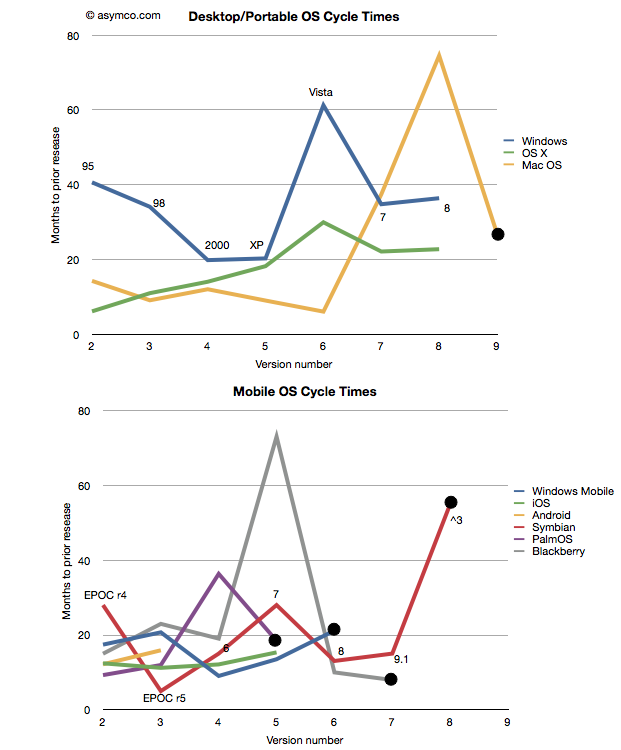
    Taking the data from the last post I added a few more platforms: Symbian[1], PalmOS and Blackberry OS[2] to seek out patterns. I also separated the desktop/portable OS's from Mobile OS's and plotted these version-demarcated lifespans.

    One thing to observe is that the scales of the two charts are comparable. There are examples of short- and long-term version updates and the number of iterations (lifespan) can be similar. I noted also that there were several platforms which have reached end-of-life[3][4]. Those platforms have a big black dot at the end of the line.

    That leads to another observation. The end of a platform seems to be indicated not by simple age (the shortest lived was six years and the longest lived was 16) nor by the number of versions (PalmOS lived for five while MacOS lived for nine). Instead the end of life is most clearly visible as a lengthening of the development cycle.

    Note that each platform that ended was preceded by a spike into the vertical--a significant delay in the release of a version. The data is one thing, but it's anecdotally supported by observation. Industry observers note that delays in improving the product are symptoms of some fundamental architectural or marketing roadblock. In the case of Mac OS, Apple struggled to bring modernity to its "Classic" OS. It need memory management, more reliability and a better file system to support the move to networking and media hub use that defined the consumer expectations of a PC.

    There was a change in the basis of competition, away from pure productivity and more toward entertainment that turned out to be more demanding in new ways. Apple had to move away from Mac OS and lost time with its internal Copland effort before punting with NextSTEP. Similar transitions are visible with Palm (from PalmOS to WebOS), Microsoft (from Windows Mobile to Windows Phone) and Nokia (from Symbian to MeeGo) and RIM (from Blackberry OS to QNX). In fact, survival of a transition is relatively rare and never without significant pain and loss of value or share.

    This is also understandable through the lens of disruption theory. As a product reached the point of being good enough, "breakthroughs" are harder to come by. Engineers and marketers struggle to push the product into increasingly rarefied strata of performance. The old architecture does not fit the new demands but it's crammed into them anyway. This last big push is then followed by a stall and ultimate demise. Meanwhile, an entrant gains lift in the rich atmosphere of new bases of competition with an architecture that's built specifically for it. The process then repeats.

    And so the charts relate the same story of sustaining improvements followed by inevitable last gasps that Clayton Christensen first illustrated[5] in The Innovator's Dilemma. A book that came out just as the first mobile platforms cataloged in these charts began their ascent.

    ---

    Notes:

    1. Versions of Symbian do not match easily to integer values. I used the versions as recorded by pdadb.net. The sequence is as follows: EPOC Release 3: "1", Release 4: "2", Release 5: "3", Symbian OS 6.0: "4", OS 7.0: "5",  OS 8.0: "6", OS 9.1: "7" (9.0 was deproductized), Symbian ^3: "8". Symbian ^4 has been cancelled. These original version numbers are noted on the chart.
    2. The times recorded are for "general availability of product" which in the case of mobile OS's means the time when a device using that OS was released.


      Symbian
      PalmOS
      Blackberry
      Jun-97
      Jun-96
      Jan-99
      Oct-99
      Mar-97
      Apr-00
      Mar-00
      Mar-98
      Mar-02
      Jun-01
      Mar-01
      Oct-03
      Oct-03
      Oct-02
      Nov-09
      Nov-04
      Sep-10
      Feb-06
      May-11
      Sep-10
    3. End of life is defined as the last version generally available. In some cases (e.g. PalmOS 6) newer versions are built but they may not be released into a working complete product.
    4. Windows Mobile is treated differently here than in the previous post. I chose to declare it EOL after version 6 and consider Windows Phone as a separate OS. This is because the name change is indicative of a break with the past. As before, I defer decisions about continuity to the developers and/or marketers who choose the naming conventions.
    5. See slides 3 and 5 here
  3. RIM and the lamentation of the analyst

    Research · 83 comments

    RIM shipped 10.6 million Blackberries and 200,000 PlayBooks in the last quarter. Management noted that their sell-through was significantly higher for Blackberry (13.7 million) but seems to be very weak for PlayBook as the prior quarter saw 500k units shipped. Additional PlayBook units this quarter probably mostly went into new channels in Asia and there were no additional sales into North America or Europe.

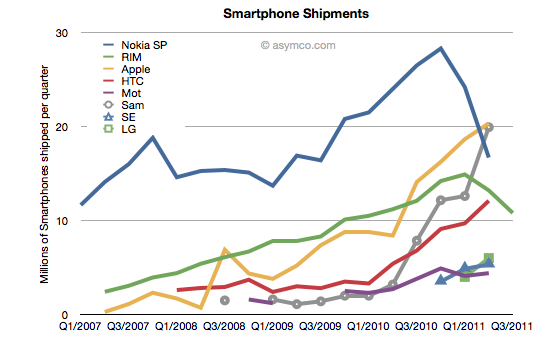
    The figures for units are very poor. How poor depends on the frame of reference. Consider the shipment chart below:

    In terms of the competition, 10.6 million units is less than half what Apple or Samsung sold in its prior quarter. It's also less than what HTC sold. RIM's volume rank will likely go to fifth place as a smartphone vendor.

    In terms of its performance relative to its own history, the Blackberry volume dropped by 11% year-on-year and 18% sequentially. This is the second quarter that shipments shrank.

    In terms of market share, we'll have to wait for the competitor data over the next six weeks but the market has been growing at an average of 77% for four quarters so any continuation of this trend would imply RIM's share dropping to single digits.

    Finally, the biggest shock has been the decline in profitability. It seems that operating margin dropped from 21% to 13%. The company did incur some one-time charges for recent layoffs, but even without that charge, the margins would be around 16%. This is most alarming. The reason for such drops is that as volumes decrease fixed costs don't decrease as rapidly or at all. The company still needs to keep sales, administration and engineering staff around and they become a larger part of the operating expenses (vs. the component costs which vary with volume of goods sold).

    This effect is well understood by financial analysts and the stock price shows it with a huge drop.

    But stepping back to look at the picture above, there is a clear turning point in the company. You can see the elbow in the curve for volumes whose effect is felt so deeply. What's curious is why the pivot occurred when it did. We can point the finger to competition as the cause. But why was there no effect in the company's fortunes when the competition actually emerged. It's been years since the iPhone and even Android entered the market. Yet we see an impact on Nokia and RIM individually at apparently arbitrary points of time.

    This is the lament of the analyst: you can clearly and accurately state what will happen but when remains a mystery. It's the elasticity between obvious causes and their effects that makes this an inexact science or not a science at all. In retrospect, you can say that Nokia's pivot was triggered by its public execution of Symbian, but that assumes that it was preventable--which we know is not the case. But what caused RIM's change of growth, exactly? Why did it happen this past spring? Why didn't the company volumes begin to decline as iPhone and Android boomed in 2009 or 2010? For quite some time RIM seemed immune to competitive pressure. We all were made fools as we called its imminent demise. Then, as Steve Jobs would say, boom!

    ---

    Footnote:

    Piecing together RIM's performance is becoming more difficult each quarter. The data being presented is increasingly obfuscated by irrelevant detail while major information is omitted. This last management presentation was full of holes, namely:

    • We have no idea of device pricing. Valiant efforts have to be made to piece together that aspect of the business. Matt Richman does a good job but it still requires some guesswork regarding PlayBook pricing to back out Blackberry pricing.
    • Management detailed where Blackberries were selling-out but only detailed sell-in for the PlayBook. Obvious spin.
    • They are cherry picking the data they present and each quarter it's a different story making pattern recognition impossible.

    This leads to an erosion of trust. Observers are faced with the problem of increasingly guessing what is happening each quarter. For instance, regarding pricing I prefer to include service revenues in the analysis of device sales because device+service is what is being bought by the user and vendors which can offer services as part of the device get a justifiably higher value for the product--value that I think needs to be considered as advantageous. Nokia and Apple also account for services (though not apps) as part of device sales and it makes it more convenient to compare these businesses.

    Given RIM's smokescreen, this quarter I decided to stop trying to guess Blackberry pricing and used Operating Income/Units sold as the average selling price.


  4. The third ecosystem. What are the odds?

    Research · 155 comments

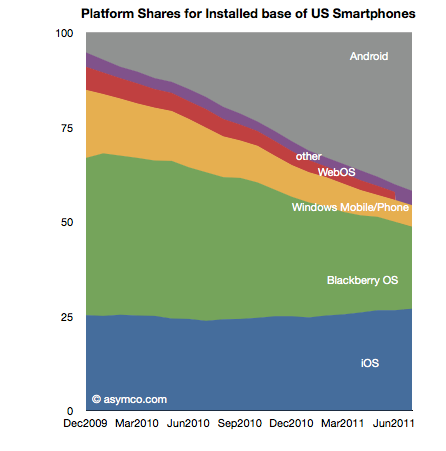
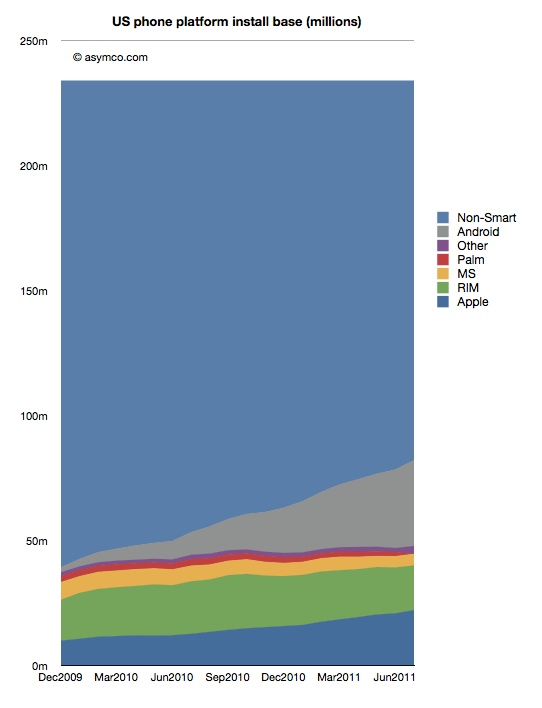
    The latest survey from ComScore breaks down the installed base of specific mobile platforms in the US. Tracing the data over time shows the following charts:

    In the last month Android gained about 2.9 million users, iPhone 1.3 million, Blackberry lost 530k users and Windows held on with a gain of 132k. Other platforms had a net loss of 95k users.

    In the last 12 months, Android gained 25 million users in the US. iPhone gained 9.5 million while Blackberry lost 3.2 million and Microsoft lost 1.6 million. Other platforms had a net loss of 1.2 million.

    The total net gain of smartphones was about 29 million new users.

    RIM switched from being a consistent net gainer of users to a consistent net loser of users in October 2010. Windows Phone is showing signs of holding the line on user base erosion but share remains below 5% (now at 4.7% vs. 4.6% last month). To put the mountain-sized hurdle in perspective, Android now has 7 times more users in the US while iPhone has about 5 times more. To become the largest mobile platform in the US, as some analysts are predicting, Microsoft has a 12:1 disadvantage that looks to continue to grow.

    Those are some pretty tough odds.

  5. The Android (in)adequacy: How to tell if a platform is good enough

    Research · 97 comments

    About 10 years ago I met an advertising executive in New York who explained the difficulty of advertising a new brand of deodorant to consumers. “Most people never change their deodorant,” I remember him saying. “They pick one brand when they are young, and stick with it for a long, long time. If it works, why switch?”

    The same theory can be applied to customers who are making the switch to smartphones today. Once they have picked a type of phone, whether it’s Apple iOS, Google Android or something else, it’s difficult, and often expensive, to switch. Consumers become comfortable with the interface and design of the phone and the apps they have purchased on that platform. If it works, why switch?

    Many Smartphone Customers Are Still Up for Grabs - NYTimes.com

    This quote says a lot. The notion that customers remain captive to a platform is well understood. After all, it seems impossible to get people to switch out of Windows (or Mac or iPod). Platform vendors are aware of this as the land grab for users seems to be running at full pitch.

    However, there is a critical condition described in the quote above: "If it works, why switch?"  The condition which keeps users loyal is that the product they chose is good enough--i.e. "it works." That's a symptom of over-service and commoditization. If a product, like deodorant, is good enough you won't be tempted to move to another brand even if it's marginally better since the new brand has switching costs in the form of uncertainties ("Will it be as good? What if I don't like the smell? etc.) People are inherently conservative and you can't compete with comfort and familiarity by launching a marginally better product.

    So with that in mind, why is it that millions are switching mobile platforms?In this blog I've cataloged the massive shifts occurring away from mobile platforms that have been around for years with deeply entrenched user bases. Microsoft's Windows Mobile, Nokia's Symbian, Palm's PalmOS and RIM's Blackberry have collectively lost tens of millions of users. A net of half a million Blackberries are being abandoned in the US every month.

    So we would need to say that the condition of "it works" or being good enough was not met with those platforms. The attraction of something better is clearly greater than the switching cost.

    So this highlights a good test for how to tell if smartphones are good enough: If users are fiercely loyal with a given platform then it's probably good enough but if they are willing to switch (i.e. disloyal) then it's probably not good enough. It seems like a trivial observation but it's a very important clue to the bigger question of whether we can "call the end" of the market. Just like it would have been premature to call the end in 2006 when Symbian and RIM seemed unbeatable, it will seem premature to call the end now in the event that a significant innovation is yet to appear.

    The correct calling of the end has profound investment implications. Do you (like Microsoft) invest billions in a new platform if you know that there is no more room for entrants? Should Samsung bother with Bada or HP with WebOS if the game is already over? Even more, should Apple even bother to improve iOS if they have no shot at switching a billion likely Android adopters. Why not just nurture the current installed base and work on building walls and moats around them?

    So with this hypothesis in mind, it makes sense to analyze whether Android or iOS, the current presumed champions, are "good enough" on the basis of how often users switch out of them. My bet is that neither is good enough and that there will be increasing churn between platforms. I imagine that Android is less sticky (and hence less than good enough) based on app consumption but there is little evidence of churn because most phones in use have been bought less than one device generation ago. More importantly, there have been few opportunities yet for switching as many Android buyers don't even have the choice of other platforms either due to where they live or how much income they have available.

    To really tell where we stand, we would need to collect stats on switchers to know just how satisfactory the platforms may be. Remember that a choice of a new deodorant on the same shelf at nearly the same price is the test for loyalty. For an adequacy test we need to see better distribution and more choices for consumers. It's still very early even in the US for any conclusions to be drawn about the adequacy of Android.

  6. Nokia a trop écouté les réseaux télécoms

    Research · 70 comments

    My thanks to Robert van Apeldoorn, journalist for Trends Tendances Magazine, for asking good questions. My responses are reproduced below. The article (in French) is titled "Nokia a trop écouté les réseaux télécoms" and can be found in the June 23rd edition of the magazine along with more details in the article "Comment Nokia peut-il renaître?".

    -About your post “Does the phone market forgive failure”, that puts forward the idea that all mobile device vendors experiencing losses never really recover… It seems that this possible “rule” is more severe than in the computer industry. If Digital Equipement, Compaq, WordPerfect did fail, IBM and, yes, Apple, did survive failure and rebound strongly. Do you think that there is a difference between the industries? What makes the failures more lethal in the mobile device market ?

    The observation is unique to the mobile phone market and even there it's only an observation not a rule. It could be that Nokia will be the first mobile phone company that will recover from severe crisis, but history shows it to be very unlikely. I try to shed some light on the reasons why it's unlikely and what makes the mobile phone market so unforgiving. I think much of the problem rests with the fact that mobile phones are sold indirectly, through intermediaries who are amplifying both success and failure. A company like Apple was able to recover in the computer industry because it launched new products like iPod which could be sold directly to consumers. It had to convince the consumer and only the consumer. Having to convince a distributor, retailer, value added reseller, operator and consumer would be much more difficult. These intermediaries are "institutional" buyers who are risk averse and have low tolerance for untested ideas. Institutional buyers need to think about dealing with other people's money not just their own so they are doing the right thing from their point of view.

    Nokia needs to persuade first operators, then distributors and then consumers that its new products are great (even though maybe the old ones were not so great.) That's tough. Apple works in the other direction. It creates consumer demand then "sells" that demand to the intermediaries as needed.

    These intermediaries (which Steve Jobs famously called "orifices" to the market) amplify the success and failure of a company. For a long time after a product may lose favor with consumers, it will still be sold out of momentum of the channel. But it works the other way as well. If you're out of the channel, getting in is much harder even if the product may have favor with consumers. This is Microsoft's problem with Windows Phone. Surveys show that it's well liked by users, but because Microsoft relies on a long chain of intermediaries, it's still very hard to get started. Microsoft (and Nokia) rely on momentum to carry them once they get some traction and they plan to spend a lot of money ($ billions) to ensure they get some traction.

    -You are absolutely not optimistic at all about the Microsoft partnership (see “in memoriam” post). What could be the best solution? To enhance Symbian platform? Go for Android?  To create a new market with a new kind of device (cf book “How new ideas can win fast”)? Or to go back in the tire business ;-) ?

    I only observe and record data and then try to have a theory of why it happens that way. The empirical data shows that Microsoft has been very unsuccessful with mobile. Their partners seem to all have failed and the list is long. So the question is why. Is it just bad luck? Is there something wrong with management? Is it that perhaps there is a failure in strategy or business architecture?  All these are possible hypotheses but I believe the problem is that Microsoft has chosen not to integrate products and to rely on intermediaries at a time when that strategy leads to uncompetitive products. One can understand why they went with this strategy: They believe the scale of the market is so large that they cannot address it like they did with Xbox (building their own complete solution). However, that also means that they are likely to be uncompetitive during the time when integrated products/ecosystems are still not good enough and can iterate more quickly to capture the market. This was true for the iPod where Microsoft tried to license technology to device makers. It was true during the time of Windows Mobile when Microsoft's OS could not compete with either Blackberry or Symbian and it may still be true today with iPad which redefined what a computer could be.

    -What and when, precisely, Nokia did fail to understand how to be remain the market leader and innovator?

    I think the answer goes beyond the failures in execution or software development. Being late or sloppy with Symbian evolution is a symptom not a cause of the failure. What Nokia failed to understand is that software and data-oriented products would be built and sold and valued differently than voice-oriented products. Nokia listened very carefully to its best customers, the operators. Operators saw data as a sustaining improvement to their core business and steered Nokia into building "voice-plus" products. Every technology that came out of the laboratories was used to enhance the phone *as a terminal* in a network. Nokia never framed the product as a computer using the network as an accessory the way modern smartphones are valued (or if they did as with Maemo, it was a half-hearted effort). Users today are glued to apps and local media storage and see network access as a necessary inconvenience. The network is only valued in terms of being available.

    The re-framing of the device from being a terminal to being the center of user's focus is the "disruption" which is sweeping aside all the incumbents in the phone space. They all did what was expected of the best managers: they listened very closely to their best customers. That also leads to blindness when the industry itself is being ripped apart by disruptive forces.

    -In many aspects, Nokia developed many innovations (email on the phone, music store, smartphone with applications, tv on the phone,..). I remember visiting a Nokia exhibition four or five years ago, in Nice, with a broad and incredible new services range that I almost never see on the Belgian market. Many of the innovations were related (dependant) to a deal with telcos, as network device vendor. Blackberry (RIM) or Apple were more successful. Is it because they had nothing to sell as network device vendors ?

    This is answered by the previous answer as well. All of Nokia's services were designed to help operators improve their business. Operators were the best customers and they ensured Nokia would sell large volumes. But consumers did not see it that way. When a competitor came with an alternative, consumers defected en masse. By then it was too late to change the strategy. It takes years. Nokia still perseveres with this operator-first strategy. Elop continues to say they will do what operators need first. The first thing he did when on the job was visit every major operator. The decision on Windows Phone was based on whether operators saw it as a viable third alternative to the iOS/Android duopoly. Strategy is a matter of priorities not capabilities.

    -How is the Nokia strategic problem perceived in Finland ?

    The problem is very deeply felt in Finnish society. Nokia was a source of pride for the country and also a large employer both directly and indirectly. I think the impact is felt more psychologically than financially. There was a sense of betrayal when Symbian was publicly "terminated". Many people criticize present and past management, but I think that anger is misplaced. The failure of a company rarely comes from the failure of character or intelligence. It's usually a failure of being too rational, too reliant on best practices. What Finns need is a dose of independence in thought and a re-assertion of their willingness to take risks.

    The Finnish character is one of independence and perseverance in face of adversity. If Nokia loses its independence then it will need to deal with a lot more adversity. I believe however that innovation will continue. Case in point: Rovio, the maker of Angry Birds is a Finnish company.

  7. Capital.bg | Nobody wants to buy RIM

    Research · 24 comments

    Технологии и наука | Хорацио Дедиу: Никой не иска да купи Research In Motion RIM - Капитал.

    My thanks again to Andrian Georgiev for interview questions [Bulgarian] related to RIM. My answers to his questions (in English) are below:

    Q: What should RIM do to reinvent itself? Should it stray from its business-oriented image?

    RIM had begun to move away from a business image already in 2005 or so when it started its "Pearl" brand and a consumer-oriented strategy. The company probably foresaw that business customers would not be enough to maintain the growth they had become accustomed to. The strategy has led to a growing popularity in Latin America and other regions like the Middle East where the product is used as a low-cost alternative to SMS for avid texters. Even in the US, many teenagers use Blackberries instead of iPhones because they can use it for the BBM service (at a lower cost). I believe that it is not coincidence that iMessage was launched.

    The company's salvation is not in branching into new markets but in establishing a credible platform. When Nokia announced that they would be the "third option" after the iPhone and Android ecosystems, they did not even mention the Blackberry. The fact that Blackberry is not seen as an ecosystem is the root of the problem.

    Q: How should RIM accelerate the introduction of QNX?

    QNX is a solid operating system and I believe RIM should have begun developing with it much earlier. By waiting long after the iPhone launched (and even after Android) to upgrade its OS, RIM missed a great opportunity. The foothold market the company had was wasted by not leveraging it into building a mobile computing ecosystem.

    There is little that can be done to move any more rapidly now. Product development cannot be done any faster. What the company could do is to very carefully define why QNX based products are better than the competition and not rely on specifications. In other words, what jobs does their platform solve for users that current solutions don't address? I note that this is the problem with the Playbook. It's not differentiated on what it does to improve the life of the user.

    Q: Should RIM move on with just one CEO?

    The problem is not the number of managers but their view of the world. What would benefit the company is a better marketing manager where marketing is defined as understanding of user needs. Engineering expertise is not enough.

    Q: What would you advice RIM to do in terms of R&D?

    RIM is an engineering led company. Many successful companies rightly develop their engineering skills first because that is what allows them to create new products more quickly. This is true of Nokia and also of Apple and Microsoft in their early years. What is difficult is to allow marketing people to define products after that early phase. This is partly due to the fact that there is less respect for "Marketing" among engineers. Many see it as a "soft" discipline where there is little rigor. But this is not an accurate or fair picture. Great marketing determines what products should be built not just how they should be sold. Engineering can discover new products based on new technology becoming available, but Marketing can discover new products based on unmet user needs. Both need each other.

    My advice would be to allow a way for R&D to absorb input from marketing.

    Q: Do you think that RIM could be bought by a bigger company in the short-term?

    Mature companies are usually bought for their assets and not so much for their vision or priorities. The opposite is true for young companies who are selling themselves to the public via IPOs. For young companies the vision or priorities of business models is seen as more important. When companies are only valued for their assets, they are usually very under-valued. When companies are only valued for their vision, they are usually over-valued.

    RIM's challenge is that nobody believes they have any vision and their assets are weak (no good ecosystem as I pointed out above.) So the price anybody would pay for RIM today would probably be far lower than what management thinks it's worth. And since they are still profitable they won't sell the company at a deep discount.

    So my guess is that we won't see any acquisition soon.

  8. iPhone liquidity: Why an unlocked Phone in the US matters

    Research · 93 comments

    The iPhone is now available in the US unlocked. Judging by the lack of reaction to the news, one would assume that this is not a significant event. I would argue however that it's a very significant event.

    What is unappreciated is that the iPhone is a very restricted product. Unlike any of Apple's other products (iPod, Mac and iPad), the iPhone is designed to be hard to get. Apple did not make it easy in the one dimension of ease that matters most: its purchase.

    Consider that many people in the world cannot buy an iPhone because it's not available locally. In case it is, in most cases you need to sign a contract and commit to a long-term relationship with a company other than Apple. In those cases where you don't sign a contract, you cannot use it with a service provider other than the one (arbitrarily) chosen for you.

    A few have been able to buy iPhones unlocked if they lived in a few countries (UK, France, Australia, Belgium, Hong Kong[1]) but those phones could only be purchased online if sent to a local address or in an Apple retail store--of which there are not many.

    Consider that in Europe alone, the following countries do not have iPhone distribution: Albania, Armenia, Azerbaijan, Belarus, Bosnia, Georgia, Iceland, Kazakhstan, Serbia and Ukraine. The populations total over 100 million people. In Asia the number of countries without iPhone distribution outnumber those with distribution. Add in Africa, Latin America and the Middle East and the unaddressed market begins to look very large.

    If you contrast this with every other phone platform out there, Blackberry, Android or Symbian, the iPhone is extremely restricted and the number of people that are permitted to buy it much more limited. The number of operators supporting Blackberry outnumber the iPhone at least by a ratio of two to one.

    Then there is the matter of distributors. This is a channel that iPhone does not leverage. Distributors account for more than half of Nokia's volumes. They buy in bulk and resell (sometimes illegally or in violation of contracts) vast quantities of phones.

    By offering unlocked iPhones in the US, the restriction on distribution is lifted to a large degree. What's different is that these phones can be purchased in 200+ retail locations. Many of these locations are in tourist hubs where there are large diaspora communities rotating continuously back to home countries. iPhones can now be purchased with cash and become as good as cash.

    And this is not a new phenomenon. When the original iPhone was available, Apple had to restrict buyers to 5 per person and stopped accepting cash because of the huge grey market demand. The same thing happened with the original iPad and with iPad 2 lines are still forming for it because distribution is so restricted. Consider also that sales in Verizon stores pale in comparison with those for GSM products.

    The way to think about it is that the iPhone has just become more "liquid" and it can now flow to parts of the world where it has been difficult to acquire. The iPhone was already liquid to some degree with unlocking and sales through Hong Kong/UK, but the US market's retail footprint and the lower costs that result will boost liquidity dramatically and probably increase volumes substantially.

    ---

    Note:

    1. According to Apple, the following 27 countries offer phones which are not "locked to carrier" : Belgium, Czech Republic, Finland, Germany, Greece, Italy, Luxembourg, Russia, Slovakia, Turkey, Hong Kong, India, Indonesia, South Korea, Macau, Malaysia, New Zealand, Singapore, Taiwan, Thailand, Vietnam, Bahrain, Kuwait, Qatar, Saudi Arabia, United Arab Emirates, South Africa
  9. Peak RIM

    Research · 37 comments

    In their monthly survey update on US phone usage, comScore reported that by the end of April 74.6 million people in the U.S. owned smartphones. In the same period a year ago only 48.1 million did. The percent of smartphone users out of total phone users has reached 32%.

    The following data points can also be deduced:

    • 2.1 million or 474k people/week became smartphone users during April.
    • 62% of smartphones in use in the US are either Android or iOS. The sum a year ago was 37%.
    • There are about 20 million iPhone users and 27 million Android users in the US today. A year ago there were 12 and 6 million respectively.
    • RIM's US user base peaked at 22 million in Sept 2010. It is now 19 million and dropping.
    • Usage of Microsoft mobile operating systems in the US is in steady decline dropping from 7 to 5 million users in one year.
    • During April 475,000 people abandoned their Blackberries.
    • Android and iOS gained 3 million users in April. One million switched from other smartphones and 2 million switched from non-smartphones.

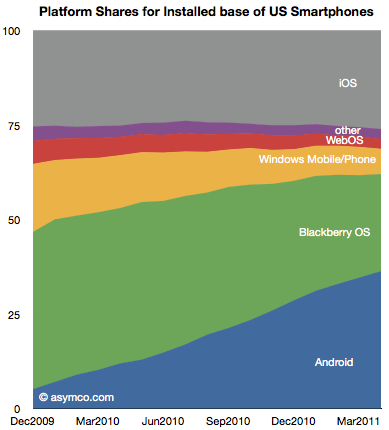
    The following chart shows the evolution of installed base share of platforms among users of smartphones in the US.

    The impressive share gains for Android are apparently at the expense of RIM and Microsoft. Over the period shown, Android gained 25 million users while RIM gained only about 2.8 million.

    Although perhaps comforting to see some growth overall, the situation for RIM is more grim than that. During the first half of the period (December 2009 to August 2010) RIM had gained 4.6 million users. During the second half (Sept 2010 to April 2011) RIM lost 1.8 million users.

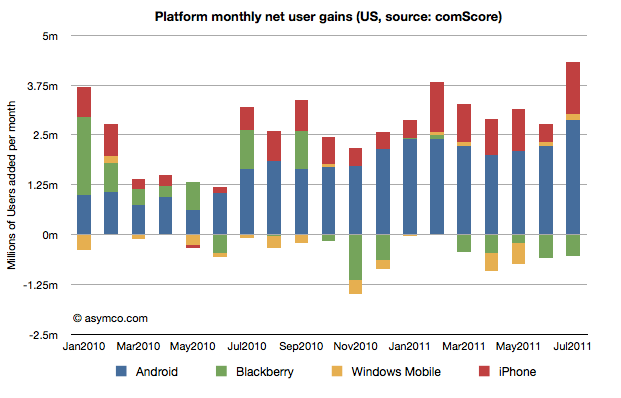
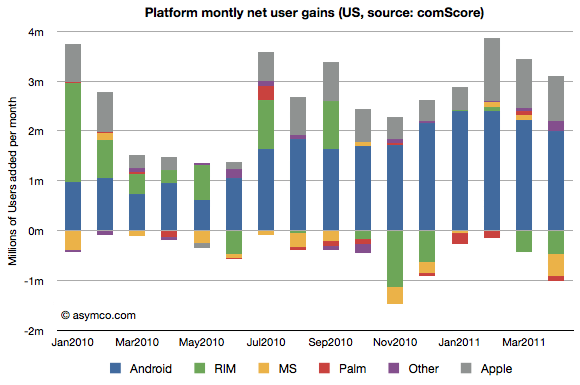
    The net user gains and losses for the various platforms is shown in the following chart:

    Note how RIM (green bars) went from being a consistent net usage gainer to a consistent net usage loser during this 16 month period. In addition, note how Microsoft's platforms (yellow bars) have had a very poor showing with very small gains during four months and moderate losses during the others. The losses in usage even increased after the release of Windows Phone late last year suggesting no traction whatsoever for Windows Phone.

    The other point to be made is that if we assume smartphone users remain smartphone users, then those platform losses are gains by other platforms. In other words, the areas less than zero in the chart above represent smartphone "churn" or switching between platforms (As a percent of all smartphone users that number represents 1.35%.) That number is far lower than the total smartphone gains, so it's safe to say that most of the iOS and Android gains were at the expense of feature phones rather than other smartphones. And since iOS share is consistent (and supplies are constrained), few if any Android gains are at the expense of iOS.

    There are many interesting patterns to observe in the data, but I think the most evocative is the erosion of Blackberry usage. If the Blackberry peaked, and a follower platform not yet in sight, the question is how long will RIM survive?

  10. The controversy of playing it safe: What's IDC's Smartphone Market Message?

    Research · 53 comments

    IDC released a new forecast for the worldwide smartphone market which included a long range forecast--all the way to 2015.

    Most people fixated on the share data in 2015. Not hard to do since whoever wrote the press release highlighted this flashy headline. Putting aside the three significant digits of accuracy on every data point and the hard to swallow declaration that a painfully underperforming (in more ways than one) Windows Phone will overtake iOS and BlackBerry to become the second largest platform by units/year in 2015, there is much more to the report.

    Using only the public data from the press release we can put together a pretty good picture of the transition being forecast and determine some of the (unstated) assumptions being made. It's these assumptions about the underlying market dynamics which illuminate far more than the falsely precise share data.

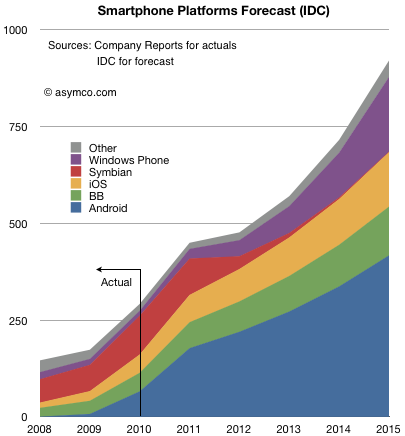
    The following chart shows both historic platform performance (which is detailed in the Asymco Interactive data sets on a quarterly basis) and the forecast based on the given compound growth rate published.[1]

    I see three main assumptions being made:

    1. Nokia (or more precisely Symbian) share will be swapped for Windows Phone. The transition period 2011 to 2015 shows approximately 150 million Symbian devices will be sold which is the stated goal for Nokia. IDC is making an assumption that the hardware vendors will roughly maintain their respective shares irrespective of platform dynamics and that Nokia will switch its share of users from one platform to another in a predictable way.
    2. iOS and BlackBerry will maintain share. Presumably this is also driven by hardware channel dynamics and relationships with carriers.
    3. Android will grow share slightly but the vast bulk of growth will come from market growth.
    4. Market growth is strong but undramatic.

    Overall this is not a controversial set of assumptions.

    Except perhaps that it assumes that the basis of competition in the market is unchanging. Of course it's well understood that the basis has shifted during the tumultuous 2007 to 2010 and forecasts made before the iPhone was launched sound absurd today.

    But IDC says that the unpleasantness won't happen again. From listening to the conversations going on today on this blog and elsewhere, their assumption that things will not change (again) is fairly deeply ingrained, indeed conventional wisdom. In that sense IDC is not taking any liberties with the future. The projections of current realities onto the future leads to this type of forecast and status quo defenders should be satisfied, if not rejoice.[2]

    However, there are a few more consequences of even this uncontroversial forecast which should make keen observers sit up and notice.

    If we look at more than the before and after snapshots and comfortable pie-splitting sound-bites there are some profound seismic things being implied.

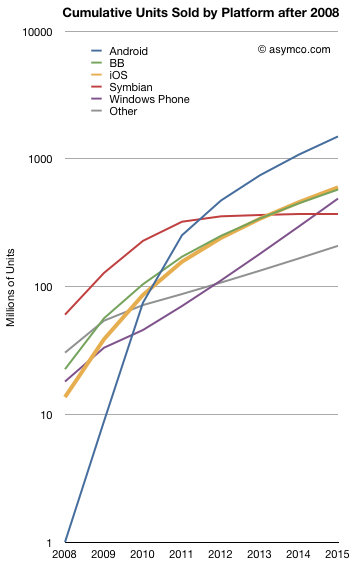
    For example the entire market will be nearly 1 billion smartphones a year (in four years!). Even more startling, considering the "race to a billion" discussion we've been having, some of the platforms seem to be reaching that threshold rather quickly. The following chart shows the cumulative unit sales for the candidate platforms on a log scale:


    Android is considered likely to break one billion units in five years post-launch. Windows Phone will sell nearly half a billion units and Blackberry will be well over that number.

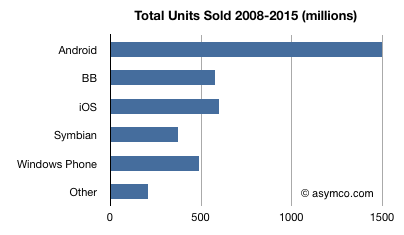
    I tallied the cumulative platform unit totals below:

    No less than four platforms will have sold half-billion units by 2015. The suggestion that Android will "win" by having the most units sold seems as hollow as the suggestion that Symbian "won" by having the most users in 2008. Not so much because it will go on to lose them, but because there were plenty of viable alternatives for users to buy and developers to build for. Half a billion users cannot be easily ignored.

    So even "safe" assumptions can lead to astonishing results in this market. Namely, IDC is saying that the smartphone market will not have any platform losers.

    There is one more thing the report implies. If you look at the ranking of leading platforms (by units/year) in 2008,  2015 and, with a little extrapolation, 2016/2017 you get:

    Rank in 2008Rank in 2015Rank in 2016/2017
    SymbianAndroidAndroid
    OtheriOSWindows Mobile
    RIMRIMiOS
    Windows MobileWindows MobileRIM
    iOSSymbianOther
    AndroidOtherSymbian


    In other words, there is a complete reversal being projected. An almost perfect flip: those on top end up at the bottom and those on the bottom end up on top. That's about as controversial as it gets. Pretty impressive for a set of safe assumptions.

    --

    Notes:

    1. You should ignore the shape of the curve between 2011 and 2015 as it assumes the CAGR is applied to every year. Although the press release shows a CAGR, the actual report may include various fluctuation in yearly growth. The starting point of 2011 and the end result in 2015 however should be the same.
    2. If, on the other hand, you believe that exponential growth, rapid gains in communications speed, new breakthroughs in interaction with devices, and entrants winning with new business models are causes for a disruption, then perhaps extrapolation may not be the way to forecast this market.
  11. Understanding RIM's tablet platform app strategy

    Research · 135 comments

    Yesterday RIM reported their quarterly earnings. The results were mixed to slightly negative and the shares were down 10% in after-hours trading.

    I'll work through the smartphone market data at a later time but for now what I want to focus on is RIM's strategy which really means understanding RIM's intentions or their approach to the market. For that we have to go straight to the source: what management actually says. Trouble is, management often speaks in a jargon that is unfamiliar to people (sometimes unfamiliar to anyone outside the company).

    Strategy analysis involves translation. So here follows the interpretation of Jim Balsillie's remarks during the conference call (transcript sourced from Businessinsider.com).

    What Balsillie SaidMy interpretation
    First of all, what we announced is Gingerbread. This is not Honeycomb. I don't know what the number of Honeycomb apps is, but it's not very many. Whereas Gingerbread they've got lots of them.RIM will support Android apps in the PlayBook tablet. As there is not one Android, I need to clarify that RIM will not support Android tablet (Honeycomb) apps but Android phone (Gingerbread) apps. So RIM's tablet will support Android phone apps even though our tablet does not actually have a phone in it, but requires tethering to a BlackBerry for cellular data.
    You've got the volume of the handset apps, so if you're looking for the tonnage of apps, or some kind of long tail stuff, you've got it.This support means there will be many apps including apps that are not very popular. We don't like supporting unpopular apps. We like a few good quality apps but this approach allows us to offer all kinds of apps.
    At the end of the day, people are going to want performance.However, many apps will not run smoothly.
    You're just not going to get things like gaming and multimedia, you're not going to get the speed going through a VM interface. If you want content, or Flash type stuff, or you're looking at AIR-type, evolving web-type assets, that's what you're going to do.Games and graphics will not run well through emulation. For processor intensive experiences we will have native execution options or browser apps.
    There's no compromise here. You've got the tonnage of apps. And you've got the performance. Do I think the tonnage is overplayed? Yes.By supporting emulation of Android apps we can offer a large catalog of so-so apps while having a small portfolio of high quality native apps.
    But if you think it's about having a couple hundred thousand apps, there you goFor people who value large selections, they can go to one store.
    Do we believe it's about super high performance? YesBut for those people who value quality, they can come to our store.
    I'll just offer that observation that today broadly in the world without any specific comment on us or our competitors, there are multiple ecosystem patterns that need to be consideredBeside emulation and native we also think there are many other ways to deliver applications.
    Do we believe it's about full web fidelity? Yes.For example, Flash.
    These are concepts that were really relegated as not technically possible, which we're doing here. This is a no compromise environment.Because of Moore's law, Flash is becoming viable on a mobile device.
    If you want to work on Android, great. Do we think people will want to migrate web assets? YesThen there are browser apps.
    Do we think they're going to want super high performance native assets with the SDK? AbsolutelyWe will have our own native SDK.
    You think they're going to want to use their Flash based stuff for an offline Flash/AIR type environment? YesAnd support Flash.
    I'm just not interested in these sort of religious application tonnage issues.  I really think we put that issue to bed.We have a new platform but catalog sizes can no longer be used against us.
    And if you think the whole world's going to want to develop for Gingerbread, fine. Do I think that's going to happen? Then why is there a different environment for a tablet? And you know about the performance issues and you know about the app volume issues, cause it's tough. And that's why QNX mattersGoogle's ecosystem is fragmented, Android apps are not able to rely on competitive hardware and there is too much competition. That's why developers should target QNX (which is unfragmented, built on fast hardware and there are few apps on it).
    Is this stuff going to go more in the browser and HTML 5 and more native? These are going to be strong trends. But if you want these app players for different VMs -- and don't forget we have 25,000 BlackBerry 6 appsBrowser apps will increase in value and we also have legacy BlackBerry apps.
    So, at the end of the day, we believe this is going to be about performance. It's going to be about enterprise greatness.But we believe in a future with native applications running on QNX.
    Things like multi-threaded capability, symmetric multiprocessing. We believe it's about an uncompromised web. We believe it's about enterprise security. True multitasking, not with suspension -- and that matters because you're going to want to run these things in the background.Because QNX is a robust operating system with PC-like performance. It also supports a good browser.
    But I'm out of the religious war on tonnage, which I'm delighted.However, before QNX takes off, we will provide access to catalogs of apps which are built for other platforms.