
Asymco

Asymmetric Intelligence

BlackBerry

  1. [Updated] RIM's sales down 15% in the US, up 112% outside the US

    Research · 41 comments

    First, a round-up of the quarter's numbers:

    • 14.2 million devices shipped, sell-through: 12.3 million
    • expect to ship 14.5 to 15 million units in the next quarter
    • ASP of approximately $315
    • US, UK and Canada are 56% of sales
    • US represented 34% of the total revenue
    • Last year US represented 57% of revenue
    • BlackBerry Torch launched in over 75 new markets, Torch launched with the $99 pricing from AT&T
    • BlackBerry Curve 3G launched with 118 carriers in 48 countries
    • China Mobile introduced BIS for small-to-medium sized businesses. The service starts at $14 per month
    • App World applications grew 60%
    • More than 16,000 applications available
    • 2 million downloads daily
    • 1,000 vendors registered for PlayBook apps
    • Revenue: $5.5 billion
    • Net subscriber additions: 5.1 million
    • Top three customers: 12%, 9%, and 9% of revenue
    • The same quarter a year ago: 25%, 13% and 10% of revenue
    • Service revenue in Q3: $835 million
    • Software revenue: $78 million
    • Gross margin in the quarter was 43.6%
    • Cash: $2.5 billion

    For comparison, here are a select few vendors' smartphone reported shipments. RIM is the first to report and we'll be hearing the the rest by the end of January.
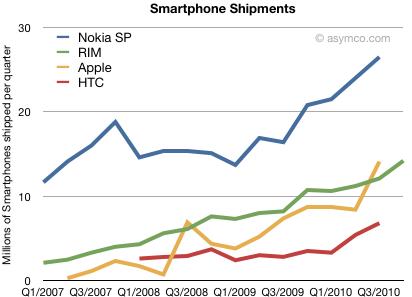
    The number most RIM "bears" focus on is the new subscriber additions. At 5.1 million out of 14.2 million units sold implying that the new subscribers added per unit sold is 0.34, a new low.

    The bulls will argue that the gross margin is healthy and slightly higher than anticipated.

    My observation is that the company is finding growth outside its traditional markets. Given the figures above, the US went from $1.65b in revenue to $1.87b; a mere 13% growth while the company experienced 89% overall growth in revenues.

    The following chart illustrates the situation:
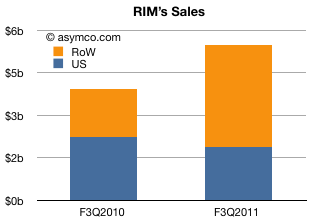
    Of the total increase in sales ($1.6 billion), the US contributed -15% while the rest of the world accounted for 112%.

    This can be seen as positive news since RIM has been weak internationally for many years and they really need to penetrate world markets. However, a -15% growth in the US is implies significant share loss in a rapidly growing and traditional stronghold.

  2. Smartphone parochialism: How operator policies prevent or promote platform adoption

    Research · 42 comments

    When comparing smartphone platforms it's tempting to consider the global market as unified and commonly addressable. However, when you look at individual countries some strange patterns of behavior emerge:

    • Indonesia, the fourth most populous country in the world (230 million people) loves Nokia's Communicator. It's the ultimate mobile status symbol.
    • Japan had one of the largest installed bases of Symbian phones. The version running in Japan is not compatible with versions elsewhere. Famous for its Galapagos mobile culture, the iPhone is changing what the Japanese consider the basis of phone performance.
    • The iPhone just became Korea's favorite smartphone even though hegemonic Samsung and LG are doing a roaring trade selling Android phones elsewhere.
    • The US has four incompatible 3G network technologies in widespread use. No widely distributed smartphone phone works with any two. Blackberry ruled supreme until AT&T started promoting the iPhone and Verizon started promoting Android.
    • Latin America loves BlackBerry. BBM is wildly popular as an SMS alternative.
    • Saudi Arabia loves BlackBerry. When face-to-face conversations are taboo, the BlackBerry is a social lubricant.
    • Australia loves the iPhone. Android is almost non-existent.
    • Italy has more smartphones per capita than the US. The majority are made by Nokia.
    • China uses two incompatible 3G technologies. The most popular (TDSCDMA) is not available anywhere else. WiFi was illegal in phones until this year.
    • Germany has a disproportionally large installed base of Windows Mobile
    • There are no Blackberries in Finland.

    Although some of these idiosyncrasies may be cultural (like the Indonesian penchant for large devices) most of them are due to operator decisions. In some cases operators choose incompatible network technologies to protect from competition. In others they promote local vendors or price certain products out of reach.

    Sometimes big bangs take place and demand explodes for "banned" technologies or vendors. However, it's just as easy to see how the pendulum can swing against free market choice.

    Ultimately users and device vendors are at the mercy of operator decisions. In the long term operator control over platforms might diminish but it will take many years.

  3. Law of conservation of modularity

    Research · 32 comments

    When I applied the modularity dichotomy to smartphone operating system there were several implications that came to light. One was the question of whether the market has reached the point where products were "good enough" and the speed of innovation became less important than price. Another was: will integrated vendors be able to hold on to a healthy share of growth against non-consumption?

    Now I bring up another implication of modularity: the concept of "law of conservation of modularity".

    Clayton Christensen illustrated this as follows[1]:

    If you are writing a software application to run on top of a platform, are you permitted to modify the platform to make your application run better?

    If the platform is interdependent, changing it could cause unintended side-effects and you will not be allowed to make them. If the platform is modular, changes are possible and you will have access to the code.

    The reason is not not political. It's that in the case of interdependence, the application has to be suboptimized and conform itself to the platform so that the platform could remain optimized (to its goals). The platform needs to remain optimized is because it needs to keep improving (since it's not good enough).

    In the case of modularity, the application can be optimized and the platform can conform itself to the application because the application needs to keep improving while the platform is good enough and does not.

    Conformability is what constrains up-market progress.

    This also holds in hardware architecture. This was plainly evident in the WinTel era. During that time the microprocessor and the operating systems had a proprietary and interdependent architecture even while Dell’s product has a modular architecture.

    So the microprocessor wasn’t good enough. That meant that the desktop computer had to have a modular architecture to conform itself in order to allow this to be optimized because the line widths on the circuit were not good enough.

    This is what is meant by conservation of modularity: one side or the other of an value chain boundary needs to be modular and conformable to allow what’s not good enough to be optimized. The key question is what's not good enough: the device or the platform (the whole or part?)

    How does this apply today in the post-PC era?

    If you think about it in a hardware context, because historically the microprocessor had not been good enough, then its architecture inside was proprietary and optimized and that meant that the computer's architecture had to be modular and conformable to allow the microprocessor to be optimized. But in a little mobile computer like the smartphone, it’s the device itself that’s not good enough, and you therefore cannot have a one-size-fits-all Intel processor inside of a BlackBerry or iPhone, but instead, the processor itself has to be modular and conformable so that it has on it only the functionality that the BlackBerry needs and none of the functionality that it doesn't need (hence the ARM modular architecture is dominant). So again, one side or the other needs to be modular and conformable to optimize what’s not good enough.

    Now today (and, I believe for some time to come) in smartphones, or in any situation where logic gets embedded in a system it’s the device itself that is not yet good enough and, therefore, you cannot back off the frontier of what’s technologically possible. It has to be optimized with a proprietary interdependent architecture. That means that the processor and the operating system inside of a Smartphone has to be modular and conformable to allow that to be optimized.

    In order for you to believe otherwise you have to convince yourself that smartphones, as a system, have reached the limit of what is technologically possible.

    [1] The source is a presentation by Clayton Christensen at  Open Source Business Conference in 2004

  4. What job is a Blackberry hired to do?

    Research · 15 comments

    When mobile platforms are discussed, the conversation frequently turns to market share battles between Android and iOS. I've pointed out before that the problem with this reasoning is that market share in a market that's growing at 90% is a false measure of performance.

    The more important measure is how much of the non-smartphone market is being taken by smartphones and how fast the whole phone market is growing. Competition with non-consumption is very different from platform warfare.

    But even when discussing the rivalry between current platforms, the Blackberry and Symbian are often overlooked as contenders. Windows Phone and iOS come in and out of discussion only on the basis of press releases. The truth is however that Symbian, Windows, Blackberry are not going to disappear anytime soon.  Why is that?

    The reason is that when you stop framing the market as rivalry between platforms, you see that many buying decisions are driven by specific device value propositions or jobs that the products are hired to do. For many years smartphones were purchased because they had the best cameras or the best keyboards and users never downloaded any apps or even used data plans.

    Later, smartphones were purchased because they allowed for browsing and gameplay. Very rarely did buyers opt for "iOS" or "Symbian". Most buyers don't even know what these words mean. Phones are rarely advertised according to their platforms. (As an aside, the mention of Windows in a PC ad is made possible by Microsoft funding, the same as "Intel Inside." So for platform recognition, someone needs to fund the promotion and that implies some revenue to justify it.)

    To illustrate, consider the Blackberry: A product that continues to grow despite a completely different basis of competition from the large screen touch competitors. It comes down to being good at some very specific jobs. RIM continues to grow in certain markets like Latin America and the Middle East on the basis of BBM (RIM’s sales outside the U.S. climbed 94 percent last quarter from a year earlier.)

    “A 15-year-old boy who likes a 15-year-old girl, sends her a BBM and he’s able to measure how important he is to her based on the speed of response after the letter turns to an R,” meaning it’s been read, he says. “No one else runs an end-to- end service plan like we do. That’s killer and is why it’s almost a social phenomenon.”

    or

    BBM is also popular in socially conservative Saudi Arabia where its speed -- messages are typically sent in less than two seconds, according to Morgan Keegan -- has made it a way for teenagers to communicate in a country where religious police bar unmarried couples from meeting in public.

    You could argue that the other platforms also allow for free messaging (through free texting apps) but the combination of a low cost device, a data plan and attention to detail (like Message Read notification) gives the Blackberry an edge.

    The general purpose smartphone that Google and Microsoft and Apple promote is still not the prevailing view of mobile usage for most buyers. One could also argue that many if not most Nokia smartphones are still being "hired" to do feature phone jobs.

    The fact that all these devices are classified as smart and therefore competing misses the point that they are hired for different things.

  5. Postcards for Asymco: metropolitan distribution of views by operating system

    Research · 26 comments

    Based on a reader query, I tried to find out where, by city, my readership is concentrated. I also sought to break this audience down by operating system.

    Here are some observations:

    For the last 30 days, here are the top operating systems used to reach Asymco.com, with the number of views from each.

    1. Macintosh 153,768
    2. Windows 101,329
    3. iPhone 78,716
    4. iPad 34,878
    5. Linux 7,262
    6. iPod 5,516
    7. Android 4,869
    8. (not set) 1,236
    9. BlackBerry 447
    10. SymbianOS 396

    Looking at each OS, I can list the top cities where readers came from.

    Macintosh 153,768

    1. London 6,513
    2. San Francisco 5,316
    3. New York 5,089
    4. Cupertino 4,293
    5. Austin 2,589
    6. Sydney 2,182
    7. Helsinki 2,131
    8. Los Angeles 1,918
    9. Seattle 1,847
    10. Portland 1,482

    Windows 101,329

    1. London 3,827
    2. New York 3,275
    3. Helsinki 1,598
    4. San Francisco 1,504
    5. Seoul 1,409
    6. San Jose 1,260
    7. Chennai 1,226
    8. Sydney 1,116
    9. Seattle 1,100
    10. Melbourne 1,035

    iPhone 78,716

    1. San Francisco 5,203
    2. New York 4,406
    3. London 4,053
    4. Chicago 2,328
    5. Seattle 1,836
    6. Los Angeles 1,638
    7. Melbourne 1,430
    8. Seoul 1,402
    9. (not set) 1,376
    10. Sydney 1,261

    iPad 34,878

    1. London 1,759
    2. New York 1,060
    3. San Francisco 1,020
    4. Chicago 857
    5. Melbourne 739
    6. Outremont 694
    7. Santa Rosa 585
    8. Seattle 555
    9. San Jose 456
    10. Santa Clarita 440

    Linux 7,262

    1. San Francisco 376
    2. London 233
    3. Helsinki 180
    4. New York 131
    5. Cambridge 126
    6. Bangalore 109
    7. Nantes 109
    8. Sydney 107
    9. Perchtoldsdorf 93
    10. Paris 86

    iPod 5,516

    1. Eau Claire 471
    2. Melbourne 396
    3. Seattle 290
    4. Abuja 248
    5. San Jose 214
    6. Hudson 197
    7. Sydney 195
    8. Budapest 109
    9. Boston 95
    10. London 86

    Android 4,869

    1. Seoul 761
    2. (not set) 325
    3. Dallas 248
    4. New York 169
    5. Amsterdam 148
    6. Calcutta 131
    7. San Francisco 81
    8. London 74
    9. Los Angeles 74
    10. Bergen 72

    BlackBerry 447

    1. New York 121
    2. (not set) 78
    3. Waterloo 56
    4. London 50
    5. Buenos Aires 16
    6. Hong Kong 9
    7. Oldsmar 9
    8. Fairfield 7
    9. Wappingers Falls 6
    10. Boston 5

    Symbian OS 396

    1. Helsinki 216
    2. Kauniainen 23
    3. London 21
    4. Seoul 13
    5. Tehran 10
    6. Frederiksberg 6
    7. (not set) 4
    8. Chennai 4
    9. Krakow 4
    10. San Francisco 4

    The first surprise for me is that Seoul is the most popular source for Android views.

    The second is that London is so prominent. Although the US is the biggest source of traffic by far, London is a very concentrated source from the UK.

    The third is how there seem to be no Blackberry readers in the SF area.

  6. The imminent demise of killers

    Research · 36 comments

    Before proclaiming the death of a company or product it's important to understand what makes it live. I'll illustrate with a personal experience.

    I was once asked to comment on a product designed to be a "Blackberry killer". Much like the latest Droid Pro, the product looked like a Blackberry. It had a monoblock keyboard and a nearly square screen. It was, in other words, a product designed for thumb typing emails.

    The backstory is that, like many phones, the requirements came from operators. At the time, RIM was growing extremely quickly and was causing some consternation at operators over an upstart's increasing reach into the relationship with end-users (sounds familiar?)

    The rigidly predictable response was to call all phone vendors and task them with developing Blackberry alternatives (aka killers). Of course, each vendor was called independently so they all got excited about having this opportunity to be assassins.

    So when I looked at the product my employer was building as a "killer" I asked: "Well, what makes Blackberry live?" This was not just rhetorical. I felt it was critical to the success of the product. Unfortunately it was not a question on anybody else's list. My cursory review of RIM's business would show that the product Blackberry was popular because it enabled a service, not because of the design of the device.

    RIM was like a barkeeper who enabled socializing on his premises by selling beer. The product he sold was not really beer but meeting services. A brewer looking enviously at the high margin beer being sold there might try to compete by launching "Pub-style beer" but the product won't help people socialize any more if they drank it at home. Bar patrons were paying the high price of bar beer because it had an implicit rent attached for using the meeting site.

    So no matter how much a brewer tried, unless they got into the business of managing taverns, they won't ever put the barkeeper out of business.

    But the rush to copy the design was in full force. Not only Nokia (E 61), but HTC (T-Mobile Dash), Motorola (Q), Samsung (Blackjack) and even Sony Ericsson (M600) rushed similar products out. And they all reached the market at about the same time. (Evidence that not only were they all asked to make products by operators at the same time, but that their product development cycles were roughly the same.)

    The deluge of keyboard monoblock Blackberry killers led to lots of comments predicting the imminent demise of RIM by way of powerful entrenched incumbent responses.

    RIM's market share actually grew after these launches.

    This is because none of the products addressed the real question of what makes Blackberry live and thrive. They were just pub-style beer, not thinly disguised meeting places.

    So next time you hear about the imminent demise of an upstart due to the reaction of suddenly awakened incumbents, ask whether the reaction is to the product or to the way the product makes money.

  7. If RIM did not exist today and someone were to suggest it, could it ever get funded?

    Research · 22 comments

    Consider what RIM had to overcome to even be: It was an outsider entering the mobile phone business at a time when incumbent market power was far more concentrated. It evolved from data-only pagers awkwardly adapted to carry voice without pandering to the fashion consciousness of its contemporaries obsessed as they were with the RAZR. Its foothold market was the most difficult market to enter, the US; and within it, in most difficult sector--business users.

    RIM's solution has no architectural elegance and their non-standard approach to email using their own servers and protocols defied all IT policies regarding security and the entrenched use of Exchange. Even after Microsoft offered a cleaner solution (Exchange push) that avoided the RIM back end, businesses otherwise committed to Microsoft stuck with RIM for mobile email. In spite of various government opposition, RIM continues to grow internationally.

    Even its acceptance may be an accident of history.

    The absence of interoperable SMS in the US early last decade meant that there was no reliable way to send text from one mobile to another across CDMA and GSM networks. The Blackberry was hired to to the same job that SMS was hired to do anywhere else, but by the time SMS was working in the US, the use of Blackberry increased irrespectively.

    It should be no wonder then that the company can be considered both disruptive and a dead end. Analysts have been split about it from day one. Gartner advised against adoption by any self-respecting IT shop.

    Equities analysts are still split into bulls and bears more evenly than any other company in this space. See: RIMM: Street Split Sharply On The Stock; Avian Cuts Rating (Updated) - Tech Trader Daily - Barrons.com

    The arguments are pretty straight forward:

    • Competitive pressure from 'better' architectures, uninspiring products, lower growth

    vs.

    • Fierce loyalty of users, continuing international expansion, continuing growth

    The market has largely voted with the bears as the price shows absurdly low valuation (4.3x EV/EBITDA) but the company continues to show growth quarter after quarter.

    My own point of view has been for some time that RIM's disruptive days are over because the engineer in me says that their code base is a dead end. But the disruptive analyst in me leads me to be hesitant in proclaiming their imminent demise. The fact remains that their product is good enough for a subset of the users who want nothing more than a messaging phone. I will add however that this subsets unlikely to grow especially relative to the number of users who will opt for more highly functional devices.

    So the riddle of RIM remains: rumors of its death has been exaggerated but it's not an unforeseeable growth story anymore. As a result the company is in limbo.

  8. RIM Quarterly update: just the numbers

    Research · 11 comments

    Noteworthy data (with my notes in parentheses.)

    • 12.1 million phones shipped, 11 million sold through (estimated iPhones for this Q range from 11 to 13 million)
    • Net subscriber account additions were 4.5 million which was lower than anticipated (41% of units sold through were to new subscribers which implies nearly 60% were to existing users)
    • Revenue grew 31% over the same quarter last year and GAAP earnings grew 76%.
    • The BlackBerry subscriber account base grew 56% year-over-year to over 50 million
    • RIM has shipped approximately 115 million handhelds to date. (note: 120 million iOS to date)
    • BlackBerries are available through over 565 carrier and distribution partners in approximately 175 countries and international markets (vs. 150 carriers and 88 countries for the iPhone)
    • Approximately 52% of revenue in the quarter was generated outside the United States and over 45% of BlackBerry subscriber account base is outside of North America. (70% of iPhones were sold outside the US through the first half of this year)
    • Torch was launched with one carrier but will expand to 75 next quarter
    • To date over 35 million BlackBerry Smartphones have downloaded App World at an average of over 1.5 million Apps are being downloaded every day which is up 40% sequentially (iOS apps are running at 17 million downloads per day)
    • Average selling price for RIM devices was $304 (vs. $600 for the iPhone)
    • Gross margin was 44.5% (upward of 50% for the iPhone)

    Research In Motion CEO Discusses F2Q2011 Results - Earnings Call Transcript -- Seeking Alpha

  9. iPad in the enterprise: Once the head goes, the body follows

    Research · 28 comments

    In my talks with about 100 senior-level people at as many companies over the past six months, the feeling is that the tablet is here to stay and it's going to be bigger than everyone expected it to be. It's an always-on, always-with-you data experience. The other thing is that we spend about $1,500 for a laptop and another $300 per year over five years for the Microsoft Office suite. That same capability on an iPad is $600 to $800, and the software is $10 per application forever. It's about one-third or one-fourth the price. The cost of ownership is inexpensive--and that's just the first generation before they drop prices.

    via Rise Of The Tablet Computer Page 3 of 3 - Forbes.com.

    How fast is it catching on?

    In the C-suite and the executive suite there is mass adoption. In Bank of America it took 60 days to hit the corporate standards list, which is the fastest any technology has hit that list. We've already bought 1,000 of these and we hadn't bought anything from Apple in more than a decade. Executives everywhere are carrying iPads. And like we saw with the BlackBerry, once the head goes the body follows. The top executives get them and then they order them for the next 10 or 20 people.

    The iPad use in corporate settings is even more disruptive than the Blackberry. No contract to sign, no administration overhead for voice and data plans. Trivial setup and instant gratification.

    The way iPad is knocking down IT barriers to entry makes one wonder if Apple did not engineer it for this. But when you look at the product and positioning corporate use is that last thing you think of. This is often the case with disruptive products.

    Lost of other great quotes in the article. For example: the iPad can be passed around a table but a laptop can't.

  10. RIM Torch on pace for 500k units in August

    Research · 8 comments

    “In our view, investors are missing the way BlackBerries are eating into Nokia’s messaging phone share in Europe, Latin America and Southeast Asia now that the E-series demand is slowing,” he writes. “We believe the Torch is on pace for 500K units in August,

    via Research In Motion: MKM Still Bullish; Cites Growth Outside U.S. - Tech Trader Daily - Barrons.com.

    Torch selling 500k units a month may be good news to RIM but it's hardly a barnburner.

    The news about Nokia losing share to RIM is another curious data point. First, because it identifies two competing smartphone classes (E-series and Blackberries) as "messaging phones". That's like saying that HP is losing share to Dell in the "email PC" business. Though the classification of general purpose devices by single uses is probably fair here since these devices are not much good for anything else.

  11. RIMM near 52 week low

    Research · 1 comment

    RIMM shares dropped more than 5% after hours after company reported "light" units and a 20% rise in profit with a 24% rise in revenue.

    RIMM sold 11.2 million units (of which 4.9 million were new subscribers and the rest replacement units--a deterioration in replacement rate). This represents 43% growth. The unit growth is nearly double the revenue rise implying a lower ASP ($300--half the iPhone) and margin (45.4%).

    RIM passed another milestone: 100 millionth BlackBerry was sold during the quarter. We've noted before that Apple will also pass its 100 millionth iOS device this month. RIM sold 20 million units as of October 2007, right on the heels of the iPhone launch. That means that iOS grew 100 million to BlackBerry OS growing 80 million in the same time frame.

    So why are shares at a P/E of 13? 20% EPS growth would be respectable numbers, but the smartphone market is growing faster than that. The implication is that RIMM is losing share and everyone is expecting that loss to accelerate.

    Simona Jankowski from Goldman Sachs repeats her Sell rating. “RIM has now missed top-line expectations for three of the last four quarters, in our view demonstrating the building competitive pressures on its business from the iPhone and more recently from Android,” she writes. “We estimate that net subscriber additions in North America declined on a sequential basis, which we attribute primarily to the success of Android-based phones, such as the Motorola Droid and the HTC Incredible at Verizon.”

    Research In Motion Limited (USA): NASDAQ:RIMM quotes & news - Google Finance.