‘Any argument that a pad is not a PC is simply out of sync,’ said Chiam. ‘With screen sizes of seven inches or above, ample processing power, and a growing number of applications, pads offer a computing experience comparable to netbooks. They compete for the same customers and will happily coexist. As with smart phones, some users will require a physical keyboard, while others will do without.’
‘Each new product category typically causes a significant shift in market shares,’ said Chiam. ‘Apple is benefiting from pads, just as Acer, Samsung and Asus previously did with netbooks. The PC industry has always evolved this way, starting when Toshiba and Compaq rode high on the original notebook wave.’
Five years ago, back when Gartner and IDC were confused about what a smartphone was Canalys was on top of the market and was the first to correctly describe the smartphone.
Kudos for being first again to recognize a re-defined market.
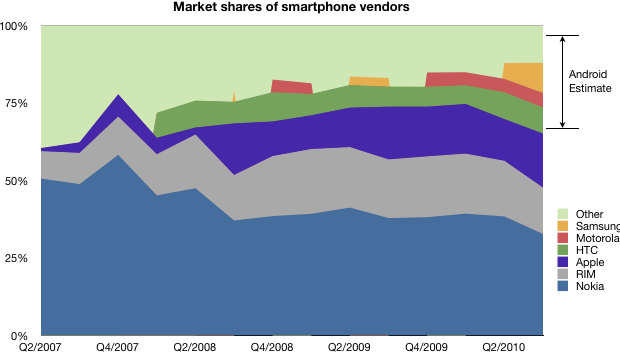
Take a look at this chart. It combines the known shipment data with the total market size for smartphones as defined by Canalys.
Knowing the platform/vendor make-up we can estimate the percent of the market that was Android.
Note that the major unknown is still how much the platform hedgers (Samsung, Other) split their volumes between Android and Windows Mobile (yes, it's still being sold).
Given this information, I would estimate Android share was around 30% globally. Canalys estimates 25%, which makes this analysis look reasonable.
On a platform basis, Android gains were mostly at the expense of RIM, Symbian and Windows Mobile as we know that the iPhone share remained steady.
Note that in years past the licensing vendors predominantly opted for Windows Mobile, a market that Microsoft wants to regain.
Only sell-through (i.e. not exact numbers that companies report as sold, i.e. excluding inventory in the channel)
Other includes Symbian devices not sold by Nokia, Microsoft Windows Mobile and various Linux, WebOS
iOS includes only phones, no iPads, no iPod touch, similarly Android includes only phones
Some of these numbers are approximate as they are based on partial data (Canalys does not publish complete share data and some must be interpolated)
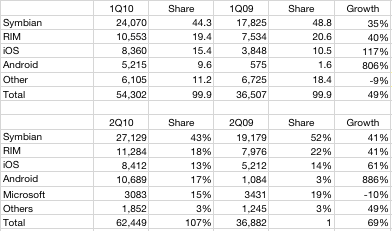
Data used to build charts:
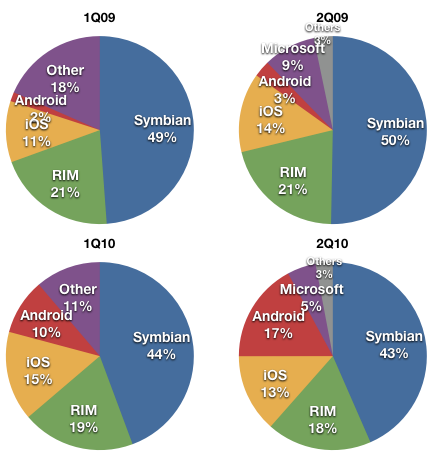
Overall the market grew 64% last Q, with Apple maintaining share y/y even though transitioning to a new model and draining channel during several weeks. Android continued to experience over 8x growth which is phenomenal. Share was taken mostly from incumbent Nokia (-7), Microsoft (-4) and RIM (-3), though bear in mind that the whole pie grew by nearly 70%.
[Updated]
Canalys OS share data has become available and I've updated the charts and table.
Much ink is being spilled over Android outselling the iPhone in the US in Q1. Here's what NPD survey data shows:
Q1 units for Android reached 28% vs. iPhone at 21%.
AT&T stated that they activated 2.7 million iPhones. That is 31% of all iPhones sold by Apple. Assuming NPD data is accurate, we can conclude that Android shipped 3.6 million units in the US or 65% of their total.
In a previous posting (Global smart phone OS shares « Asymco) I estimated, based on Canalys estimates, that global Android share reached 10% last quarter or about 5.5 million.
We can compute that Android captured only 4% of smartphone share outside the US while Apple obtained 14% share.
You can also observe that iPhone's US share increased y/y while every other platform except Android dropped (implying that Android took share from everybody but Apple.)
NPD claims AT&T accounted for 32% of the smartphone market, and even though AT&T carried both Android and WinMo and Blackberry devices, 21 out of every 32 phones or 65% of AT&T's volume were iPhones.
We can conclude that Android captured 34% of the non-AT&T US smartphone market.
The table below combines the NPD, AT&T, and Canalys data to show units for iPhone and Android in the US, Global and non-US regions.
One can only wonder what would happen if iPhone would be available non-exclusively. Would iPhone achieve greater than 60% share as it did on AT&T? Certainly that's what happened in France.
In the free press release linked below Canalys reveals their estimates of vendor shares but not the OS shares for smartphones. However it's not hard to see the OS split due to the high degree of exclusivity of OS's to vendors.
For example, virtually all Nokia devices are Symbian powered, all RIM devices are Blackberries and all Apple devices are iPhone OS. Motorola is only shipping Android and HTC is the only top 5 vendor that now licenses more than one OS. Even HTC's portfolio is now heavily Android weighted.
We can carve out Palm (960k units shipped) from the "others" and we're left with mostly Windows Mobile. My estimate would be about 5 to 6 millionWinMo made it out.
That leads me to the following estimated OS shares:
Symbian (Nokia): 42%
Blackberry OS (RIM): 19%
iPhone OS (Apple): 16%
WinMo (Microsoft): 10%
Android (Google): 10%
WebOS (Palm): 2%
If anyone knows the actual Canalys OS shares, let me know.
"...in our October study of 600 European decision makers in medium and large enterprises, more than 20% said they expect the iPhone to be the dominant smart phone platform for running business applications in their organisation within the next 3 to 5 years. In France, the iPhone was ahead of Windows Mobile and RIM in this regard – a remarkable result.”
This short quote brought back to mind the recently formed partnership between Nokia and Microsoft to deal with RIM. One fruit of this relationship is a recent job posting atcareers.microsoft.com which seeks Symbian developers to work for Microsoft:
Job Category: Software Engineering: Development Location: India, Hyderabad Job ID: 702365 Division: Microsoft Business Division
The Office team is looking for a self-motivated and highly passionate Developers to contribute in building a new team and drive discipline excellence in the delivery of Office Mobile and Communication experiences for Nokia’s Symbian smartphones.
Microsoft and Nokia have formed a global alliance to design, develop and market mobile productivity, communications and collaboration solutions.
Under the terms of the agreement, the two companies will begin collaborating immediately on the design, development and marketing of productivity solutions for the mobile professional, bringing Microsoft Office Mobile and Microsoft business communications, collaboration and device management software to Nokia’s Symbian devices. These solutions will be available for a broad range of Nokia smartphones starting with the company’s business optimized range, Nokia Eseries. The two companies will also market these solutions to businesses, carriers and individuals.
This project builds on the existing relationship with Nokia who is optimizing access to email and other personal information with Exchange Activesync. Next year, Nokia intends to start shipping Microsoft Office Communicator Mobile on their smartphones, followed by other Office applications and related software and services in the future.
While the iPhone wins hearts and minds in IT through sheer brilliance Nokia tries to become a supplier to IT departments through a strategy deeply rooted in the 1980s: the manipulation and exertion of control over file formats. As IT has diminished in importance (to the point of ceasing to matter to some) it's hard to understand this misplaced alliance with Microsoft over something so inconsequential.