Asymco

Asymmetric Intelligence

Microsoft

  1. Where is the Windows Phone Tablet?

    Research · 78 comments

    The Windows Phone platform currently has hardware specifications that imply a cellular phone device. What is interesting in light of the new WebOS TouchPad, the newly announced Android tablets, the RIM Playbook and the iPad is that this supposed "third horse" of Windows Phone has no hint of present or future presence in the tablet form factor.

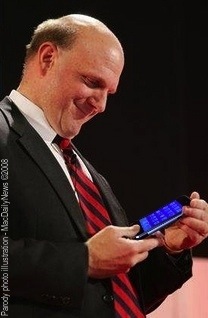
    That might have something to do with the plans to move Windows to the tablet form factor. Perhaps Microsoft thinks that pocket size devices deserve a separate operating system, platform and ecosystem than portable mobile computers. Perhaps Microsoft plans to have two separate interfaces for these tablets (slates vs. tablets?) Then again, Ballmer held up a Windows Phone and said "This is Windows too."

    It gets confusing.

    The bottom line is that without a tablet implementation, Windows Phone developers and content providers will find that the WP ecosystem will have a limited addressable market and will not be suitable for all forms of media or apps. Tablets are currently expected to grow even more rapidly than smartphones did and so there will be significant numerical advantages to those platforms that support multiple screen sizes and form factors.

    Now that Nokia has anointed the Windows Phone platform as its exclusive conveyance to the device market, the question in the headline becomes: Where is the Nokia tablet?
  2. Adobe and Microsoft sitting in a tree

    Research · 16 comments

    Adobe is one of the last surviving desktop software companies. So is Microsoft. Consolidation happens when an industry matures and excess capacity and excess overhead can be squeezed out of the value chain, giving a temporary burst of earnings growth.

    So, in this way of thinking, recognizing that the sun is setting on desktop software, a merger of old schools of thought may make sense. Rather like Sun and Oracle or HP and Compaq.

    But then a lot of other things make more sense. Like both companies trying to expand into new growth areas. Like Microsoft talking to RIM or Adobe developing tools for HTML5. Adobe's cash cow products are not going anywhere without a deep reset. Same is true for Microsoft. They will both face these challenges whether standing alone or together.

    There would be nothing strange about a Microsoft Adobe merger, but there would be nothing great about it either.

  3. Ballmer on leadership changes aka voluntary retirements

    Research

    "And I think i've been quite public about the fact that I chose to make a set of leadership changes in the team of people building and executing on our Windows Phone software.

    "We had to do a little cleanup, change things around," Ballmer said

    via AppleInsider | Microsoft CEO hopes to reenter phone market, disputes PC shift.

    "I chose to make leadership changes" and Robbie Bach the ultimate leader of Windows Phone "retiring".  Did he jump or was he pushed?

  4. Microsoft OEM VP on tablets: wait and see, could flop like netbooks

    Research · 3 comments

    Giving Android the green light:

    In addition, for the time being, Microsoft will not offer new Windows versions to support non-Intel architectures that are targeting tablet PC development, noted Guggenheimer.

    The formation of a market segment for a new product category necessitates the existence of a supporting ecosystem made up of a complete industry supply chain, Guggenheimer emphasized. He cited the netbook market as an example; units were selling well initially and people believed that the market was going to be established as a new segment, but recently market growth has slowed down considerably, Guggenheimer pointed out.

    via Whether tablet PCs can become market segment is still uncertain, says Microsoft VP.

    I remember when Microsoft used to be paranoid.

  5. At 135 devices, the Android army marches on but what happened to the Windows Mobile legions?

    Research · 2 comments

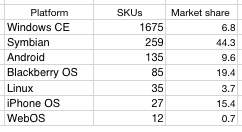
    The number of Android devices is rising steadily; it's already up to 135.  Android devotees should rightly rejoice.  However, Android is not the first mobile platform with an open licensing strategy. A quick visit to pdadb.net lets us count the number of devices that shipped for every mobile platform in history.  We can also see the current market shares as listed by Gartner for these platforms.

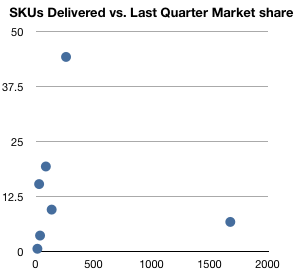
    The numbers of SKUs (stock keeping units) that have shipped historically vs. the market shares of the mobile phones running those platforms are (see Footnote below for some caveats):

    The same data in a scatter plot:

    (SKUs on the x-axis and share on the y-axis)

    The thing that jumps out is how uncorrelated the two quantities are.  The Windows Mobile/CE number is such an outlier that it breaks any attempt to link the two variables.

    What's likely to happen is that since the licensing of Android is even less problematic than it was for WinCE (i.e. it's both free as in beer and free as in speech) the number of Android SKUs is likely to overtake WinCE.  In other words, we're very likely to see Android grow from hundreds to thousands SKUs.

    However, the real question for the Android platform isn't whether it will have licensees. WinCE proved that there is vast demand from many companies to build cloned and undifferentiated devices. The real challenge is whether Android can achieve significant volumes without fragmentation to keep the platform/network effect going.

    The WinCE platform was actually less fragmented through its life than Android is today. This is understandable since the source code was decidedly not open and thus not modifiable and new versions were released far less frequently. And even with a high price tag, it was wildly popular with licensees. Nevertheless, the volumes never came and Microsoft was forced to abandoned the whole strategy.  The next version of Windows Mobile (Windows Phone 7) will follow an "iPhone lite" model of highly restricted configurations and device and ecosystem specification.

    So will Android follow the fate of Windows Mobile with an even more fragmented, bazaar-like licensing model? Or will thousands of undifferentiated Android devices swamp their integrated competitors?

    Footnote: The total SKU number includes non-cellular devices whereas the market share number includes only cellular devices. Omitting non-cellular devices will not detract from the pattern or change the correlation meaningfully.  The argument can also be made that the "platform" value lies in both cellular and non-cellular devices (e.g. iPad) and they should both be counted.  Unfortunately there are no market share statistics that blend both device types into one market.

  6. The reason Robbie Bach was fired

    Research · 37 comments

    Vague justifications about under-performance of Windows Mobile or cancelled Courier miss the whole point.  The chronic problems with Microsoft’s consumer businesses cited as causes for dismissal have roots in core processes and priorities which management changes will not address.  The failure of Zune was evident long ago. Windows Mobile has not been competitive with RIM for years, and failed to take significant share from Symbian, never mind iPhone. Tablets were the responsibility of the Windows team.  Kin is a rogue project based on a bone-headed acquisition. From a P/L point of view, Entertainment was mostly Xbox, which although deep in the hole over its lifetime, was starting to break even.

    No, the reason I believe Bach lost his head is that HP bought Palm.

    Bach lost a key account; in fact, he could be responsible for having lost the biggest account that Microsoft ever had.  Ballmer is a sales guy and he knows the importance of these relationships.  A customer like HP must be managed carefully and their strategy must be steered to fit with yours.  If HP felt they needed to go somewhere else for their mobile OS, it's a slap in the face, but if they buy the asset and IP and internalize a competing platform, then that is a dagger to the heart for Ballmer.

    Consider Google's seduction of Dell. Microsoft can tolerate Dell's affairs (Dell even fooled around with Linux back in the day.) But in contrast, HP is effectively filing for divorce.

    The blow could not have been more obvious and more cruel.

  7. Google and Microsoft swap mobile share

    Research

    according to a report published Monday. ComScore reported that Google's share of smartphone subscribers rose to 9%, compared to 3.8% at the end of November. Meanwhile Apple's share fell 0.1 points to 25.4%, while Microsoft's share fell 4 points to 15.1%.

    via Google's share of mobile market grows: report - MarketWatch.

    Seems Google's gain is Microsoft's loss.

    BlackBerry, saw its share rise 1.3 points to 42.1%, according to the data. The number of owners of smartphones rose 21% in the U.S. in the three months ended in February compared to the prior period.

  8. The day the Windows died

    Research · 3 comments

    I always thought Windows 2000 was the point of over-service for Microsoft. The book linked below puts a date on the point when Microsoft could and should have created an autonomous division whose task would be to create the platform that would eventually disrupt its core business.

    Clearly Microsoft did not do this but Apple, with iPad, did.

    In September 1999, Kodesh wrote a memo to Gates and Ballmer under the heading “Starting from Scratch.” We need to kill Windows CE for those categories, he argued. Win32 is not an advantage; it’s a tax on device design. It served to further Microsoft’s strategy but not to help consumers. Given all their other alternatives, electronics manufacturers wouldn’t pay the tax. Kodesh wanted to take a small group of developers and work solely on developing the best software for information appliances, unconstrained by the needs of the rest of the company. Gates rejected the suggestions. “It’s very disappointing you feel that way,” he told Kodesh. “We don’t have time to start from scratch.”

    link: Who Fatally Wounded Microsoft? It Was Bill Gates. « Mike Cane's iPad Test