Asymco

Asymmetric Intelligence

cloud computing

  1. Measuring Not Getting the Cloud

    Research · 140 comments

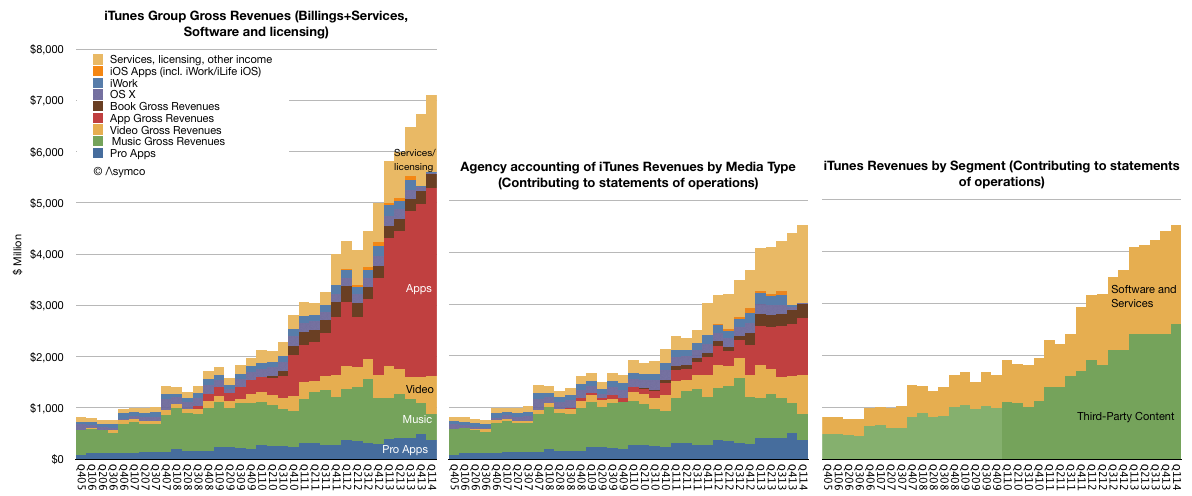
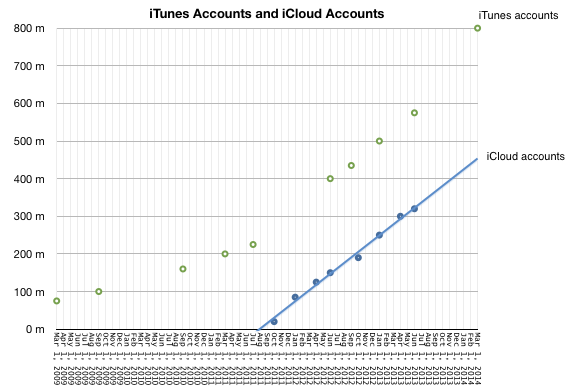
    This is what "Not getting the Cloud" looks like:

    Screen Shot 2014-05-09 at 5-9-3.30.03 PM
    Screen Shot 2014-05-09 at 5-9-4.04.33 PM


    "Not getting the cloud" means that in the last 12 months Apple obtained:

    • 800 million iTunes users and
    • an estimated 450 million iCloud users spending
    • $3 billion/yr for end-user services plus
    • $4.7 billion/yr for licensing and other income which includes
    • more than $1 billion/yr paid by Google for traffic through Apple devices and
    • $13 billion/yr in app transactions of which
    • $9 billion/yr was paid to developers and
    • $3.9 billion/yr was retained as operating budget and profit for the App Store. In addition,
    • $2.7 billion/yr in music download sales and
    • more than $1 billion/yr in Apple TV (aka Apple's Kindle) and video sales and
    • $1 billion/yr in eBooks sold

    In summary, iTunes, Software and Services has been growing between 30% and 40% for four years and is on its way to $30 billion/yr in transactions and sales for 2014.

    This is what can be deduced from a reading of Apple's financial statements of operations. If there are comparable details for companies which do get the cloud, I'll be happy to tally the comparison so we can calibrate this failure.

  2. The newly integrated company

    Research · 25 comments

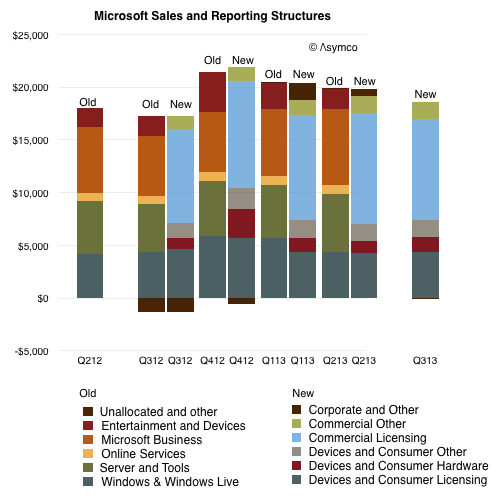
    During the first quarter of fiscal year 2014, we changed our organizational structure as part of our transformation to a devices and services company. As a result of these changes, information that our chief operating decision maker regularly reviews for purposes of allocating resources and assessing performance changed. Therefore, beginning in fiscal year 2014, we are reporting our financial performance based on our new segments; Devices and Consumer (“D&C”) Licensing, D&C Hardware, D&C Other, Commercial Licensing, and Commercial Other.

    The previous reporting segments were:

    • Windows & Windows Live
    • Server and Tools
    • Online Services
    • Microsoft Business
    • Entertainment and Devices
    • Unallocated and other

    The new are:

    • D&C Licensing: Windows OEM licensing, Consumer Windows, Consumer Office, Windows Phone (including related patent licensing)
    • D&C Hardware:  Xbox 360, second-party and third-party video games, and Xbox LIVE subscriptions; Surface; PC accessories
    • D&C Other: Resale, including Windows Store, Xbox LIVE transactions, Windows Phone Marketplace; search advertising; display advertising; Subscriptions including Office 365 Home Premium; Studios including first-party video games; retail stores.
    • Commercial Licensing: Windows Server, Microsoft SQL Server, Visual Studio, System Center; Windows Embedded; volume licensing of Windows; Microsoft Office for business (Office, Exchange, SharePoint, and Lync); Client Access Licenses;  Dynamics, Skype.
    • Commercial Other: Enterprise Services, including Premier product support services and Microsoft Consulting Services; Cloud Services, comprising O365, other Microsoft Office online offerings, Dynamics CRM Online, and Windows Azure.

    From Microsoft's FY14 Q1 10Q via Microsoft Investor Relations - Press Releases

    The mapping between the old and new is not straight forward. There is overlap between D&C Licensing and the old Windows and perhaps between Entertainment and Devices and D&C Hardware but there are many gaps. There is also some overlap between the old "Business"/"Server" segments and the new "Commercial" but, again, they cannot be matched.

    I show the difference between the two structures in the way revenues are allocated below, using color to try to show similarities.

    Screen Shot 2013-10-25 at 10-25-11.25.07 AM

    Given the re-stated quarters it's possible to compare one year's historic performance at a segment level. For example, the company states that "Devices and Consumer revenue grew 4% to $7.46 billion" while "Commercial revenue grew 10% to $11.20 billion".

    Since we don't have data older than one year, our ability to assess the company over longer time periods will be drastically reduced and a new picture will take a long time to emerge.

    There is however one aspect of the new structure that needs to be appreciated right away: the allocation of costs has changed fundamentally. The company explains:

    Cost of revenue is directly charged to the D&C Hardware segment. For the remaining segments, cost of revenue is directly charged in most cases and allocated in certain cases, generally using a relative revenue methodology.

    We do not allocate operating expenses to our segments. Rather, we allocate them to our two segment groups, Devices and Consumer and Commercial. Due to the integrated structure of our business, allocations of expenses are made in certain cases to incent[sic] cross-collaboration among our segment groups so that a segment group is not solely burdened by the cost of a mutually beneficial activity as we seek to deliver seamless experiences across devices, whether on premise or in the cloud.

    [my emphasis]

    In that brief paragraph Microsoft has formally and in a financially binding way declared itself to being a functional organization. ((Welcome to the club.))

    The mechanism seems banal: operating costs are no longer assigned to product divisions but to two large buckets. In practice this means that profitability (P/L) cannot be assessed or assigned to individual managers. The lack of P/L responsibility means that incentives from top to bottom have to be re-engineered. If this goes wrong, the Assets ((read: people)) of the company could evaporate.

    If the assets go, then processes and priorities are for naught.

    In other words, what the company is undertaking is a priority shift (to a  functional structure to create integrated experiences) which requires a process change (whereby employees work according to new incentives) while preserving the fragile assets the company depends on (a motivated and skilled base of employees.)

    This makeover is as ambitious as a re-org gets and the context, scope and target are as difficult as they can be. This is, after all, the largest software company operating the the most dynamic industry whose multi-sided markets are notoriously volatile due to disruptive forces.

    The challenge also suggests why Ballmer left and who should replace him. A priority transplant operation requires a different set of skills than those held by the manager who created the processes for the previous set of priorities. That's the manager's dilemma: even if you foresee the changes needed and push for them to be enacted, your reward might be to be replaced by someone who can make the changes happen.

    Those who envision and persuade for change are rarely allowed to enact it.

  3. Making rain

    Podcast · 72 comments

    The following is a slightly edited transcript of a portion of the Critical Path podcast #79. I am reproducing it here for the sake of brevity and focus of discussion.

    ---

    I'm going to try to put together an analogy together here that maybe will help us think through the Facebook Home and the Google Fiber issue.

    I've been thinking a lot about how to illustrate Google's business model. The problem is that discussion has been polarized: Two camps have formed. One camp suggests that Google is a benevolent entity that does great things and only asks that we indulge their hobby of a business model called advertising. Fundamentally they are about pushing the envelope on technology, making wonderful things happen.

    That is one camp. I call them the utopians. It may not be a nice thing to call them but I frame it as being exceedingly idealistic.

    The anti-utopian camp is one that suggests that Google is an advertising company primarily, and fundamentally and overwhelmingly. And anything they do technologically is in support of that. The implication is that Google is sinister and manipulative, bent on getting away with as much privacy extraction as possible.

    I believe that the anti-utopians dismissing Google as an advertising company sounds a bit incomplete. It's not incorrect. It's not erroneous. It's just not a complete story.

    And also the utopian view that they do everything for us out of the goodness of their hearts and that advertising is something that they are reluctant to do, saying in effect, "We only do it because it earns us enough money so that we can do good deeds." That too is not an accurate picture. Google is a business and its business management team is hard nosed and knows what they're doing and they are not purely idealistic in that sense.

    And so the question could be where across this spectrum does Google lie? Possibly it moves around between these points. Where they are becomes a question of motivation and what they want to become.

    But this is only one dimension. It does not help us answer the question of Home, or Fiber or Reader or Blink. Their actions seem contradictory. Holistic or selfless in one case, greedy and capricious in another.

    Let's step out of this spectrum and try to think of different ways which can describe the situation.

    I propose a way to think about it as: Google tries to make a business succeed through having a huge amount of _flow_ in terms of data, traffic, queries and information that is indexed. So think about this idea of them tapping into a vast stream. The more volume that is flowing through the system the more revenue they generate.

    As so given this very rough analogy I try to sharpen it up by saying: imagine it more as a river. And even more than a river, as a watershed, a river basin. Perhaps a giant basin the size of a continent. The business is, let's say, capturing fish at the mouth of the biggest river, before it exits into the ocean at its delta.

    And so your job (as Google) is to catch fish mostly at one point. It's the most efficient way to catch fish because you have the most flow of water at that point and building nets is not trivial.

    But in order for you to improve your business, to create more opportunity, presumably, you want to essentially have more water flowing.

    And so how would you do that? Think of the Mississippi river. If you've got a net down at the bottom of the river, the question is how would you engineer, through civil engineering, or shaping the earth itself, a way of catching more fish.

    The answer I think, in terms of the way Google might be thinking, is that they want to create more sources of water. So they would look to connect tributaries and lakes. "How about having another river join our river?" Let's make sure that we have "everything east of the Rockies" flow into our river system.

    Now, think of it this way: After you've gotten all the tributaries, what are the remaining sources?

    First, you'll want to make sure that no-one can dam or stop the flow of water into your main channels. And so you become extremely anxious about people building dams. That's the number one concern.

    So your strategy becomes one of "how do we avoid dam building"?

    That's one part of your strategy.

    The other thing you could do to improve your business would be to make it rain more. So there's the question in your mind of: If we had more rainfall, then everything will flow more rapidly and we'll get many more tiny rivers forming and joining together into our main river.

    Android and the Fiber business and even Facebook fit into this analogy rather well. In this context more rainfall means more people using the Internet. If you have more people you'll have more rivers and you'll have more water and hopefully more fish. Fiber means the water will flow more rapidly: you're essentially dredging the riverbed.

    But the two are very disconnected (rain, dredging and fish). So your strategy amounts to not really worrying about the ratio. You don't create incentives to people who make rain in the form of fish catch quotas next quarter.

    In other words, your performance as a manager of cloud seeding efforts should not be measured in fish.

    Leadership should instead simply put out the mandate of "Go out and make it rain".

    So that's the notion of Google going out on these projects and doing all these "great things" for us. They make it rain. The Internet expands. There is minimal censorship.

    By the way, censorship is a dam. Being blocked out of a country is a huge dam. It's actually more like building a mountain range that diverts water flow away from your watershed.

    And so they have these notions of how to prevent these things from happening.

    So it sounds like they are doing good things. It sounds like asking for it to rain; they want to make sure that people don't divert resources; they want to make sure that there are no barriers between the raindrop and getting access to the channel to the ocean.

    So it sounds like they're doing all the good things like a good civil engineer. Like the US Army Corps of Engineers who developed the irrigation, flood control, energy generation and waterway transportation of the United States.

    Google seems to be the world's "internet civil engineer". They are building all these things to make sure that we have good water (i.e internet) supply. That we have plenty of navigable channels. That's the analogy.

    But let's not forget that the only reasons those things are happening is because they are catching fish at some point down the Mississippi.

    From that point of view you have to ask yourself: do they deserve this concession? Because they are ultimately affecting the environment to such a degree; and the environment is the internet; and the whole scope is how the world operates.

    That is where people have to step back and ask themselves: Even a group of civil engineers that have all the best intentions may realize that they didn't think of all the consequences of their actions. A lot of the criticisms may come decades later. From people who'll note an effect on the environment. Dams get silted, a lack of floods reduces nutrients to crops which then need fertilizer, which has a whole other set of problems.

    That is when you have to reflect more deeply on what is right and what is wrong. So saying, as the City Council of Austin might: thank you for coming and paying for installing broadband for us. Fine, but we just don't know what the unintended consequences might be. It all _sounds_ good but we don't know if it _is_ good.

    And similarly, in the case of Facebook, there is a subtle hijacking going on where Android creates more rain, and Facebook and Amazon are essentially putting down nets and catching fish upstream. They're not damming the tributaries. They're not putting up mountain ranges and saying they'll make sure the water flows away from the Mississippi. But rather they are putting nets and saying "Thanks for the rain". They took advantage of what amounts to a public resource. Here the failure of anticipating consequences falls on Google. But they could not have possibly foreseen all that? Or could they?

    Then there is the question of measuring success. It's complicated and hard to measure performance. Even Google's own performance. We don't really know if the cloud projects work. We don't get to run this as an experiment that can be tweaked as data comes in.

    Google does not report performance. When they go off on these rain making projects, it's natural to ask how many fish were caught as a result. Is that incremental new rainfall causing more fish to get caught. And Google won't say anything about the profitability of rain making. They will never give you a profit and loss statement for all these projects: the dam eradication project, the project dredge a channel, the project to seed clouds. They will say that these are projects that will result in only one thing, which we do measure, which is the number of fish we catch in the delta of the Mississippi down by New Orleans. But so far although rainfall seems to be increasing exponentially there are not that many new fish.

    So that's where we struggle as analysts: is rainmaking good? Is the dam destruction process working? We can't answer these question. And we don't even know if Google themselves can. They might think of it as a strategic thing: it's always better to have more rain than less and more water flowing. End of discussion.

    To borrow a phrase from Zuckerberg, it's above my pay grade to know what all the consequences are. I have opinions as environmentalists have opinions and sometimes they have some data to back up those opinions. For instance whether a dam project is a good thing on balance. But they are bound to have partial answers because the cost/benefit analysis is definitely missing a lot of the costs and missing a lot of the benefits as well. You can't put a number on a lot of these things.

    That's where we are today. Google and Android are forces which are are very powerful but which are, to a large degree, uncontrolled, even by their own managers.
     

  4. 5by5 | The Critical Path #14: The Super-platform ecosystem

    Podcast · 24 comments

    The Critical Path show switches format for this week's episode. I interview a guest.

    5by5 | The Critical Path #14: The Super-platform ecosystem.

    The idea is that rather than just telling stories and interpreting the world from my point of view, I should also ask others to teach from their experience.

    In this case I discuss the disruptive potential of cloud computing with Randy Bias. Randy is the CTO of Cloudscaling, a designer of infrastructure cloud systems and a vast knowledge of the challenges and value of what we now call cloud systems. I've consulted for Randy in the past and I thought he could add a lot to the understanding of super-platforms. Super-platforms, you may recall, is a term I used to describe the coupling of Web Services and Devices in a mutually inter-dependent business model. I introduced the concept as a way to think about Siri and iCloud and potentially the Kindle and Amazon in general.

    In this show I ask Randy to comment on the thesis that devices and cloud systems as a coupled system are a potential disruption to both the device-only model of computing and the cloud-only model of services. In other words, is the new ecosystem the coupling of devices with backend cloud APIs? We also touch on the scope of Apple's data centers and the way we can calibrate the investment.

    I think this is a ripe area of research and thinking about the future of computing. It will require learning a new way of measuring "performance" of solutions and the businesses built around it. It will take a multi-disciplinary approach to ferret out the key value propositions.

  5. The asymmetric competition between Google and Apple app stores

    Research · 56 comments

    In the latest version of Android, Google shifted from bitmaps to vector rendering for maps.  The shift is probably more a function of available processing power on the device than a strategic shift to position value on the device rather than in the cloud. Vector maps, which are much more efficient in terms of bandwidth and local storage, have been the choice for in-car navigators but Google has always been using bitmap tiles which are fetched from a server and delivered only if the device is using a data connection. The downside for vectors is that they require a bit more local processing power.

    I doubt that Google's move to vectors is part of a shift to more app-centered/edge-of-network strategy.

    How is this relevant?

    Google has been riding a wave of re-centralization of value toward the center of the network as broadband made the cloud feasible. Keep in mind that Microsoft rode a wave of de-centralization as value moved to the PC and away from the mainframe. As intelligence was pushed to the edge, Microsoft accrued value from enabling the edge as a locus of productivity. This is no small thing.

    Then came apps.

    The supernova that is the App Store illuminated the possibility that apps are perhaps a "pushback" on the center. Like all good disruptions this was unforeseen: Apple built the store and the apps sold; by the billions. Apple joined the world in a scramble to react. Something profound was happening, but the very brightness of this explosive growth blinds us to what is actually going on.

    My hypothesis is that there is a tug-of-war going on between the mobile cloud and the device-at-the-edge. Both will become better and neither is good enough. Technology roadmaps point to both higher availability of local storage/processing power as well as faster, cheaper and more ubiquitous mobile broadband. So technology insight by itself is not enough to give us a clue to the outcome.

    What I would focus on is what is more natural for the user.  Note that Twitter and Facebook both have better interfaces with their apps than they do with their browser interfaces. That and innovations in game interaction points out that apps are as much a disruption of UI metaphors as they are of the locus of power in the network. It would not surprise me if people end up spending a larger part of their lives tethered to device-enabled social media, "firing" the PC from the job of social interaction.

    If we believe the app will grow as the preferred interface for the web (and I'm leaning in that direction) then the implications are potentially harmful to Google. Google does not "do" interfaces. Their strategic assumption has been that interfaces are commodities. The browser is the universal interface. Perhaps HTML5 will offer sustenance to the concept, but it's not a panacea. Web apps have a long way to go to become competitive with hand-crafted app UIs. (While web apps have been possible for iPhone since its inception, developers vote en-masse for apps and almost zero popular web apps exist. Ditto for Flash-to-app interface ports.)

    This brings us to focus on the asymmetry of business models.

    the App Internet

    What we end up with is the "app internet": a potential disruption of the browser-as-interface and the re-integration of the user experience around the device. Because the iTunes store allows money to be attached to new interface innovations, developers follow and compete on better interfaces rather than on access to the back end.  The asymmetry ensues from the fact that by attaching profit to the point where the user touches the screen, Apple took the basis of competition for developers away from the cloud.

    In other words, the point where the electrical charge of the human skin is detected is suddenly the exact location of value capture from mobile computing.

    Of course, Google is responding, but since they did not focus on seamless and curated experiences, developers are not seeing returns for investment in interfaces at the touch point. As a consequence, Google apps developers seek ad revenues. In turn, this is a road that leads to less innovation in interfaces and more innovation in network-dependent services.

    I sense a distinct asymmetry in app trajectories between the platforms due to core business model choices. Asymmetric competition causes the great fortunes to be made and great fortunes to be lost.

  6. Apple: When Will They Build Their Own Mobile Search Engine?

    Research

    Apple: When Will They Build Their Own Mobile Search Engine? - Tech Trader Daily - Barrons.com.

    The opportunity here is not to do web search better than Google, but to find a way to index the information that lives on the iPhone ecosystem.  With potential for millions of apps and hundreds of millions of iPhones generating usage patterns a separate mountain of information is emerging independent of the current cloud.  The mobile cloud has different hooks and different relevance measures.

    Mobile search will be as much about new algorithms as about getting a new way to spider the data.

    It seems Apple is better positioned to leverage this emerging space than Google.