Asymco

Asymmetric Intelligence

CPU

  1. Why won't Apple become a cloud company?
    Research · 2 comments

    An Office Hours question asked by Fred S., May 1, 2026

    Q: Ever since Johny Srouji started talking about Apple Silicon and the power consumption for the performance and the unified memory, and now we've seen the Mac mini surge, I just wonder about high-end computing. The whole area of where that Mac architecture may go beyond its success as an individual consumer computing product. From all the high-end workloads that might be coming their way.

    The story of Apple is one of personal computing. It's not a story of servers, it's not a story of clouds, it's not a story of centralized computing. They've tried once or twice to make a server product, and they abandoned it. They've even abandoned the high-end Pro product, and created the almost-as-fast Studio product.

    Now, that does not mean they're shying away from high-power computing. They're just saying, we're going to put that high-power computing in a desktop, or in the laptop, or even in the phone. Everyone who's grown up throughout the personal computer era can remember Moore's Law, and how exponential growth has driven computation to levels that seemed impossible just a few years earlier. We've hit some slowdowns, but fundamentally, the potential exists.

    And by the way, it's not even a classic computational CPU problem. We're dealing with AI. We're mostly dealing with high bandwidth, large data, and we're dealing with simple calculations on it in parallel, which means the architecture is much more around large matrix computations. This is why Nvidia came from graphics. Graphics was the same problem — a graphics accelerator is a matrix problem. And so is machine learning. So different variations of these have come in as a sort of a parallel to the CPU, the general computation problem.

    The idea Apple has is that they're going to catch up with whatever is done on the server, they're going to do it on the device. You can call it Edge, you can call it personal — the old term was personal computing.

    I may be naive, but I think we'll get very powerful desktop computers that can do what is essentially AI, but for the individual. The other aspect here is that Apple is a consumer company, not a B2B company — it's a B2C. They want to bring that power to as many people as possible. And they're certainly delivering hundreds of millions of computers a year. Nvidia's making tens of millions of computers a year. Apple is capable of doing orders of magnitude more.

    So I think they're going to affect the disruption in AI. It's not going to be that there's no profit in AI, it'll be that it'll be done with Edge more, especially as it doesn't have to be a world model — it can be a personal model. If you want to look up something globally, you can use the cloud, but if you want to deal with tasks in your world, you're going to work with Apple computers.

    It may take years to get there. But in the meantime, I don't think a centralized service — these OpenAI, or Anthropic, or Microsoft, who are trying to make us a singular superintelligence — is necessary for everyone. It'll be a good reference, but it's not how you want to handle your personal information. So I think that's what the future is, and I think Apple's very much planning for it.

    It sounds cliche, but when Apple started, it was IBM that dominated computing. And IBM was about centralized computing, and their thesis was everything we now call "the cloud" — but it was all in one big computer that served the entire organization, whether that organization is a government or a big company. And then we went to mini computers, then we went to desktop computers, then we went to portable computers.

    Then, fast forward 25 years and we had Google. Well, now central computing is the internet. In the internet, everything needs to be indexed to be able to be found. So they created an index in the cloud. And then a lot of companies moved that computing they used to have locally into the cloud, as a shared resource from Amazon, AWS, and others, and that became cloud compute. Even now, those are the drivers for growth for Microsoft and Amazon and Google.

    The AI part of that is tiny — there's revenue from AI, but there's a lot of revenue from cloud. That still is valuable. But that's not a job for consumers. You do some things in the cloud — you store things, you search, you communicate in messages and so on. But most of the data that matters to you will get also indexed locally, so you can pull up your photos, pull up these things, and it'll be a blend of the two.

    So that's where Apple lives, and I don't see anything fundamentally changing about this, because computation tends to commoditize. Software tends to be replicated. Algorithms tend to be replicated. In fact, even the AIs we have today were all because people publish papers, and one company invents it, another implements it, as was the case with the transformer. As far as I understand, it was Google who actually wrote the paper on it.


    Editor's Note: This was one of the questions asked by the participants in Asymco's May 2026 Office Hours live Q&A sessions, open to Asymco One subscribers.
  2. Apple announces new MacBook Air with M5 and MacBook Pro with M5 Pro and M5 Max

    Nota Bene · 1 comment

    The high end, the low end and the middle end.

    The world’s most popular laptop gets even better with the incredible performance of M5, double the starting storage, and improved wireless connectivity, packed into a thin, light, and durable aluminum design

    The world’s best pro laptop raises the bar again with blazing-fast CPU and GPU performance, plus up to 2x faster SSD speeds and 1TB of starting storage.

    Apple announced M5 Pro and M5 Max, the world’s most advanced chips for pro laptops, powering the new MacBook Pro. Built using the new Apple-designed Fusion Architecture, M5 Pro and M5 Max feature an advanced CPU, a next‑generation GPU with Neural Accelerators, and higher unified memory bandwidth for a massive increase in AI compute.

    Source: Apple Newsroom MacBook Air

    NB: This week saw a blast of new products spanning fro…

  3. Apple's new factories

    Research · 87 comments

    Two years ago, almost to the day, I wrote a post titled It’s time for Apple to look at owning factories again.

    What I argued then was that of the problems that Apple had the means to fix, production was what most needed fixing.

    Since then we've seen evidence of significant investment in manufacturing tooling, where Apple is effectively purchasing the means of production rather than just renting or contracting it out. This capital equipment investment is the equivalent of owning one of the three asset classes that make up a manufacturing operation:

    1. Tooling or capital equipment. The "Capital" at the root of the concept of "Capitalism".
    2. Skills, talent and knowledge. This is the softer kind of asset that turns out to be harder to replace or buy.
    3. Labor pool. Although considered a commodity even unskilled labor is difficult to obtain if flexible employment is needed in a regulated environment.

    It did not stop there. It has also used capital to ensure capacity through pre-orders thereby allowing the skills and labor to be more predictably applied by its suppliers (and preventing competitors from having sufficient supplies). Apple has also taken control of chip design for the vast majority of its CPUs thus building a more bespoke supplier chain.

    However these are not enough steps to make production "good enough" to meet the demands of a billion customers buying a new product every other year.

    An insidious problem emerges when outsourcing:  suppliers tend to become competitors. It happened in the PC industry with Acer vs. Dell. But it's also happening to Apple. Consider how Samsung's foreknowledge of Apple's orders allowed them to anticipate the demand for large screen smartphones. Receiving orders years in advance for memory, screens and CPUs in the hundreds of millions would be a clear indication of demand. Receiving funds with which to build capacity is an enormous help when turning on production for your own versions of the product.

    With that knowledge and the capacity built to serve Apple, Samsung was able to go from near zero market share in smartphones to being the largest vendor in two years a feat that Apple itself could not accomplish.

    The supplier-turned-competitor is one of the risks of outsourcing production and is at the root of disruption from value chain evolution.

    Hence it's gratifying to see that Apple has committed to "in-sourcing" assembly of at least one product. Tim Cook in an interview with Rock Center:

    And next year we are going to bring some production to the U.S. on the Mac. We’ve been working on this for a long time, and we were getting closer to it. It will happen in 2013. We’re really proud of it. We could have quickly maybe done just assembly, but it’s broader because we wanted to do something more substantial. So we’ll literally invest over $100 million. This doesn’t mean that Apple will do it ourselves, but we’ll be working with people, and we’ll be investing our money.

    For the first time since the 90s, Apple is taking steps to control the last pieces of the value chain it participates in.

    It's a baby step and perhaps it's going to remain symbolic, but one can imagine a trajectory for this effort which will pay off as well as retail has paid off ten years after the first Apple store opened.

    –

    Looking for more information on the renaissance of production and its effect on the technology industries? Then come to Asymconf and take part in the debate.

  4. Top-down vs. bottom-up: Which market analysis method is appropriate when disruption is knocking

    Research · 29 comments

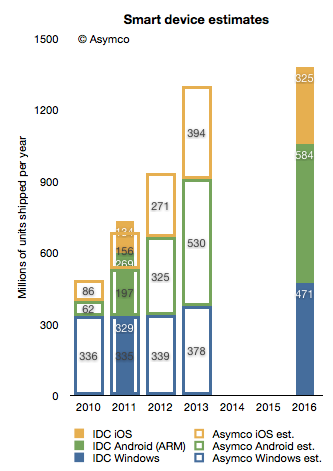
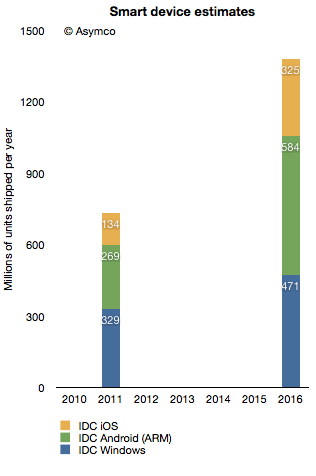
    In terms of platforms, IDC expects a relatively dramatic shift between 2011 and 2016, with the once-dominant Windows on x86 platform, consisting of PCs running the Windows operating system on any x86-compatible CPU, slipping from a leading 35.9% share in 2011 down to 25.1% in 2016. The number of Android-based devices running on ARM CPUs, on the other hand, will grow modestly from 29.4% share in 2011 to a market-leading 31.1% share in 2016. Meanwhile, iOS-based devices will grow from 14.6% share in 2011 to 17.3% in 2016.

    Via: IDC - Press Release - prUS23398412

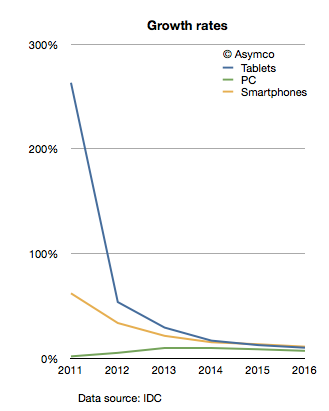
    The company provides a stacked bar chart (follow link above) to illustrate their view of the market. I took the data they included and measured the implied growth rates for the product categories:

    IDC is implying that in four years the tablet market will be growing at 10%, the Smartphone market will grow at 11% and the PC category will grow at 11%. In other words, five years from now the PC market is expected to grow faster than the tablet market and just as fast as the smartphone market!

    What's more remarkable is that this situation is not going to happen in four years. The slowdown in growth is actually expected much sooner. The growth rates two years from now are expected to be: Tablets 17%, Smartphones 15% and PC 10%. IDC is unequivocal: by 2014 the good times will come to an end to the post-PC challengers. These growth rates would be catastrophic for share prices and the value propositions of the new platforms to developers, partners and consumers.

    What's more, these growth rates are striking not only because they predict a collapse in the value of most market challengers but that they also predict a strongly resilient PC market. How can we test this forecast?

    I tried to reconcile this doomsday scenario with what is known about the components making up the data. I.e. what "bottom-up" data is IDC using? In the quote above, IDC offers some insight into this market participant data. Based on the category and share data they published it's possible to infer the following:

    Bearing in mind that neither iOS nor Android existed five years ago, we can observe they are bigger together than the PC market. And yet, IDC predicts a compounded average yearly growth rate of 16.7% in Android, 19.4% in iOS and 7.5% in Windows between today and 2016.

    In aggregate, IDC forecasts that in the next five years Android will not manage to double and that iOS will only increase by a factor of 2.4. Is this believable?

    I try to stay away from long term forecasts, but I do maintain a short term forecast based on recent growth data. My forecasts for this year and next year are shown below.

    I super-imposed my short-term forecast (outline bars) on IDC's long term forecast (solid bars) and a several differences become apparent.

    First, my 2013 forecast is nearly the same as IDC's 2016 forecast. To see why we need to look at each platform separately.

    Perhaps we might (with difficulty) agree on Microsoft's potential. I believe Windows 8 will have a catalyzing effect and that Microsoft will begin to see its platform grow again. However, my expectations are modest. To increase Windows sales rate by 100 million units/yr between 2013 and 2016 is possible but ambitious.

    The real problem is that our Android and iOS forecasts are outside any zone of possible agreement. Maybe there is a difference in what we measure. For a hint, we seem to disagree on the number of Android devices shipped in 2011. I used Google's own reports of activations to work out the yearly shipment estimates. Perhaps IDC is including versions of Android that are not Google sanctioned.

    We also disagree on the 2011 iOS figures. I obtained 156 from Apple's own reports. Again, perhaps the difference is the inclusion of the iPod in my case.

    Nevertheless, the difference in the long term cannot be accounted for only through these categorization differences. I would put the cause of the difference down to the methods used in forecasting. As can be seen from the first chart above, IDC's growth rate reductions are extraordinarily steep. Perhaps the approach used by IDC was to forecast the overall market growth and then assignment of shares to participants. This can be called the "top-down" approach. In contrast, my approach is to forecast growth rates based on recent growth rates and moderating these rates gradually. This can be called the "bottom-up" approach.

    My experience and all the data I've ever collected about historic disruptions tell me that the entrants tend to win these types of paradigm shifts. They win through a vast expansion of consumption and the recruitment of non-consumers. Markets tend to experience vast shifts in composition. If we believe this to be true then the bottom-up approach focused on entrants is likely to be more effective vis-a-vis the top-down approach of projecting steady state markets and the implicit assumption of incumbent share preservation.

  5. The growth surprise in Apple retail

    Research · 58 comments

    In Apple: For What It’s Worth Jeff Matthews asks a question "about the most disturbing pattern coming out of Apple’s earning release: the measly 1% year/year revenue increase at Apple’s retail stores".

    He notes that prior to the drop, Apple stores were growing at 36%. Such a huge drop quarter on quarter seems suspicious and he thinks something is happening.

    Something is happening.

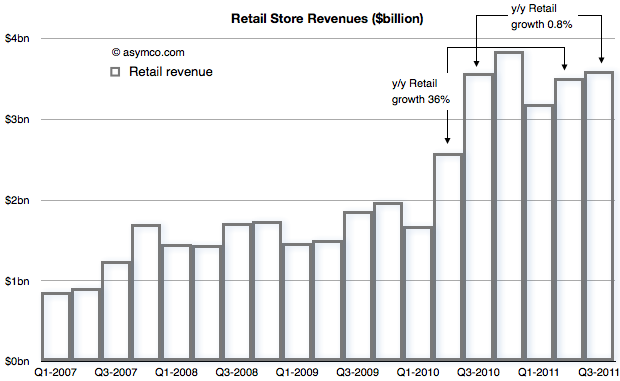
    To find out what, let's start with the revenue from Retail that Apple reports[1]


    The concern is with that low growth between calendar Q3 last year and this year. That is being contrasted with the growth in the previous quarter (Q2) of 36%.

    When seen as a chart, the explanation for a big change in growth is perhaps easier. The third quarter of last year was a boom for retail and the quarters that followed were more-or-less similar in sales level.

    With this perspective, it's clear that there was a surge in sales during the last year which did not repeat this year.

    But what's the cause for this pattern? If we know the cause can we predict if retail sales growth will increase or decrease?

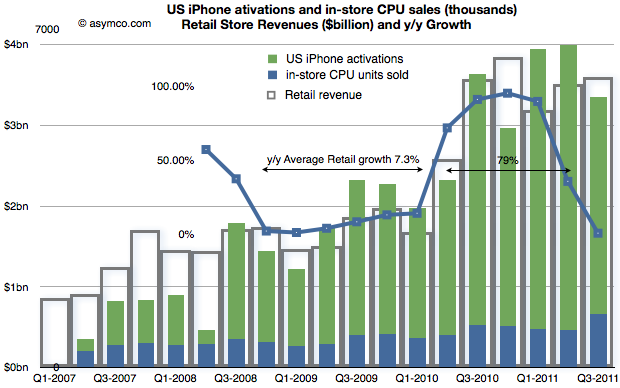
    Consider the following compound chart:

    The chart shows three different quantities.

    1. The original retail sales values in "hollow" bars
    2. The growth in those values year-on-year (in a line chart)
    3. A "proxy" candidate for retail growth explanation: the sum of US phone activations and in-store CPU units sold as a stacked bar chart.

    The choice of proxy includes the blue bars which Apple reports as in-store "CPU units" and the US phone activations[2] coming from AT&T and Verizon[3].

    We can see now that there is a strong relationship between iPhone sales growth and store sales growth. The Mac business is growing but not in the bursty way that iPhones are growing. The growth of US iPhones matches the growth in (US mostly) Apple retail. This should not be a surprise.

    The bursty nature of iPhone means that store growth varies just as dramatically. I highlighted that during the period of Q4 2008 to Q1 2010, Apple store revenue grew at an average of 7.3% but following the "big bang" of the iPhone 4 launch they grew at 79% over the subsequent five quarters (because the comps were easy).

    In the latest quarter the growth dropped as there was no launch of a new iPhone to top the big bang of a year earlier. Even so, store revenues actually increased by a slight amount.

    Knowing that the comp with the year before was so tough the surprise isn't that the growth slowed, it's that there was any growth at all.

    If iPhone as a cause for growth in retail is to be believed, then how hard can it be to forecast retail growth in the future?

    ---

    Notes:

    1. Apple does not submit this information to the SEC but reports it (exclusively I believe) during the earnings conference call. Transcripts are available on seekingalpha.com but fortunately they are recorded as well by Gary Allen at ifoapplestore.com.
    2. I used US data for the iPhone as most of Apple stores are in the US. The global pattern is similar.
    3. I had to estimate Verizon units used during the last quarter as they have not been reported yet. I used a similar ratio between AT&T and Verizon as for the last quarter.
  6. Why Apple is on top today: the top 10 technology decisions

    Research · 91 comments

    As Apple overtook Microsoft in market cap and as Steve Jobs reminisced about some recent history, I thought I'd reflect on some of the decisions that brought Apple to the pinnacle of technology companies.  The criteria I used to select these is how improbable and hence courageous they were when taken and how much impact they have had on the industry. Since the impact of these decisions could not be felt for a long time, the courage required to act early is all the more remarkable.

    At the time they were made, none of these decisions did anything to move the stock price or cause great rejoicing. In fact, in many cases the decisions were ridiculed by those who should know better. Yet each one became a massive pillar of the foundation of Apple as it is today.  As you read through, think of the decisions that Apple competitors made or did not make in the same time frame.

    Top 10 Apple technology decisions of the 2000 decade in reverse order:

    • 10. HTML 5 (canvas). It was initially introduced by Apple for use inside their own Mac OS X WebKit component, powering applications like Dashboard widgets and the Safari browser. Still in its infancy, the canvas element is an Apple technology that promises to finally offer a credible Flash equivalent.  Remember that Flash is now over 10 years old and was incubated at a time when the Web was barely 1.0.  HTML canvas finally brings vector graphics to the modern era.
    • 9. H.264. The decision to support a standard video codec at a time when the industry was mostly arguing over whether Blu-ray or HD-DVD would win signaled a foresight that physical media was not long for this world.  The consequences are still being weighed as YouTube and other media sources are shifting their inventory to this format.
    • 8. iTunes. iTunes started as a personal music database, grew into a music and media store-front, a payment processing engine, device synchronization and updating center, and finally an application store.  It was forked into both a PC and a mobile version.  Without iTunes the iPod would have been just another MP3 player.
    • 7. WiFi. Implemented in Airport before the spec was finished, WiFi gave the laptop wings.  Think back to when you still had to plug a wire into a computer to have it communicate. PC's did not catch up in being wireless for years.  WiFi was even a rare feature on mobile phones when the iPhone shipped in 2007 with some operators (Verizon) banning it from their phones even in 2009.
    • 6. FireWire. Along with iTunes brought iPod to life.  Launched at a time when external drives required screwdrivers and a circuit board to install, FireWire made opening your computer case to expand it as common as opening the hood of your car to fix it.
    • 5. iLife. Did to user-generated media what word processors did to words and spreadsheets did to numbers. A singularly great reason to get a Mac.
    • 4. Portability. OSX migrated across three different CPU architectures in less than 10 years. Apple revealed that they built it from day one to be portable to different CPUs.  That took amazing foresight in the late 90s.
    • 3. WebKit. Speed and flexibility.  The biggest reason why we can surf on a phone today.
    • 2. Multi-Touch UI. Seven years in development and still sublime.  Starting down this road in 2003 must have seemed science fiction.  But, unlike other companies, Apple took this science experiment and went to market.  Steve Jobs said how he wanted a screen keyboard and how scrolling opened his eyes to making a phone. That took vision.
    • 1. OSX/Cocoa. The company's backbone.  Everything above hangs off OSX. Remarkably scaleable, portable, robust and reliable.  With roots going back decades, it's the canonical OS. Somebody should build a monument to it.