iTunes/Software/Services revenues grew at 12%. This was the second fastest segment growth last quarter, with the Mac growing at a slightly faster 13% rate. Apple mentioned in the quarterly earnings conference call the for the first nine months of its fiscal year (i.e. since September) the line item iTunes/Software/Services has been the fastest growing part of the business. The following graph shows the growth scorecard for Apple's line items and it shows how the iTunes store is the only line that has been consistently green (growing above 10% for at least seven years.
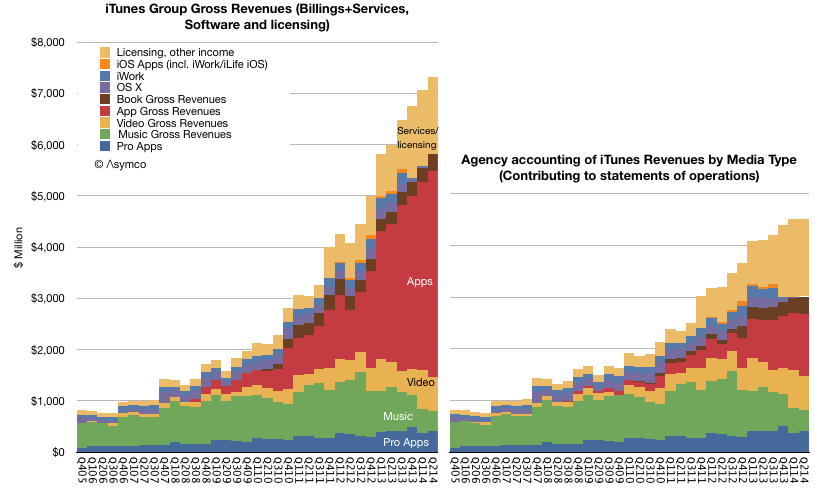
In addition to its revenues, iTunes can also be measured in terms of billings (or gross revenues). The billings growth rate is even higher at more than 25%. This is mostly to the more rapid growth of apps relative to a decline in music. As Apple only records the 30% it keeps as "revenue" for apps the overall growth in apps is less visible in its accounts.
The relative performance of billings vs. reported revenues is shown in the following graphs:
Note the estimated split between media types and software and services. The software and services portion of the business had sales of $1.9 billion while the revenues from third party content/apps sales reached $2.6 billion.
The value of this data is that it encompasses an almost complete view of the Apple ecosystem. As almost all content and transactions are tracked and reported and one can get a very precise view of the economic value of the ecosystem. ((In addition to iTunes/Software/Services Accessories could also be considered as part of the ecosystem. The value of Accessories and licensing as Apple reports it adds another $6 billion to iTunes/S/S)) (( What is missing are ad revenues through apps which don't use iAd )) (( What is also worth asking is what is the size of alternate ecosystems such as those of Microsoft, Google etc. ))
From the launch of the iPhone the value of Apple's ecosystem has grown more than 600% which is faster than overall sales growth (approximately 400%). If ecosystem value grows more rapidly than underlying hardware sales the question that emerges is when would the ecosystem transaction value exceed that of the business is supposedly supports.
Today the iTunes/S/S ecosystem is about $20 billion/yr. iPod, iPhone, iPad and Mac sales are about $150 billion/yr. It does not seem likely that the former will overtake the latter. If that were the case then one wonders why build a business entirely predicated on retailing and services without the support of hardware revenues. Something along the lines of Amazon.
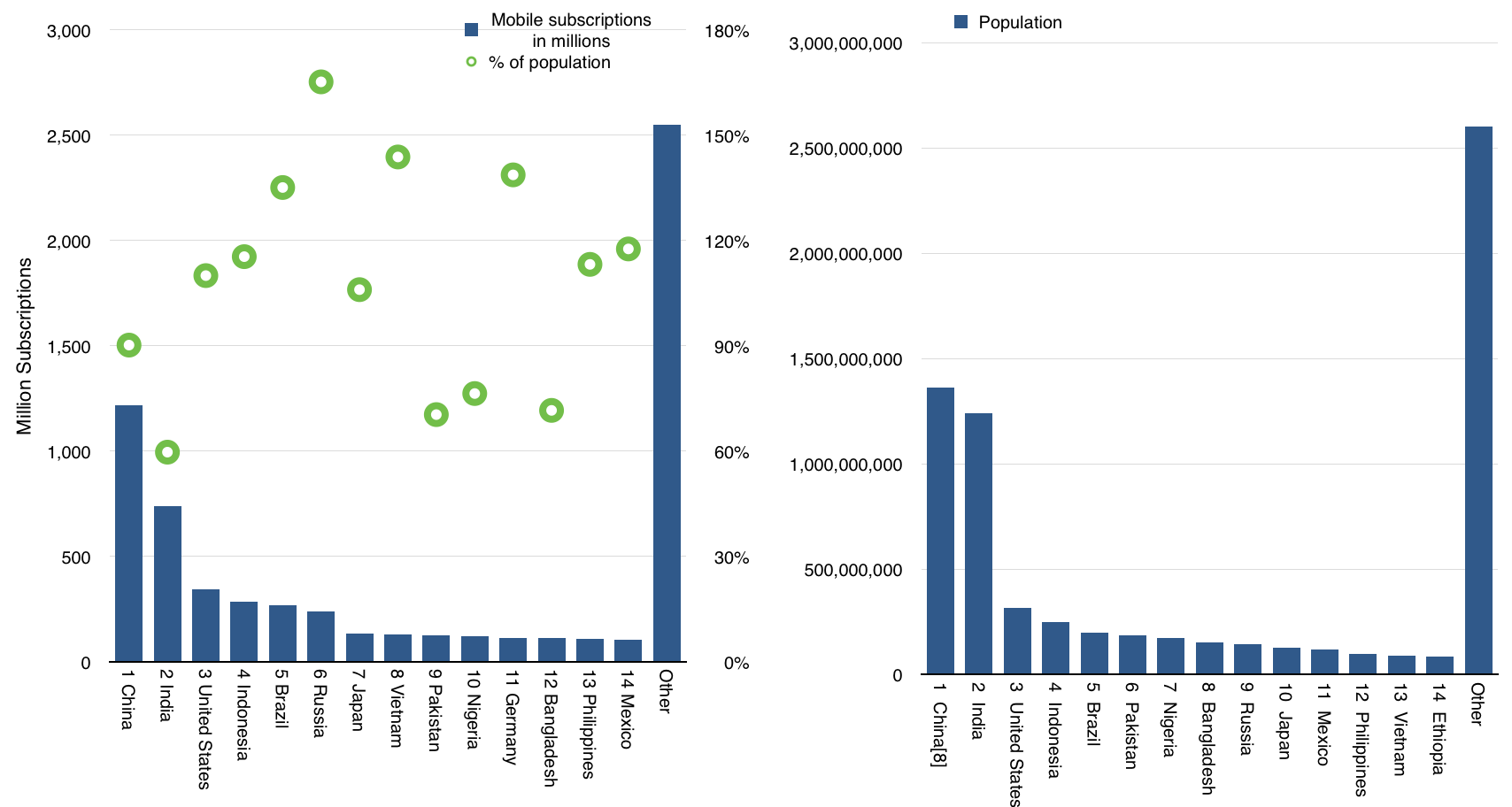
There are 7.1 billion people on Earth. Coincidentally there are also 7 billion mobile connections. Those connections are held by 3.45 billion unique mobile subscribers. ((GSMA)) Unsurprisingly, the largest national mobile markets (by number of subscriptions) correspond closely to the most populous nations.
Considering smartphones, last year 1 billion smartphones were sold and the number of smartphones in use is about 2 billion ((There are also about 2 billion 3G/4G connections world-wide))
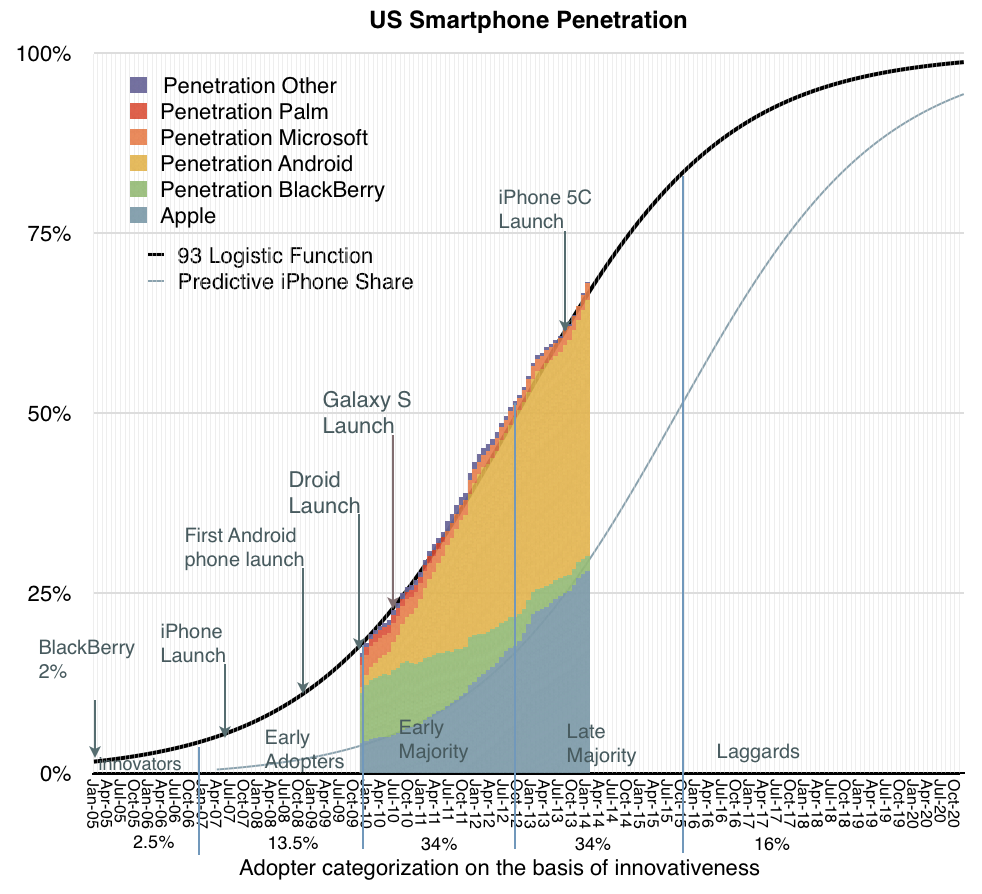
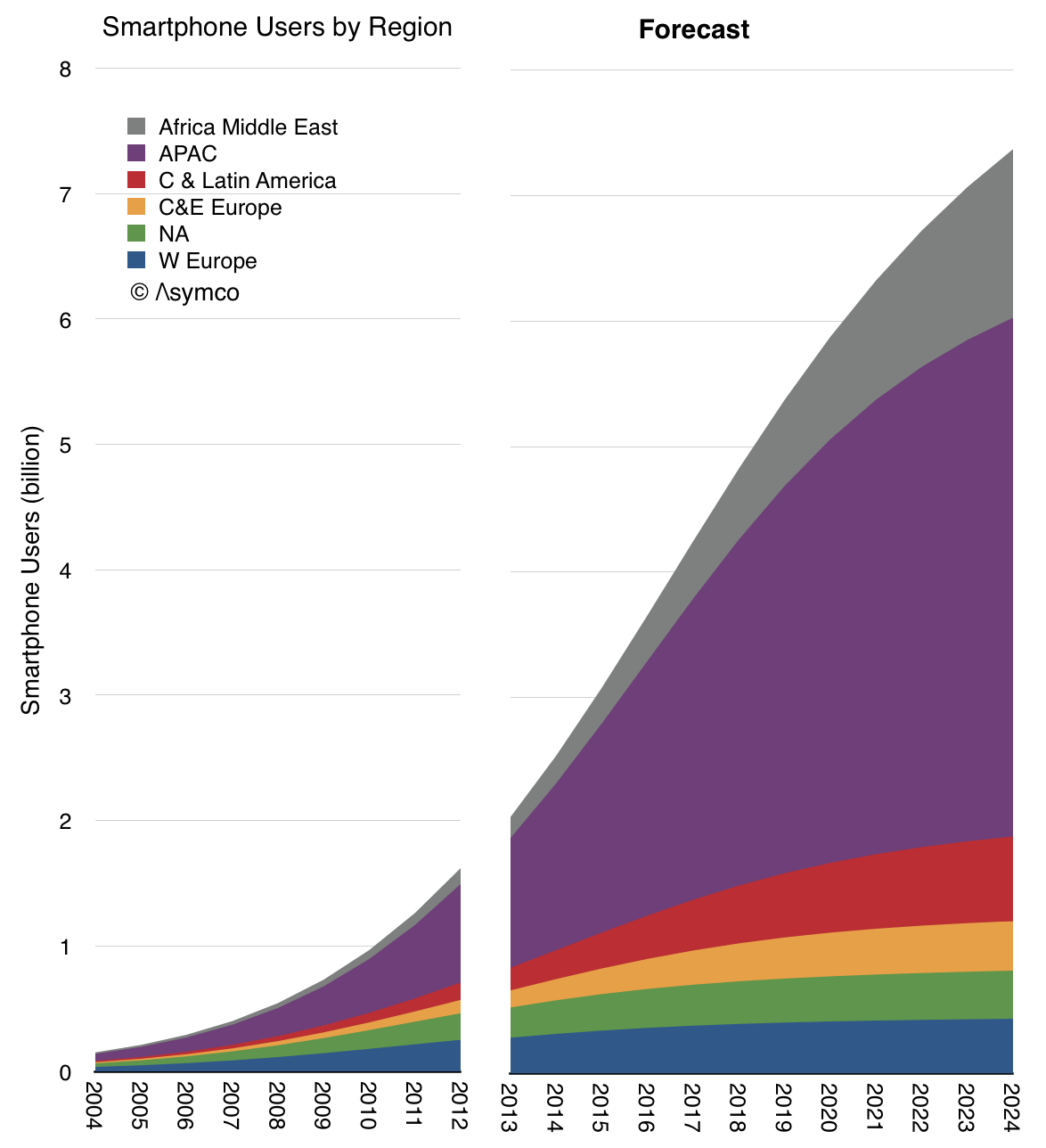
Given the rapid adoption of smartphones, it's also safe to assume that smartphone penetration will follow population distribution. In the US, where comScore data is published monthly, penetration is following a predictable logistic curve.
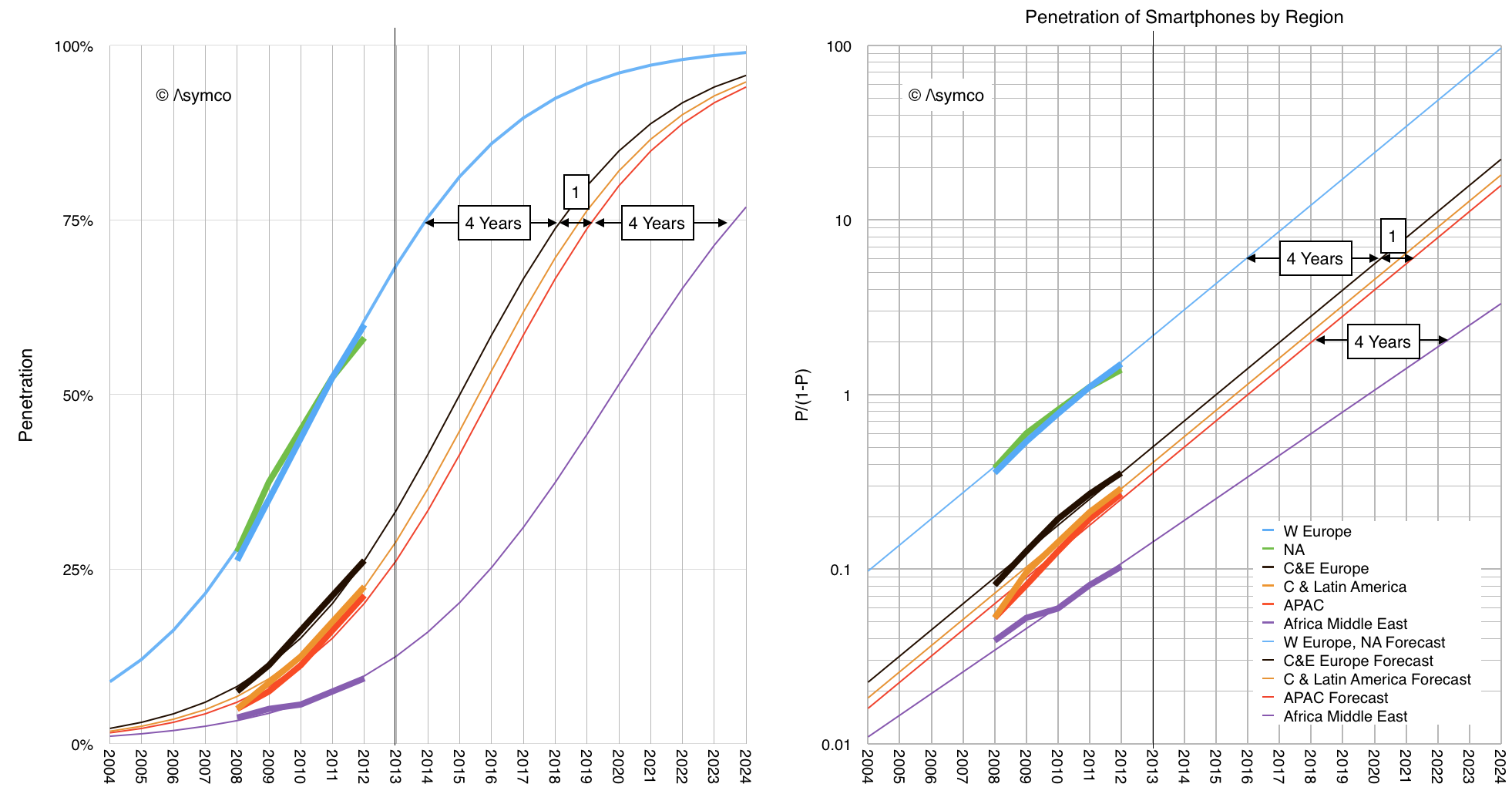
Assuming similar patterns world-wide we can forecast regional smartphone penetration.
This yields the following forecast for smartphone usage world-wide.
Three years ago the notion of smartphones becoming as ubiquitous as toothbrushes seemed far fetched but it's now gradually being accepted. The smartphone is well on its way to becoming the most successful technology in history.
So what?
What will the smartphone do for us? Does smartphone ubiquity change anything? Besides increasing ARPU slightly in a $1.2 trillion industry? Besides doubling the size of the device business? ((
))
Besides creating a $20 billion app industry? How do we assess the impact of having a connected computer in one's pocket? In everyone's pockets? With us all day. Every day.
Before we answer, we have to realize that the smartphone has been disruptive. Which means it has that special quality of not affecting the world in a predictable way. Its growth has been largely unforeseen and has affected the fortunes of the incumbents. As big and ubiquitous as it has become, the companies which were most intimately aware of it, its very own creators, were cursed by it.
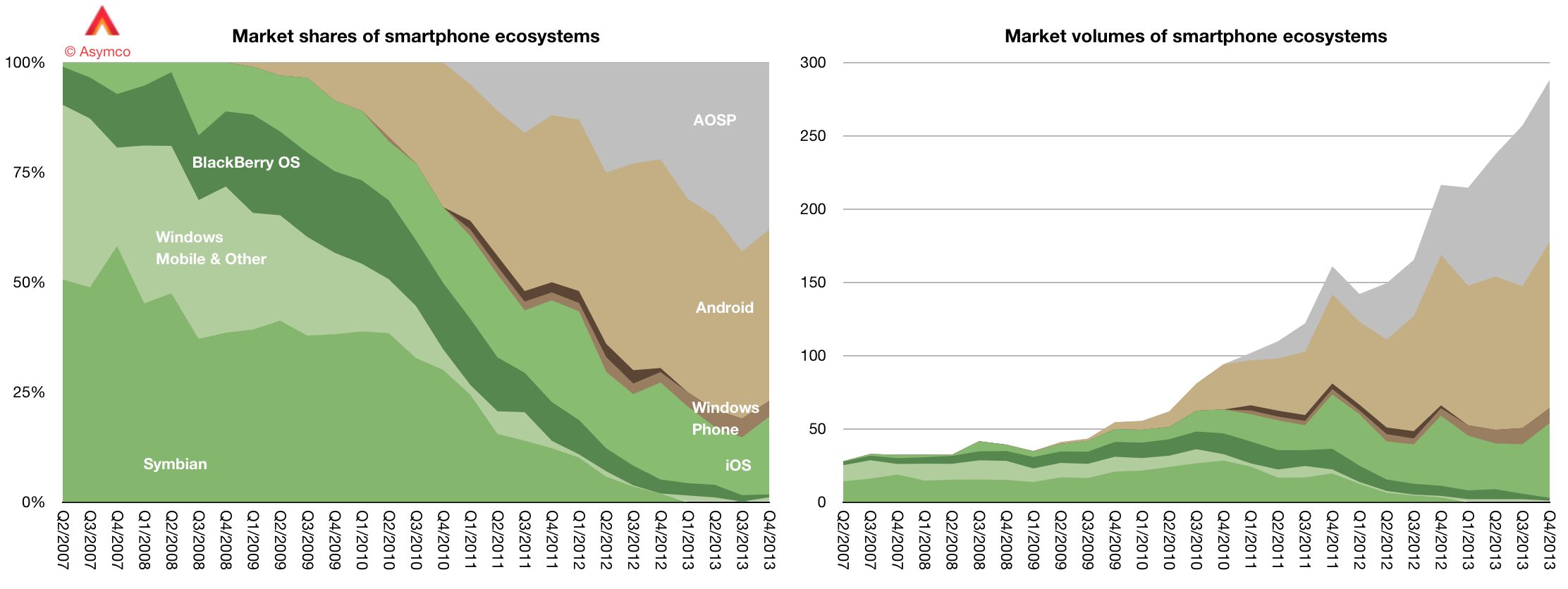
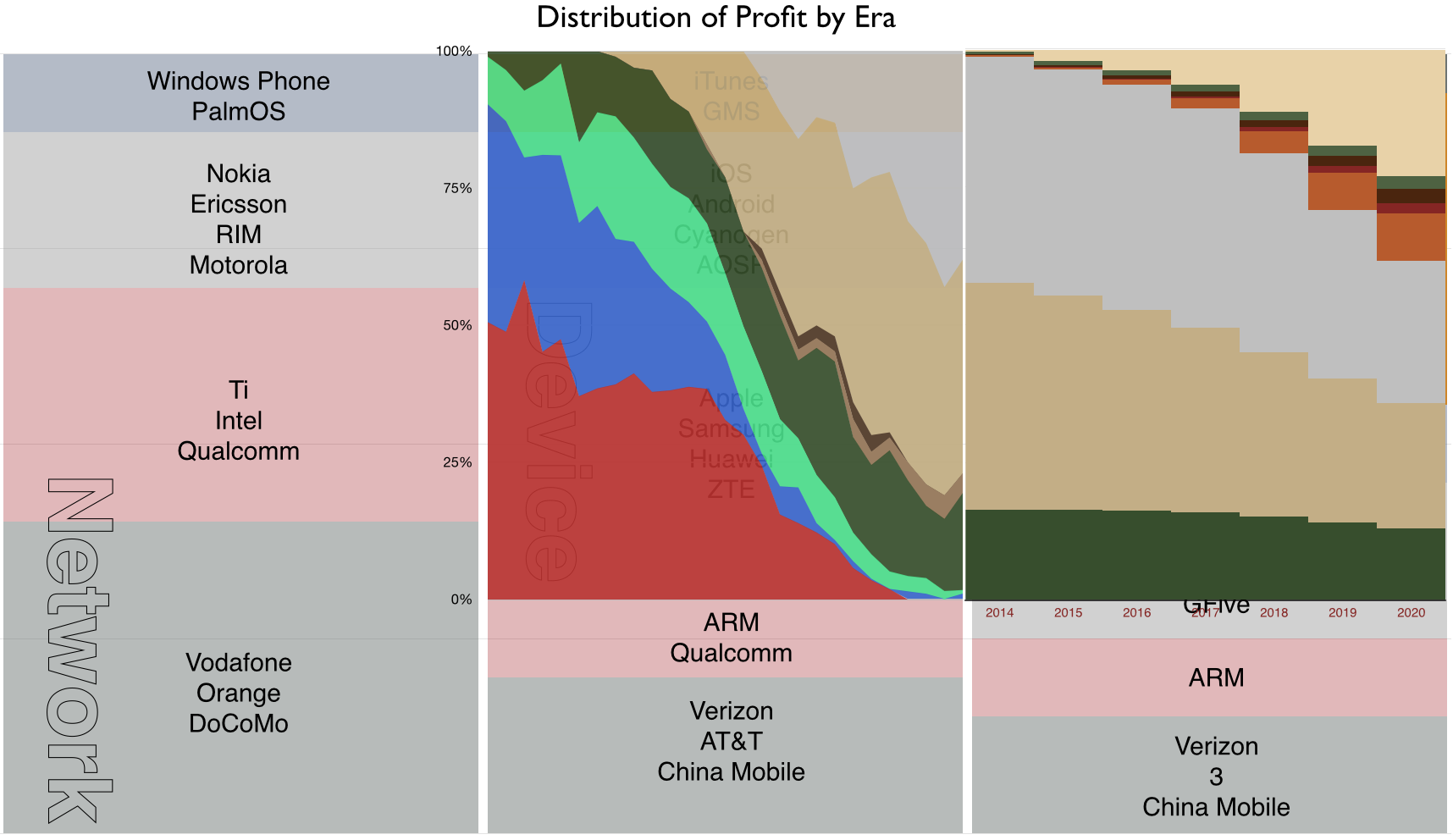
The evidence is in this graph:
As the market exploded, the incumbent platforms all but disappeared. The innovators fell into the trap of treating the complex new product as a niche whose appeal was for selected "segments" described by the coarse data they were able to gather. Ubiquity itself was asymmetric to the basis of competition they established.
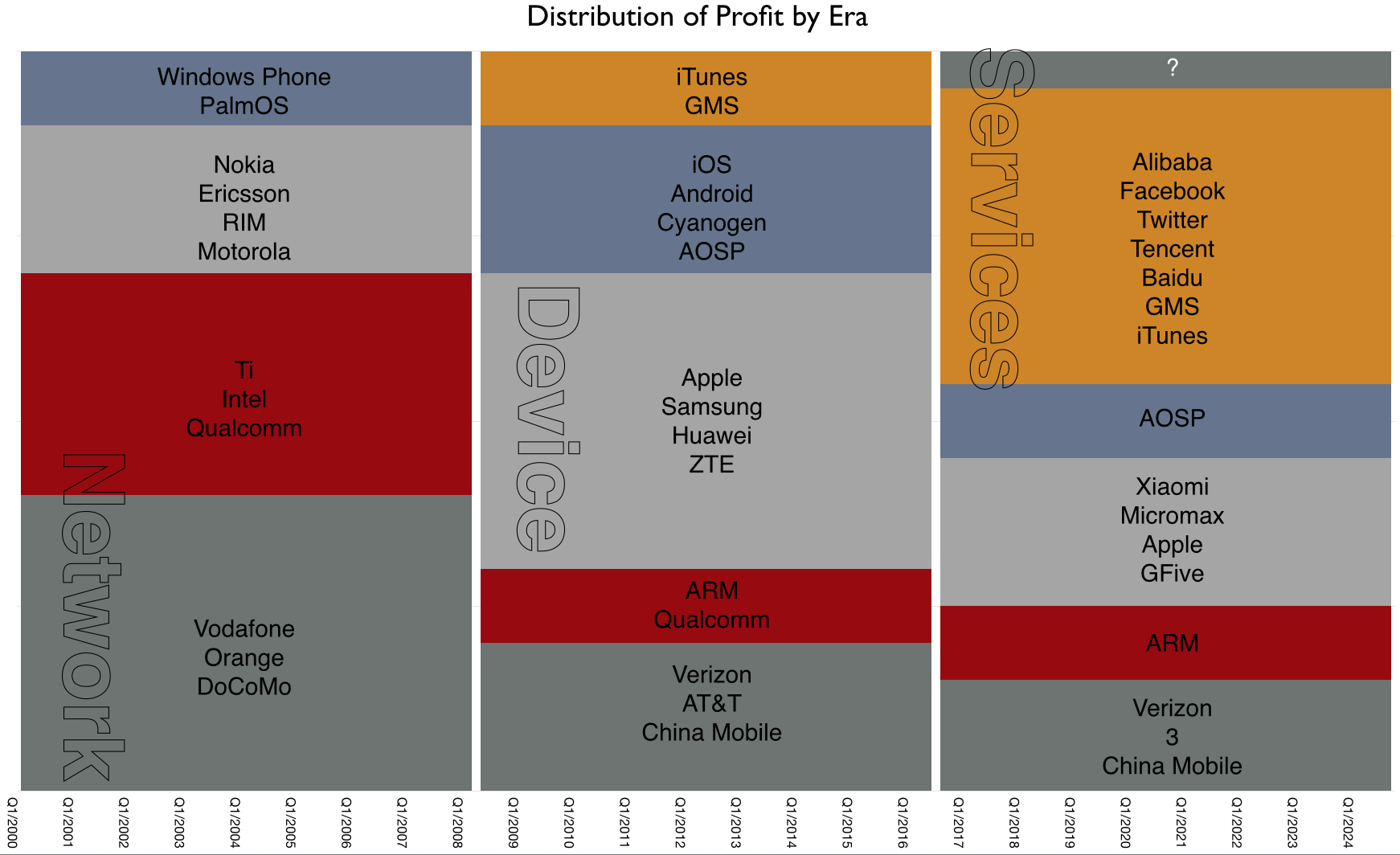
Today we can note how even the usurpers iOS and GMS Android are being swamped by the more modular alternative AOSP. Indeed, if we squint a bit we might notice that the OS/platform churn we see is part of a trend where the value is migrating up the stack from Components and Networks, through Devices and Operating Systems and on to Services and Experiences.
I call these the three mobile eras: (Firm names used are representative of a cohort and are not a complete list of participants.)
The thesis is based on Value Chain Evolution Theory which states that disruptions cause profits to evaporate from commoditized segments and condense in adjacent spaces, usually toward more modular, more convenient or lower cost innovations.
Note that the eras have specific time spans. If the pattern holds then we can overlay the time frame of smartphone penetration on these eras and even plot ecosystem entrants.
Disruption suggests that we are likely to see yet more shifting of fortunes. It means enabling new ecosystems to take advantage of the modularization of platforms. But how can it happen given the entrenched nature of the incumbent duopolists?
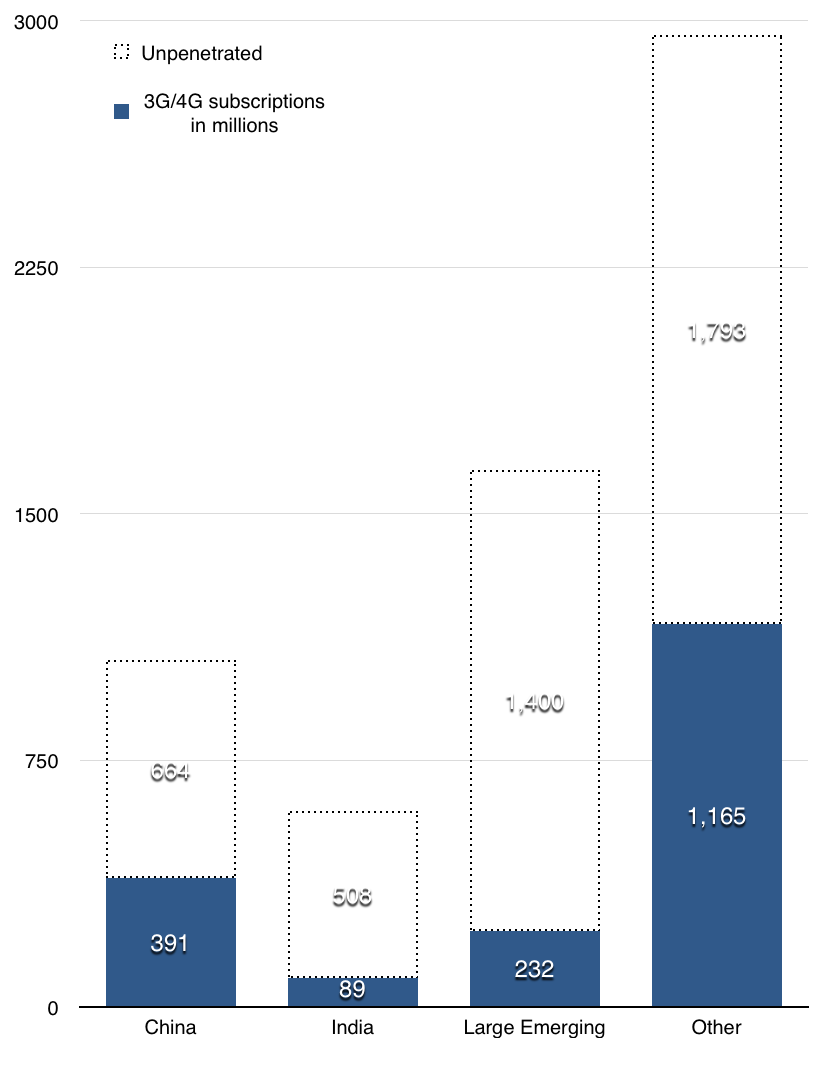
The clue lies in the first graph in this post: It suggests a geographic segmentation. The largest markets are large enough to sustain independent ecosystems. Note that China and Russia have already established alternative local service ecosystems. We may dismiss the possibility of localized Google and Facebooks in emerging markets but China and India are universes in and of themselves. But there are another 10 markets of more than 100 million users. That's another billion users among them.
But it's not just the availability of a vast pool of new users. The rapidity of growth of services like WhatsApp and SnapChat and Tencent shows that barriers to entry are low. We see increasing indigenous innovation in payments, logistics and business models in the newest markets. We see no shortage of talent and capital to start these businesses. We see increasing language and culture clustering in social media. We see political resistance to hegemony.
Focusing on the established, highly penetrated markets as an indicator of opportunity would be a mistake. Those markets foretell the rate of adoption but not the evolution of the value chain. Apple and Google will continue to anchor in those markets but there is no reason for the remaining two thirds of the world to follow. Indeed, there are incentives not to.
Incentives exist to localize services. Indeed, service businesses have always been local businesses. There are few global service brands. This has been true in retail, transportation, banking, hospitality, media and communications. Why should we believe that ecosystems can overcome the advantages of localization? Services are local because they are delivered by individuals and have high "touch" with the user.
Fundamentally, ecosystems are social systems and social systems have cultural and political dependencies. ((Post-modernism is a typological world view which sees truth as socially constructed and a rejection of 'totality')) Technology does not homogenize unless it is centrally controlled. The control of mobile computing has already been abdicated by its creators.
When trying to assess the success of an ecosystem, the primary measure is the size of the user base or the "audience" for the product. Companies like FaceBook and WhatsApp and Twitter are measured first and foremost on this metric. Companies like Google, Amazon, Apple and Microsoft are less so. When revenues are firmly attached to products the focus shifts to "follow-the-money" rather than "follow-the-users" metrics.
That's as it should be, but for the sake of understanding the competition between ecosystems, they should be compared on some similar basis. If the basis of competition in this day and age is ecosystems ((As Microsoft, Apple and Google seem to agree it is.)) how does one evaluate Facebook's vs. Microsoft's? Or, more poignantly, how does one compare WhatsApp's valuation with that of iMessage?
It's common to value a company which aggregates audiences at a multiple of that audience size. The implication being that each member of the audience returns a certain cash flow to the aggregator and the discounting of those flows is the net present value. Which is why, for example, a newspaper is valued in terms of its subscribers. As is a TV network and as might be a social network. Using this metric, a WhatsApp (i.e. free messaging) user is worth $40 and the average social media user may be worth around $100. ((The degree to which a user is actually worth the sum of all the subscriptions she may have made is a good topic for discussion.))
The implication is that users/subscribers/audience members are loyal and will stay with the programming for some time. There is also a second implication that businesses which are not measured by audience size don't have this loyal and recurring revenue base. The absence of an "audience" implies transience and impermanence and results in deep discounting of long-term viability.
Which is why ecosystems are the desired business construct for technology companies. They allow a more consistent and repeatable transaction model and offer predictability which is sorely lacking in the rapidly changing technology industries. It allows a company to define itself on its customers rather than on its products.
However, old habits die hard. Regardless of the exhortations of product companies, the notion of being valued on audiences is reserved for the service-oriented. Hence the outburst from Tim Cook at the latest shareholder's meeting. Reports have him saying that:
Apple now has 800 million iOS users and has handled over 16 trillion push notifications, with 40 billion new ones occurring every day. Apple also delivers several billion iMessages and FaceTime requests every day. Cook added that iPad now accounts for 78 percent of all tablets used throughout the enterprise.
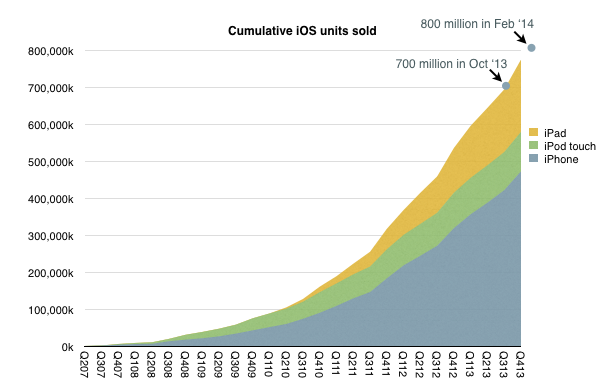
Trillions of push notifications aside, the claim that Apple has 800 million iOS users seemed way out of line. This is because the number of iOS devices (excluding Apple TVs) shipped through to the end 2013 was exactly 774,336,000. One could easily imagine another 25 million or so since, giving us about 800 million sold, but I cannot see the number in use being the same, and even if they were, the number of users being the same.
The following graph shows the claim in context of shipments.
Note that last September Cook made the claim that 700 million iOS devices "by October", which did indeed happen. The 800 million claim in February is certainly believable in that context.
Determining the total number in use is a very speculative exercise. Assuming useful life of 9 quarters for iPhone and iPod and negligible iPad retirements yields about 560 million iOS devices in use. Obviously this can be very inaccurate as also there can be multiple users per device but the claim of 800 million users seems very hard to reconcile.
Perhaps he was mis-quoted or he mis-spoke but the real question isn't the exact number but rather the implication that Apple should be seen for its users rather than its quarterly shipments.
Them's fighting words, Mr. Cook.
[Update: Thanks for Philip Elmer-DeWitt's investigation, Apple clarified that Tim Cook referred to 800 million as the number of iOS devices sold not users of iOS. He was mis-quoted.]
Barcelona, Spain - Today at Mobile World Congress, Nokia unveiled five new affordable handsets including a new family of smartphones debuting on the Nokia X software platform. Based on the Android Open Source Project AOSP, and backed by Nokias deep ties with operators, the Nokia X platform gives AndroidTM developers the chance to tap into, and profit from, a rapidly expanding part of the market.
Today's announcement is consistent with the declaration of Nokia is engaged in a "war of ecosystems." Note that this is in contrast to "a war of platforms" or a "battle of operating systems" or a "competition of devices."
Devices are commoditizing, operating systems are commodities and the Android platform is a commodity. Value will not be captured in any of these technology modules. Ecosystems are another matter. It's where Facebook (and its acquisitions) reside. It's where Google lives and it's where iTunes has been for a decade.
Nokia's adoption of AOSP as an operating system is consistent with the ecosystem strategy set forth three years ago, and is also consistent with Microsoft's competitive strategy.
Which is why I believe Microsoft is not only comfortable with this development but had agreed to it over a year ago when work on this initiative was already well under way.
Benedict Evans explains well the problem with measuring Android tablets. There are no reliable data collected because many of the devices are invisible through the regular, measurable channels:
There are no firms which report their shipments
They are not sold through retail chains which normally are sampled in the US and Europe (NPD and GfK respectively.)
They don't show up in browsing or ad transaction data
Google Play statistics are missing most of the activations since they are not sold as bona fide Google-sanctioned Android.
The only measured statistic happens to be component shipments. Items such as screens, CPUs or perhaps memory might be visible to market analysts. It's therefore tempting to add up tires manufactured to determine what's getting sold in auto dealerships.
But it's also hugely problematic.
Before we go into that rat's hole, I want to re-visit my original criticism for market analysis based on device attributes. When the iPad was new it was famously labeled a "media tablet" by Gartner and excluded from being counted (and hence compared) with PCs. This created an implicit signal to the analyst's clients to ignore the entrant as irrelevant.
That actually accelerated their demise (and the revenue prospects for the analyst).
In contrast to that exclusion--of a clear and present danger based on an arbitrary definition of form factor--the analyst who defines categories of products purely on the definition of their components is guilty of the same sin.
Snowing the audience with irrelevant comparisons is just as bad as withholding relevant comparisons. This is explicitly asked of witnesses: to tell the truth, the whole truth and nothing but the truth. The "nothing but the truth" means the exclusion of irrelevance.
The correct approach is to identify which devices are comparable (and thus in the same category) based on the jobs they're hired to do. If a tablet overlaps considerably in the work it does with a PC (e.g. browsing, email, media play, and other applications) then they should be considered comparable. If a tablet does nothing that a PC does or nothing that an iPad does (e.g. no browsing, email, apps or ecosystem activity other than piracy) then they should not be considered comparable.
Which brings me back to the question of what these dark matter "Android tablets" actually do.
To answer I want to recall another "dark matter" technology that seems to have gone largely unnoticed but was exceptionally popular. This was the VCD or Video CD. It was an alternative to the DVD without the licensing and DRM overhead it entailed. It was extremely popular in Asia as a way of not only buying but also sharing video content. The cost of content was a fraction of sanctioned versions, essentially taking the role that mass-copied VHS had in previous years.
The "job to be done" was to enjoy video content cheaply and conveniently for the equivalent of pennies a day. A job very similar to what we think of as cable TV today.
These devices and discs were largely invisible mainly because they did not exist in economies which adopted protected DVDs and because the content consumed did not hit against any databases that tracked consumption. Nevertheless there might have been hundreds of millions of these devices sold and billions of discs viewed.
Now we are in a situation where devices whose primary purpose is to watch video content (cheaply and conveniently) are being counted. By their counting, their implicit competitiveness is asserted. But it means nothing if they are not hired for the same jobs. In fact it misdirects attention.
Sometimes these "low end" devices do grow up to swamp the higher-powered alternatives with good enough functionality. That is the innovator's dilemma for low end disruption. But in some cases they don't because other factors are at work. Because ecosystems have complex multi-sided markets and because regulations and channels and consumer behavior conflict with the technical specification.
For this reason the VCD did not "disrupt" DVD or grow up into a Blu-Ray equivalent that caused Hollywood to crumble. It faded away as an anomaly.
Whether the dark matter Video-only Android device will come to swamp the iPad will depend not on just volume shipments in select geographies. It will depend largely on the ecosystems built around it. The ecosystems of VCD were largely unsustainable because there was no value placed on the content itself. The value chain did not strive to sustain the technology. When something better came along, it got dropped.
In contrast, content-based value chains sustain technologies which keep the revenues coming. And we can measure this revenue.
You don't need to look too hard for that in tablets. Apple states it quite frequently: total payments to developers.
Apple has sold 700 million iOS devices. Google claims one billion Android device activations. Microsoft has about 1.5 billion Windows users and Facebook about 1.19 billion. LinkedIn has 259 million users and Twitter has 232 million. Amazon has 215 active account holders and PayPal 137 million.
Markets place a value on these users implicitly when company shares are priced. For example, Twitter whose users are worth about $110 or FaceBook's $98 and LinkedIn at $93.
This consistency suggests a universally accepted value per social media user but what is the value of an ecosystem user? Apple, Google, Microsoft and even Amazon aspire to enable ecosystems which should be seen are more valuable than mere communities. Ecosystems enable a higher level of economic activity because they are unbounded by the medium itself. Any number of media can be created. Or so the theory goes.
If we could determine a value for an ecosystem user we could test it against the going value of a social media user. Fortunately we have enough data to do so.
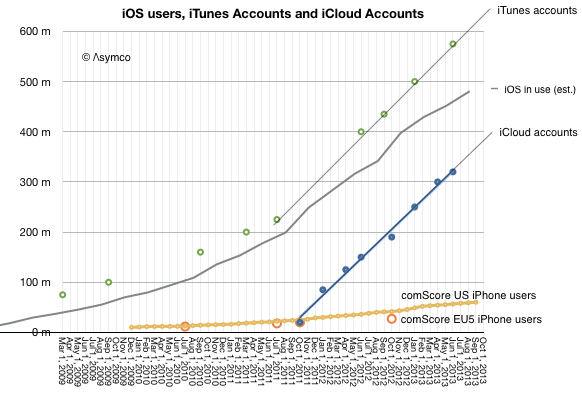
The total number of iOS devices sold per quarter allows us to measure the install base of device users. With some assumptions regarding the retirement and attrition rate we can get the following history:
Since the total number of iTunes accounts is updated with some regularity I've added it to the graph. I've also shown on the same graph the total number of iCloud accounts. For calibration, I included survey data showing the number of iPhone users in two regions (US and EU5).
These combined graphs give us an upper bound of active users (iTunes accounts) and a lower bound (iCloud) calibrating our device-based estimate. The regional iPhone data offers some additional test on growth.
The result is "about 500 million" ((482 million by my count but with quite a bit of margin of error)) with a growth of about 11 million per month.
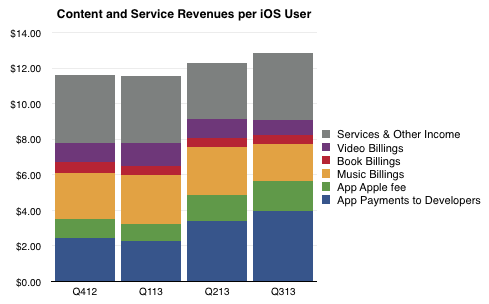
So if we know with some confidence that there are about 500 million active users as part of the iOS ecosystem, how do we know how much value they generate? The answer is in the consolidated iTunes revenues as reported by Apple: $4.26 billion/quarter. With some attention to the reported media retail and purchases, the following picture of the average iOS user's quarterly spending emerges:
The bottom line is that in the last 12 months the average iOS user contributed about $48/yr to the ecosystem via Apple's own properties. They also bought the device and paid for cellular service in most cases. They may also have engaged in quite a bit of browsing and online purchases which fed other ecosystems. But as far as Apple is concerned, it transacted about $48 per user.
As Twitter revenues last year were $317 million, the Twitter user today generates about $1.36 of revenue per year or one thirty-fifth of what an iOS user generates through iTunes and iCloud alone. And note that the number of iOS users is about twice that of Twitter.
Of course one could argue that the iOS user's participation is not profitable for Apple. It does obtain massive cash flow from iTunes which finances its fashionable data centers and bandwidth but it does not presume to value itself primarily through this revenue.
Or at least the market doesn't think so. We don't hear much about how Apple is worth so many dollars per user. ((I suppose the corollary to this is that Apple users are disloyal or fickle or fleeting, and quite contrary to observed behavior.))
The paradox is that while the device which enables this commerce is where Apple guides the consumer's perception of value, markets discount devices and bid up services. In other words, users continue to pay for the devices which delight them enough to participate in services (especially the monthly billable kind) but markets walk right by these shiny baubles and and shower money on services which have negligible sales and even fewer profits. There must be some serious misdirection going on here. The question is who's being fooled.
Put another way: Why is it that everyone wants to copy Apple’s products but nobody wants to copy being Apple?
Being Apple means, at least:
Insourcing all aspects of operations which affect the customer experience. Increasingly that has meant insourcing everything, a toxic idea to every MBA-trained professional since forever.
Organizing functionally and having no product level P/L responsibility. That also means removing almost all incentives for employees to climb ladders and thus prove their worth.
Developing products using integrated "heroic" efforts which shun every best (or even adequate) process for product development.
I asked somewhat rhetorically because it's an open question. Apple's operating model and devotion to integration have been asymmetric to technology dogma for decades. To the casual (read: naïve) observer, pursuing the Apple way seemed also to be tied to one individual. You could not "be Apple" unless you were also Steve Jobs and there was only one of him.
But it seems I did not give enough credit to other observers.
According to Microsoft, they began negotiating the buying of Nokia assets in earnest (coincidentally) in February. It has, also since February, been planning a massive re-organization along functional lines. Thus, by owning significant hardware operations and organizing functionally, Microsoft might go about two thirds toward "being Apple-like". The development process is the final hurdle and it may be a bridge too far, but my thesis that nobody wants to copy Apple is now in tatters.
And it gets worse. We can see a similar, though far weaker, example in Google's approach to integration. Their purchase of Motorola did not result in an integrated business, with Motorola being kept at arm's length and allowed to wither on the vine. Crucially, while Google bought Motorola's IP, Microsoft only licensed Nokia's. Microsoft clearly valued Nokia for something different than what Google valued Motorola for.
Nevertheless there is a semblance of similarity. We can generalize enough and say that Apple (iOS), Google (Android/Chrome) and Microsoft (Windows (Phone)) are all becoming near facsimiles of each other. They are all producers of Software, Services and Hardware. Each came from a different basis but expanded into areas which were missing.
Google started with a service, expanded into systems software and bought into hardware.
Apple started with hardware running its own software, expanded into application software and is developing services.
Microsoft started with software, expanded organically into services and bought into hardware.
All three major platform companies are now racing to offer that which completes them as an integrated producer and eliminates the dependencies on others as a modular producer.
This is re-integration of the computing industry--a reversal of the dis-integration brought about by the personal computer. Mobility, it turns out, was as important to the evolution of the computing value chain as microprocessors were to the previous era. It just had the opposite effect.
I should point out that Apple was more lucky than enlightened through this sea change. Having always been integrated, Apple was out of favor during one period of the computing epoch, but, simply by surviving, its model came back into favor in the next. I don't think anybody there foresaw just how dramatic the shift would be and how important their structure was to being successful.
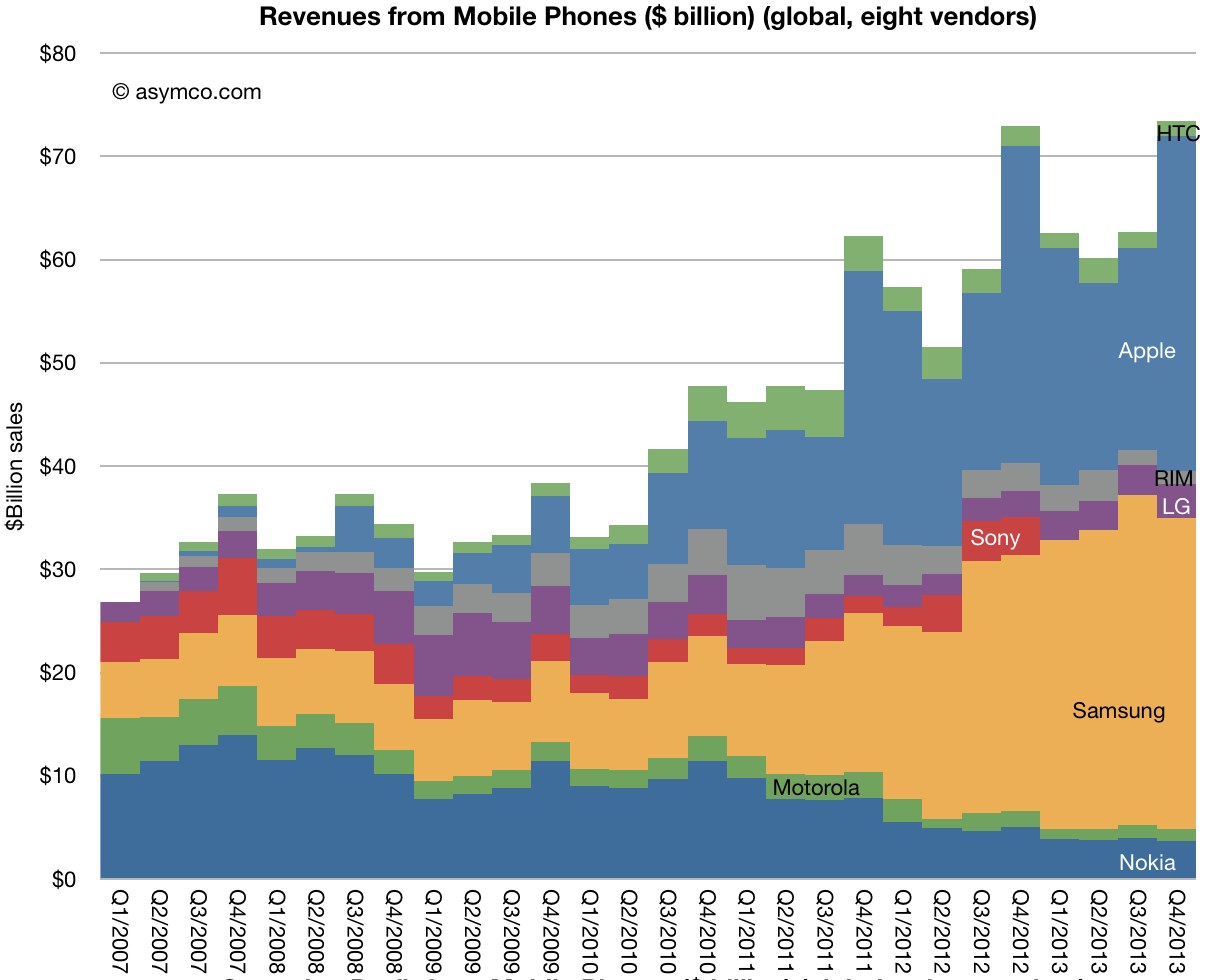
But there is one company which seems left out of this discussion. Samsung is absorbing a large part of the available profits in computing today and it's not an integrated hardware/software/services player. Does this mean that there is room to be a module in an interdependent world?
I argue that no, there isn't. Samsung must either stretch into becoming one of the ecosystem contenders or be relegated to a commodity hardware company--a path clearly visible when looking at Chinese entrants. Samsung itself benefited from disrupting from below and should be aware of the threat it faces as it races up-market. More importantly though there is the ability of creating new markets altogether. This new market creation and rapid iteration due to integration is what the Google/Microsoft/Apple trio are seeking.
Without the components of software (ecosystems included[1]) and services, Samsung will depend on the good graces of suppliers. They may not be as keen to share when profits accrue to the whole rather than the part.
Building a successful business is hard. Many try, few succeed and those that do tend not to thrive for long. So success in business it should be respected. Especially in highly competitive industries like technology. The fragility of success however should also give one pause to think about how delicate a business model is.
The presumption that companies can shift business models at will is usually false. Businesses are balanced on a knife's edge of dependency on multiple variables. Almost all resources are expended on preserving this balance.
This being my observation, I take issue with assumptions that large companies can "pivot" on a dime or that they can change their business models "when conditions are right". Consider Microsoft's dilemma. They have all the resources in the world and yet they could not pivot to take advantage of a change so mundane as a low power microprocessor (which enabled a mobile computer and hence a new ecosystem and profit model for software.)
Or consider the dilemma of Apple which after building a successful computer business which included system software, could not pivot to license that system software so others could build computers with it.
Or consider the dilemma of Nokia which had an early and large leadership in smartphones including having its own OS and platform and large volumes and users bases. It could not pivot to allow into an ecosystem and had all its advantages disappear.
Each company thought they could manage change but none of them actually did.
It's with this thinking about inertial navigation that came to consider the idea that Amazon has a flexible business model which, though unprofitable today, will be profitable some day.
The premise that Amazon can, on a whim, change its business model from selling other people's products at a razor thin margin while investing in capital-intensive distribution to selling other people's products at a large margin while not investing in capital-intesive distribution is not credible.
I would argue that Amazon's existing business model is a direct consequence of the market it's in: that it could not be anything else given the circumstances it finds itself in. Enlightenment may be an illusion.[*]
That's not to say that there is no wisdom in the management of Amazon. Quite the contrary; recall the respect that's called for in creating a great business. Managing the business to this point was a work of decades of vision and creativity.
What I take issue with is the premise that Amazon is the "anti-Apple" in its hunger for growth and patience for profits. Apple has its own "Amazon-like-business": iTunes has been growing at a steady 25% or more and it also has its ancillary zero-profit hardware analogue to the Kindle called Apple TV. iTunes is a great business in the Amazon vein, harvesting hundreds of millions of users (and their credit cards.) Presumably iTunes could also some day "flip the switch" and become profitable, but something magical needs to happen. Something like becoming a payments processor or retailer of other things. Analyst beware however. There might be conditions that make such switch flipping extremely difficult.
At an even deeper level, Apple and Amazon are much more alike than they are different. They are both hired for similar jobs (convenience, ease of use and a controlled, predictable environment for average users interacting with technology). They both focus on delighting customers and controlling all the variables which come into contact with that delight. They both have long-term views and are driven by vision rather than competition.
Where they differ is in others' perception of sustainability. Whereas Apple is perpetually given an expected lifespan of less than a decade, Amazon is expected to have an indefinite lifespan. This is because Amazon is seen as having no competition and Apple is seen as having infinite competition. In other words, Amazon is perceived as a monopoly and Apple is perceived as the innovator that is in a permanent state of being disrupted by the low end.
I disagree with both assumptions. I've always thought Apple fragile but dedicated to moving into new markets as older markets are disrupted. It's a tough strategy and one which (literally) nobody believes possible. But I've also thought Amazon's monopoly status fragile. This too is not a popular idea but the company depends on many variables.
Retail is hard and it is being disrupted by technology wielded well by Amazon. But it's also subject to further disruption. Amazon's job to be done can be done by alternatives. Buyers are typically hiring Amazon for convenience, not just price and ease of use is where the value is. But again, new information technology which makes shopping, discovery and delivery of products directly from the vendor, bypassing the aggregator (i.e. retailer) could shift value along the value chain yet again.
By the time Amazon reaches some point of monopoly in distribution it could be too late to make the switch to profit generation.
I don't want to suggest that failure is inevitable, but I want to point out that success is not certain by any means. Disruption happens.
--
* It's possible that Enlightenment is also an illusion at Apple. Even if they once had it, there are forces which act on companies that make them lose their wisdom.
Last week Frank X. Shaw, VP of corporate communications at Microsoft stated:
... most of the people around me were using their iPads exactly as they would a laptop – physical keyboard attached, typing away, connected to a network of some kind, creating a document or tweet or blog or article. In that context, it’s hard to distinguish between a tablet and a notebook or laptop. The form factors are different, but let’s be clear, each is a PC.
Actually this "admission" that iPads are PCs is not something new. Steve Ballmer made the same assertion in 2010 pre-iPad (though calling them slates). Arguably, the notion that tablets are PCs has been dogma at Microsoft for over a decade and Windows running on all form factors has been a strategic guiding principle.
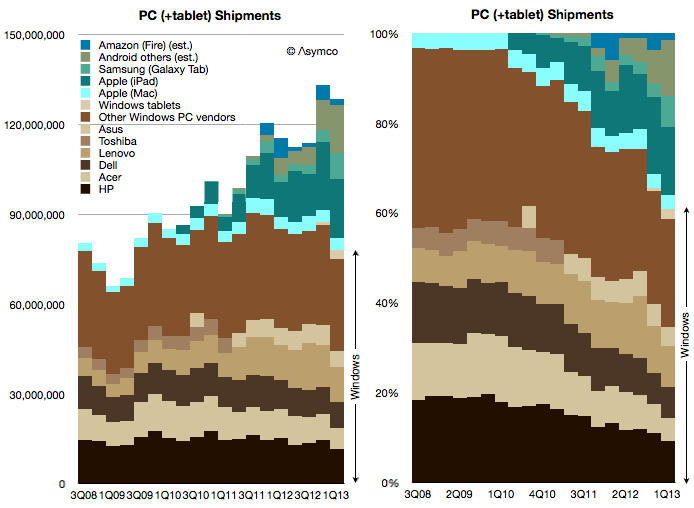
Which is why I've always added the tablet data to the PC data to create a picture of the "personal computing" market. And this is what that picture looks like today:
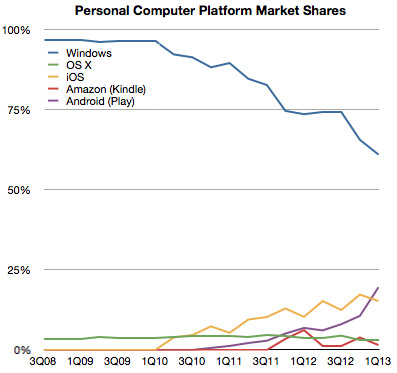
Note how the share of various platforms has evolved over this brief time span:
Seen this way, Windows has now reached 60% market share and it's likely to dip below 50% during this year. What happens beyond then is harder to imagine. If Windows tablets start growing as fast as the tablet market overall then Windows could stabilize in share. But if Android and iOS tablets follow their phone brethren in growth then it will be far harder for Microsoft to maintain share. But is that cause for concern?
Not necessarily.
The total computing market[1] is likely to expand to over 4 billion users with 1.5 devices per user in the next five years. That expansion implies that 20% share equals more than one billion devices, making such an ecosystem "good enough" for the average developer. It certainly has been good enough for Windows developers to date and they have kept hiring it throughout the new mobile app revolution.
So even if Windows dips to only 20% of the world's computing market it will still be perfectly "viable" for some time to come.
--
I define the computing market as the total number of devices which have (a) a CPU (b) a broadband connection (c) a native application execution environment which is open to third party apps. This definition implies the presence of an "ecosystem" which is bound specifically to a platform.
LG Electronics has acquired HP's WebOS for an undisclosed amount. When last it changed hands WebOS was part of Palm which was purchased for $1.2 billion in 2010.
Palm has thus been effectively divided into several smaller pieces distributed as follows:
HP will own:
Support of existing Palm users
Palm back-end assets including source code, infrastructure and talent
webOS patents
LG will own:
Stewardship of the Open WebOS and Enyo open-source projects where the source code resides
Associated talent
WebOS websites
License for IP related to webOS
LG announced that it plans to offer an "intuitive user experience an Internet services across a range of consumer electronics devices." In an interview, the CTO of LG said that given the current situation with Android, LG does not plan on making smartphones running webOS but will use it in televisions and other devices such as cars, signage and appliances where there are no embedded OS's. "We'd like to secure a software platform across all devices."
Most commentary regarding the deal focused on the use of the platform for TVs but management seems to consider all devices, perhaps even phones, at some future date, to be webOS targets.
The TV however seems to be low hanging fruit today. The TV as an app platform will be the new ecosystem war and no platform today has a lock on the developers or users. The way this rivalry will shape up will not mirror other device classes for the same reason that current device classes are platform silos.
PCs, music players, tablets and phones all have different super-majority platform leaders. The association of a platform with a device class depends first on the distribution model, which favors a specific business model which favors a specific vendor which favors a specific platform. As each device is distributed differently, a different platform takes precedence.
Consider that the PC has historically been purchased by IT departments which led to a monoculture of Windows which led to a persistent leadership for Microsoft.
The music player created dominance around iTunes mostly because the distribution model for music labels was baked-in. With network effects, the iPod quickly gained and perpetually retained market share leadership.
The smartphone business initially favored Symbian and BlackBerry because they had the market access through operators. After the touch UI became dominant (and incumbents failed to respond in a timely manner), Apple and Google took leadership as soon as they accepted the operator distribution model. Android in particular is especially resonant with operators and has been developed with their requirements in mind.
The tablet business is more like the PC business but without enterprise requirements or patterns of purchase. This has meant that app/content ecosystems and retail distribution were the key gating factors. The story is still unfolding but so far Microsoft has not found a foothold while iOS and Android and Amazon have.
That leads to the question of how will smart TVs be sold and which business model (or go-to-market strategy) will succeed. Steve Jobs pointed out the difficulty in trying to deliver innovation into a value chain dominated by cable companies which can effectively block it. A TV which is an application execution device rather than a content terminal will require a re-definition of the category. That will require a re-positioining of this product. Few companies are able to do that. [See also my post Tele Vision from mid-2011].
Which brings us back to the question of webOS. As long as LG sells TVs as content terminals they might not obtain much value from webOS. If, on the other hand, LG were to use webOS to re-define their televisions to be something else entirely, namely software execution devices, sold differently and hired to do a different job than a TV, then webOS becomes not only necessary but potentially a source of great prosperity.
2013 will see two billion phones shipped into a market of over 6 billion points of network connectivity for over 4 billion consumers. In addition to phones, there will be a few hundred million more tablets and mobile computers shipped. It's very likely that the majority of these devices will be "smart", meaning designed to be a part of an ecosystem of software, content and services. Contrary to the common assumption that larger markets sustain more competitors, this immense and rapidly growing market has become profitable for only two device vendors. The reason is that the windows for competitive advantage are fairly narrow and although production can be ramped more quickly than ever, the resources needed are available to few. The frequency and amplitude of market flux benefits only those who can operate at scale and punishes those who can't. Close observation of the investments of these "superpower" competitors shows an extraordinary level of capital purchases of manufacturing equipment, regardless of their nominal position in the value chain. These capital expenses have been growing in proportion to in the frequency of product launches. I present data showing a correlation between manufacturing equipment CapEx and ecosystem success and put forward a hypothesis that this relationship is causal. I also discuss the implications for ecosystems owners with regard to the processes, resources and priorities necessary to succeed in this evolved value chain.
The event is open to the public and taking place March 7th, 3:00PM to 4:30PM in the Cotting Conference Room.