Asymco

Asymmetric Intelligence

ecosystem

  1. The race to a billion—2012 Update

    Research · 66 comments

    I last looked at the race to a billion in March 2011. Since then, I've been updating and adding data to the set giving a broader selection of platforms to compare.

    Before we dive in, an explanation: the initial review excluded Windows (PC) and Facebook mainly because (a)  the ramp scale I'm using is about a decade in duration and (b) I was reluctant to compare platforms that require payment to join to those that don't. The (DOS/Windows) PC ramped over several decades (starting in 1981) and Facebook is a service that costs nothing to join. There was much gnashing of teeth and shaking of fists as a result.

    Therefore, in the interest of inclusion, I added both to the data set and let the chips fall where they may.

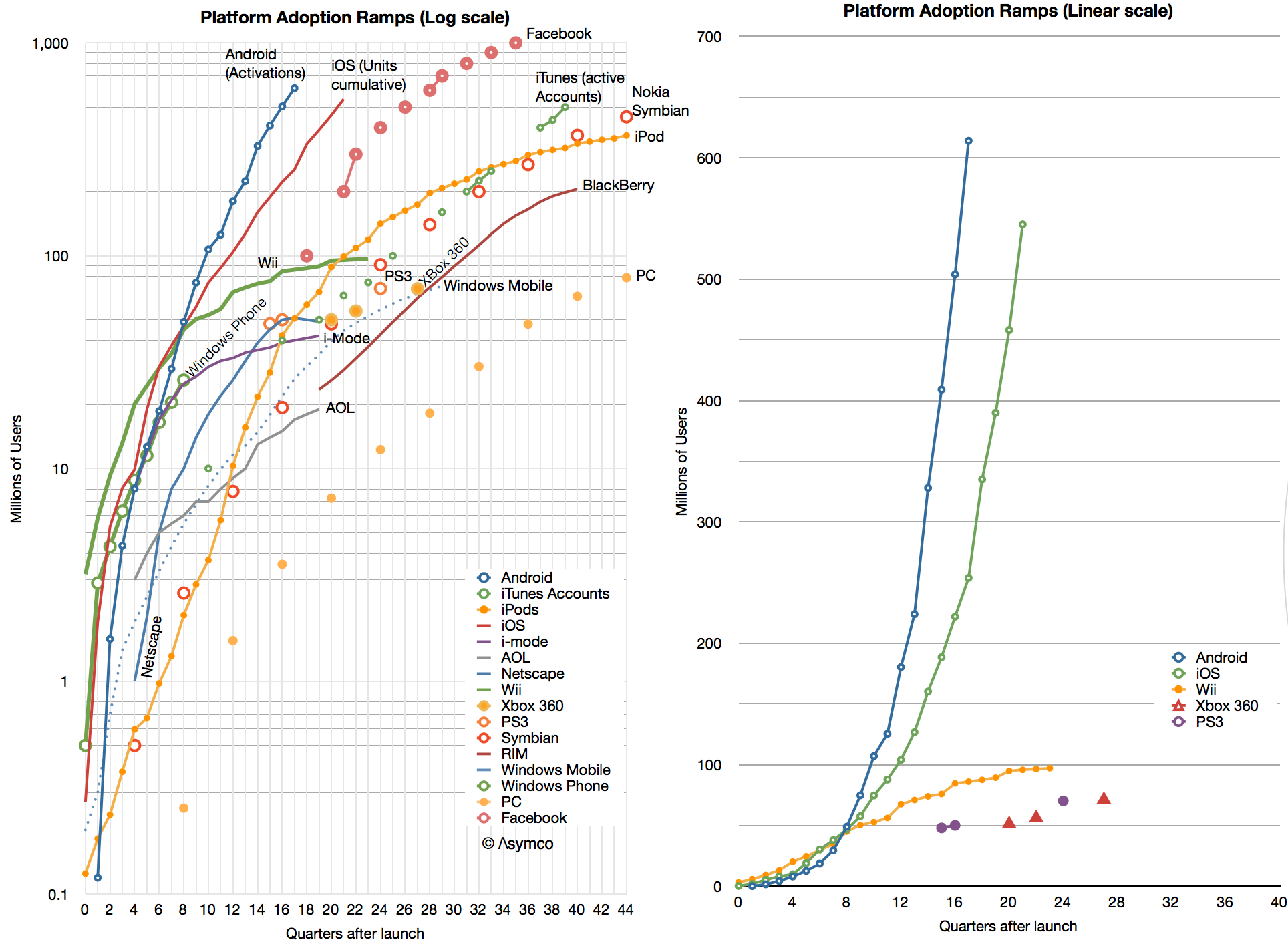
    The data is shown below.

    Screen Shot 2013-01-16 at 1-16-2.11.50 PM

    I kept the scale to about a decade so that individual lines can be resolved. As a result, you'll note that although Windows reached one billion first it did so slowly enough to be off the scale shown. Indeed, the "race to a billion" should be titled  "The race to one billion users in less than a decade".

    In such a competition, the winner would be Facebook which, in October 2012, 35 quarters after launch, reached the finish line. The second looks to be Android (probably this year) and the third iOS (sometime next year.)

    That may sound like the end of it, but what the graph also shows are the more subtle trends:

    • Game consoles seem to saturate at below 100 million total. One can see the difference in ramps between recent mobile platforms and consoles in the second chart. There might be implications for which platforms will end up dominating the entertainment industry. There should also be some explanations of why consoles are so limited.
    • iTunes accelerated with iOS and left the iPod behind. This is unsurprising but it shows that a content platform can be more flexible than one attached to any particular device or architecture. An important lesson perhaps for those in the content businesses.
    • Early mobile platforms like Nokia's Symbian, RIM BlackBerry and Windows Mobile have faded indicating that there was no early-mover advantage in platforms. The same can be said for early PC platforms.
    • Windows Phone began by tracking the Android/iOS ramps but seems not to be accelerating into its second year in a way that implies potential parity.
    • Although Facebook did reach 1 billion rather quickly the slopes of Android and iOS indicate that they may overtake it in overall ecosystem size.

    One billion is significant in several ways: First, because it is the "high-water mark" set by Windows and signifies what a global platform needs to become to be essentially "universal". Second, because it implies sustainability. A threshold perhaps from which network effects are sufficient to sustain (assuming some switching costs and an ability and willingness to adapt e.g. software, content or time investments from users.) Third, because it implies sufficient value to the ecosystem (assuming a monetization mechanism exists e.g. Windows software developers and IT managers.)

    Looking beyond this milestone however, there is no reason why it should be thought of as a barrier. Mobile connections number over 5 billion and computing is likely to reach most of them. Therefore one billion may turn out to be only 20% penetration. In fact, I expect this series of posts will need to be updated in 2013 as "The race to two billion."

  2. The App Revolution (in Filmmaking)

    Research · 21 comments

    The following article is published in Filmmaker Magazine. Fall 2012, Vol. 21 #1.

    There is a saying I once heard: "Once you change the method of distribution, the product has to change."

    This itself is a take on the idea that distribution defines the product. You see this around you every day in the products you buy. Cars are influenced by the dealership networks that sell them. Phones by the mobile network operators and the choice of computer you use at work by whatever the IT department or value added reseller prefers to work with. Mass market restaurants offer what can be sold by wholesalers--typically frozen, long shelf-life staples. Almost every product category is shaped more by what can be distributed than what can be produced. That's simply because in mature economies distribution is harder than production. In consumer products it requires access to wholesalers who then require access to shops who themselves have access to prime real estate which attracts foot traffic. Production only requires capital. Distribution requires relationships, often exclusive ones.

    This pattern is even more pronounced when looking at media products. Production is arguably easier since it's constrained by talent, which is fungible. But distribution is even harder as it is addressing bigger audiences in shorter time frames. You see this lopsided balance of power in the abundance of books being written relative to those being published. There are thousands of films produced and hundreds get distributed.

    But the saying suggests that if distribution were to change then the product itself would change. Indeed, if you can sell ebooks direct, then they tend to evolve into new genres (e.g. Fifty Shades of Grey). If you can sell cheap adult video online it tends to evolve into new genres as well (I'll leave examples to the imagination.) YouTube videos quickly cluster around "Fail" or "Win" compilations which evolved from America's Funniest Home Videos. They get millions of views. Even before the Internet, the availability of cable created the genre of music video, which created the first music broadcast alternative to radio. And of course, cinema itself redefined theater once it could get shown to millions rather than thousands. The new methods of distribution of media affected what gets produced rather than the other way around. Consider the converse: innovative filmmakers who try new storytelling methods are stymied by a lack of acceptance by existing distributors and find their material languishing in festivals or perpetual cult status.

    So we can re-state the saying to a new "Law of new media": Once you change the method of distribution, the medium itself has to change.

    I gave examples of how Internet distribution changed some media formats. However, the Internet itself has not had any effect on long-form cinema so far. In fact, you would be able to tell if Internet distribution did work by watching if the product would change. So far, it seems, at least to me, that the commercially successful product has not changed. One reason has been that film is still a very difficult product to distribute digitally as most of the world does not have the capacity to buy, consume and enjoy films digitally. Another is that the current distributors have had an allergic reaction to the option. As existing products have been crammed into the new distribution chain (e.g. Netflix) the established distributors are experiencing channel conflict and are raising the costs of digital distribution rights. Netflix has seen its costs triple as it ate into Cable market share. Fundamentally, the incumbent distributors are reluctant to open a channel of distribution which conflicts with or reduces margins of the existing channels.

    This brings up another corollary: fundamentally, you can’t move an existing media to a new network. You have to think of it as a deeply rooted-in system, and it's just not going to like moving to another environment. You have to uproot this huge tree, and it just won’t come out and if it did it will not take root in a new place.

    The only way to create this new value network around new distribution is to plant a new tree.

    This is the problem for the technology industry today. The only way technology companies can solve the “content is king” dilemma (which, by the way, is an euphemism for "Hollywood is king and Silicon Valley isn't"), is by allowing new content to flourish on top of new platforms. It’s not about moving the old content to the new platform. It’s about allowing new content to be created exclusively on the new platforms. This new content will therefore, by our law, be a new medium.

    For me, apps are that new medium. Apps offered a new way to package entertainment for “niche time”. The early fart apps evolved into a whole new genre of games which are now challenging the established game studios. The result is that a generation of developers has moved from building PC or web software to apps with cloud back-ends. The first to switch to this new medium were those with the least to lose and with the most modest of goals. Apps have now a more valuable industry than digital music with over 55 billion installs between the iPhone and Android ecosystems. Consumers are increasingly spending their spare time in front of apps. In the US “app consumption” increased from 43 min/day in 2010 to 94 min/day at the end of 2011. This number already exceeds the time spent in web consumption. I find it difficult to doubt that app time will exceed TV time, especially as TV time is increasingly a dual screen experience.

    (Feels like it needs one sentence explaining why. Is it because of their accessibility to small developers, or their ability to reach mobile handsets natively, or because of consumer trend?) If it’s absolutely impossible to move long-form video or long-form cinema to this new medium in such a way that everyone in the world can consume it on every device, then the app ecosystems will take up that challenge and say, “There’s a job to be done, and that’s to enertain people for an hour-and-a-half with characters, plots and wonderful stories, and we will make that happen, and we’ll call this thing an app.”

    And that app will solve that job for that person. It's what's happening to the game console business. The new game apps are distributed differently, priced differently and produced differently. As a result they are used differently and make a different set of developers thrive.

    The new app media will mean that we’ll just have to live in app universes, and go eat popcorn somewhere else. Microsoft and Google and Apple and Amazon and anybody else whose belly is at the bar has been scratching their heads wondering "How do we move that content over to us?" They've been barking up the wrong tree. The fundamental question isn't how to cram old media into a new shiny screen. It is how do you let developers and artists and creative people create stuff that is new and compatible with this new way of living.

    Think also about the history of media -- movies haven't been around forever; music hasn't existed as a recorded medium forever. Not even books. What did people do before these forms of expression? We think of the use cases of going to the movies, or the use cases of sitting in front of a TV on Sunday night, or playing a console game. These things didn’t get done at some point in time. Nor will they be done at some future point in time.

    In a few years we’ll move on and we won’t do those things. Each person will probably have his own screen in front of them--many already do--and whatever we do together we’ll do through a shared screen. We won’t have communal experiences that we associate with the old media. Certainly not in a theater. Maybe not even in a living room. And that is how we will move into a new value network.

    It is inevitable. As a technology provider, you shouldn’t try to squeeze a 19th-century model into a 21st-century model. Just let it go. Create a platform and give people the freedom to create on it. As a media creator, you should try to learn what the new model demands. New forms of interaction, new story telling opportunities, new ways to communicate with audiences. Create experiments and learn. It's the only way.

  3. The next 100 million iPads

    Research · 56 comments

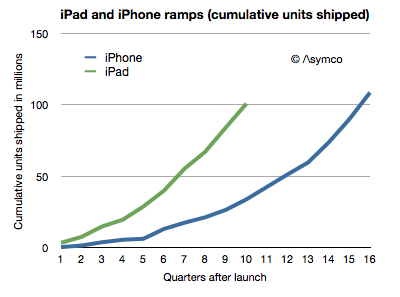
    Having reached 100 million iPads shipped in 2.5 years the natural question is how long will it take for the next 100 million iPads?

    The ramp of cumulative units shipped is shown below.


    I also added the equivalent ramp for the iPhone. [The last data point for the iPad is based on an estimate of 16.5 million units in Q3 which may need revision depending on company reporting.]

    The next 100 million will depend to a large degree on the success of the new iPad mini. To make an estimate we have to realize that there are several aspects of the tablet market which differ from the phone market and that therefore the predictive power for previous data is weak.

    First, the channels are different. Tablets are sold as media consumption or "computing" products. They are not sold as communication devices. Therefore operators have few incentives to promote and subsidize them. They do participate in the distribution but not with the same level of commitment. That means less "push" and opportunity for discovery. Apple has an advantage in this case with their stores and brand value. The lack of operator engagement and lack of points of sale might be one reason why Android tablets have not ramped as quickly.

    Second, for some competitors, the tablet itself is a loss leader and acts more as a terminal into an ecosystem rather than a product in itself. In cases where tablets are given away it's possible that consumers might own one for each platform or ecosystem. This is similar to the game console model where the cost of the console is not a barrier to many avid gamers. This means that penetration of tablets can reach above 100% of users in some markets. Although network connections (i.e. SIM cards) can and do reach well above 100%, the number of phones in use by one person simultaneously is bounded.

    Third, the lifetime of the product is as yet undetermined. Phones tend to last 2 years. This is due to evolving standards as well as high wear and tear and breakage or losses. Tablets are not as "mobile" and are less likely to be used and the basic functionality does not evolve as rapidly. It's possible that replacement rates for tablets will follow more that of notebook computers than phones. Perhaps between 2 and 4 years. I suspect most iPads purchased are still in use today, including the first version. There will be some obsolescence from system upgrades, but the older systems will keep going.

    Some of these aspects of the product could lead to slower growth and some to faster growth. That and the fact that it's a completely new category with business and consumer and educational and vertical applications makes it a difficult product to forecast.

    Having said that, the product is extremely resonant with buyers. The growth to 100 million is testament to that. The liquidity of the product, with no carrier locking and no pricing illusions means that it reaches all parts of the world quickly. So there is no obvious upper bound on the size of population who might buy it. The new price points and form factor may lead to a wave of new adoption, similar to the impact the iPod mini had on the iPod line.

    There are still many factors that can slow growth, especially production capacity, but I believe that the iPad could growth between 50% and 80% which would mean 100 million more iPads could be sold by the end of 2013.

  4. An interview with Matteo Fumagalli

    Research · 12 comments

    Matteo Fumagalli is a student of economics at University of Insubria, Italy. He is writing a thesis for a bachelor's degree analyzing the smartphone industry.

    He asked me to answer the following questions:

    -First question is about you. Why did you found Asymco?

    I founded the company to develop software, mainly apps. I began writing the blog as a way to drive traffic to the site. I would have preferred to build a blog only but did not think it was possible to earn any money doing that so I treated it as a hobby. Even after the site became more visible I changed from development to consulting and did not expect that writing in itself could be self-sustaining. It took about two years before I felt comfortable with the idea that I could do writing and speaking exclusively. I am still exploring additional business models however.

    -You worked 8 years as analyst and business development manager at Nokia and you anticipated their current crisis with your first post on Asymco. Do you think Nokia will have the chance to recuperate, and eventually what will be the role of Windows Phone?

    Nokia may recover or remain independent, at least. But it will be far smaller. The idea of a return to dominance or 40% share seems very unlikely. As I pointed out in the first post, the organization cannot cope with the new marketplace. Large organizations require extreme stress and damage to change. It's a phenomenon at all levels of society that success results in rigidity. From the individual to the nation to the civilization, success makes change very, very difficult.

    Windows Phone is an attempt to create a third ecosystem. I am concerned that the logic of having a third alternative is not solving a consumer need but an operator need. In other words, consumers are not asking for a third option and when they are presented with a third option they are not excited by it. The consumer does not think in terms of increasing their options. They decide once every two years which phone to buy and that is the end of their thinking on the subject. By focusing on the operator's needs the platform is fundamentally mis-positioned.

    What Windows Phone needs to be positioned as is either as fundamentally different, solving a different job for the consumer. Or fundamentally better along a new dimension like price or convenience. These are some of the claims it makes but they are very weak claims right now.

    -What about RIM, other company which is going through difficult times? What do you think about their decision not to move to Android and stake everything on their closed OS?

    The decision to remain with their own platform may sound risky but it's a simple decision about retaining their business model. RIM is not a general-purpose manufacturer. They have always made an incremental margin on services, messaging and email. For them to use a third party OS would force them to build within the constraints of that OS or platform. That would result in a difficult competitive environment and not one where the company could sustain margins vs. larger competitors. In other words, the company faced two risky alternatives. They chose the risk they were more familiar with or the one that they already had an operating company organized for.

    -Recently Apple lost market share in Europe and China favoring Android. What will be the impact of iPhone5 on this situation? As expert of Apple strategy, do you think Apple has done something wrong in these last months?

    Apple lost market share when considering the smartphone market. I agree with management (and I've argued this before they did) that the market for the iPhone is all phones, not just smartphones. In that context, Apple is increasing its share consistently. Since Apple has only one product in the market (with some residual older versions as well), it's very seasonal. It would be natural to see variance in share through the year. What should be watched is a four period average performance. Overall, Apple is growing its iPhone business faster than the overall phone market so it follows that its share is increasing. I see a long-term potential for the iPhone having 20% share of all phones. That would give it an installed base of over 1 billion users.

    -Smartphone penetration is reaching 60% and we probably talk about saturation in next 2 years. What will be for you the future role of tablets and phablets, they will be threaths of substitution for smartphone or maybe an opportunity to offer complementary products?

    The evidence so far is that buyers don't mind having more than one device. It makes sense if each device is hired for a different job and it cannot be general purpose enough. We've seen this phenomenon with mobile phones where penetration in many markets is above 100%. That implies that even a basic feature like a phone number cannot serve all the needs on one person. To me it seems likely that one person will have more than one device and more than one form factor.

    -What do you think about legal battle between Apple and Samsung? There will be consequences also for Google and Android?

    I defer to my blog post Deus Ex Machina. Legal battles are not strategy.

    -What will be the role of the possible entry of Amazon in the smartphone industry? It's too late for them?

    Amazon is a retailer. I find it hard seeing a retailer becoming a platform provider. Not only is retail a difficult to expand business model internationally, but it's hard to imagine partners being comfortable building an ecosystem on top of retail. Retail is not sufficiently flexible as a business model.

  5. It’s costly and has unpredictable consequences

    Research · 26 comments

    ``It’s costly and has unpredictable consequences. That makes it a very bad business model. I suppose both companies have agendas that are not visible in court and perhaps Apple is signaling to other parties, and perhaps Samsung is using it to raise its profile. It still seems that unintended consequences may arise and the result could be very bad for everybody,’’ said Horace Dediu, founder of equity-research firm Asymco, in an e-mail interview with The Korea Times.

    The above was a quote from the article  Samsung can’t afford to lose Apple fight by Yoo-chul Kim from The Korea Times. Yoo-chul contacted me via email with a series of questions. I want to share all his questions and my answers as well:

    Samsung wides market gap with Apple, according to research firms. You think the gap will further be widen and please tell me why

    As Samsung converts its phone portfolio to be all smartphones, it is very likely to reach much higher smartphone volumes. One year ago Samsung sold about 56 million feature phones. Last quarter it sold about 43 million. The smartphone portion increased from 20 million to 50 million. At the same time, Apple has maintained a growth in its smartphone business of about 100% on a yearly basis. I expect that to continue into 2013 as well. Therefore it's possible that Samsung could sell 290 million smartphones in the next 12 months and Apple could sell about 200 million in the same time frame.

    However, it's important to understand that the companies compete on different bases. What I mean is that what generates a profit (i.e. payment by the consumer above what a product costs) is different for each company. Apple is a platform company that sells access to the iOS ecosystem across many other device types. Samsung sells consumer electronics with limited "network effects" but desirable features. In this view, the gap in device sales is "asymmetric" and not reflective of the actual competition which is between Google's Android and Apple's iOS as forms of access.

    Samsung's rapid rises mainly due to the company's heady dependence
    on Google Android. If Google applies better software for Motorola,
    then you think Samsung will face difficulties?

    Think of Google as a supplier to Samsung. No manufacturer wants to have a situation where they are dependent on only one supplier, especially when there are huge substitution costs for another supplier. And even more especially if that supplier owns one of your competitors. However, it's unlikely that Motorola will become a strong competitor to Samsung. I also don't expect Google will damage their OEM "customers" by favoring Motorola. Motorola can't become big enough quickly enough to be a threat to Samsung. What is more likely to be a problem for Samsung is ZTE and Huawei. They are on the same trajectory that Samsung was on 10 years ago. For Samsung to beat them in the future it will need to develop products that nobody can copy.

    How about software? Samsung is good to roll out price competitive
    models, however, software is always problem. Any advice for this
    issue?

    Software is hard and expertise can't be quickly acquired. It takes time. Only advice [I have] is that efforts must be patient and there need to be many experiments like Bada and Tizen. Google started with Android in 2005 and Apple started with iOS in 2003 or 2004.

    How about the patent dispute with Apple and Samsung. The patent war
    is helping Samsung see a rise in its brand awareness and that also
    worked for Samsung to grab more shares in smartphones?

    It's very difficult to measure the impact of litigation, both in the positive and negative. It's costly and has unpredictable consequences. That makes it a very bad "business model". I suppose both companies have agendas that are not visible in court and, perhaps, Apple is signaling to other parties and perhaps Samsung is using it to raise its profile. It still seems that unintended consequences may arise and the result could be very bad for everybody.

    Samsung wants to become a market creator not just a fast follower.
    For me, it's quite negative for Samsung to create a wholly-new
    eco-systems because Samsung's edges are coming from manufacturing, not creative thinking. What do you think? If Samsung wants to be a
    creator, what conditions should Samsung need and what things should
    the company do?

    Unfortunately, manufacturing excellence is not enough to remain successful long term. US companies were successful, then the Japanese, Taiwanese, Hong Kong, and now Chinese. Companies either adapt or become irrelevant. Building ecosystems is the new basis of competition but it's not the only option. Unfortunately we don't know what will be necessary to build the next basis. What matters is experimentation and the building of new businesses. I can't offer specific recommendations as there is no recipe book for how to create new markets.

    For your views, who is much better so far since the trial has begun
    in the US. Samsung or Apple?

    I cannot comment on this. Performance in court can only be judged by those present and I'm sure everybody present disagrees.

    You think Apple is enjoying its so-called a homeground advantage
    for the trial and is there any possibility that the issue to go for
    the highest court in the US. My Samsung contacts say that's the
    possibility, though.

    Again, I don't have an opinion on legal matters. Broadly speaking, IP litigation is similar to playing the lottery.

    Need your perspectives about Google's support for Samsung. Google
    confirms its supports for Samsung for an united front against Apple
    because the fight between Samsung and Apple is a kind of version that
    represents Google and Apple fight.
    Any comments about that?

    I believe Google does support Samsung. I question however how this relationship will develop over time. I attached below commentary from a researcher at Deutsche Bank on Android in China. I think it has some clues about how Google treats its partners.

    What are pre-conditions before Samsung making an action to sign a
    peace treaty with Apple?

    It depends on the motives behind Apple's actions. I think they want to see a "no copying" rule. They don't mind competition and Android could be a help in the long run by moving users from feature phones to basic smartphones which could later be upgraded to Apple phones. But what I think they want is to signal to others that direct copying is unacceptable. Essentially, the work of their designers is very important to them and copying destroys [the designers'] incentives to do breakthrough products.

    ---

    See also: Who Cares If Samsung Copied Apple? by James Allworth - Harvard Business Review

  6. The poetry of Steve Ballmer

    Research · 121 comments

    Steve Ballmer July 9th, 2012 on competing with Apple:

    We are trying to make absolutely clear:
    We are not going to leave any space uncovered to Apple
    We are not.
    No space uncovered that is Apple’s
    We have our advantages in productivity
    We have our advantages in terms of enterprise management, manageability
    We have our advantages in terms of when you plug into server infrastructure in the enterprise.
    But we are not going to let any piece of this [go uncontested to Apple]
    Not the consumer cloud
    Not hardware software innovation
    We are not leaving any of that to Apple by itself
    Not going to happen
    Not on our watch.

    Steve Ballmer, July 2010 on competing with Apple's iPhone and iPad:

    Today, kind of I'd say one of the top issues on my mind, let alone on your minds, one of the top issues on my mind, is, hey, there is a category that we've had Windows on for actually a long time. We've had Windows 7 on, tablets and slate machines now for a number of years, and Apple has done an interesting job of putting together a synthesis and putting a product out, and in which they've -- they sold certainly more than I'd like them to sell, let me just be clear about that.

    We think about that. We think about that in competitive sense. And for us, then, the job is to say: Okay, we have a lot of IP, we have a lot of good software in this area, we've done a lot of work on ink and touch and everything else -- we have got to make things happen. Just like we had to make things happen on netbooks, we've got to make things happen with Windows 7 on slates. And we are in the process of doing that as we speak. We're working with our hardware partners, we're tuning Windows 7 to new slate hardware designs that they're bringing them to market. And, yeah, you're going to get a lot of cacophony. There will be people who do things with other operating systems. But we've got the application base, we've got the user familiarity. We've got everything on our side if we do things really right.

    So, we think about these devices and I don't think there really is one size that fits all. I don't think everybody wants a slate. I've been to too many meetings with journalists who'd spend the first 10 minutes of the meeting setting up their iPad to look like a laptop...

    Laptops actually are well designed for a lot of things. I notice they are all light. In fact, if you look around this room, they all weigh zero pounds, because they're just sitting on the table, you are not holding them and you don't set them up when you want to type, and they prop up -- they have good attributes. But some people are going to want that form factor. Some people are going to want probably a screen that they take with them and maybe they throw it back into the keyboard. Some people are going to want a device that is screen and keyboard that spins around for inking purposes. Some people are going to want things very light or very cheap or very expensive or very powerful. All of those things are going to be important, and we've got a push right now -- right now -- with our hardware partners.

    ... We're coming full guns. The operating system is called Windows. No -- there's -- let me be unambiguous. A new Windows Phone for screen sizes that, let me just say, are, you know, sort of bigger than three or four inches -- the answer is Windows Phone. We are in the game. We're all in the game today with Intel architecture machines. We've got improvements coming from Intel. We're driving forward. We're unambiguous about that. Now, where we'll go and what's going to matter -- I said also in my remarks that in no way will we allow hardware to be the impediment. We will embrace what we need to embrace over time in terms of hardware evolution.

    But you say to me are we going to see slate? Yes. What processor are they going to have? They are going to have an Intel architecture processor at least in any foreseeable future. Are they going to run Windows? Yeah. Will it be tuned? Yes! And we are going to sell like crazy. We are going to market like crazy. We have devices that will run more applications, that have as much content, that have anything you want on the planet.

    And we have an ecosystem of developers that know how to write applications for that thing. Believe me, as I think everybody knows, you can buy two PCs for the price of one iPad -- two netbooks today for the price of one iPad. So, people are sitting there over-celebrating BOM costs and blah, blah, blah. We and Intel can get our job done and know how to make money. There's good money for everybody in the ecosystem to go make.

    I talked about power. We've got work we have to do with hardware partners, with Intel. There's certainly some work to be done there. And over time where we go is where we go. But at least in the timeframe that which anybody does these models, for example, let's go. Let's go and we'll be in market as soon as we can with new devices, whether that's, you know, really, really soon or just really pretty soon. I'm going to wait until I have the device that I want to hand you and tell you to go use, or a collection of devices. I think that would be the appropriate time to say it is time. But it ain't a long time from now. Pardon my English...

    On the netbook, nor the slate, if it's two weeks one way or the other, or it's a month, I mean, let's not speculate, let's merely say when you get your Windows 7 machine, it will print. Let's just start with that. I mean some people actually like to print every now and then. Ours will print. I'm not trying to say that other guys aren't doing good work. I'm not saying that. We've got to ‑‑ come on, every day. Every day you come to work you have to prove yourself, prove yourself, prove yourself. We'll prove ourselves. ...

    I relish the competition. I relish holding up those couple of machines today that I wanted to hand you. It's not today. I'll relish doing it tomorrow. Bring on ‑‑ particularly if with the application base, with the tools that we have, with the user understanding and momentum and everything going on, we can't compete with ‑‑ particularly whatever the weird collection of Android machines is going to look like, shame on us.

    Apple is Apple. They're always a little tougher to compete with. They're a really good competitor, and tend to be a really high-priced competitor. People worried a little bit about our bottom costs. They've got a lot of margin in those devices, which creates a lot of room in which to operate. Okay. We've competed with Apple before. I talked about that.

    We've been competing with Macs, and I notice in this audience you get one profile for the 93 percent of people almost who agree with us every day about laptops. We're going to have things that should be interesting to them. That doesn't mean it's not going to be exciting. That doesn't mean you're not going to have to pay attention to shareholders. It certainly means we've got to pay attention. But, at the end of the day kind of what makes life kind of interesting, kind of fun, and you're going to see very interesting things.

    Steve Ballmer, January 2007 on competing with Apple's iPhone and iPod:

    Right now, well let’s take phones first Right now we’re selling millions and millions and millions of phones a year. Apple is selling zero phones a year. In six months they’ll have the most expensive phone by far ever in the marketplace and let’s see. You know what’s so special...? Let’s see how the competition goes.

    In the case of music and entertainment players Apple absolutely has the preeminent position We said we want to be in this market. There’s a lot of reasons why. There’s synergy with other things that we’re doing. We’ve got some neat innovations. In particular, what we’re doing with community, with wireless networking. And we came into a market in which they’re very strong and we took, you know, about, by most estimates, I would say we took about twenty, twenty-five percent of the high-end of the market. We weren’t down at some of the lower price points but for devices 249 dollars and over we took, you know, let’s say about twenty percent of the market. So I feel like we’re in the game. We’re driving our innovation hard. Ok, we’re not the incumbent. He’s the incumbent in this game but, uh, at the end of the day he’s gonna have to keep up with an agenda that we’re gonna drive as well.

  7. Building and dismantling the Windows advantage

    Research · 328 comments

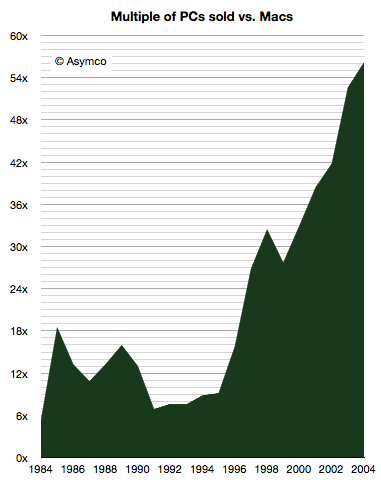
    When the Macintosh was launched in 1984, computers running the MS-DOS operating system were nearing a dominant position in the market. Having launched in 1981 as the IBM PC, they were quickly cloned and four years later "PCs" were selling at the rate of 2 million/yr.  The Mac only managed 372k units in its first year.

    In other words, PC was outselling the Mac by a factor of nearly 6. It turned out to be a high point. The ratio by which the PC outsold the Mac only increased from there.

    When Windows 95 launched in 1995 it negated most of the advantages of the ease of use of the Macintosh and the PC market took off. The ratio reached 56 in 2004 when 182.5 million PCs were sold vs. 3.25 million Macs.

    During the second half of the 90s it was already clear that Windows won the PC platform war. Windows had an  advantage that seemed unsurmountable.

    I should point out that this ratio between platforms is not just an exercise in arithmetic. It's a measure of leverage. The advantage of dominance is realized in an ecosystem which creates lock-in and additional economies in marketing. Ecosystems become self-perpetuating and there is a tendency toward monopoly. The stronger you are, the stronger you get.

     Then, in 2004, something happened.

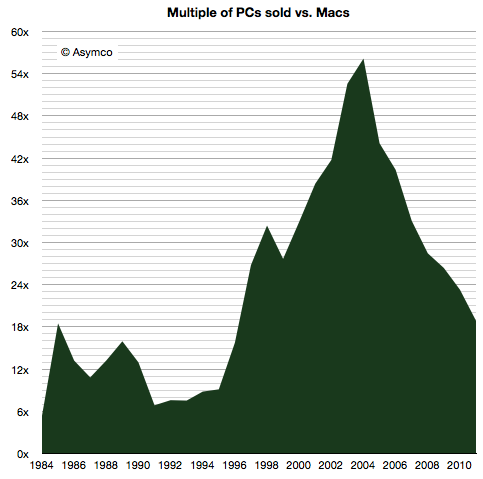
    Although PC volumes continued to grow, they did so more slowly and the Mac grew faster. What coincided with this was the emergence of portable computing. The MacBook became easily differentiable as a "better" laptop. It was not faster, did not have more storage or any key metrics being used to sell PCs. It was just better as an integrated product. The integration manifested itself through a sense of quality and robustness as well as intangibles like aesthetics and "feel". I wrote about this a few years ago.

    As a result the Mac began to whittle down the advantage Windows had. The ratio  of Windows to Mac units shipped fell to below 20, a level that was last reached before Windows 95 launched. It's as if the Mac reversed the Windows advantage. This was an amazing turnaround for the Mac.

    But the story does not end there.

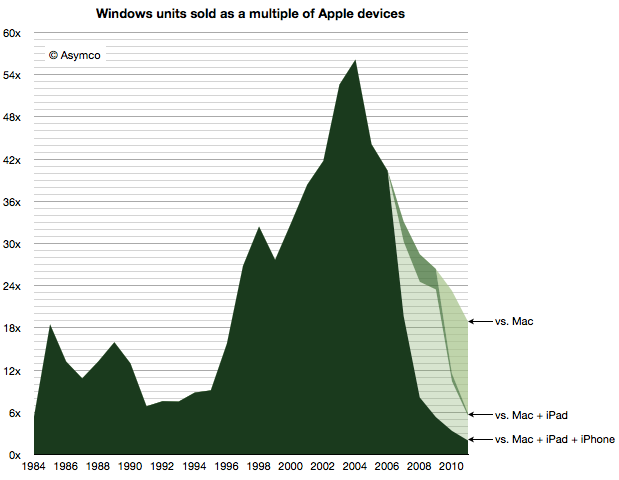
    If we consider all the devices Apple sells, the whittling becomes even more significant and the multiple drops to below 2. Seen this way, Post-PC devices wiped out of leverage faster than it was originally built. They not only reversed the advantage but cancelled it altogether.

    Considering the near future, it's safe to expect a "parity" of iOS+OS X vs. Windows within one or two years. The install base may remain larger for some time longer but the sales rate of alternatives will swamp it in due course.

    The consequences are dire for Microsoft. The wiping out of any platform advantage around Windows will render it vulnerable to direct competition. This is not something it had to worry about before. Windows will have to compete not only for users, but for developer talent, investment by enterprises and the implicit goodwill it has had for more than a decade.

    It will, most importantly, have a psychological effect. Realizing that Windows is not a hegemony will unleash market forces that nobody can predict.

  8. An interview with Kenney Ho of The Chosun Daily of Korea

    Research · 21 comments

    Kenney Ho, a staff reporter from Korean newspaper The Chosunilbo (The Chosun Daily) sent me a set of delightful questions.

    According to Kenney, The Chosunilbo "has a history of 90 years, has been the most dominant, and influential paper of all time in Korea. It is the No.1 newspaper company in Korea with more than 1.8 million circulation, firmly holding the largest market possession. The paper is recognized Asianwide, where there are many readers in Japan and China."

    -You said "All mobile device vendors experiencing losses are not likely to really recover". Even though, it wouldn't mean that the employees, executives of Nokia has completely nothing in hands for recovery. If you are the CEO of Nokia right now, What are your steps to make Nokia recover its deficits?

    My statement was based on the historic data which shows that 14 phone vendors have either exited the business or lost their independence during the last decade. No vendor that has reached a period of prolonged loss making has recovered. These are just observations and it's possible that Nokia may be the first to recover. However, going by the patterns of the past, it would be very unlikely. When I thought about the reasons why companies have not been able to recover I came to the second observation about the way phones are sold. Once a brand reaches a point where it's considered "risky" for distributors and operators to range they tend to defer purchases which leads to a spiral of continuing losses and more damage to the brand. The market amplifies "distress" and recovery becomes impossible.

    If I were the CEO of Nokia I would set course for turning the company into a new business. I would approach the market asymmetrically and not try to compete directly with the other vendors. I would look toward services, platforms and software solutions and de-emphasize hardware.

    -Many experts say that because Nokia dominated phone making industry in the 2000s, they maintained a corporate culture of complacency, which led them to decline. Do you agree with this? If you agree, Can you point out the examples of Nokia's complacency?

    Complacency would mean that Nokia would not invest or try new things. This is not quite right. The company invested in software, services and platforms. It tried many new things and had a large R&D budget. It was the leader in mobile software for many years. There was, however, a culture of arrogance about their position. This meant that they did not think the basis of competition would change. They thought they were too big to fail. They did not challenge the core business model of hardware-first and try to find an internal disruptive business.

    -Experts note that Nokia should have reacted directly to Apple's iPhone appearance at 2007. What should have Nokia have done at that time?

    The iPhone showed that software and experiences matter more than operator relationships. Nokia did a lot of research on user experiences and software but when the decision came to implement the ideas, the constraints of hardware and logistics and operator preferences took precedence and the software was compromised. What Nokia needed to do is build product around software not software around the hardware and the market.

    -Since Apple's iPhone appeared in 2007, Samsung took a Fast-follower tactics which made them successful, which Nokia could not. Do you think Fast-follower have advantage over first-mover?

    I don't consider first-mover or fast-follower to be accurate descriptions of strategy. Success follows from innovation and only from innovation. There are various forms of innovation: there is new market creation, new business models, low cost or distribution innovation. Nokia tended to create low cost innovations which opened new, low-end markets. Apple created a new market for browser-based devices and for app-based experiences. These were enabled by an ecosystem that benefited from integration.

    Samsung implemented a portfolio strategy with a large number of devices and price points which allowed them to find market niches that could be exploited. This was a distribution innovation. Each strategy has advantages and disadvantages and each strategy is usually linked to company core priorities and processes. There are times during a technology cycle when one strategy is better and another is worse. This is why companies find themselves successful and then fail. Their processes don't match the technology adoption cycle.

    For example, in the PC market there is little potential for new experiences tied to an integrated device (except for tablets) and hence there is little growth opportunity for an Apple-like approach. The innovation that matters in the PC market is mostly cost reduction. Nokia was doing cost reduction at a time when voice products were commoditizing. Cost reduction does not work when the basis of competition is new experiences and new business models. As smartphone hardware commoditizes, it's unlikely that Samsung will have an advantage unless is goes to a low-cost approach and enters into direct competition with low-end devices.

    -Can you predict the 'Big 5' in handset industry 10years from now? Many people think the list will include Apple, Samsung. Who else might be on the lists?

    There is no guarantee that Apple or Samsung will be the top vendors 10 years from now. I expect Chinese brands to become dominant in market volumes. I expect online service companies like Amazon, Baidu, Facebook to create new platforms which and have their own devices, perhaps in large volumes. I expect new input methods (like voice) to create new opportunities and perhaps new platforms and ecosystems. I expect Google may make a lot of money. One thing is for sure, being a hardware-oriented company without software and services and platforms and ecosystems is a sure path to becoming disrupted.

    -Nokia was the leading company in Finland. What are the reactions of Finland towards Nokia's downfall?

    People tend to blame each other for failures and this is the main discussion topic in Finland: who's to blame. The failure of a company is rooted in complex decision processes which usually take years to run their course. It's quite futile to lay blame on persons, especially since the same persons were celebrated for their wisdom at another point of time. At the same time as Nokia is failing however, another Finnish startup is celebrated world-wide and about to go public: Rovio, the maker of Angry Birds. It will be bigger than Nokia. Finland should make sure there are more Rovios to come.

  9. Android Revenues in Perspective

    Research · 90 comments

    Data is useful only when put in perspective. Yesterday's post on the Android Income Statement showed how sales and revenues are captured and how costs are paid for that revenue. The data was shown for the entire calendar year 2011 and the maximum value in the vertical axis was $1.5 billion.

    Google has also reported that their revenue "run rate" is now in excess of $2.5 billion so there is significant growth, as would be expected from an exponentially increasing user base.

    However, it's important to place this growth in perspective, both in absolute and in relative terms.

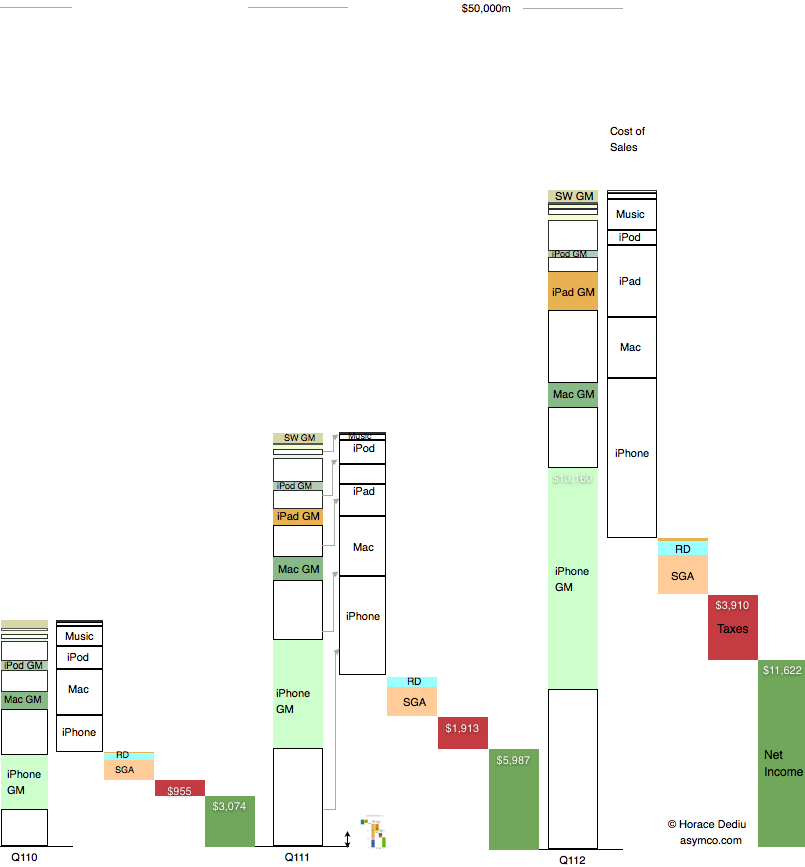
    Below is a diagram showing Apple's revenues for the first calendar quarters of 2010, 2011 and 2012. Each product group (iPhone, Mac, iPad and iPod) is shown separately with estimated gross margins (GM). Operational costs, taxes and net income are also shown.

    Consistent with previous versions of this data are the color schemes where white areas represent costs of goods sold.

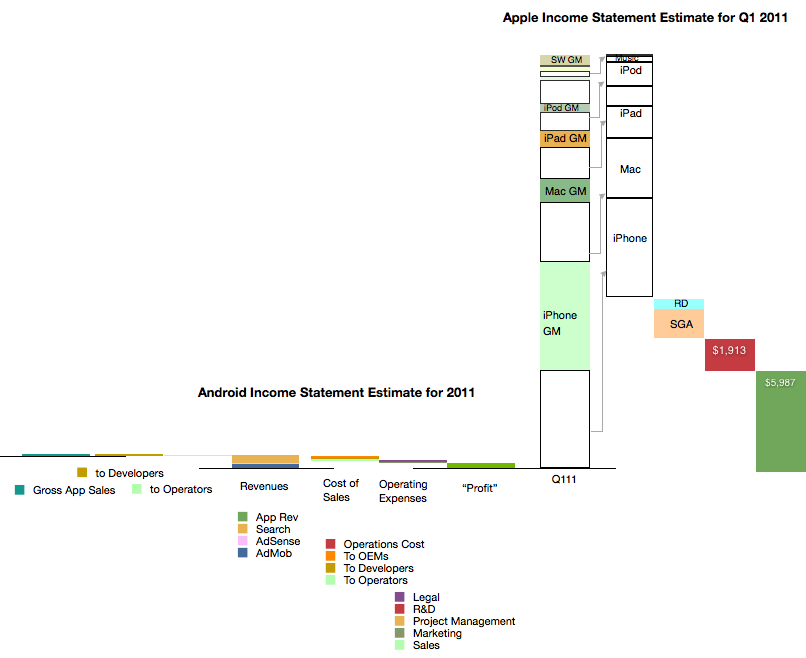
    I also placed a scaled version of the Android Income statement next to the first quarter 2011 revenue bar for Apple. The scale is maintained where $1 billion is represented by the double-ended arrow line.[1]

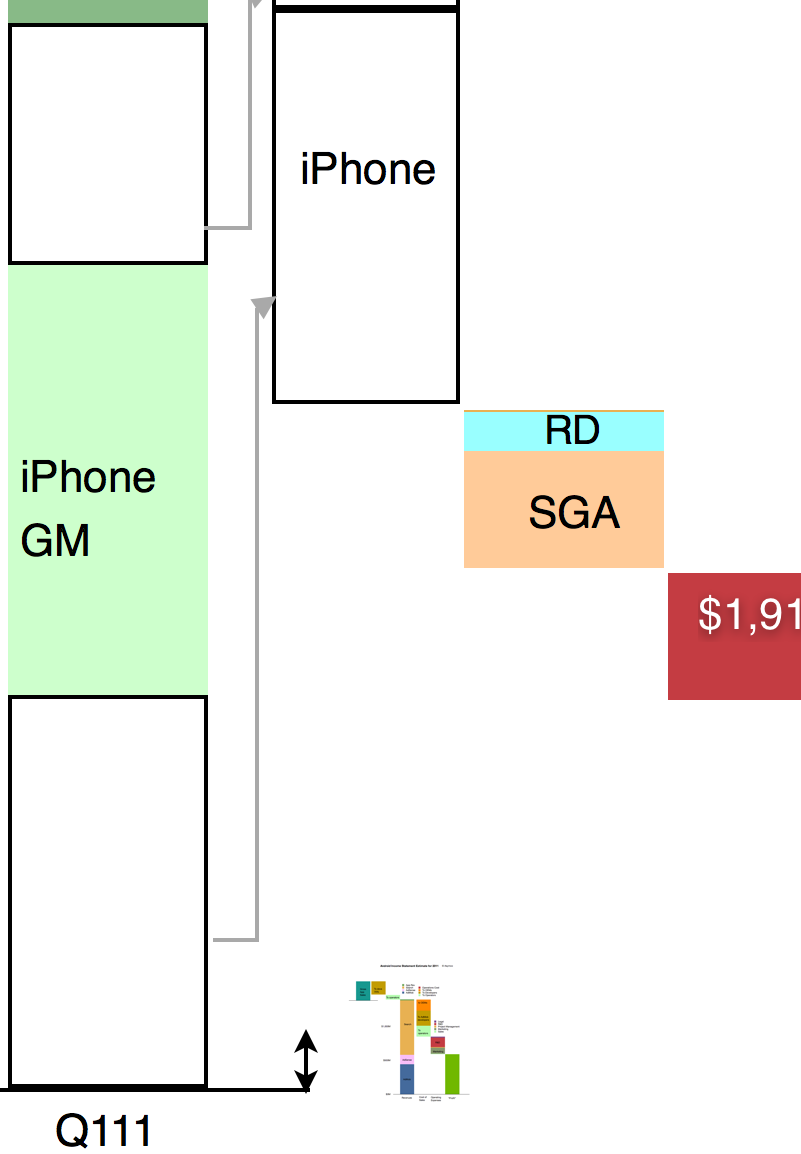
    It might be hard to see the Android section of the chart so I expanded it below at 400% the original:

    It is still difficult to resolve the data at this resolution but the picture should become clear nevertheless. Keep in mind that the iPhone data is for one quarter while the Android data is for one year. Comparing revenue "run rates", on a yearly basis Android is 2.5% of iPhone or 1.6% of iOS.

    As various members of the Android ecosystem are rewarded from the 40% revenue share of Android, it would be important to consider the scales involved in these illustrations when considering the influence Google exerts. It could be argued that Google's spreading of wealth from search creates strong incentives for participation in its ecosystem.

    However, there is little wealth created. 40% of a little is a lot less.

    ---

    Note:

    1. The scaling of the image in both X and Y dimensions can be deceptive. I provide the following view where only the vertical dimension (value) is reduced for Android
    1. :


  10. Take the money and run

    Research · 26 comments

    In August 2007, during the HD format wars between HD-DVD and Blu-ray format, Toshiba offered Paramount and Dreamworks $150 million to produce HD versions of their movies exclusively as HD-DVD.[1]

    This type of deal is equivalent to an "advance" offered to a book author. The DVD manufacturer pays studios up-front cash for the right to make its DVDs. From an accounting point of view this is treated as an advance that the manufacturer recovers by selling the DVDs back to the studio's video division in the same way a publisher earns back the advance it gives an author.

    In this case, the payment was so large and the sales of HD-DVDs so small that Toshiba was unlikely to earn back the entire advance. The way the deal made any sense for Toshiba was that it was exclusive: the studios could not continue to release their movies in Blu-ray. The deal was done explicitly to hobble a competitor and create "critical mass" of content for its own format.

    But then in March 2008, Toshiba threw in the towel and abandoned the HD-DVD format. The way the deal worked, the studios got to keep almost all of the $150 million. They then re-released all their movies in the Blu-ray format. The only "cost" to the $150 million windfall was that there was a nine month delay in the eventual release to Blu-ray--a small price to pay for an emergent format without a large install base.[2]

    Platform owners go to great lengths to ensure "content" for their platform. They will, essentially, finance an ecosystem when there are barriers to entry or when competing ecosystems are far more lucrative.

    This scenario for movies is being played again with Netflix, Hulu and other distributors who need to fill their pipelines. Netflix's content acquisition costs are exploding and putting the whole company's future in doubt.

    But this scenario is also being played out with app developers. Most recently, news broke that developers are receiving payments from Microsoft for Windows Phone ports of popular apps. In mobile platforms, apps are the new content and developers are the new studios.  It's also a practice that is not without precedent[3].

    This is as it should be. The value of the platform lies mainly in what is built on top of it just like a foundation is not much use without a house on it. However, the practice of "priming the pump" with cash payments for porting is not ideal. Like spiffs, those who receive payments may become used to it and withhold development if there is no payment. Also, those who did not get payment offers may feel shunned and retaliate in kind. Those who receive payment may become cynical about it and may not put in the extra effort (or, more probably, outsource) to make the work spectacular.

    Or, like Paramount, they may just take the money and run if/when the platform fails.

    ---

    Notes:

    1. Source: The Hollywood Economist 2.0: The Hidden Financial Reality Behind the Movies by Edward Jay Epstein.
    2. Paramount made $250 million more from three "replication output" deals: $50 million from Toshiba for agreeing to release Titanic on DVD in time for Christmas sales, $150 million from Panasonic for agreeing to allow them to take over video replication from Thompson, and $50 million from the law firm Ziffrin, Brittenham and Circuit City stores for agreeing to support the DIVX format. Paramount got to keep the money even though DIVX never launched.
    3. Although it's never been reported that Apple pays developers for building iOS apps, some developers do benefit from promotional placement and visibility during launch events and from early access to devices or SDKs under development.
  11. 5by5 | The Critical Path #14: The Super-platform ecosystem

    Podcast · 24 comments

    The Critical Path show switches format for this week's episode. I interview a guest.

    5by5 | The Critical Path #14: The Super-platform ecosystem.

    The idea is that rather than just telling stories and interpreting the world from my point of view, I should also ask others to teach from their experience.

    In this case I discuss the disruptive potential of cloud computing with Randy Bias. Randy is the CTO of Cloudscaling, a designer of infrastructure cloud systems and a vast knowledge of the challenges and value of what we now call cloud systems. I've consulted for Randy in the past and I thought he could add a lot to the understanding of super-platforms. Super-platforms, you may recall, is a term I used to describe the coupling of Web Services and Devices in a mutually inter-dependent business model. I introduced the concept as a way to think about Siri and iCloud and potentially the Kindle and Amazon in general.

    In this show I ask Randy to comment on the thesis that devices and cloud systems as a coupled system are a potential disruption to both the device-only model of computing and the cloud-only model of services. In other words, is the new ecosystem the coupling of devices with backend cloud APIs? We also touch on the scope of Apple's data centers and the way we can calibrate the investment.

    I think this is a ripe area of research and thinking about the future of computing. It will require learning a new way of measuring "performance" of solutions and the businesses built around it. It will take a multi-disciplinary approach to ferret out the key value propositions.