Asymco

Asymmetric Intelligence

exit

  1. What are the odds of Apple surviving?

    Research · 2 comments

    A tale of two Apples

    What are the odds of it surviving another year, ten years, 50 years?

    Companies don't last long. A recent study that analyzed thousands of European firms yielded a corporate life expectancy figure of 12.5 years. The Boston Consulting Group analyzed the entry, growth, and exit dates of 35,000 publicly listed companies and determined that one in ten of all public companies fail each year, a fourfold increase since 1965.

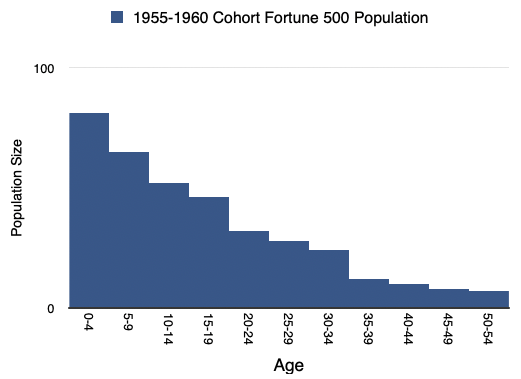
    As I illustrated many years ago in a talk titled "The Unfortunate 500" most companies die not long after adolescence. Of the Fortune 500 1955-1960 cohort, the 81 companies which joined the index in those years, only 7 remain there today. One third of the corporations on the 1970 Fortune 500 list were no longer in existence thirteen years later. Broadly speaking, as a population, large companies that make it to the Fortune 500 listing have life expectancy within that group of 17 years.
    What are the odds of Apple surviving?

    To illustrate further, here is the list of the companies that joined the Fortune 500 In 1976, the year of Apple's birth:

    EntryCompanyExit
    1976SuCrest1976
    1976International Systems & Controls1977
    1976Kewanee Industries1977
    1976Hunt International Resources1979
    1976Peabody Holding1979
    1976Consolidated Aluminum1981
    1976HP Hood1981
    1976Envirotech1982
    1976Peabody International1984
    1976Hughes Tool1987
    1976Cameron Iron Works1990
    1976Foxboro1990
    1976Tektronix1994
    1976Mapco1998
    1976Molson Coors Brewing2009
    1976Baker Hughes2014
    1976Masco2014
    1976Ball2014
    1976Ecolab2014
    1976CF Industries2014

    Not one of those in the 1976 cohort are on the list today. The longest to survive managed to stay on for 38 years.

    Apple joined the Fortune 500 in 1983. Here is a list of all the other companies that joined the index in 1983.

    EntryCompanyExit
    1983North American Coal1983
    1983Datapoint1986
    1983MEI1986
    1983Mobay1986
    1983Coleco Industries1988
    1983Liquid Air1988
    1983AH Robins1989
    1983Sipco1989
    1983Wilson Foods1989
    1983Oxford Industries1991
    1983DR Holdings Inc of Delaware1992
    1983Media General1992
    1983Wisconsin Dairies Cooperative1992
    1983Ametek1994
    1983Hanson Industries NA1994
    1983Meredith1994
    1983Snap On1994
    1983Sun Diamond Growers1994
    1983Universal Foods1994
    1983Worthington Industries1994
    1983AMDAHL1994
    1983Dr Pepper Seven Up1994
    1983Diebold1994
    1983Echlin1998
    1983Stone Container1998
    1983Tyco International1998
    1983Flowers Industries2001
    1983Cooper Tire & Rubber2005
    1983Tribune2008
    1983Holly2011
    1983Apple--

    Apple is the only survivor from that cohort.

    Out of about 2500 companies that existed in the Fortune 500 index since 1955, 50 are still in it. That's a survival rate of only 2%. Approximately 87% of all people born globally between 1955 and 2026 are still alive today. This is why I titled my talk The Unfortunate 500. If this was a human population it would be considered chronically unhealthy.

    However, unlike people, large companies that make it past age 50 tend to stay alive (or independent, as most who exit the index do so because they are merged or acquired--another distinction from biological entities).

    But the way they manage to be resilient is by adapting to a changing world in some fundamental ways. The environment a business lives in (technological, market, economical) changes more rapidly than the biological environment (genetic, radiological, reproduction).

    Companies have to essentially re-define themselves and become something that has little to do with their initial conception.

    In the case of Apple there are clearly two separate entities. The original and the one that was reborn in 1998 when Steve Jobs returned. When you look at the company closely, it's pretty clear that the second Apple was fundamentally different even though the original founder returned.

    In some ways one could argue that Apple 1.0 eventually strayed from its original culture and the reset in 1998 returned it to a core that was resilient but it's more complicated than that.

    To measure "distance" in terms of corporate culture you need to think of culture as a three dimensional vector. it's a composition of resources, processes and priorities (RPP). The combination of these forms what we call the "DNA" or the "culture" or the unwritten constitution of the firm.

    The vector of RPP for Apple changed dramatically in Apple 2.0 in terms of resources (capital, software, silicon), processes (engineering, operations and marketing), and priorities (focus, integration, product/service cohesion)

    I would summarize it as there being a tangible "theory of the firm" for version 2. The first version was very much a theory of the team: a group of great people without a binding operating model.

    Stay tuned as we explore the Theory of Apple.
  2. The Entrant's Guide to The Automobile Industry

    Podcast · 152 comments

    Like a siren, it calls.

    The Auto Industry is significant. With gross revenues of over $2 trillion, production of over 66 million vehicles and growing ((The industry continues to grow, registering a 30 percent increase over the past decade, mainly due to Asia and China in particular)) it seems to be a big, juicy target. It employs 9 million people directly and 50 million indirectly and politically it must rank among the top three industries worthy of government subsidy (or interference). Indeed, in many countries--the US included--government interference makes it practically impossible for a producer to go out of business, no matter how poorly it's managed or how untenable the market conditions.

    But this might be the tell-tale sign that danger lurks. Theory suggests that incumbents going out of business is an essential indicator of industry health. Without their exit, entrants are never allowed to bring disruptive ideas to bear and innovation simply stops. Is this interference with mortality the only indication of entrant obstacles? Are things about to change? Is there pressure for innovation? Can we spot other indications of a crisis in this industry?

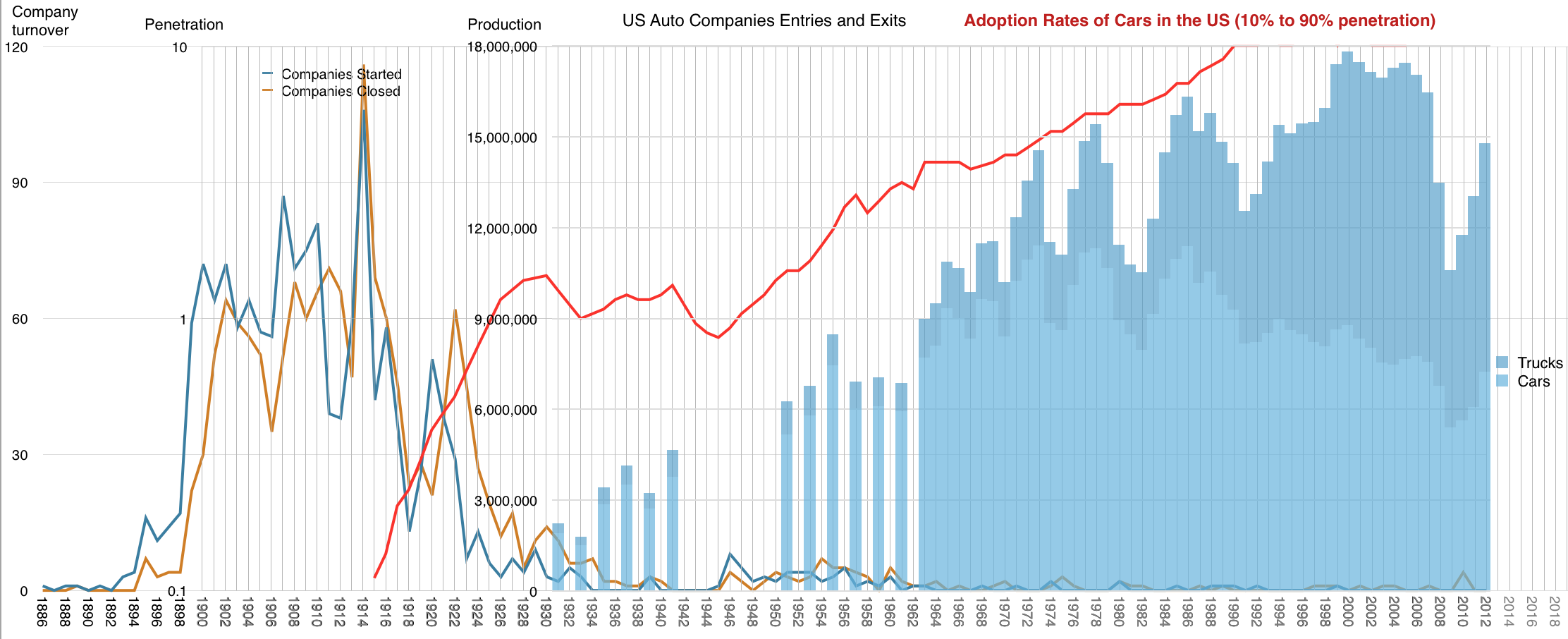
    Taking the US as a proxy, here is a graph of the number of new car firm entries (and exits):

    Screen Shot 2015-02-23 at 6.58.54 AM

    The total number of firms ((counted as brands)) that entered the US market is 1,556. The blue line graph shows the entries and the orange line shows the exits. This sounds impressive, but note that the year when the peak of entries took place was 1914, exactly 100 years ago.

    1914 was also the year when penetration of the market first reached 10% and the rapid slope of adoption was joined. You can follow this adoption rate as the red line in the graph above ((The line is on a log graph and shows the P/(1-P) where P is the penetration of households)) ((Note that all line graphs have the same x-axis but have different y-axes.))

    The first analytical task for the entrant today is therefore to ask why there have been so few others succeeding in the last century. In the last half-century 14 tried and all failed.

    One clue is the third set of data plotted above: production figures. The blue area represents the production total for the industry on a yearly basis. ((The graph is split into cars and trucks. You can plainly see the recessions and the patterns of war and peace)). Note that all three data sets have some relationships to each other: Production growth is dependent on new demand growth and that on a household basis demand ceased growing in 1990. Production and penetration accelerated when entries ended. Given the economies of scale in manufacturing, a consolidation occurred and barriers to entry exploded when volumes became significant.

    This leads the casual observer to conclude that production is the predominant consideration for participants and that the entire industry revolves around this measure.

    Indeed, production is everything. Capacity utilization is the first priority for an auto manufacturer. Capacity is why firms are not allowed to die and entrants are not allowed to enter.

    But you don't need the data to tell you this. There are other clues. I will summarize these observations in the following "ten commandments" for the industry:

    1. It's easier ((read: cheaper)) to design and build a Ferrari than a Ford. At its logical extrapolation of this rule one can observe that a Formula One team is a trifling hobby compared to the effort needed to build the shabbiest of hatchbacks.
    2. Low-end disruption happened early in the adoption curve. The very first cars were luxuries, but the Model T from Ford set up the Ford production system as a template for all and it was a low-end disruption. It happened 100 years ago. The Volkswagen Beetle and the Toyota Tercel were also low-end and they built non-US concentrations for production in the 60s and 70s. Same can be said for Mini, Fiat, Renault and Citroen. More recently Korean and Chinese entrants have appeared but they have not been disruptive.
    3. Almost all meaningful innovation occurs in the production system (not the vehicle). The improvements in vehicles are many but they have not been meaningful in the sense of shifting any of the power in the industry. Certainly not to new companies. The production system innovations of Ford, GM and Toyota  allowed them to establish what is to date an unassailable power base of production. If you want to find the next "big thing" in automobiles, look for a new production system.
    4. To understand how cars will or won't change, study roads. There were roads before cars, but not paved and not for going far. Road construction and the deep understanding of safety, capacity and economic impact took 50 years between 1920 and 1970 in the US. ((Thanks to Steve Crandall for many of these insights. He further notes via Twitter that ~1.5% of the US land mass is paved for transportation)) The cars pay for the roads and, as a result, they pay for the logistic system that allowed all forms of powerful businesses to emerge.  Walmart, McDonalds and Amazon and the entire retail, food and agriculture sectors owe their existence to the roads that car adoption paid for. Furthermore, the real-estate and entire living structure of many countries depends on roads. If you want to change the car you have to also understand how the roads need to change. ((Hint: for cars to improve through the reduction in the need to be driven, an understanding of their environment--roads--is mandatory. This is an information problem mainly but it's also a regulatory and tax problem.))
    5. There has never been a disruption based on drivetrain innovation. Everything to date has been sustaining. Since 1886, the internal combustion engine has been dominant. Even though there have been diesel, natural gas, all-wheel drive, front wheel drive and electric drive, none of these innovations have changed who controls the profits in the industry. Hydrogen fuel cells won't either. The reason is simple: incumbents can easily adopt/buy any improvement/innovation as it sustains their production-oriented profit formula. Entrants with drivetrain innovation can't build a business model moat around the idea without a production base.
    6. China is the largest producing (and consuming) nation. The global center of production shifted over the years and tends to follow consumption. As a new middle class emerges, the fact that China is leading now should not be surprising. As each new producing center was built, it created an opportunity for local entrants, however they did not displace the incumbents rooted in other markets. This is mainly because they were protected and they were protected because of political considerations including jobs, taxes (roads), etc.
    7. Almost all car companies own each other. There is a vast cross-ownership network and a disinterest in independence. This is again due to production-led thinking. The spreading of over-capacity or under-capacity risk leads firms to disregard product or market considerations and enter into joint ventures and partial acquisitions. Portions of manufacturers are bought and sold by competitors almost as regularly as they are bailed out by governments. Competition is therefore perverted if not prevented.
    8. For most motorists, congestion is a bigger problem than any deficiency in the vehicle. We think people want better cars, but they don't. Cars stopped getting "better" and started becoming worse when congestion became common and congestion became common when saturation was reached. We can't build more roads (see Commandment 4) and as populations grow, the traffic becomes unbearable. The vehicle's role switches from freeing to constraining. The industry is adding cupholders to alleviate the problem.
    9. Contract manufacturing is nearly non-existent. Unlike other industries which modularized long before saturation, automobile manufacturing is largely inter-dependent. You can't buy your chassis from one maker, the body from another and fit the electronics, user interface and engine from a few others. All available configurations come from one brand. This is symptomatic of the production system leading to innovation insufficiency.
    10. It's easier to make a car go fast than to make it go far. This rule is partly corollary to the first rule (Ferrari vs. Ford) but it is also alluding to fuel and energy considerations. Fuel has always been seen as a handicap for the industry. Crises of availability have been around since the 20's. Somehow demand has led to supply but there are new, unpriced costs to bear. For the industry to continue it needs to solve its own range problem.

    All these topics and much more have been discussed in Asymcar, the podcast for those interested in entering the automobile industry.

    As technology companies listen to the siren's song they should contemplate the basis of survival in the industry. Whether your approach and innovation sustains the hegemony or changes it will largely depend on your business model being asymmetric to the incumbent. Determining what is and isn't symmetric should be the first step in your analysis.

  3. The price is right

    Research · 162 comments

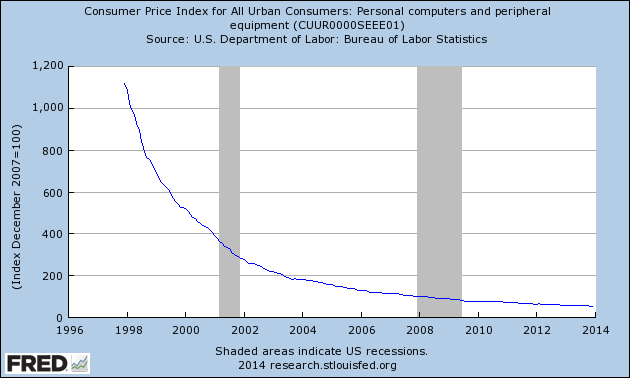
    One of the axioms of hardware business is that prices fall over time. The consumer price index for personal computers and peripheral equipment from 1998 to 2014 is shown below:

    CUUR0000SEEE01_Max_630_378

    The price index suggests that prices for computers should be 54% of 2007 levels. Charles Arthur illustrated this on a global basis using a separate set of data.

    The data shows that the weighted average selling price (ASP) of a PC has fallen from $614.60 in the first quarter of 2010 to just $544.30 in the third quarter of 2013, the most recent date for which data is available.

    The result is a chronically low margin for computer manufacturers. As Charles points out, the average profit for a PC is less than the price of a coffee at Starbucks. LG and Sony's exits from the market are symptomatic of the crisis. This is not a new phenomenon. There has been a long series of mergers, acquisitions and exits by incumbents.

    Except of course for one incumbent.

    The Mac, aged 30, seems to soldier on. Phil Schiller noted that of its original competitors, Apple is the only PC maker to still be in the market. One could imagine that this existence is marginal, or that the Mac managed to survive by giving up on unit volumes or pricing.

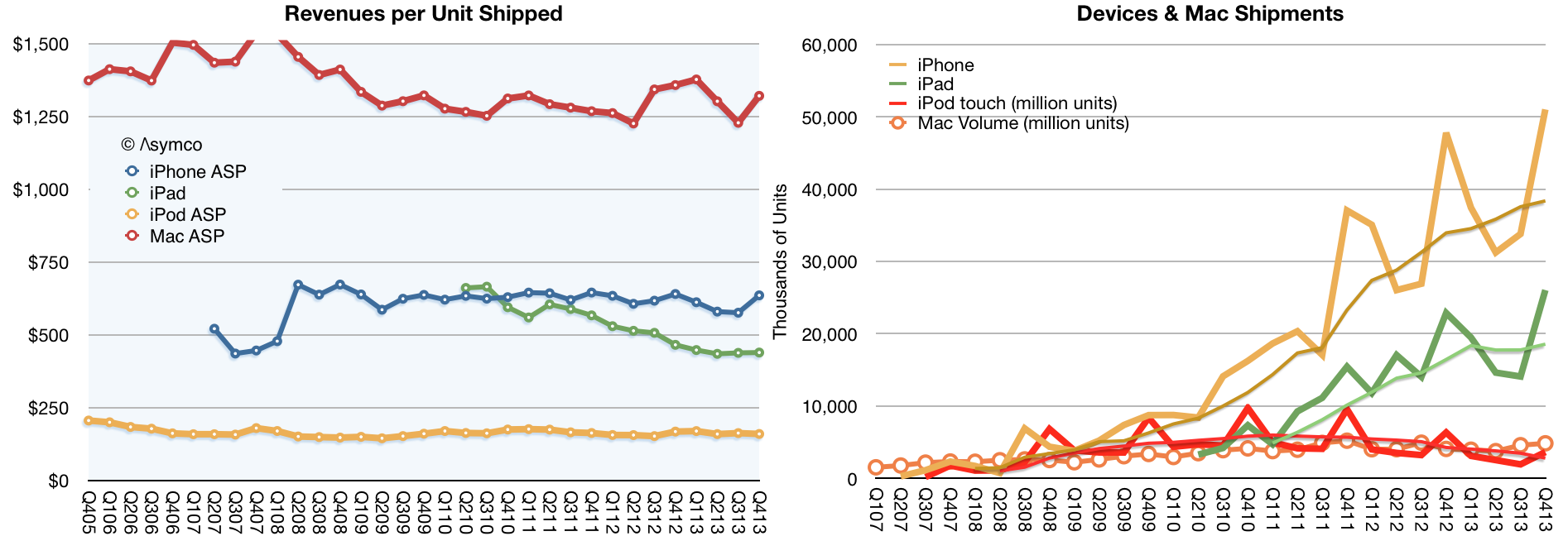
    The following graph shows the revenue per unit for the Mac and its volumes.

    Screen Shot 2014-02-20 at 2.59.43 PM

    The Mac not only continues to preserve pricing but it also seems to grow volumes at a time of overall market decline. Going back to the consumer price index, the Mac in December 2007 was priced, on average, at $1539. In December 2014, the price was $1322, with $40 deferred.

    So rather than being 54% of December 2007 prices, the Mac is almost at 90%.

    You'll note that along with the Mac I also illustrate the pricing of Apple's other devices. Even with the iPod, the pricing has remained stubbornly consistent for over 7 years. Whether the volumes are falling, rising rapidly or remaining flat, Apple's product pricing remains predictably consistent.

    The point being that the violation of the axiomatic price erosion rule in PCs is not anomalous. It suggests something about the violation of the same rule in devices. It suggests that perhaps the company does not respond to the same market forces.

    But we already know that. Jony Ive told us as much:

    “We’re keenly aware that when we develop and make something and bring it to market that it really does speak to a set of values. And what preoccupies us is that sense of care, and what our products will not speak to is a schedule, what our products will not speak to is trying to respond to some corporate or competitive agenda. We’re very genuinely designing the best products that we can for people.”

    The result is plain to see: Caring about the product means that it can be priced at a point which consumers care to pay.

    Trouble is, judging by how Apple is valued, nobody believes that this is sustainable. Regardless of the evidence within Apple's own history, it's the exception, not the rule and the bet continues to be that they cannot continue to remain an exception.

    Is Apple going to continue to repeal the laws that govern its industry, as it has for decades, or will it, as the market expects, abide by them?

  4. Unforgiven, Continued

    Research · 5 comments

    In June of 2011 I asked "Does the phone market forgive failure?" Not much time has passed since but the answer still seems to be no. The trigger I was using for this point of no return when the vendor began making losses.

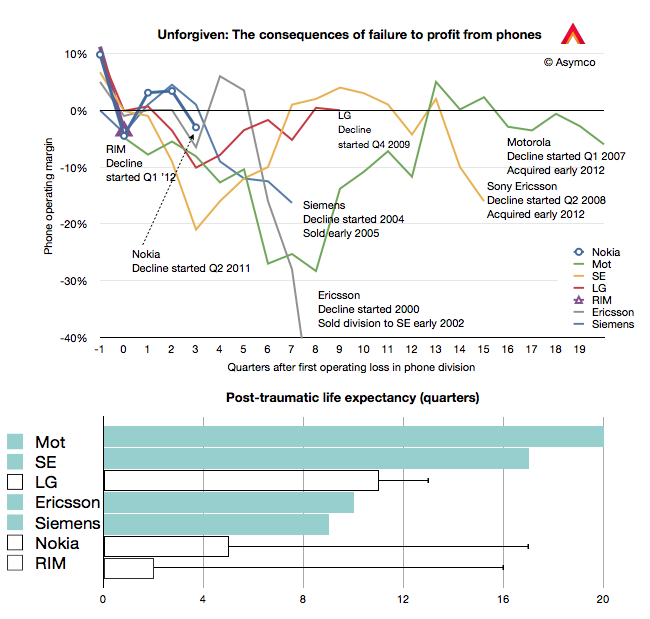
    The list at the time consisted of 13 phone vendors who either merged, were liquidated or acquired after this trigger point was reached. There were no examples of vendors who recovered. Since then two more vendors reached the threshold (Nokia and RIM) and a third will do so this quarter (HTC). One vendor (LG) may be recovering but Nokia has just been acquired and RIM has put itself up for sale. Some Japanese vendors like Panasonic have also called it quits since then. So the score so far is about 18 triggers, 15 exits and three pending.

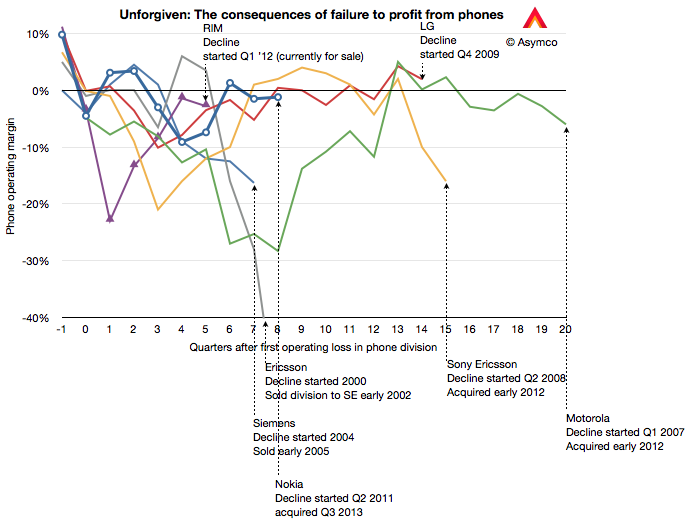
    Some of this data is summarized in the following graph:

    Screen Shot 2013-09-03 at 9-3-9.19.51 AM

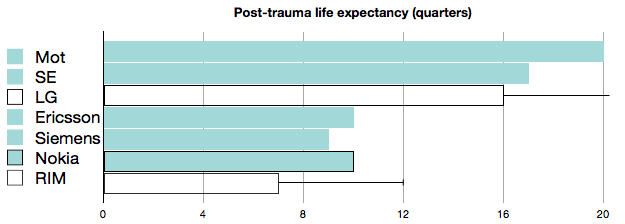
    It shows that post-trauma life expectancy is now running at about 2.5 years. As RIM is only in its second year, one could perhaps expect another 6 to 9 months of independence. HTC could go on until 2015 but the smaller the company, the more vulnerable, so HTC's exit time should be shorter.

    Screen Shot 2013-09-03 at 9-3-9.20.57 AM

    The exception might be LG which seems to be recovering. As a conglomerate, LG is much less vulnerable and might have the resources internally to sustain the phone business indefinitely.


  5. What will happen to Nokia?

    Research · 42 comments

    There is no shortage of information about what happens to companies in distress. The cause of distress varies widely and is often not well understood but the actions and symptoms of distress are very consistent. We can look at examples in each industry, even in each product category for a rich set of distressed company data.

    For over a year I've been chronicling the decline of incumbents in the mobile phone industry. However, decline cannot continue indefinitely. At some point a company "exits" the industry. Either through a sale or divestiture or, rarely bankruptcy. The list of exits is already long. The length and the correlation between exit and the lack of recovery implies that Nokia will also exit.

    But how, exactly?

    Will Nokia be acquired? If so, then by whom? What other options exist? How can we analyze this?

    The easiest way to guess is to look at what happened to other companies in similar circumstances. The clearest and easiest comparison to apply is Motorola. Motorola was at one time the largest phone vendor and it went through a violent decline. Like Nokia, it was diversified into networks and a few other businesses. Unlike Motorola it's not an American company. This matters because American companies are more comfortable targets for corporate raiders. The legal and boardroom mechanics are not "better" or "easier" in the US than in Europe but they are more familiar to those who might engage in it.

    So one avenue that Motorola traveled on was the intervention of activist investors who forced management change, affected strategy and pushed some tactical initiatives. This external pressure was successful in the case of Motorola. The company was split up, it was re-purposed and re-focused and, with a bit of good luck, was acquired.

    The process however still took two years. In that time the company languished but stayed alive. Its headcount was reduced by nearly two thirds. It was in a precarious situation throughout. Its story is not over but ownership did change hands and those who took a risk with it while in distress managed to get a reward.

    This example (and Sony's acquisition of Sony Ericsson and HP's acquisition of Palm) cannot apply to Nokia.  An activist investor is unlikely and the company has not yet made itself attractive to a buyer. So what would Nokia need to do to  be acquired?

    The first step toward an acquisition will be divestiture of its Nokia Siemens venture. The second will be a spinoff or sale of its non-smart phone division. The third might be the allocation of its IP across these separate entities or in a separate holding.

    As the company is broken up, value can be released. Investors will be able to value it better and make appropriate assessments of risk. Only at this point would an acquirer perhaps buy the "rump" Nokia smartphones group.

    However, even this scenario is not without huge risks. By the time the split is completed, the operating companies could have deteriorated to such a degree that they are no longer viable. Timing is critical.

    So if the smartphone group is isolated and made available, who could buy it? Microsoft is always cited as the primary buyer. I've been skeptical of this as Microsoft has found it difficult to make hardware work. It acquired Danger leading to Kin which failed. It has struggled with Xbox for a decade and has yet to recover all its costs for the effort. It has failed embarassingly with Zune. It also has shown no particular success with its original Surface table computer.

    But management has re-committed itself to a new hardware effort with the new Surface. This renewed potential opens up the possibility of entering into the integration of a phone again into their business, and Nokia would be remarkably well positioned to help.

    At this time, the possibility still seems remote. The company has dismissed speculation of building phones again and again. Unlike PCs, the phone platform is not yet mature and volumes and distribution are very different.

    However, there is one other option.

    Microsoft has historically "rescued" technology companies in distress with cash infusions for minority equity stakes. It injected some cash into Apple, Barnes & Noble and even Facebook. It did so not because they wanted to own these companies but because they wanted them to survive or thrive. The move acts as a signal to the industry, partners and developers. So what I see more likely than an acquisition is Microsoft capitalizing a spun-off Nokia Smartphones company in exchange for a small equity stake.

    The valuation of this stake will be huge as I expect billions of dollars for single digit share ownership. However, Microsoft would not be doing it to get a return from those shares. It would probably later sell them at a loss. But it would be buying a strategic option whose value may be far greater.

  6. Post-traumatic life expectancy of phone vendors

    Research · 46 comments

    “Clearly this stuff isn’t selling,” said Monga [an analyst at Veritas Investments Research in Toronto.]...

    RIM took a $485 million pretax charge to write down the value of its PlayBook inventory in December, after shipping just 150,000 of the tablet computers in the quarter. Then in March, the company recorded a $267 million expense for BlackBerry inventory. RIM said at the time that it would stop giving sales and profit guidance because of “ongoing weakness” in the U.S.

    via RIM Writedown Risked With $1 Billion Inventory: Corporate Canada - Businessweek.

    RIM has just entered what I call the Post-traumatic period of a phone maker's life. This period is defined as beginning with a loss-making quarter and ending  with the company's exit from the business. These post-traumatic periods were visualized first here and the pattern was first discussed about a year ago here.

    I've updated the chart with the current data and added the bar chart below to illustrated the "post-traumatic life expectancy" for the companies shown. Companies still operating are shown with bars without color while companies that have exited are shown with solid color bars.

    The pattern may be that companies either have short post-trauma lives of about two to three years or relatively long post-trauma lives lasting 4 to 5 years. What determines this life expectancy and how long do RIM, Nokia and LG have?

    There is precious little data, but perhaps one hypothesis I could offer could be that the bigger the commitment to the industry (in terms of having no fall-back options) the longer the post-traumatic period lasts. In other words, as there is no easy way out, the fight lasts longer.

    This can also be interpreted using Porter's "barriers to exit" force analysis where companies which can liquidate a division see it as a low cost of exit whereas companies that need to restructure (usually more than once) and then seek either a buyout or rescue may interpret exit as a very costly endeavor.

    Long exits compile larger costs of distress and can cause more pain for stakeholders, especially if the end is inevitable.

    Given this hypothesis, as both Nokia and RIM depend largely on mobile phone sales, it's likely that they will not exit quickly. (Ironically perhaps, LG has a better shot at a quick exit given its diversified conglomerate status.) It might imply that there are at least two more years before Nokia and RIM call it quits.


  7. Unforgiven: The consequences of profit failure in mobile phones

    Research · 34 comments

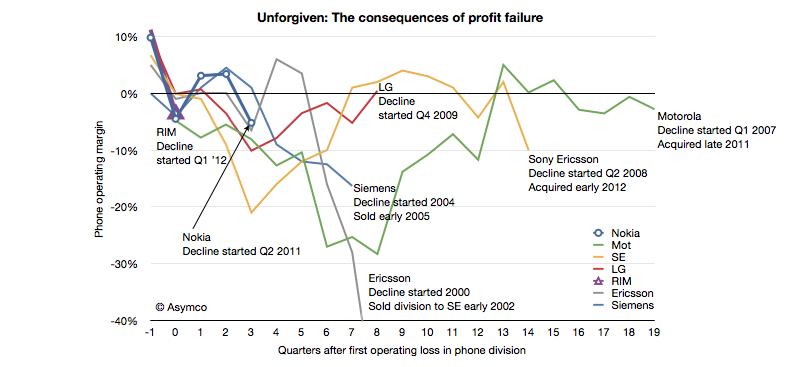
    In June of last year I wrote a post titled "Does the phone market forgive failure?" It was written on the eve of Nokia's Q2 2011 report highlighting the historic consequences of a dip into negative operating margins for a phone vendor.

    I listed 13 phone vendors who were either merged, liquidated or acquired. There are no examples of vendors who recovered from a position of loss making.

    I was prompted to follow-up by a note Charter Equity Research analyst Edward Snyder wrote illustrating the effect of negative operating margins on phone vendors. I took his illustration and expanded it with additional data.

    Since my post in June last year Sony Ericsson and Motorola were acquired making the victims list total 14 companies, with Nokia, LG and RIM having joined the "endangered species list". If the pattern repeats, then RIM and Nokia are in early phases of what promises to be an extended period of pain followed by an exit.

    What the analysis does not answer is when a vendor loses its independence after beginning loss making. Motorola took 20 quarters; Sony Ericsson 14, Ericsson 8 and Siemens only 7. We cannot tell if or when LG, which is still operating after 8 and Nokia, which is now in its fourth and RIM, now in its second quarter post-loss, will lose independence.

    The rumors swirling around RIM and LG are centered around exits and some suggest Nokia will follow. Many also argue that these companies will recover. The conditions they each face are different in details but broadly they are the same. Earlier last decade the exits were prompted by loss of brand value and subsequent loss of distribution. This decade disruption brought upon by mobile computing brings with it new business models centered on ecosystems and value captured through software and services.

    Until and unless these endangered companies solve the dilemma of having the wrong business model at the wrong time, the chances are that they will not be forgiven for market failure.