Asymco

Asymmetric Intelligence

forecast

  1. Will Apple rule the iPad market?

    Research · 1 comment

    This question sounds like a tautology. It's like asking "Will Apple rule the iPod market?" But redundancy has not stopped WSJ journalist Benjamin Pimentel from asking. His answer to the question is below:

    But while Apple apparently has the edge in the emerging tablet war, it is unclear if the company will end up dominating the market the way it has come to rule the digital music player market with the iPod.

    Gartner's Fiering said the iPad has "raised the bar and suppliers are now scrambling to make sure they get it right."

    IDC now projects 6 million tablet devices to ship this year, including 4 million iPads, Shim said. But while Apple has taken the lead, he added, the company faces the "burden of lifting or defining this entire new market," because there are no other competitive devices available.

    "In the iPhone market, they learned from everybody else," he added in a video interview. "In this new space, there's nobody else to kind of bounce ideas of so to speak."

    But Apple may not have to feel so alone for long.

    Fiering specifically pointed to H-P's as the best positioned challenger, given its scale, reach and its upcoming merger with Palm.

    "There are not too many suppliers that can pull all those pieces together," she said. "H-P could if they integrate the Palm acquisition properly."

    Another IDC analyst, Crawford Del Prete, agreed saying, while the "buzz" from H-P had generally been defensive in relation to the iPad, "the longer term story is far more interesting."

    "Given H-P's massive scale, I think they have the ability to drive new price points for this kind of product," he said. "With a lower price point, the category becomes far more interesting."

    via PC Makers Look To Challenge Apple's IPad - WSJ.com.

    Before diving into the statements above it's worth noting where the journalist went to get opinions to fill his column. He called Gartner and IDC. Quoting industry analysts is a standard operating procedure to fill column-inches with material that does not offend. But how good are they?

    In my years of watching those who watch markets I formed a ranking of analyst types and their likely accuracy with respect to prognosticating a market shift. In order from most accurate to least accurate:

    1. The most accurate are rank amateurs (deagol, Muller, et. al).  Independent bloggers who do some fact checking tend to make the boldest but most accurate forecasts.
    2. The next most accurate are sell-side analysts (purveyors of analyst reports from established brokerages).  They follow financials for individual companies.  You might think their record is quite poor, but in fact they are much better than..
    3. Industry analysts (like Gartner, IDC).  Their forecasts and sensitivity to disruption are often off by an order of magnitude.  This is partly because they forecast a bit further out than Wall St. but also because they are closer to their industry clients-- the source of their ideas.  They spend a lot of time talking to the least accurate forecasters...
    4. The corporate analysts.  They are typically hired to advise management in the incumbent companies. These are people who have the most information about the way the industry is performing on a daily basis.

    You might notice a pattern here: the closer you are to the market, the less likely you are to observe how that market is crumbling around you. You cannot see the forest for the trees.

    How could this be? How can having more access give you a poorer picture? The answer lies in the asymmetry of a disruptive attack. The more you know about how things are the less you know about how things could be.

    In practice, the analyst information value chain works like this:

    Corporate analysts feed information to management that management is comfortable digesting. Those managers then hire industry analysts to validate their opinions. Industry analysts are keen to maintain a relationship with those firms and so they listen carefully to the prejudices of their clients. They then hold up a mirror to those myths and consolidate those opinions for wider distribution and quotation by journalists at respectable publications.

    Stock analysts listen with one ear to the chatter but with the other to the way the wind blows with the stock market. Sometimes they actually sample the data in the value chain directly by calling acquaintances in the market and hire interns to watch what's happening in the shops. They then build an opinion that has some level of surprise but that they hope will not stray too far into controversy so that they can keep their jobs in case they are wrong. The safe bet is always to say that things will stay mostly the way they are, but to say it in clever ways.

    So that just leaves only one group of analysts with independence from a paycheck who can make an opinion on the basis of facts alone.

    This post has become longer than I planned, so I'll dive into the exact answer to the article claims in part II.

  2. Analysts predict iPad sales

    Research

    After 1 million units sold in 28 days, it's time to review the analysts' predictions:

    First year iPad unit forecasts (sourced from TMO Finance Board)

    • Brian Marshall, Broadpoint AmTech   7.0
    • David Bailey, Goldman Sachs           6.2
    • Kathryn Huberty, Morgan Stanley     6.0
    • Shaw Wu, Kauffman Bros.              5.0
    • Mike Abramsky, RBC Capital Markets   5.0
    • Gene Munster, Piper Jaffray           3.5
    • Ben Reitzes, Barclays Capital           2.9
    • Keith Bachman, BMO Capital         2.5
    • Jeff Fidacaro, Susquehanna           2.1
    • Chris Whitmore, Deutsche Bank       2.0
    • Scott Craig, Merrill Lynch               1.2
    • Peter Misek, Canaccord Adams       1.2
    • Doug Reid, Thomas Weisel             1.1
    • Yair Reiner, Oppenheimer             1.1

    Looks like at least half of these guys have already blown it.

    For the record, in January I forecast 6 million units for calendar 2010 (and 10 million in first year).

    Thanks to MfH for the tip.

  3. Analysts scrambling to update models as app download rates explode

    Research

    Analysts at Yankee Group recently boosted their forecasts for what they call a mobile app “gold rush,” saying that revenue from U.S. downloads alone would reach nearly $1.6 billion in 2010 and would hit $11 billion in 2014. Only six months ago, their analysis indicated that U.S. downloads would bring in far less — about $4.2 billion in 2013.

    link: Studies Forecast Rapid Growth in Mobile Apps - Digits - WSJ

    These attempts at forecasting are fraught with errors.

    For the record, I've blown my estimates on this multiple times. The growth of the iPad will put another wrench in the works. I wonder how these "mobile" forecasts will change when the platform consists of a music player, a phone and a pseudo-computer.

  4. Analyst Cuts Nexus One Estimates by 71%

    Research

    We previously estimated that Google might sell 3.5 mn Nexus One units in 2010. Initial data-points were disappointing, possibly due to limited marketing and customer service challenges. Flurry estimated (based on mobile traffic) that Google sold 20,000 in the first week, and 80,000 in the first month, both annualizing to 1.0 mn. We forecast that Google sells 1.0 mn Nexus One units in FY2010, benefiting from US carriers other than T-Mobile, and non-US carriers such as Vodafone, promoting the device too, but suffering from limited marketing activity. We assume that Google rolls out a second Nexus handset, markets it more aggressively, and makes it available offline, and therefore forecast that Google sells 2 mn handsets per year in 2011 and future years.

    link: Goldman: We Were Too Rosy on Google Smartphone Unit Sales - MarketBeat - WSJ

    First they get excited over Palm then fawn over Nexus One. Then they take it all back. Give us a break.

    Read my takes here:

    Google the Shopkeeper
    Nexus One: 80k units in first month -Flurry
    Android vs. Google

  5. Kathryn Huberty Predicts Apple Performance

    Research · 7 comments

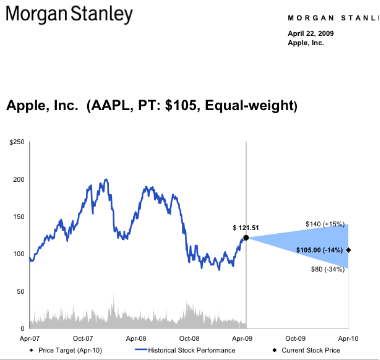
    10 months ago Ms. Huberty released her price target for April 2010 (see graph) at between $100 and $105. The stock was trading at $121 then and her forecast was for a 14% decline.

    She wrote:

    Investment Conclusion: The combination of a March quarter beat and positive management tone is likely to keep AAPL shares in its recent trading range. Valuation is not stretched by any means but at 21x our adjusted C09 EPS, the market already assigns AAPL a 16% premium to RIMM which credits AAPL for lower risk given its large cash balance and a more diversified revenue model. We remain Equal-weight AAPL shares.

    We note that the stock is currently trading above $200 at a P/E of 19x. She had forecast a price of $100 on a P/E of 21x Calendar 2009 Earnings Per Share. The implication is that EPS would have been $100/21 or $4.7 for calendar 2009.

    She already had one quarter of data ($1.79 for CQ1) therefore she forecast $4.7-$1.79 = $2.97 for the remainder of the 2009 calendar year.

    In reality, Apple earned $10.24 for 2009 and $8.45 for CQ2 through CQ4. That makes her error ($8.45-$2.97)/$2.97 = 184%.

    We see today that she has a new forecast for $225 a share which leads us to conclude that she still has a job.

  6. Is Mobile Computing Good Enough?

    Research · 1 comment

    This new "mobile computing" use case that smartphones try to serve is not going to be satisfied with solutions that are built from modular components.

    The reason is simple: as the solutions are not good enough (because it's early days), they need to be improved. If they are to be improved, competitive pressure will compel those who try to do so as rapidly as possible. The fastest climb up the trajectory of performance will get the bulk of the benefits. Modular implementations are simply not fast enough in cycle time of iteration in comparison to the integrated approaches.

    This is why Apple will grow faster than Google, Nokia and Windows Mobile.

    How does this relate to the ecosystem?

    Many have been commenting that Google's (or Nokia's or Microsoft's) ecosystems are more "open" or "flexible" with respect to Apple's. And that in the long run that is the right architecture. That may be, however implementing loose ecosystems coupled loosely to modular devices and operating systems and services as a whole will not be competitive. They will be too late, too slow and too hard to use. They will be awkward to position and the benefits will be impossible to explain to end users. They will be sold through a distribution channel that is too long and with poor information feedback. Too many "vested" interests will dilute the product's reason for being. The pricing of the integrated player will cause poor economies for the modular cohort. I could go on but it suffices to say that the modular approach will fail to be competitive.

    Footnote: the arguments for the imminent explosion of Android are all based on a forecast from Ken Dulaney at Gartner. It was also Ken who in 2004 forecast that Windows Mobile will dominate business devices and that RIM would never gain share leadership. Here is why he is wrong now as he was wrong then:

    Ken and his peer group are implicitly and explicitly owned by the customers he tries to serve. What I mean is that Ken is hired by those who have the money but not the competence to think by themselves. His clients are the incumbent device vendors who are signaling to him that they will increasingly license Android (as they signaled that they will license WinMo before). He adds up all the signals he gets and multiples by random numbers to get a forecast. It's a supply-side forecast assuming "Porter's five forces" is still at work. In that sense, he is selling back to his clients what they've already told him. He is hired to validate their assumptions and that's what he delivers. Rinse, repeat.